Confidential © ams AG
Peter Sarson CMgr MCMI SMIEEE
Full Service Foundry
10th April 2017
Shohei Shibuya,
Tomonori Yanagida,
Hauro Kobayashi
A Technique for
Dynamic Range Improvement of
Intermodulation Distortion Products
for
an Interpolating DAC-based
Arbitrary Waveform Generator
Using a Phase Switching Algorithm
2
Outline
 Introduction
 Current Research
 Overview of Phase Switching Technique
 Details of the Simulation
 Measurement of the System
 Algorithm Modification for Interpolation DAC
 16 bit ADC Example
 Future Work & Conclusion
3
Outline
 Introduction
 Current Research
 Overview of Phase Switching Technique
 Details of the Simulation
 Measurement of the System
 Algorithm Modification for Interpolation DAC
 16 bit ADC Example
 Future Work & Conclusion
4
Outline
 Introduction
 Current Research
 Overview of Phase Switching Technique
 Details of the Simulation
 Measurement of the System
 Algorithm Modification for Interpolation DAC
 16 bit ADC Example
 Future Work & Conclusion

5
Outline
 Introduction
 Current Research
 Overview of Phase Switching Technique
 Details of the Simulation
 Measurement of the System
 Algorithm Modification for Interpolation DAC
 16 bit ADC Example
 Future Work & Conclusion
6
Outline
 Introduction
 Current Research
 Overview of Phase Switching Technique
 Details of the Simulation
 Measurement of the System
 Algorithm Modification for Interpolation DAC
 16 bit ADC Example
 Future Work & Conclusion
7
Outline
 Introduction
 Current Research
 Overview of Phase Switching Technique
 Details of the Simulation
 Measurement of the System
 Algorithm Modification for Interpolation DAC
 16 bit ADC Example
 Future Work & Conclusion
8
Outline
 Introduction
 Current Research
 Overview of Phase Switching Technique
 Details of the Simulation
 Measurement of the System
 Algorithm Modification for Interpolation DAC
 16 bit ADC Example
 Future Work & Conclusion
9
Outline
 Introduction
 Current Research
 Overview of Phase Switching Technique
 Details of the Simulation
 Measurement of the System
 Algorithm Modification for Interpolation DAC
 16 bit ADC Example
 Future Works & Conclusion
10
Introduction
 ATE test instrumentation becomes end of life
due to performance limitations
 Generates the need to buy
newer tester instrumentation
or new test platforms
11
Introduction
 ATE test instrumentation becomes end of life
due to performance limitations
 Generates the need to buy
newer tester instrumentation
or new test platforms
12
Introduction
 This in turn drives up test cost.
 When test cost is being constantly driven down!
 ADC testing is limited to the base performance
of the AWG that is stimulating it.
 I will show how to extend the base performance
of an Interpolating AWG
using a simple DSP technique.
13
Introduction
 This in turn drives up test cost.
 When test cost is being constantly driven down!
 ADC testing is limited to the base performance
of the AWG that is stimulating it.
 I will show how to extend the base performance
of an Interpolating AWG
using a simple DSP technique.
14
Introduction
 This in turn drives up test cost.
 When test cost is being constantly driven down!
 ADC testing is limited to the base performance
of the AWG that is stimulating it.
 I will show how to extend the base performance
of an Interpolating AWG
using a simple DSP technique.
15
Introduction
 This in turn drives up test cost.
 When test cost is being constantly driven down!
 ADC testing is limited to the base performance
of the AWG that is stimulating it.
 I will show how to extend the base performance
of an Interpolating AWG using a simple DSP
technique.
Current Research
 Two-tone signal generation without IMD3
using AWG
 Simple DSP algorithm
 No need for AWG nonlinearity identification
 Gunma University group research
for standard DAC inside AWG
K. Kato et. al., “Two-tone Signal Generation for
Communication Application ADC Testing”,
IEEE Asian Test Symposium, Niigata, Japan (Nov. 2012)
16
17
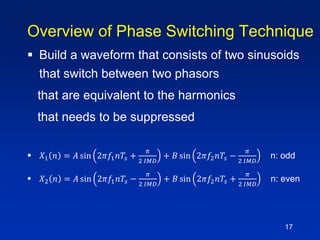
Overview of Phase Switching Technique
 Build a waveform that consists of two sinusoids
that switch between two phasors
that are equivalent to the harmonics
that needs to be suppressed
 𝑋1 𝑛 = 𝐴 sin 2𝜋𝑓1 𝑛𝑇𝑠 +
𝜋
2 𝐼𝑀𝐷
+ 𝐵 sin 2𝜋𝑓2 𝑛𝑇𝑠 −
𝜋
2 𝐼𝑀𝐷
n: odd
 𝑋2 𝑛 = 𝐴 sin 2𝜋𝑓1 𝑛𝑇𝑠 −
𝜋
2 𝐼𝑀𝐷
+ 𝐵 sin 2𝜋𝑓2 𝑛𝑇𝑠 +
𝜋
2 𝐼𝑀𝐷
n: even
Confidential © ams AG
Page 18
AWG
DAC
CLK
DSP
X XXX
Din
Din
AWG sampling frequency: fs(AWG) = 1/Ts
A
𝐗= Acos(2πfinnTs)
0 0.1 0.2 0.3 0.4 0.5
-300
-200
-100
0
Power[dB]
Normalized frequency f/fs
𝐟𝐢𝐧
𝐇𝐃𝟑
In case
Single-tone generation
DAC has 3rd-order distortion
Conventional Signal Generation with
AWG
Confidential © ams AG
Page 19
Signal Generation with AWG using
Phase Switching
AWG
DAC
CLK
DSP
X0 X1X0X1
Din
Din
AWG sampling frequency: fs(AWG) = 1/Ts(AWG)
𝐗 𝟎= 1.15Acos(2πfinnTs−π/6)
𝐗 𝟏= 1.15Acos(2πfinnTs+𝜋/6)
0 0.1 0.2 0.3 0.4 0.5
-300
-200
-100
0
𝐟𝐢𝐧
𝐟𝒔/2−𝟑𝐟in
𝐟𝒔/2−𝐟in
Power[dB]
Normalized frequency f/fs
Θ = π/3𝐓𝐬(𝐀𝐖𝐆)
X0
𝐗 𝟏
In case
Single-tone generation
DAC has 3rd-order distortion
HD3 disappears
20
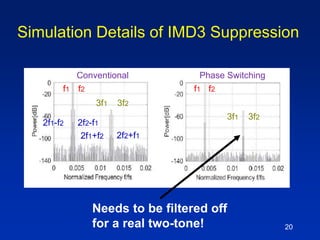
Simulation Details of IMD3 Suppression
Needs to be filtered off
for a real two-tone!
f1 f2f1 f2
3f1 3f2
3f1 3f2
2f1+f2 2f2+f1
2f1-f2 2f2-f1
Conventional Phase Switching
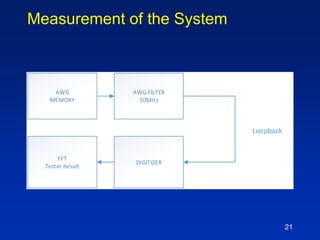
Measurement of the System
21
AWG
MEMORY
AWG FILTER
50MHz
DIGITIZER
FFT
Tester Result
Loopback
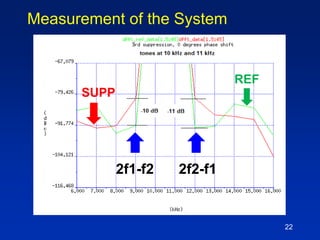
22
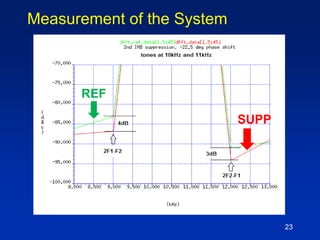
Measurement of the System
REF
SUPP
2f1-f2 2f2-f1
23
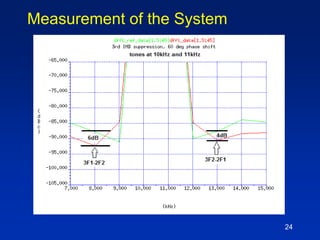
Measurement of the System
SUPP
REF
Measurement of the System
24
25
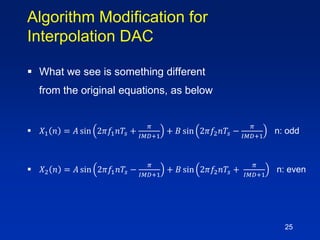
Algorithm Modification for
Interpolation DAC
 What we see is something different
from the original equations, as below
 𝑋1 𝑛 = 𝐴 sin 2𝜋𝑓1 𝑛𝑇𝑠 +
𝜋
𝐼𝑀𝐷+1
+ 𝐵 sin 2𝜋𝑓2 𝑛𝑇𝑠 −
𝜋
𝐼𝑀𝐷+1
n: odd
 𝑋2 𝑛 = 𝐴 sin 2𝜋𝑓1 𝑛𝑇𝑠 −
𝜋
𝐼𝑀𝐷+1
+ 𝐵 sin 2𝜋𝑓2 𝑛𝑇𝑠 +
𝜋
𝐼𝑀𝐷+1
n: even
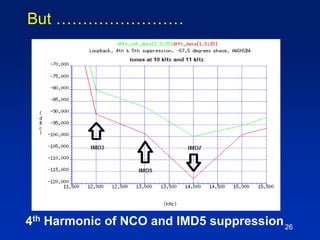
But ……………………
26
4th Harmonic of NCO and IMD5 suppression
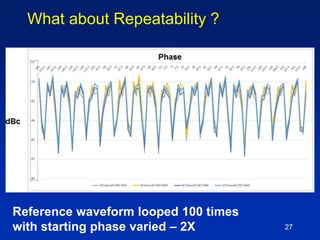
What about Repeatability ?
27
Reference waveform looped 100 times
with starting phase varied – 2X
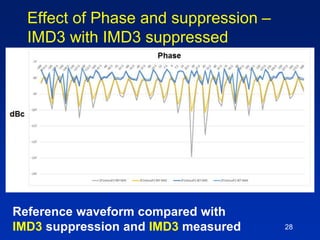
Effect of Phase and suppression –
IMD3 with IMD3 suppressed
28
Reference waveform compared with
IMD3 suppression and IMD3 measured
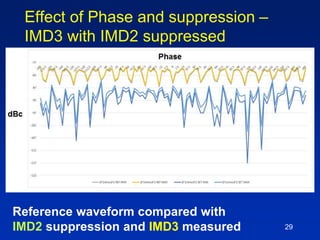
Effect of Phase and suppression –
IMD3 with IMD2 suppressed
29
Reference waveform compared with
IMD2 suppression and IMD3 measured
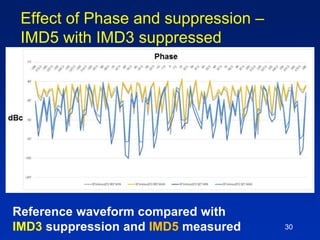
Effect of Phase and suppression –
IMD5 with IMD3 suppressed
30
Reference waveform compared with
IMD3 suppression and IMD5 measured
Effect of Phase and suppression –
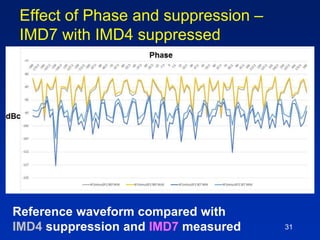
IMD7 with IMD4 suppressed
31
Reference waveform compared with
IMD4 suppression and IMD7 measured
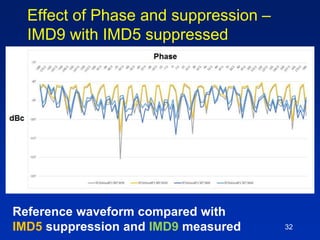
Effect of Phase and suppression –
IMD9 with IMD5 suppressed
32
Reference waveform compared with
IMD5 suppression and IMD9 measured
33
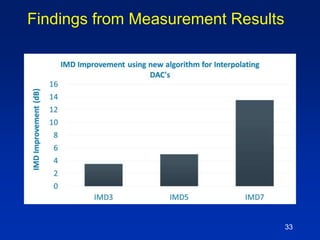
Findings from Measurement Results
34
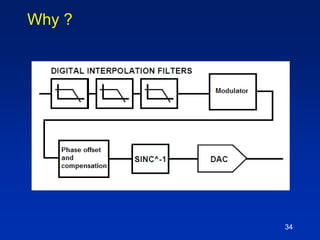
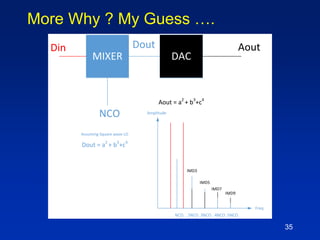
Why ?
More Why ? My Guess ….
35
MIXER DAC
NCO
Din AoutDout
Assuming Square wave LO
Dout = a2
+ b3
+c4
Aout = a2
+ b3
+c4
NCO 2NCO 3NCO 4NCO 5NCO
IMD3
IMD5
IMD7
IMD9
Freq
Amplitude
36
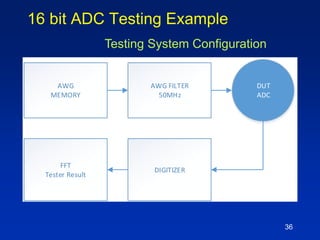
16 bit ADC Testing Example
AWG
MEMORY
AWG FILTER
50MHz
DUT
ADC
DIGITIZER
FFT
Tester Result
Testing System Configuration
37
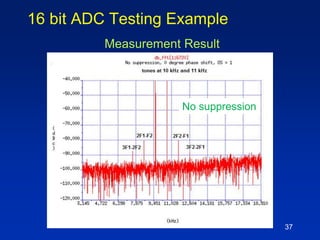
16 bit ADC Testing Example
Measurement Result
No suppression
38
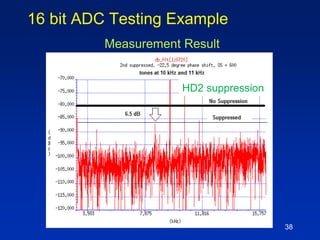
16 bit ADC Testing Example
Measurement Result
HD2 suppression
Future Work
 Remember, I am seeing this in an AWG
where an interpolating DAC is one of its parts.
 Need researchers to investigate harmonic
and Intermodulation distortion suppression
solely using Interpolating DAC’s
39
Conclusion
 Using two-tone phase switching techniques and
understanding the AWG architecture
it is possible to
• Decrease IMD across tester installed base
• With good repeatability
This can result in around a 6dB improvement
of the IMD3 and IMD5 products
~ 1-bit improvement Significant ! 40
Confidential © ams AG
Thank you
 Please visit our website www.ams.com

A Technique for Dynamic Range Improvement of Intermodulation Distortion Products for an Interpolating DAC-based Arbitrary Waveform Generator Using a Phase Switching Algorithm

  • 1.
    Confidential © amsAG Peter Sarson CMgr MCMI SMIEEE Full Service Foundry 10th April 2017 Shohei Shibuya, Tomonori Yanagida, Hauro Kobayashi A Technique for Dynamic Range Improvement of Intermodulation Distortion Products for an Interpolating DAC-based Arbitrary Waveform Generator Using a Phase Switching Algorithm
  • 2.
    2 Outline  Introduction  CurrentResearch  Overview of Phase Switching Technique  Details of the Simulation  Measurement of the System  Algorithm Modification for Interpolation DAC  16 bit ADC Example  Future Work & Conclusion
  • 3.
    3 Outline  Introduction  CurrentResearch  Overview of Phase Switching Technique  Details of the Simulation  Measurement of the System  Algorithm Modification for Interpolation DAC  16 bit ADC Example  Future Work & Conclusion
  • 4.
    4 Outline  Introduction  CurrentResearch  Overview of Phase Switching Technique  Details of the Simulation  Measurement of the System  Algorithm Modification for Interpolation DAC  16 bit ADC Example  Future Work & Conclusion 
  • 5.
    5 Outline  Introduction  CurrentResearch  Overview of Phase Switching Technique  Details of the Simulation  Measurement of the System  Algorithm Modification for Interpolation DAC  16 bit ADC Example  Future Work & Conclusion
  • 6.
    6 Outline  Introduction  CurrentResearch  Overview of Phase Switching Technique  Details of the Simulation  Measurement of the System  Algorithm Modification for Interpolation DAC  16 bit ADC Example  Future Work & Conclusion
  • 7.
    7 Outline  Introduction  CurrentResearch  Overview of Phase Switching Technique  Details of the Simulation  Measurement of the System  Algorithm Modification for Interpolation DAC  16 bit ADC Example  Future Work & Conclusion
  • 8.
    8 Outline  Introduction  CurrentResearch  Overview of Phase Switching Technique  Details of the Simulation  Measurement of the System  Algorithm Modification for Interpolation DAC  16 bit ADC Example  Future Work & Conclusion
  • 9.
    9 Outline  Introduction  CurrentResearch  Overview of Phase Switching Technique  Details of the Simulation  Measurement of the System  Algorithm Modification for Interpolation DAC  16 bit ADC Example  Future Works & Conclusion
  • 10.
    10 Introduction  ATE testinstrumentation becomes end of life due to performance limitations  Generates the need to buy newer tester instrumentation or new test platforms
  • 11.
    11 Introduction  ATE testinstrumentation becomes end of life due to performance limitations  Generates the need to buy newer tester instrumentation or new test platforms
  • 12.
    12 Introduction  This inturn drives up test cost.  When test cost is being constantly driven down!  ADC testing is limited to the base performance of the AWG that is stimulating it.  I will show how to extend the base performance of an Interpolating AWG using a simple DSP technique.
  • 13.
    13 Introduction  This inturn drives up test cost.  When test cost is being constantly driven down!  ADC testing is limited to the base performance of the AWG that is stimulating it.  I will show how to extend the base performance of an Interpolating AWG using a simple DSP technique.
  • 14.
    14 Introduction  This inturn drives up test cost.  When test cost is being constantly driven down!  ADC testing is limited to the base performance of the AWG that is stimulating it.  I will show how to extend the base performance of an Interpolating AWG using a simple DSP technique.
  • 15.
    15 Introduction  This inturn drives up test cost.  When test cost is being constantly driven down!  ADC testing is limited to the base performance of the AWG that is stimulating it.  I will show how to extend the base performance of an Interpolating AWG using a simple DSP technique.
  • 16.
    Current Research  Two-tonesignal generation without IMD3 using AWG  Simple DSP algorithm  No need for AWG nonlinearity identification  Gunma University group research for standard DAC inside AWG K. Kato et. al., “Two-tone Signal Generation for Communication Application ADC Testing”, IEEE Asian Test Symposium, Niigata, Japan (Nov. 2012) 16
  • 17.
    17 Overview of PhaseSwitching Technique  Build a waveform that consists of two sinusoids that switch between two phasors that are equivalent to the harmonics that needs to be suppressed  𝑋1 𝑛 = 𝐴 sin 2𝜋𝑓1 𝑛𝑇𝑠 + 𝜋 2 𝐼𝑀𝐷 + 𝐵 sin 2𝜋𝑓2 𝑛𝑇𝑠 − 𝜋 2 𝐼𝑀𝐷 n: odd  𝑋2 𝑛 = 𝐴 sin 2𝜋𝑓1 𝑛𝑇𝑠 − 𝜋 2 𝐼𝑀𝐷 + 𝐵 sin 2𝜋𝑓2 𝑛𝑇𝑠 + 𝜋 2 𝐼𝑀𝐷 n: even
  • 18.
    Confidential © amsAG Page 18 AWG DAC CLK DSP X XXX Din Din AWG sampling frequency: fs(AWG) = 1/Ts A 𝐗= Acos(2πfinnTs) 0 0.1 0.2 0.3 0.4 0.5 -300 -200 -100 0 Power[dB] Normalized frequency f/fs 𝐟𝐢𝐧 𝐇𝐃𝟑 In case Single-tone generation DAC has 3rd-order distortion Conventional Signal Generation with AWG
  • 19.
    Confidential © amsAG Page 19 Signal Generation with AWG using Phase Switching AWG DAC CLK DSP X0 X1X0X1 Din Din AWG sampling frequency: fs(AWG) = 1/Ts(AWG) 𝐗 𝟎= 1.15Acos(2πfinnTs−π/6) 𝐗 𝟏= 1.15Acos(2πfinnTs+𝜋/6) 0 0.1 0.2 0.3 0.4 0.5 -300 -200 -100 0 𝐟𝐢𝐧 𝐟𝒔/2−𝟑𝐟in 𝐟𝒔/2−𝐟in Power[dB] Normalized frequency f/fs Θ = π/3𝐓𝐬(𝐀𝐖𝐆) X0 𝐗 𝟏 In case Single-tone generation DAC has 3rd-order distortion HD3 disappears
  • 20.
    20 Simulation Details ofIMD3 Suppression Needs to be filtered off for a real two-tone! f1 f2f1 f2 3f1 3f2 3f1 3f2 2f1+f2 2f2+f1 2f1-f2 2f2-f1 Conventional Phase Switching
  • 21.
    Measurement of theSystem 21 AWG MEMORY AWG FILTER 50MHz DIGITIZER FFT Tester Result Loopback
  • 22.
    22 Measurement of theSystem REF SUPP 2f1-f2 2f2-f1
  • 23.
    23 Measurement of theSystem SUPP REF
  • 24.
  • 25.
    25 Algorithm Modification for InterpolationDAC  What we see is something different from the original equations, as below  𝑋1 𝑛 = 𝐴 sin 2𝜋𝑓1 𝑛𝑇𝑠 + 𝜋 𝐼𝑀𝐷+1 + 𝐵 sin 2𝜋𝑓2 𝑛𝑇𝑠 − 𝜋 𝐼𝑀𝐷+1 n: odd  𝑋2 𝑛 = 𝐴 sin 2𝜋𝑓1 𝑛𝑇𝑠 − 𝜋 𝐼𝑀𝐷+1 + 𝐵 sin 2𝜋𝑓2 𝑛𝑇𝑠 + 𝜋 𝐼𝑀𝐷+1 n: even
  • 26.
  • 27.
    What about Repeatability? 27 Reference waveform looped 100 times with starting phase varied – 2X
  • 28.
    Effect of Phaseand suppression – IMD3 with IMD3 suppressed 28 Reference waveform compared with IMD3 suppression and IMD3 measured
  • 29.
    Effect of Phaseand suppression – IMD3 with IMD2 suppressed 29 Reference waveform compared with IMD2 suppression and IMD3 measured
  • 30.
    Effect of Phaseand suppression – IMD5 with IMD3 suppressed 30 Reference waveform compared with IMD3 suppression and IMD5 measured
  • 31.
    Effect of Phaseand suppression – IMD7 with IMD4 suppressed 31 Reference waveform compared with IMD4 suppression and IMD7 measured
  • 32.
    Effect of Phaseand suppression – IMD9 with IMD5 suppressed 32 Reference waveform compared with IMD5 suppression and IMD9 measured
  • 33.
  • 34.
  • 35.
    More Why ?My Guess …. 35 MIXER DAC NCO Din AoutDout Assuming Square wave LO Dout = a2 + b3 +c4 Aout = a2 + b3 +c4 NCO 2NCO 3NCO 4NCO 5NCO IMD3 IMD5 IMD7 IMD9 Freq Amplitude
  • 36.
    36 16 bit ADCTesting Example AWG MEMORY AWG FILTER 50MHz DUT ADC DIGITIZER FFT Tester Result Testing System Configuration
  • 37.
    37 16 bit ADCTesting Example Measurement Result No suppression
  • 38.
    38 16 bit ADCTesting Example Measurement Result HD2 suppression
  • 39.
    Future Work  Remember,I am seeing this in an AWG where an interpolating DAC is one of its parts.  Need researchers to investigate harmonic and Intermodulation distortion suppression solely using Interpolating DAC’s 39
  • 40.
    Conclusion  Using two-tonephase switching techniques and understanding the AWG architecture it is possible to • Decrease IMD across tester installed base • With good repeatability This can result in around a 6dB improvement of the IMD3 and IMD5 products ~ 1-bit improvement Significant ! 40
  • 41.
    Confidential © amsAG Thank you  Please visit our website www.ams.com