Technical Internship Program (TIP)
By:
Utkarsh Tiwari
71208120038
Mba-Tech-ExTC (4’th Year)
BHABHA ATOMIC RESEARCH
CENTRE (BARC)
At Control & Instrumentation Division (CnID)
‘DIGITAL THERMOMETER AND
FAST NETWORK BUSES’
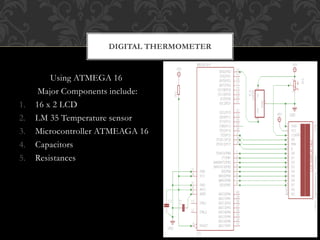
Using ATMEGA 16
Major Components include:
1. 16 x 2 LCD
2. LM 35 Temperature sensor
3. Microcontroller ATMEAGA 16
4. Capacitors
5. Resistances
DIGITAL THERMOMETER
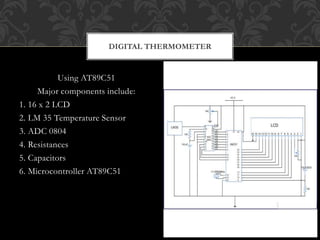
Using AT89C51
Major components include:
1. 16 x 2 LCD
2. LM 35 Temperature Sensor
3. ADC 0804
4. Resistances
5. Capacitors
6. Microcontroller AT89C51
DIGITAL THERMOMETER
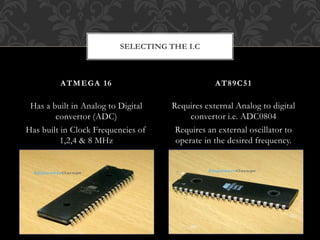
Has a built in Analog to Digital
convertor (ADC)
Has built in Clock Frequencies of
1,2,4 & 8 MHz
Requires external Analog to digital
convertor i.e. ADC0804
Requires an external oscillator to
operate in the desired frequency.
ATMEGA 16 AT89C51
SELECTING THE I.C
ATMEGA 16 AT 89C51
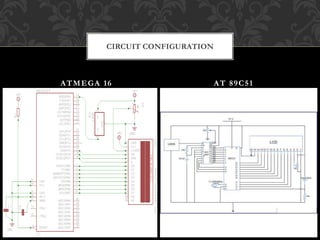
CIRCUIT CONFIGURATION
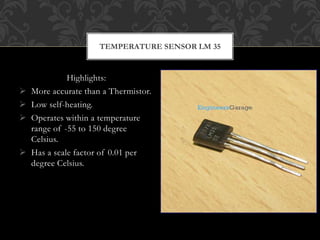
Highlights:
 More accurate than a Thermistor.
 Low self-heating.
 Operates within a temperature
range of -55 to 150 degree
Celsius.
 Has a scale factor of 0.01 per
degree Celsius.
TEMPERATURE SENSOR LM 35
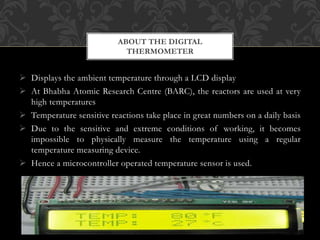
 Displays the ambient temperature through a LCD display
 At Bhabha Atomic Research Centre (BARC), the reactors are used at very
high temperatures
 Temperature sensitive reactions take place in great numbers on a daily basis
 Due to the sensitive and extreme conditions of working, it becomes
impossible to physically measure the temperature using a regular
temperature measuring device.
 Hence a microcontroller operated temperature sensor is used.
ABOUT THE DIGITAL
THERMOMETER
FAST Networking Buses:
 USB 2.0/3.0
 IEEE 1394
 JESD 204
 PCI Express
 TEST
 JTAG 1149
STUDY PROJECT
• Universal Serial Bus (USB) is an
industry standard developed in
the mid-1990s that defines the
cables, connectors and
communications protocols used
in a bus for connection,
communication, and power
supply between computers and
electronic devices.
• The Universal Serial Bus (USB)
has become commonplace on
other devices, such as
smartphones, PDAs and video
game consoles.
USB
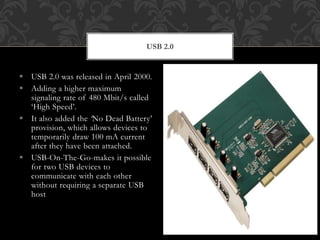
 USB 2.0 was released in April 2000.
 Adding a higher maximum
signaling rate of 480 Mbit/s called
‘High Speed’.
 It also added the ‘No Dead Battery’
provision, which allows devices to
temporarily draw 100 mA current
after they have been attached.
 USB-On-The-Go-makes it possible
for two USB devices to
communicate with each other
without requiring a separate USB
host
USB 2.0
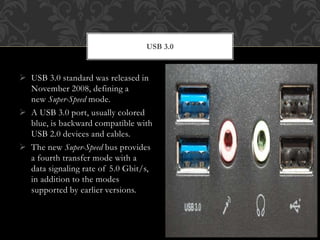
 USB 3.0 standard was released in
November 2008, defining a
new Super-Speed mode.
 A USB 3.0 port, usually colored
blue, is backward compatible with
USB 2.0 devices and cables.
 The new Super-Speed bus provides
a fourth transfer mode with a
data signaling rate of 5.0 Gbit/s,
in addition to the modes
supported by earlier versions.
USB 3.0
 IEEE 1394 is an interface standard for a serial bus for high-speed
communications and isochronous real-time data transfer.
 The 1394 interface is comparable to USB though USB has more market
share.
 In IEEE 1394, 80% of the bus is reserved for isochronous cycles, leaving
asynchronous data with a minimum of 20% of the bus.
 In an aircraft, for instance, Isochronous devices include control of the
rudder, mouse operations and data from pressure sensors outside the
aircraft. All these elements require constant, uninterrupted bandwidth.
IEEE 1394
 The JESD204 and the JESD204B are revision data converter serial
interface standard that were created through the Joint Electron Device
Engineering Council (JEDEC)
 JEDEC is accredited by ANSI and maintains liaisons with numerous
standards bodies throughout the world.
 The purpose of their creation was to standardize and reduce the number
of data inputs/outputs between high-speed data converters and other
devices, such as FPGAs (field-programmable gate arrays).
 Fewer interconnects simplifies layout and allows smaller form factor
realization without impacting overall system performance.
JESD 204
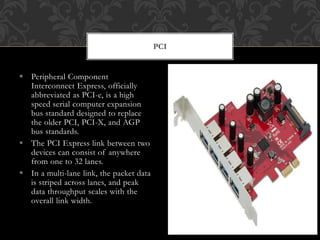
 Peripheral Component
Interconnect Express, officially
abbreviated as PCI-e, is a high
speed serial computer expansion
bus standard designed to replace
the older PCI, PCI-X, and AGP
bus standards.
 The PCI Express link between two
devices can consist of anywhere
from one to 32 lanes.
 In a multi-lane link, the packet data
is striped across lanes, and peak
data throughput scales with the
overall link width.
PCI
o The Joint Test Action Group (JTAG) is an electronics industry association
formed in 1985 for developing a method of verifying designs and testing
printed circuit boards after manufacture.
o JTAG implements standards for on-chip instrumentation in Electronic
Design Automation (EDA) as a complementary tool to digital simulation.
o The JTAG standards have been extended by many semiconductor chip
manufacturers with specialized variants to provide vendor-specific features.
o There are two different standards/ types of JTAG i.e.
1.Daisy-chained JTAG (IEEE 1149.1)
2.Reduced pin count JTAG (IEEE 1149.7)
JTAG 1149
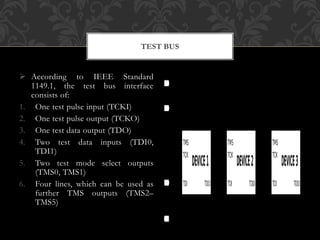
 According to IEEE Standard
1149.1, the test bus interface
consists of:
1. One test pulse input (TCKI)
2. One test pulse output (TCKO)
3. One test data output (TDO)
4. Two test data inputs (TDI0,
TDI1)
5. Two test mode select outputs
(TMS0, TMS1)
6. Four lines, which can be used as
further TMS outputs (TMS2–
TMS5)
TEST BUS
 The architecture of TBC consists of the following 6 blocks:
1. Sequence block
2. Serial block
3. Event block
4. Counter block
5. Command block
6. Host block
TEST BUS ARCHITECTURE
I was able to learn a lot about the importance played by the Instrumentation
department in achieving successful functioning of any organization by this
opportunity of interning at the Control Instrumentation Department.
The future of the industrial automation environment holds the potential for
installation of many different networks that yield information to improve
operations and profitability.
The plethora of choices makes decisions difficult, It’s important to have a
strategy going forward.
Networks are proliferating, not only in offices and commercial environments
but also in factory aid manufacturing processes and throughout the enterprise.
CONCLUSION
• Books, Journals, Papers:
1. David M Pozar, Microwave engineering.
2. Danny Causey, PIC microcontroller and Embedded system
3. Mazdi.M.A, The 8051 microcontrollers and Embedded systems.
4. Texas Instrument application Report-August 2000.
• Websites:
1. www.engineersgarage.com
2. www.avr-tutorial.com
3. www.en.wikipedia.org
4. www.atmel.com
5. www.avrfreaks.net
REFERENCES
THANK YOU!!

Bhabha atomic research Centre (BARC)

  • 1.
    Technical Internship Program(TIP) By: Utkarsh Tiwari 71208120038 Mba-Tech-ExTC (4’th Year) BHABHA ATOMIC RESEARCH CENTRE (BARC)
  • 2.
    At Control &Instrumentation Division (CnID) ‘DIGITAL THERMOMETER AND FAST NETWORK BUSES’
  • 3.
    Using ATMEGA 16 MajorComponents include: 1. 16 x 2 LCD 2. LM 35 Temperature sensor 3. Microcontroller ATMEAGA 16 4. Capacitors 5. Resistances DIGITAL THERMOMETER
  • 4.
    Using AT89C51 Major componentsinclude: 1. 16 x 2 LCD 2. LM 35 Temperature Sensor 3. ADC 0804 4. Resistances 5. Capacitors 6. Microcontroller AT89C51 DIGITAL THERMOMETER
  • 5.
    Has a builtin Analog to Digital convertor (ADC) Has built in Clock Frequencies of 1,2,4 & 8 MHz Requires external Analog to digital convertor i.e. ADC0804 Requires an external oscillator to operate in the desired frequency. ATMEGA 16 AT89C51 SELECTING THE I.C
  • 6.
    ATMEGA 16 AT89C51 CIRCUIT CONFIGURATION
  • 7.
    Highlights:  More accuratethan a Thermistor.  Low self-heating.  Operates within a temperature range of -55 to 150 degree Celsius.  Has a scale factor of 0.01 per degree Celsius. TEMPERATURE SENSOR LM 35
  • 8.
     Displays theambient temperature through a LCD display  At Bhabha Atomic Research Centre (BARC), the reactors are used at very high temperatures  Temperature sensitive reactions take place in great numbers on a daily basis  Due to the sensitive and extreme conditions of working, it becomes impossible to physically measure the temperature using a regular temperature measuring device.  Hence a microcontroller operated temperature sensor is used. ABOUT THE DIGITAL THERMOMETER
  • 9.
    FAST Networking Buses: USB 2.0/3.0  IEEE 1394  JESD 204  PCI Express  TEST  JTAG 1149 STUDY PROJECT
  • 10.
    • Universal SerialBus (USB) is an industry standard developed in the mid-1990s that defines the cables, connectors and communications protocols used in a bus for connection, communication, and power supply between computers and electronic devices. • The Universal Serial Bus (USB) has become commonplace on other devices, such as smartphones, PDAs and video game consoles. USB
  • 11.
     USB 2.0was released in April 2000.  Adding a higher maximum signaling rate of 480 Mbit/s called ‘High Speed’.  It also added the ‘No Dead Battery’ provision, which allows devices to temporarily draw 100 mA current after they have been attached.  USB-On-The-Go-makes it possible for two USB devices to communicate with each other without requiring a separate USB host USB 2.0
  • 12.
     USB 3.0standard was released in November 2008, defining a new Super-Speed mode.  A USB 3.0 port, usually colored blue, is backward compatible with USB 2.0 devices and cables.  The new Super-Speed bus provides a fourth transfer mode with a data signaling rate of 5.0 Gbit/s, in addition to the modes supported by earlier versions. USB 3.0
  • 13.
     IEEE 1394is an interface standard for a serial bus for high-speed communications and isochronous real-time data transfer.  The 1394 interface is comparable to USB though USB has more market share.  In IEEE 1394, 80% of the bus is reserved for isochronous cycles, leaving asynchronous data with a minimum of 20% of the bus.  In an aircraft, for instance, Isochronous devices include control of the rudder, mouse operations and data from pressure sensors outside the aircraft. All these elements require constant, uninterrupted bandwidth. IEEE 1394
  • 14.
     The JESD204and the JESD204B are revision data converter serial interface standard that were created through the Joint Electron Device Engineering Council (JEDEC)  JEDEC is accredited by ANSI and maintains liaisons with numerous standards bodies throughout the world.  The purpose of their creation was to standardize and reduce the number of data inputs/outputs between high-speed data converters and other devices, such as FPGAs (field-programmable gate arrays).  Fewer interconnects simplifies layout and allows smaller form factor realization without impacting overall system performance. JESD 204
  • 15.
     Peripheral Component InterconnectExpress, officially abbreviated as PCI-e, is a high speed serial computer expansion bus standard designed to replace the older PCI, PCI-X, and AGP bus standards.  The PCI Express link between two devices can consist of anywhere from one to 32 lanes.  In a multi-lane link, the packet data is striped across lanes, and peak data throughput scales with the overall link width. PCI
  • 16.
    o The JointTest Action Group (JTAG) is an electronics industry association formed in 1985 for developing a method of verifying designs and testing printed circuit boards after manufacture. o JTAG implements standards for on-chip instrumentation in Electronic Design Automation (EDA) as a complementary tool to digital simulation. o The JTAG standards have been extended by many semiconductor chip manufacturers with specialized variants to provide vendor-specific features. o There are two different standards/ types of JTAG i.e. 1.Daisy-chained JTAG (IEEE 1149.1) 2.Reduced pin count JTAG (IEEE 1149.7) JTAG 1149
  • 17.
     According toIEEE Standard 1149.1, the test bus interface consists of: 1. One test pulse input (TCKI) 2. One test pulse output (TCKO) 3. One test data output (TDO) 4. Two test data inputs (TDI0, TDI1) 5. Two test mode select outputs (TMS0, TMS1) 6. Four lines, which can be used as further TMS outputs (TMS2– TMS5) TEST BUS
  • 18.
     The architectureof TBC consists of the following 6 blocks: 1. Sequence block 2. Serial block 3. Event block 4. Counter block 5. Command block 6. Host block TEST BUS ARCHITECTURE
  • 19.
    I was ableto learn a lot about the importance played by the Instrumentation department in achieving successful functioning of any organization by this opportunity of interning at the Control Instrumentation Department. The future of the industrial automation environment holds the potential for installation of many different networks that yield information to improve operations and profitability. The plethora of choices makes decisions difficult, It’s important to have a strategy going forward. Networks are proliferating, not only in offices and commercial environments but also in factory aid manufacturing processes and throughout the enterprise. CONCLUSION
  • 20.
    • Books, Journals,Papers: 1. David M Pozar, Microwave engineering. 2. Danny Causey, PIC microcontroller and Embedded system 3. Mazdi.M.A, The 8051 microcontrollers and Embedded systems. 4. Texas Instrument application Report-August 2000. • Websites: 1. www.engineersgarage.com 2. www.avr-tutorial.com 3. www.en.wikipedia.org 4. www.atmel.com 5. www.avrfreaks.net REFERENCES
  • 21.