Test time efficient group
delay filter characterization
technique using a discrete
chirped excitation signal
2016 International Test Conference
November 16th
Peter Sarson
2
Outline
 What problem are we trying to resolve
 How to measure phase based metrics
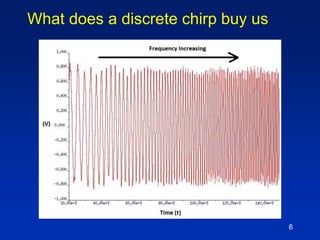
 What does a discrete chirp buy us
 How to generate a chirp
 Implementation
 Measurements
 Correlation and stability
 Conclusion
3
What problem are we addressing
 Produce a Group Delay production style test
• That gives full characterization data
• That is faster than the standard approach
• That can be reused easily like an IP Block
 Save coding time for future projects
 Remove last minute requests for
characterization tests
4
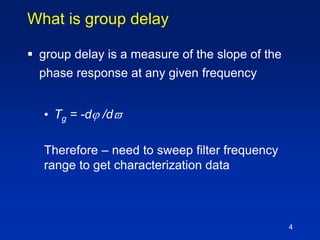
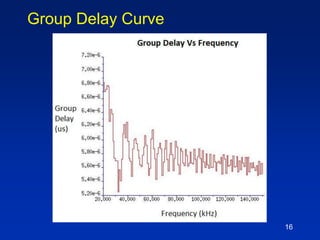
What is group delay
 group delay is a measure of the slope of the
phase response at any given frequency
• Tg = -d /d
Therefore – need to sweep filter frequency
range to get characterization data
5
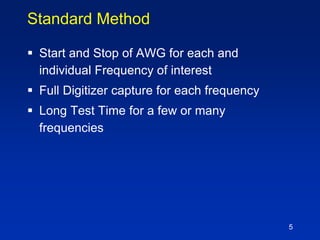
Standard Method
 Start and Stop of AWG for each and
individual Frequency of interest
 Full Digitizer capture for each frequency
 Long Test Time for a few or many
frequencies
What does a discrete chirp buy us
6
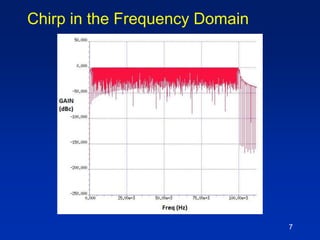
Chirp in the Frequency Domain
7
8
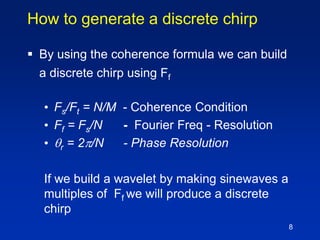
How to generate a discrete chirp
 By using the coherence formula we can build
a discrete chirp using Ff
• Fs/Ft = N/M - Coherence Condition
• Ff = Fs/N - Fourier Freq - Resolution
• r = 2/N - Phase Resolution
If we build a wavelet by making sinewaves a
multiples of Ff we will produce a discrete
chirp
9
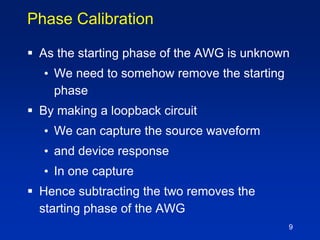
Phase Calibration
 As the starting phase of the AWG is unknown
• We need to somehow remove the starting
phase
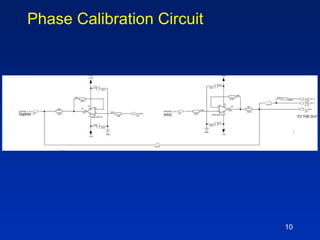
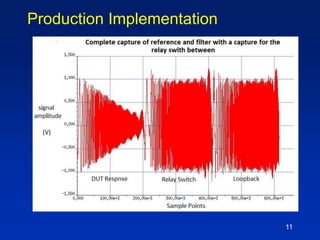
 By making a loopback circuit
• We can capture the source waveform
• and device response
• In one capture
 Hence subtracting the two removes the
starting phase of the AWG
10
Phase Calibration Circuit
11
Production Implementation
12
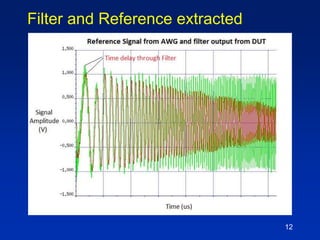
Filter and Reference extracted
13
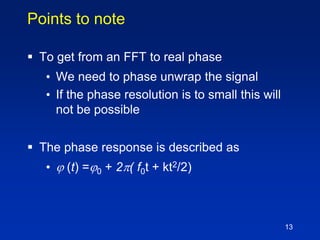
Points to note
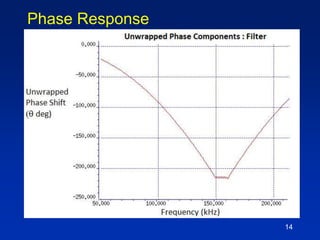
 To get from an FFT to real phase
• We need to phase unwrap the signal
• If the phase resolution is to small this will
not be possible
 The phase response is described as
•  (t) =0 + 2( f0t + kt2/2)
14
Phase Response
15
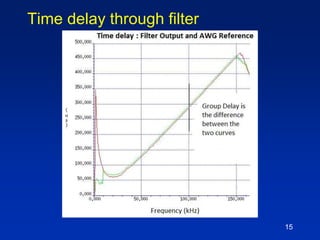
Time delay through filter
16
Group Delay Curve
17
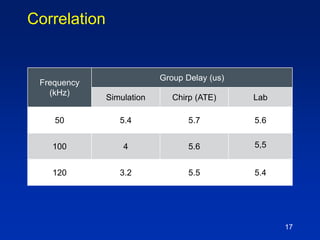
Correlation
Frequency
(kHz)
Group Delay (us)
Simulation Chirp (ATE) Lab
50 5.4 5.7 5.6
100 4 5.6 5,5
120 3.2 5.5 5.4
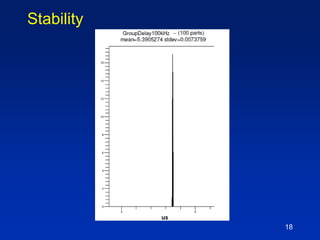
Stability
18
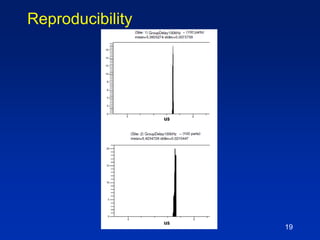
Reproducibility
19
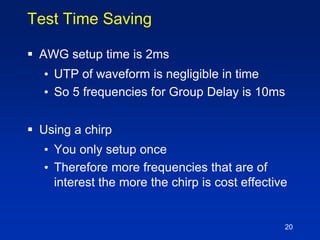
Test Time Saving
 AWG setup time is 2ms
• UTP of waveform is negligible in time
• So 5 frequencies for Group Delay is 10ms
 Using a chirp
• You only setup once
• Therefore more frequencies that are of
interest the more the chirp is cost effective
20
Conclusion
 Using a chirp for group delay measurements
gives reliable, accurate and reproducible
results that is not only test time efficient but
also gives full characterization data that is
priceless to a semiconductor integrated circuit
designer.
21
Confidential © ams AG
Thank you
 Please visit our website www.ams.com

Test time efficient group delay filter characterization technique using a discrete chirped excitation signal

  • 1.
    Test time efficientgroup delay filter characterization technique using a discrete chirped excitation signal 2016 International Test Conference November 16th Peter Sarson
  • 2.
    2 Outline  What problemare we trying to resolve  How to measure phase based metrics  What does a discrete chirp buy us  How to generate a chirp  Implementation  Measurements  Correlation and stability  Conclusion
  • 3.
    3 What problem arewe addressing  Produce a Group Delay production style test • That gives full characterization data • That is faster than the standard approach • That can be reused easily like an IP Block  Save coding time for future projects  Remove last minute requests for characterization tests
  • 4.
    4 What is groupdelay  group delay is a measure of the slope of the phase response at any given frequency • Tg = -d /d Therefore – need to sweep filter frequency range to get characterization data
  • 5.
    5 Standard Method  Startand Stop of AWG for each and individual Frequency of interest  Full Digitizer capture for each frequency  Long Test Time for a few or many frequencies
  • 6.
    What does adiscrete chirp buy us 6
  • 7.
    Chirp in theFrequency Domain 7
  • 8.
    8 How to generatea discrete chirp  By using the coherence formula we can build a discrete chirp using Ff • Fs/Ft = N/M - Coherence Condition • Ff = Fs/N - Fourier Freq - Resolution • r = 2/N - Phase Resolution If we build a wavelet by making sinewaves a multiples of Ff we will produce a discrete chirp
  • 9.
    9 Phase Calibration  Asthe starting phase of the AWG is unknown • We need to somehow remove the starting phase  By making a loopback circuit • We can capture the source waveform • and device response • In one capture  Hence subtracting the two removes the starting phase of the AWG
  • 10.
  • 11.
  • 12.
  • 13.
    13 Points to note To get from an FFT to real phase • We need to phase unwrap the signal • If the phase resolution is to small this will not be possible  The phase response is described as •  (t) =0 + 2( f0t + kt2/2)
  • 14.
  • 15.
  • 16.
  • 17.
    17 Correlation Frequency (kHz) Group Delay (us) SimulationChirp (ATE) Lab 50 5.4 5.7 5.6 100 4 5.6 5,5 120 3.2 5.5 5.4
  • 18.
  • 19.
  • 20.
    Test Time Saving AWG setup time is 2ms • UTP of waveform is negligible in time • So 5 frequencies for Group Delay is 10ms  Using a chirp • You only setup once • Therefore more frequencies that are of interest the more the chirp is cost effective 20
  • 21.
    Conclusion  Using achirp for group delay measurements gives reliable, accurate and reproducible results that is not only test time efficient but also gives full characterization data that is priceless to a semiconductor integrated circuit designer. 21
  • 22.
    Confidential © amsAG Thank you  Please visit our website www.ams.com