Dr Chris Willmott Dept of Biochemistry, University of Leicester  [email_address] Ethical issues associated with fertility treatment TSN Masterclass: “Reproductive Technologies” University  of Leicester
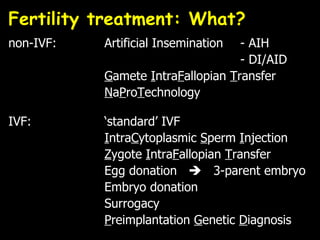
Fertility treatment: What?  non-IVF: Artificial Insemination   - AIH   - DI/AID G amete  I ntra F allopian  T ransfer N a P ro T echnology IVF: ‘standard’ IVF I ntra C ytoplasmic  S perm  I njection Z ygote  I ntra F allopian  T ransfer  Egg donation     3-parent embryo Embryo donation Surrogacy P reimplantation  G enetic  D iagnosis
Fertility treatment: Why?  Childlessness is a psychological as well as physical condition “ Human reproductive technology has developed,  not because doctors and scientists have been consumed by an overwhelming desire to ‘play God’, but because of pressure from ordinary people with  a desperate wish for a child”  John Wyatt,  Matters of Life and Death
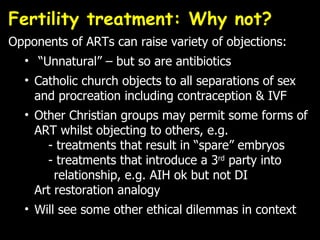
Fertility treatment: Why not?  Opponents of ARTs can raise variety of objections: “ Unnatural” – but so are antibiotics Catholic church objects to all separations of sex and procreation including contraception & IVF Other Christian groups may permit some forms of ART whilst objecting to others, e.g.   - treatments that result in “spare” embryos   - treatments that introduce a 3 rd  party into    relationship, e.g. AIH ok but not DI Art restoration analogy Will see some other ethical dilemmas in context
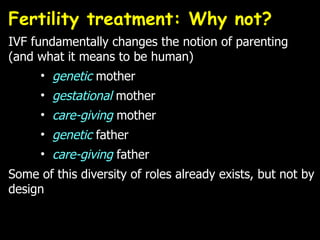
Fertility treatment: Why not?  IVF fundamentally changes the notion of parenting (and what it means to be human) genetic  mother gestational  mother care-giving  mother genetic  father care-giving  father Some of this diversity of roles already exists, but not by design
Fertility treatment: Who?  Relationship status: Married couple? Unmarried couple? Single woman? Same-sex couple? Age: Too young? Too old?   Pre-menopause?   Post-menopause? Other restrictions: HIV+ ? Criminal record? Ability to pay? Existing family?
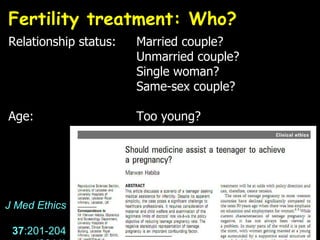
Fertility treatment: Who?  Relationship status: Married couple? Unmarried couple? Single woman? Same-sex couple? Age: Too young? J Med Ethics   37 :201-204  (2011)
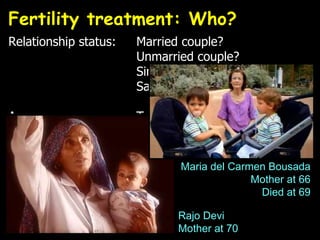
Fertility treatment: Who?  Relationship status: Married couple? Unmarried couple? Single woman? Same-sex couple? Age: Too young? Too old?   Pre-menopause?   Post-menopause? Rajo Devi Mother at 70 Maria del Carmen Bousada Mother at 66 Died at 69
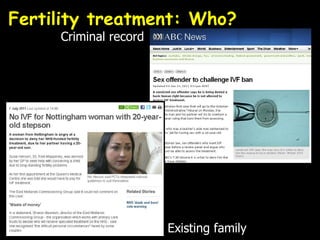
Fertility treatment: Who?  Criminal record Existing family
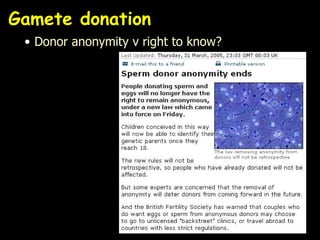
Gamete donation Donor anonymity v right to know?
Gamete donation Donor anonymity v right to know? Dead partner? e.g. Diane Blood Egg donation - altruistic v payment?  - egg sharing - “3 parent IVF” Impact on family dynamic?  Psychological impact on child? “ Fertility tourism”
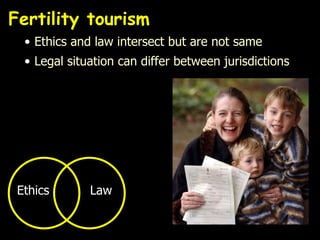
Fertility tourism Ethics and law intersect but are not same Legal situation can differ between jurisdictions  Ethics Law
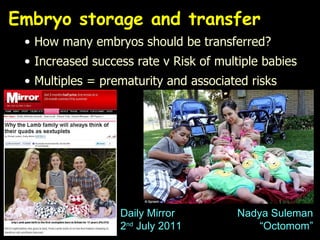
Embryo storage and transfer How many embryos should be transferred? Increased success rate v Risk of multiple babies Multiples = prematurity and associated risks Daily Mirror  2 nd  July 2011 Nadya Suleman “Octomom”
Embryo storage and transfer How many embryos should be transferred? Increased success rate v Risk of multiple babies Multiples = prematurity and associated risks Selective reduction? UK recommendation 1-3 transfers per cycle Fate of stored embryos if relationship ends
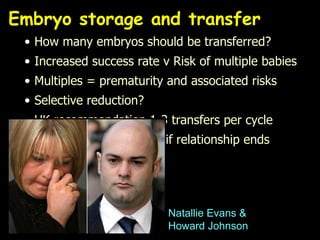
Embryo storage and transfer How many embryos should be transferred? Increased success rate v Risk of multiple babies Multiples = prematurity and associated risks Selective reduction? UK recommendation 1-3 transfers per cycle Fate of stored embryos if relationship ends Natallie Evans & Howard Johnson
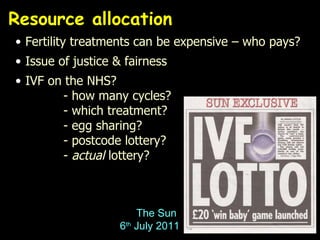
Resource allocation Fertility treatments can be expensive – who pays? Issue of justice & fairness IVF on the NHS? - how many cycles? - which treatment? - egg sharing? - postcode lottery? -  actual  lottery? The Sun  6 th  July 2011
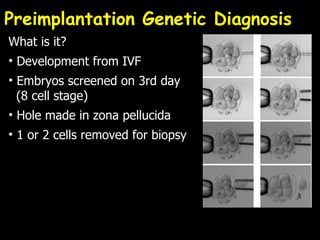
Preimplantation Genetic Diagnosis What is it? Development from IVF Embryos screened on 3rd day    (8 cell stage) Hole made in zona pellucida 1 or 2 cells removed for biopsy
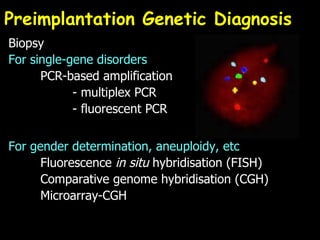
Preimplantation Genetic Diagnosis Biopsy For single-gene disorders PCR-based amplification - multiplex PCR - fluorescent PCR For gender determination, aneuploidy, etc Fluorescence  in situ  hybridisation (FISH) Comparative genome hybridisation (CGH) Microarray-CGH
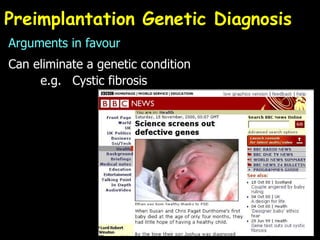
Preimplantation Genetic Diagnosis Arguments in favour Can eliminate a genetic condition e.g.  Cystic fibrosis
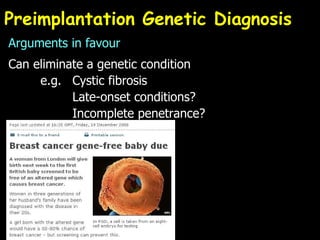
Preimplantation Genetic Diagnosis Arguments in favour Can eliminate a genetic condition e.g.  Cystic fibrosis Late-onset conditions? Incomplete penetrance?
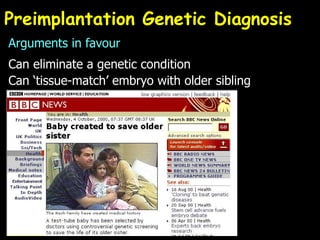
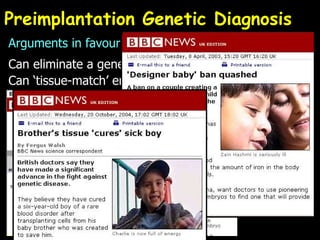
Preimplantation Genetic Diagnosis Arguments in favour Can eliminate a genetic condition Can ‘tissue-match’ embryo with older sibling
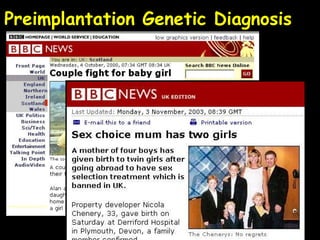
Preimplantation Genetic Diagnosis Arguments in favour Can eliminate a genetic condition Can ‘tissue-match’ embryo with older sibling Sex selection - X-linked conditions   - “Family balancing”
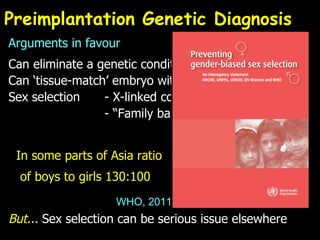
Preimplantation Genetic Diagnosis Arguments in favour Can eliminate a genetic condition Can ‘tissue-match’ embryo with older sibling Sex selection - X-linked conditions   - “Family balancing” In some parts of Asia ratio of boys to girls 130:100 But...  Sex selection can be serious issue elsewhere WHO, 2011
Preimplantation Genetic Diagnosis Arguments against Not a ‘cure’, inappropriate embryos destroyed - healthy, but ‘wrong’ gender or tissue-type
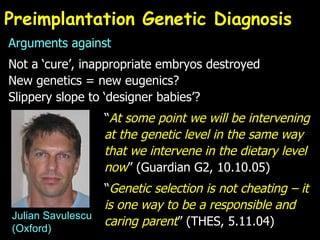
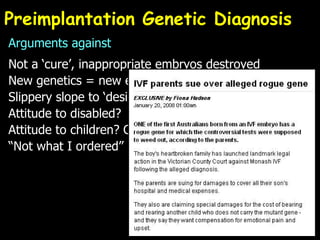
Preimplantation Genetic Diagnosis Arguments against Not a ‘cure’, inappropriate embryos destroyed New genetics = new eugenics? Slippery slope to ‘designer babies’? “ At some point we will be intervening  at the genetic level in the same way  that we intervene in the dietary level  now ” (Guardian G2, 10.10.05) “ Genetic selection is not cheating – it  is one way to be a responsible and  caring parent ” (THES, 5.11.04) Julian Savulescu (Oxford)
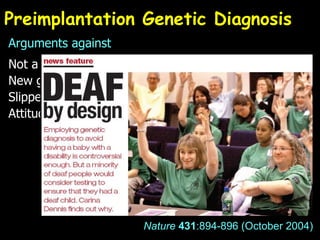
Preimplantation Genetic Diagnosis Arguments against Not a ‘cure’, inappropriate embryos destroyed New genetics = new eugenics? Slippery slope to ‘designer babies’? Attitude to disabled? e.g. Selection against deafness? Selection  for  deafness?
Preimplantation Genetic Diagnosis Arguments against Not a ‘cure’, inappropriate embryos destroyed New genetics = new eugenics? Slippery slope to ‘designer babies’? Attitude to disabled? e.g. Selection against deafness? Selection  for  deafness? Nature   431 :894-896 (October 2004)
Preimplantation Genetic Diagnosis Arguments against Not a ‘cure’, inappropriate embryos destroyed New genetics = new eugenics? Slippery slope to ‘designer babies’? Attitude to disabled? Attitude to children? Commodification “Not what I ordered”
Spotlight on ethics IVF often produce more embryos than needed by the couple. What should happen to these ‘spare’ embryos? Used for research? Donated to other couples? Destroyed? Stored indefinitely?  Treatments producing spare embryos should not  be permitted Your response to this question give you an insight into your dominant ethical framework
How can we make ethical decisions?  Starting points 1.  Principles  - the intrinsic rightness or wrongness Deontological 2.  Consequences  – what will happen if something   is done Teleological, Consequentialist 3.  Virtue ethics  – importance of character  Ethic of being v Ethic of doing
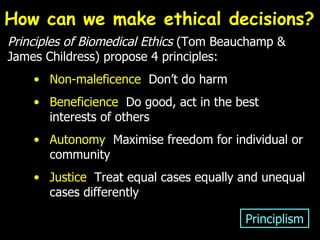
Principles of Biomedical Ethics  (Tom Beauchamp & James Childress) propose 4 principles: Non-maleficence   Don’t do harm Beneficience   Do good, act in the best interests of others Autonomy   Maximise freedom for individual or community Justice  Treat equal cases equally and unequal cases differently Principlism How can we make ethical decisions?
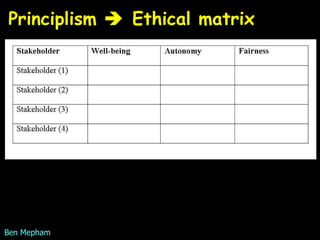
Principlism    Ethical matrix Ben Mepham
Any Questions? E-mail :  [email_address] Twitter :  cjrw Slideshare : cjrw2 Delicious :  chriswillmott Blogs : www.bioethicsbytes.wordpress.com www.biosciencecareers.wordpress.com www.lefthandedbiochemist.wordpress.com   University  of Leicester

Ethical issues associated with fertility treatment

  • 1.
    Dr Chris WillmottDept of Biochemistry, University of Leicester [email_address] Ethical issues associated with fertility treatment TSN Masterclass: “Reproductive Technologies” University of Leicester
  • 2.
    Fertility treatment: What? non-IVF: Artificial Insemination - AIH - DI/AID G amete I ntra F allopian T ransfer N a P ro T echnology IVF: ‘standard’ IVF I ntra C ytoplasmic S perm I njection Z ygote I ntra F allopian T ransfer Egg donation  3-parent embryo Embryo donation Surrogacy P reimplantation G enetic D iagnosis
  • 3.
    Fertility treatment: Why? Childlessness is a psychological as well as physical condition “ Human reproductive technology has developed, not because doctors and scientists have been consumed by an overwhelming desire to ‘play God’, but because of pressure from ordinary people with a desperate wish for a child” John Wyatt, Matters of Life and Death
  • 4.
    Fertility treatment: Whynot? Opponents of ARTs can raise variety of objections: “ Unnatural” – but so are antibiotics Catholic church objects to all separations of sex and procreation including contraception & IVF Other Christian groups may permit some forms of ART whilst objecting to others, e.g. - treatments that result in “spare” embryos - treatments that introduce a 3 rd party into relationship, e.g. AIH ok but not DI Art restoration analogy Will see some other ethical dilemmas in context
  • 5.
    Fertility treatment: Whynot? IVF fundamentally changes the notion of parenting (and what it means to be human) genetic mother gestational mother care-giving mother genetic father care-giving father Some of this diversity of roles already exists, but not by design
  • 6.
    Fertility treatment: Who? Relationship status: Married couple? Unmarried couple? Single woman? Same-sex couple? Age: Too young? Too old? Pre-menopause? Post-menopause? Other restrictions: HIV+ ? Criminal record? Ability to pay? Existing family?
  • 7.
    Fertility treatment: Who? Relationship status: Married couple? Unmarried couple? Single woman? Same-sex couple? Age: Too young? J Med Ethics 37 :201-204 (2011)
  • 8.
    Fertility treatment: Who? Relationship status: Married couple? Unmarried couple? Single woman? Same-sex couple? Age: Too young? Too old? Pre-menopause? Post-menopause? Rajo Devi Mother at 70 Maria del Carmen Bousada Mother at 66 Died at 69
  • 9.
    Fertility treatment: Who? Criminal record Existing family
  • 10.
    Gamete donation Donoranonymity v right to know?
  • 11.
    Gamete donation Donoranonymity v right to know? Dead partner? e.g. Diane Blood Egg donation - altruistic v payment? - egg sharing - “3 parent IVF” Impact on family dynamic? Psychological impact on child? “ Fertility tourism”
  • 12.
    Fertility tourism Ethicsand law intersect but are not same Legal situation can differ between jurisdictions Ethics Law
  • 13.
    Embryo storage andtransfer How many embryos should be transferred? Increased success rate v Risk of multiple babies Multiples = prematurity and associated risks Daily Mirror 2 nd July 2011 Nadya Suleman “Octomom”
  • 14.
    Embryo storage andtransfer How many embryos should be transferred? Increased success rate v Risk of multiple babies Multiples = prematurity and associated risks Selective reduction? UK recommendation 1-3 transfers per cycle Fate of stored embryos if relationship ends
  • 15.
    Embryo storage andtransfer How many embryos should be transferred? Increased success rate v Risk of multiple babies Multiples = prematurity and associated risks Selective reduction? UK recommendation 1-3 transfers per cycle Fate of stored embryos if relationship ends Natallie Evans & Howard Johnson
  • 16.
    Resource allocation Fertilitytreatments can be expensive – who pays? Issue of justice & fairness IVF on the NHS? - how many cycles? - which treatment? - egg sharing? - postcode lottery? - actual lottery? The Sun 6 th July 2011
  • 17.
    Preimplantation Genetic DiagnosisWhat is it? Development from IVF Embryos screened on 3rd day (8 cell stage) Hole made in zona pellucida 1 or 2 cells removed for biopsy
  • 18.
    Preimplantation Genetic DiagnosisBiopsy For single-gene disorders PCR-based amplification - multiplex PCR - fluorescent PCR For gender determination, aneuploidy, etc Fluorescence in situ hybridisation (FISH) Comparative genome hybridisation (CGH) Microarray-CGH
  • 19.
    Preimplantation Genetic DiagnosisArguments in favour Can eliminate a genetic condition e.g. Cystic fibrosis
  • 20.
    Preimplantation Genetic DiagnosisArguments in favour Can eliminate a genetic condition e.g. Cystic fibrosis Late-onset conditions? Incomplete penetrance?
  • 21.
    Preimplantation Genetic DiagnosisArguments in favour Can eliminate a genetic condition Can ‘tissue-match’ embryo with older sibling
  • 22.
    Preimplantation Genetic DiagnosisArguments in favour Can eliminate a genetic condition Can ‘tissue-match’ embryo with older sibling
  • 23.
    Preimplantation Genetic DiagnosisArguments in favour Can eliminate a genetic condition Can ‘tissue-match’ embryo with older sibling Sex selection - X-linked conditions - “Family balancing”
  • 24.
    Preimplantation Genetic DiagnosisArguments in favour Can eliminate a genetic condition Can ‘tissue-match’ embryo with older sibling Sex selection - X-linked conditions - “Family balancing”
  • 25.
    Preimplantation Genetic DiagnosisArguments in favour Can eliminate a genetic condition Can ‘tissue-match’ embryo with older sibling Sex selection - X-linked conditions - “Family balancing” In some parts of Asia ratio of boys to girls 130:100 But... Sex selection can be serious issue elsewhere WHO, 2011
  • 26.
    Preimplantation Genetic DiagnosisArguments against Not a ‘cure’, inappropriate embryos destroyed - healthy, but ‘wrong’ gender or tissue-type
  • 27.
    Preimplantation Genetic DiagnosisArguments against Not a ‘cure’, inappropriate embryos destroyed New genetics = new eugenics? Slippery slope to ‘designer babies’? “ At some point we will be intervening at the genetic level in the same way that we intervene in the dietary level now ” (Guardian G2, 10.10.05) “ Genetic selection is not cheating – it is one way to be a responsible and caring parent ” (THES, 5.11.04) Julian Savulescu (Oxford)
  • 28.
    Preimplantation Genetic DiagnosisArguments against Not a ‘cure’, inappropriate embryos destroyed New genetics = new eugenics? Slippery slope to ‘designer babies’? Attitude to disabled? e.g. Selection against deafness? Selection for deafness?
  • 29.
    Preimplantation Genetic DiagnosisArguments against Not a ‘cure’, inappropriate embryos destroyed New genetics = new eugenics? Slippery slope to ‘designer babies’? Attitude to disabled? e.g. Selection against deafness? Selection for deafness? Nature 431 :894-896 (October 2004)
  • 30.
    Preimplantation Genetic DiagnosisArguments against Not a ‘cure’, inappropriate embryos destroyed New genetics = new eugenics? Slippery slope to ‘designer babies’? Attitude to disabled? Attitude to children? Commodification “Not what I ordered”
  • 31.
    Preimplantation Genetic DiagnosisArguments against Not a ‘cure’, inappropriate embryos destroyed New genetics = new eugenics? Slippery slope to ‘designer babies’? Attitude to disabled? Attitude to children? Commodification “Not what I ordered”
  • 32.
    Spotlight on ethicsIVF often produce more embryos than needed by the couple. What should happen to these ‘spare’ embryos? Used for research? Donated to other couples? Destroyed? Stored indefinitely? Treatments producing spare embryos should not be permitted Your response to this question give you an insight into your dominant ethical framework
  • 33.
    How can wemake ethical decisions? Starting points 1. Principles - the intrinsic rightness or wrongness Deontological 2. Consequences – what will happen if something is done Teleological, Consequentialist 3. Virtue ethics – importance of character Ethic of being v Ethic of doing
  • 34.
    Principles of BiomedicalEthics (Tom Beauchamp & James Childress) propose 4 principles: Non-maleficence Don’t do harm Beneficience Do good, act in the best interests of others Autonomy Maximise freedom for individual or community Justice Treat equal cases equally and unequal cases differently Principlism How can we make ethical decisions?
  • 35.
    Principlism  Ethical matrix Ben Mepham
  • 36.
    Any Questions? E-mail: [email_address] Twitter : cjrw Slideshare : cjrw2 Delicious : chriswillmott Blogs : www.bioethicsbytes.wordpress.com www.biosciencecareers.wordpress.com www.lefthandedbiochemist.wordpress.com University of Leicester