



A Look at the Life of the
Unborn and the Methods Used
to Take that Life
JOFRED M. MARTINEZ, RN
1. Outline the distinction between “human” and
“person”, and to dispute regarding personhood
criteria.
2. List the basic facts of fetal development.
3. Explain the different types of abortion.
4. Describe the sociology of abortion issue.
5. Outline the religious arguments against abortion.
6. Explain the pro-choice position from a “life plan”
point of view.
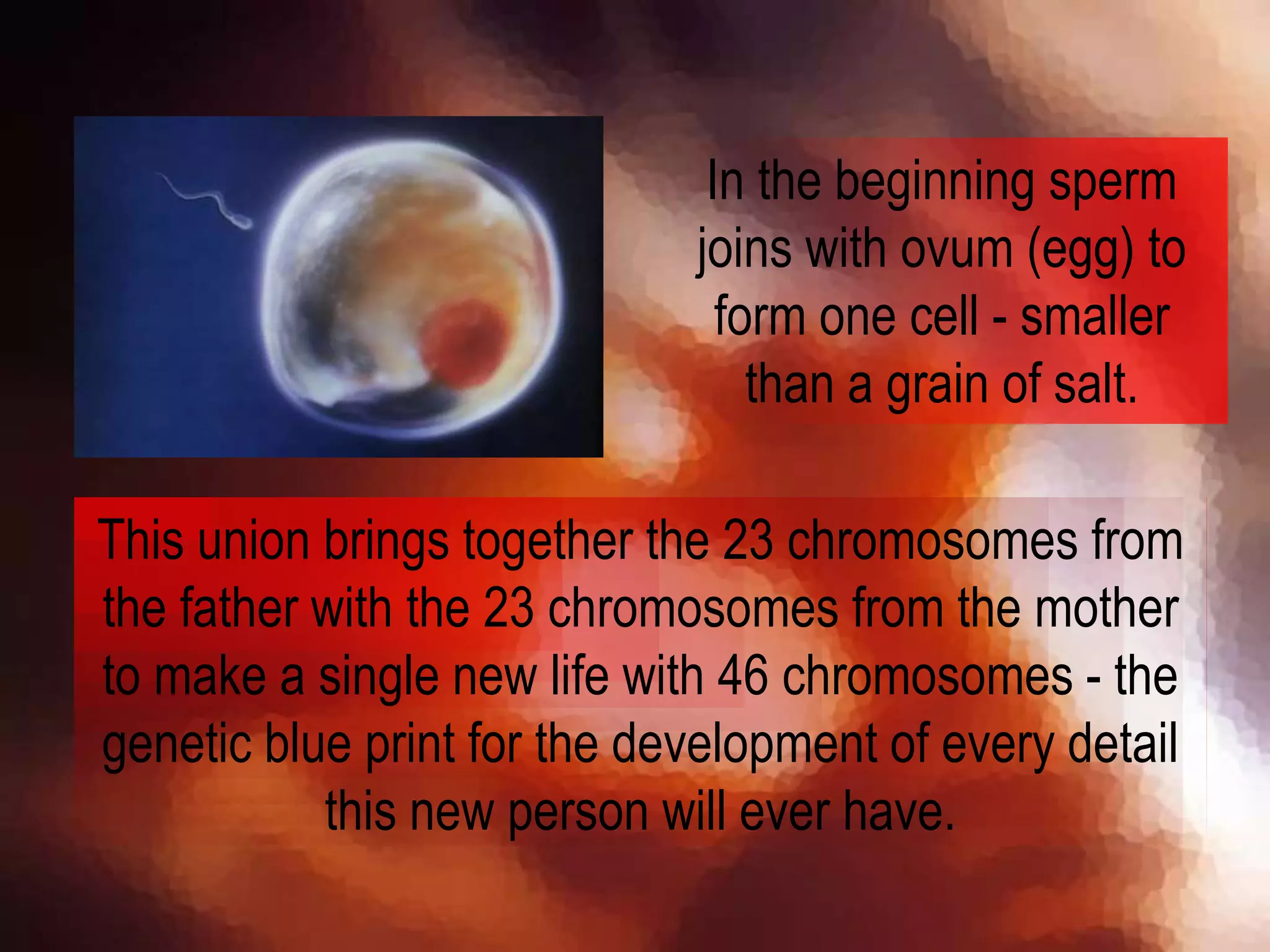
In the beginning sperm
joins with ovum (egg) to
form one cell - smaller
than a grain of salt.
This union brings together the 23 chromosomes from
the father with the 23 chromosomes from the mother
to make a single new life with 46 chromosomes - the
genetic blue print for the development of every detail
this new person will ever have.
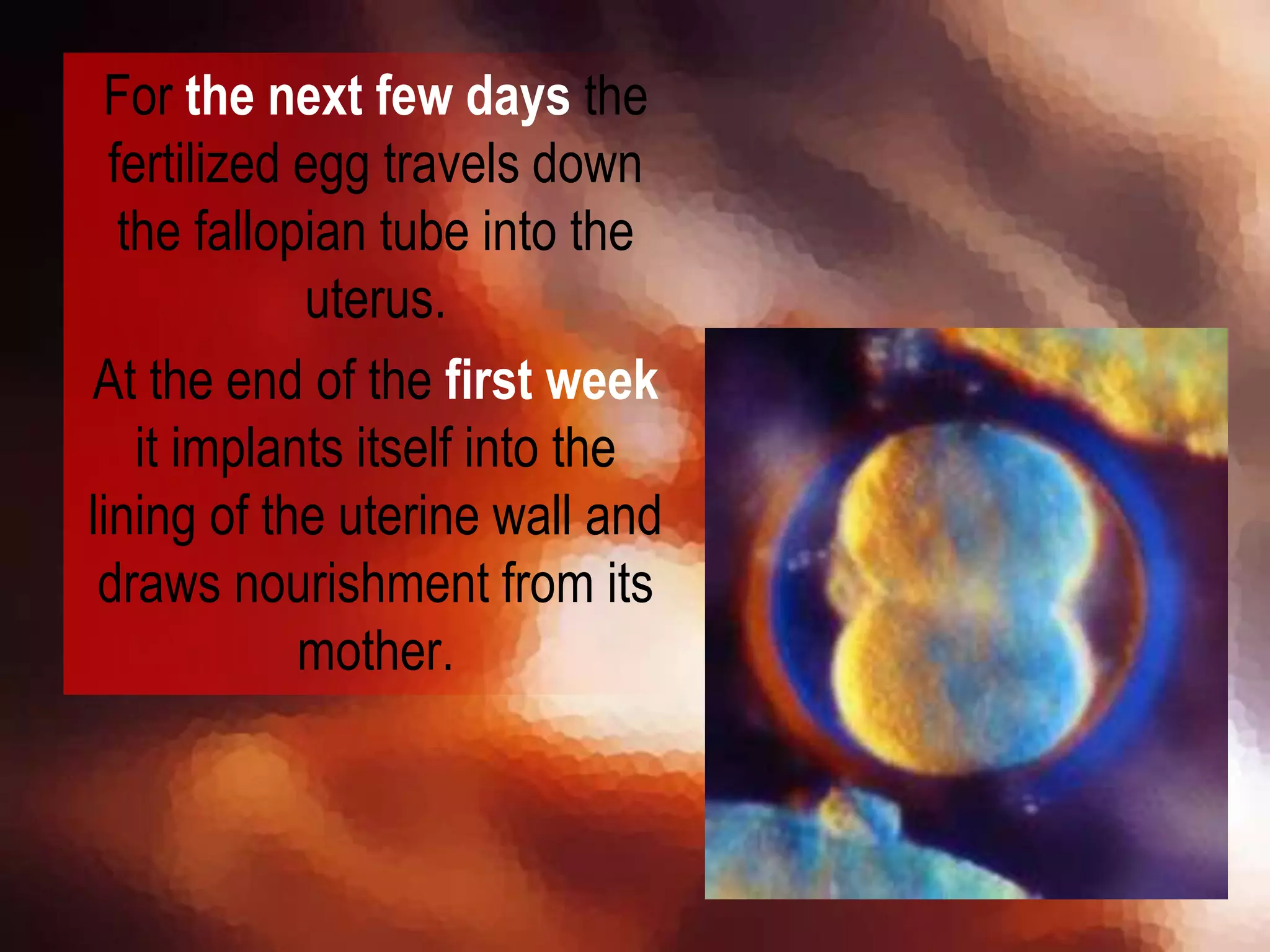
For the next few days the
fertilized egg travels down
the fallopian tube into the
uterus.
At the end of the first week
it implants itself into the
lining of the uterine wall and
draws nourishment from its
mother.
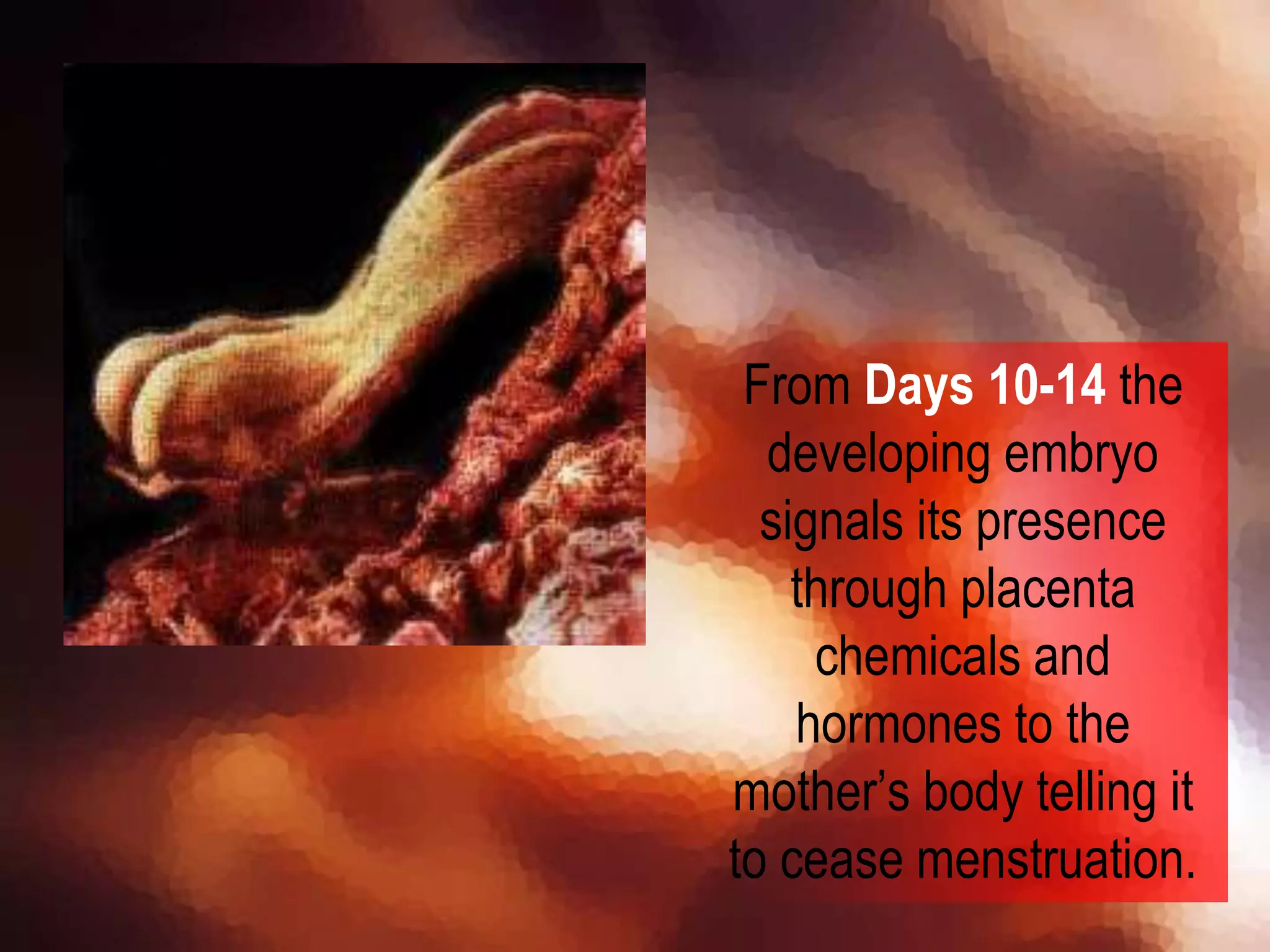
From Days 10-14 the
developing embryo
signals its presence
through placenta
chemicals and
hormones to the
mother’s body telling it
to cease menstruation.
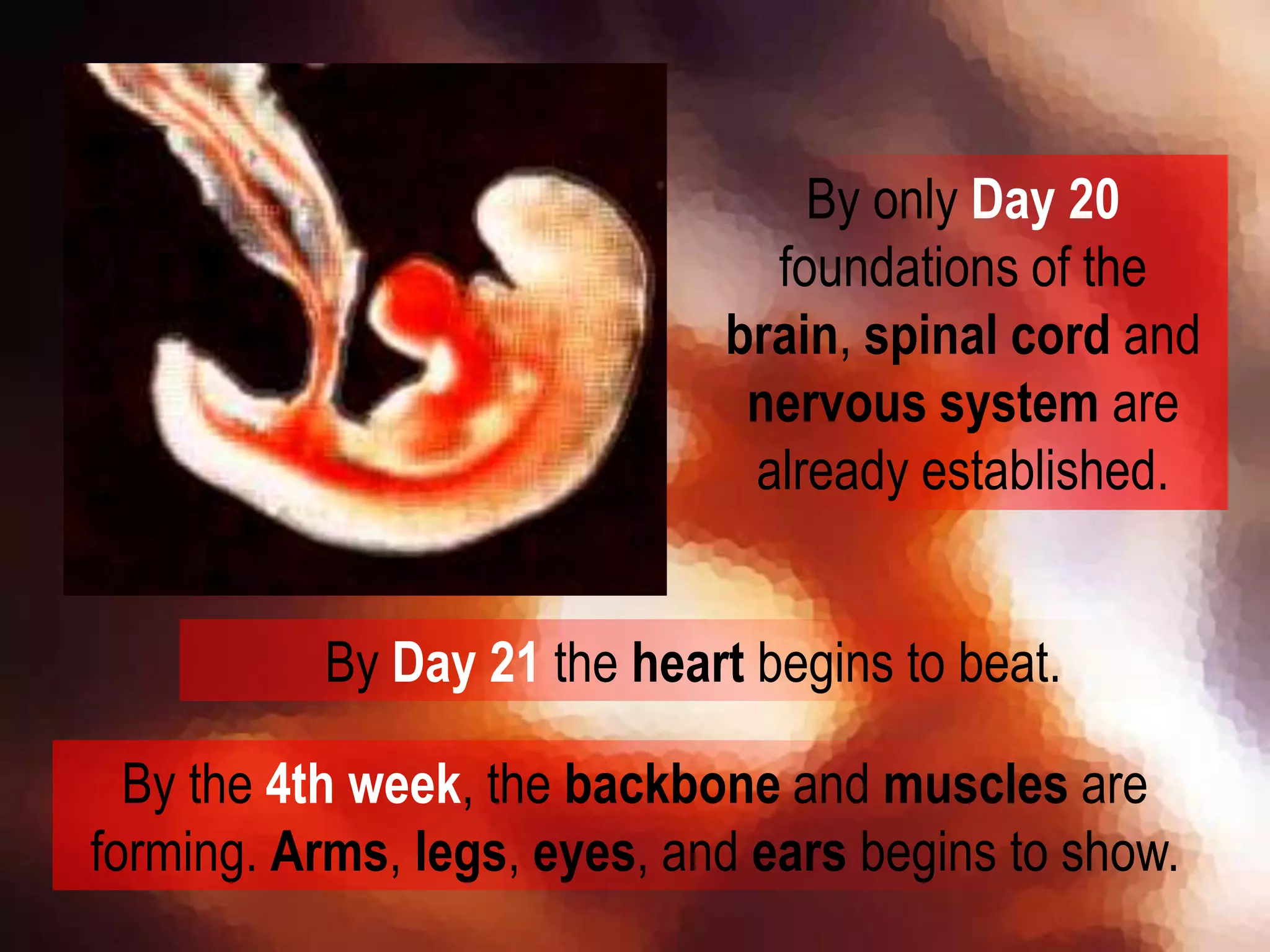
By Day 21 the heart begins to beat.
By the 4th week, the backbone and muscles are
forming. Arms, legs, eyes, and ears begins to show.
By only Day 20
foundations of the
brain, spinal cord and
nervous system are
already established.
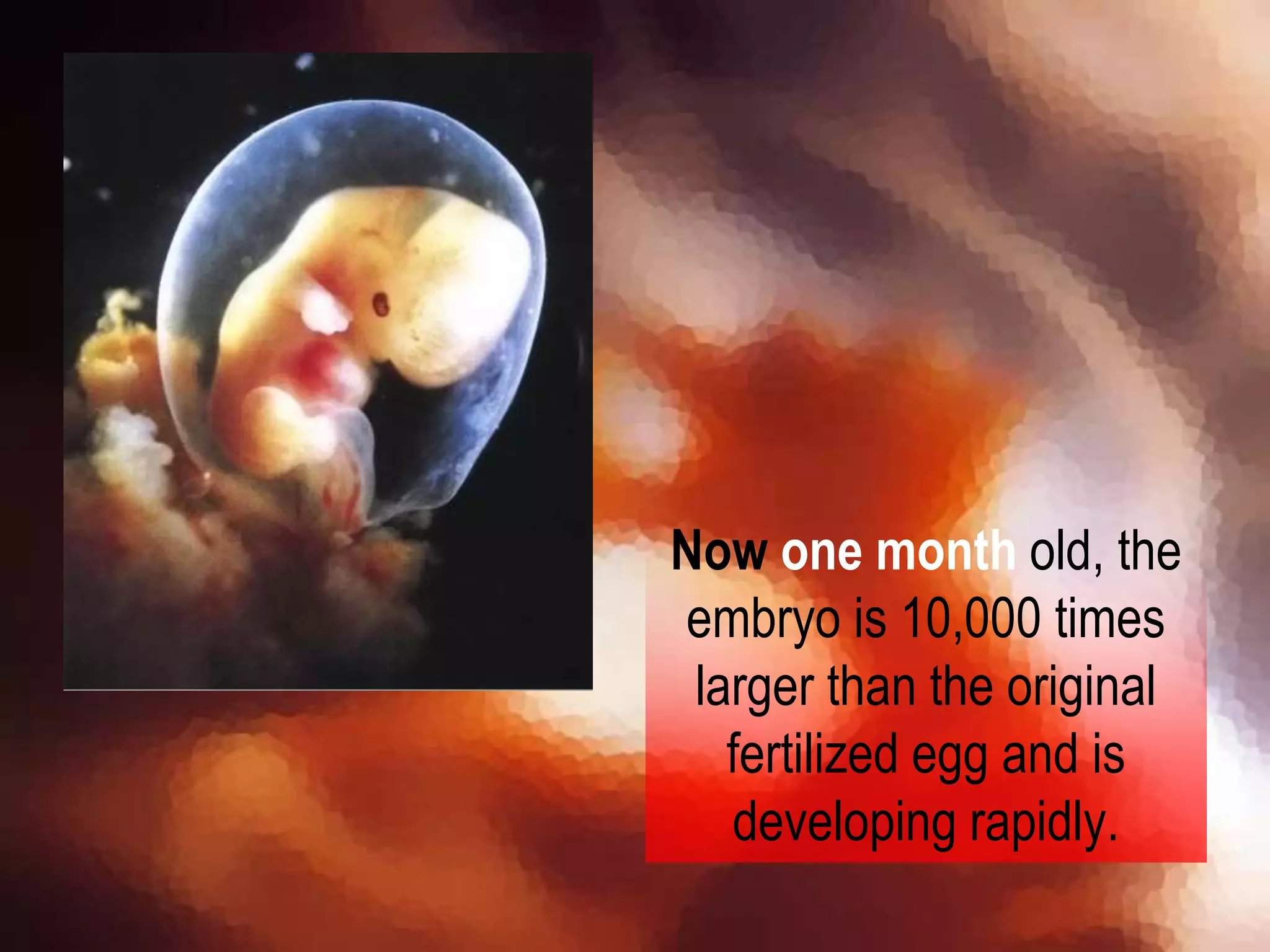
Now one month old, the
embryo is 10,000 times
larger than the original
fertilized egg and is
developing rapidly.
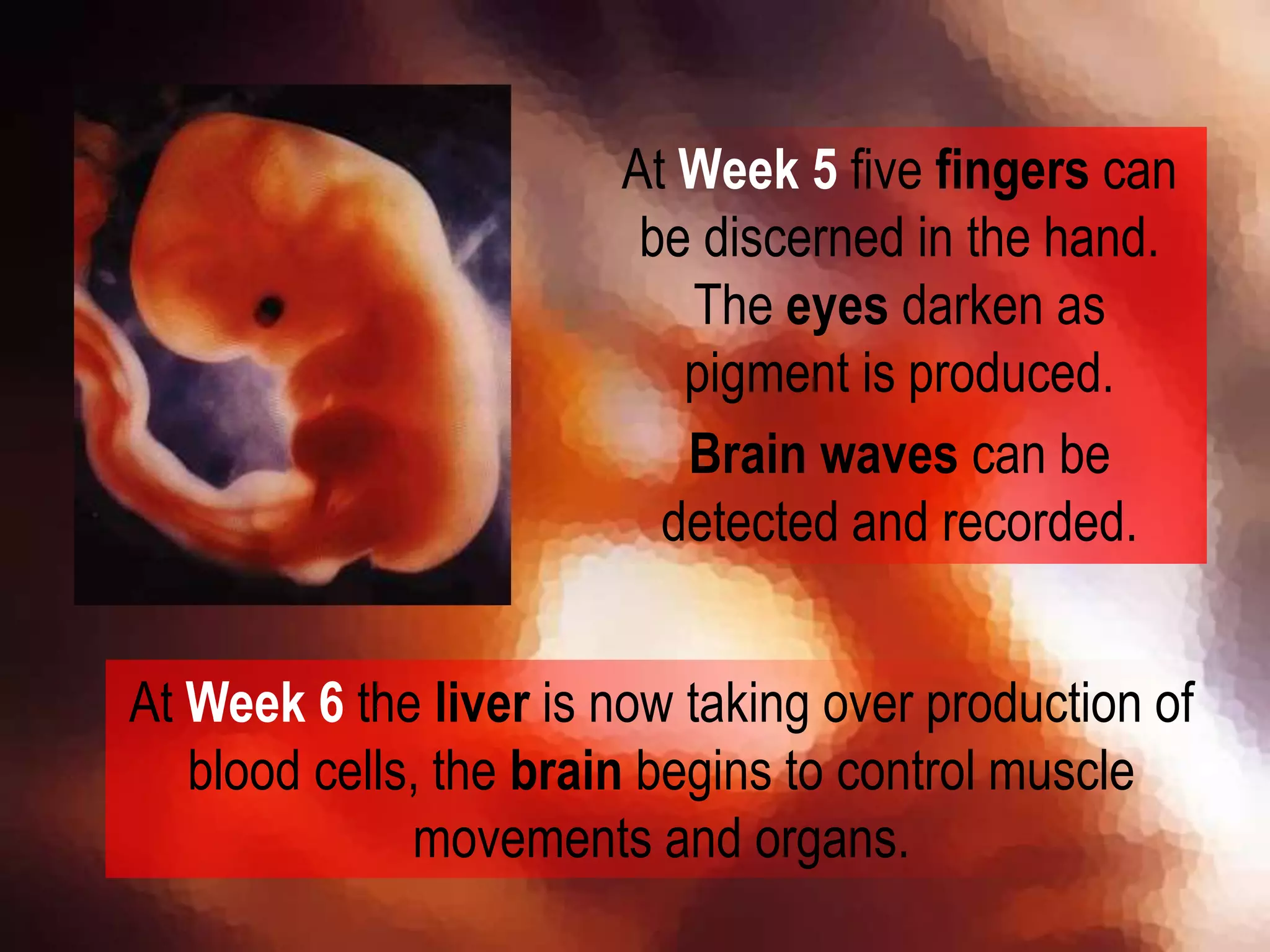
At Week 5 five fingers can
be discerned in the hand.
The eyes darken as
pigment is produced.
Brain waves can be
detected and recorded.
At Week 6 the liver is now taking over production of
blood cells, the brain begins to control muscle
movements and organs.
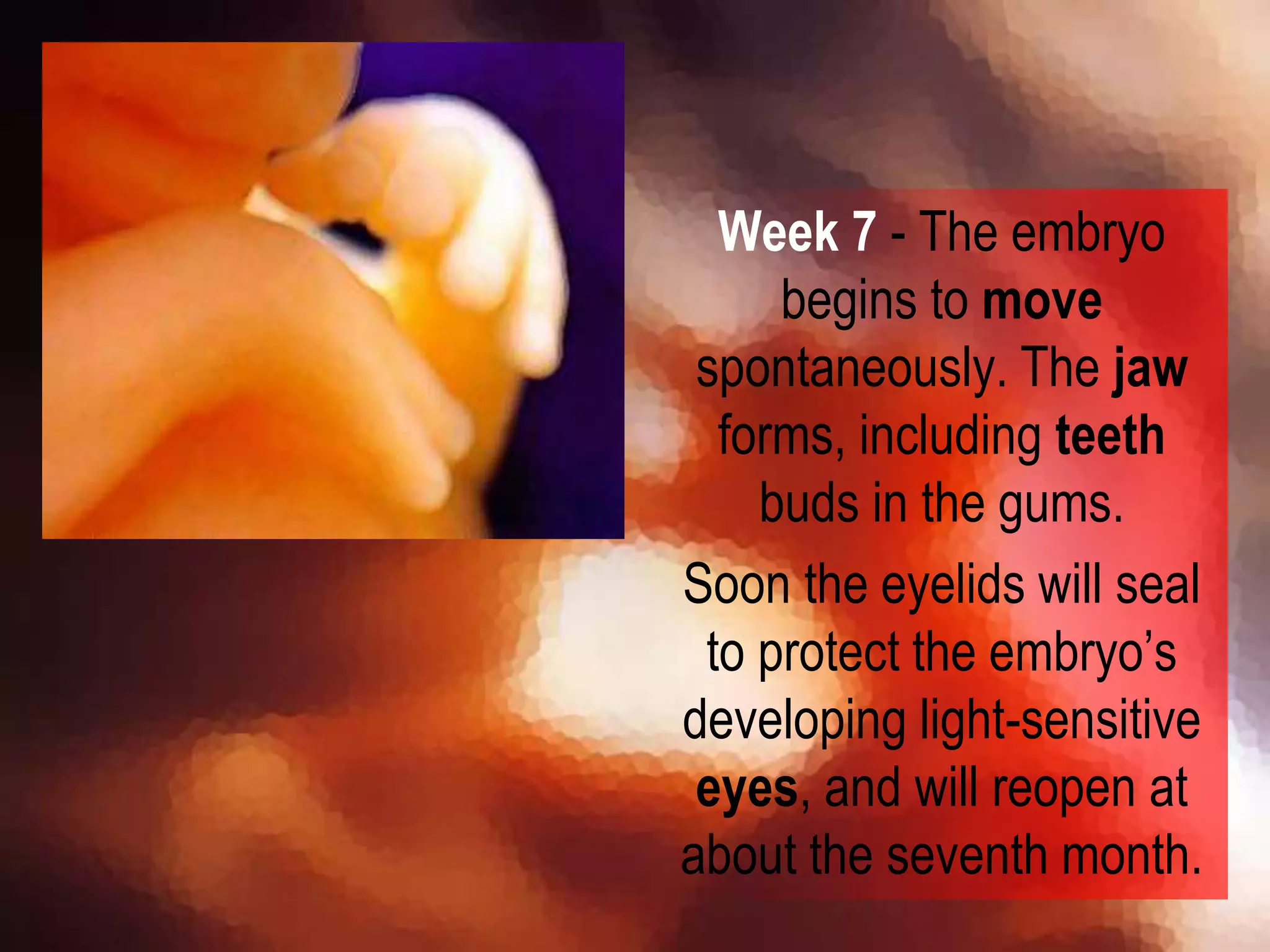
Week 7 - The embryo
begins to move
spontaneously. The jaw
forms, including teeth
buds in the gums.
Soon the eyelids will seal
to protect the embryo’s
developing light-sensitive
eyes, and will reopen at
about the seventh month.
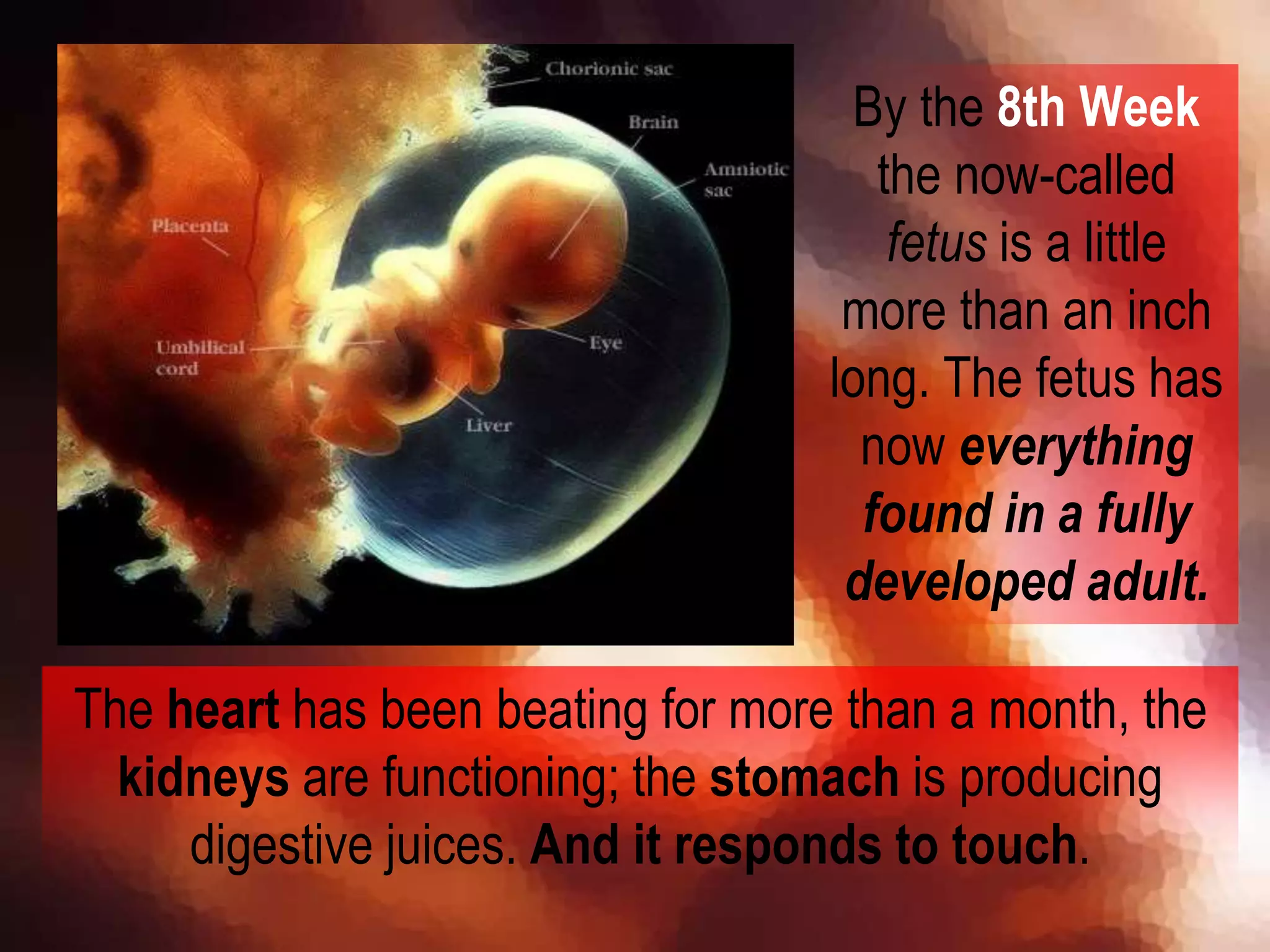
By the 8th Week
the now-called
fetus is a little
more than an inch
long. The fetus has
now everything
found in a fully
developed adult.
The heart has been beating for more than a month, the
kidneys are functioning; the stomach is producing
digestive juices. And it responds to touch.
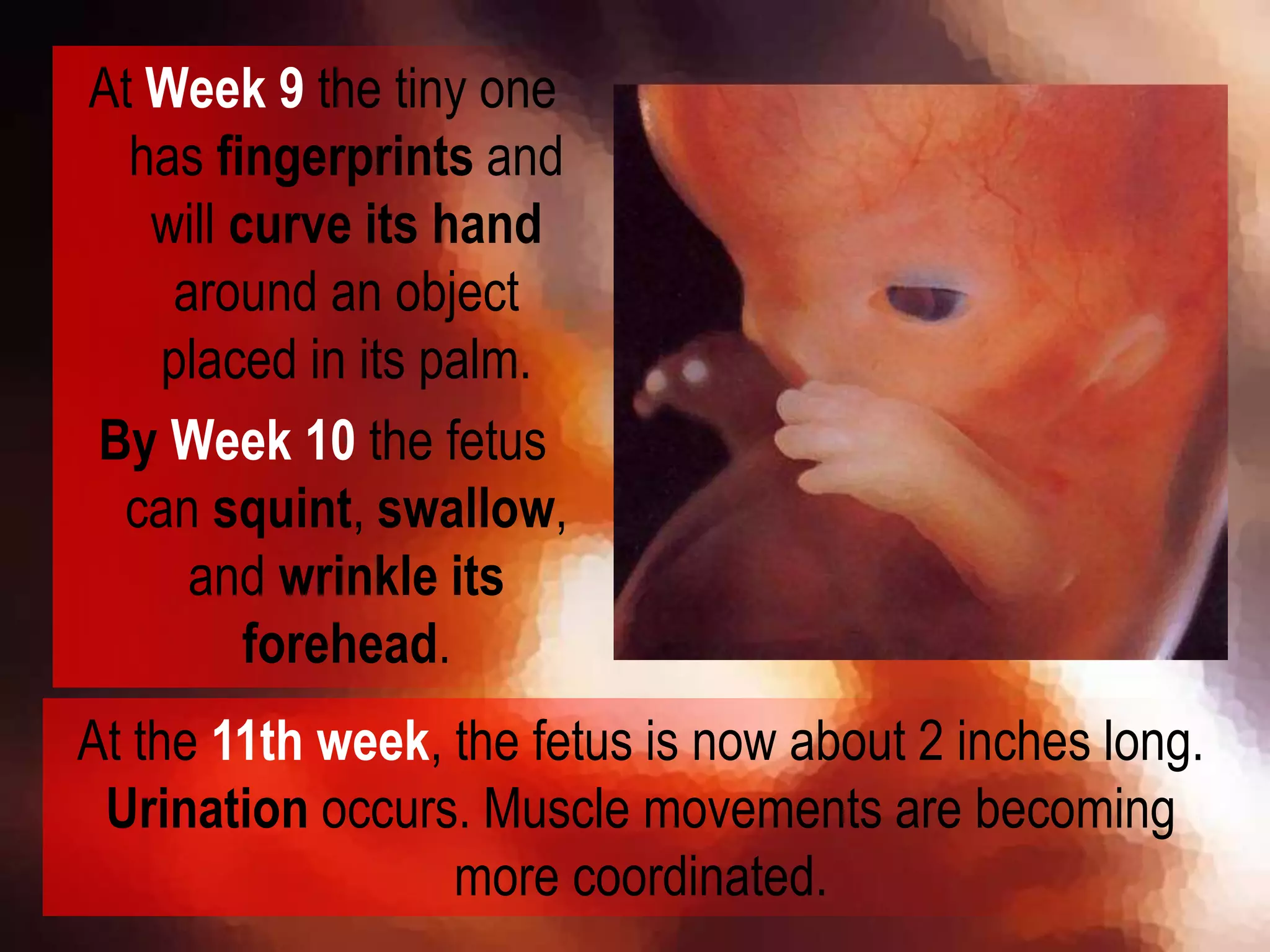
At Week 9 the tiny one
has fingerprints and
will curve its hand
around an object
placed in its palm.
By Week 10 the fetus
can squint, swallow,
and wrinkle its
forehead.
At the 11th week, the fetus is now about 2 inches long.
Urination occurs. Muscle movements are becoming
more coordinated.
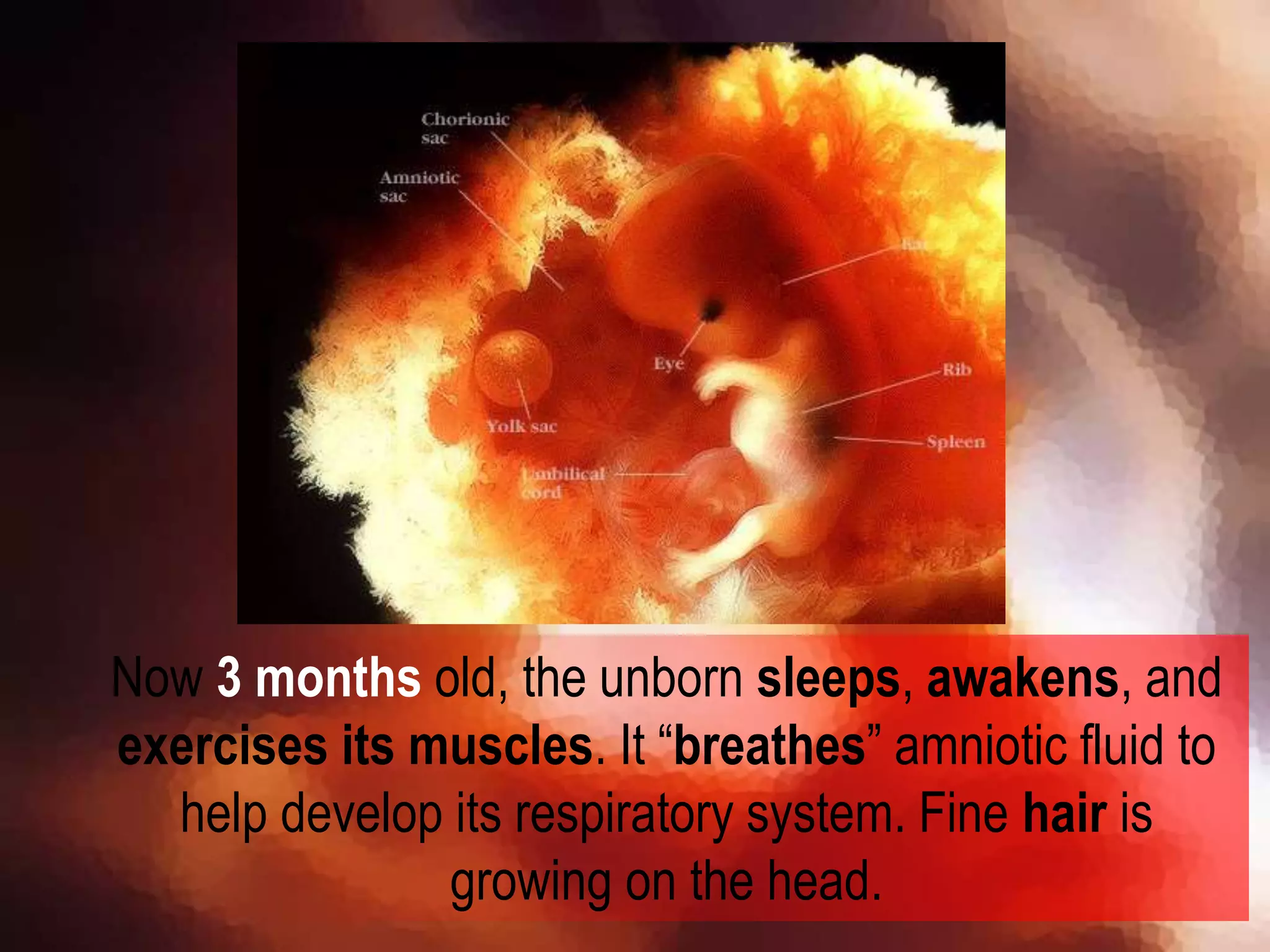
Now 3 months old, the unborn sleeps, awakens, and
exercises its muscles. It “breathes” amniotic fluid to
help develop its respiratory system. Fine hair is
growing on the head.
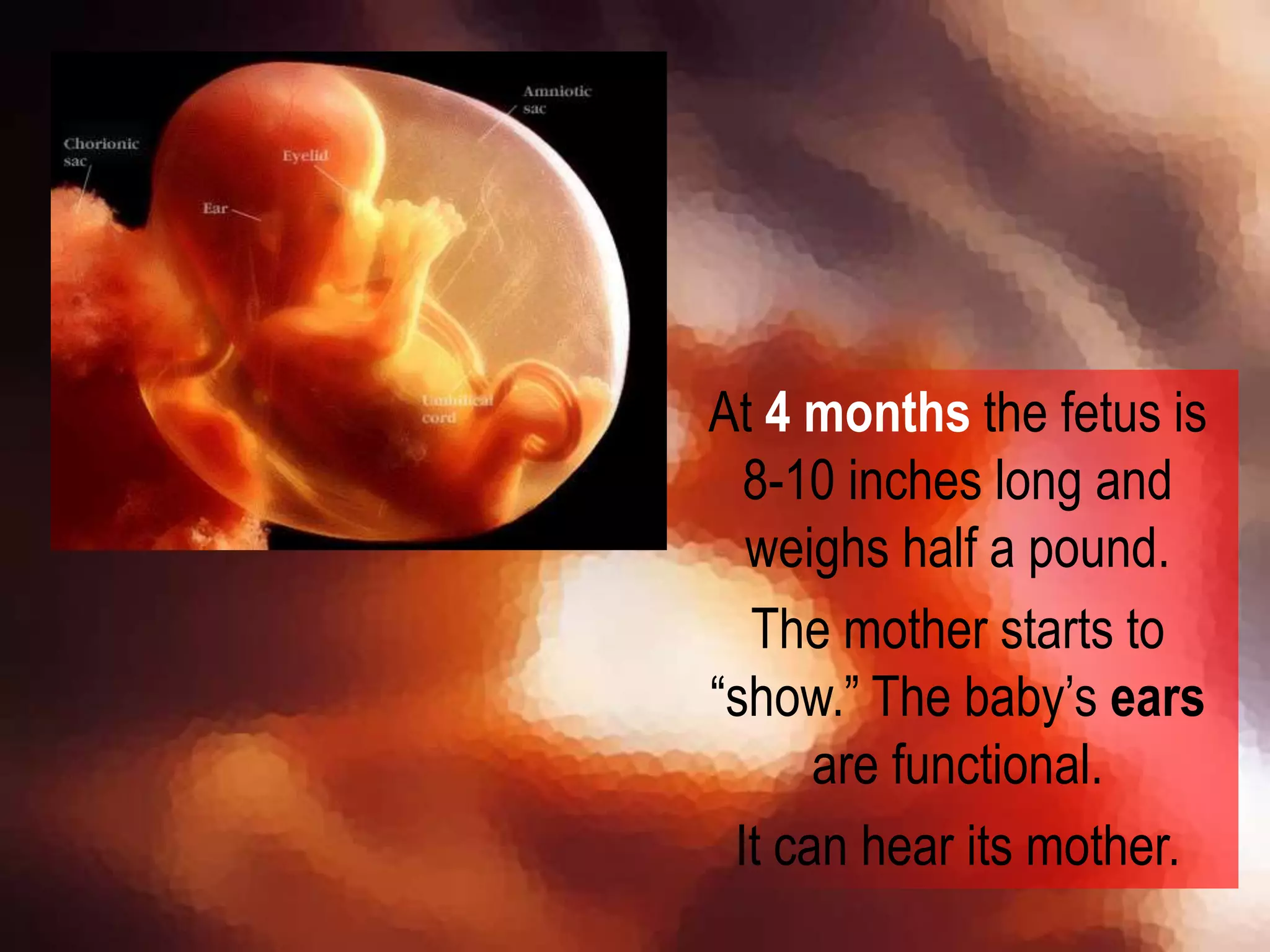
At 4 months the fetus is
8-10 inches long and
weighs half a pound.
The mother starts to
“show.” The baby’s ears
are functional.
It can hear its mother.
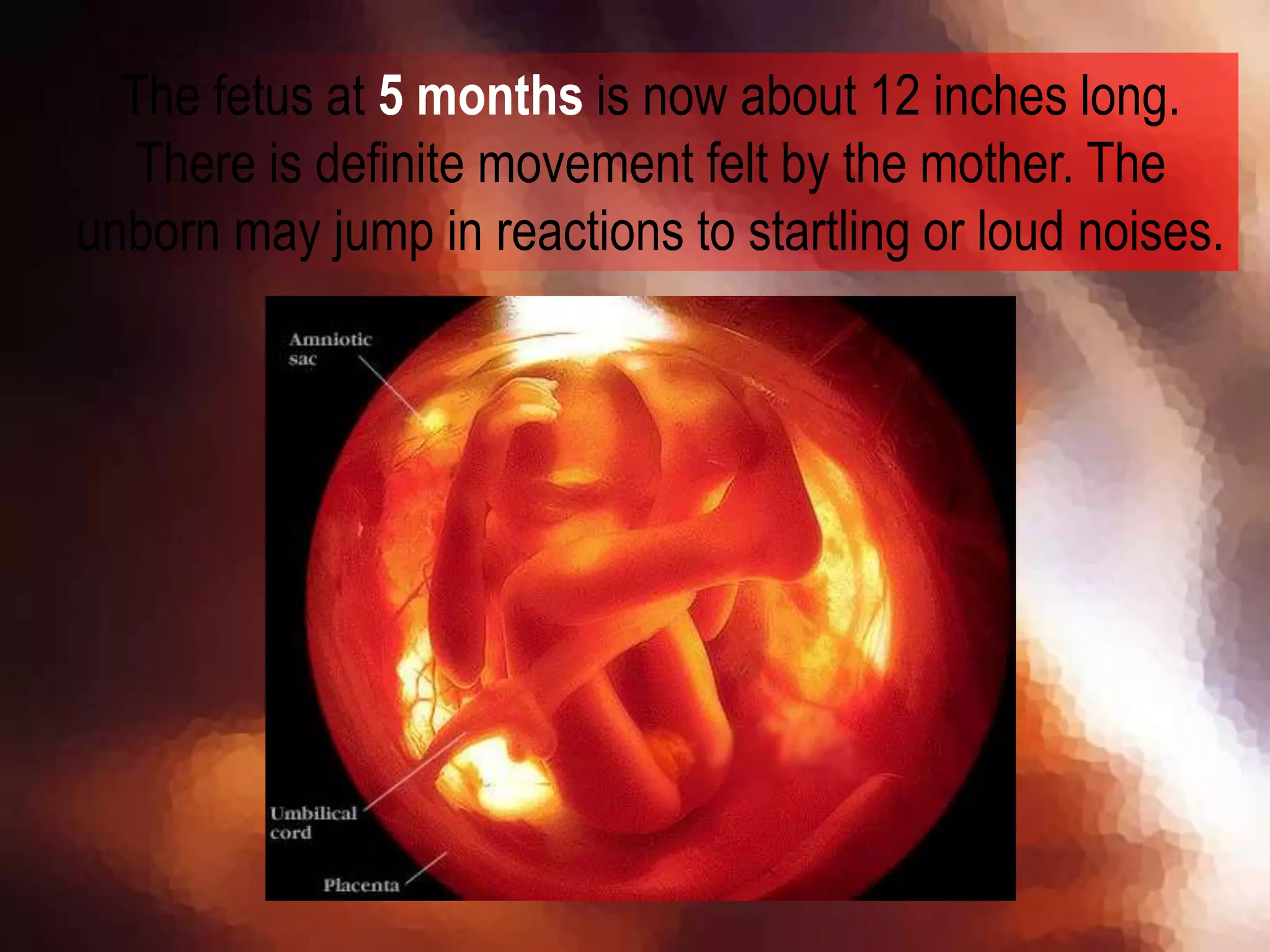
The fetus at 5 months is now about 12 inches long.
There is definite movement felt by the mother. The
unborn may jump in reactions to startling or loud noises.
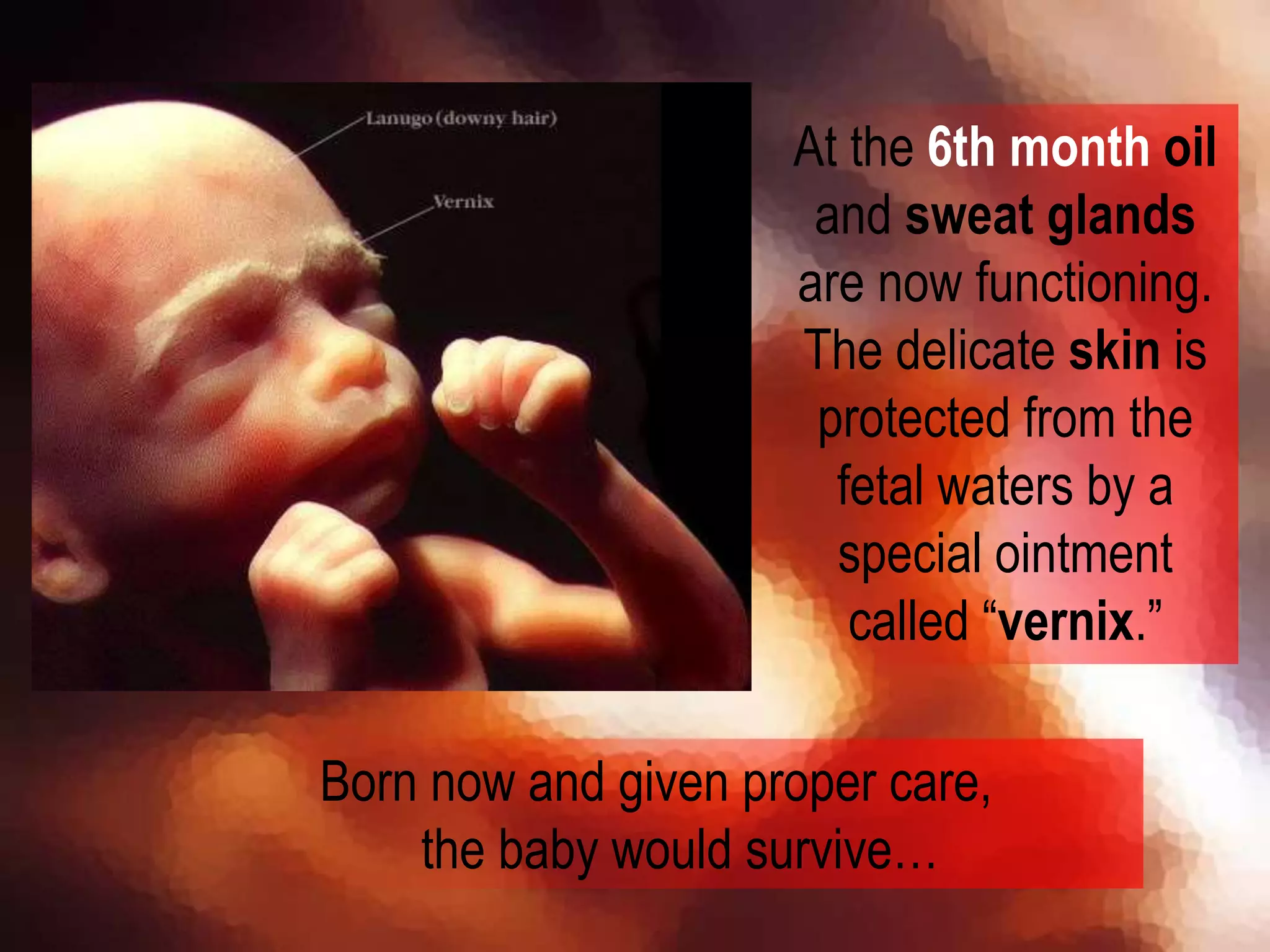
At the 6th month oil
and sweat glands
are now functioning.
The delicate skin is
protected from the
fetal waters by a
special ointment
called “vernix.”
Born now and given proper care,
the baby would survive…
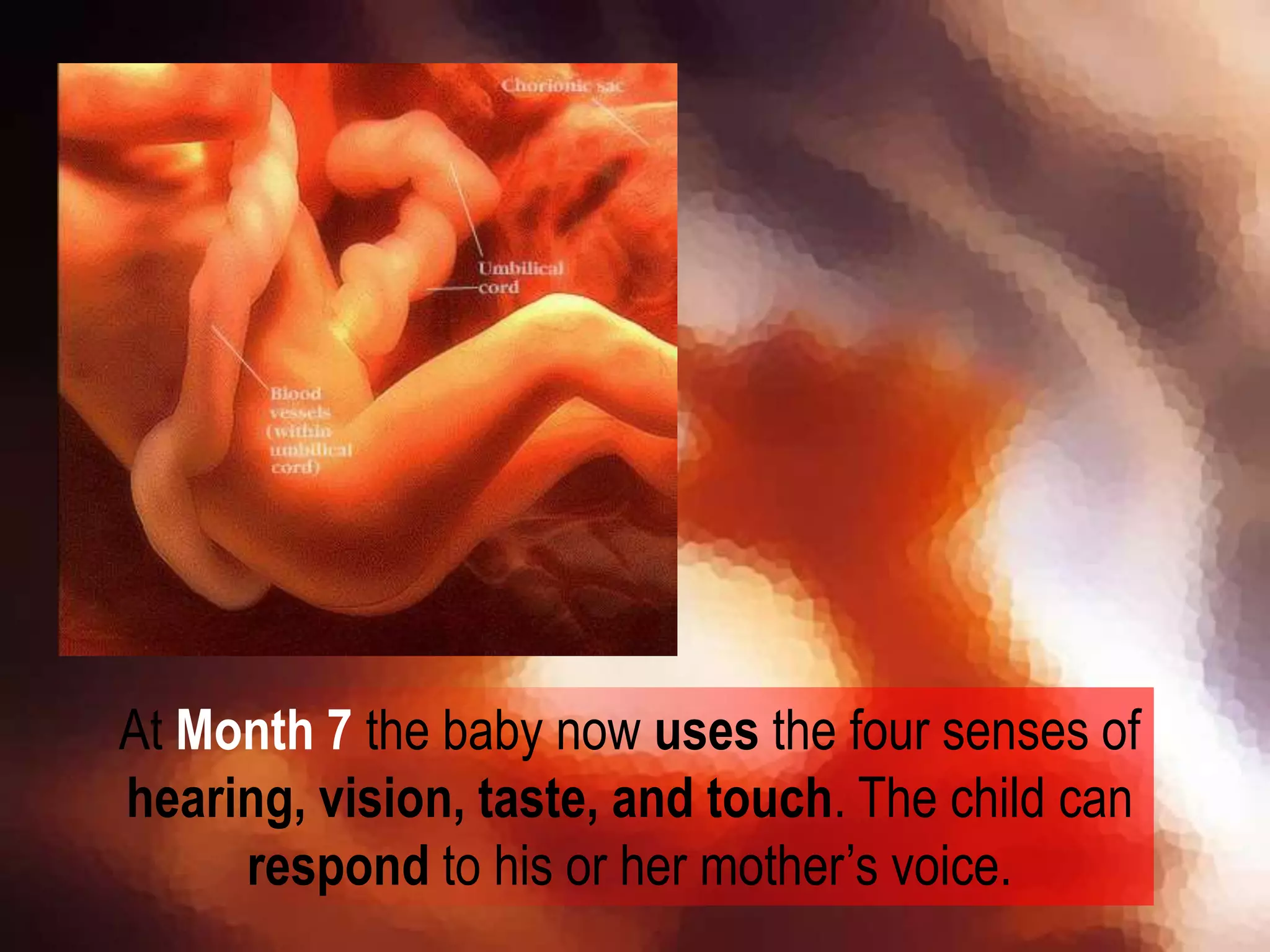
At Month 7 the baby now uses the four senses of
hearing, vision, taste, and touch. The child can
respond to his or her mother’s voice.
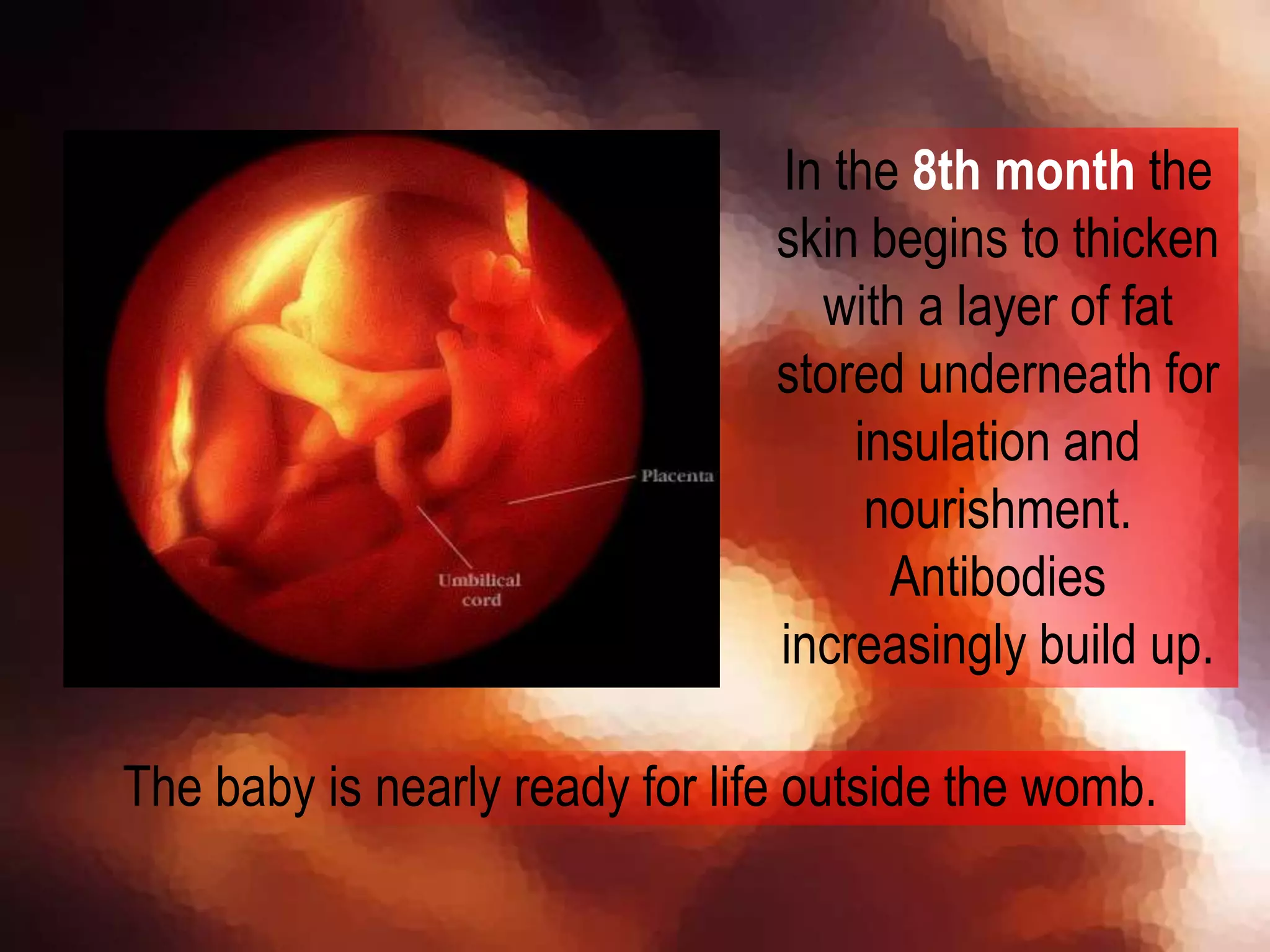
In the 8th month the
skin begins to thicken
with a layer of fat
stored underneath for
insulation and
nourishment.
Antibodies
increasingly build up.
The baby is nearly ready for life outside the womb.
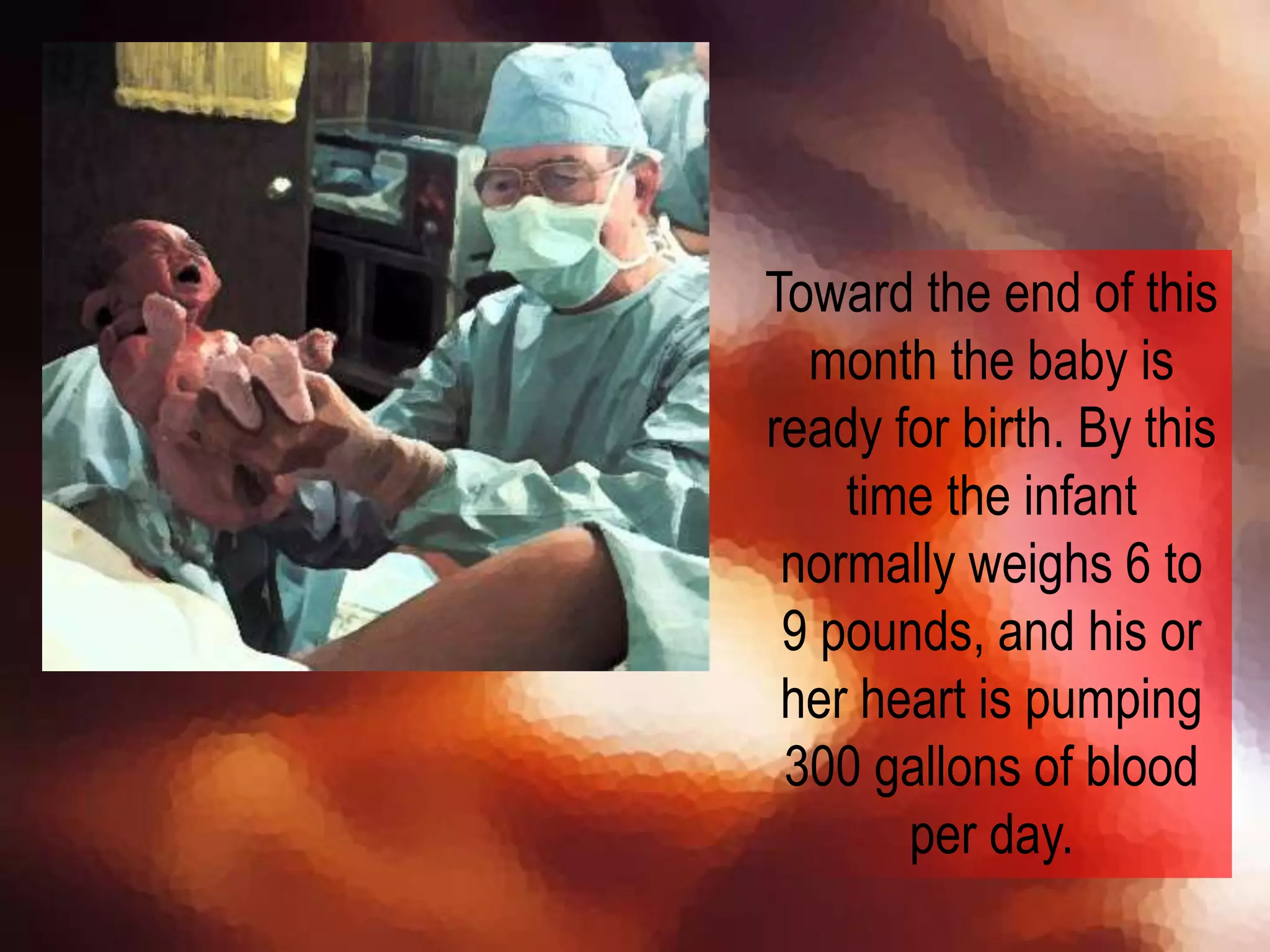
Toward the end of this
month the baby is
ready for birth. By this
time the infant
normally weighs 6 to
9 pounds, and his or
her heart is pumping
300 gallons of blood
per day.
When does life Begin
Is the embryo or fetus merely a
“globule of tissue”
What exactly is murder
Is abortion murder
Does knowing the facts about preborn
life and the methods of abortion
make us more responsible
What is abortion
Abortion is the expulsion of a living fetus from the
mother’s womb before it is viable.
Reasons for abortion
Economic Cost
Family Planning
Health
Rape incest
Age
Society’s moralism
Abortion
150,000 to 750,000 abortion every year
4,000 case of abortion annually in Manila
PHILIPPINES
ARTICLE II, SECTION 12 OF THE 1986
PHILIPPINE CONSTITUTION
“The state recognizes the sanctity of life and shall
protect and strengthen the family as a basic
autonomous social institution. It shall equally protect
the life of the mother and the life of the unborn from
conception.”
Historical Background
Revised Penal Code of the Philippines (enacted in
1930 and remains in effect today)
Articles 256, 258 and 259 of the Code mandate
imprisonment for the woman who undergoes the
abortion, as well as for any person who assists in the
procedure, even if they be the woman's parents, a
physician or midwife.
Historical Background
NATURAL ABORTION/SPONTANEOUS OR
ACCIDENTAL ABORTION
The expulsion of the fetus through natural or
accidental causes.
Types of Abortion
DIRECT OR INTENTIONAL ABORTION
Deliberately induced expulsion of a living fetus
before it has become viable.
Types of Abortion
THERAPEUTIC ABORTION
Deliberately induced expulsion of a living fetus in
order to save the mother from the danger of
death brought on by pregnancy.
Types of Abortion
EUGENIC ABORTION/SELECTIVE ABORTION OR
ABORTION ON FETAL INDICATIONS
- This is recommended in cases where certain
defects are discovered in the developing fetus.
Types of Abortion
INDIRECT ABORTION
The removal of the fetus occurs as a secondary
effect of a legitimate or licit action, which is
direct and primary object of the intention.
Types of Abortion
The conservative
The liberal
The moderate or intermediate
Viewpoints on Abortion
It declares that abortion is never permissible, or at
most, is permissible if and only it is required to save the
pregnant woman’s life, as in the case of the removal of
a cancerous uterus or the removal of the fallopian tube,
or a part of it, because of ectopic pregnancy.
Conservative Viewpoint
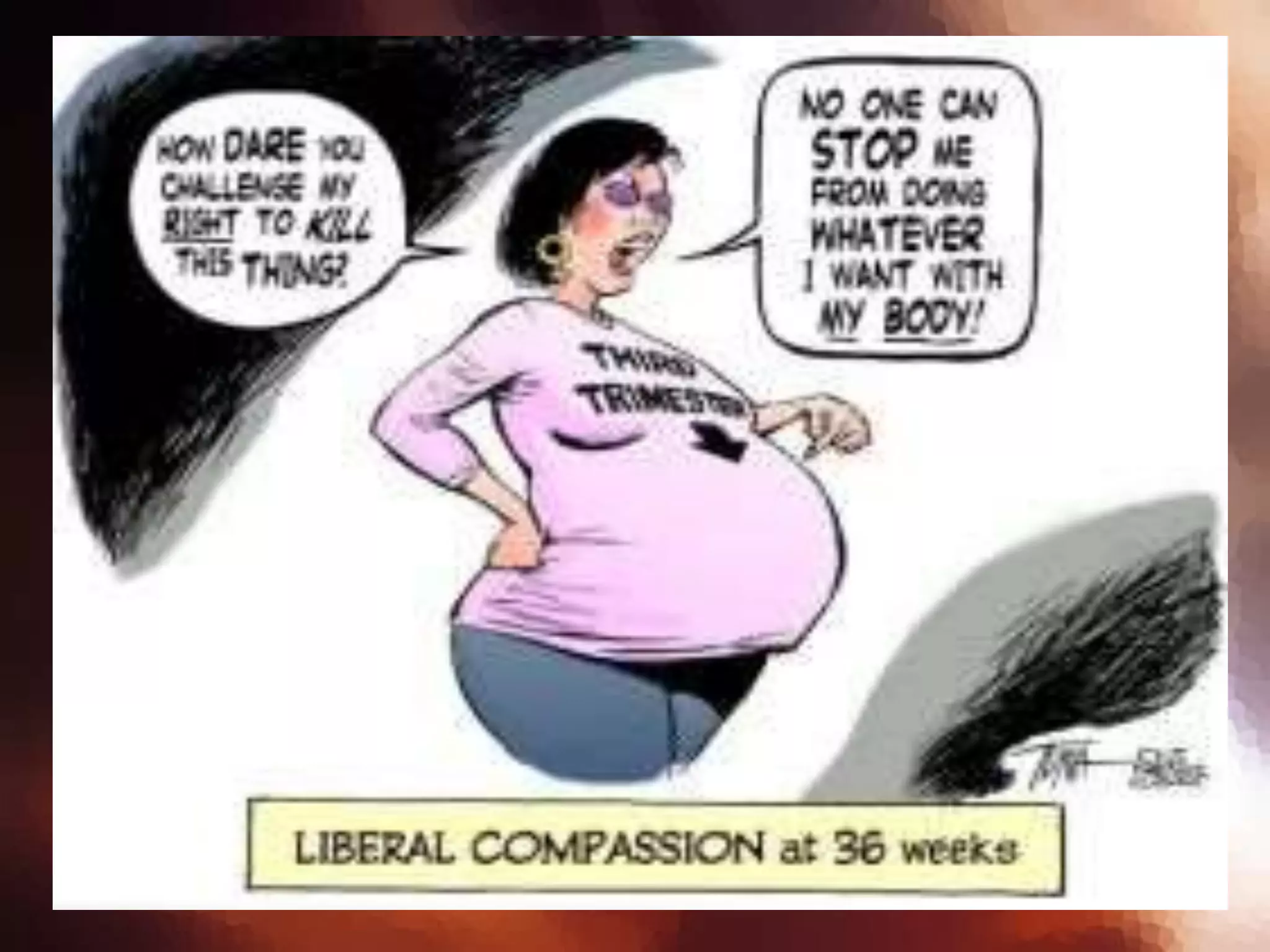
States that abortion is always permissible, whatever
the state of fetal development may be. If women are
truly to be liberated, this view contends, they must
ultimately have full freedom to control their own
reproductive capacities.
Liberal Viewpoint
“The fetus has no ontological status; it is neither an
individual, human, nor a person, but only a tissue in
a woman’s uterus; therefore, it possesses no rights
and no moral status.”
Liberals
It holds that abortion is morally permissible up to
certain stage of fetal development, or for some limited
set of reasons sufficient to justify the taking of life in
this or that special circumstances. As far as the
moderates are concerned, the fetus attains ontological
status at quickening or viability.
Moderate Viewpoint
PLANTS AND PLANT PREPARATIONS
e.g.,Makabuhay, Essencia maravilosa.
Methods of Abortion
“If you prick us do we not bleed,
if you tickle us do we not laugh, if
you poison us do we not die…”
- Shakespeare the Merchant of Venice
PHYSICAL METHODS
Massage and abdominal pressure are applied by the
hilot, or sometimes by the pregnant woman herself.
Methods of Abortion
INSERTION OF CATHETERS
Women have been known to insert hangers,
brooms, walis tingting.
Methods of Abortion
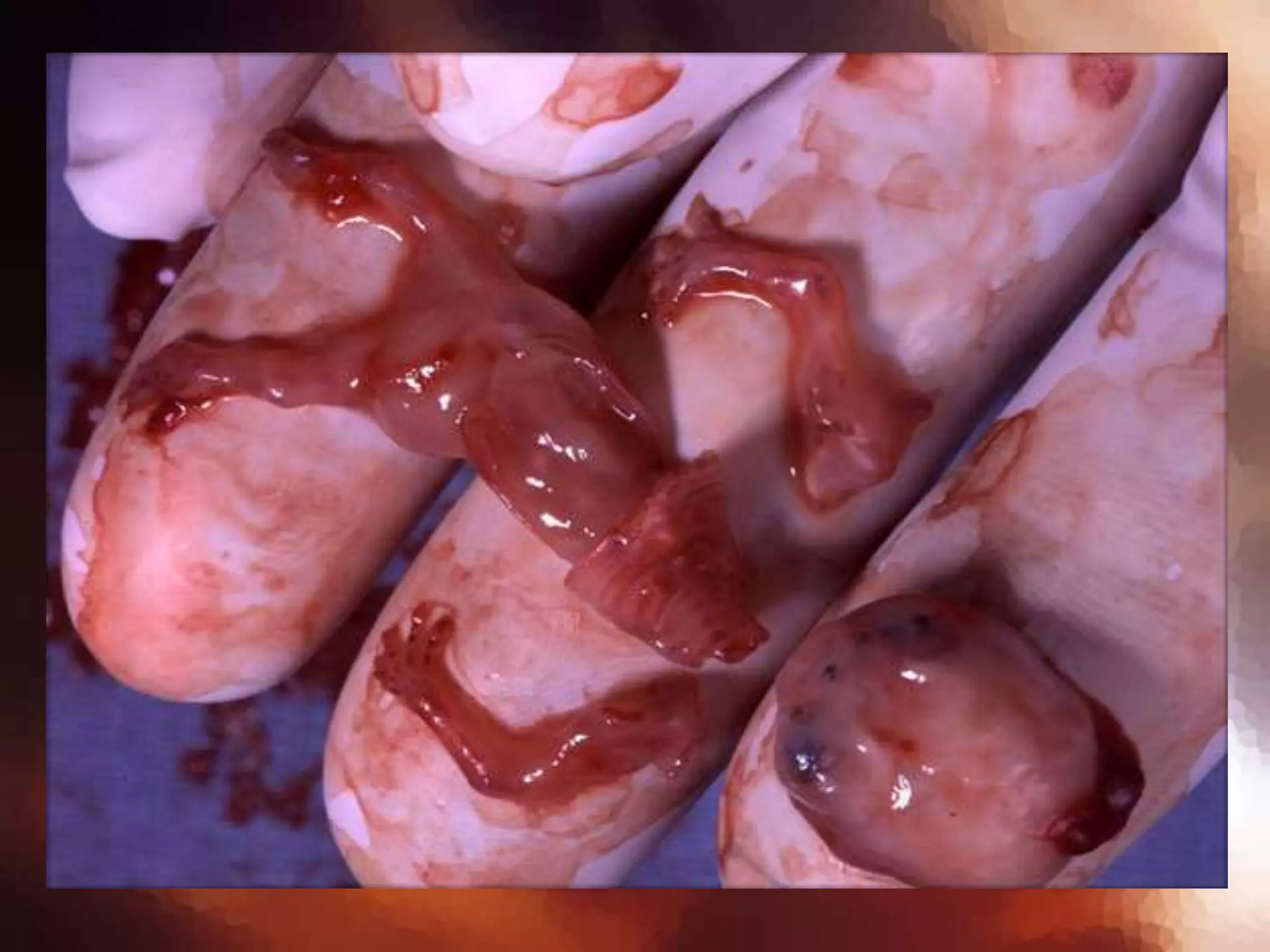
DILATION AND CURETTAGE
Usually, this is done with women who had already
began the abortion, in which case it is called
completion curettage.
Methods of Abortion
MENSTRUAL REGULATION (MR)
This involves the use of suction or vacuum aspiration to
terminate a very early pregnancy.
Methods of Abortion
MENSTRUAL REGULATION (MR)
This involves the use of suction or vacuum aspiration to
terminate a very early pregnancy.
Methods of Abortion
DRUGS
These include medicines such as quinine, an anti-
malarial; methylergometrin, a uterine stimulant and
methotrexate, an anti-cancer drug.
Bricanyl (terbutaline) is perceived as an
abortifacient in large doses
Methods of Abortion
DRUGS
Misoprostol (Cytotec) is actually a drug used to
prevent ulcers but has abortion as a side effect.
Another drug called RU486 (Mifepristone) is now legal
in China and a few European countries.
Methods of Abortion
SALT POISONING
A needle is inserted through the mother’s abdomen
and 50-250 ml of amniotic fluid is withdrawn and
replaced with a solution of concentrated salt.
Methods of Abortion
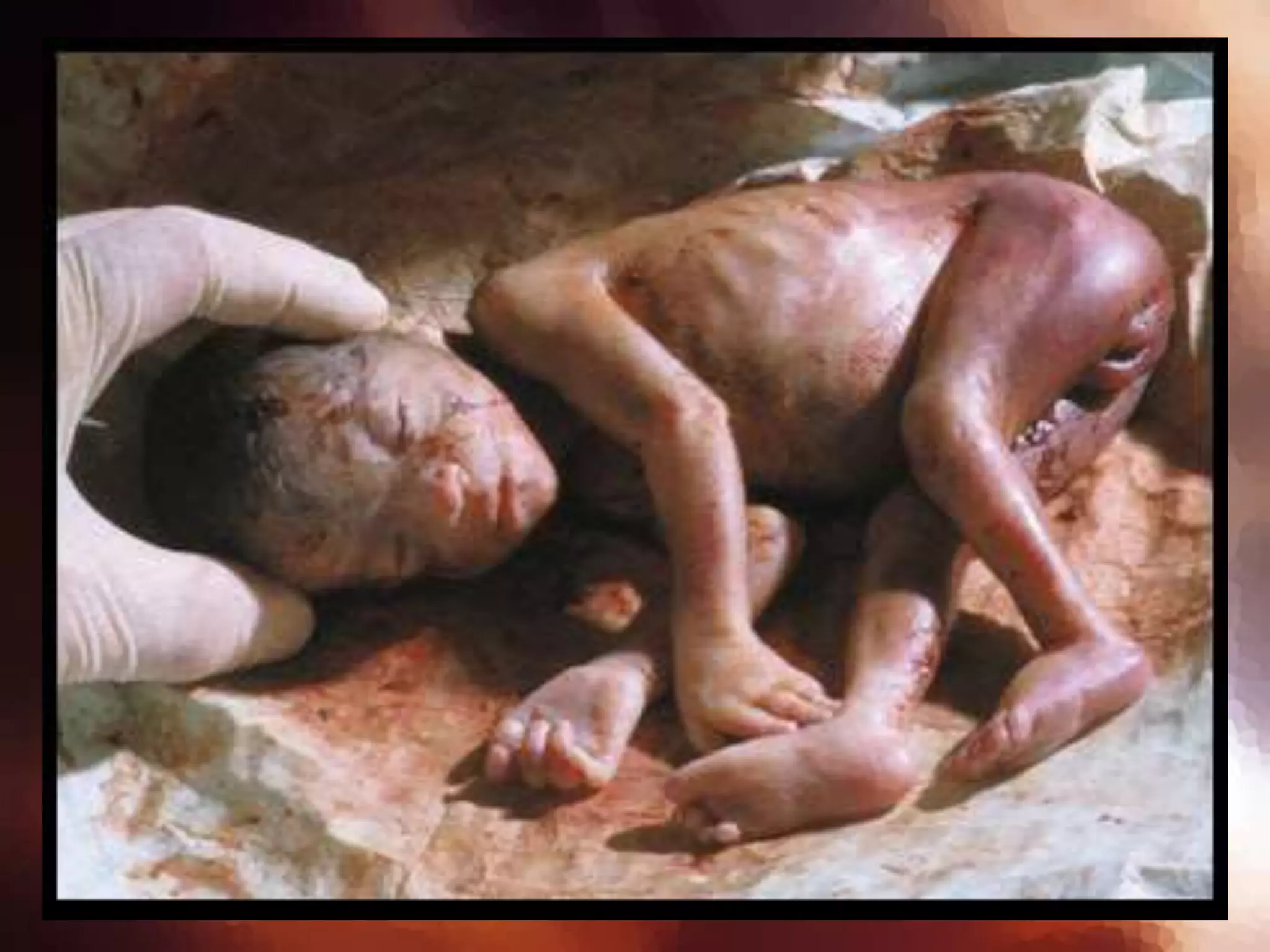
HYSTEROTOMY
Incisions are made in the abdomen and uterus. The
baby, placenta, and amniotic sac are removed.
Methods of Abortion
THE TWO POSITIONS
The pro-life position
The pro-choice position
Moral Issues
SANCTITY OF LIFE ARGUMENT
Moral Issues
THE DOCTRINE OF DOUBLE EFFECT
The course chosen must be good or at
least morally neutral
The good must not follow as a consequence
of the secondary harmful effects
The harm must never be intended but merely tolerated
as casually connected with the good intended
The good must outweigh the harm
Moral Issues
“HUMAN” OR “PERSON”
Consciousness of objects and events
The ability to feel pain
Reasoning
Self-motivated activity
The capacity to communicate
A concept of the self
Moral Issues
THE VIABILITY ARGUMENT
Moral Issues
THE VIOLINIST ANALOGY
Moral Issues
THE RAPIDLY GROWING CHILD ANALOGY
Moral Issues
THE CARPET –SEED CHILDREN ANALOGY
Moral Issues
TRADITIONALISM VS. MODERNISM
Moral Issues
ABORTION AND FREEDOM OF RELIGION
Moral Issues
THE ENVIRONMENT PERSPECTIVE
Moral Issues
The LORD God formed the man from the dust of the
ground and breathed into his nostrils the breath of life,
and the man became a living being
(Genesis 2:7).
Biblical Viewpoint
The word of the LORD came to me, saying,
"Before I formed you in the womb I knew
you, before you were born I set you apart;
I appointed you as a prophet to the nations"
(Jeremiah 1:4-5).
Biblical Viewpoint
You shall not murder.
(Exodus 20:13)
Biblical Viewpoint
1. Edge, R. S. and Groves, J. R. (1999) Ethics of
Health Care: A Guide for Clinical Practice (Second
Edition). Albert Complex, Singapore: Delmar
Publishers. pp. 180 – 201
2. Timbreza, F. T. (2007) Bioethics and Moral
Decisions. Quezon Avenue: C & E Publishing Inc.
pp. 87 - 106
References

Bioethics the Moral Issue of Abortion

  • 1.
    A Look atthe Life of the Unborn and the Methods Used to Take that Life JOFRED M. MARTINEZ, RN
  • 2.
    1. Outline thedistinction between “human” and “person”, and to dispute regarding personhood criteria. 2. List the basic facts of fetal development. 3. Explain the different types of abortion. 4. Describe the sociology of abortion issue. 5. Outline the religious arguments against abortion. 6. Explain the pro-choice position from a “life plan” point of view.
  • 4.
    In the beginningsperm joins with ovum (egg) to form one cell - smaller than a grain of salt. This union brings together the 23 chromosomes from the father with the 23 chromosomes from the mother to make a single new life with 46 chromosomes - the genetic blue print for the development of every detail this new person will ever have.
  • 5.
    For the nextfew days the fertilized egg travels down the fallopian tube into the uterus. At the end of the first week it implants itself into the lining of the uterine wall and draws nourishment from its mother.
  • 6.
    From Days 10-14the developing embryo signals its presence through placenta chemicals and hormones to the mother’s body telling it to cease menstruation.
  • 7.
    By Day 21the heart begins to beat. By the 4th week, the backbone and muscles are forming. Arms, legs, eyes, and ears begins to show. By only Day 20 foundations of the brain, spinal cord and nervous system are already established.
  • 8.
    Now one monthold, the embryo is 10,000 times larger than the original fertilized egg and is developing rapidly.
  • 9.
    At Week 5five fingers can be discerned in the hand. The eyes darken as pigment is produced. Brain waves can be detected and recorded. At Week 6 the liver is now taking over production of blood cells, the brain begins to control muscle movements and organs.
  • 10.
    Week 7 -The embryo begins to move spontaneously. The jaw forms, including teeth buds in the gums. Soon the eyelids will seal to protect the embryo’s developing light-sensitive eyes, and will reopen at about the seventh month.
  • 11.
    By the 8thWeek the now-called fetus is a little more than an inch long. The fetus has now everything found in a fully developed adult. The heart has been beating for more than a month, the kidneys are functioning; the stomach is producing digestive juices. And it responds to touch.
  • 12.
    At Week 9the tiny one has fingerprints and will curve its hand around an object placed in its palm. By Week 10 the fetus can squint, swallow, and wrinkle its forehead. At the 11th week, the fetus is now about 2 inches long. Urination occurs. Muscle movements are becoming more coordinated.
  • 13.
    Now 3 monthsold, the unborn sleeps, awakens, and exercises its muscles. It “breathes” amniotic fluid to help develop its respiratory system. Fine hair is growing on the head.
  • 14.
    At 4 monthsthe fetus is 8-10 inches long and weighs half a pound. The mother starts to “show.” The baby’s ears are functional. It can hear its mother.
  • 15.
    The fetus at5 months is now about 12 inches long. There is definite movement felt by the mother. The unborn may jump in reactions to startling or loud noises.
  • 16.
    At the 6thmonth oil and sweat glands are now functioning. The delicate skin is protected from the fetal waters by a special ointment called “vernix.” Born now and given proper care, the baby would survive…
  • 17.
    At Month 7the baby now uses the four senses of hearing, vision, taste, and touch. The child can respond to his or her mother’s voice.
  • 18.
    In the 8thmonth the skin begins to thicken with a layer of fat stored underneath for insulation and nourishment. Antibodies increasingly build up. The baby is nearly ready for life outside the womb.
  • 19.
    Toward the endof this month the baby is ready for birth. By this time the infant normally weighs 6 to 9 pounds, and his or her heart is pumping 300 gallons of blood per day.
  • 20.
    When does lifeBegin Is the embryo or fetus merely a “globule of tissue”
  • 21.
    What exactly ismurder Is abortion murder
  • 22.
    Does knowing thefacts about preborn life and the methods of abortion make us more responsible
  • 23.
    What is abortion Abortionis the expulsion of a living fetus from the mother’s womb before it is viable.
  • 25.
    Reasons for abortion EconomicCost Family Planning Health Rape incest Age Society’s moralism
  • 26.
    Abortion 150,000 to 750,000abortion every year 4,000 case of abortion annually in Manila
  • 27.
    PHILIPPINES ARTICLE II, SECTION12 OF THE 1986 PHILIPPINE CONSTITUTION “The state recognizes the sanctity of life and shall protect and strengthen the family as a basic autonomous social institution. It shall equally protect the life of the mother and the life of the unborn from conception.” Historical Background
  • 28.
    Revised Penal Codeof the Philippines (enacted in 1930 and remains in effect today) Articles 256, 258 and 259 of the Code mandate imprisonment for the woman who undergoes the abortion, as well as for any person who assists in the procedure, even if they be the woman's parents, a physician or midwife. Historical Background
  • 29.
    NATURAL ABORTION/SPONTANEOUS OR ACCIDENTALABORTION The expulsion of the fetus through natural or accidental causes. Types of Abortion
  • 30.
    DIRECT OR INTENTIONALABORTION Deliberately induced expulsion of a living fetus before it has become viable. Types of Abortion
  • 31.
    THERAPEUTIC ABORTION Deliberately inducedexpulsion of a living fetus in order to save the mother from the danger of death brought on by pregnancy. Types of Abortion
  • 32.
    EUGENIC ABORTION/SELECTIVE ABORTIONOR ABORTION ON FETAL INDICATIONS - This is recommended in cases where certain defects are discovered in the developing fetus. Types of Abortion
  • 33.
    INDIRECT ABORTION The removalof the fetus occurs as a secondary effect of a legitimate or licit action, which is direct and primary object of the intention. Types of Abortion
  • 34.
    The conservative The liberal Themoderate or intermediate Viewpoints on Abortion
  • 35.
    It declares thatabortion is never permissible, or at most, is permissible if and only it is required to save the pregnant woman’s life, as in the case of the removal of a cancerous uterus or the removal of the fallopian tube, or a part of it, because of ectopic pregnancy. Conservative Viewpoint
  • 36.
    States that abortionis always permissible, whatever the state of fetal development may be. If women are truly to be liberated, this view contends, they must ultimately have full freedom to control their own reproductive capacities. Liberal Viewpoint
  • 38.
    “The fetus hasno ontological status; it is neither an individual, human, nor a person, but only a tissue in a woman’s uterus; therefore, it possesses no rights and no moral status.” Liberals
  • 39.
    It holds thatabortion is morally permissible up to certain stage of fetal development, or for some limited set of reasons sufficient to justify the taking of life in this or that special circumstances. As far as the moderates are concerned, the fetus attains ontological status at quickening or viability. Moderate Viewpoint
  • 40.
    PLANTS AND PLANTPREPARATIONS e.g.,Makabuhay, Essencia maravilosa. Methods of Abortion
  • 41.
    “If you prickus do we not bleed, if you tickle us do we not laugh, if you poison us do we not die…” - Shakespeare the Merchant of Venice
  • 42.
    PHYSICAL METHODS Massage andabdominal pressure are applied by the hilot, or sometimes by the pregnant woman herself. Methods of Abortion
  • 44.
    INSERTION OF CATHETERS Womenhave been known to insert hangers, brooms, walis tingting. Methods of Abortion
  • 45.
    DILATION AND CURETTAGE Usually,this is done with women who had already began the abortion, in which case it is called completion curettage. Methods of Abortion
  • 47.
    MENSTRUAL REGULATION (MR) Thisinvolves the use of suction or vacuum aspiration to terminate a very early pregnancy. Methods of Abortion
  • 48.
    MENSTRUAL REGULATION (MR) Thisinvolves the use of suction or vacuum aspiration to terminate a very early pregnancy. Methods of Abortion
  • 49.
    DRUGS These include medicinessuch as quinine, an anti- malarial; methylergometrin, a uterine stimulant and methotrexate, an anti-cancer drug. Bricanyl (terbutaline) is perceived as an abortifacient in large doses Methods of Abortion
  • 50.
    DRUGS Misoprostol (Cytotec) isactually a drug used to prevent ulcers but has abortion as a side effect. Another drug called RU486 (Mifepristone) is now legal in China and a few European countries. Methods of Abortion
  • 51.
    SALT POISONING A needleis inserted through the mother’s abdomen and 50-250 ml of amniotic fluid is withdrawn and replaced with a solution of concentrated salt. Methods of Abortion
  • 53.
    HYSTEROTOMY Incisions are madein the abdomen and uterus. The baby, placenta, and amniotic sac are removed. Methods of Abortion
  • 55.
    THE TWO POSITIONS Thepro-life position The pro-choice position Moral Issues
  • 56.
    SANCTITY OF LIFEARGUMENT Moral Issues
  • 57.
    THE DOCTRINE OFDOUBLE EFFECT The course chosen must be good or at least morally neutral The good must not follow as a consequence of the secondary harmful effects The harm must never be intended but merely tolerated as casually connected with the good intended The good must outweigh the harm Moral Issues
  • 58.
    “HUMAN” OR “PERSON” Consciousnessof objects and events The ability to feel pain Reasoning Self-motivated activity The capacity to communicate A concept of the self Moral Issues
  • 59.
  • 60.
  • 61.
    THE RAPIDLY GROWINGCHILD ANALOGY Moral Issues
  • 62.
    THE CARPET –SEEDCHILDREN ANALOGY Moral Issues
  • 63.
  • 64.
    ABORTION AND FREEDOMOF RELIGION Moral Issues
  • 65.
  • 66.
    The LORD Godformed the man from the dust of the ground and breathed into his nostrils the breath of life, and the man became a living being (Genesis 2:7). Biblical Viewpoint
  • 67.
    The word ofthe LORD came to me, saying, "Before I formed you in the womb I knew you, before you were born I set you apart; I appointed you as a prophet to the nations" (Jeremiah 1:4-5). Biblical Viewpoint
  • 68.
    You shall notmurder. (Exodus 20:13) Biblical Viewpoint
  • 69.
    1. Edge, R.S. and Groves, J. R. (1999) Ethics of Health Care: A Guide for Clinical Practice (Second Edition). Albert Complex, Singapore: Delmar Publishers. pp. 180 – 201 2. Timbreza, F. T. (2007) Bioethics and Moral Decisions. Quezon Avenue: C & E Publishing Inc. pp. 87 - 106 References