Adventures in Flipping theTeaching:
A bioethical example
Dr Chris Willmott
Dept of Molecular & Cell Biology
University of Leicester, UK
cjrw2@le.ac.uk
STEMTeaching & Learning Conference 2019
Overview
• What is “flipped teaching”?
• Context: Bioethics in Yr 2
• Why have I adopted a “flipped” approach?
• What advice do I have for anyone considering
adopting a flipped model?
Terminology
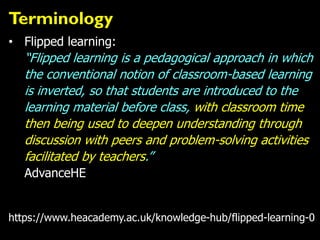
• Flipped learning:
“Flipped learning is a pedagogical approach in which
the conventional notion of classroom-based learning
is inverted, so that students are introduced to the
learning material before class, with classroom time
then being used to deepen understanding through
discussion with peers and problem-solving activities
facilitated by teachers.”
AdvanceHE
https://www.heacademy.ac.uk/knowledge-hub/flipped-learning-0
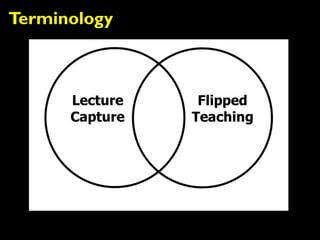
Terminology
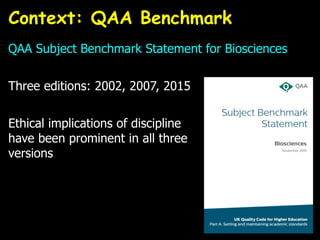
QAA Subject Benchmark Statement for Biosciences
Three editions: 2002, 2007, 2015
Ethical implications of discipline
have been prominent in all three
versions
Context: QAA Benchmark
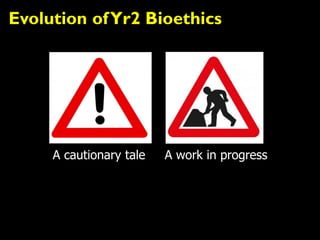
Evolution ofYr2 Bioethics
A cautionary tale A work in progress
Evolution ofYr2 Bioethics
• BS2060 Research Skills (2004-2014)
- 7 lectures: Introduction to ethics
6 themed – PGD, gene therapy, etc
- Assessment (from 2009) “Headline Bioethics”
Analysis of bioethical news story
25% of module mark
- Bioethics consistently most popular component of
the module
(“stimulated interest” 4.32 out of 5 in 2011-12)
Evolution ofYr2 Bioethics
2014 – major overhaul of Yr2 curriculum
• Redesign of delivery and assessment
• Research Skills replaced by Research Topic
• Major assignment – students work in groups to write
research grant proposal
• Consequential changes to bioethics component
- fewer lectures
- loss of Headline Bioethics task
- lecture content altered to fit grant writing task
• Opportunity to introduce some case studies
Why ethics case studies?
• Case-based teaching promotes*:
- Engagement with topic
- Higher-level skills, e.g. critical thinking
empathy
• Appropriate medium for debate about controversial
issues with legitimate divergence of viewpoint
* e.g. Yadav et al, 2007
Evolution ofYr2 Bioethics
• BS2000 Research Topic (first time 2014)
- 4 lectures: Introduction
3 instrumentalist (inc practicalities)
- Working with humans
- Working with animals
- Working with GMOs
- Case studies in tutorial (2 hrs)
- Assessment “Research Proposal”
5% of 60% of module (= 3%)
Cases in BS2000
• 8 (semi-)fictional cases prepared for 2 hr tutorial
• Students given week to prepare
• Tutors given guidance notes
Feedback 2014
• n= 279
• total of 12 out of 116 comments mentioned ethics
• Lectures generally well received (if mentioned)
• Some students unhappy with group discussion time
being “wasted” on bioethics scenarios
• Some staff uncomfortable with ethics teaching
Redesign 2015
• Pre-record lectures (using new lecture capture
software) and release online
- free up tutorial slots
- move case studies to “lecture slot”
• Introductory lecture retained
• Other lectures (working with humans, animals and
GMOs) delivered as series of shorter videos via VLE
• Case studies in lectures 2&3
(4th lecture dropped)
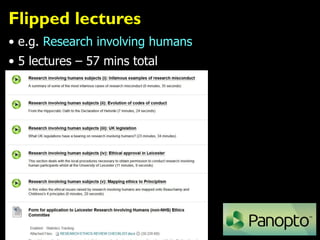
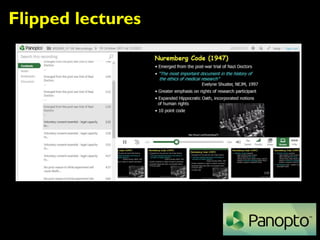
Flipped lectures
• e.g. Research involving humans
• 5 lectures – 57 mins total
Flipped lectures
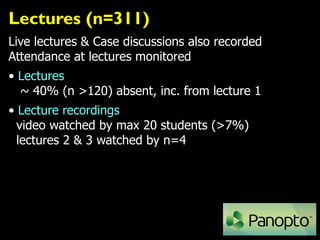
Lectures (n=311)
Live lectures & Case discussions also recorded
Attendance at lectures monitored
• Lectures
~ 40% (n >120) absent, inc. from lecture 1
• Lecture recordings
video watched by max 20 students (>7%)
lectures 2 & 3 watched by n=4
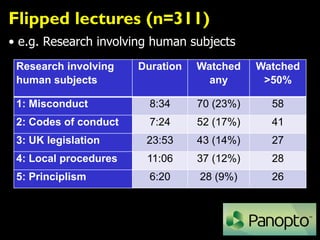
Flipped lectures (n=311)
Research involving
human subjects
Duration Watched
any
Watched
>50%
1: Misconduct 8:34 70 (23%) 58
2: Codes of conduct 7:24 52 (17%) 41
3: UK legislation 23:53 43 (14%) 27
4: Local procedures 11:06 37 (12%) 28
5: Principlism 6:20 28 (9%) 26
• e.g. Research involving human subjects
Feedback 2015(a)
• n = 311
• questionnaire format STOP – START – CONTINUE
• total of 23 comments re ethics
• Lectures:
- “I found the ethics lectures very interesting”
- “Ethics lectures really helped when writing the
research proposal”
- “[Continue] bioethics lectures as they are really
interesting and can be useful in the future”
- “The case study lectures were really interesting”
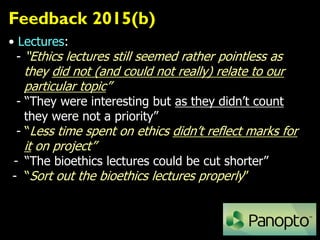
Feedback 2015(b)
• Lectures:
- “Ethics lectures still seemed rather pointless as
they did not (and could not really) relate to our
particular topic”
- “They were interesting but as they didn’t count
they were not a priority”
- “Less time spent on ethics didn’t reflect marks for
it on project”
- “The bioethics lectures could be cut shorter”
- “Sort out the bioethics lectures properly”
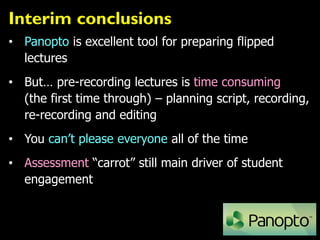
Interim conclusions
• Panopto is excellent tool for preparing flipped
lectures
• But… pre-recording lectures is time consuming
(the first time through) – planning script, recording,
re-recording and editing
• You can’t please everyone all of the time
• Assessment “carrot” still main driver of student
engagement
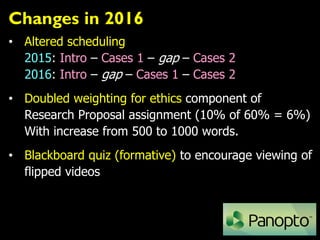
Changes in 2016
• Altered scheduling
2015: Intro – Cases 1 – gap – Cases 2
2016: Intro – gap – Cases 1 – Cases 2
• Doubled weighting for ethics component of
Research Proposal assignment (10% of 60% = 6%)
With increase from 500 to 1000 words.
• Blackboard quiz (formative) to encourage viewing of
flipped videos
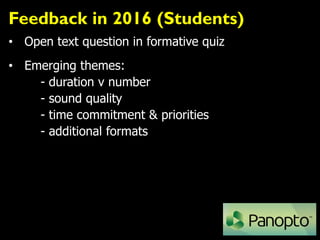
Feedback in 2016 (Students)
• Open text question in formative quiz
• Emerging themes:
- duration v number
- sound quality
- time commitment & priorities
- additional formats
Feedback in 2016 (Staff)
• It was noted that students had watched fewer
videos (using Panopto data) than they claimed (in
the formative quiz)
• Academic staff felt the increase 500 to 1000 words
for ethics component had led to more waffle not
valuable content
Changes in 2017
• Ethics component kept at 6% of mark, but format
altered to be in style of ethics application form
• Additional video to explain the ethics form
• Several videos altered:
- 2 videos (Humans 1 and Humans 2) re-recorded to
remove irritating buzz, 1 intentionally left unaltered
- Music track added to two videos
(Animals 5 and GMO 3)
Summary so far…
• Bioethics in core Research Topic module for all
Yr 2 Bioscientists. Team-based assessment involves
students completing grant proposal, including
ethics form
• QAA benchmarking statements include expectation
that all students have basic understanding of
bioethics issues
• By 2017 there are total of 15 online videos
(duration 3:30 to 23:30 mins)
replacing 3 previous F2F lectures
• Formative online quiz
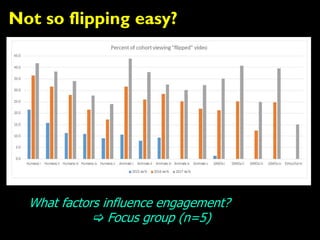
Not so flipping easy?
What factors influence engagement?
 Focus group (n=5)
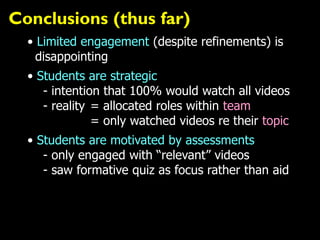
Conclusions (thus far)
• Limited engagement (despite refinements) is
disappointing
• Students are strategic
- intention that 100% would watch all videos
- reality = allocated roles within team
= only watched videos re their topic
• Students are motivated by assessments
- only engaged with “relevant” videos
- saw formative quiz as focus rather than aid
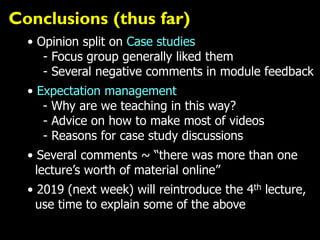
Conclusions (thus far)
• Opinion split on Case studies
- Focus group generally liked them
- Several negative comments in module feedback
• Expectation management
- Why are we teaching in this way?
- Advice on how to make most of videos
- Reasons for case study discussions
• Several comments ~ “there was more than one
lecture’s worth of material online”
• 2019 (next week) will reintroduce the 4th lecture,
use time to explain some of the above
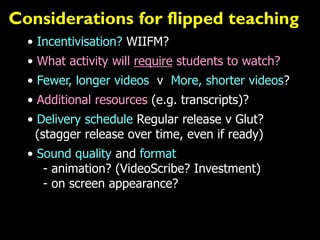
Considerations for flipped teaching
• Incentivisation? WIIFM?
• What activity will require students to watch?
• Fewer, longer videos v More, shorter videos?
• Additional resources (e.g. transcripts)?
• Delivery schedule Regular release v Glut?
(stagger release over time, even if ready)
• Sound quality and format
- animation? (VideoScribe? Investment)
- on screen appearance?
Acknowledgements
• Matt Mobbs
• Gemma Mitchell
• Alan Cann
• David Bridgwood
• University Teaching Excellence Project Fund
E-mail: cjrw2@le.ac.uk
Twitter: cjrw
Slideshare: cjrw2
Blogs: www.bioethicsbytes.wordpress.com
www.biologyonthebox.wordpress.com
www.biosciencecareers.wordpress.com
www.lefthandedbiochemist.wordpress.com
Thank you
Any questions?

Adventures in Flipping the Teaching: A bioethical example

  • 1.
    Adventures in FlippingtheTeaching: A bioethical example Dr Chris Willmott Dept of Molecular & Cell Biology University of Leicester, UK cjrw2@le.ac.uk STEMTeaching & Learning Conference 2019
  • 2.
    Overview • What is“flipped teaching”? • Context: Bioethics in Yr 2 • Why have I adopted a “flipped” approach? • What advice do I have for anyone considering adopting a flipped model?
  • 3.
    Terminology • Flipped learning: “Flippedlearning is a pedagogical approach in which the conventional notion of classroom-based learning is inverted, so that students are introduced to the learning material before class, with classroom time then being used to deepen understanding through discussion with peers and problem-solving activities facilitated by teachers.” AdvanceHE https://www.heacademy.ac.uk/knowledge-hub/flipped-learning-0
  • 4.
  • 5.
    QAA Subject BenchmarkStatement for Biosciences Three editions: 2002, 2007, 2015 Ethical implications of discipline have been prominent in all three versions Context: QAA Benchmark
  • 6.
    Evolution ofYr2 Bioethics Acautionary tale A work in progress
  • 7.
    Evolution ofYr2 Bioethics •BS2060 Research Skills (2004-2014) - 7 lectures: Introduction to ethics 6 themed – PGD, gene therapy, etc - Assessment (from 2009) “Headline Bioethics” Analysis of bioethical news story 25% of module mark - Bioethics consistently most popular component of the module (“stimulated interest” 4.32 out of 5 in 2011-12)
  • 8.
    Evolution ofYr2 Bioethics 2014– major overhaul of Yr2 curriculum • Redesign of delivery and assessment • Research Skills replaced by Research Topic • Major assignment – students work in groups to write research grant proposal • Consequential changes to bioethics component - fewer lectures - loss of Headline Bioethics task - lecture content altered to fit grant writing task • Opportunity to introduce some case studies
  • 9.
    Why ethics casestudies? • Case-based teaching promotes*: - Engagement with topic - Higher-level skills, e.g. critical thinking empathy • Appropriate medium for debate about controversial issues with legitimate divergence of viewpoint * e.g. Yadav et al, 2007
  • 10.
    Evolution ofYr2 Bioethics •BS2000 Research Topic (first time 2014) - 4 lectures: Introduction 3 instrumentalist (inc practicalities) - Working with humans - Working with animals - Working with GMOs - Case studies in tutorial (2 hrs) - Assessment “Research Proposal” 5% of 60% of module (= 3%)
  • 11.
    Cases in BS2000 •8 (semi-)fictional cases prepared for 2 hr tutorial • Students given week to prepare • Tutors given guidance notes
  • 12.
    Feedback 2014 • n=279 • total of 12 out of 116 comments mentioned ethics • Lectures generally well received (if mentioned) • Some students unhappy with group discussion time being “wasted” on bioethics scenarios • Some staff uncomfortable with ethics teaching
  • 13.
    Redesign 2015 • Pre-recordlectures (using new lecture capture software) and release online - free up tutorial slots - move case studies to “lecture slot” • Introductory lecture retained • Other lectures (working with humans, animals and GMOs) delivered as series of shorter videos via VLE • Case studies in lectures 2&3 (4th lecture dropped)
  • 14.
    Flipped lectures • e.g.Research involving humans • 5 lectures – 57 mins total
  • 15.
  • 16.
    Lectures (n=311) Live lectures& Case discussions also recorded Attendance at lectures monitored • Lectures ~ 40% (n >120) absent, inc. from lecture 1 • Lecture recordings video watched by max 20 students (>7%) lectures 2 & 3 watched by n=4
  • 17.
    Flipped lectures (n=311) Researchinvolving human subjects Duration Watched any Watched >50% 1: Misconduct 8:34 70 (23%) 58 2: Codes of conduct 7:24 52 (17%) 41 3: UK legislation 23:53 43 (14%) 27 4: Local procedures 11:06 37 (12%) 28 5: Principlism 6:20 28 (9%) 26 • e.g. Research involving human subjects
  • 18.
    Feedback 2015(a) • n= 311 • questionnaire format STOP – START – CONTINUE • total of 23 comments re ethics • Lectures: - “I found the ethics lectures very interesting” - “Ethics lectures really helped when writing the research proposal” - “[Continue] bioethics lectures as they are really interesting and can be useful in the future” - “The case study lectures were really interesting”
  • 19.
    Feedback 2015(b) • Lectures: -“Ethics lectures still seemed rather pointless as they did not (and could not really) relate to our particular topic” - “They were interesting but as they didn’t count they were not a priority” - “Less time spent on ethics didn’t reflect marks for it on project” - “The bioethics lectures could be cut shorter” - “Sort out the bioethics lectures properly”
  • 20.
    Interim conclusions • Panoptois excellent tool for preparing flipped lectures • But… pre-recording lectures is time consuming (the first time through) – planning script, recording, re-recording and editing • You can’t please everyone all of the time • Assessment “carrot” still main driver of student engagement
  • 21.
    Changes in 2016 •Altered scheduling 2015: Intro – Cases 1 – gap – Cases 2 2016: Intro – gap – Cases 1 – Cases 2 • Doubled weighting for ethics component of Research Proposal assignment (10% of 60% = 6%) With increase from 500 to 1000 words. • Blackboard quiz (formative) to encourage viewing of flipped videos
  • 22.
    Feedback in 2016(Students) • Open text question in formative quiz • Emerging themes: - duration v number - sound quality - time commitment & priorities - additional formats
  • 23.
    Feedback in 2016(Staff) • It was noted that students had watched fewer videos (using Panopto data) than they claimed (in the formative quiz) • Academic staff felt the increase 500 to 1000 words for ethics component had led to more waffle not valuable content
  • 24.
    Changes in 2017 •Ethics component kept at 6% of mark, but format altered to be in style of ethics application form • Additional video to explain the ethics form • Several videos altered: - 2 videos (Humans 1 and Humans 2) re-recorded to remove irritating buzz, 1 intentionally left unaltered - Music track added to two videos (Animals 5 and GMO 3)
  • 25.
    Summary so far… •Bioethics in core Research Topic module for all Yr 2 Bioscientists. Team-based assessment involves students completing grant proposal, including ethics form • QAA benchmarking statements include expectation that all students have basic understanding of bioethics issues • By 2017 there are total of 15 online videos (duration 3:30 to 23:30 mins) replacing 3 previous F2F lectures • Formative online quiz
  • 26.
    Not so flippingeasy? What factors influence engagement?  Focus group (n=5)
  • 27.
    Conclusions (thus far) •Limited engagement (despite refinements) is disappointing • Students are strategic - intention that 100% would watch all videos - reality = allocated roles within team = only watched videos re their topic • Students are motivated by assessments - only engaged with “relevant” videos - saw formative quiz as focus rather than aid
  • 28.
    Conclusions (thus far) •Opinion split on Case studies - Focus group generally liked them - Several negative comments in module feedback • Expectation management - Why are we teaching in this way? - Advice on how to make most of videos - Reasons for case study discussions • Several comments ~ “there was more than one lecture’s worth of material online” • 2019 (next week) will reintroduce the 4th lecture, use time to explain some of the above
  • 29.
    Considerations for flippedteaching • Incentivisation? WIIFM? • What activity will require students to watch? • Fewer, longer videos v More, shorter videos? • Additional resources (e.g. transcripts)? • Delivery schedule Regular release v Glut? (stagger release over time, even if ready) • Sound quality and format - animation? (VideoScribe? Investment) - on screen appearance?
  • 30.
    Acknowledgements • Matt Mobbs •Gemma Mitchell • Alan Cann • David Bridgwood • University Teaching Excellence Project Fund
  • 31.
    E-mail: cjrw2@le.ac.uk Twitter: cjrw Slideshare:cjrw2 Blogs: www.bioethicsbytes.wordpress.com www.biologyonthebox.wordpress.com www.biosciencecareers.wordpress.com www.lefthandedbiochemist.wordpress.com Thank you Any questions?