ETHICAL PROBLEMS
IN REPRODUCTIVE
HEALTH
By Kripa Justine
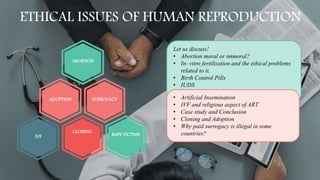
ETHICAL ISSUES OF HUMAN REPRODUCTION
RAPE VICTIMS
SURROGACY
CLONING
IVF
ADOPTION
ABORTION
Let us discuss!
• Abortion moral or immoral?
• In- vitro fertilization and the ethical problems
related to it.
• Birth Control Pills
• IUDS
• Artificial Insemination
• IVF and religious aspect of ART
• Case study and Conclusion
• Cloning and Adoption
• Why paid surrogacy is illegal in some
countries?
ETHICAL DILEMMA’S OF HUMAN
REPRODUCTION
Ethics simply refer to the moral principles that govern a
person or group's behavior.
Complex cases
• Oocyte donors always from economically backward
women who sell their egg to support family.
• The commercialism of surrogacy raises fears of a
black market and baby selling.
• Surrogacy degrades a pregnancy to a service and a
baby to a product.
• Rape victims are delayed justice.
• Delaying cancer treatment in order to retrieve and
cryopreserve may be problematic to the success of
the cancer treatment. The informed choice to be
taken is also very difficult for cancer patients.
• Whether abortion is moral or not.
• Financially well-off people can only afford IVF
treatment.
• Free and informed choice for research
purposes. This is completely with regard to
the patient, but she might feel that rejecting
that offer might compromise with her
clinical care.
• Most of the women who provided their
eggs for stem research might be coerced.
• Adolescent girls along with their parents
should take the decision.
• Fetal sex determination leading to female
foeticide.
• Prenatal testing to avoid giving birth to a
child with severe genetic disorder
• Financial rewards for IVF doctors dissuade
them from recommending other methods to
couples.
• Infertility is treated as a disease and not as
a symptom of underlying medical
problems.
Ethical
Dilemma
Cryopreservation of
oocyte
In IVF they make multiple
embryos to increase
success rate. The unused
embryos are discarded or
buried or you can donate to
someone.
ART
If either man or woman are
unable to produce sperms
or egg but the woman is
able to conceive. Then
they can opt Assisted
Reproductive Technology.
There may be cases where
the child is not biologically
of both of their parents.
This cause an ethical
dilemma.
PGD AND PGH
It is used to determine
characteristics of baby.
couples have for more
than 10 years purchased
sperm from genius sperm
banks and oocytes from
‘‘Ron’s Angels’’ to create
‘‘intelligent’’ or
conventionally ‘‘beautiful’’
child.
PGD involves removing
a cell from
an IVF embryo to test it
for a specific genetic
condition (cystic fibrosis)
before transferring the
embryo to the uterus.
RAPE
VICTIMS
CASE STUDY 1
• The Supreme Court of India denied a rape survivor living with HIV from
seeking an abortion.
• In its ruling, the Supreme Court bench rejected the abortion plea due to
her being 26 weeks pregnant and as a result of the recommendation it
received from a court-appointed medical panel that indicated that an
abortion at this stage of pregnancy posed a risk to the lives of the woman
and the fetus.
• The woman learned of her pregnancy and HIV status and initially
requested an abortion while at 17 weeks of pregnancy.
• After significant delays, both the government hospital and the high court
in Bihar denied her request for legal abortion services, resulting in her
appeal to the Supreme Court.
• The World Health Organization and colleges of obstetricians and
gynecologists globally have recognized that second trimester abortions
are “an important component of comprehensive women’s health care”
and affirmed that abortions past 20 weeks provided in accordance with
medical guidelines are safer than the risks women face from unsafe
abortions.
• Medical Termination of Pregnancy Act, abortion is only legal within 20
weeks of pregnancy—including in cases of grave injury to the woman’s
physical or mental health, rape, incest, fetal impairment and
contraceptive failure—or any time during a pregnancy where it is
“immediately necessary” to save the life of a pregnant woman
CASE STUDY 2
• Angela C. was a twenty-eight-year-old married woman who was
approximately twenty-six weeks pregnant. She had suffered from
cancer since she was thirteen-years-old, but had been in remission for
approximately two years before she became pregnant.
• Her health seemed reasonably good until about the twenty-fifth week
of pregnancy, when she was admitted to the Hospital
• Within a few days the physicians determined that her condition was
terminal and she would die within weeks. Because her fetus would
have a much better chance to be born healthy at twenty-eight weeks
or more gestation, she agreed to treatment that might help her survive
longer, but insisted that her own care and comfort be primary.
• Ms. C's husband agreed that keeping her comfortable while she died
was what they wanted and that her wishes should be honored. The
next morning this information was communicated to hospital
administration. Legal counsel was consulted.
• Lawyers concentrated not on the interest of Angela. They insisted she
should undergo C-section to which she clearly mouthed no.
• The judge reaffirmed his order and without consent did the C-section
on Angela
ARE YOU PRO-
CHOICE OR PRO-
LIFE??
Pro-choice: advocating the legal right
of a woman to choose whether or not
she will have an abortion.
Pro-life: opposing abortion
1
MEDICAL
TERMINATION
OF PREGNANCY
(MTP)
Intentional or voluntary termination of pregnancy before
full term is called medical termination of pregnancy
(MTP) or induced abortion.
• MTP has a significant role in decreasing the population though it is not meant for that purpose.
• Whether to accept /legalize MTP or not is being debated upon in many countries due to emotional, ethical, religious and
social issues involved in it. Government of India legalized MTP in 1971 with some strict conditions to avoid its misuse.
• Such restrictions are all the more important to check indiscriminate and illegal female feticides which are reported to be
high in India.
• MTPs are also essential in certain cases where continuation of the pregnancy could be harmful or even fatal either to the
mother or to the fetus or both.
• MTPs are considered relatively safe during the first trimester, i.e., up to 12 weeks of pregnancy. Second trimester abortions
are much more riskier.
AMNIOCENTESIS
Implementation of better
techniques and new strategies from
time to time are also required to
provide more efficient care and
assistance to people. Statutory ban
on amniocentesis (a fetal sex
determination test based on the
chromosomal pattern in the
amniotic fluid surrounding the
developing embryo) for sex-
determination .
Did you know?
The natural sex
ratio is assumed to
be between 103 and
107, and any
number above it is
considered as
suggestive of female
feticide.
BIRTH CONTROL
.
An ideal contraceptive should be user-friendly, easily
available, effective and reversible with no or least side-effects.
The most effective and popular method is the use of Intra
Uterine Devices.
Ethical reason why contraception is wrong
• Contraception is unnatural
it is wrong to interfere with the natural order of the universe
• Contraception is anti-life
those who use contraception are engaged in an intentionally
"anti-life" act because they intend to prevent a new life
coming into being
• Contraception is a form of abortion
The "morning-after" pill is also capable of operating by
preventing implantation of a fertilized egg. IUD’s can operate
by preventing implantation of a fertilized egg
• Contraception separates sex from reproduction
it makes immoral behavior less risky. it weakens the family.
01
02
03
04
Adoption is another way in
which infertile couples can
have children.
ova from the female and
sperms from the male are
collected and are induced to
form zygote under simulated
conditions in the laboratory.
.
TEST TUBE BABY
Human cloning is the
creation of a genetically
identical copy or clone of
a human. It is prohibited
and medical malpractice
can lead to 20 years in jail
all these techniques
require extremely high
precision handling by
specialized professionals
and expensive
instrumentation.
IVF
Art and science of getting gametes together may be done by artificial or partially
artificial means may or may not involve third party.
To provide ethical state of art fertility services with utmost honesty &
transparency to the customers through quality standards as well as an
atmosphere of empathy and comfort.. Fertilization- The egg and sperm are either
mixed IVF or ICSI. Embryo culture -The fertilized egg that forms the embryo is
cultured in the laboratory for 2-3 days.
Ethical issues of IVF:
• The quality of consent obtained from the parties
• the motivation of the parents
• the uses and implications of pre-implantation genetic diagnosis
• the permissibility of sex-selection (or the choice of embryos for other
traits)
• the storage and fate of surplus embryos.
CASE STUDY 3
Wrong embryos transferred in IVF
• A couple was being treated in the fertility clinic and underwent IVF treatment.
• As soon as the embryos had been transferred, the embryologist realized that the
embryos belonged to another couple.
• The embryologists informed the clinical director, who immediately consulted both
couples.
• One couple the genetic parents of the embryos which were transferred wanted the
embryos to be allowed the opportunity to implant, and if the pregnancy was
successful, for the baby or babies to be passed back to them.
• The woman who had the embryos replaced inside her was adamant that she wanted
the treatment cycle aborted immediately.
• Although the ethical duties to do no harm (non-maleficence) and to do good
(beneficence) are involved, the key ethical issue is the clash of autonomy between
the couple whose embryos were incorrectly transferred and the woman in whom they
were placed.
Art and science of getting gametes together may be done
by artificial or partially artificial means may or may not
involve third party.
Gamete intrafallopian transfer (GIFT): GIFT is similar
to IVF. It is used when a woman has at least one normal
fallopian tube. Eggs are placed in this tube along with a
man’s sperm to fertilize there.
Zygote intrafallopian transfer (ZIFT): ZIFT is tubal
embryo transfer in which a woman’s eggs are taken from
her ovaries, fertilized in the laboratory, and put back in the
fallopian tubes rather than the uterus.
Ethical aspects:
• Consent of donor, recipient and their spouses.
• Donor and Couple should be psychologically fit and
emotionally stable.
• Delivery should not be done by the physician who
performed AI.
A r t i f i c i a l
Insemination
SURROGACY
The system mainly exploits
economically backward
women. Therefore paid
surrogacy is banned in
Canada.
ILL EFFECTS
EMPHASIS
ill effects
Emphasis
Surrogacy is often thought to be
a ‘treatment’ option for the
infertile or an alternative to
adoption, and so to be
celebrated in fulfilling people’s
desires to be parents. However,
surrogacy also brings a wealth
of more complex ethical issues
around gender, labor, payment,
exploitation and inequality
A surrogate mother who is at 32 weeks
needs an emergency C-section because the
baby is in distress but the mother tries to
refuses because she will not receive her
bonus if it’s not full term.
CASE STUDY
Here the surrogate mother is from a financially disadvantaged
background. She has 2 sons whom she needs to feed and
economically support.
She agrees and delivers a premature but healthy child.
Here the physician knows about the patient history but
recommends her that the proteins in her plasma are
poisoning her blood and she could get an eclamptic
seizure that could harm her and the baby
BRIEF CONCLUSION
Though options are many, all these techniques require
extremely high precision handling by specialized
professionals and expensive instrumentation.
Adoption is
the best
strategy!
Obviously their benefits is affordable to only a limited
number of people
Emotional, religious and social factors are also
deterrents in the adoption of these methods.
Our laws permit legal adoption and it is as yet, one
of the best methods for couples looking for
parenthood.
RELIGIOUS ASPECT OF ART
 Catholic Christians
Most strictest regarding ART.
Only IUI is accepted whereas others are not accepted due to
interference of third party.
 Orthodox and Protestants
Most ART are accepted and all embryos must be placed in
uterus.
 Buddhism and Hinduism
Very liberal regarding ART
 Islam
All forms of assisted reproduction are allowed as long as the
sperm and oocyte are those of the husband and his wife and
the embryo is replaced into the wife’s uterus during an
existing marriage contract. surrogacy is permitted for Shia
Muslims only.
CONCLUSION
Bioethics in the field of human
reproduction is extremely
difficult to take decisions due to
vulnerable mother and child.
This inturn leads to ethical
dilemma especially for
physicians. That is why we have
case studies to take better
decision by looking into ethical
principles of Bioethics.
Thank You

Bioethics

  • 1.
  • 2.
    ETHICAL ISSUES OFHUMAN REPRODUCTION RAPE VICTIMS SURROGACY CLONING IVF ADOPTION ABORTION Let us discuss! • Abortion moral or immoral? • In- vitro fertilization and the ethical problems related to it. • Birth Control Pills • IUDS • Artificial Insemination • IVF and religious aspect of ART • Case study and Conclusion • Cloning and Adoption • Why paid surrogacy is illegal in some countries?
  • 3.
    ETHICAL DILEMMA’S OFHUMAN REPRODUCTION Ethics simply refer to the moral principles that govern a person or group's behavior. Complex cases • Oocyte donors always from economically backward women who sell their egg to support family. • The commercialism of surrogacy raises fears of a black market and baby selling. • Surrogacy degrades a pregnancy to a service and a baby to a product. • Rape victims are delayed justice. • Delaying cancer treatment in order to retrieve and cryopreserve may be problematic to the success of the cancer treatment. The informed choice to be taken is also very difficult for cancer patients. • Whether abortion is moral or not. • Financially well-off people can only afford IVF treatment.
  • 4.
    • Free andinformed choice for research purposes. This is completely with regard to the patient, but she might feel that rejecting that offer might compromise with her clinical care. • Most of the women who provided their eggs for stem research might be coerced. • Adolescent girls along with their parents should take the decision. • Fetal sex determination leading to female foeticide. • Prenatal testing to avoid giving birth to a child with severe genetic disorder • Financial rewards for IVF doctors dissuade them from recommending other methods to couples. • Infertility is treated as a disease and not as a symptom of underlying medical problems. Ethical Dilemma
  • 5.
    Cryopreservation of oocyte In IVFthey make multiple embryos to increase success rate. The unused embryos are discarded or buried or you can donate to someone. ART If either man or woman are unable to produce sperms or egg but the woman is able to conceive. Then they can opt Assisted Reproductive Technology. There may be cases where the child is not biologically of both of their parents. This cause an ethical dilemma. PGD AND PGH It is used to determine characteristics of baby. couples have for more than 10 years purchased sperm from genius sperm banks and oocytes from ‘‘Ron’s Angels’’ to create ‘‘intelligent’’ or conventionally ‘‘beautiful’’ child. PGD involves removing a cell from an IVF embryo to test it for a specific genetic condition (cystic fibrosis) before transferring the embryo to the uterus.
  • 6.
    RAPE VICTIMS CASE STUDY 1 •The Supreme Court of India denied a rape survivor living with HIV from seeking an abortion. • In its ruling, the Supreme Court bench rejected the abortion plea due to her being 26 weeks pregnant and as a result of the recommendation it received from a court-appointed medical panel that indicated that an abortion at this stage of pregnancy posed a risk to the lives of the woman and the fetus. • The woman learned of her pregnancy and HIV status and initially requested an abortion while at 17 weeks of pregnancy. • After significant delays, both the government hospital and the high court in Bihar denied her request for legal abortion services, resulting in her appeal to the Supreme Court. • The World Health Organization and colleges of obstetricians and gynecologists globally have recognized that second trimester abortions are “an important component of comprehensive women’s health care” and affirmed that abortions past 20 weeks provided in accordance with medical guidelines are safer than the risks women face from unsafe abortions. • Medical Termination of Pregnancy Act, abortion is only legal within 20 weeks of pregnancy—including in cases of grave injury to the woman’s physical or mental health, rape, incest, fetal impairment and contraceptive failure—or any time during a pregnancy where it is “immediately necessary” to save the life of a pregnant woman
  • 7.
    CASE STUDY 2 •Angela C. was a twenty-eight-year-old married woman who was approximately twenty-six weeks pregnant. She had suffered from cancer since she was thirteen-years-old, but had been in remission for approximately two years before she became pregnant. • Her health seemed reasonably good until about the twenty-fifth week of pregnancy, when she was admitted to the Hospital • Within a few days the physicians determined that her condition was terminal and she would die within weeks. Because her fetus would have a much better chance to be born healthy at twenty-eight weeks or more gestation, she agreed to treatment that might help her survive longer, but insisted that her own care and comfort be primary. • Ms. C's husband agreed that keeping her comfortable while she died was what they wanted and that her wishes should be honored. The next morning this information was communicated to hospital administration. Legal counsel was consulted. • Lawyers concentrated not on the interest of Angela. They insisted she should undergo C-section to which she clearly mouthed no. • The judge reaffirmed his order and without consent did the C-section on Angela
  • 8.
    ARE YOU PRO- CHOICEOR PRO- LIFE?? Pro-choice: advocating the legal right of a woman to choose whether or not she will have an abortion. Pro-life: opposing abortion
  • 9.
    1 MEDICAL TERMINATION OF PREGNANCY (MTP) Intentional orvoluntary termination of pregnancy before full term is called medical termination of pregnancy (MTP) or induced abortion. • MTP has a significant role in decreasing the population though it is not meant for that purpose. • Whether to accept /legalize MTP or not is being debated upon in many countries due to emotional, ethical, religious and social issues involved in it. Government of India legalized MTP in 1971 with some strict conditions to avoid its misuse. • Such restrictions are all the more important to check indiscriminate and illegal female feticides which are reported to be high in India. • MTPs are also essential in certain cases where continuation of the pregnancy could be harmful or even fatal either to the mother or to the fetus or both. • MTPs are considered relatively safe during the first trimester, i.e., up to 12 weeks of pregnancy. Second trimester abortions are much more riskier.
  • 10.
    AMNIOCENTESIS Implementation of better techniquesand new strategies from time to time are also required to provide more efficient care and assistance to people. Statutory ban on amniocentesis (a fetal sex determination test based on the chromosomal pattern in the amniotic fluid surrounding the developing embryo) for sex- determination . Did you know? The natural sex ratio is assumed to be between 103 and 107, and any number above it is considered as suggestive of female feticide.
  • 11.
    BIRTH CONTROL . An idealcontraceptive should be user-friendly, easily available, effective and reversible with no or least side-effects. The most effective and popular method is the use of Intra Uterine Devices. Ethical reason why contraception is wrong • Contraception is unnatural it is wrong to interfere with the natural order of the universe • Contraception is anti-life those who use contraception are engaged in an intentionally "anti-life" act because they intend to prevent a new life coming into being • Contraception is a form of abortion The "morning-after" pill is also capable of operating by preventing implantation of a fertilized egg. IUD’s can operate by preventing implantation of a fertilized egg • Contraception separates sex from reproduction it makes immoral behavior less risky. it weakens the family.
  • 12.
    01 02 03 04 Adoption is anotherway in which infertile couples can have children. ova from the female and sperms from the male are collected and are induced to form zygote under simulated conditions in the laboratory. . TEST TUBE BABY Human cloning is the creation of a genetically identical copy or clone of a human. It is prohibited and medical malpractice can lead to 20 years in jail all these techniques require extremely high precision handling by specialized professionals and expensive instrumentation.
  • 13.
    IVF Art and scienceof getting gametes together may be done by artificial or partially artificial means may or may not involve third party. To provide ethical state of art fertility services with utmost honesty & transparency to the customers through quality standards as well as an atmosphere of empathy and comfort.. Fertilization- The egg and sperm are either mixed IVF or ICSI. Embryo culture -The fertilized egg that forms the embryo is cultured in the laboratory for 2-3 days. Ethical issues of IVF: • The quality of consent obtained from the parties • the motivation of the parents • the uses and implications of pre-implantation genetic diagnosis • the permissibility of sex-selection (or the choice of embryos for other traits) • the storage and fate of surplus embryos.
  • 14.
    CASE STUDY 3 Wrongembryos transferred in IVF • A couple was being treated in the fertility clinic and underwent IVF treatment. • As soon as the embryos had been transferred, the embryologist realized that the embryos belonged to another couple. • The embryologists informed the clinical director, who immediately consulted both couples. • One couple the genetic parents of the embryos which were transferred wanted the embryos to be allowed the opportunity to implant, and if the pregnancy was successful, for the baby or babies to be passed back to them. • The woman who had the embryos replaced inside her was adamant that she wanted the treatment cycle aborted immediately. • Although the ethical duties to do no harm (non-maleficence) and to do good (beneficence) are involved, the key ethical issue is the clash of autonomy between the couple whose embryos were incorrectly transferred and the woman in whom they were placed.
  • 15.
    Art and scienceof getting gametes together may be done by artificial or partially artificial means may or may not involve third party. Gamete intrafallopian transfer (GIFT): GIFT is similar to IVF. It is used when a woman has at least one normal fallopian tube. Eggs are placed in this tube along with a man’s sperm to fertilize there. Zygote intrafallopian transfer (ZIFT): ZIFT is tubal embryo transfer in which a woman’s eggs are taken from her ovaries, fertilized in the laboratory, and put back in the fallopian tubes rather than the uterus. Ethical aspects: • Consent of donor, recipient and their spouses. • Donor and Couple should be psychologically fit and emotionally stable. • Delivery should not be done by the physician who performed AI. A r t i f i c i a l Insemination
  • 16.
    SURROGACY The system mainlyexploits economically backward women. Therefore paid surrogacy is banned in Canada. ILL EFFECTS EMPHASIS ill effects Emphasis Surrogacy is often thought to be a ‘treatment’ option for the infertile or an alternative to adoption, and so to be celebrated in fulfilling people’s desires to be parents. However, surrogacy also brings a wealth of more complex ethical issues around gender, labor, payment, exploitation and inequality
  • 17.
    A surrogate motherwho is at 32 weeks needs an emergency C-section because the baby is in distress but the mother tries to refuses because she will not receive her bonus if it’s not full term. CASE STUDY Here the surrogate mother is from a financially disadvantaged background. She has 2 sons whom she needs to feed and economically support. She agrees and delivers a premature but healthy child. Here the physician knows about the patient history but recommends her that the proteins in her plasma are poisoning her blood and she could get an eclamptic seizure that could harm her and the baby
  • 18.
    BRIEF CONCLUSION Though optionsare many, all these techniques require extremely high precision handling by specialized professionals and expensive instrumentation. Adoption is the best strategy! Obviously their benefits is affordable to only a limited number of people Emotional, religious and social factors are also deterrents in the adoption of these methods. Our laws permit legal adoption and it is as yet, one of the best methods for couples looking for parenthood.
  • 19.
    RELIGIOUS ASPECT OFART  Catholic Christians Most strictest regarding ART. Only IUI is accepted whereas others are not accepted due to interference of third party.  Orthodox and Protestants Most ART are accepted and all embryos must be placed in uterus.  Buddhism and Hinduism Very liberal regarding ART  Islam All forms of assisted reproduction are allowed as long as the sperm and oocyte are those of the husband and his wife and the embryo is replaced into the wife’s uterus during an existing marriage contract. surrogacy is permitted for Shia Muslims only.
  • 20.
    CONCLUSION Bioethics in thefield of human reproduction is extremely difficult to take decisions due to vulnerable mother and child. This inturn leads to ethical dilemma especially for physicians. That is why we have case studies to take better decision by looking into ethical principles of Bioethics.
  • 21.