Informed Consent
Lena Haygood (R) RT
With Informed Consent....
……It’s Not About the Form
….It’s more than a signature on a piece of
paper!
What is Informed Consent ?
• The process of communication between a patient
and physician that results in the patient’s
authorization of agreement to undergo a specific
medical intervention
(American Medical Association)
• Failure to obtain informed consent renders any
physician liable for negligence or battery and
constitutes medical malpractice.
Why Do We Need Informed Consent?
The Short Answer:
• It’s the ethical thing to do
• It’s a safety and quality of care issue
• It’s the law
• Regulatory Requirement
• Hospital Policy
Why Do We Need Informed Consent?
The Slightly Longer Answer:
• Greater patient safety and satisfaction
• Attainment of higher ethical standards and
organizational morale
• Closer adherence to legal requirements and
reduced risk of litigation
• Increased levels of institutional quality (e.g.
compliance with accreditation standards)
• Potential time and money savings related to
reduced litigation
Who is Responsible for Informed Consent?
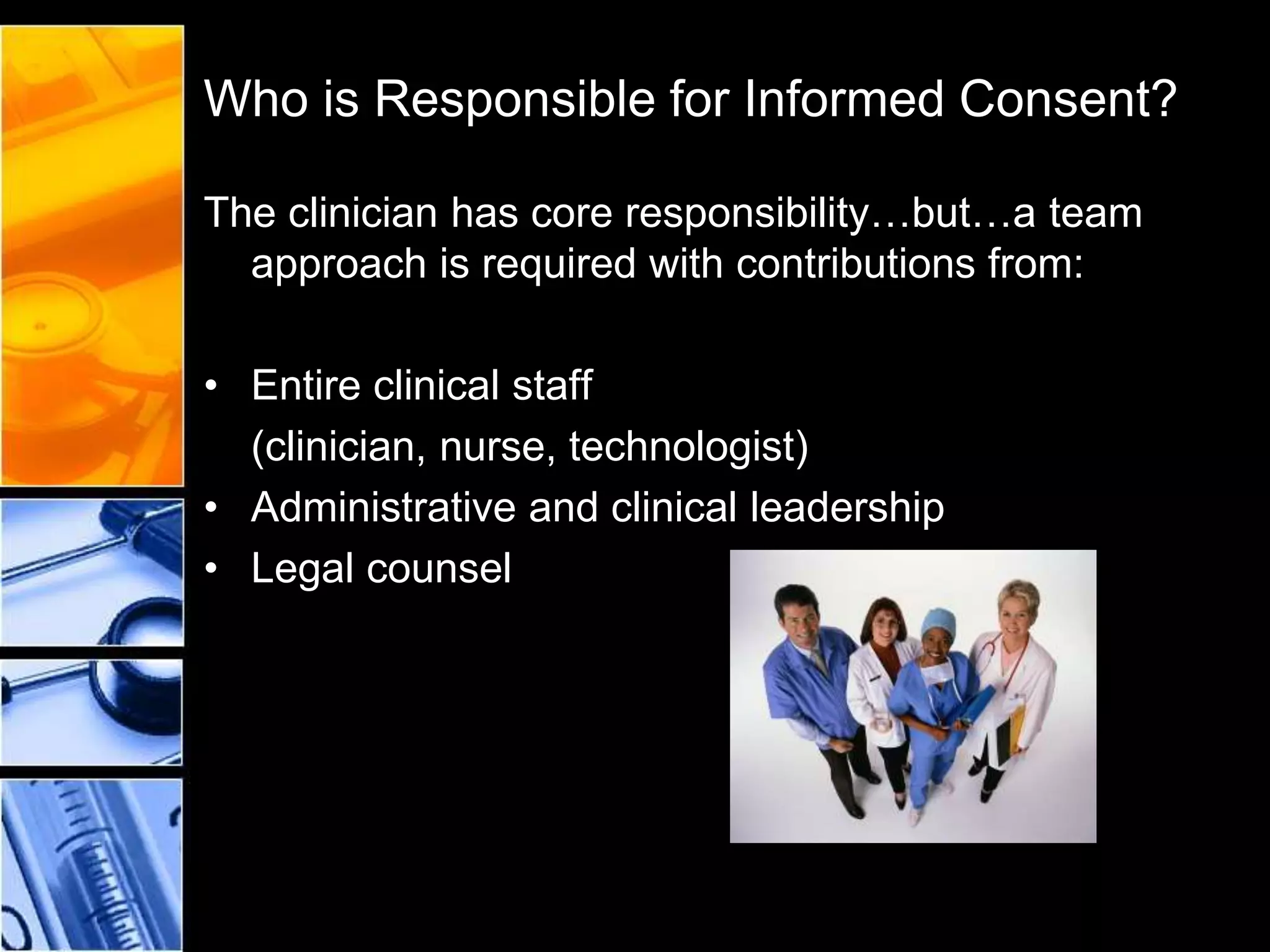
The clinician has core responsibility…but…a team
approach is required with contributions from:
• Entire clinical staff
(clinician, nurse, technologist)
• Administrative and clinical leadership
• Legal counsel
When is Informed Consent Required?
In most institutions, for:
• Surgery
• Anesthesia
• Other invasive or complex medical or radiologic
procedures
What is considered an invasive procedure?
• Any penetration of the skin, use of radiation for
treatment, or comparable invasive procedure
involving interference with the body tissues.
• Also can be any other procedure that entails
substantial risk to the patient.
– Angiographic procedures
– Anything with scalpels, needles
– Injection of diagnostic substances into body cavities,
internal organs, etc.
What’s Needed for Informed Consent?
• The diagnosis, if known
• The nature and purpose of a proposed treatment or
procedure
• The risk and benefits of proposed treatment or
procedures
• Alternatives (regardless of costs or extent covered
by insurance)
• The risk and benefits of alternatives
• The risks and benefits of not receiving treatments or
undergoing procedures
Who Can Consent?
• Patient, if adult and competent
– Impaired due to injury, ETOH or medications of drugs
• Healthcare Power of Attorney or legal guardian
• In the absence of a legally authorized
representative, a “statutory surrogate” may give
consent.
Statutory Surrogates
Statutory Surrogates Include, in order of priority, the following:
1. Patient's spouse, unless legally separated.
2. Adult child of the patient. If more than one child, consent of a
majority who are reasonably available
3. Parent of the patient.
4. If the patient is unmarried, the patient's domestic partner if no
other person has assumed any financial responsibility for the
patient.
5. Brother or sister of patient.
6. A close friend of patient who is familiar with the patient's health
care views and desires and is willing to become involved in
the patient's healthcare and to act in the patient's best
interest.
• The sad part is that, many studies reveal that
physicians often fail to observe the practice and the
spirit of informed consent.
Why Do We Need to Improve Informed
Consents?
Even after signing a consent form, many patients still
do not understand basic information about the risks
and benefits of their proposed treatment options.
What are the Potential Consequences of
Lack of True Informed Consent
• Increased chance of a patient safety incident or
medical error
• Increased chance for malpractice cases
• Violation of professional and ethical obligations to
clinicians to communicate clearly
What Can We Do to Improve Our Informed
Consent?
• Simplify our language
• Allow time for questions
• Make sure the patient understands
• Plan for language assistance in advance of
appointment
• Train support staff
Use of Interpreter
• Information must be verbally provided to patient in
their native language; consent must be written in
English.
• If patient/family refuses hospital interpreter and
chooses to use a friend or family member; if must
be noted in the medical record.
• If translation services are used the interpreter
should sign as a “witness” and specify their name,
title, date and time.
Signing and Witnessing the Consent
• The patient (or the patient’s health care decision
maker) should sign the consent along with two
persons should witness the patient’s signature.
These witnesses are attesting to the fact that the
patient signed the form only and need not witness
the full consent discussion between the patien and
the physician.
Misc.
• The identify and professional status of individuals
responsible for authorizing and performing
procedures or treatments must be on consent.
• Discussion…..

Informed consent

  • 1.
  • 2.
    With Informed Consent.... ……It’sNot About the Form ….It’s more than a signature on a piece of paper!
  • 3.
    What is InformedConsent ? • The process of communication between a patient and physician that results in the patient’s authorization of agreement to undergo a specific medical intervention (American Medical Association) • Failure to obtain informed consent renders any physician liable for negligence or battery and constitutes medical malpractice.
  • 4.
    Why Do WeNeed Informed Consent? The Short Answer: • It’s the ethical thing to do • It’s a safety and quality of care issue • It’s the law • Regulatory Requirement • Hospital Policy
  • 5.
    Why Do WeNeed Informed Consent? The Slightly Longer Answer: • Greater patient safety and satisfaction • Attainment of higher ethical standards and organizational morale • Closer adherence to legal requirements and reduced risk of litigation • Increased levels of institutional quality (e.g. compliance with accreditation standards) • Potential time and money savings related to reduced litigation
  • 6.
    Who is Responsiblefor Informed Consent? The clinician has core responsibility…but…a team approach is required with contributions from: • Entire clinical staff (clinician, nurse, technologist) • Administrative and clinical leadership • Legal counsel
  • 7.
    When is InformedConsent Required? In most institutions, for: • Surgery • Anesthesia • Other invasive or complex medical or radiologic procedures
  • 8.
    What is consideredan invasive procedure? • Any penetration of the skin, use of radiation for treatment, or comparable invasive procedure involving interference with the body tissues. • Also can be any other procedure that entails substantial risk to the patient. – Angiographic procedures – Anything with scalpels, needles – Injection of diagnostic substances into body cavities, internal organs, etc.
  • 9.
    What’s Needed forInformed Consent? • The diagnosis, if known • The nature and purpose of a proposed treatment or procedure • The risk and benefits of proposed treatment or procedures • Alternatives (regardless of costs or extent covered by insurance) • The risk and benefits of alternatives • The risks and benefits of not receiving treatments or undergoing procedures
  • 10.
    Who Can Consent? •Patient, if adult and competent – Impaired due to injury, ETOH or medications of drugs • Healthcare Power of Attorney or legal guardian • In the absence of a legally authorized representative, a “statutory surrogate” may give consent.
  • 11.
    Statutory Surrogates Statutory SurrogatesInclude, in order of priority, the following: 1. Patient's spouse, unless legally separated. 2. Adult child of the patient. If more than one child, consent of a majority who are reasonably available 3. Parent of the patient. 4. If the patient is unmarried, the patient's domestic partner if no other person has assumed any financial responsibility for the patient. 5. Brother or sister of patient. 6. A close friend of patient who is familiar with the patient's health care views and desires and is willing to become involved in the patient's healthcare and to act in the patient's best interest.
  • 12.
    • The sadpart is that, many studies reveal that physicians often fail to observe the practice and the spirit of informed consent.
  • 13.
    Why Do WeNeed to Improve Informed Consents? Even after signing a consent form, many patients still do not understand basic information about the risks and benefits of their proposed treatment options.
  • 14.
    What are thePotential Consequences of Lack of True Informed Consent • Increased chance of a patient safety incident or medical error • Increased chance for malpractice cases • Violation of professional and ethical obligations to clinicians to communicate clearly
  • 15.
    What Can WeDo to Improve Our Informed Consent? • Simplify our language • Allow time for questions • Make sure the patient understands • Plan for language assistance in advance of appointment • Train support staff
  • 16.
    Use of Interpreter •Information must be verbally provided to patient in their native language; consent must be written in English. • If patient/family refuses hospital interpreter and chooses to use a friend or family member; if must be noted in the medical record. • If translation services are used the interpreter should sign as a “witness” and specify their name, title, date and time.
  • 17.
    Signing and Witnessingthe Consent • The patient (or the patient’s health care decision maker) should sign the consent along with two persons should witness the patient’s signature. These witnesses are attesting to the fact that the patient signed the form only and need not witness the full consent discussion between the patien and the physician.
  • 18.
    Misc. • The identifyand professional status of individuals responsible for authorizing and performing procedures or treatments must be on consent. • Discussion…..

Editor's Notes

  • #3 Process not a form Mutual understanding of what will happen Setting reasonable expectations Acceptance by patient
  • #9 Per Radiologist BE and UGIs do not require an consent
  • #10 (American Medical Association)
  • #11 If adult, look at whether person is of sound mind and body; is conscious, mentally unimpaired and physically able to read and/or hear and understand; and has not been declared to be legally incompetent.
  • #12 7. If the list has been exhausted or a reasonable effort has been made and a surrogate has not been found, the attending Physician may become the surrogate and make decisions after consulting with the Bioethics Committee or after consulting with a 2nd Physician who agrees with the attending Physician decisions.
  • #14 Low health literacy Limited English proficiency Patient Factors: Cognitive impairments Confusion about the purpose of consent process Feeling of intimidation, and stress or time pressure Provider Factors: Lack of time for up-front patient education Overly complex or overly broad written materials Lack of support with interpreters Wrong assumptions about the patients comprehension
  • #19 For example. If a tech is performing a PICC placement; they must include their name and creditials on the consent form. 1. Important to understand and observer what the procedure entails including anatomy…that is the key. That way you can explain it in lamens terms to the patient as what we are doing. Anything you stick inside the patient, any needle that goes inside the patient there is risk of bleeding and risk of infection. Tell patient that everything is done sterile to decrease that risk. 2. Be knowledgeable in contrast reaction. Understand where the dye is going and the reaction to it. Tell patient we will be putting dye into you system and you could have a mild reaction (itching) to severe (tongue swelling, difficulty breathing). Any other questions you can ask Radiologist.