





Infertility:
a disease of the reproductive system defined by the
failure to achieve a clinical pregnancy after 12 months or
more of regular unprotected sexual intercourse.
International Committee for Monitoring Assisted Reproductive Technology (ICMART) and the
World Health Organization (WHO) revised “glossary of ART terminology”, Fertility and
Sterility, Vol. 92, No. 5, November 2009
The cumulative spontaneous pregnancy rate for a couple is
approximately 57% after three months, 72% after six
months, 85% after one year and 93% after two years.
Church, Elaine. "Obstetrics and Gynaecology: An Evidence‐based Text for MRCOG, edited by
David M Luesley, Philip N Baker." (2011): E206-E206.
It has been estimated that infertility affects 9% of
couples, of whom 70% suffer from primary infertility
i.e. no previous conception, and 30% secondary infertility
i.e. have achieved a previous pregnancy (regardless of the
outcome of that pregnancy).
Worldwide, more than 70 million couples suffer from
infertility, the majority being residents of the developing
countries.
Church, Elaine. "Obstetrics and Gynaecology: An Evidence‐based Text for MRCOG, edited by
David M Luesley, Philip N Baker." (2011): E206-E206.
Subfertility:
This term can be applied to most couples that are
described as infertile while they can actually conceive if
given enough time (more than 1 year). They represent 50%
of cases of infertility.
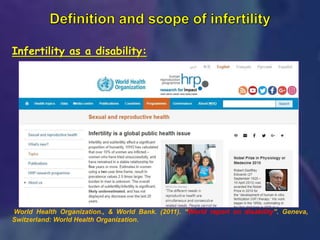
Infertility as a disability:
World Health Organization., & World Bank. (2011). “World report on disability”. Geneva,
Switzerland: World Health Organization.
Infertility as a disability:
Infertility generates disability (an impairment of
function), and thus access to health care falls under the
Convention on the Rights of Persons with Disability.
Infertility in women was ranked by WHO as the 5th
highest serious global disability (among populations under
the age of 60)..
World Health Organization., & World Bank. (2011). “World report on disability”. Geneva,
Switzerland: World Health Organization.
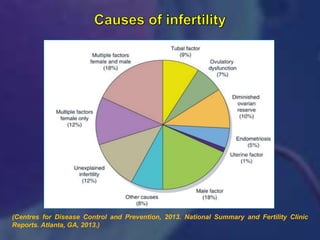
(Centres for Disease Control and Prevention, 2013. National Summary and Fertility Clinic
Reports. Atlanta, GA, 2013.)
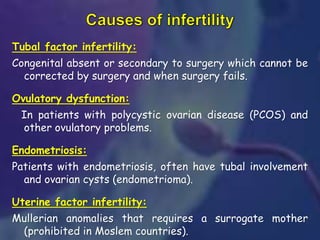
Tubal factor infertility:
Congenital absent or secondary to surgery which cannot be
corrected by surgery and when surgery fails.
Ovulatory dysfunction:
In patients with polycystic ovarian disease (PCOS) and
other ovulatory problems.
Endometriosis:
Patients with endometriosis, often have tubal involvement
and ovarian cysts (endometrioma).
Uterine factor infertility:
Mullerian anomalies that requires a surrogate mother
(prohibited in Moslem countries).
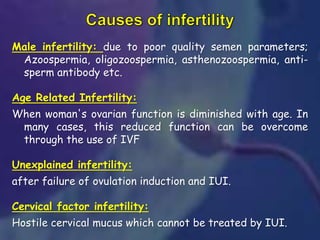
Male infertility: due to poor quality semen parameters;
Azoospermia, oligozoospermia, asthenozoospermia, anti-
sperm antibody etc.
Age Related Infertility:
When woman's ovarian function is diminished with age. In
many cases, this reduced function can be overcome
through the use of IVF
Unexplained infertility:
after failure of ovulation induction and IUI.
Cervical factor infertility:
Hostile cervical mucus which cannot be treated by IUI.
all treatments or procedures that include the in vitro
handling of both human oocytes and sperm or of embryos
for the purpose of establishing a pregnancy. This includes,
but is not limited to, in vitro fertilization and embryo
transfer, gamete intrafallopian transfer, zygote
intrafallopian transfer, tubal embryo transfer, gamete and
embryo cryopreservation, oocyte and embryo donation, and
gestational surrogacy.
ART does not include assisted insemination (artificial
insemination) using sperm from either a woman’s partner or
a sperm donor.
International Committee for Monitoring Assisted Reproductive Technology (ICMART) and the
World Health Organization (WHO) revised “glossary of ART terminology”, Fertility and
Sterility, Vol. 92, No. 5, November 2009
An estimated 1 in 7 couples (approximately 3.5 million in
the UK) have difficulty conceiving, and many of these
couples have IVF treatment. Every year about 12,000
babies are born using assisted conception treatment in the
UK, representing approximately 2% of all babies born
every year.
Church, Elaine. "Obstetrics and Gynaecology: An Evidence‐based Text for MRCOG, edited by
David M Luesley, Philip N Baker." (2011): E206-E206.
According to HFEA data 49,636 women had a total of
64,600 cycles of IVF and 2379 women had a total of 4611
cycles of donor insemination (DI) in 2013 in the UK.
Worldwide, about 1 million babies have been born as a
result of ART.
Church, Elaine. "Obstetrics and Gynaecology: An Evidence‐based Text for MRCOG, edited by
David M Luesley, Philip N Baker." (2011): E206-E206.
In vitro fertilization (IVF) and embryo transfer (ET):
is a process of fertilization an egg with sperm outside the
body, in vitro ("in test tube"). The process involves
monitoring and stimulating a woman's ovulatory process,
Ovum pick-up and letting sperm fertilize them in a liquid in
a laboratory. The fertilized egg (zygote) undergoes embryo
culture for 2–5 days, and is then transferred to the same
or another woman's uterus, with the intention of
establishing a successful pregnancy.
Intracytoplasmic Sperm Injection (ICSI)
It was first introduction in 1992, for those couples would
have not achieved fertilization or very low fertilization
rates using standard IVF techniques.
A single motile morphologically normal sperm is carefully
identified, picked up using a tiny pipette and carefully
injected directly into the cytoplasm (center) of each
mature egg. The fertilized embryos are allowed to develop
as for standard IVF prior to transfer.
Tubal factor infertility
Ovulatory dysfunction
Uterine factor infertility
Male infertility
Age Related Infertility
Unexplained infertility
Cervical factor infertility
Endometriosis
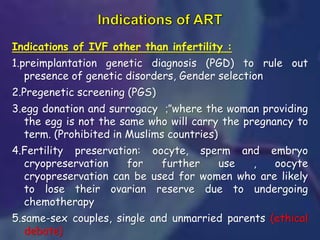
Indications of IVF other than infertility :
1.preimplantation genetic diagnosis (PGD) to rule out
presence of genetic disorders, Gender selection
2.Pregenetic screening (PGS)
3.egg donation and surrogacy "
; where the woman providing
the egg is not the same who will carry the pregnancy to
term. (Prohibited in Muslims countries)
4.Fertility preservation: oocyte, sperm and embryo
cryopreservation for further use , oocyte
cryopreservation can be used for women who are likely
to lose their ovarian reserve due to undergoing
chemotherapy
5.same-sex couples, single and unmarried parents (ethical
debate)
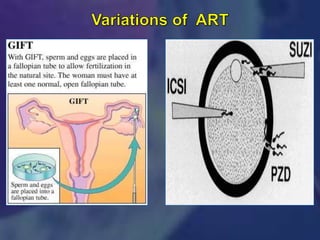
Gamete intrafallopian transfer (GIFT): Oocytes and
sperms are placed into the fallopian tube. The procedure is
applicable in patients who have normal fallopian tubes.
Zygote intrafallopian transfer (ZIFT):
The fertilized oocytes in the pronuclear stage (zygotes)
are placed into the fallopian tube. It has the same
indications as GIFT. In this case the male and female
pronuclei are seen in the cytoplasm.
Tubal embryo transfer (TET)
The embryos (zygotes after cleavage) are placed into the
fallopian tube.
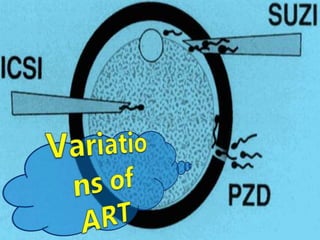
Peritoneal oocyte and sperm transfer (POST):
The oocytes and sperms are placed into the pelvic cavity.
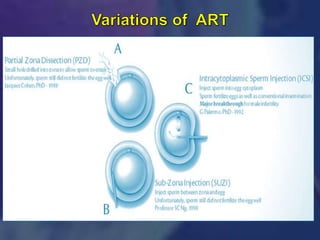
Subzonal insemination (SUZI):
A hole is made in the zona pellucida and 3-6 spermatozoa
are introduced into the subzonal space.
Intracytoplasmic sperm injection (ICSI):
A single sperm or spermatid is injected into the cytoplasm
of the oocyte under the control of the microscope.
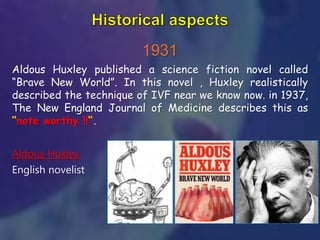
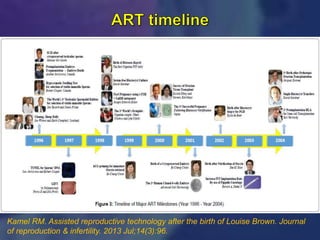
1931
Aldous Huxley published a science fiction novel called
“Brave New World”. In this novel , Huxley realistically
described the technique of IVF near we know now. in 1937,
The New England Journal of Medicine describes this as
“note worthy !!“.
Aldous Huxley
English novelist
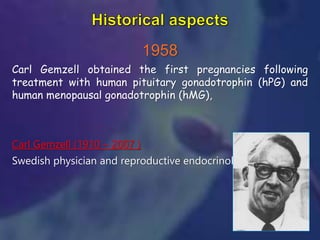
1958
Carl Gemzell obtained the first pregnancies following
treatment with human pituitary gonadotrophin (hPG) and
human menopausal gonadotrophin (hMG),
Carl Gemzell (1910 – 2007 )
Swedish physician and reproductive endocrinologist
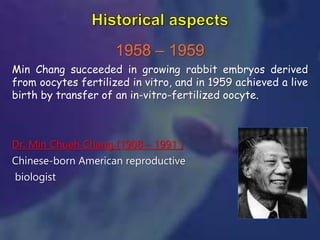
1958 – 1959
Min Chang succeeded in growing rabbit embryos derived
from oocytes fertilized in vitro, and in 1959 achieved a live
birth by transfer of an in-vitro-fertilized oocyte.
Dr. Min Chueh Chang (1908 – 1991 )
Chinese-born American reproductive
biologist
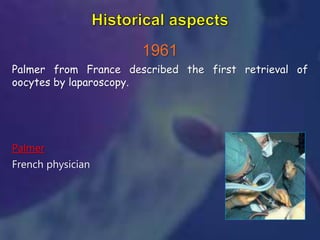
1961
Palmer from France described the first retrieval of
oocytes by laparoscopy.
Palmer
French physician
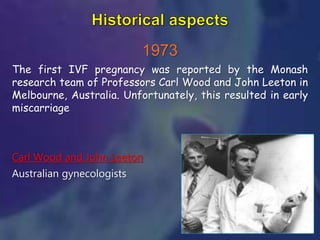
1973
The first IVF pregnancy was reported by the Monash
research team of Professors Carl Wood and John Leeton in
Melbourne, Australia. Unfortunately, this resulted in early
miscarriage
Carl Wood and John Leeton
Australian gynecologists
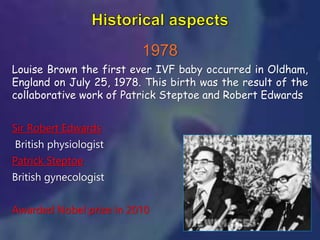
1978
Louise Brown the first ever IVF baby occurred in Oldham,
England on July 25, 1978. This birth was the result of the
collaborative work of Patrick Steptoe and Robert Edwards
Sir Robert Edwards
British physiologist
Patrick Steptoe
British gynecologist
Awarded Nobel prize in 2010
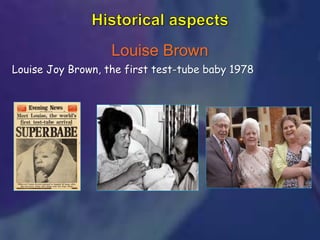
Louise Brown
Louise Joy Brown, the first test-tube baby 1978
1983
• First pregnancy after oocyte donation
• The first vaginal egg retrieval using an abdominal
ultrasound
1984
• First surrogacy embryo transfer baby born in California,
USA
• First report on pregnancy following translaparoscopic
gamete intrafallopian transfer “GIFT”
1985
Human pregnancy by in vitro fertilization (IVF) using sperm
aspirated from the epididymis
1986
First report on pregnancy after translaparoscopic zygote
intrafallopian transfer “ZIFT”
1989
First report on biopsy of human preimplantation embryos
and sexing by DNA amplification
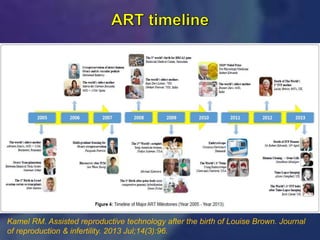
1992
• The first pregnancy after intracytoplasmic sperm
injection “ICSI”
• Successful in-vitro fertilization and embryo transfer
after treatment with recombinant human FSH
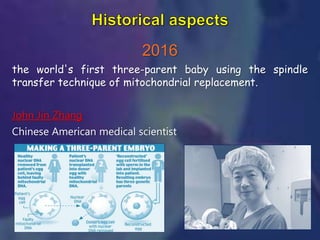
2016
the world's first three-parent baby using the spindle
transfer technique of mitochondrial replacement.
John Jin Zhang
Chinese American medical scientist
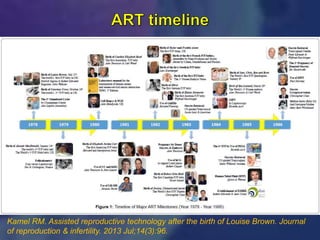
Kamel RM. Assisted reproductive technology after the birth of Louise Brown. Journal
of reproduction & infertility. 2013 Jul;14(3):96.
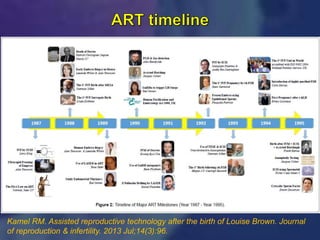
Kamel RM. Assisted reproductive technology after the birth of Louise Brown. Journal
of reproduction & infertility. 2013 Jul;14(3):96.
Kamel RM. Assisted reproductive technology after the birth of Louise Brown. Journal
of reproduction & infertility. 2013 Jul;14(3):96.
Kamel RM. Assisted reproductive technology after the birth of Louise Brown. Journal
of reproduction & infertility. 2013 Jul;14(3):96.
Bourn Hall worlds first IVF Conference 1982
Assisted reproduction in Judaism
14 million people around the world that identify themselves
as Jewish represent 0.2% of the global population.
three sects of Judaism exist: (1) the Orthodox Jews who
form about 10%, (2) the conservative Jews, who form
about 5% and (3) the reformed Jews who form the
majority at about 85%
Sallam HN, Sallam NH. Religious aspects of assisted reproduction. Facts, views & vision in
ObGyn. 2016 Mar 3;8(1):33.
Assisted reproduction in Judaism
in general, if IVF is mandatory, it is allowed as Jews have
an obligation to “be fruitful and multiply”.
PGD and PGS are also allowed because the soul does not
enter the body until 40 days (Halacha = Kosher).
Selective reduction is acceptable as it enhances the
possibility of life as determined by doctors.
Embryo research to promote life is also acceptable as well
as therapeutic cloning and any research, which can promote
lifesaving treatment
Assisted reproduction in Christianity
Christians form about 31.5 % of the world population (2.2
billions). A number of various churches exist within
Christianity and each one of them reacted differently to
assisted reproduction. Most of these churches are opposed
to assisted reproduction, although some of them are more
fiercely opposed than others
Sallam HN, Sallam NH. Religious aspects of assisted reproduction. Facts, views & vision in
ObGyn. 2016 Mar 3;8(1):33.
Assisted reproduction in Christianity
the Catholic Church :
all forms of assisted reproduction including IUI, IVF,
ICSI, ET and surrogate motherhood are not accepted.
IUI can be accepted if the semen is collected by sexual
intercourse while AID is forbidden because it involves a
third party.
Assisted reproduction in Christianity
the Catholic Church :
Moreover, the Catholic Church offers its respect and
protection to the human being starting with its first
seconds of existence; it therefore considers research on
embryos, cryopreservation and abortion strongly
disapproves
Sallam HN, Sallam NH. Religious aspects of assisted reproduction. Facts, views & vision in
ObGyn. 2016 Mar 3;8(1):33.
Assisted reproduction in Christianity
Protestantism:
Protestants vary in their beliefs on IVF, and unlike the
Catholic Church, there is not one set of ethical guidelines
for Protestant couples to follow regarding its use. Those
who support IVF, limit its use to married couples. All the
embryos must be replaced into the uterus and selective
reduction is not allowed.
Sallam HN, Sallam NH. Religious aspects of assisted reproduction. Facts, views &
vision in ObGyn. 2016 Mar 3;8(1):33.
Assisted reproduction in Christianity
Eastern Orthodox Churches:
The Eastern (Greek) Orthodox Church is not as strict as
the Roman (Latin) Catholic Church regarding assisted
reproduction. It allows the medical and surgical treatment
of infertility including IUI using the husband’s sperm but
cannot accept IVF and other assisted reproductive
techniques, surrogate motherhood, donor insemination and
embryo donation.
Assisted reproduction in Christianity
the Coptic Church:
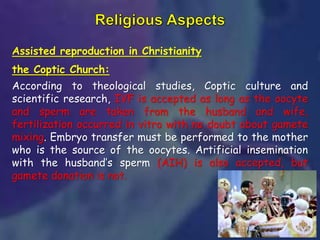
According to theological studies, Coptic culture and
scientific research, IVF is accepted as long as the oocyte
and sperm are taken from the husband and wife,
fertilization occurred in vitro with no doubt about gamete
mixing. Embryo transfer must be performed to the mother
who is the source of the oocytes. Artificial insemination
with the husband’s sperm (AIH) is also accepted, but
gamete donation is not.
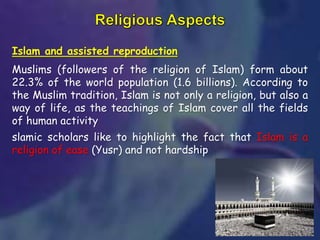
Islam and assisted reproduction
Muslims (followers of the religion of Islam) form about
22.3% of the world population (1.6 billions). According to
the Muslim tradition, Islam is not only a religion, but also a
way of life, as the teachings of Islam cover all the fields
of human activity
slamic scholars like to highlight the fact that Islam is a
religion of ease (Yusr) and not hardship
Islam and assisted reproduction
Sunni Islam:
According to these Fatwas and guidelines of Sunni Islam,
all forms of assisted reproduction are allowed as long as
the sperm and oocyte are those of the husband and his
wife and the embryo is replaced into the wife’s uterus
during an existing marriage contract (which ends by death
or divorce).
Cryopreservation of spermatozoa and oocytes is also
allowed as well as cryopreservation of embryos. T
Islam and assisted reproduction
Sunni Islam:
These embryos remain the property of the couple and may
be transferred to the same wife in a subsequent cycle but
only during the validity of the current marriage.
Research on embryos younger than 120 days is also allowed
as according to the Quran, the “soul” enters the body of
the foetus after 120 days
Islam and assisted reproduction
Sunni Islam:
Islam and assisted reproduction
Sunni Islam:
Islam and assisted reproduction
Shi’a Islam:
Shi’a form about 10% of Muslims.
The practice of assisted reproduction in Shi’a Muslim
communities follows the Fatwa issued by Ayatollah Ali
Khamenei in 1999. The Shi’as principles and practice are
similar to the Sunni Fatwas except in one important
difference: Shi’as allow gamete donation.
Sallam HN, Sallam NH. Religious aspects of assisted reproduction. Facts, views &
vision in ObGyn. 2016 Mar 3;8(1):33.
Assisted reproduction in Hinduism
There are about 1 billion Hindus around the world,
representing 15% of the global population
Hinduism is a very liberal religion concerning assisted
reproduction. In fact the Hindu religion agrees with most
of the assisted reproduction techniques, but it demands
that the oocyte and the sperm used in the procedure to
(better) come from a married couple.
Assisted reproduction in Hinduism
However, Hinduism also accepts sperm donation but the
donor has to be a close relative of the infertile husband.
In addition, abortion is not prohibited and the adoption of
a child, which usually comes from a numerous family, is also
practiced. This liberal attitude has made India an
important destination for reproductive tourism and many
couples travel to India for assisted reproduction.
Sallam HN, Sallam NH. Religious aspects of assisted reproduction. Facts, views &
vision in ObGyn. 2016 Mar 3;8(1):33.
Assisted reproduction in Buddhism
There are about 488 million Buddhists worldwide,
representing 7% of the world’s total population.
Buddhism is also a very liberal religion regarding assisted
reproduction. It allows the use of IVF without restricting
the access to this medical procedure to the married
couples and sperm donation is also permitted. In the
Buddhist tradition, a child conceived from donated genetic
material has the right to meet his genetic parents as he
reaches maturity
Sallam HN, Sallam NH. Religious aspects of assisted reproduction. Facts, views &
vision in ObGyn. 2016 Mar 3;8(1):33.
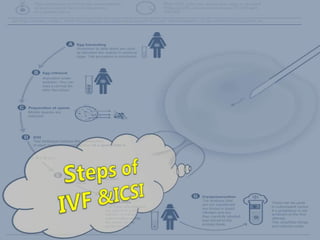
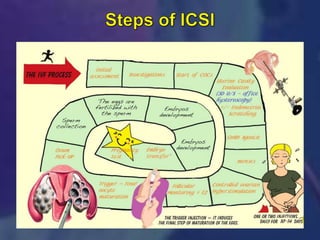
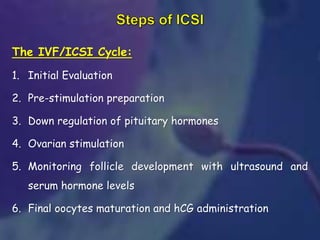
The IVF/ICSI Cycle:
1. Initial Evaluation
2. Pre-stimulation preparation
3. Down regulation of pituitary hormones
4. Ovarian stimulation
5. Monitoring follicle development with ultrasound and
serum hormone levels
6. Final oocytes maturation and hCG administration
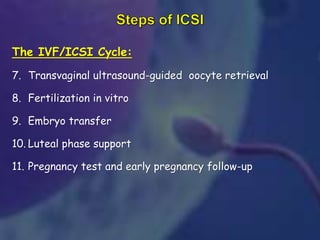
The IVF/ICSI Cycle:
7. Transvaginal ultrasound-guided oocyte retrieval
8. Fertilization in vitro
9. Embryo transfer
10. Luteal phase support
11. Pregnancy test and early pregnancy follow-up
Introduction to Assisted reproductive technology.pptx

Introduction to Assisted reproductive technology.pptx

  • 6.
    Infertility: a disease ofthe reproductive system defined by the failure to achieve a clinical pregnancy after 12 months or more of regular unprotected sexual intercourse. International Committee for Monitoring Assisted Reproductive Technology (ICMART) and the World Health Organization (WHO) revised “glossary of ART terminology”, Fertility and Sterility, Vol. 92, No. 5, November 2009
  • 7.
    The cumulative spontaneouspregnancy rate for a couple is approximately 57% after three months, 72% after six months, 85% after one year and 93% after two years. Church, Elaine. "Obstetrics and Gynaecology: An Evidence‐based Text for MRCOG, edited by David M Luesley, Philip N Baker." (2011): E206-E206.
  • 8.
    It has beenestimated that infertility affects 9% of couples, of whom 70% suffer from primary infertility i.e. no previous conception, and 30% secondary infertility i.e. have achieved a previous pregnancy (regardless of the outcome of that pregnancy). Worldwide, more than 70 million couples suffer from infertility, the majority being residents of the developing countries. Church, Elaine. "Obstetrics and Gynaecology: An Evidence‐based Text for MRCOG, edited by David M Luesley, Philip N Baker." (2011): E206-E206.
  • 9.
    Subfertility: This term canbe applied to most couples that are described as infertile while they can actually conceive if given enough time (more than 1 year). They represent 50% of cases of infertility.
  • 10.
    Infertility as adisability: World Health Organization., & World Bank. (2011). “World report on disability”. Geneva, Switzerland: World Health Organization.
  • 11.
    Infertility as adisability: Infertility generates disability (an impairment of function), and thus access to health care falls under the Convention on the Rights of Persons with Disability. Infertility in women was ranked by WHO as the 5th highest serious global disability (among populations under the age of 60).. World Health Organization., & World Bank. (2011). “World report on disability”. Geneva, Switzerland: World Health Organization.
  • 14.
    (Centres for DiseaseControl and Prevention, 2013. National Summary and Fertility Clinic Reports. Atlanta, GA, 2013.)
  • 15.
    Tubal factor infertility: Congenitalabsent or secondary to surgery which cannot be corrected by surgery and when surgery fails. Ovulatory dysfunction: In patients with polycystic ovarian disease (PCOS) and other ovulatory problems. Endometriosis: Patients with endometriosis, often have tubal involvement and ovarian cysts (endometrioma). Uterine factor infertility: Mullerian anomalies that requires a surrogate mother (prohibited in Moslem countries).
  • 16.
    Male infertility: dueto poor quality semen parameters; Azoospermia, oligozoospermia, asthenozoospermia, anti- sperm antibody etc. Age Related Infertility: When woman's ovarian function is diminished with age. In many cases, this reduced function can be overcome through the use of IVF Unexplained infertility: after failure of ovulation induction and IUI. Cervical factor infertility: Hostile cervical mucus which cannot be treated by IUI.
  • 19.
    all treatments orprocedures that include the in vitro handling of both human oocytes and sperm or of embryos for the purpose of establishing a pregnancy. This includes, but is not limited to, in vitro fertilization and embryo transfer, gamete intrafallopian transfer, zygote intrafallopian transfer, tubal embryo transfer, gamete and embryo cryopreservation, oocyte and embryo donation, and gestational surrogacy.
  • 20.
    ART does notinclude assisted insemination (artificial insemination) using sperm from either a woman’s partner or a sperm donor. International Committee for Monitoring Assisted Reproductive Technology (ICMART) and the World Health Organization (WHO) revised “glossary of ART terminology”, Fertility and Sterility, Vol. 92, No. 5, November 2009
  • 21.
    An estimated 1in 7 couples (approximately 3.5 million in the UK) have difficulty conceiving, and many of these couples have IVF treatment. Every year about 12,000 babies are born using assisted conception treatment in the UK, representing approximately 2% of all babies born every year. Church, Elaine. "Obstetrics and Gynaecology: An Evidence‐based Text for MRCOG, edited by David M Luesley, Philip N Baker." (2011): E206-E206.
  • 22.
    According to HFEAdata 49,636 women had a total of 64,600 cycles of IVF and 2379 women had a total of 4611 cycles of donor insemination (DI) in 2013 in the UK. Worldwide, about 1 million babies have been born as a result of ART. Church, Elaine. "Obstetrics and Gynaecology: An Evidence‐based Text for MRCOG, edited by David M Luesley, Philip N Baker." (2011): E206-E206.
  • 23.
    In vitro fertilization(IVF) and embryo transfer (ET): is a process of fertilization an egg with sperm outside the body, in vitro ("in test tube"). The process involves monitoring and stimulating a woman's ovulatory process, Ovum pick-up and letting sperm fertilize them in a liquid in a laboratory. The fertilized egg (zygote) undergoes embryo culture for 2–5 days, and is then transferred to the same or another woman's uterus, with the intention of establishing a successful pregnancy.
  • 24.
    Intracytoplasmic Sperm Injection(ICSI) It was first introduction in 1992, for those couples would have not achieved fertilization or very low fertilization rates using standard IVF techniques. A single motile morphologically normal sperm is carefully identified, picked up using a tiny pipette and carefully injected directly into the cytoplasm (center) of each mature egg. The fertilized embryos are allowed to develop as for standard IVF prior to transfer.
  • 27.
    Tubal factor infertility Ovulatorydysfunction Uterine factor infertility
  • 28.
    Male infertility Age RelatedInfertility Unexplained infertility Cervical factor infertility Endometriosis
  • 29.
    Indications of IVFother than infertility : 1.preimplantation genetic diagnosis (PGD) to rule out presence of genetic disorders, Gender selection 2.Pregenetic screening (PGS) 3.egg donation and surrogacy " ; where the woman providing the egg is not the same who will carry the pregnancy to term. (Prohibited in Muslims countries) 4.Fertility preservation: oocyte, sperm and embryo cryopreservation for further use , oocyte cryopreservation can be used for women who are likely to lose their ovarian reserve due to undergoing chemotherapy 5.same-sex couples, single and unmarried parents (ethical debate)
  • 32.
    Gamete intrafallopian transfer(GIFT): Oocytes and sperms are placed into the fallopian tube. The procedure is applicable in patients who have normal fallopian tubes. Zygote intrafallopian transfer (ZIFT): The fertilized oocytes in the pronuclear stage (zygotes) are placed into the fallopian tube. It has the same indications as GIFT. In this case the male and female pronuclei are seen in the cytoplasm. Tubal embryo transfer (TET) The embryos (zygotes after cleavage) are placed into the fallopian tube.
  • 33.
    Peritoneal oocyte andsperm transfer (POST): The oocytes and sperms are placed into the pelvic cavity. Subzonal insemination (SUZI): A hole is made in the zona pellucida and 3-6 spermatozoa are introduced into the subzonal space. Intracytoplasmic sperm injection (ICSI): A single sperm or spermatid is injected into the cytoplasm of the oocyte under the control of the microscope.
  • 38.
    1931 Aldous Huxley publisheda science fiction novel called “Brave New World”. In this novel , Huxley realistically described the technique of IVF near we know now. in 1937, The New England Journal of Medicine describes this as “note worthy !!“. Aldous Huxley English novelist
  • 39.
    1958 Carl Gemzell obtainedthe first pregnancies following treatment with human pituitary gonadotrophin (hPG) and human menopausal gonadotrophin (hMG), Carl Gemzell (1910 – 2007 ) Swedish physician and reproductive endocrinologist
  • 40.
    1958 – 1959 MinChang succeeded in growing rabbit embryos derived from oocytes fertilized in vitro, and in 1959 achieved a live birth by transfer of an in-vitro-fertilized oocyte. Dr. Min Chueh Chang (1908 – 1991 ) Chinese-born American reproductive biologist
  • 41.
    1961 Palmer from Francedescribed the first retrieval of oocytes by laparoscopy. Palmer French physician
  • 42.
    1973 The first IVFpregnancy was reported by the Monash research team of Professors Carl Wood and John Leeton in Melbourne, Australia. Unfortunately, this resulted in early miscarriage Carl Wood and John Leeton Australian gynecologists
  • 43.
    1978 Louise Brown thefirst ever IVF baby occurred in Oldham, England on July 25, 1978. This birth was the result of the collaborative work of Patrick Steptoe and Robert Edwards Sir Robert Edwards British physiologist Patrick Steptoe British gynecologist Awarded Nobel prize in 2010
  • 44.
    Louise Brown Louise JoyBrown, the first test-tube baby 1978
  • 45.
    1983 • First pregnancyafter oocyte donation • The first vaginal egg retrieval using an abdominal ultrasound 1984 • First surrogacy embryo transfer baby born in California, USA • First report on pregnancy following translaparoscopic gamete intrafallopian transfer “GIFT”
  • 46.
    1985 Human pregnancy byin vitro fertilization (IVF) using sperm aspirated from the epididymis 1986 First report on pregnancy after translaparoscopic zygote intrafallopian transfer “ZIFT” 1989 First report on biopsy of human preimplantation embryos and sexing by DNA amplification
  • 47.
    1992 • The firstpregnancy after intracytoplasmic sperm injection “ICSI” • Successful in-vitro fertilization and embryo transfer after treatment with recombinant human FSH
  • 48.
    2016 the world's firstthree-parent baby using the spindle transfer technique of mitochondrial replacement. John Jin Zhang Chinese American medical scientist
  • 49.
    Kamel RM. Assistedreproductive technology after the birth of Louise Brown. Journal of reproduction & infertility. 2013 Jul;14(3):96.
  • 50.
    Kamel RM. Assistedreproductive technology after the birth of Louise Brown. Journal of reproduction & infertility. 2013 Jul;14(3):96.
  • 51.
    Kamel RM. Assistedreproductive technology after the birth of Louise Brown. Journal of reproduction & infertility. 2013 Jul;14(3):96.
  • 52.
    Kamel RM. Assistedreproductive technology after the birth of Louise Brown. Journal of reproduction & infertility. 2013 Jul;14(3):96.
  • 53.
    Bourn Hall worldsfirst IVF Conference 1982
  • 54.
    Bourn Hall worldsfirst IVF Conference 1982
  • 57.
    Assisted reproduction inJudaism 14 million people around the world that identify themselves as Jewish represent 0.2% of the global population. three sects of Judaism exist: (1) the Orthodox Jews who form about 10%, (2) the conservative Jews, who form about 5% and (3) the reformed Jews who form the majority at about 85% Sallam HN, Sallam NH. Religious aspects of assisted reproduction. Facts, views & vision in ObGyn. 2016 Mar 3;8(1):33.
  • 58.
    Assisted reproduction inJudaism in general, if IVF is mandatory, it is allowed as Jews have an obligation to “be fruitful and multiply”. PGD and PGS are also allowed because the soul does not enter the body until 40 days (Halacha = Kosher). Selective reduction is acceptable as it enhances the possibility of life as determined by doctors. Embryo research to promote life is also acceptable as well as therapeutic cloning and any research, which can promote lifesaving treatment
  • 59.
    Assisted reproduction inChristianity Christians form about 31.5 % of the world population (2.2 billions). A number of various churches exist within Christianity and each one of them reacted differently to assisted reproduction. Most of these churches are opposed to assisted reproduction, although some of them are more fiercely opposed than others Sallam HN, Sallam NH. Religious aspects of assisted reproduction. Facts, views & vision in ObGyn. 2016 Mar 3;8(1):33.
  • 60.
    Assisted reproduction inChristianity the Catholic Church : all forms of assisted reproduction including IUI, IVF, ICSI, ET and surrogate motherhood are not accepted. IUI can be accepted if the semen is collected by sexual intercourse while AID is forbidden because it involves a third party.
  • 61.
    Assisted reproduction inChristianity the Catholic Church : Moreover, the Catholic Church offers its respect and protection to the human being starting with its first seconds of existence; it therefore considers research on embryos, cryopreservation and abortion strongly disapproves Sallam HN, Sallam NH. Religious aspects of assisted reproduction. Facts, views & vision in ObGyn. 2016 Mar 3;8(1):33.
  • 62.
    Assisted reproduction inChristianity Protestantism: Protestants vary in their beliefs on IVF, and unlike the Catholic Church, there is not one set of ethical guidelines for Protestant couples to follow regarding its use. Those who support IVF, limit its use to married couples. All the embryos must be replaced into the uterus and selective reduction is not allowed. Sallam HN, Sallam NH. Religious aspects of assisted reproduction. Facts, views & vision in ObGyn. 2016 Mar 3;8(1):33.
  • 63.
    Assisted reproduction inChristianity Eastern Orthodox Churches: The Eastern (Greek) Orthodox Church is not as strict as the Roman (Latin) Catholic Church regarding assisted reproduction. It allows the medical and surgical treatment of infertility including IUI using the husband’s sperm but cannot accept IVF and other assisted reproductive techniques, surrogate motherhood, donor insemination and embryo donation.
  • 64.
    Assisted reproduction inChristianity the Coptic Church: According to theological studies, Coptic culture and scientific research, IVF is accepted as long as the oocyte and sperm are taken from the husband and wife, fertilization occurred in vitro with no doubt about gamete mixing. Embryo transfer must be performed to the mother who is the source of the oocytes. Artificial insemination with the husband’s sperm (AIH) is also accepted, but gamete donation is not.
  • 65.
    Islam and assistedreproduction Muslims (followers of the religion of Islam) form about 22.3% of the world population (1.6 billions). According to the Muslim tradition, Islam is not only a religion, but also a way of life, as the teachings of Islam cover all the fields of human activity slamic scholars like to highlight the fact that Islam is a religion of ease (Yusr) and not hardship
  • 66.
    Islam and assistedreproduction Sunni Islam: According to these Fatwas and guidelines of Sunni Islam, all forms of assisted reproduction are allowed as long as the sperm and oocyte are those of the husband and his wife and the embryo is replaced into the wife’s uterus during an existing marriage contract (which ends by death or divorce). Cryopreservation of spermatozoa and oocytes is also allowed as well as cryopreservation of embryos. T
  • 67.
    Islam and assistedreproduction Sunni Islam: These embryos remain the property of the couple and may be transferred to the same wife in a subsequent cycle but only during the validity of the current marriage. Research on embryos younger than 120 days is also allowed as according to the Quran, the “soul” enters the body of the foetus after 120 days
  • 68.
    Islam and assistedreproduction Sunni Islam:
  • 69.
    Islam and assistedreproduction Sunni Islam:
  • 70.
    Islam and assistedreproduction Shi’a Islam: Shi’a form about 10% of Muslims. The practice of assisted reproduction in Shi’a Muslim communities follows the Fatwa issued by Ayatollah Ali Khamenei in 1999. The Shi’as principles and practice are similar to the Sunni Fatwas except in one important difference: Shi’as allow gamete donation. Sallam HN, Sallam NH. Religious aspects of assisted reproduction. Facts, views & vision in ObGyn. 2016 Mar 3;8(1):33.
  • 71.
    Assisted reproduction inHinduism There are about 1 billion Hindus around the world, representing 15% of the global population Hinduism is a very liberal religion concerning assisted reproduction. In fact the Hindu religion agrees with most of the assisted reproduction techniques, but it demands that the oocyte and the sperm used in the procedure to (better) come from a married couple.
  • 72.
    Assisted reproduction inHinduism However, Hinduism also accepts sperm donation but the donor has to be a close relative of the infertile husband. In addition, abortion is not prohibited and the adoption of a child, which usually comes from a numerous family, is also practiced. This liberal attitude has made India an important destination for reproductive tourism and many couples travel to India for assisted reproduction. Sallam HN, Sallam NH. Religious aspects of assisted reproduction. Facts, views & vision in ObGyn. 2016 Mar 3;8(1):33.
  • 73.
    Assisted reproduction inBuddhism There are about 488 million Buddhists worldwide, representing 7% of the world’s total population. Buddhism is also a very liberal religion regarding assisted reproduction. It allows the use of IVF without restricting the access to this medical procedure to the married couples and sperm donation is also permitted. In the Buddhist tradition, a child conceived from donated genetic material has the right to meet his genetic parents as he reaches maturity Sallam HN, Sallam NH. Religious aspects of assisted reproduction. Facts, views & vision in ObGyn. 2016 Mar 3;8(1):33.
  • 77.
    The IVF/ICSI Cycle: 1.Initial Evaluation 2. Pre-stimulation preparation 3. Down regulation of pituitary hormones 4. Ovarian stimulation 5. Monitoring follicle development with ultrasound and serum hormone levels 6. Final oocytes maturation and hCG administration
  • 78.
    The IVF/ICSI Cycle: 7.Transvaginal ultrasound-guided oocyte retrieval 8. Fertilization in vitro 9. Embryo transfer 10. Luteal phase support 11. Pregnancy test and early pregnancy follow-up

Editor's Notes

  • #17 PGD: is an early form of prenatal genetic diagnosis for couples at high risk eg. monogenic disease, sex linked disorder and chromosomal aberration. (eg; thalassemia) PGS: PGS is an early form of prenatal genetic screening for couples at low risk to improve IVF results.eg. Patients increase maternal age, multiple IVF failure, repeated miscarriage, moaicism.
  • #29 PGD: is an early form of prenatal genetic diagnosis for couples at high risk eg. monogenic disease, sex linked disorder and chromosomal aberration. (eg; thalassemia) PGS: PGS is an early form of prenatal genetic screening for couples at low risk to improve IVF results.eg. Patients increase maternal age, multiple IVF failure, repeated miscarriage, moaicism.
  • #30  PGD: is an early form of prenatal genetic diagnosis for couples at high risk eg. monogenic disease, sex linked disorder and chromosomal aberration. (eg; thalassemia) PGS: PGS is an early form of prenatal genetic screening for couples at low risk to improve IVF results.eg. Patients increase maternal age, multiple IVF failure, repeated miscarriage, moaicism. increasingly being used to detect numerical chromosomal abnormalities in embryos to improve implantation rates after IVF. The main indications for the use of PGS in IVF treatments include advanced maternal age, repeated implantation failure, and recurrent pregnancy loss.