
PedR Journal Club (November 2019)
Discussion of:
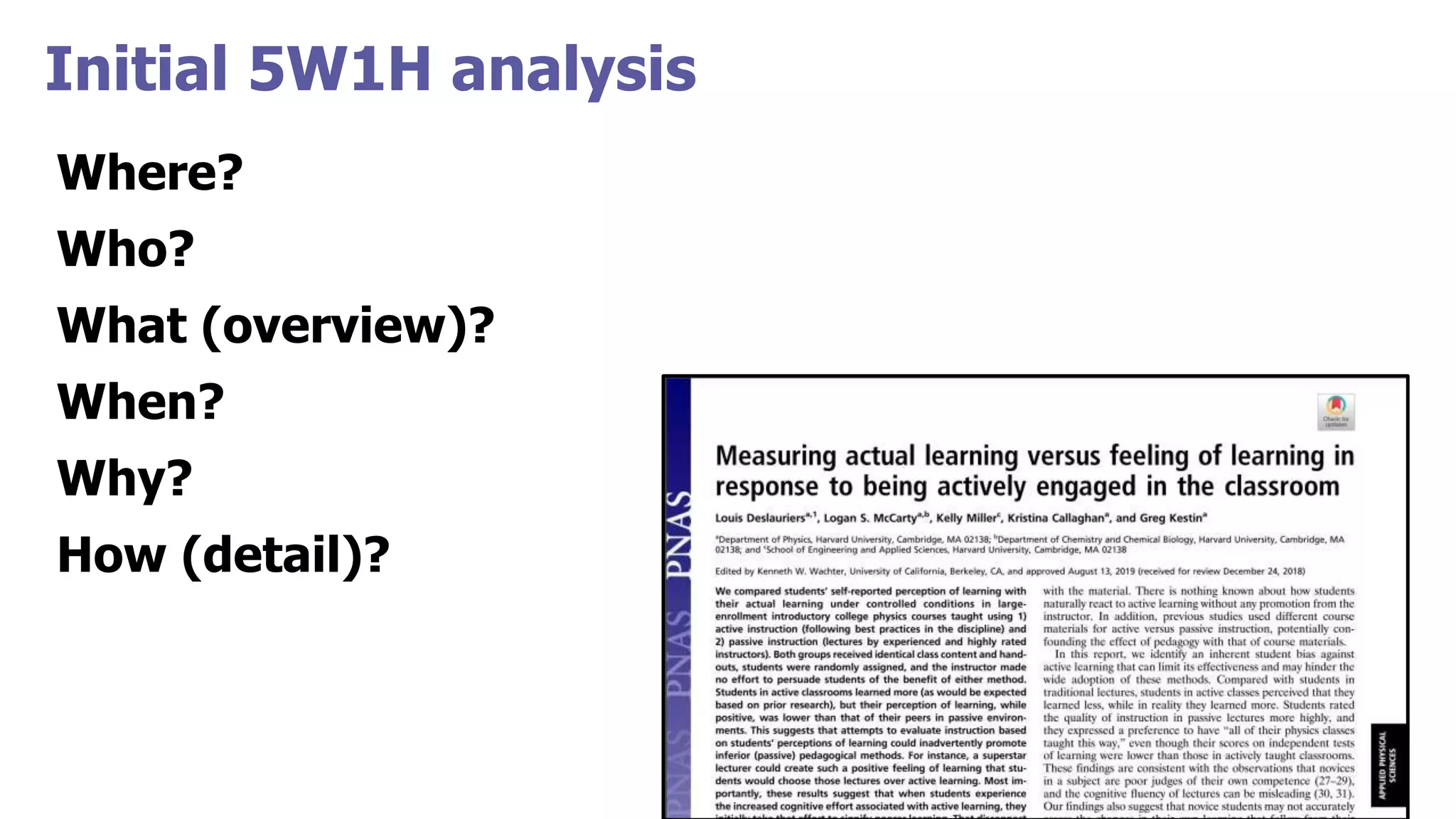
Measuring actual learning versus feeling of learning in
response to being actively engaged in the classroom
Deslauriers et al. (2019) PNAS 116:19251-12957
Led by Dr Chris Willmott
Molecular & Cell Biology Dept
University of Leicester
Initial 5W1H analysis
Where?
Who?
What (overview)?
When?
Why?
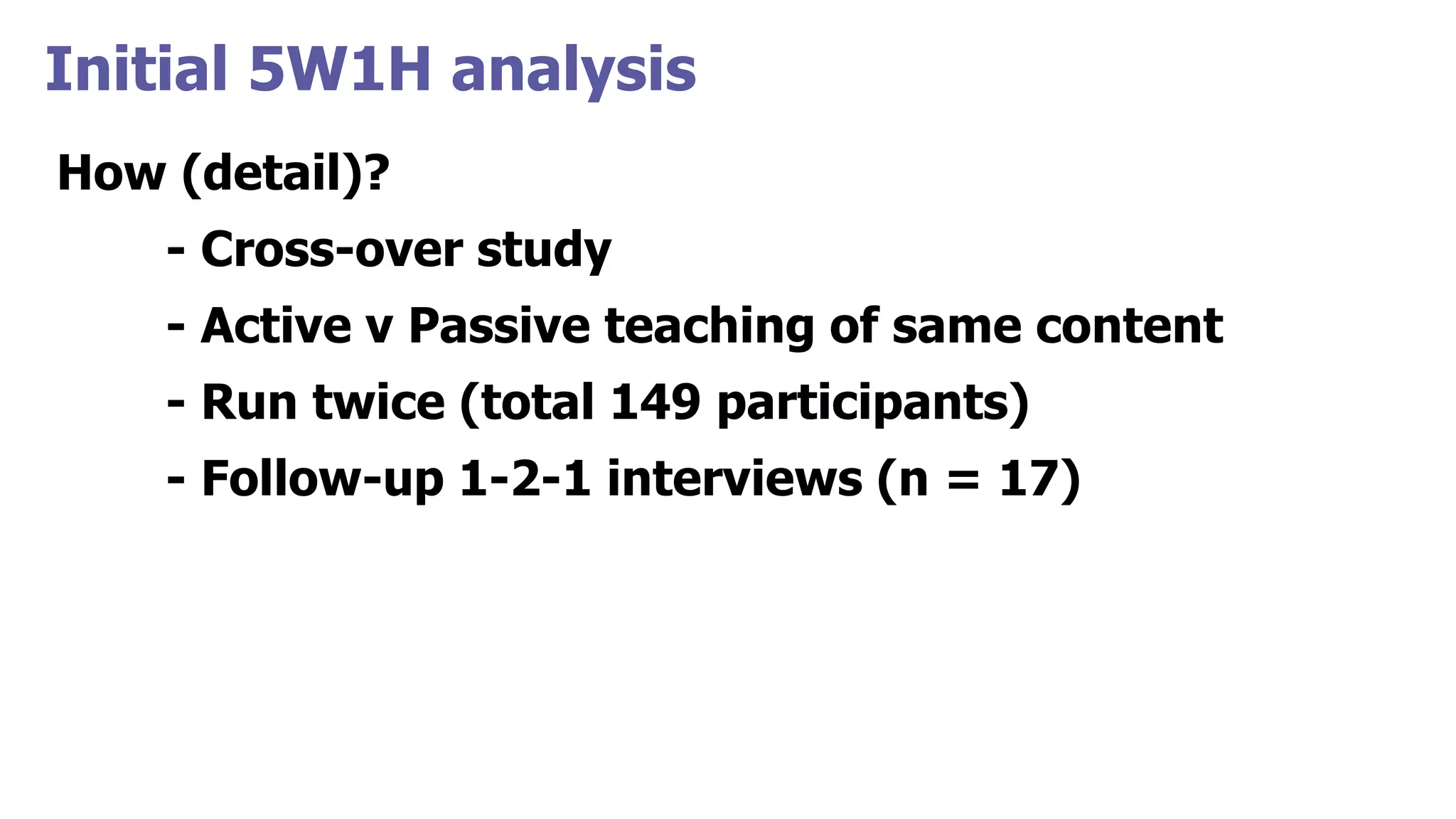
How (detail)?
Initial 5W1H analysis
Where?
- Single-centre study @ Harvard University
- Participants on Physics courses
Initial 5W1H analysis
Who?
- Lead author = Louis Deslauriers
Director, Science Teaching & Learning
Faculty of Arts and Sciences
(previously Uni of British Columbia)
- Kelly Miller = frequent co-author with
Eric Mazur (esp Peer Instruction)
Initial 5W1H analysis
What (overview)?
“We compared students’ self-reported perception of
learning with their actual learning under controlled
conditions in large enrollment introductory college
physics courses” (from Abstract, p19251)
“Identical class content and handouts” delivered via:
(1) Active instruction (best practice) or
(2) Passive instruction (by experienced staff)
Initial 5W1H analysis
When?
- Published September 2019
- Submitted December 2018
- Study repeated in Spring and Fall semesters,
but no year identified
Initial 5W1H analysis
Why?
“Despite active learning being recognized as a
superior method of instruction in the classroom, a
major recent survey* found that most college STEM
instructors still choose traditional teaching methods.”
(Significance, p19251)
* Stains et al. [n=31] (2018)
Anatomy of STEM teaching in North American universities
Science 359:1468-1470
Initial 5W1H analysis
How (detail)?
- Cross-over study
- Active v Passive teaching of same content
- Run twice (total 149 participants)
- Follow-up 1-2-1 interviews (n = 17)
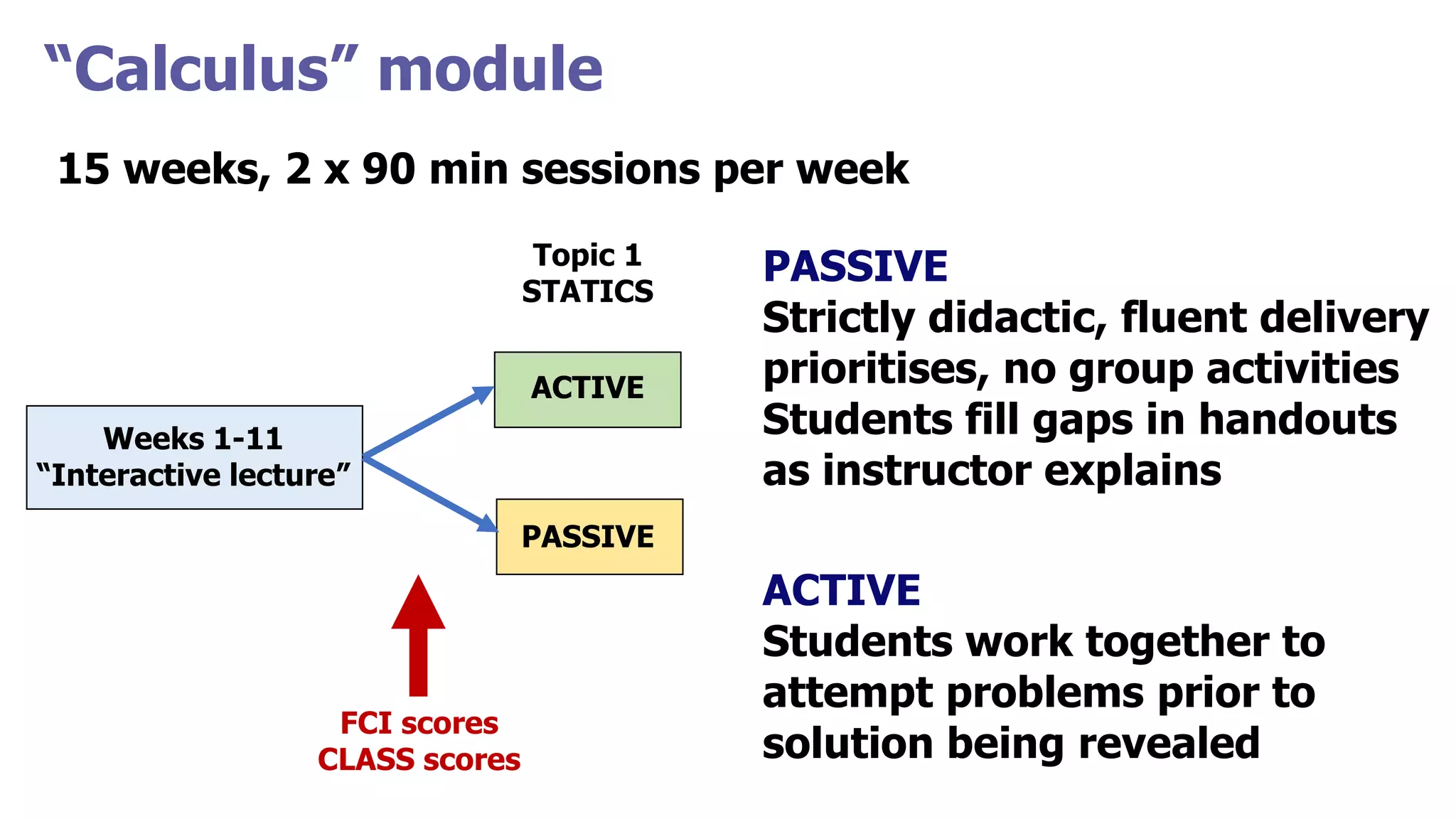
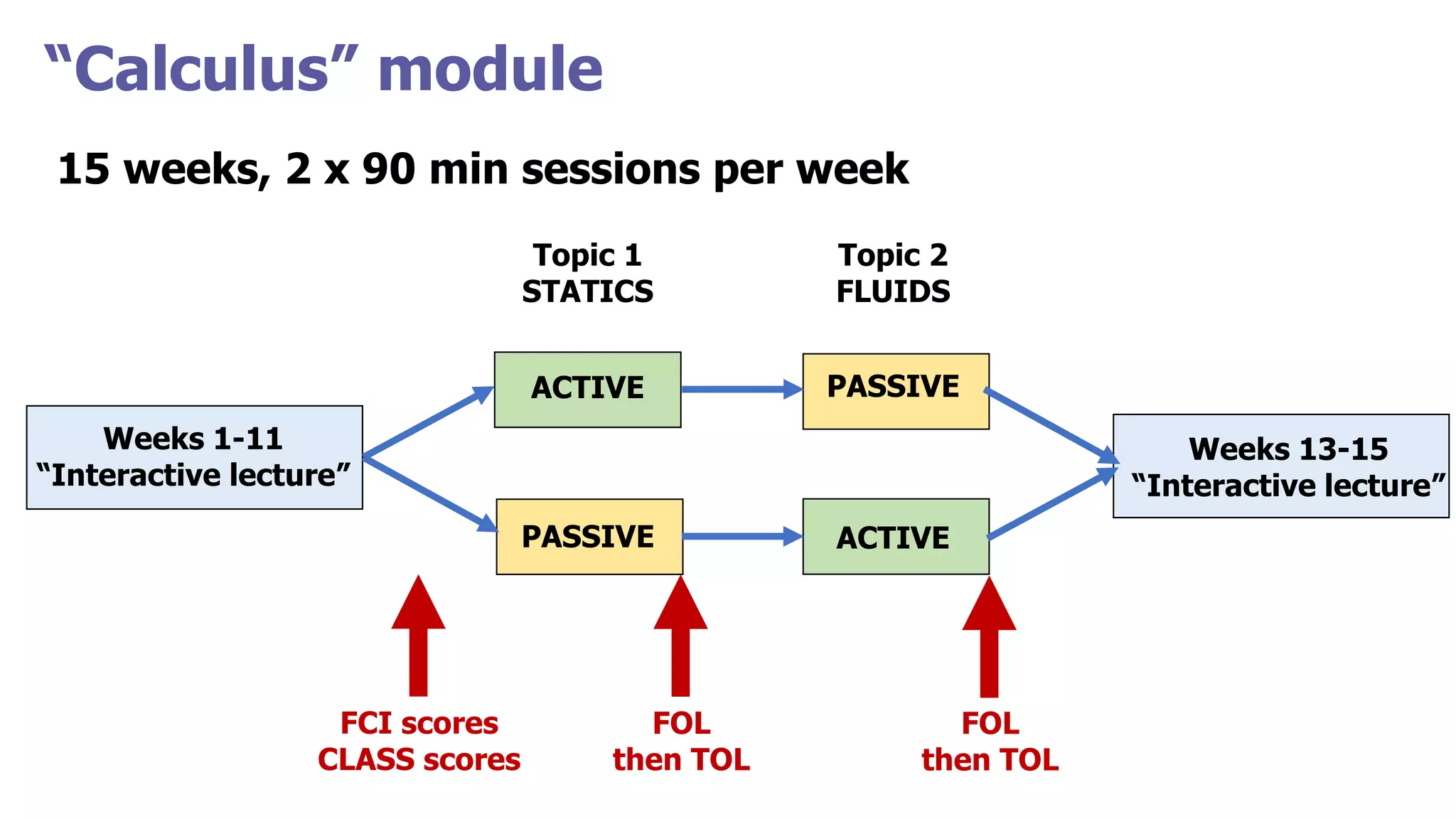
“Calculus” module
15 weeks, 2 x 90 min sessions per week
Weeks 1-11
“Interactive lecture”
FCI scores
CLASS scores
Force Concept Inventory (FCI)
Basic knowledge about mechanics
Colorado Learning Attitudes about
Science Survey (CLASS)
Measures alignment to expert
thinking about physics
“Calculus” module
15 weeks, 2 x 90 min sessions per week
ACTIVE
Weeks 1-11
“Interactive lecture”
PASSIVE
Topic 1
STATICS
FCI scores
CLASS scores
PASSIVE
Strictly didactic, fluent delivery
prioritises, no group activities
Students fill gaps in handouts
as instructor explains
ACTIVE
Students work together to
attempt problems prior to
solution being revealed
“Calculus” module
15 weeks, 2 x 90 min sessions per week
ACTIVE
Weeks 1-11
“Interactive lecture”
PASSIVE
Topic 1
STATICS
FCI scores
CLASS scores
PASSIVE
Strictly didactic, fluent delivery
prioritises, no group activities
Students fill gaps in handouts
as instructor explains
ACTIVE
Students work together to
attempt problems prior to
solution being revealed
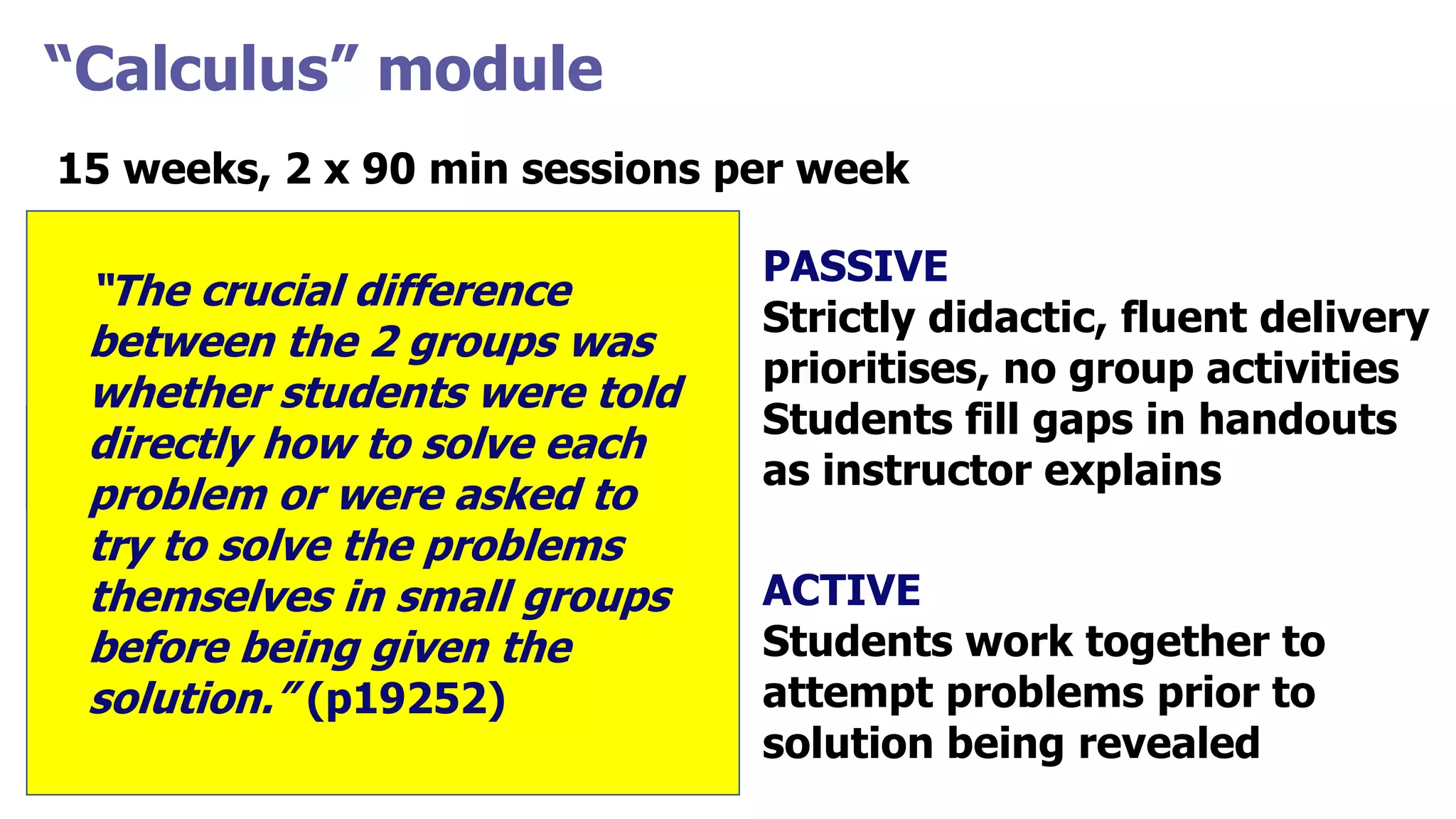
“The crucial difference
between the 2 groups was
whether students were told
directly how to solve each
problem or were asked to
try to solve the problems
themselves in small groups
before being given the
solution.” (p19252)
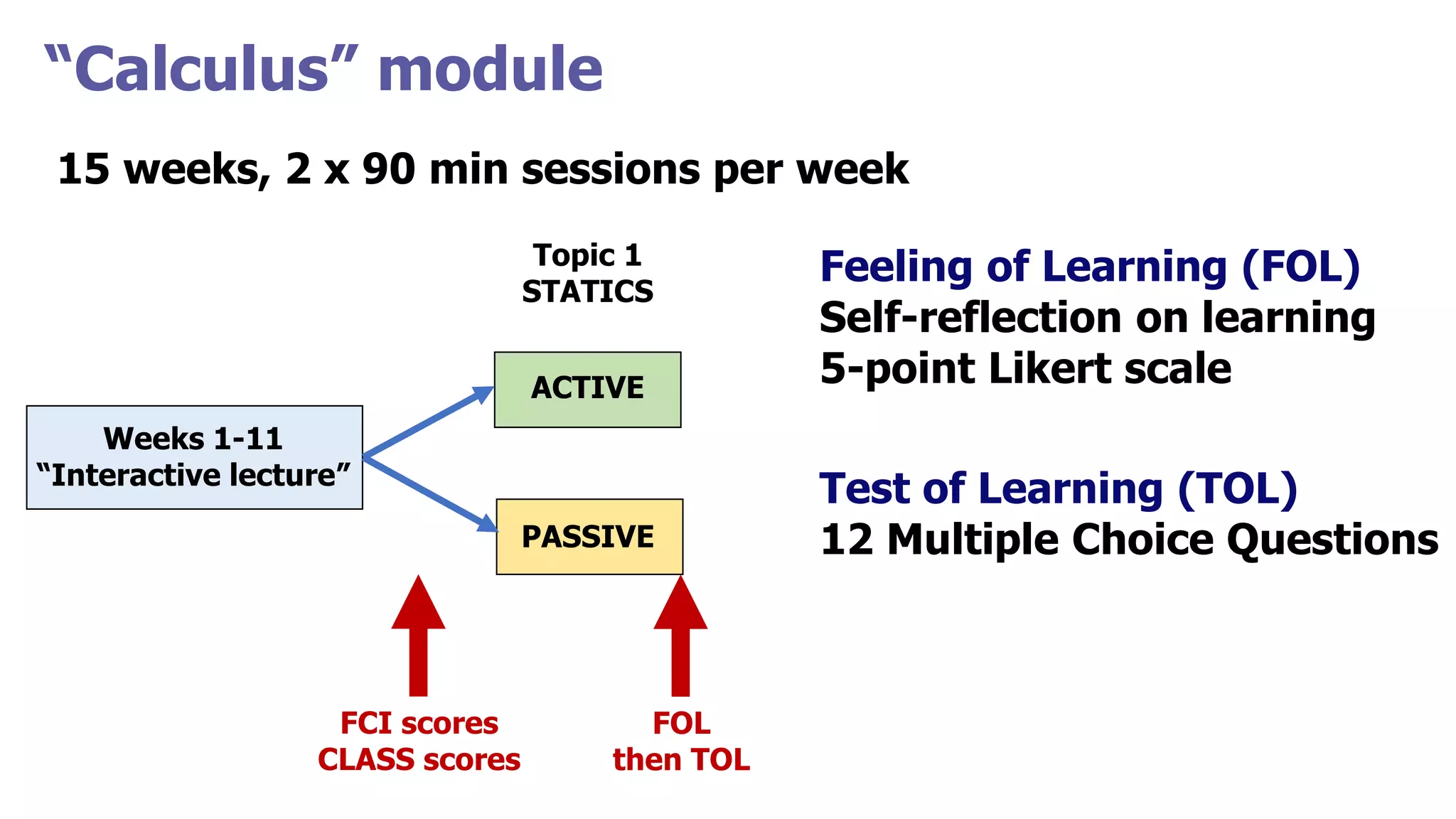
“Calculus” module
15 weeks, 2 x 90 min sessions per week
ACTIVE
Weeks 1-11
“Interactive lecture”
PASSIVE
Topic 1
STATICS
FCI scores
CLASS scores
FOL
then TOL
Feeling of Learning (FOL)
Self-reflection on learning
5-point Likert scale
Test of Learning (TOL)
12 Multiple Choice Questions
“Calculus” module
15 weeks, 2 x 90 min sessions per week
ACTIVE
Weeks 1-11
“Interactive lecture”
Weeks 13-15
“Interactive lecture”
ACTIVEPASSIVE
Topic 1
STATICS
Topic 2
FLUIDS
PASSIVE
FCI scores
CLASS scores
FOL
then TOL
FOL
then TOL
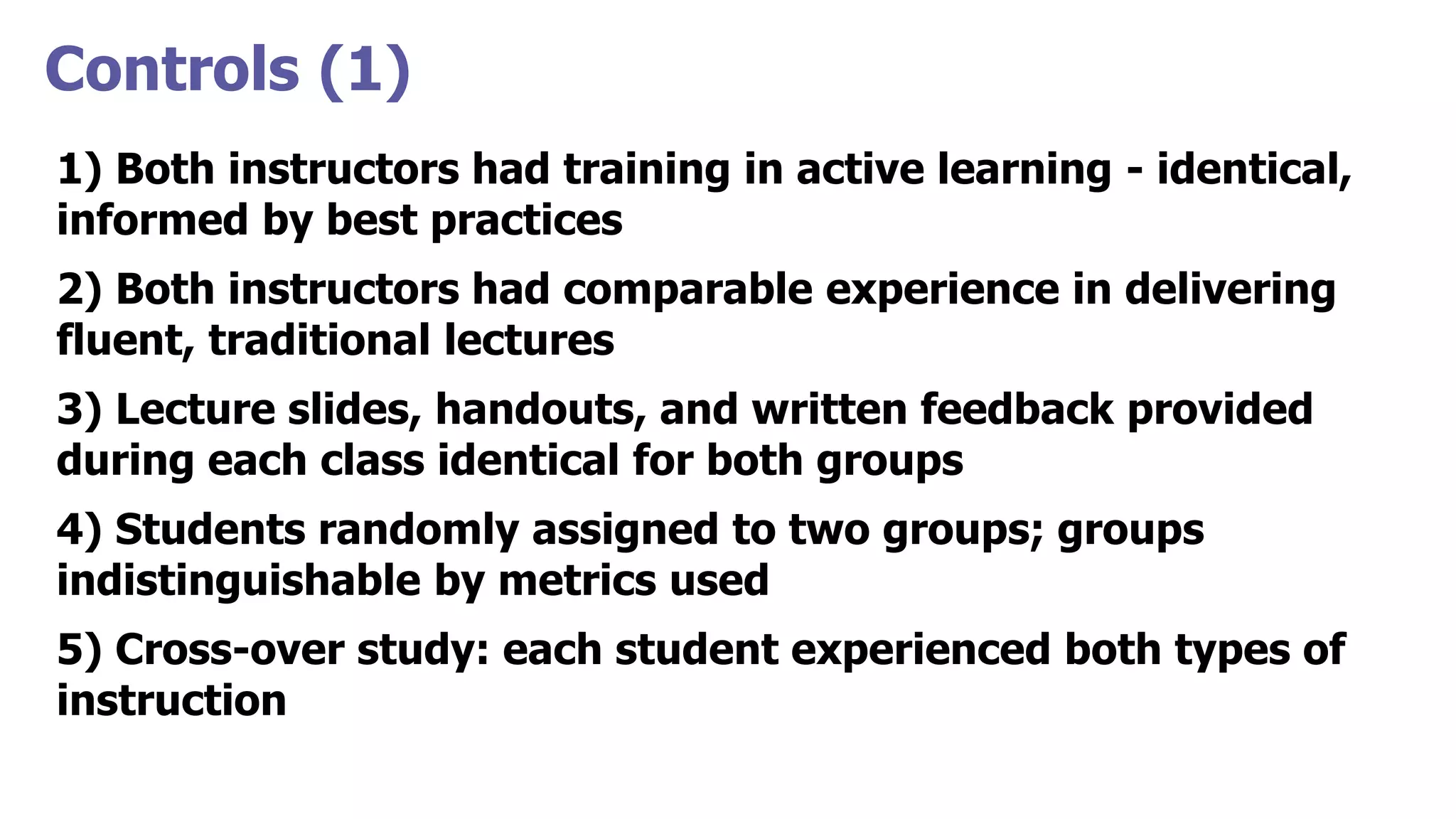
Controls (1)
1) Both instructors had training in active learning - identical,
informed by best practices
2) Both instructors had comparable experience in delivering
fluent, traditional lectures
3) Lecture slides, handouts, and written feedback provided
during each class identical for both groups
4) Students randomly assigned to two groups; groups
indistinguishable by metrics used
5) Cross-over study: each student experienced both types of
instruction
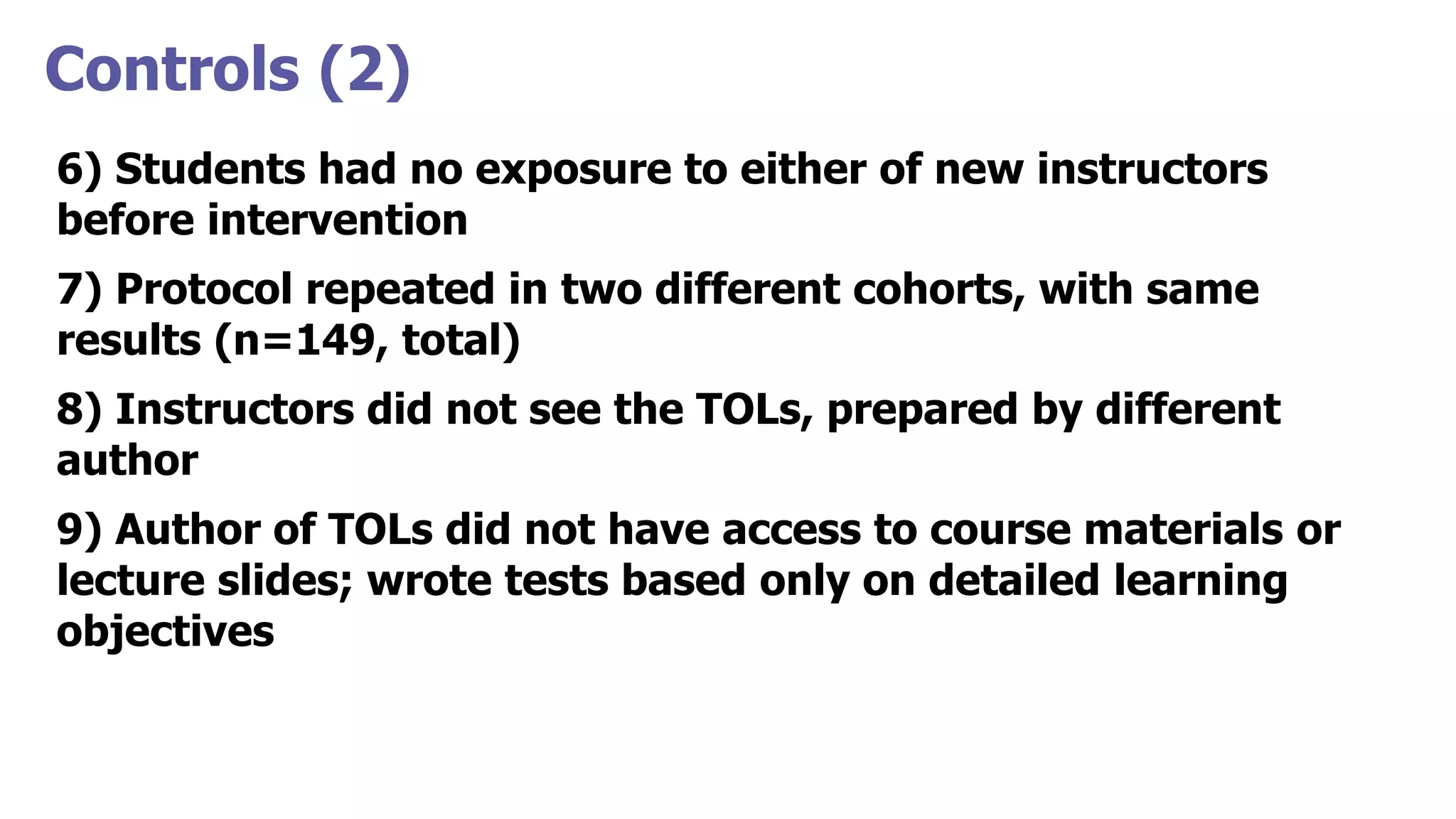
Controls (2)
6) Students had no exposure to either of new instructors
before intervention
7) Protocol repeated in two different cohorts, with same
results (n=149, total)
8) Instructors did not see the TOLs, prepared by different
author
9) Author of TOLs did not have access to course materials or
lecture slides; wrote tests based only on detailed learning
objectives
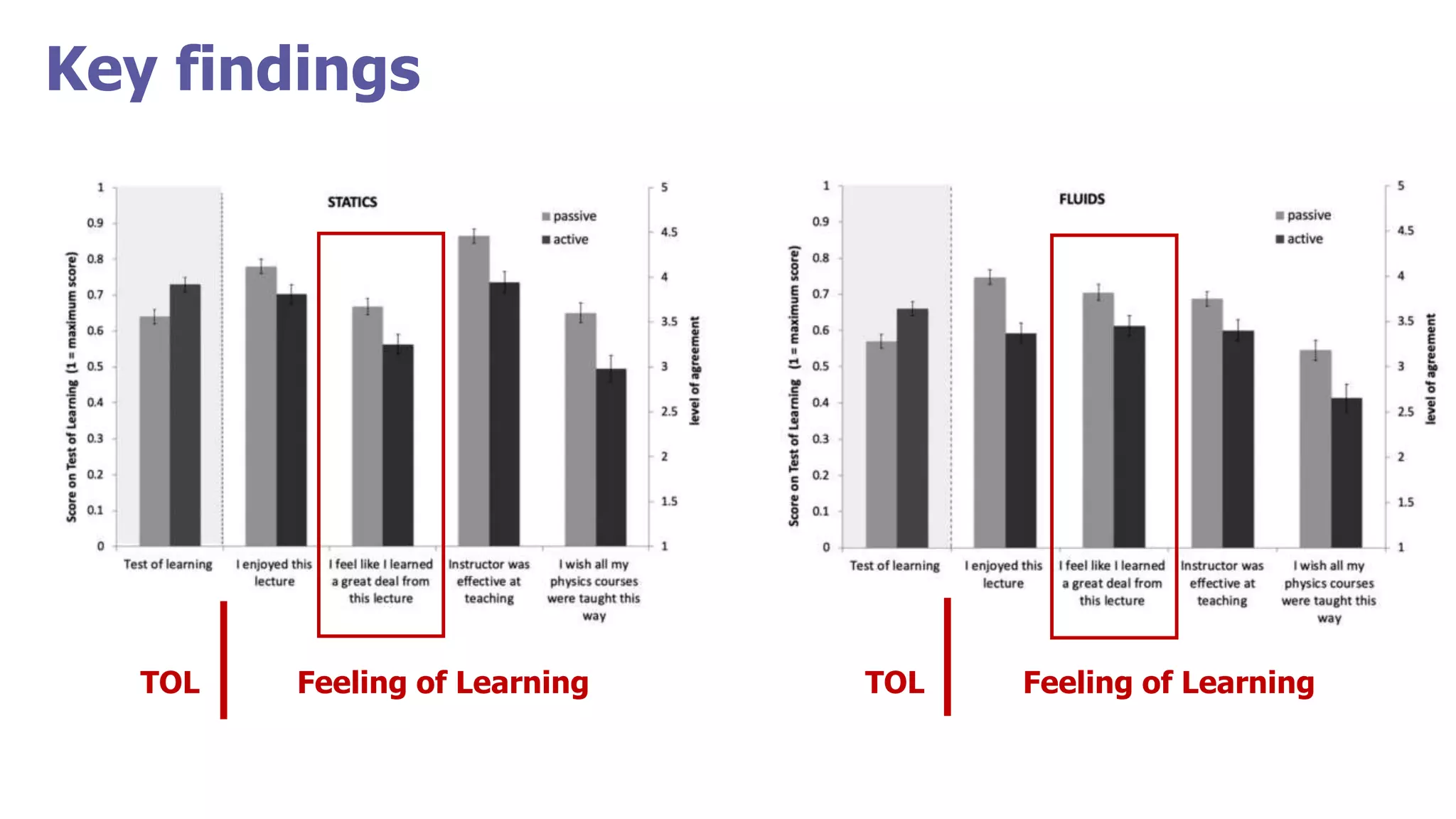
Key findings
TOL TOLFeeling of Learning Feeling of Learning
Follow-up interviews
- n=17, drawn from both Spring & Fall cohorts
- “Representative” sample re FCI, CLASS, grades
- Structured, one-to-one
- Instruction in active classroom disjointed (n=15)
- Frequent interruptions (n=14)
- Concerns errors would not be corrected (n=10)
- General feeling of frustration and confusion (n=14)
[no discussion of interview methodology, coding, etc]
Follow-up interviews
- Correlation “the instructor was effective at teaching”
and “I feel like I learned a great deal from this
lecture”, more than half an SD greater than those
who felt instructor not effective
- Interviews probed interpretation of the teaching
efficacy question:
1. Clarity of explanation
2. Organisation of presentation
3. Smooth flow of instruction
Key findings
- Cognitive fluency of good lecturers can mislead
students into believing they have learned more than
they actually have
- Novices in a subject are ill-equipped to judge how
much they have learned (Dunning-Kruger effect)
- Students unfamiliar with active learning methods
may misconstrue cognitive struggle as a bad thing,
unaware of its merits for aiding learning
And now for the odd bit…
- Not odd in the research, odd in the reporting
- “We carried out a semester-long intervention to see
if these attitudes could be changed…” (p 19255)
- Crucial part of the story, but minimal description in
formal paper (some in Supplementary Information)
re intervention or evaluation method (“a survey”)
- Some percentages offered, but no description of
research instrument
Changing attitudes
- “As the success of active learning crucially depends
on student motivation and engagement, it is of
paramount importance that students appreciate,
early in the semester, the benefits of struggling
with the material during active learning.” (p19255)
- “We recommend that instructors intervene early on
by explicitly presenting the value of increased
cognitive efforts associated with active learning.
Instructors should also give an examination (or
other assessment) as early as possible so students
can gauge their actual learning.” (p19256)
Changing attitudes
- “ The success of active learning will be greatly
enhanced if students accept that it leads to deeper
learning - and acknowledge that it may sometimes
feel like exactly the opposite is true.” (p19256)
Implications (for us)?
- Limitations of FOL as measure of academic worth?
- Modes of teaching that are better for learning may
involve more effort on part of students and
therefore receive lower satisfaction scores
Caution re Module review surveys, NSS, etc
“…student evaluations of teaching should be used
with caution as they rely on students’ perceptions
of learning and could inadvertently favor inferior
passive teaching methods over research-based
active pedagogical approaches” (p19256)
Implications (for us)?
- Limitations of FOL as measure of academic worth?
- Modes of teaching that are better for learning may
involve more effort on part of students and
therefore receive lower satisfaction scores
Caution re Module review surveys, NSS, etc
- Priming of student expectations may be crucial to
successfully introducing active learning
- You CAN get PedR published in major science
journals (PNAS, Science)

Measuring actual learning versus feelings of learning (Journal Club)

  • 1.
    PedR Journal Club(November 2019) Discussion of: Measuring actual learning versus feeling of learning in response to being actively engaged in the classroom Deslauriers et al. (2019) PNAS 116:19251-12957 Led by Dr Chris Willmott Molecular & Cell Biology Dept University of Leicester
  • 2.
    Initial 5W1H analysis Where? Who? What(overview)? When? Why? How (detail)?
  • 3.
    Initial 5W1H analysis Where? -Single-centre study @ Harvard University - Participants on Physics courses
  • 4.
    Initial 5W1H analysis Who? -Lead author = Louis Deslauriers Director, Science Teaching & Learning Faculty of Arts and Sciences (previously Uni of British Columbia) - Kelly Miller = frequent co-author with Eric Mazur (esp Peer Instruction)
  • 5.
    Initial 5W1H analysis What(overview)? “We compared students’ self-reported perception of learning with their actual learning under controlled conditions in large enrollment introductory college physics courses” (from Abstract, p19251) “Identical class content and handouts” delivered via: (1) Active instruction (best practice) or (2) Passive instruction (by experienced staff)
  • 6.
    Initial 5W1H analysis When? -Published September 2019 - Submitted December 2018 - Study repeated in Spring and Fall semesters, but no year identified
  • 7.
    Initial 5W1H analysis Why? “Despiteactive learning being recognized as a superior method of instruction in the classroom, a major recent survey* found that most college STEM instructors still choose traditional teaching methods.” (Significance, p19251) * Stains et al. [n=31] (2018) Anatomy of STEM teaching in North American universities Science 359:1468-1470
  • 8.
    Initial 5W1H analysis How(detail)? - Cross-over study - Active v Passive teaching of same content - Run twice (total 149 participants) - Follow-up 1-2-1 interviews (n = 17)
  • 9.
    “Calculus” module 15 weeks,2 x 90 min sessions per week Weeks 1-11 “Interactive lecture” FCI scores CLASS scores Force Concept Inventory (FCI) Basic knowledge about mechanics Colorado Learning Attitudes about Science Survey (CLASS) Measures alignment to expert thinking about physics
  • 10.
    “Calculus” module 15 weeks,2 x 90 min sessions per week ACTIVE Weeks 1-11 “Interactive lecture” PASSIVE Topic 1 STATICS FCI scores CLASS scores PASSIVE Strictly didactic, fluent delivery prioritises, no group activities Students fill gaps in handouts as instructor explains ACTIVE Students work together to attempt problems prior to solution being revealed
  • 11.
    “Calculus” module 15 weeks,2 x 90 min sessions per week ACTIVE Weeks 1-11 “Interactive lecture” PASSIVE Topic 1 STATICS FCI scores CLASS scores PASSIVE Strictly didactic, fluent delivery prioritises, no group activities Students fill gaps in handouts as instructor explains ACTIVE Students work together to attempt problems prior to solution being revealed “The crucial difference between the 2 groups was whether students were told directly how to solve each problem or were asked to try to solve the problems themselves in small groups before being given the solution.” (p19252)
  • 12.
    “Calculus” module 15 weeks,2 x 90 min sessions per week ACTIVE Weeks 1-11 “Interactive lecture” PASSIVE Topic 1 STATICS FCI scores CLASS scores FOL then TOL Feeling of Learning (FOL) Self-reflection on learning 5-point Likert scale Test of Learning (TOL) 12 Multiple Choice Questions
  • 13.
    “Calculus” module 15 weeks,2 x 90 min sessions per week ACTIVE Weeks 1-11 “Interactive lecture” Weeks 13-15 “Interactive lecture” ACTIVEPASSIVE Topic 1 STATICS Topic 2 FLUIDS PASSIVE FCI scores CLASS scores FOL then TOL FOL then TOL
  • 14.
    Controls (1) 1) Bothinstructors had training in active learning - identical, informed by best practices 2) Both instructors had comparable experience in delivering fluent, traditional lectures 3) Lecture slides, handouts, and written feedback provided during each class identical for both groups 4) Students randomly assigned to two groups; groups indistinguishable by metrics used 5) Cross-over study: each student experienced both types of instruction
  • 15.
    Controls (2) 6) Studentshad no exposure to either of new instructors before intervention 7) Protocol repeated in two different cohorts, with same results (n=149, total) 8) Instructors did not see the TOLs, prepared by different author 9) Author of TOLs did not have access to course materials or lecture slides; wrote tests based only on detailed learning objectives
  • 16.
    Key findings TOL TOLFeelingof Learning Feeling of Learning
  • 17.
    Follow-up interviews - n=17,drawn from both Spring & Fall cohorts - “Representative” sample re FCI, CLASS, grades - Structured, one-to-one - Instruction in active classroom disjointed (n=15) - Frequent interruptions (n=14) - Concerns errors would not be corrected (n=10) - General feeling of frustration and confusion (n=14) [no discussion of interview methodology, coding, etc]
  • 18.
    Follow-up interviews - Correlation“the instructor was effective at teaching” and “I feel like I learned a great deal from this lecture”, more than half an SD greater than those who felt instructor not effective - Interviews probed interpretation of the teaching efficacy question: 1. Clarity of explanation 2. Organisation of presentation 3. Smooth flow of instruction
  • 19.
    Key findings - Cognitivefluency of good lecturers can mislead students into believing they have learned more than they actually have - Novices in a subject are ill-equipped to judge how much they have learned (Dunning-Kruger effect) - Students unfamiliar with active learning methods may misconstrue cognitive struggle as a bad thing, unaware of its merits for aiding learning
  • 20.
    And now forthe odd bit… - Not odd in the research, odd in the reporting - “We carried out a semester-long intervention to see if these attitudes could be changed…” (p 19255) - Crucial part of the story, but minimal description in formal paper (some in Supplementary Information) re intervention or evaluation method (“a survey”) - Some percentages offered, but no description of research instrument
  • 21.
    Changing attitudes - “Asthe success of active learning crucially depends on student motivation and engagement, it is of paramount importance that students appreciate, early in the semester, the benefits of struggling with the material during active learning.” (p19255) - “We recommend that instructors intervene early on by explicitly presenting the value of increased cognitive efforts associated with active learning. Instructors should also give an examination (or other assessment) as early as possible so students can gauge their actual learning.” (p19256)
  • 22.
    Changing attitudes - “The success of active learning will be greatly enhanced if students accept that it leads to deeper learning - and acknowledge that it may sometimes feel like exactly the opposite is true.” (p19256)
  • 23.
    Implications (for us)? -Limitations of FOL as measure of academic worth? - Modes of teaching that are better for learning may involve more effort on part of students and therefore receive lower satisfaction scores Caution re Module review surveys, NSS, etc “…student evaluations of teaching should be used with caution as they rely on students’ perceptions of learning and could inadvertently favor inferior passive teaching methods over research-based active pedagogical approaches” (p19256)
  • 24.
    Implications (for us)? -Limitations of FOL as measure of academic worth? - Modes of teaching that are better for learning may involve more effort on part of students and therefore receive lower satisfaction scores Caution re Module review surveys, NSS, etc - Priming of student expectations may be crucial to successfully introducing active learning - You CAN get PedR published in major science journals (PNAS, Science)