Employee Rights and Responsibilities Rights That which belongs to a person by law, nature, or tradition. Responsibilities Obligations to perform certain tasks and duties. Statutory Rights Rights based on specific laws and statutes passed by federal, state, and local governments. Equal employment opportunity Collective bargaining Workplace safety
Contractual Rights Contractual Rights Rights based on a specific contract between employer and employee. Employment Contract An agreement that formally outlines the details of employment . Implied Contract Notion that a contract exists between employer and employee based on implied promises of employer .
Provisions in Employment Contracts
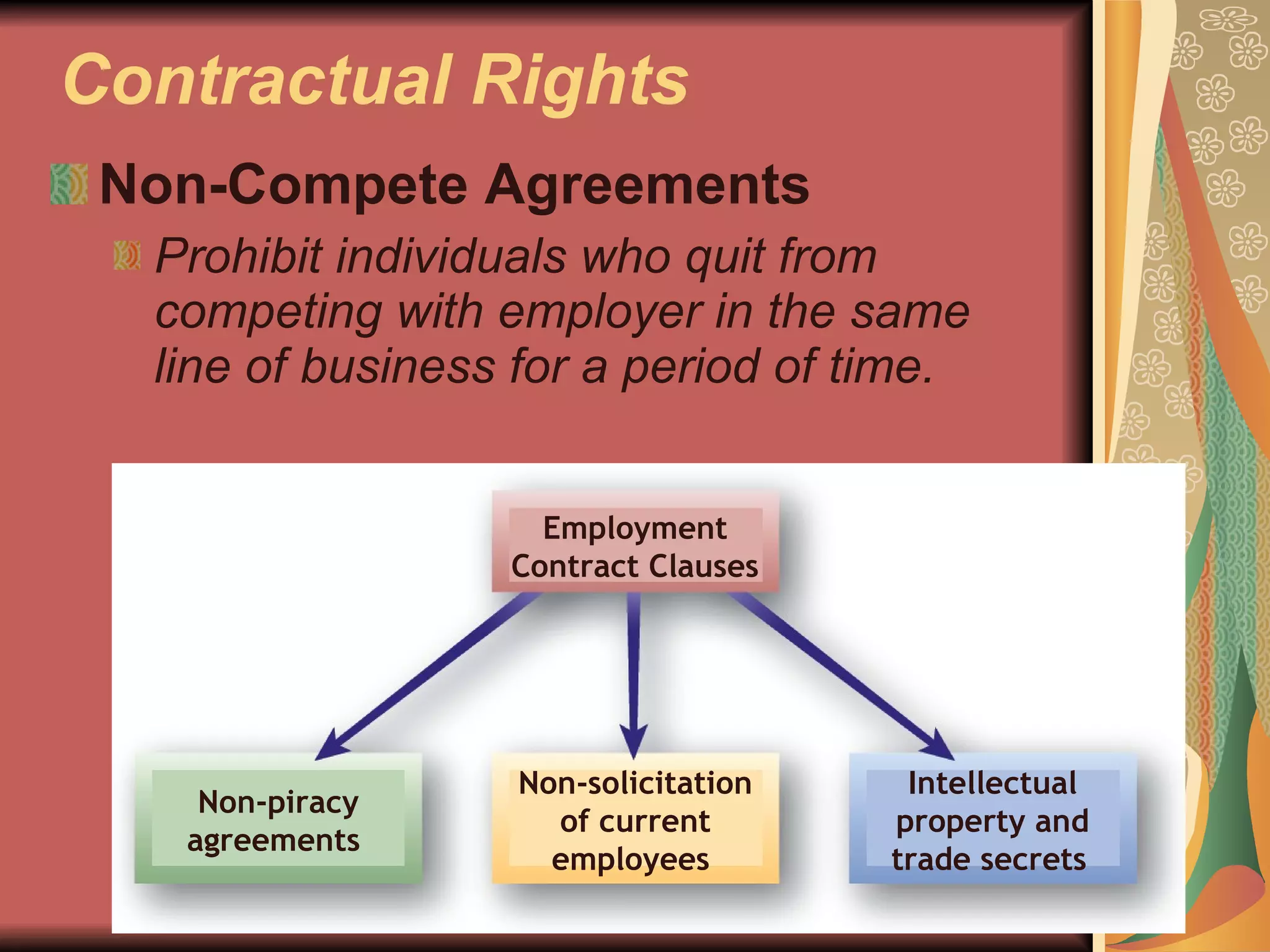
Contractual Rights Non-Compete Agreements Prohibit individuals who quit from competing with employer in the same line of business for a period of time. Non-piracy agreements  Non-solicitation of current employees  Intellectual property and trade secrets   Employment Contract Clauses
Contractual Rights   Employment Practices Liability Insurance (EPLI) Covers employer’s costs for legal fees, settlements, and judgments associated with employment-related actions.
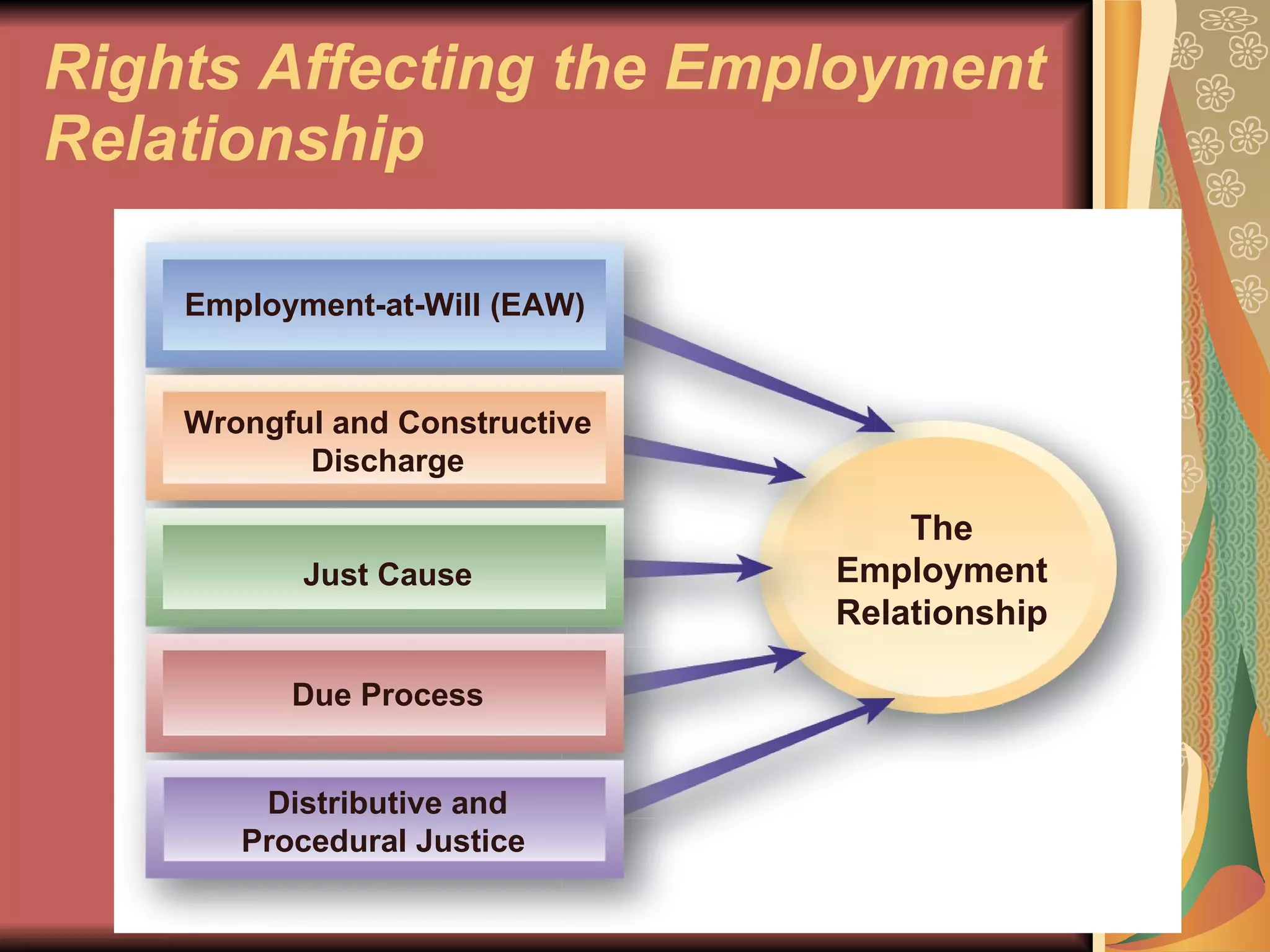
Rights Affecting the Employment Relationship Employment-at-Will (EAW) Wrongful and Constructive Discharge Just Cause Due Process Distributive and Procedural Justice  The Employment Relationship
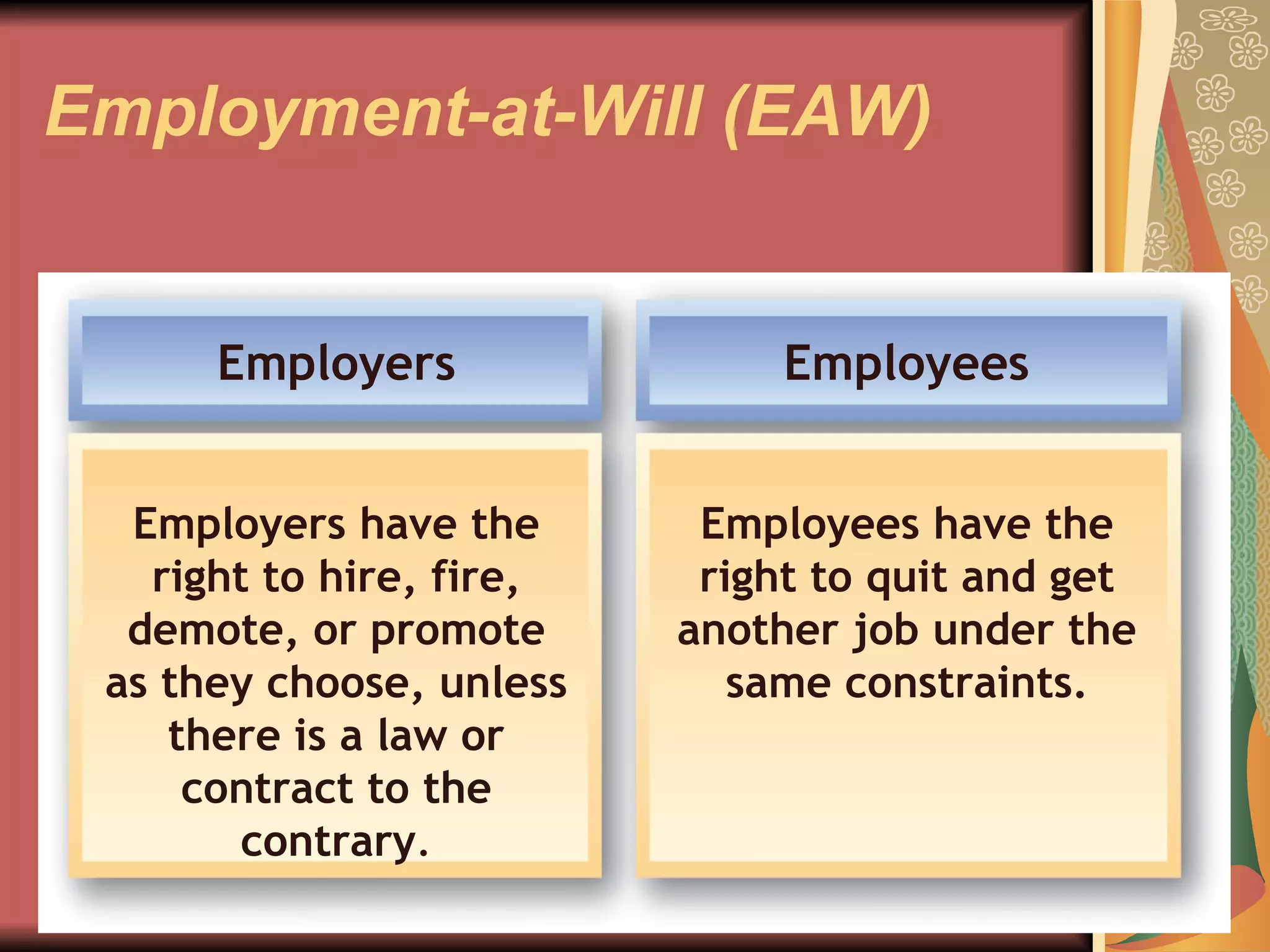
Employment-at-Will (EAW) Employers Employers have the right to hire, fire, demote, or promote as they choose, unless there is a law or contract to the contrary . Employees Employees have the right to quit and get another job under the same constraints .
Employment-at-Will (EAW) Exceptions to EAW Violation of Public Policy Implied Contract of Continuing Employment Covenant of Good-faith and Fair-dealing
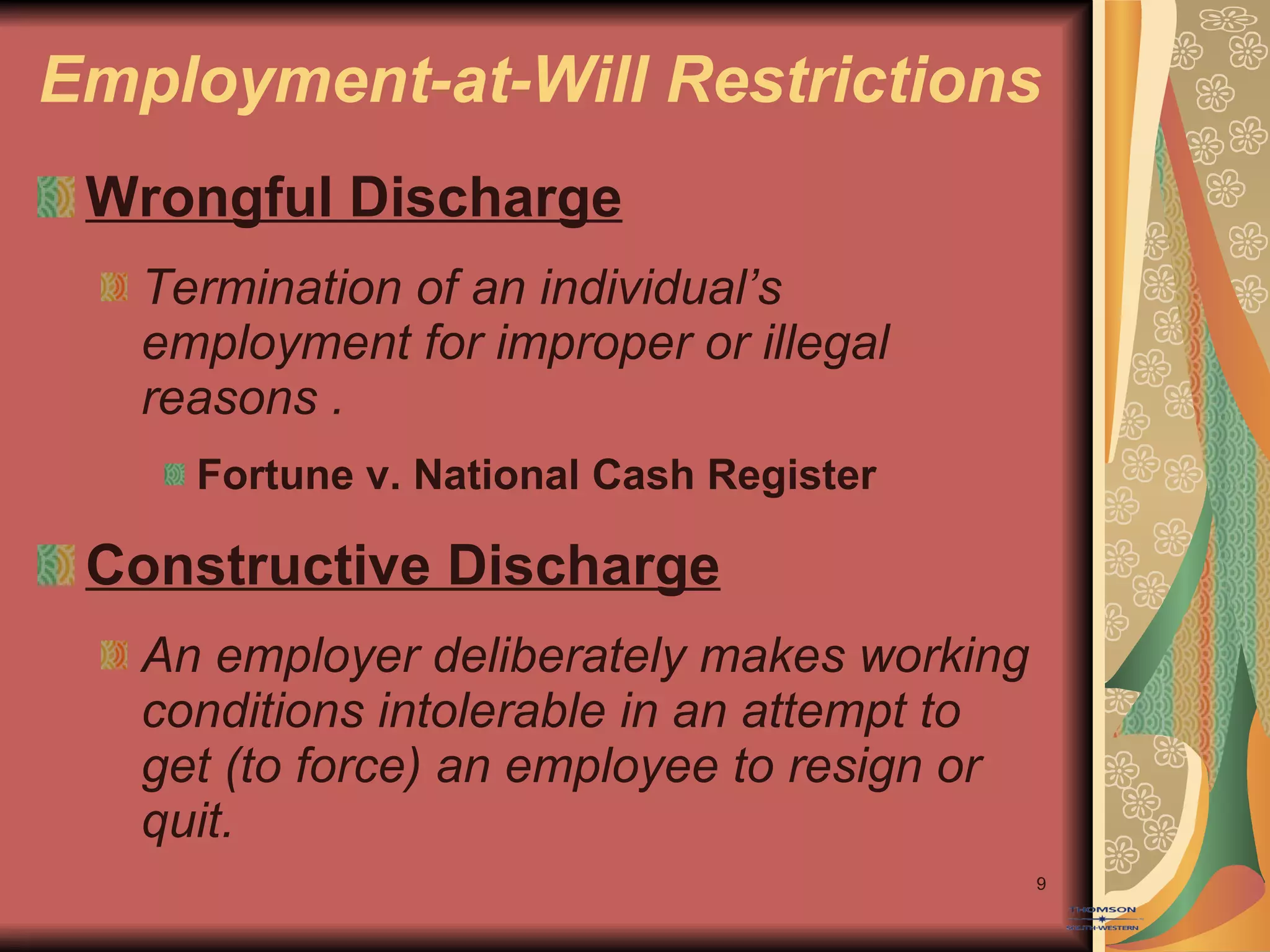
Employment-at-Will Restrictions Wrongful Discharge Termination of an individual’s employment for improper or illegal reasons . Fortune v. National Cash Register Constructive Discharge An employer deliberately makes working conditions intolerable in an attempt to get (to force) an employee to resign or quit.
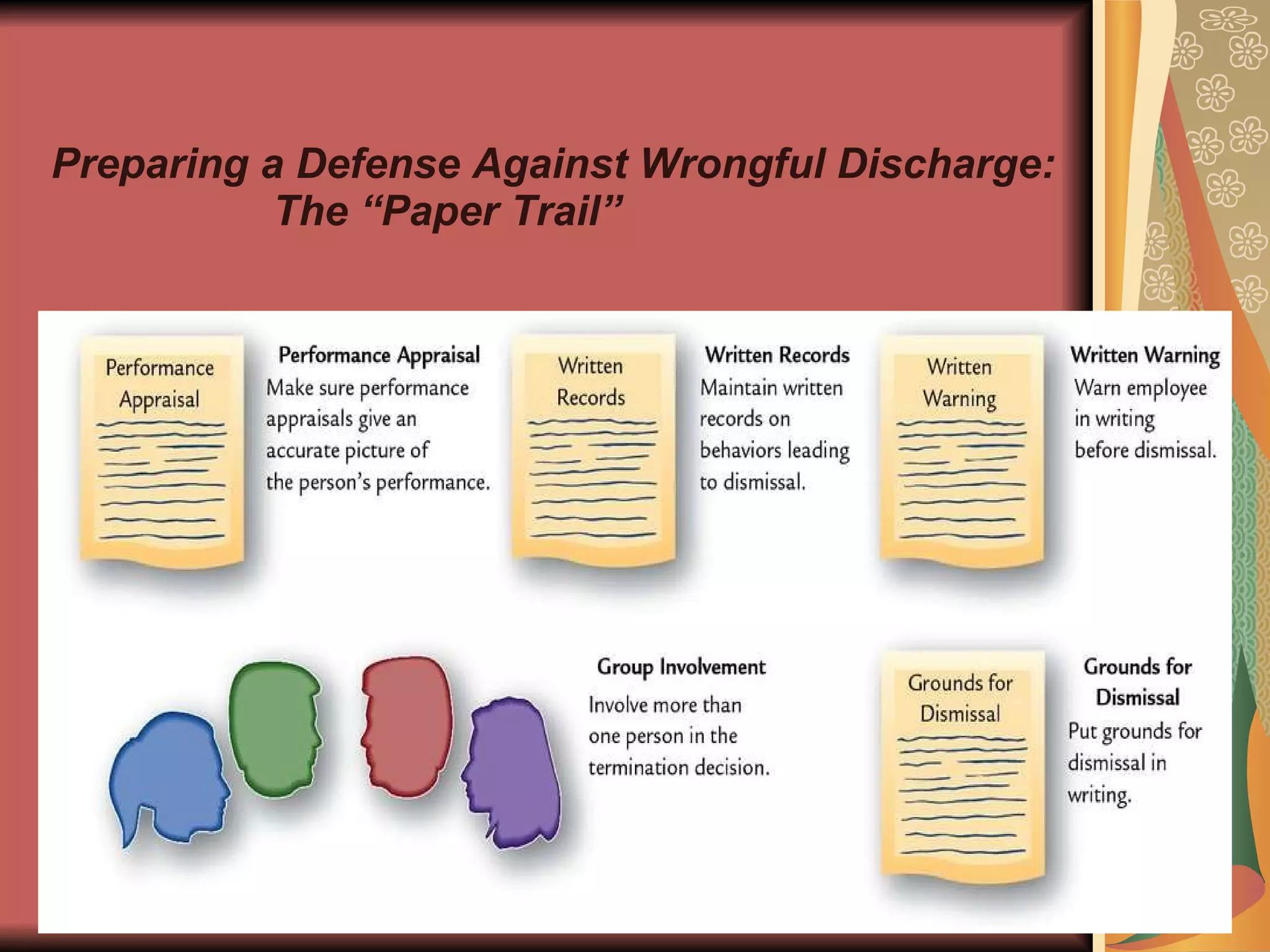
Preparing a Defense Against Wrongful Discharge: The “Paper Trail”
Employment-at-Will: Fairness Just Cause Reasonable justification for taking an employment-related action. Due Process The means used to allow individuals to explain and defend their actions against charges or discipline. Distributive Justice Perceived fairness in the distribution of outcomes. Procedural Justice Perceived fairness of the process used to make decision about employees.
Alternative Dispute Resolution (ADR) Arbitration Peer Review Panels Ombuds Alternative Dispute Resolution Methods
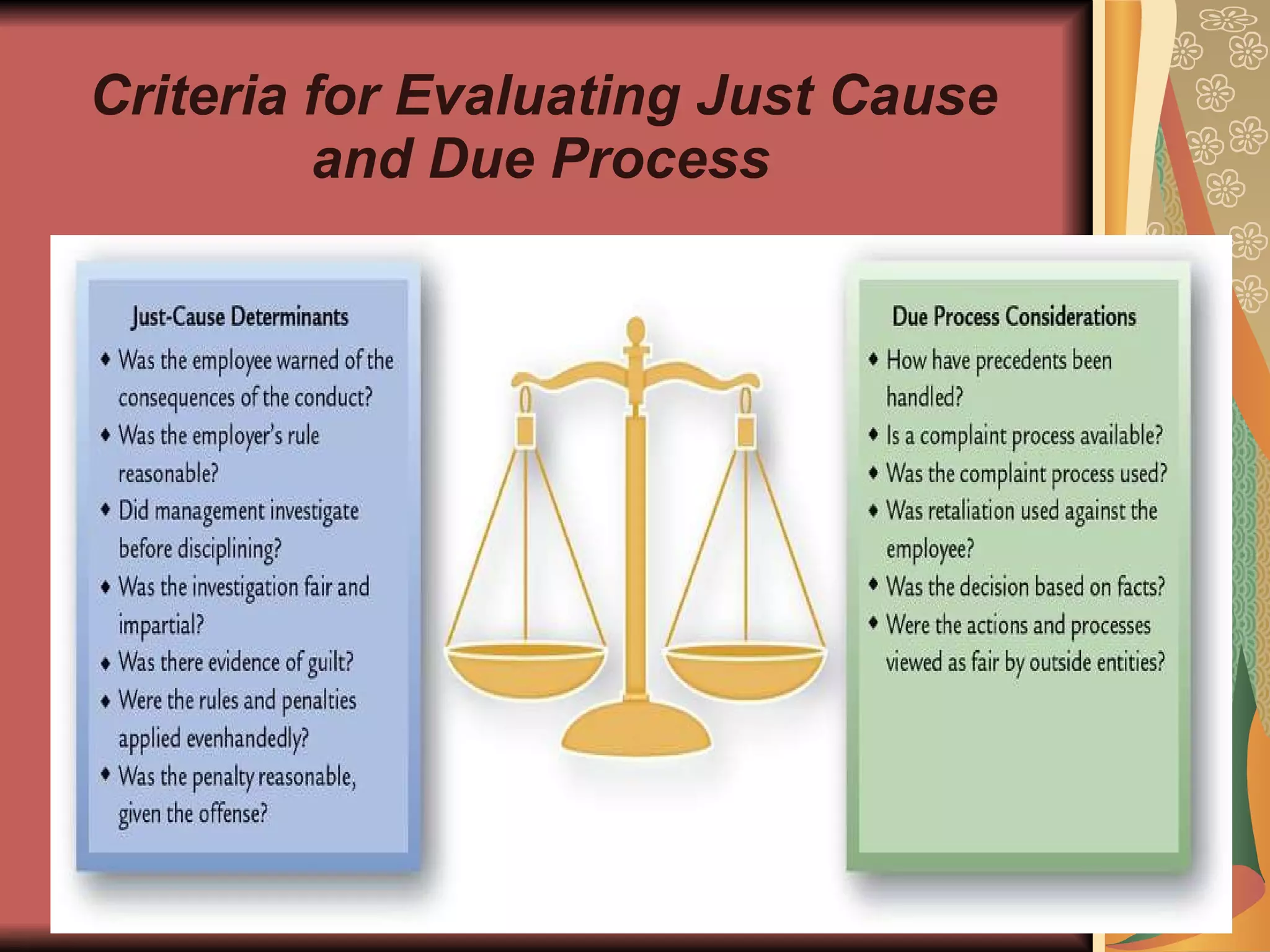
Criteria for Evaluating Just Cause and Due Process
Employees’ Free Speech Rights Employers’ Restrictions on Employees’ Free Speech Rights Advocacy of Controversial Views Publication of Blogs Engaging in Whistle-Blowing
Privacy Rights and Employee Records ADA Provisions Employee medical records are kept as separate confidential files available under limited conditions specified in the ADA. Security of Employee Records Restrict access to all records Set confidential passwords to HRIS databases Keep sensitive information in separate files and restricted databases Inform employees about data retained Purge outdated data from records Release information only with employee’s consent
Employee Record Files
Employee Rights and Personal Behavior Body Appearance An employer can place legitimate job-related limits on an employee’s personal at-work appearance such as tattoos and body piercings.  Off-Duty Behavior An employer can discipline an employee if the employee’s off-the-job behavior puts the company in legal or financial jeopardy.
Workplace Monitoring Right to Privacy Freedom from unauthorized and unreasonable intrusion into personal affairs. Privacy Rights and Employee Records : Access to personal info held by employer Response to unfavorable information in records Correction of erroneous information Prior notification when information is given to a third party
Balancing Employer Security and Employee Rights Workplace Monitoring Tracking Internet Use Monitoring Employee Performance Conducting Video Surveillance Monitoring of E-Mail and Voice Mail
E-mail and Voice Mail Electronic Communications Policy Elements Voice mail, e-mail, and computer files are provided by employer for business use only. Use of these media for personal reasons is restricted and subject to employer review. All computer passwords and codes must be available to the employer. The employer reserves right to monitor or search any of the media, without notice, for business purposes.
Recommended Employer Actions Regarding Electronic Communications
Employee Misconduct Sample Sample Sample Sample Sample Sample Sample Illegal Drug  Use Falsification of Documents Misuse of Company Funds Disclosure of Organizational Secrets Workplace  Violence Employment Harassment Employee  Theft Types of Employee  Misconduct
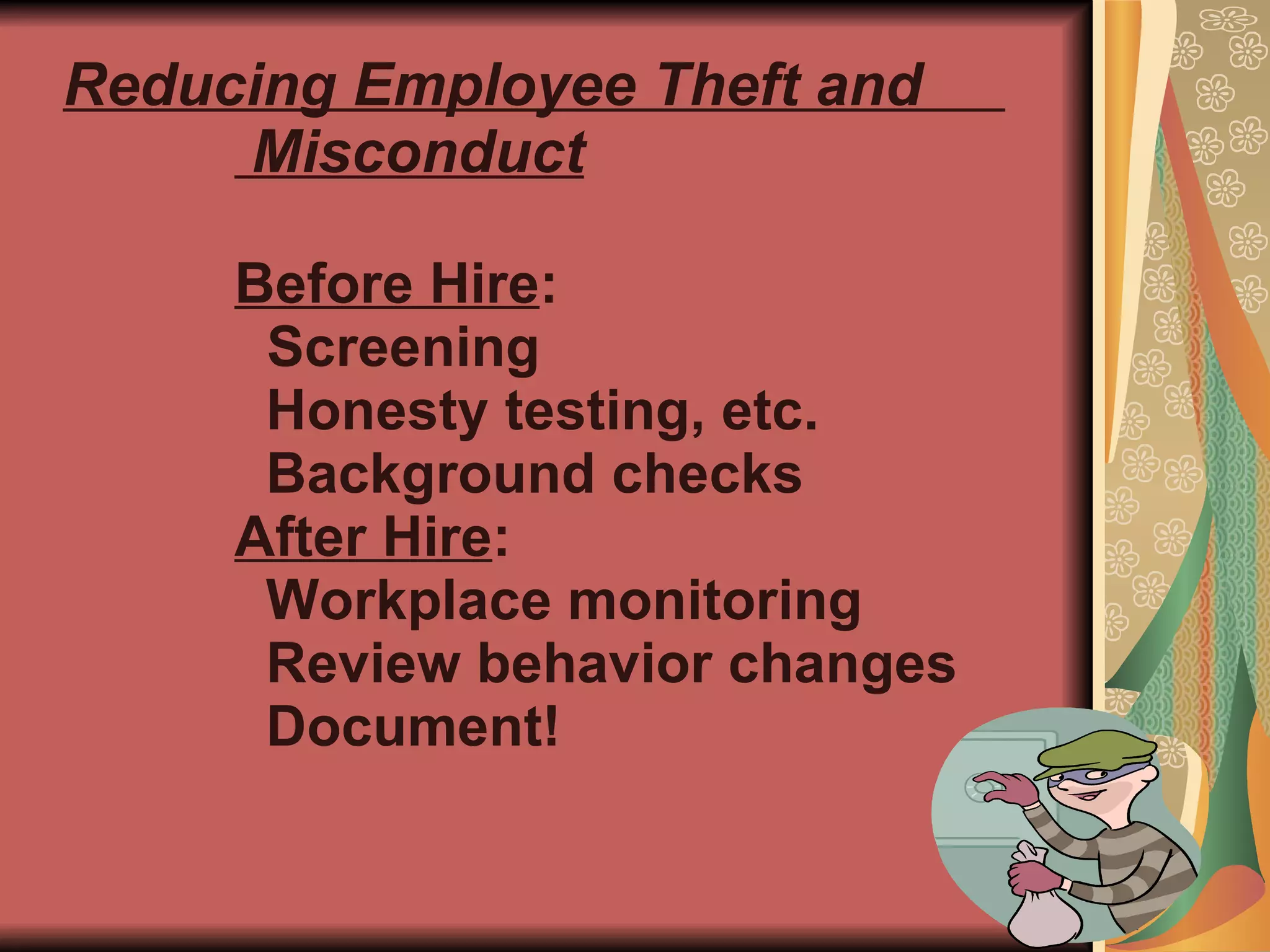
Reducing Employee Theft and  Misconduct Before Hire : Screening   Honesty testing, etc.   Background checks After Hire :   Workplace monitoring   Review behavior changes   Document!
Employer Investigations   Employer Investigation of Workplace Conduct Administering Honesty Tests Reviewing Unusual On and Off the Job Behavior Conducting Work-Related Investigations
Substance Abuse and Drug Testing Drug-Free Workplace Act of 1988 Requires government contractors to take steps to eliminate employee drug use. Failure to comply may lead to contract termination. Act does not cover tobacco and alcohol. Off-the-job drug use not included. U.S. Department of Transportation (DOT) Requires regular testing of truck and bus drivers, train crews, mass-transit employees, airline pilots and mechanics, pipeline workers, and licensed sailors.
How Substance Abuse Affects Employers Financially
Drug Testing and Employee Rights Policies for Conducting Drug Tests Random testing of all employees at periodic intervals Testing only in cases of probable cause Testing after accidents Testing Conditions Job consequences outweigh privacy concerns. Accurate test procedures are available. Written consent of the employee is obtained. Results are treated confidentially. Employer has drug program, including an EAP.
HR Policies, Procedures, and Rules Policies General guidelines that focus organizational actions. “ Why we do it” Procedures Customary methods of handling activities “ How we do it” Rules Specific guidelines that regulate and restrict the behavior of individuals. “ The limits on what  we do” Employee Rights
Typical Division of HR Responsibilities: Policies,  Procedures, and Rules
Employee Handbooks At-Will Prerogatives Harassment Pay/Overtime Discipline Electronic Communication Benefits Policies in Handbooks
Employee Handbooks Legal Language Eliminate controversial phrases in wording. Use disclaimers disavowing handbook as a contract. Keep handbook content current. Readability Make reading level appropriate for intended audience of employees. Use Communicate and discuss handbook. Notify all employees of handbook changes.
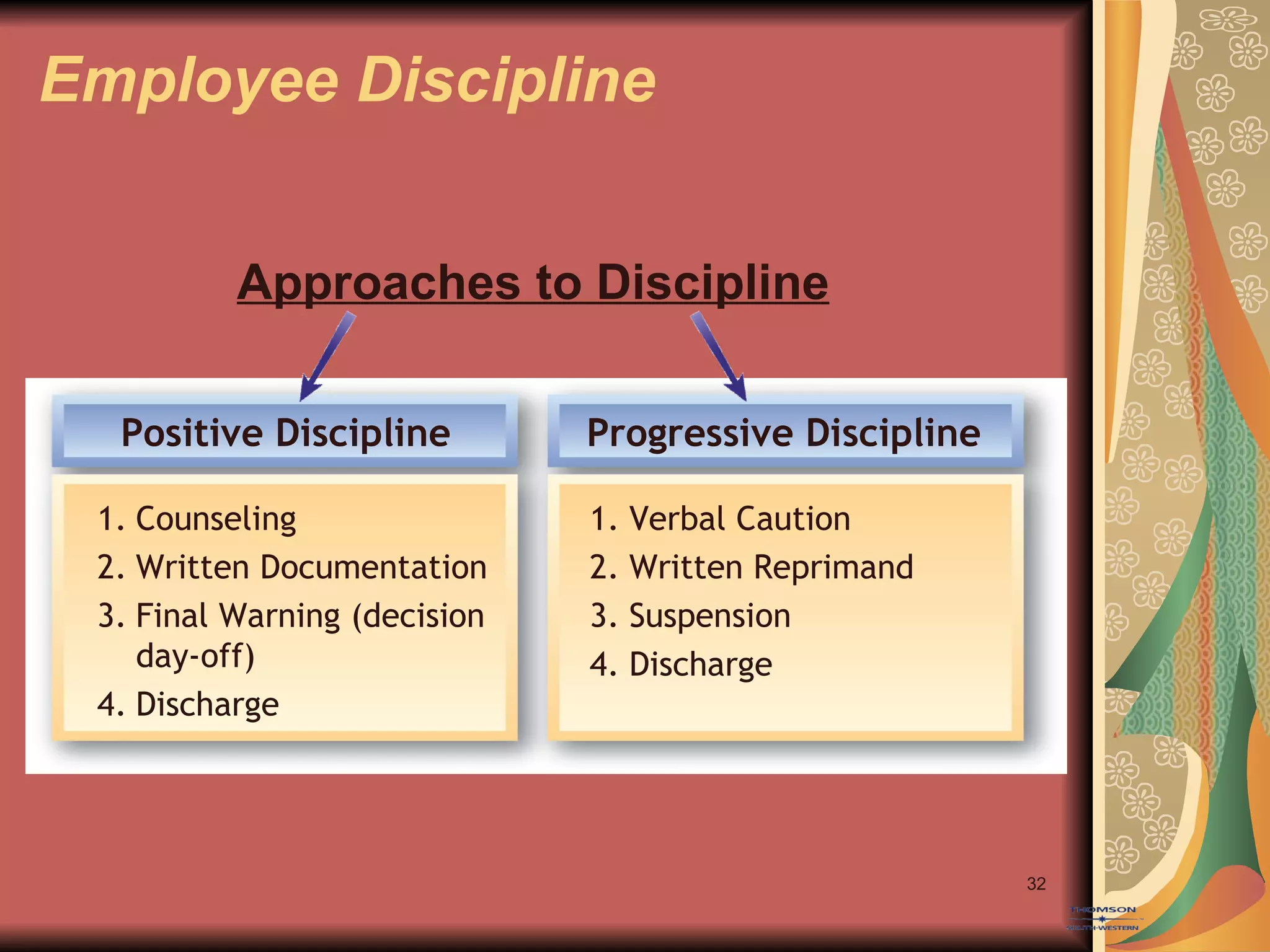
Employee Discipline Positive Discipline Counseling Written Documentation Final Warning (decision day-off) Discharge Progressive Discipline Verbal Caution Written Reprimand Suspension Discharge Approaches to Discipline
Employee Discipline Organizational culture of  avoiding discipline Lack of support by higher management Fear of  lawsuits Avoidance of  time loss Guilt about  past behavior Fear of loss of friendship Reasons Why Managers Might Not Use  Discipline
Discharge: Last Disciplinary Step Termination Process Coordinate manager and HR review Select a neutral location Conduct the termination meeting Have HR discuss termination benefits Escort the employee from the building Notify the department staff Separation Agreement Terminated employee agrees not to sue the employer, in exchange for specified benefits.

Employee Rights

  • 1.
    Employee Rights andResponsibilities Rights That which belongs to a person by law, nature, or tradition. Responsibilities Obligations to perform certain tasks and duties. Statutory Rights Rights based on specific laws and statutes passed by federal, state, and local governments. Equal employment opportunity Collective bargaining Workplace safety
  • 2.
    Contractual Rights ContractualRights Rights based on a specific contract between employer and employee. Employment Contract An agreement that formally outlines the details of employment . Implied Contract Notion that a contract exists between employer and employee based on implied promises of employer .
  • 3.
  • 4.
    Contractual Rights Non-CompeteAgreements Prohibit individuals who quit from competing with employer in the same line of business for a period of time. Non-piracy agreements Non-solicitation of current employees Intellectual property and trade secrets Employment Contract Clauses
  • 5.
    Contractual Rights Employment Practices Liability Insurance (EPLI) Covers employer’s costs for legal fees, settlements, and judgments associated with employment-related actions.
  • 6.
    Rights Affecting theEmployment Relationship Employment-at-Will (EAW) Wrongful and Constructive Discharge Just Cause Due Process Distributive and Procedural Justice The Employment Relationship
  • 7.
    Employment-at-Will (EAW) EmployersEmployers have the right to hire, fire, demote, or promote as they choose, unless there is a law or contract to the contrary . Employees Employees have the right to quit and get another job under the same constraints .
  • 8.
    Employment-at-Will (EAW) Exceptionsto EAW Violation of Public Policy Implied Contract of Continuing Employment Covenant of Good-faith and Fair-dealing
  • 9.
    Employment-at-Will Restrictions WrongfulDischarge Termination of an individual’s employment for improper or illegal reasons . Fortune v. National Cash Register Constructive Discharge An employer deliberately makes working conditions intolerable in an attempt to get (to force) an employee to resign or quit.
  • 10.
    Preparing a DefenseAgainst Wrongful Discharge: The “Paper Trail”
  • 11.
    Employment-at-Will: Fairness JustCause Reasonable justification for taking an employment-related action. Due Process The means used to allow individuals to explain and defend their actions against charges or discipline. Distributive Justice Perceived fairness in the distribution of outcomes. Procedural Justice Perceived fairness of the process used to make decision about employees.
  • 12.
    Alternative Dispute Resolution(ADR) Arbitration Peer Review Panels Ombuds Alternative Dispute Resolution Methods
  • 13.
    Criteria for EvaluatingJust Cause and Due Process
  • 14.
    Employees’ Free SpeechRights Employers’ Restrictions on Employees’ Free Speech Rights Advocacy of Controversial Views Publication of Blogs Engaging in Whistle-Blowing
  • 15.
    Privacy Rights andEmployee Records ADA Provisions Employee medical records are kept as separate confidential files available under limited conditions specified in the ADA. Security of Employee Records Restrict access to all records Set confidential passwords to HRIS databases Keep sensitive information in separate files and restricted databases Inform employees about data retained Purge outdated data from records Release information only with employee’s consent
  • 16.
  • 17.
    Employee Rights andPersonal Behavior Body Appearance An employer can place legitimate job-related limits on an employee’s personal at-work appearance such as tattoos and body piercings. Off-Duty Behavior An employer can discipline an employee if the employee’s off-the-job behavior puts the company in legal or financial jeopardy.
  • 18.
    Workplace Monitoring Rightto Privacy Freedom from unauthorized and unreasonable intrusion into personal affairs. Privacy Rights and Employee Records : Access to personal info held by employer Response to unfavorable information in records Correction of erroneous information Prior notification when information is given to a third party
  • 19.
    Balancing Employer Securityand Employee Rights Workplace Monitoring Tracking Internet Use Monitoring Employee Performance Conducting Video Surveillance Monitoring of E-Mail and Voice Mail
  • 20.
    E-mail and VoiceMail Electronic Communications Policy Elements Voice mail, e-mail, and computer files are provided by employer for business use only. Use of these media for personal reasons is restricted and subject to employer review. All computer passwords and codes must be available to the employer. The employer reserves right to monitor or search any of the media, without notice, for business purposes.
  • 21.
    Recommended Employer ActionsRegarding Electronic Communications
  • 22.
    Employee Misconduct SampleSample Sample Sample Sample Sample Sample Illegal Drug Use Falsification of Documents Misuse of Company Funds Disclosure of Organizational Secrets Workplace Violence Employment Harassment Employee Theft Types of Employee Misconduct
  • 23.
    Reducing Employee Theftand Misconduct Before Hire : Screening Honesty testing, etc. Background checks After Hire : Workplace monitoring Review behavior changes Document!
  • 24.
    Employer Investigations Employer Investigation of Workplace Conduct Administering Honesty Tests Reviewing Unusual On and Off the Job Behavior Conducting Work-Related Investigations
  • 25.
    Substance Abuse andDrug Testing Drug-Free Workplace Act of 1988 Requires government contractors to take steps to eliminate employee drug use. Failure to comply may lead to contract termination. Act does not cover tobacco and alcohol. Off-the-job drug use not included. U.S. Department of Transportation (DOT) Requires regular testing of truck and bus drivers, train crews, mass-transit employees, airline pilots and mechanics, pipeline workers, and licensed sailors.
  • 26.
    How Substance AbuseAffects Employers Financially
  • 27.
    Drug Testing andEmployee Rights Policies for Conducting Drug Tests Random testing of all employees at periodic intervals Testing only in cases of probable cause Testing after accidents Testing Conditions Job consequences outweigh privacy concerns. Accurate test procedures are available. Written consent of the employee is obtained. Results are treated confidentially. Employer has drug program, including an EAP.
  • 28.
    HR Policies, Procedures,and Rules Policies General guidelines that focus organizational actions. “ Why we do it” Procedures Customary methods of handling activities “ How we do it” Rules Specific guidelines that regulate and restrict the behavior of individuals. “ The limits on what we do” Employee Rights
  • 29.
    Typical Division ofHR Responsibilities: Policies, Procedures, and Rules
  • 30.
    Employee Handbooks At-WillPrerogatives Harassment Pay/Overtime Discipline Electronic Communication Benefits Policies in Handbooks
  • 31.
    Employee Handbooks LegalLanguage Eliminate controversial phrases in wording. Use disclaimers disavowing handbook as a contract. Keep handbook content current. Readability Make reading level appropriate for intended audience of employees. Use Communicate and discuss handbook. Notify all employees of handbook changes.
  • 32.
    Employee Discipline PositiveDiscipline Counseling Written Documentation Final Warning (decision day-off) Discharge Progressive Discipline Verbal Caution Written Reprimand Suspension Discharge Approaches to Discipline
  • 33.
    Employee Discipline Organizationalculture of avoiding discipline Lack of support by higher management Fear of lawsuits Avoidance of time loss Guilt about past behavior Fear of loss of friendship Reasons Why Managers Might Not Use Discipline
  • 34.
    Discharge: Last DisciplinaryStep Termination Process Coordinate manager and HR review Select a neutral location Conduct the termination meeting Have HR discuss termination benefits Escort the employee from the building Notify the department staff Separation Agreement Terminated employee agrees not to sue the employer, in exchange for specified benefits.