Responsibility for HRM
Shaikh Sajibur Rahman,AMC,BIM.
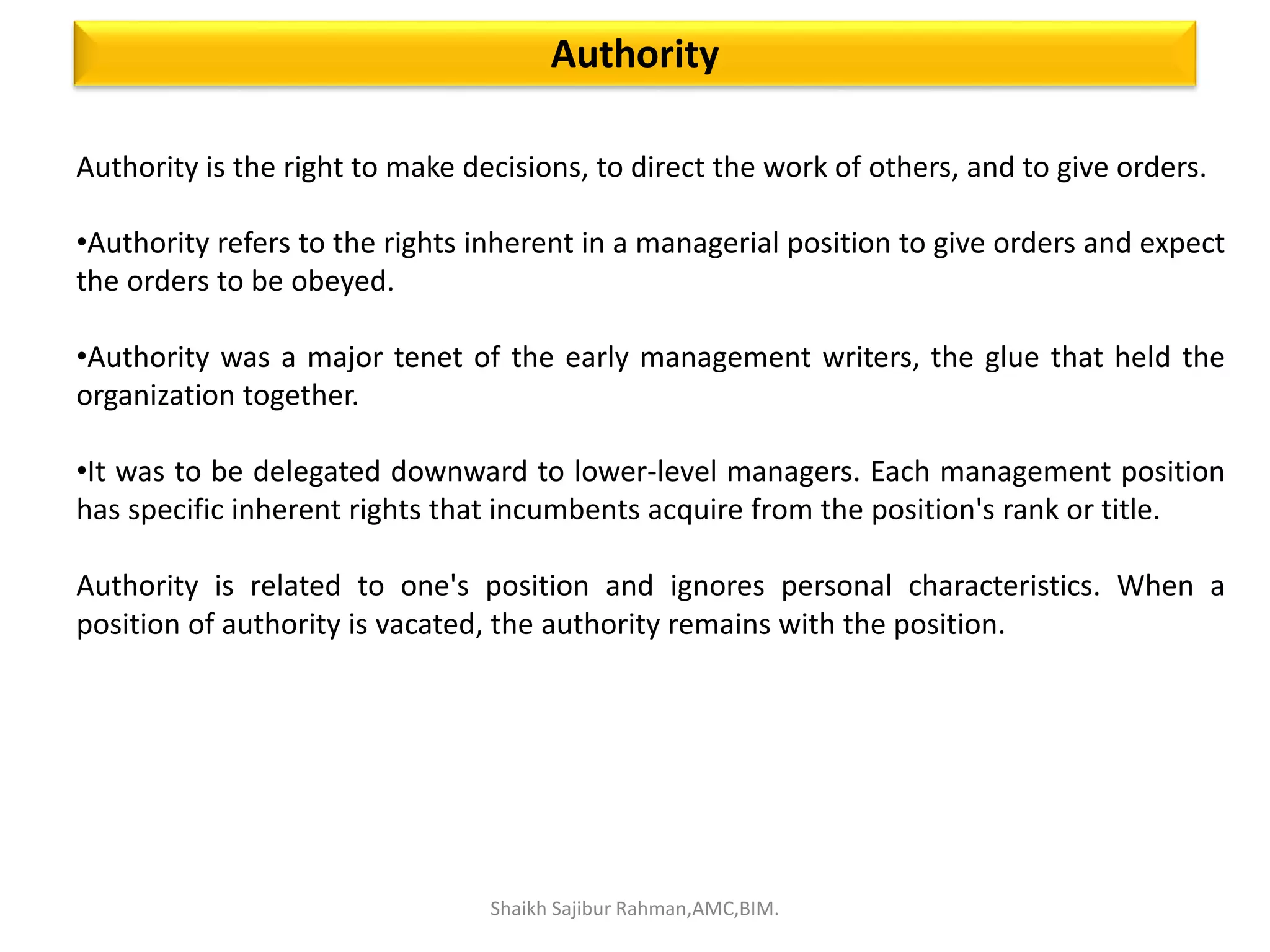
Authority is the right to make decisions, to direct the work of others, and to give orders.
•Authority refers to the rights inherent in a managerial position to give orders and expect
the orders to be obeyed.
•Authority was a major tenet of the early management writers, the glue that held the
organization together.
•It was to be delegated downward to lower-level managers. Each management position
has specific inherent rights that incumbents acquire from the position's rank or title.
Authority is related to one's position and ignores personal characteristics. When a
position of authority is vacated, the authority remains with the position.
Authority
Shaikh Sajibur Rahman,AMC,BIM.
Organization of HR Department
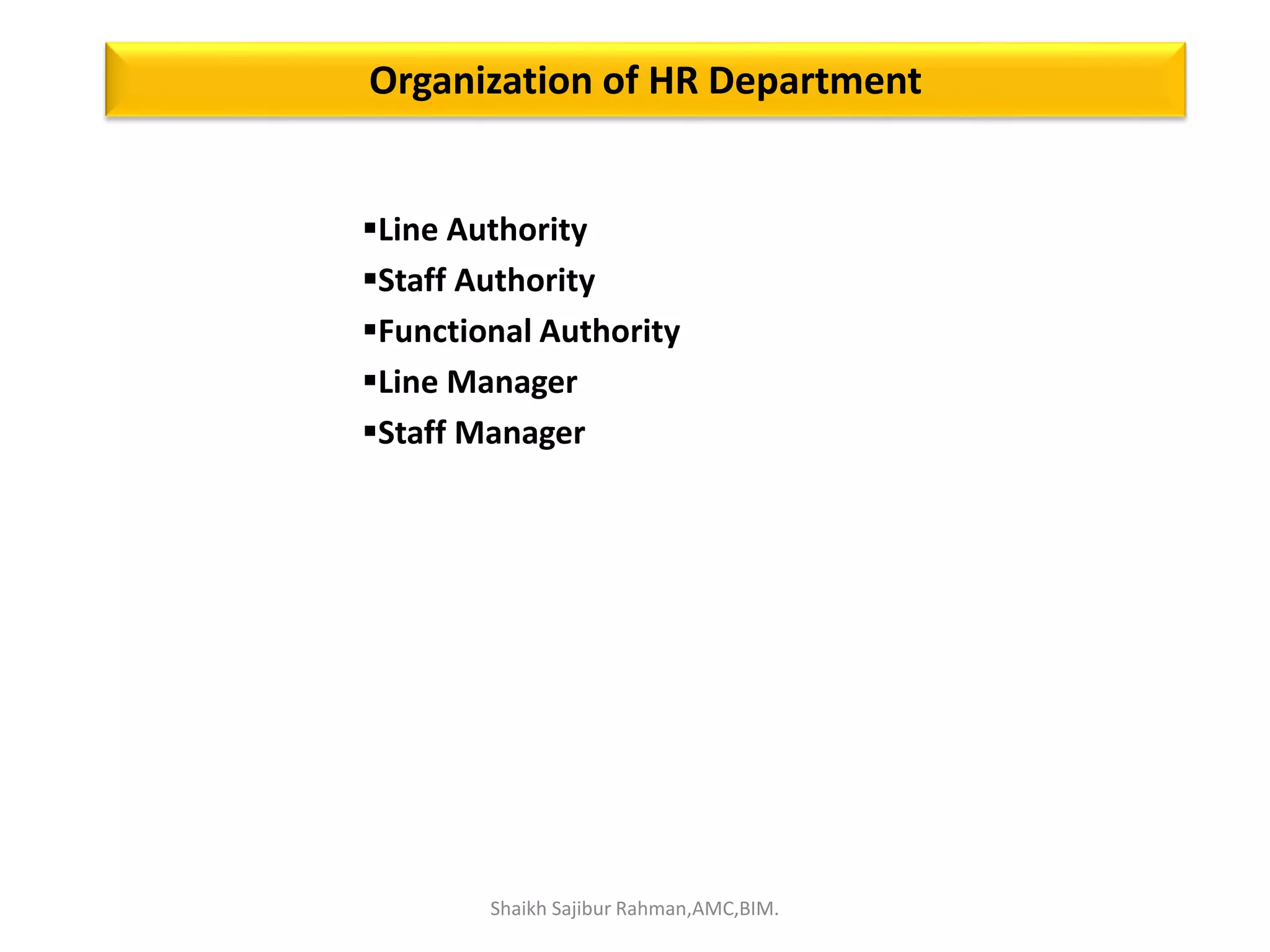
Line Authority
Staff Authority
Functional Authority
Line Manager
Staff Manager
Shaikh Sajibur Rahman,AMC,BIM.
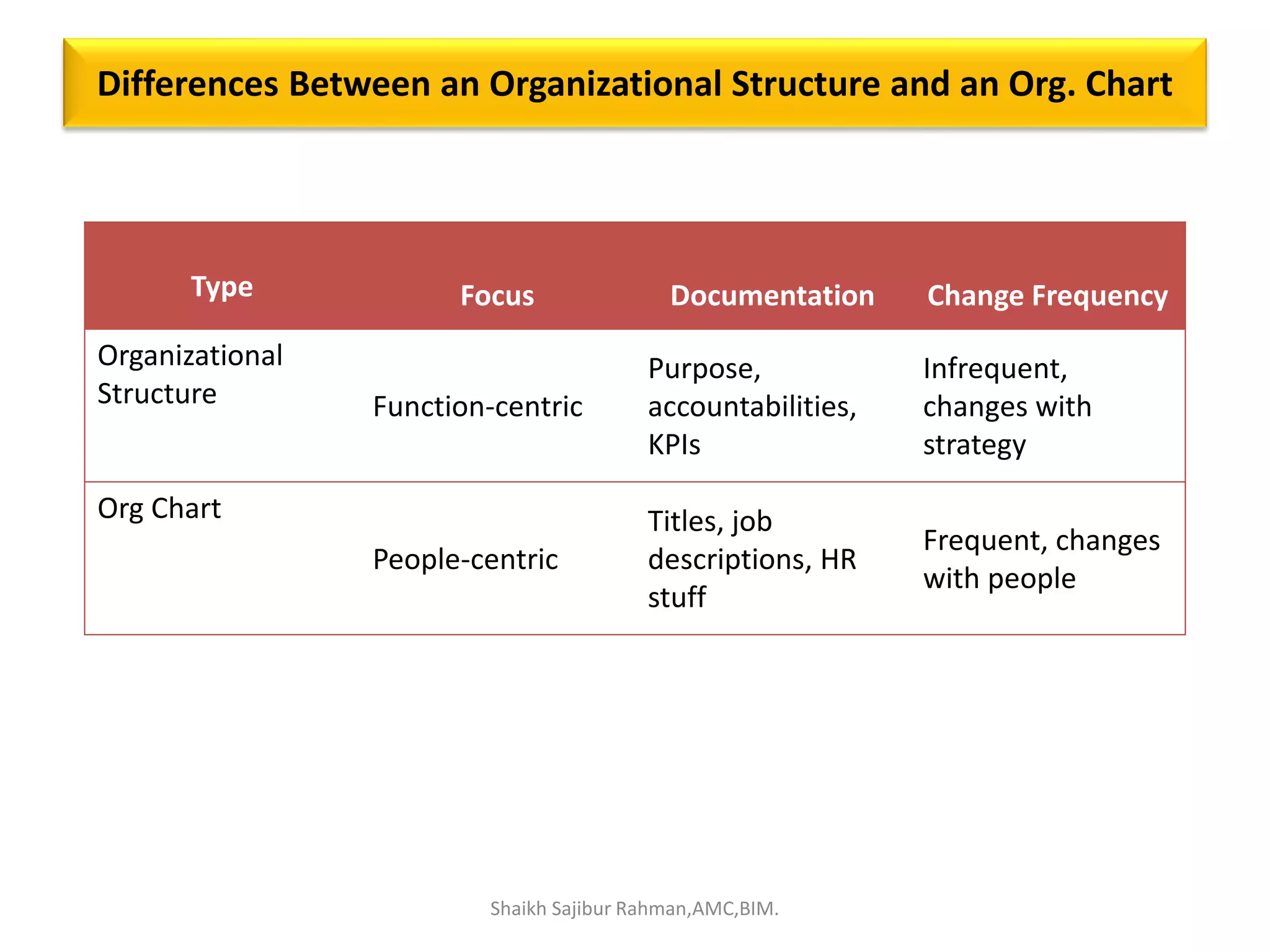
Type Focus Documentation Change Frequency
Organizational
Structure Function-centric
Purpose,
accountabilities,
KPIs
Infrequent,
changes with
strategy
Org Chart
People-centric
Titles, job
descriptions, HR
stuff
Frequent, changes
with people
Differences Between an Organizational Structure and an Org. Chart
Shaikh Sajibur Rahman,AMC,BIM.
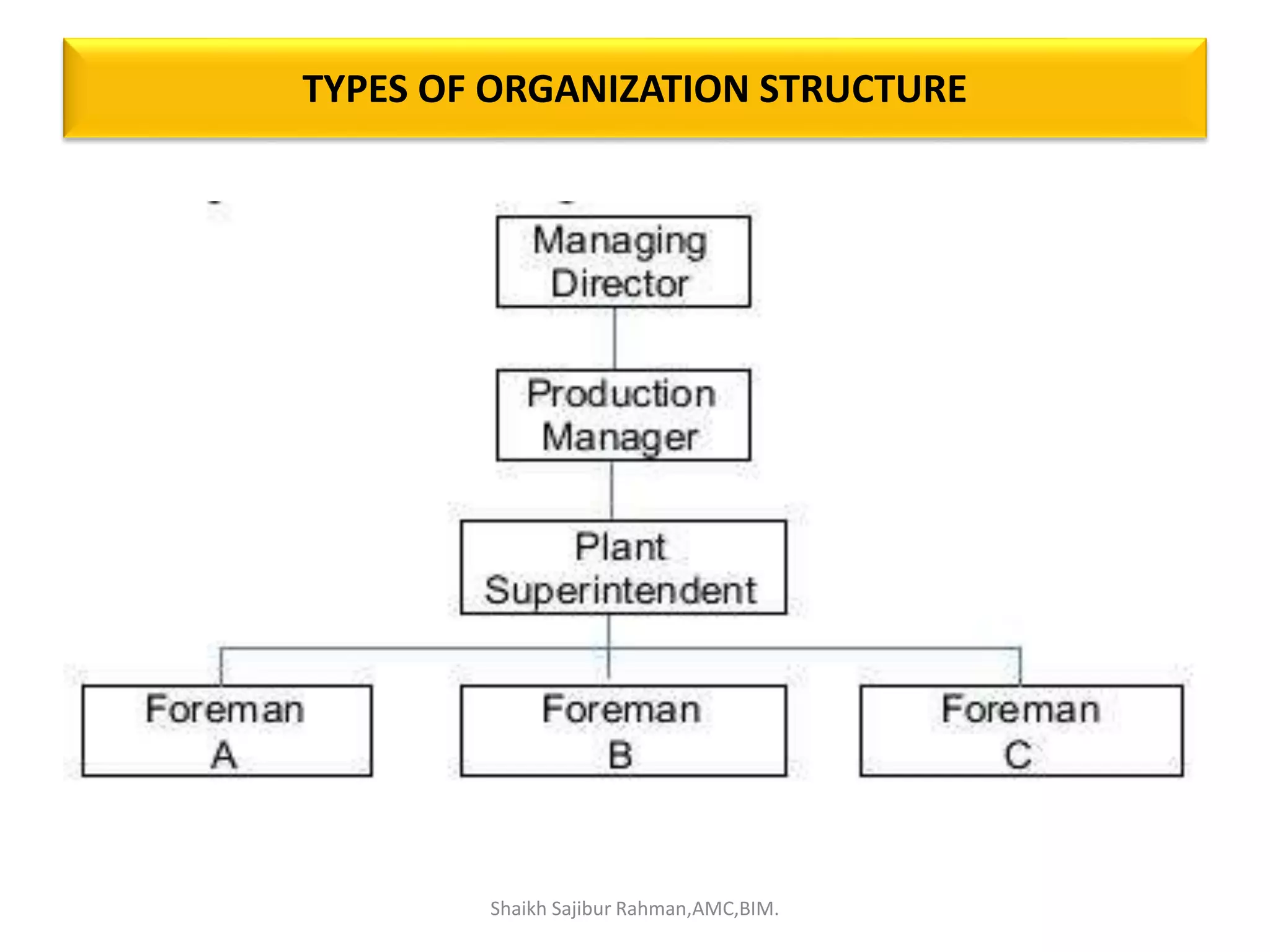
TYPES OF ORGANIZATION STRUCTURE
Shaikh Sajibur Rahman,AMC,BIM.
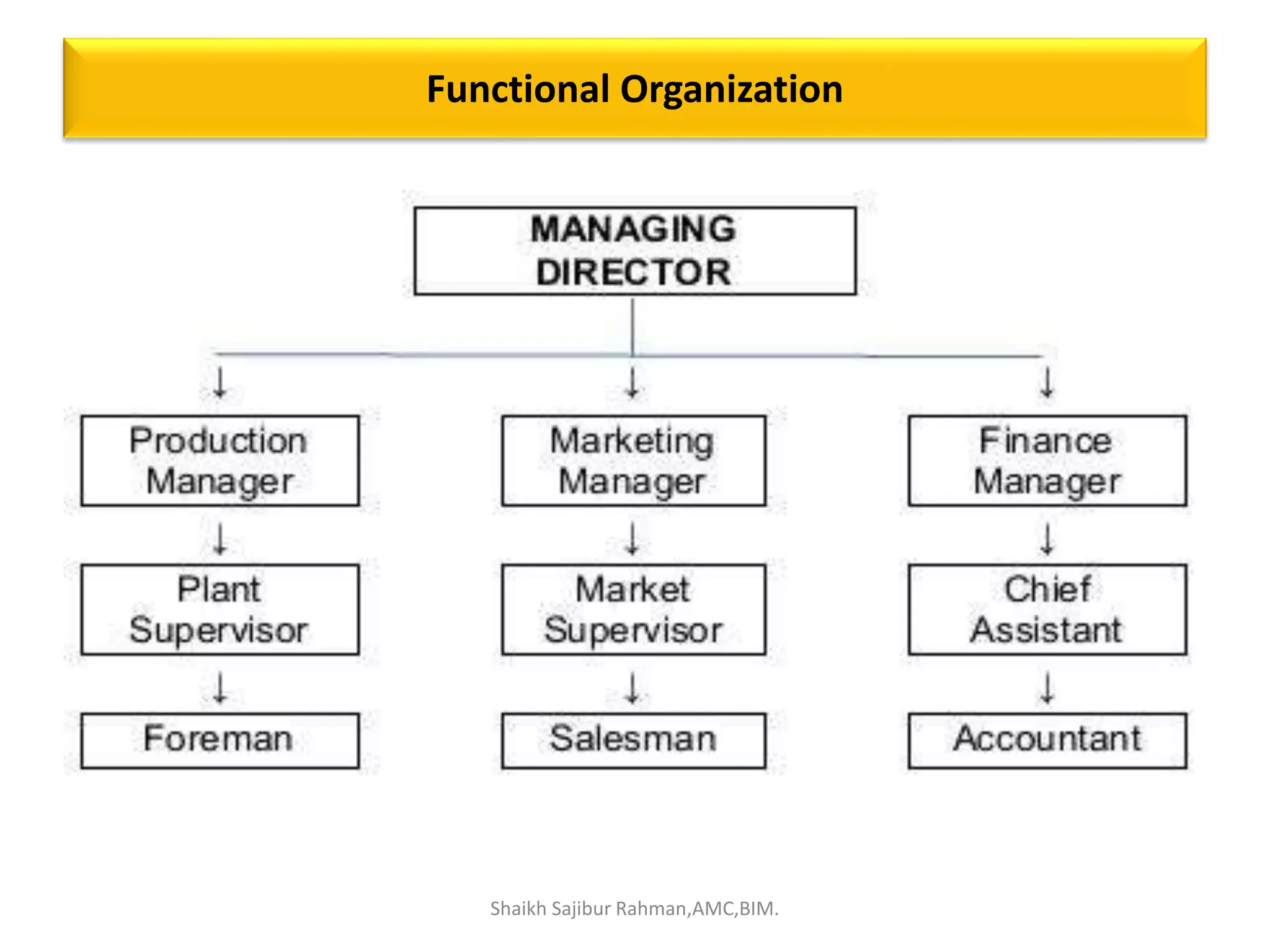
Functional Organization
Shaikh Sajibur Rahman,AMC,BIM.
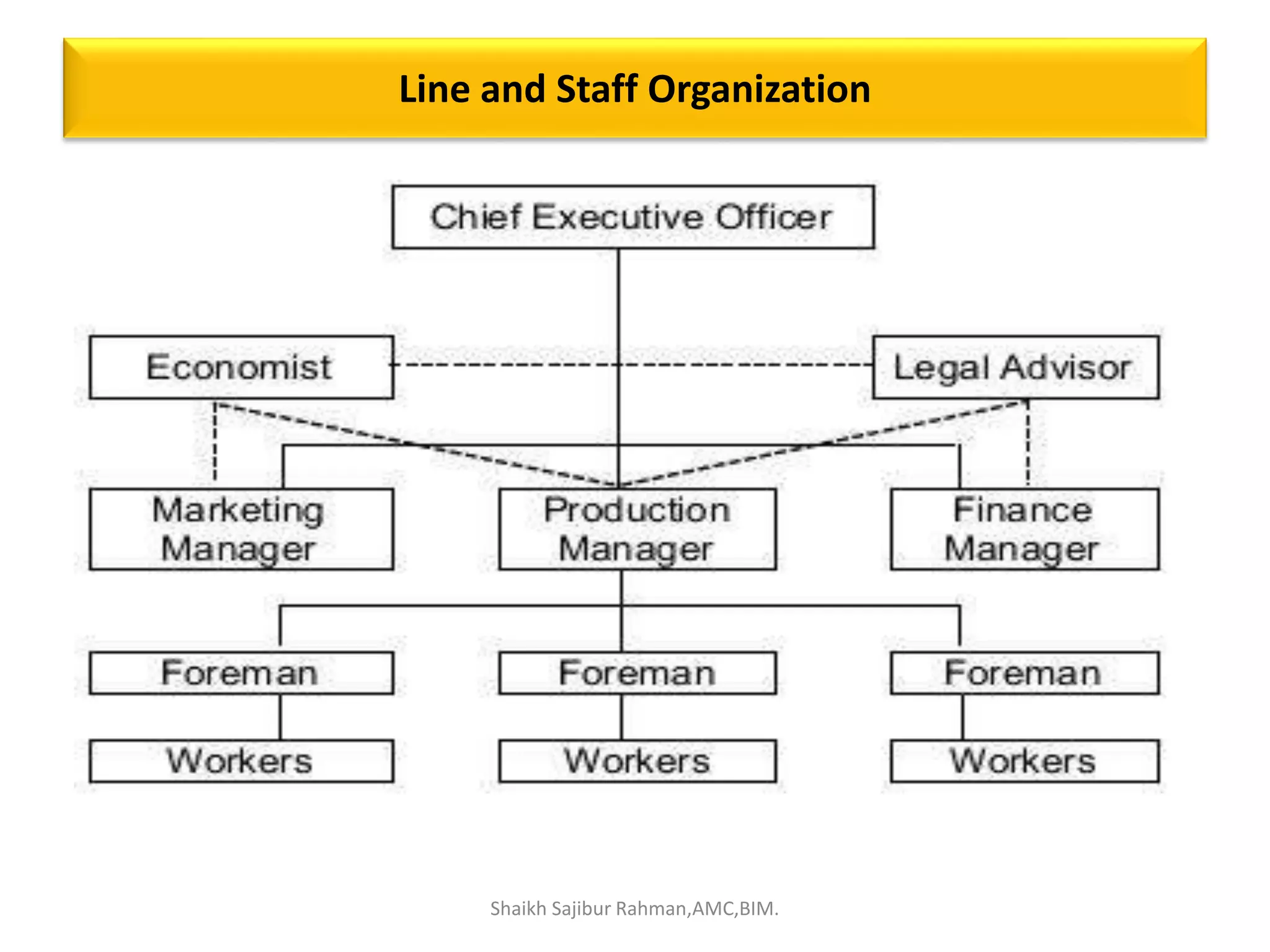
Line and Staff Organization
Shaikh Sajibur Rahman,AMC,BIM.
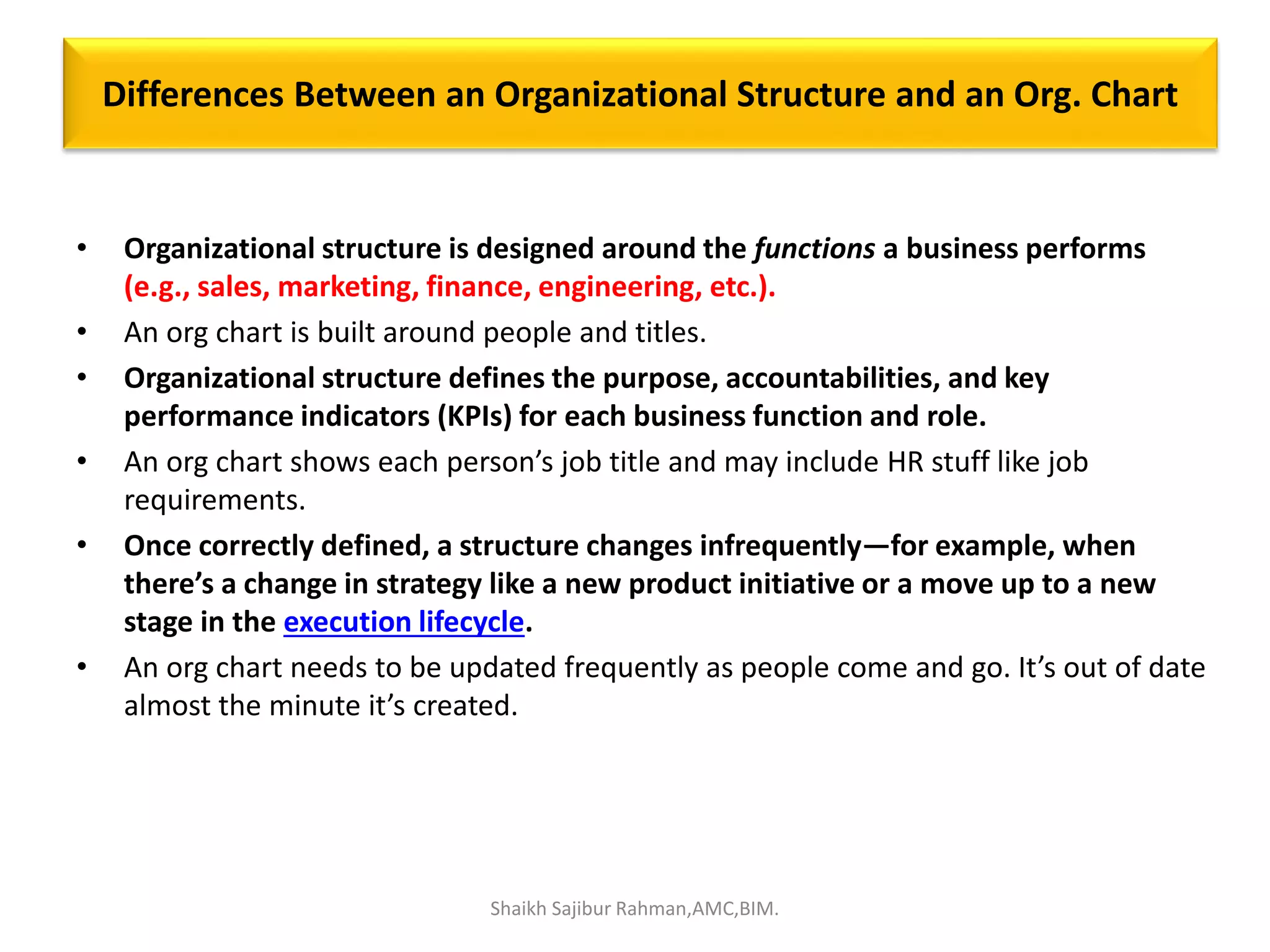
Differences Between an Organizational Structure and an Org. Chart
• Organizational structure is designed around the functions a business performs
(e.g., sales, marketing, finance, engineering, etc.).
• An org chart is built around people and titles.
• Organizational structure defines the purpose, accountabilities, and key
performance indicators (KPIs) for each business function and role.
• An org chart shows each person’s job title and may include HR stuff like job
requirements.
• Once correctly defined, a structure changes infrequently—for example, when
there’s a change in strategy like a new product initiative or a move up to a new
stage in the execution lifecycle.
• An org chart needs to be updated frequently as people come and go. It’s out of date
almost the minute it’s created.
Shaikh Sajibur Rahman,AMC,BIM.
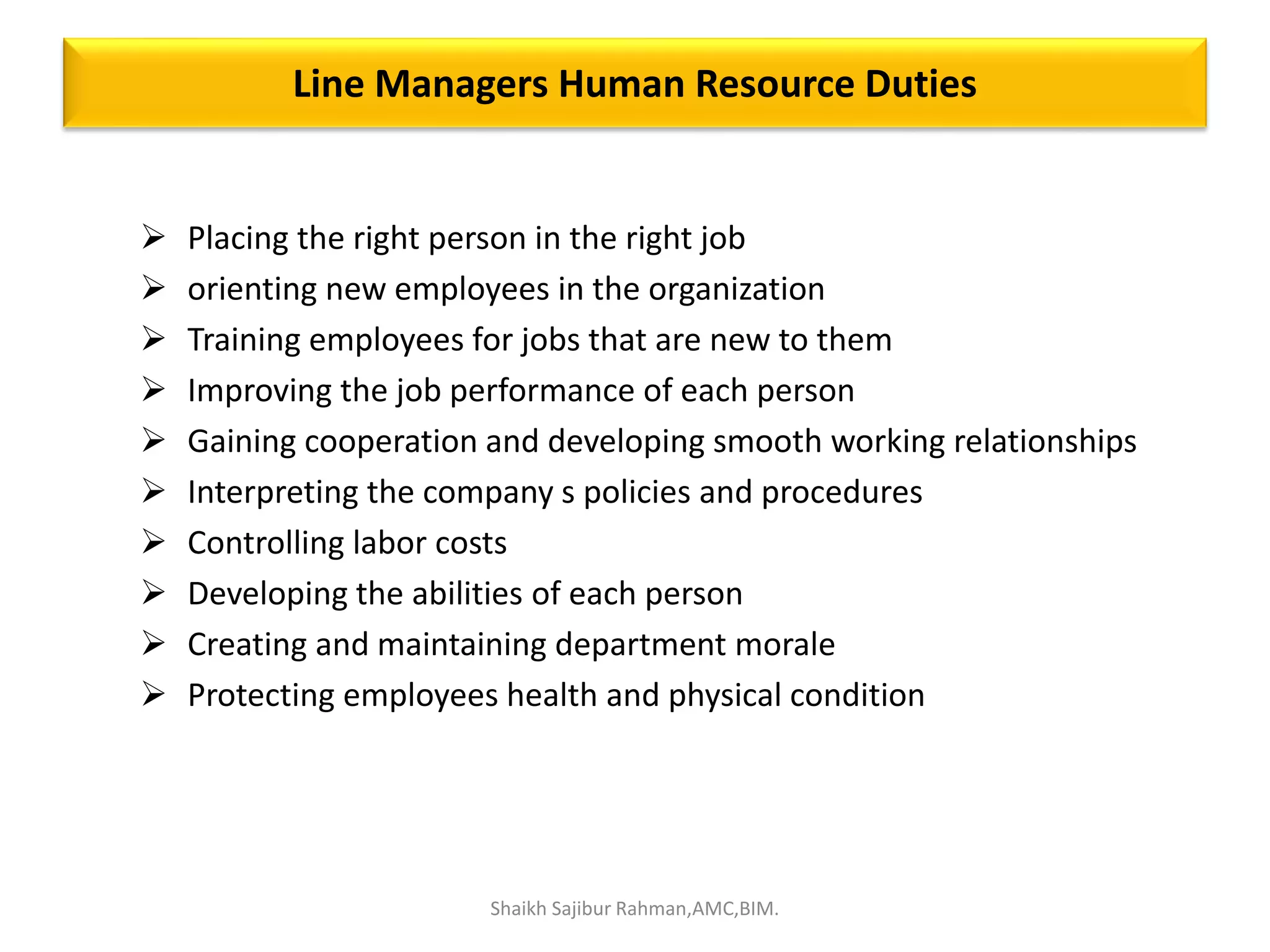
Line Managers Human Resource Duties
 Placing the right person in the right job
 orienting new employees in the organization
 Training employees for jobs that are new to them
 Improving the job performance of each person
 Gaining cooperation and developing smooth working relationships
 Interpreting the company s policies and procedures
 Controlling labor costs
 Developing the abilities of each person
 Creating and maintaining department morale
 Protecting employees health and physical condition
Shaikh Sajibur Rahman,AMC,BIM.
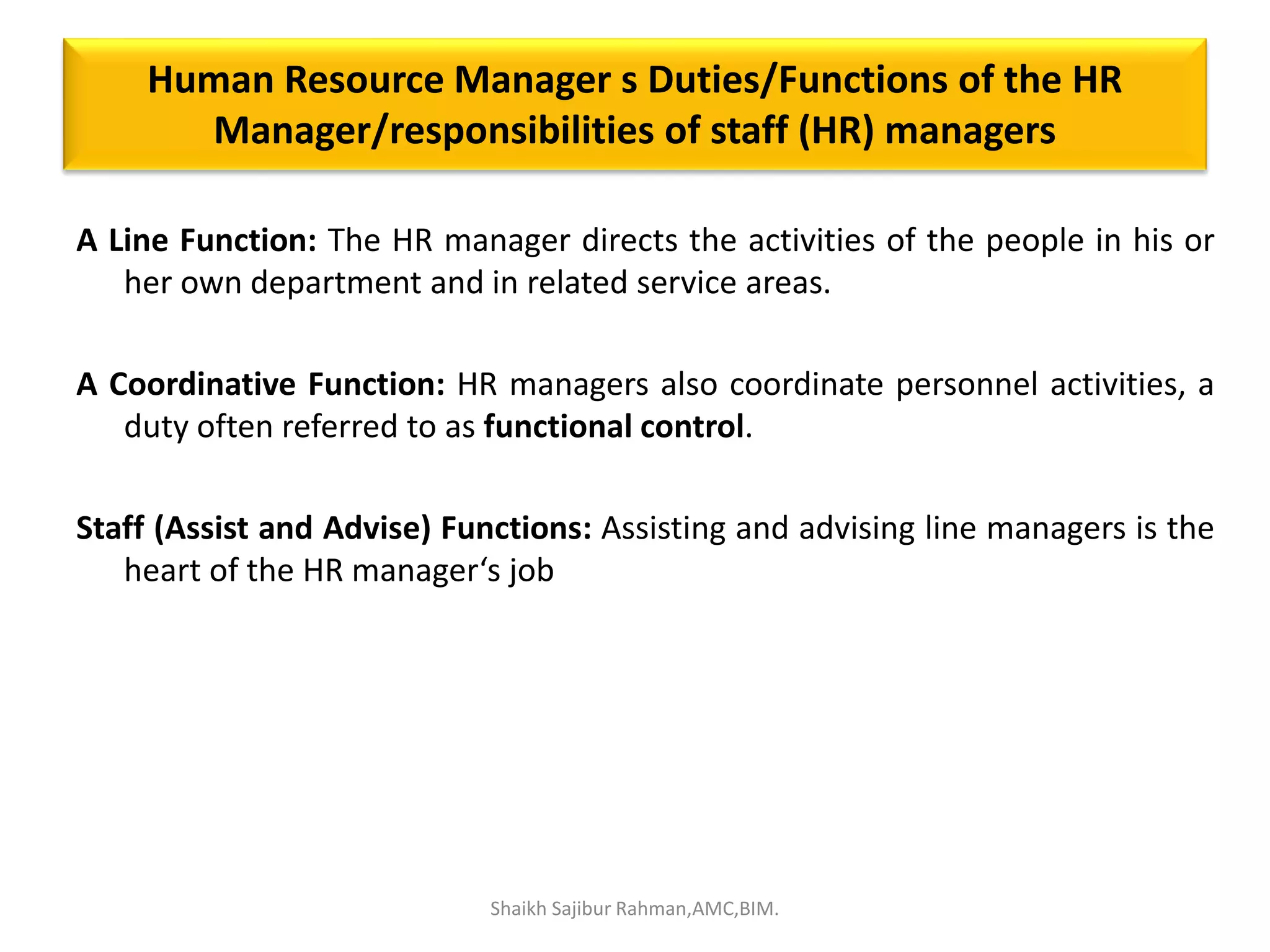
Human Resource Manager s Duties/Functions of the HR
Manager/responsibilities of staff (HR) managers
A Line Function: The HR manager directs the activities of the people in his or
her own department and in related service areas.
A Coordinative Function: HR managers also coordinate personnel activities, a
duty often referred to as functional control.
Staff (Assist and Advise) Functions: Assisting and advising line managers is the
heart of the HR manager‘s job
Shaikh Sajibur Rahman,AMC,BIM.
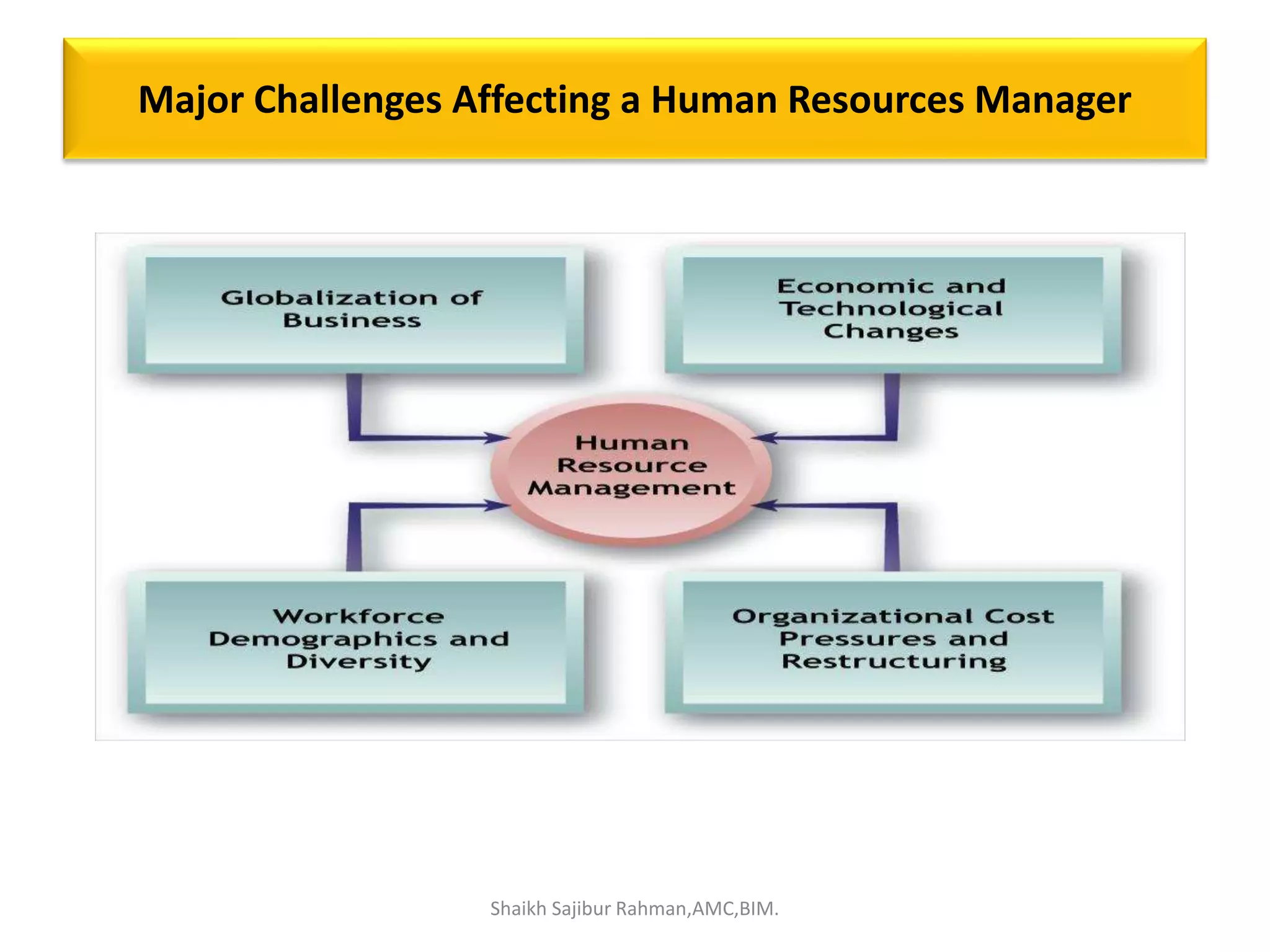
Major Challenges Affecting a Human Resources Manager
Shaikh Sajibur Rahman,AMC,BIM.
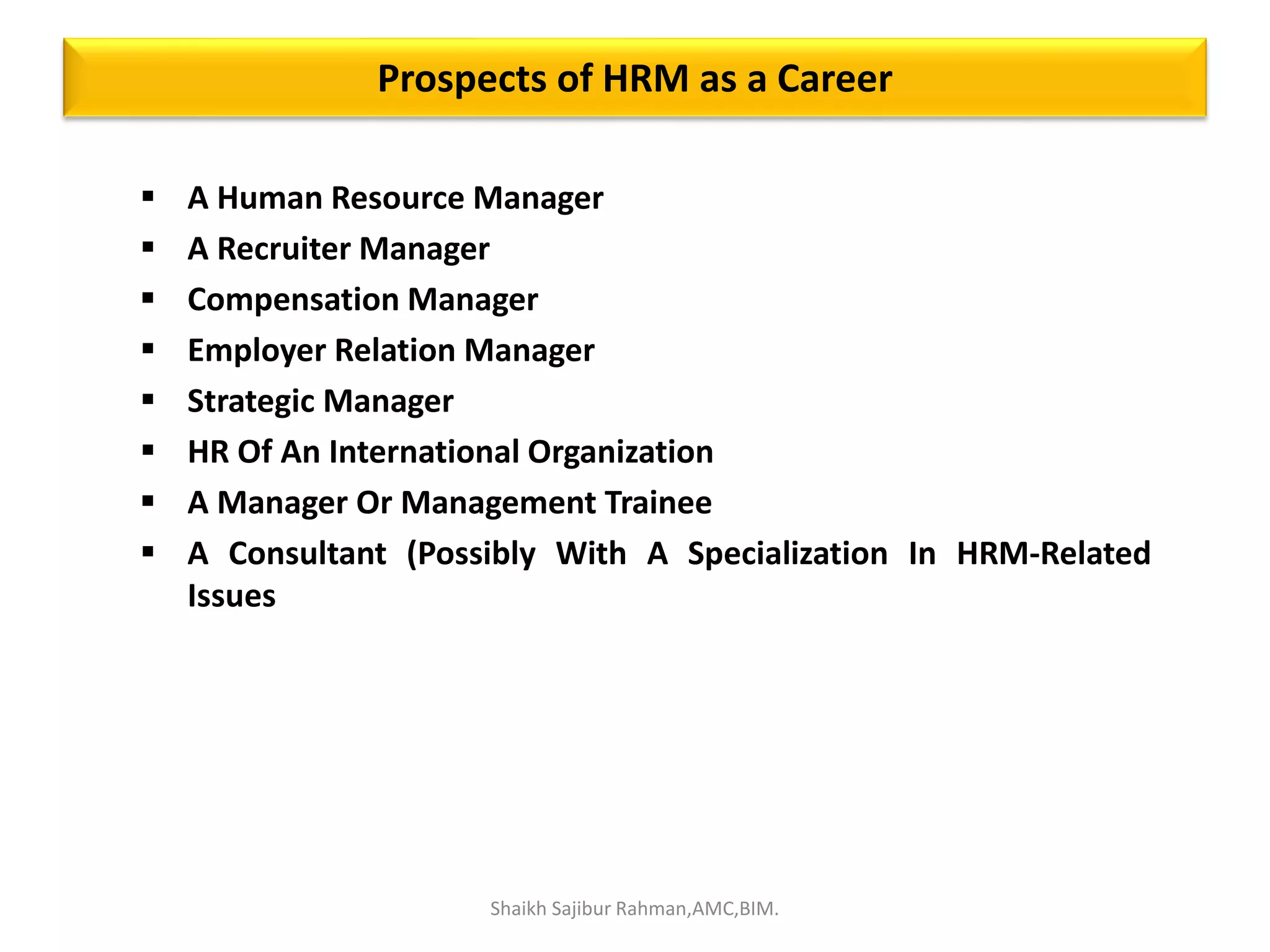
Prospects of HRM as a Career
 A Human Resource Manager
 A Recruiter Manager
 Compensation Manager
 Employer Relation Manager
 Strategic Manager
 HR Of An International Organization
 A Manager Or Management Trainee
 A Consultant (Possibly With A Specialization In HRM-Related
Issues
Shaikh Sajibur Rahman,AMC,BIM.
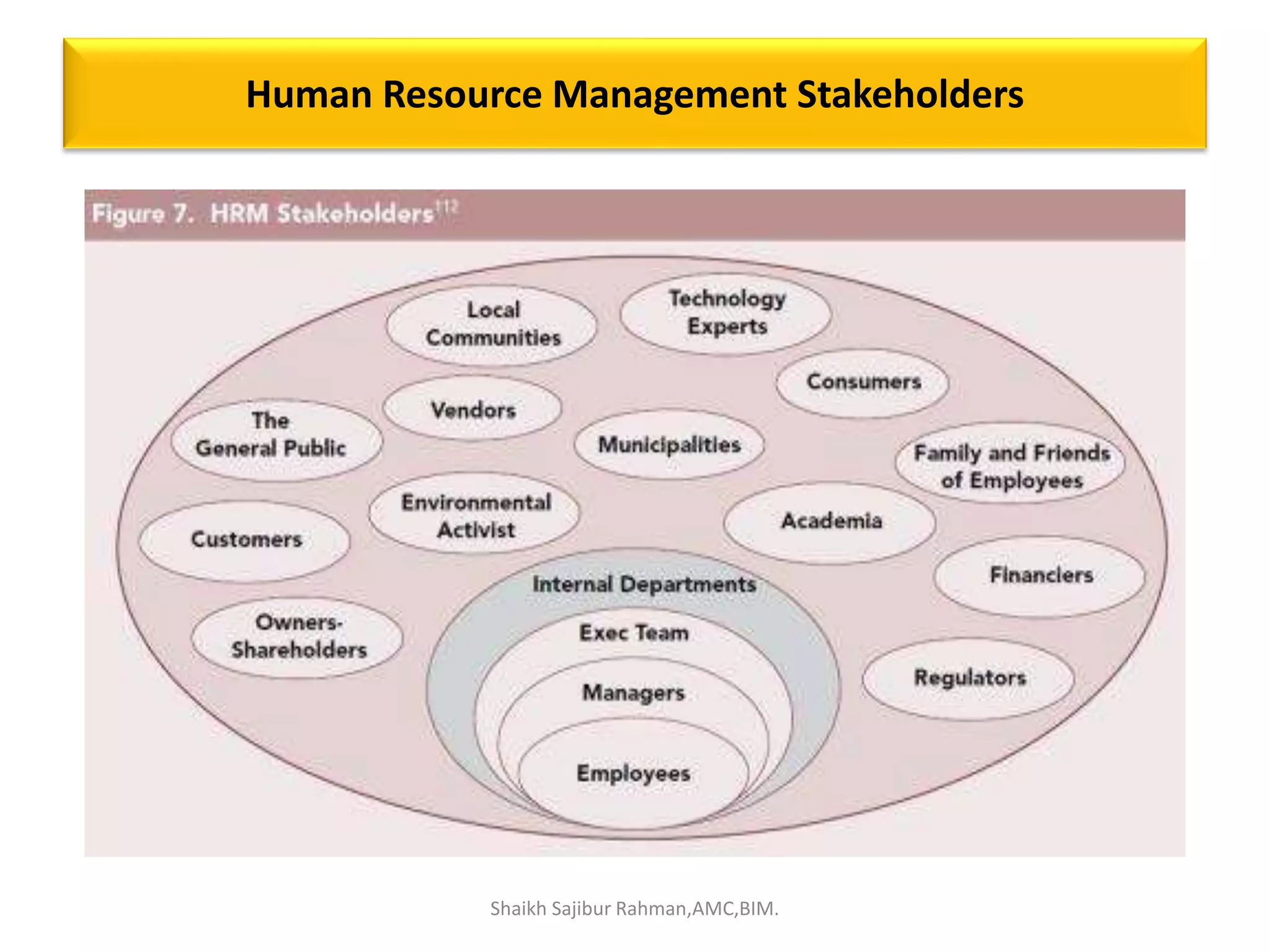
Human Resource Management Stakeholders
Shaikh Sajibur Rahman,AMC,BIM.
•Line Authority
•Staff Authority
•Functional Authority
Types of Authority
Shaikh Sajibur Rahman,AMC,BIM.
Line authority entitles a manager to direct the work of an employee. It is the
employer-employee authority relationship that extends from top to bottom.
A line manager directs the work of employees and makes certain decisions
without consulting anyone.
Sometimes the term line is used to differentiate line managers from staff
managers.
Line emphasizes managers whose organizational function contributes
directly to the achievement of organizational objectives.
Line Authority
Shaikh Sajibur Rahman,AMC,BIM.
Staff managers have staff authority. A manager's function is classified as line or staff
based on the organization's objectives.
As organizations get larger and more complex, line managers find that they do not
have the time, expertise, or resources to get their jobs done effectively.
They create staff authority functions to support, assist, advice, and generally reduce
some of the informational burdens they have.
Staff Mangers and Staff Authority
Shaikh Sajibur Rahman,AMC,BIM.
The authority exerted by a personnel manager as a coordinator of personnel activities.
Here the manager acts as “the right arm of the top executive.”
Functional control
Shaikh Sajibur Rahman,AMC,BIM.
Line VS Staff Authority – Authority is the right to make decisions,
to direct the work of others, and to give orders.
Line managers are authorized to direct the work of subordinates.
Whereas staff managers are authorized to assist and advise line
managers in accomplishing their basic goals.
HR managers are generally staff managers.
•Line Managers’ HRM Responsibilities – Most line managers are
responsible for line functions, coordinative functions, and some
staff functions.
Line versus Staff Authority
Shaikh Sajibur Rahman,AMC,BIM.
In recruiting and hiring, it’s generally the line manager’s responsibility to specify
the qualifications employees need to fill specific positions. Then the HR staff
takes over. They develop sources of qualified applicants and conduct initial
screening interviews. They administer the appropriate test. Then they refer the
best applicants to the supervisor (line manager), who interviews and selects the
ones he/she wants.
Cooperative line and staff HR management
Shaikh Sajibur Rahman,AMC,BIM.
Authorized to direct the work of subordinates—they’re always someone’s boss. In
addition, line managers are in charge of accomplishing the organization’s basic
goals.
Line Managers’ Human Resource Management Responsibilities
•Placement
•Orientation
•Training
•Improving job performance
•Gaining creative cooperation
•Interpreting policies and procedures
•Controlling labor costs
•Developing employee abilities
•Creating and maintaining departmental morale
•Protecting employees’ health and physical condition
Line Manager
Shaikh Sajibur Rahman,AMC,BIM.
Staff managers assist and advise line managers in accomplishing these basic goals.
They do, however, need to work in partnership with each other to be successful.
Some examples of the HR responsibilities of staff managers include assistance in
following tasks :
 Hiring,
 Training,
 Evaluating,
 Rewarding,
 Counseling,
 Promoting,
 Firing of employees, and the administering of various benefits programs.
Responsibilities Of Staff Managers
Shaikh Sajibur Rahman,AMC,BIM.
An individual who normally acts in an advisory or staff capacity, working
with other managers to help them deal with human resource matters.
One general trend is that HR personnel are servicing an increasing number of
employees. The human resource manager is primarily responsible for
coordinating the management of human resources to help the organization
achieve its goals.
There is a shared responsibility between line managers and human resource
professionals.
The recognition of HR as a legitimate business unit has made it highly
strategic in nature and more critical to achieving corporate objectives.
Responsibilities Of Staff Managers
Shaikh Sajibur Rahman,AMC,BIM.
Functions of HR Manager in HRM Department
Staffing
An organization must have qualified individuals, in specific jobs at specific places
and times, in order to accomplish its goals.
Obtaining such people involves job analysis, human resource planning,
recruitment, and selection.
Human resource planning (HRP) is the process of systematically reviewing
human resource requirements to ensure that the required numbers of
employees, with the required skills, are available when needed.
Shaikh Sajibur Rahman,AMC,BIM.
Human Resource Development
A major HRM function that consists not only of training and development but also
individual career planning and development activities and performance appraisal, an
activity that emphasizes T&D needs.
Training is designed to provide learners with the knowledge and skills needed for their
present jobs.
Development involves learning that goes beyond today’s job; it has a more long-term focus.
Human resource development (HRD) helps individuals, groups, and the entire organization
become more effective. It is essential because people, technology, jobs, and organizations
are always changing.
Functions of HR Manager in HRM Department
Shaikh Sajibur Rahman,AMC,BIM.
Compensation and Benefits
The term compensation includes all rewards that individuals receive as a
result of their employment. The reward may be one or a combination of the
following:
Pay: The money that a person receives for performing a job.
Benefits: Additional financial rewards other than base pay include paid
vacations, sick leave, holidays, and medical insurance.
Non financial rewards: Non monetary rewards, such as enjoyment of the
work performed or a pleasant working environment.
Functions of HR Manager in HRM Department
Shaikh Sajibur Rahman,AMC,BIM.
Safety And Health
Safety involves protecting employees from injuries caused by work-
related accidents.
Health refers to the employees’ freedom from illness and their general
physical and mental well-being.
These aspects of the job are important because employees who work in a
safe environment and enjoy good health are more likely to be productive
and yield long-term benefits to the organization.
Functions of HR Manager in HRM Department
Shaikh Sajibur Rahman,AMC,BIM.
Employee And Labor Relations
Since 1983, union membership has fallen approximately 8 percent, to only 13.9
percent of the workforce, the lowest level since the Great Depression.
Subtracting government employees, unions represent only 9.5 percent of the
private industry workforce. Even so, a business firm is required by law to
recognize a union and bargain with it in good faith if the firm’s employees want
the union to represent them. In the past, this relationship was an accepted way
of life for many employers. But most firms today would like to have a union-free
environment.
Functions of HR Manager in HRM Department
Shaikh Sajibur Rahman,AMC,BIM.
Human Resource Research
Although human resource research is not listed as a separate function, it
pervades all HRM functional areas, and the researcher’s laboratory is the
entire work environment.
Interrelationships of HRM Functions
All HRM functional areas are highly interrelated. Management must
recognize that decisions in one area will affect other areas. The
interrelationships among the five HRM functional areas will become more
obvious as we address each topic throughout the book.
Functions of HR Manager in HRM Department
Shaikh Sajibur Rahman,AMC,BIM.

Line and staff, responsibility of hrm lecture_ 02 class

  • 1.
    Responsibility for HRM ShaikhSajibur Rahman,AMC,BIM.
  • 2.
    Authority is theright to make decisions, to direct the work of others, and to give orders. •Authority refers to the rights inherent in a managerial position to give orders and expect the orders to be obeyed. •Authority was a major tenet of the early management writers, the glue that held the organization together. •It was to be delegated downward to lower-level managers. Each management position has specific inherent rights that incumbents acquire from the position's rank or title. Authority is related to one's position and ignores personal characteristics. When a position of authority is vacated, the authority remains with the position. Authority Shaikh Sajibur Rahman,AMC,BIM.
  • 3.
    Organization of HRDepartment Line Authority Staff Authority Functional Authority Line Manager Staff Manager Shaikh Sajibur Rahman,AMC,BIM.
  • 4.
    Type Focus DocumentationChange Frequency Organizational Structure Function-centric Purpose, accountabilities, KPIs Infrequent, changes with strategy Org Chart People-centric Titles, job descriptions, HR stuff Frequent, changes with people Differences Between an Organizational Structure and an Org. Chart Shaikh Sajibur Rahman,AMC,BIM.
  • 5.
    TYPES OF ORGANIZATIONSTRUCTURE Shaikh Sajibur Rahman,AMC,BIM.
  • 6.
  • 7.
    Line and StaffOrganization Shaikh Sajibur Rahman,AMC,BIM.
  • 8.
    Differences Between anOrganizational Structure and an Org. Chart • Organizational structure is designed around the functions a business performs (e.g., sales, marketing, finance, engineering, etc.). • An org chart is built around people and titles. • Organizational structure defines the purpose, accountabilities, and key performance indicators (KPIs) for each business function and role. • An org chart shows each person’s job title and may include HR stuff like job requirements. • Once correctly defined, a structure changes infrequently—for example, when there’s a change in strategy like a new product initiative or a move up to a new stage in the execution lifecycle. • An org chart needs to be updated frequently as people come and go. It’s out of date almost the minute it’s created. Shaikh Sajibur Rahman,AMC,BIM.
  • 9.
    Line Managers HumanResource Duties  Placing the right person in the right job  orienting new employees in the organization  Training employees for jobs that are new to them  Improving the job performance of each person  Gaining cooperation and developing smooth working relationships  Interpreting the company s policies and procedures  Controlling labor costs  Developing the abilities of each person  Creating and maintaining department morale  Protecting employees health and physical condition Shaikh Sajibur Rahman,AMC,BIM.
  • 10.
    Human Resource Managers Duties/Functions of the HR Manager/responsibilities of staff (HR) managers A Line Function: The HR manager directs the activities of the people in his or her own department and in related service areas. A Coordinative Function: HR managers also coordinate personnel activities, a duty often referred to as functional control. Staff (Assist and Advise) Functions: Assisting and advising line managers is the heart of the HR manager‘s job Shaikh Sajibur Rahman,AMC,BIM.
  • 11.
    Major Challenges Affectinga Human Resources Manager Shaikh Sajibur Rahman,AMC,BIM.
  • 12.
    Prospects of HRMas a Career  A Human Resource Manager  A Recruiter Manager  Compensation Manager  Employer Relation Manager  Strategic Manager  HR Of An International Organization  A Manager Or Management Trainee  A Consultant (Possibly With A Specialization In HRM-Related Issues Shaikh Sajibur Rahman,AMC,BIM.
  • 13.
    Human Resource ManagementStakeholders Shaikh Sajibur Rahman,AMC,BIM.
  • 14.
    •Line Authority •Staff Authority •FunctionalAuthority Types of Authority Shaikh Sajibur Rahman,AMC,BIM.
  • 15.
    Line authority entitlesa manager to direct the work of an employee. It is the employer-employee authority relationship that extends from top to bottom. A line manager directs the work of employees and makes certain decisions without consulting anyone. Sometimes the term line is used to differentiate line managers from staff managers. Line emphasizes managers whose organizational function contributes directly to the achievement of organizational objectives. Line Authority Shaikh Sajibur Rahman,AMC,BIM.
  • 16.
    Staff managers havestaff authority. A manager's function is classified as line or staff based on the organization's objectives. As organizations get larger and more complex, line managers find that they do not have the time, expertise, or resources to get their jobs done effectively. They create staff authority functions to support, assist, advice, and generally reduce some of the informational burdens they have. Staff Mangers and Staff Authority Shaikh Sajibur Rahman,AMC,BIM.
  • 17.
    The authority exertedby a personnel manager as a coordinator of personnel activities. Here the manager acts as “the right arm of the top executive.” Functional control Shaikh Sajibur Rahman,AMC,BIM.
  • 18.
    Line VS StaffAuthority – Authority is the right to make decisions, to direct the work of others, and to give orders. Line managers are authorized to direct the work of subordinates. Whereas staff managers are authorized to assist and advise line managers in accomplishing their basic goals. HR managers are generally staff managers. •Line Managers’ HRM Responsibilities – Most line managers are responsible for line functions, coordinative functions, and some staff functions. Line versus Staff Authority Shaikh Sajibur Rahman,AMC,BIM.
  • 19.
    In recruiting andhiring, it’s generally the line manager’s responsibility to specify the qualifications employees need to fill specific positions. Then the HR staff takes over. They develop sources of qualified applicants and conduct initial screening interviews. They administer the appropriate test. Then they refer the best applicants to the supervisor (line manager), who interviews and selects the ones he/she wants. Cooperative line and staff HR management Shaikh Sajibur Rahman,AMC,BIM.
  • 20.
    Authorized to directthe work of subordinates—they’re always someone’s boss. In addition, line managers are in charge of accomplishing the organization’s basic goals. Line Managers’ Human Resource Management Responsibilities •Placement •Orientation •Training •Improving job performance •Gaining creative cooperation •Interpreting policies and procedures •Controlling labor costs •Developing employee abilities •Creating and maintaining departmental morale •Protecting employees’ health and physical condition Line Manager Shaikh Sajibur Rahman,AMC,BIM.
  • 21.
    Staff managers assistand advise line managers in accomplishing these basic goals. They do, however, need to work in partnership with each other to be successful. Some examples of the HR responsibilities of staff managers include assistance in following tasks :  Hiring,  Training,  Evaluating,  Rewarding,  Counseling,  Promoting,  Firing of employees, and the administering of various benefits programs. Responsibilities Of Staff Managers Shaikh Sajibur Rahman,AMC,BIM.
  • 22.
    An individual whonormally acts in an advisory or staff capacity, working with other managers to help them deal with human resource matters. One general trend is that HR personnel are servicing an increasing number of employees. The human resource manager is primarily responsible for coordinating the management of human resources to help the organization achieve its goals. There is a shared responsibility between line managers and human resource professionals. The recognition of HR as a legitimate business unit has made it highly strategic in nature and more critical to achieving corporate objectives. Responsibilities Of Staff Managers Shaikh Sajibur Rahman,AMC,BIM.
  • 23.
    Functions of HRManager in HRM Department Staffing An organization must have qualified individuals, in specific jobs at specific places and times, in order to accomplish its goals. Obtaining such people involves job analysis, human resource planning, recruitment, and selection. Human resource planning (HRP) is the process of systematically reviewing human resource requirements to ensure that the required numbers of employees, with the required skills, are available when needed. Shaikh Sajibur Rahman,AMC,BIM.
  • 24.
    Human Resource Development Amajor HRM function that consists not only of training and development but also individual career planning and development activities and performance appraisal, an activity that emphasizes T&D needs. Training is designed to provide learners with the knowledge and skills needed for their present jobs. Development involves learning that goes beyond today’s job; it has a more long-term focus. Human resource development (HRD) helps individuals, groups, and the entire organization become more effective. It is essential because people, technology, jobs, and organizations are always changing. Functions of HR Manager in HRM Department Shaikh Sajibur Rahman,AMC,BIM.
  • 25.
    Compensation and Benefits Theterm compensation includes all rewards that individuals receive as a result of their employment. The reward may be one or a combination of the following: Pay: The money that a person receives for performing a job. Benefits: Additional financial rewards other than base pay include paid vacations, sick leave, holidays, and medical insurance. Non financial rewards: Non monetary rewards, such as enjoyment of the work performed or a pleasant working environment. Functions of HR Manager in HRM Department Shaikh Sajibur Rahman,AMC,BIM.
  • 26.
    Safety And Health Safetyinvolves protecting employees from injuries caused by work- related accidents. Health refers to the employees’ freedom from illness and their general physical and mental well-being. These aspects of the job are important because employees who work in a safe environment and enjoy good health are more likely to be productive and yield long-term benefits to the organization. Functions of HR Manager in HRM Department Shaikh Sajibur Rahman,AMC,BIM.
  • 27.
    Employee And LaborRelations Since 1983, union membership has fallen approximately 8 percent, to only 13.9 percent of the workforce, the lowest level since the Great Depression. Subtracting government employees, unions represent only 9.5 percent of the private industry workforce. Even so, a business firm is required by law to recognize a union and bargain with it in good faith if the firm’s employees want the union to represent them. In the past, this relationship was an accepted way of life for many employers. But most firms today would like to have a union-free environment. Functions of HR Manager in HRM Department Shaikh Sajibur Rahman,AMC,BIM.
  • 28.
    Human Resource Research Althoughhuman resource research is not listed as a separate function, it pervades all HRM functional areas, and the researcher’s laboratory is the entire work environment. Interrelationships of HRM Functions All HRM functional areas are highly interrelated. Management must recognize that decisions in one area will affect other areas. The interrelationships among the five HRM functional areas will become more obvious as we address each topic throughout the book. Functions of HR Manager in HRM Department Shaikh Sajibur Rahman,AMC,BIM.