Human Resource Management  11 th  Edition Chapter 13 INTERNAL EMPLOYEE RELATIONS
HRM in Action: Worker Retention   Organizations need to constantly give them reasons to stay  Company must have on-going strategy to retain valued employees  Virtually every topic in text can be viewed in some manner as being part of a retention strategy  Provide means of preventing a person from seeking job with a competitor and remaining with firm
Internal Employee  Relations Defined Human resource activities associated with movement of employees within firm after they become organizational members
Internal Employee Relations Activities Promotion Transfer Demotion Resignation Discharge Layoff Retirement Discipline Disciplinary action
Employment at Will Unwritten contract created when employee agrees to work for employer No agreement as to how long parties expect employment to last Approximately 2 of every 3 U.S. workers depend almost entirely on continued goodwill of employer
Not Included  Individuals with a contract for a specified time period - collective bargaining agreements between labor and management and teachers Whistleblowers
Exceptions to Employment-at-Will Doctrine  Prohibiting terminations in violation of public policy  Permitting employees to bring claims based on representations made in employment handbooks Permitting claims based on common-law doctrine of good faith and fair dealing
How Employers Can Protect Themselves No statements suggesting job security or permanent employment  Avoiding statements during job interviews, such as “You can expect to hold this job as long as you want” - Could be considered a contractual agreement  A person should not be employed without a signed acknowledgment of the at-will disclaimer
How Employers Can Protect Themselves (Cont.) Clearly defining worker’s duties Providing good feedback on a regular basis Conducting realistic performance appraisals on a regular basis  There is no law involving ethical considerations for employment at will
Discipline and Disciplinary Action Discipline  - State of employee self-control and orderly conduct  Disciplinary action  - Invokes  penalty against employee who fails to meet established standards
Effective Disciplinary Action  Addresses employee’s wrongful behavior, not employee as a person Should not be applied haphazardly Not usually management’s initial response to a problem  Normally, there are more positive ways of convincing employees to adhere to company policies
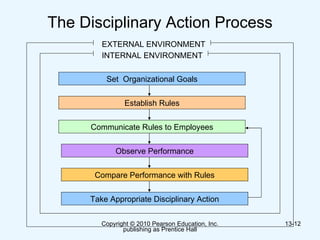
The Disciplinary Action Process Set  Organizational Goals Establish Rules Communicate Rules to Employees Take Appropriate Disciplinary Action Observe Performance Compare Performance with Rules EXTERNAL ENVIRONMENT INTERNAL ENVIRONMENT
Disciplinary Action Word  discipline   comes from word  disciple   Translated from Latin, it means  to teach   Intent of disciplinary action should be to ensure recipient sees disciplinary action as learning process
Approaches to Disciplinary Action Hot stove rule Progressive disciplinary action Disciplinary action without punishment
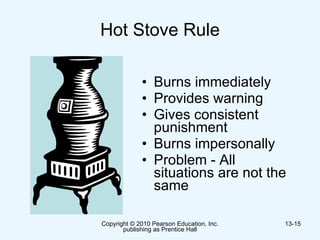
Hot Stove Rule Burns immediately Provides warning Gives consistent punishment Burns impersonally Problem - All situations are not the same
Progressive Disciplinary Action  Ensure minimum penalty appropriate to  offense is imposed  Model developed in response to National Labor Relations Act (NLRA) of 1935  Involves answering series of questions about severity of offense
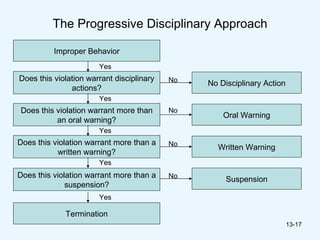
The Progressive Disciplinary Approach Improper Behavior Does this violation warrant disciplinary actions? Does this violation warrant more than an oral warning? Does this violation warrant more than a written warning? Does this violation warrant more than a suspension? Termination Yes Yes Yes Yes Yes No Disciplinary Action Oral Warning Written Warning Suspension No No No No 13-17
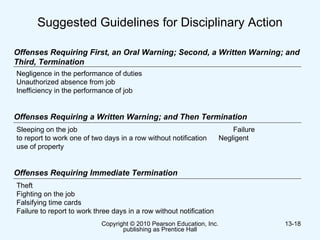
Suggested Guidelines for Disciplinary Action Offenses Requiring First, an Oral Warning; Second, a Written Warning; and Third, Termination Negligence in the performance of duties Unauthorized absence from job Inefficiency in the performance of job Offenses Requiring a Written Warning; and Then Termination Sleeping on the job  Failure to report to work one of two days in a row without notification  Negligent use of property Offenses Requiring Immediate Termination Theft  Fighting on the job  Falsifying time cards  Failure to report to work three days in a row without notification
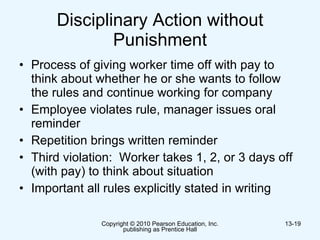
Disciplinary Action without Punishment Process of giving worker time off with pay to think about whether he or she wants to follow the rules and continue working for company  Employee violates rule, manager issues oral reminder Repetition brings written reminder Third violation:  Worker takes 1, 2, or 3 days off (with pay) to think about situation Important all rules explicitly stated in writing
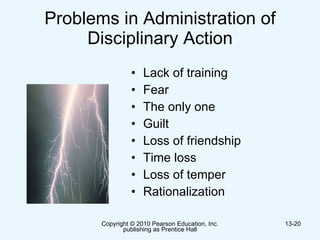
Problems in Administration of Disciplinary Action Lack of training Fear The only one Guilt Loss of friendship Time loss Loss of temper Rationalization
Disciplinary Action Advice Managers often avoid disciplinary action, even when it is in company’s best interest  Some managers believe that even attempting to terminate women and minorities is useless  Proper time and place to administer disciplinary action Many supervisors may be too lenient early in  disciplinary action process and too strict later
Grievance Handling Under  Collective Bargaining Agreement Grievance  - Employee’s dissatisfaction or feeling of personal injustice relating to employment Grievance procedure  - Formal, systematic process that permits employees to express complaints without jeopardizing their jobs
Grievance Procedure  Assists management in seeking out  underlying causes of and solutions to grievances  Virtually all labor agreements include some form of grievance procedure  Normally well defined Usually restricted to violations of terms and conditions of agreement
General Principles for Effective Grievance Administration  Grievances should be adjusted promptly. Procedures and forms used for airing grievances must be easy to utilize and well understood by employees and their supervisors. Direct and timely avenues of appeal from rulings of line supervision must exist.
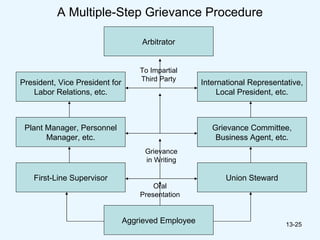
A Multiple-Step Grievance Procedure Arbitrator International Representative, Local President, etc. President, Vice President for Labor Relations, etc. Plant Manager, Personnel Manager, etc. First-Line Supervisor Grievance Committee, Business Agent, etc. Union Steward Aggrieved Employee To Impartial Third Party Grievance in Writing Oral Presentation 13-25
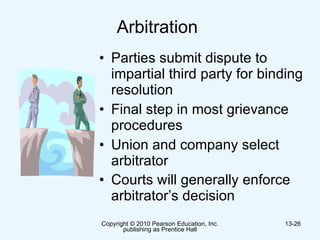
Arbitration   Parties submit dispute to impartial third party for binding resolution  Final step in most grievance procedures  Union and company select arbitrator  Courts will generally enforce arbitrator’s decision
Factors Arbitrator May Use to Evaluate Fairness of Management’s Actions   Nature of offense Due process and procedural correctness Double jeopardy Past record of grievant Length of service with company Knowledge of rules Warnings Lax enforcement of rules Discriminatory treatment
Formats of Written Warnings  Statement of facts concerning offense Identification of rule that was violated Statement of what resulted or could have resulted because of violation Identification of any previous similar violations by same individual Statement of possible future consequences should violation occur again Signature and date
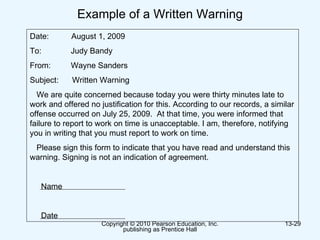
Example of a Written Warning Date:  August 1, 2009 To:   Judy Bandy From:  Wayne Sanders Subject:  Written Warning We are quite concerned because today you were thirty minutes late to work and offered no justification for this. According to our records, a similar offense occurred on July 25, 2009.  At that time, you were informed that failure to report to work on time is unacceptable. I am, therefore, notifying you in writing that you must report to work on time.  Please sign this form to indicate that you have read and understand this warning. Signing is not an indication of agreement. Name Date
Grievance Handling in  Union-free Organizations Most large and medium-sized nonunion firms have established formal grievance procedures  Means of resolving complaints varies
Ombudspersons   Complaint officer with access to top management hears employee complaints, investigates, and recommends appropriate action  Impartial, neutral counselors give employees confidential advice about problems ranging from abusive managers to allegations of illegal corporate activity Typically independent of line management and reports near or at top of organization
Alternative Dispute Resolution Procedure where employee and company agree problems will be addressed by agreed-upon means ahead of time Arbitration, mediation, mini-trials, and ombudspersons used  Uses range from racial, gender, and age discrimination to unfair firings
Alternative Dispute Resolution (Cont.) Presidential EO requires federal agencies to (1) promote greater use of mediation, arbitration, early neutral evaluation, agency ombudspersons, and other alternative dispute resolution techniques, and (2) promote greater use of negotiated rulemaking  Circuit City v Adams  –  Supreme Court ruling that   greatly enhanced employer’s ability to enforce compulsory alternative dispute resolution agreements
Termination Most severe penalty; should be most carefully considered Termination of nonmanagerial/nonprofessional employees Termination of executives Termination of middle- and lower-level managers and professionals
Trends & Innovations: Outsourcing Terminations  Consultants are now being paid to help fire workers  Consultant typically meets with the executive wanting the termination and determines and rehearses what is to be said  Consultant is at the firing making sure the manager adheres to the script
Termination of Nonmanagerial/Nonprofessional Employees If firm unionized, termination procedure well defined in labor agreement Non-union workers can generally be terminated more easily
Termination of Executives Economic Reorganization/downsize Philosophical differences Decline in productivity No formal appeals procedure
Termination of Middle- and Lower-Level Managers and Professionals In past, most vulnerable and neglected group with regard to termination Not members of union nor protected by labor agreement
Termination Software  Software available to identify employees who should be terminated during layoff  Tell the program how many employees to fire  Software sends an e-mail to managers, asking them to rate subordinates on a scale of 1 to 5 Software provides list of people who can be smoothly terminated
Demotion as Alternative to Termination Demotions used as alternative to discharge Demotion is process of moving worker to lower level of duties and responsibilities, usually involving reduction in pay
Transfers Lateral movement of worker within  organization Should not imply that  person is being either promoted or demoted
Transfers Serve Several Purposes Necessary to reorganize Make positions available in primary promotion channels Satisfy employees’ personal desires Deal with personality clashes Becoming necessary to have wide variety of experiences before achieving promotion
Promotion Movement to higher level in company One of the most emotionally charged words in human resource management
Resignation Exit interview Advance notice of resignation
Analyzing Voluntary Resignations  Exit interview  - Means of revealing real reasons employees leave jobs, which is conducted before employee departs company Postexit questionnaire  -  Sent to former employees several weeks after leaving organization to determine real reason employee left
Attitude Surveys: Means of Retaining Quality Employees Seek employee input to determine feeling about such topics as: Work environment Opportunities for advancement Firm’s compensation system Their supervisor Training and development opportunities
Advance Notice of Resignation Would like 2 weeks Communicate policy to all employees May pay employee for notice time and ask him/her to leave immediately
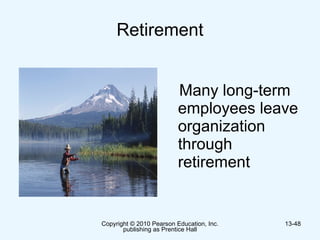
Retirement Many long-term employees leave organization through retirement
Phase-in Retirement  Working fewer hours as they near 65  More likely to be used among consulting firms, educational institutions, health care, private practice, wholesale/distribution, and other similar organizations  Pension Protection Act permits limited phased retirement by allowing in-service pension plan withdrawals to begin at age 62 rather than 65
A Global Perspective: Help for Expats: A Buddy Helps Find the Way   Companies are using formal  buddy  system when sending expatriates on assignments  Buddies at Balfour Beatty often inform expatriates of host-office norms and politics, invite them into their homes, introduce them to friends and networks, and help bolster their credibility in the office

Chapter 13

  • 1.
    Human Resource Management 11 th Edition Chapter 13 INTERNAL EMPLOYEE RELATIONS
  • 2.
    HRM in Action:Worker Retention Organizations need to constantly give them reasons to stay Company must have on-going strategy to retain valued employees Virtually every topic in text can be viewed in some manner as being part of a retention strategy Provide means of preventing a person from seeking job with a competitor and remaining with firm
  • 3.
    Internal Employee Relations Defined Human resource activities associated with movement of employees within firm after they become organizational members
  • 4.
    Internal Employee RelationsActivities Promotion Transfer Demotion Resignation Discharge Layoff Retirement Discipline Disciplinary action
  • 5.
    Employment at WillUnwritten contract created when employee agrees to work for employer No agreement as to how long parties expect employment to last Approximately 2 of every 3 U.S. workers depend almost entirely on continued goodwill of employer
  • 6.
    Not Included Individuals with a contract for a specified time period - collective bargaining agreements between labor and management and teachers Whistleblowers
  • 7.
    Exceptions to Employment-at-WillDoctrine Prohibiting terminations in violation of public policy Permitting employees to bring claims based on representations made in employment handbooks Permitting claims based on common-law doctrine of good faith and fair dealing
  • 8.
    How Employers CanProtect Themselves No statements suggesting job security or permanent employment Avoiding statements during job interviews, such as “You can expect to hold this job as long as you want” - Could be considered a contractual agreement A person should not be employed without a signed acknowledgment of the at-will disclaimer
  • 9.
    How Employers CanProtect Themselves (Cont.) Clearly defining worker’s duties Providing good feedback on a regular basis Conducting realistic performance appraisals on a regular basis There is no law involving ethical considerations for employment at will
  • 10.
    Discipline and DisciplinaryAction Discipline - State of employee self-control and orderly conduct Disciplinary action - Invokes penalty against employee who fails to meet established standards
  • 11.
    Effective Disciplinary Action Addresses employee’s wrongful behavior, not employee as a person Should not be applied haphazardly Not usually management’s initial response to a problem Normally, there are more positive ways of convincing employees to adhere to company policies
  • 12.
    The Disciplinary ActionProcess Set Organizational Goals Establish Rules Communicate Rules to Employees Take Appropriate Disciplinary Action Observe Performance Compare Performance with Rules EXTERNAL ENVIRONMENT INTERNAL ENVIRONMENT
  • 13.
    Disciplinary Action Word discipline comes from word disciple Translated from Latin, it means to teach Intent of disciplinary action should be to ensure recipient sees disciplinary action as learning process
  • 14.
    Approaches to DisciplinaryAction Hot stove rule Progressive disciplinary action Disciplinary action without punishment
  • 15.
    Hot Stove RuleBurns immediately Provides warning Gives consistent punishment Burns impersonally Problem - All situations are not the same
  • 16.
    Progressive Disciplinary Action Ensure minimum penalty appropriate to offense is imposed Model developed in response to National Labor Relations Act (NLRA) of 1935 Involves answering series of questions about severity of offense
  • 17.
    The Progressive DisciplinaryApproach Improper Behavior Does this violation warrant disciplinary actions? Does this violation warrant more than an oral warning? Does this violation warrant more than a written warning? Does this violation warrant more than a suspension? Termination Yes Yes Yes Yes Yes No Disciplinary Action Oral Warning Written Warning Suspension No No No No 13-17
  • 18.
    Suggested Guidelines forDisciplinary Action Offenses Requiring First, an Oral Warning; Second, a Written Warning; and Third, Termination Negligence in the performance of duties Unauthorized absence from job Inefficiency in the performance of job Offenses Requiring a Written Warning; and Then Termination Sleeping on the job Failure to report to work one of two days in a row without notification Negligent use of property Offenses Requiring Immediate Termination Theft Fighting on the job Falsifying time cards Failure to report to work three days in a row without notification
  • 19.
    Disciplinary Action withoutPunishment Process of giving worker time off with pay to think about whether he or she wants to follow the rules and continue working for company Employee violates rule, manager issues oral reminder Repetition brings written reminder Third violation: Worker takes 1, 2, or 3 days off (with pay) to think about situation Important all rules explicitly stated in writing
  • 20.
    Problems in Administrationof Disciplinary Action Lack of training Fear The only one Guilt Loss of friendship Time loss Loss of temper Rationalization
  • 21.
    Disciplinary Action AdviceManagers often avoid disciplinary action, even when it is in company’s best interest Some managers believe that even attempting to terminate women and minorities is useless Proper time and place to administer disciplinary action Many supervisors may be too lenient early in disciplinary action process and too strict later
  • 22.
    Grievance Handling Under Collective Bargaining Agreement Grievance - Employee’s dissatisfaction or feeling of personal injustice relating to employment Grievance procedure - Formal, systematic process that permits employees to express complaints without jeopardizing their jobs
  • 23.
    Grievance Procedure Assists management in seeking out underlying causes of and solutions to grievances Virtually all labor agreements include some form of grievance procedure Normally well defined Usually restricted to violations of terms and conditions of agreement
  • 24.
    General Principles forEffective Grievance Administration Grievances should be adjusted promptly. Procedures and forms used for airing grievances must be easy to utilize and well understood by employees and their supervisors. Direct and timely avenues of appeal from rulings of line supervision must exist.
  • 25.
    A Multiple-Step GrievanceProcedure Arbitrator International Representative, Local President, etc. President, Vice President for Labor Relations, etc. Plant Manager, Personnel Manager, etc. First-Line Supervisor Grievance Committee, Business Agent, etc. Union Steward Aggrieved Employee To Impartial Third Party Grievance in Writing Oral Presentation 13-25
  • 26.
    Arbitration Parties submit dispute to impartial third party for binding resolution Final step in most grievance procedures Union and company select arbitrator Courts will generally enforce arbitrator’s decision
  • 27.
    Factors Arbitrator MayUse to Evaluate Fairness of Management’s Actions Nature of offense Due process and procedural correctness Double jeopardy Past record of grievant Length of service with company Knowledge of rules Warnings Lax enforcement of rules Discriminatory treatment
  • 28.
    Formats of WrittenWarnings Statement of facts concerning offense Identification of rule that was violated Statement of what resulted or could have resulted because of violation Identification of any previous similar violations by same individual Statement of possible future consequences should violation occur again Signature and date
  • 29.
    Example of aWritten Warning Date: August 1, 2009 To: Judy Bandy From: Wayne Sanders Subject: Written Warning We are quite concerned because today you were thirty minutes late to work and offered no justification for this. According to our records, a similar offense occurred on July 25, 2009. At that time, you were informed that failure to report to work on time is unacceptable. I am, therefore, notifying you in writing that you must report to work on time. Please sign this form to indicate that you have read and understand this warning. Signing is not an indication of agreement. Name Date
  • 30.
    Grievance Handling in Union-free Organizations Most large and medium-sized nonunion firms have established formal grievance procedures Means of resolving complaints varies
  • 31.
    Ombudspersons Complaint officer with access to top management hears employee complaints, investigates, and recommends appropriate action Impartial, neutral counselors give employees confidential advice about problems ranging from abusive managers to allegations of illegal corporate activity Typically independent of line management and reports near or at top of organization
  • 32.
    Alternative Dispute ResolutionProcedure where employee and company agree problems will be addressed by agreed-upon means ahead of time Arbitration, mediation, mini-trials, and ombudspersons used Uses range from racial, gender, and age discrimination to unfair firings
  • 33.
    Alternative Dispute Resolution(Cont.) Presidential EO requires federal agencies to (1) promote greater use of mediation, arbitration, early neutral evaluation, agency ombudspersons, and other alternative dispute resolution techniques, and (2) promote greater use of negotiated rulemaking Circuit City v Adams – Supreme Court ruling that greatly enhanced employer’s ability to enforce compulsory alternative dispute resolution agreements
  • 34.
    Termination Most severepenalty; should be most carefully considered Termination of nonmanagerial/nonprofessional employees Termination of executives Termination of middle- and lower-level managers and professionals
  • 35.
    Trends & Innovations:Outsourcing Terminations Consultants are now being paid to help fire workers Consultant typically meets with the executive wanting the termination and determines and rehearses what is to be said Consultant is at the firing making sure the manager adheres to the script
  • 36.
    Termination of Nonmanagerial/NonprofessionalEmployees If firm unionized, termination procedure well defined in labor agreement Non-union workers can generally be terminated more easily
  • 37.
    Termination of ExecutivesEconomic Reorganization/downsize Philosophical differences Decline in productivity No formal appeals procedure
  • 38.
    Termination of Middle-and Lower-Level Managers and Professionals In past, most vulnerable and neglected group with regard to termination Not members of union nor protected by labor agreement
  • 39.
    Termination Software Software available to identify employees who should be terminated during layoff Tell the program how many employees to fire Software sends an e-mail to managers, asking them to rate subordinates on a scale of 1 to 5 Software provides list of people who can be smoothly terminated
  • 40.
    Demotion as Alternativeto Termination Demotions used as alternative to discharge Demotion is process of moving worker to lower level of duties and responsibilities, usually involving reduction in pay
  • 41.
    Transfers Lateral movementof worker within organization Should not imply that person is being either promoted or demoted
  • 42.
    Transfers Serve SeveralPurposes Necessary to reorganize Make positions available in primary promotion channels Satisfy employees’ personal desires Deal with personality clashes Becoming necessary to have wide variety of experiences before achieving promotion
  • 43.
    Promotion Movement tohigher level in company One of the most emotionally charged words in human resource management
  • 44.
    Resignation Exit interviewAdvance notice of resignation
  • 45.
    Analyzing Voluntary Resignations Exit interview - Means of revealing real reasons employees leave jobs, which is conducted before employee departs company Postexit questionnaire - Sent to former employees several weeks after leaving organization to determine real reason employee left
  • 46.
    Attitude Surveys: Meansof Retaining Quality Employees Seek employee input to determine feeling about such topics as: Work environment Opportunities for advancement Firm’s compensation system Their supervisor Training and development opportunities
  • 47.
    Advance Notice ofResignation Would like 2 weeks Communicate policy to all employees May pay employee for notice time and ask him/her to leave immediately
  • 48.
    Retirement Many long-termemployees leave organization through retirement
  • 49.
    Phase-in Retirement Working fewer hours as they near 65 More likely to be used among consulting firms, educational institutions, health care, private practice, wholesale/distribution, and other similar organizations Pension Protection Act permits limited phased retirement by allowing in-service pension plan withdrawals to begin at age 62 rather than 65
  • 50.
    A Global Perspective:Help for Expats: A Buddy Helps Find the Way Companies are using formal buddy system when sending expatriates on assignments Buddies at Balfour Beatty often inform expatriates of host-office norms and politics, invite them into their homes, introduce them to friends and networks, and help bolster their credibility in the office