JJUSTICEUSTICEJJUSTICEUSTICE
Rachel E. Khan
Associate Professor, Journalism Department, College of Mass Communication
University of the Philippines, Diliman
“Justice has to do with people’s
l ti ith th d irelations with one another and is
often important to the resolution of
thi l di t ” L i Dethical disputes.” --Louis Day
“E e citi e ha ce tai d tie of“Every citizen has certain duties of
justice. The degree of importance of
these duties depend naturall onthese duties depend, naturally, on
the level of realtions with one
another ” Dayanother. – Day
Central to the notion of JUSTICE is
FAIRNESS, in which all individuals are,
treated alike in terms of what they
deserve..
i.e. no double standards
Plato: “to give each one what is duePlato: to give each one what is due
Aristotle: “a habit, whereby man, y
renders to another his due with
constant and perpetual will.”
What is due?
RIGHTS.
“If the act of justice is to give each
one his due, then the act of justice, j
is preceded by the act, whereby
something is due.”
—St. Thomas Aquinas
Principle of Justice:
“If one man has a right, then other men have the
obligation to uphold that right.”
—St. Thomas Aquinas
“The right to swing my arm ends where your noseThe right to swing my arm ends where your nose
begins.”
— Voltaire
H d thi bHow does a thing become
someone’s due?
1. Natural law
a) on the basis of human nature (right to life,
liberty, reputation..)
b) On the basis of one’s relationship (e.g.
honor and respect due to parents)honor and respect due to parents)
2. Positive law
a) on the basis of agreements treaties anda) on the basis of agreements, treaties and
promises
b) on the basis of legislated laws (whichb) on the basis of legislated laws (which
regulates the relationship of individuals
to their community)
Note:
If an agreement or contract (positive law)If an agreement or contract (positive law)
is contrary to natural law, then it is NOT
just; e g the contract of an assassin tojust; e.g. the contract of an assassin to
murder a journalist is not a valid
contract because it is not justcontract because it is not just.
A ll l j t?Are all laws just?
J lJust law:
1. Must promote the Common Good
• presupposes respect for the person’s fundamental
and inalienable rights;
ib h i l ll b i d• contributes to the social well-being and
development of the people;
• fosters peace and order• fosters peace and order.
A ll l j t?Are all laws just?
2. The burden which the law imposes on society
must reflect an “equality of proportion.” (e.g.
t b d bilit t )taxes are based on ability to pay)
3 Must not exceed the power of its authors (i e3. Must not exceed the power of its authors (i.e.
legislators cannot legalize something evil or
immoral or a violation of human rights)
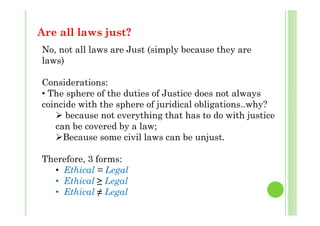
Are all laws just?w j
No, not all laws are Just (simply because they are
laws)laws)
Considerations:
• The sphere of the duties of Justice does not always
coincide with the sphere of juridical obligations..why?
 b t thi th t h t d ith j ti because not everything that has to do with justice
can be covered by a law;
Because some civil laws can be unjustBecause some civil laws can be unjust.
Therefore, 3 forms:
• Ethical = Legal
• Ethical ≥ Legal
Ethi l ≠ L l• Ethical ≠ Legal
Th ti f J ti f di titiThe practice of Justice for media practitioners:
“Media practitioners may employ the Principle ofMedia practitioners may employ the Principle of
Justice to decide what guidelines should be applied to
using deception, establishing and maintaining
confidential relationships with their sources and
intruding other people’s privacy.– Day
Point of discussion:
Justice requires that journalists report the
embarrassing behavior of others, both public and
i t b d h t th ll dprivate persons, based on what they really deserve
rather than for the purpose of titillating the morbid
curiosity of an audiencecuriosity of an audience.
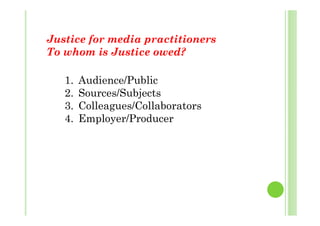
J i f di i iJustice for media practitioners
To whom is Justice owed?
1. Audience/Public
2. Sources/Subjects
3. Colleagues/Collaborators
4. Employer/Producer

Media Ethics: Justice

  • 1.
    JJUSTICEUSTICEJJUSTICEUSTICE Rachel E. Khan AssociateProfessor, Journalism Department, College of Mass Communication University of the Philippines, Diliman
  • 2.
    “Justice has todo with people’s l ti ith th d irelations with one another and is often important to the resolution of thi l di t ” L i Dethical disputes.” --Louis Day “E e citi e ha ce tai d tie of“Every citizen has certain duties of justice. The degree of importance of these duties depend naturall onthese duties depend, naturally, on the level of realtions with one another ” Dayanother. – Day
  • 3.
    Central to thenotion of JUSTICE is FAIRNESS, in which all individuals are, treated alike in terms of what they deserve.. i.e. no double standards Plato: “to give each one what is duePlato: to give each one what is due Aristotle: “a habit, whereby man, y renders to another his due with constant and perpetual will.”
  • 4.
    What is due? RIGHTS. “Ifthe act of justice is to give each one his due, then the act of justice, j is preceded by the act, whereby something is due.” —St. Thomas Aquinas
  • 5.
    Principle of Justice: “Ifone man has a right, then other men have the obligation to uphold that right.” —St. Thomas Aquinas “The right to swing my arm ends where your noseThe right to swing my arm ends where your nose begins.” — Voltaire
  • 6.
    H d thibHow does a thing become someone’s due? 1. Natural law a) on the basis of human nature (right to life, liberty, reputation..) b) On the basis of one’s relationship (e.g. honor and respect due to parents)honor and respect due to parents) 2. Positive law a) on the basis of agreements treaties anda) on the basis of agreements, treaties and promises b) on the basis of legislated laws (whichb) on the basis of legislated laws (which regulates the relationship of individuals to their community)
  • 7.
    Note: If an agreementor contract (positive law)If an agreement or contract (positive law) is contrary to natural law, then it is NOT just; e g the contract of an assassin tojust; e.g. the contract of an assassin to murder a journalist is not a valid contract because it is not justcontract because it is not just.
  • 8.
    A ll lj t?Are all laws just? J lJust law: 1. Must promote the Common Good • presupposes respect for the person’s fundamental and inalienable rights; ib h i l ll b i d• contributes to the social well-being and development of the people; • fosters peace and order• fosters peace and order.
  • 9.
    A ll lj t?Are all laws just? 2. The burden which the law imposes on society must reflect an “equality of proportion.” (e.g. t b d bilit t )taxes are based on ability to pay) 3 Must not exceed the power of its authors (i e3. Must not exceed the power of its authors (i.e. legislators cannot legalize something evil or immoral or a violation of human rights)
  • 10.
    Are all lawsjust?w j No, not all laws are Just (simply because they are laws)laws) Considerations: • The sphere of the duties of Justice does not always coincide with the sphere of juridical obligations..why?  b t thi th t h t d ith j ti because not everything that has to do with justice can be covered by a law; Because some civil laws can be unjustBecause some civil laws can be unjust. Therefore, 3 forms: • Ethical = Legal • Ethical ≥ Legal Ethi l ≠ L l• Ethical ≠ Legal
  • 11.
    Th ti fJ ti f di titiThe practice of Justice for media practitioners: “Media practitioners may employ the Principle ofMedia practitioners may employ the Principle of Justice to decide what guidelines should be applied to using deception, establishing and maintaining confidential relationships with their sources and intruding other people’s privacy.– Day Point of discussion: Justice requires that journalists report the embarrassing behavior of others, both public and i t b d h t th ll dprivate persons, based on what they really deserve rather than for the purpose of titillating the morbid curiosity of an audiencecuriosity of an audience.
  • 12.
    J i fdi i iJustice for media practitioners To whom is Justice owed? 1. Audience/Public 2. Sources/Subjects 3. Colleagues/Collaborators 4. Employer/Producer