Ethers
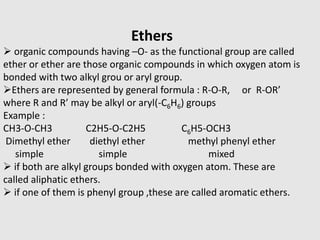
 organic compounds having –O- as the functional group are called
ether or ether are those organic compounds in which oxygen atom is
bonded with two alkyl grou or aryl group.
Ethers are represented by general formula : R-O-R, or R-OR’
where R and R’ may be alkyl or aryl(-C6H6) groups
Example :
CH3-O-CH3 C2H5-O-C2H5 C6H5-OCH3
Dimethyl ether diethyl ether methyl phenyl ether
simple simple mixed
 if both are alkyl groups bonded with oxygen atom. These are
called aliphatic ethers.
 if one of them is phenyl group ,these are called aromatic ethers.
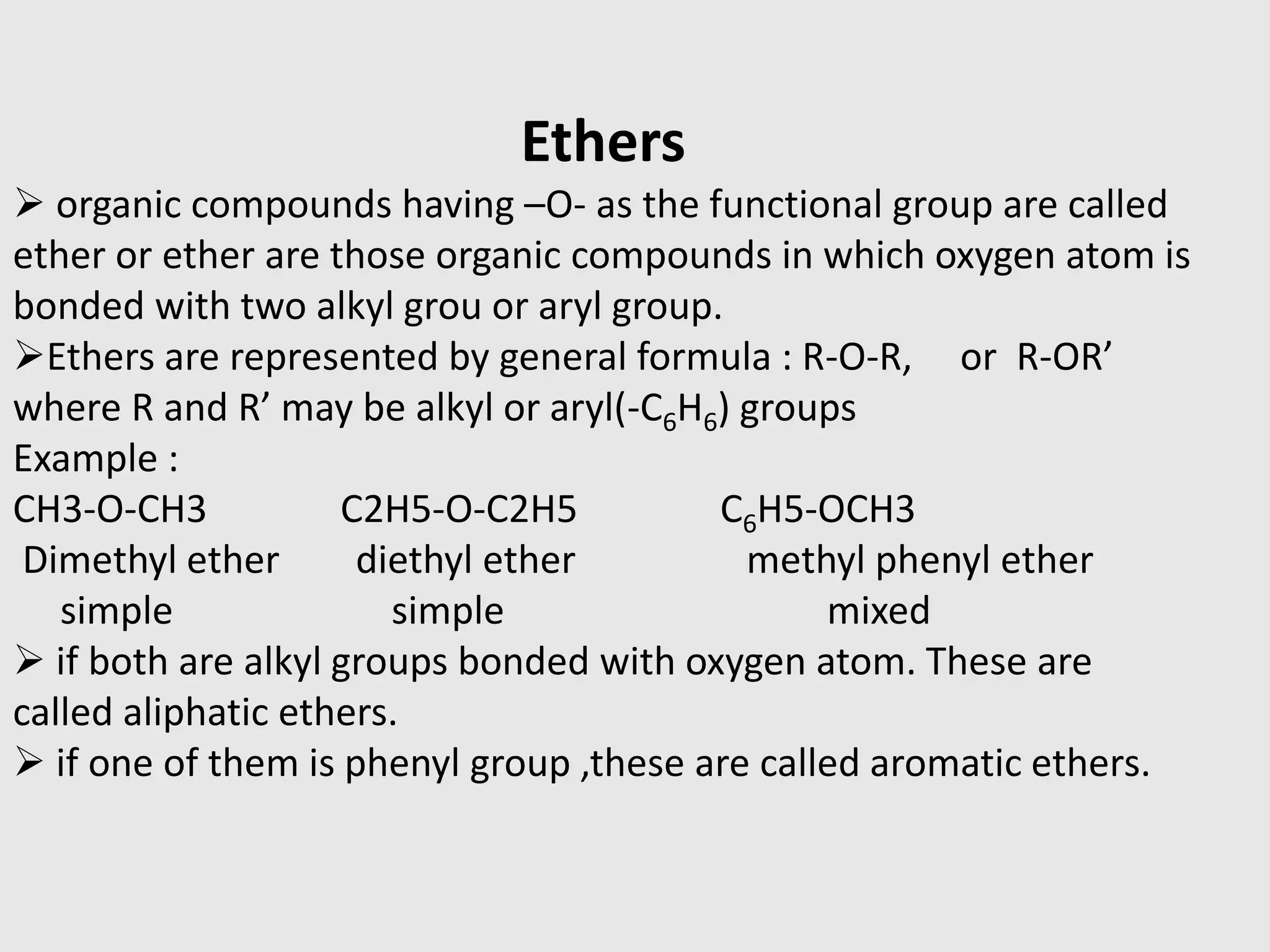
ether may also be considered as anhydride of alcohol because
there are obtained by the elimination of a water molecules between
two molecules of alcohol.
R-OH + HO-R → R-O-R +H2O
Alcohol ether
 ethers can be regarded as derivatives of water in which both
hydrogen atoms have been replaced by alkyl or aryl groups.
H-O-H → R-O-R
Water ether
 thus , the shape of ether is an angular as like water molecules,
but the bond angles is larger than in water molecules. Due to
presence of crowdy effect of larger alkyl group. There is strong
repulsion between the two alkyl group.
-2H
+2R
104.5 110
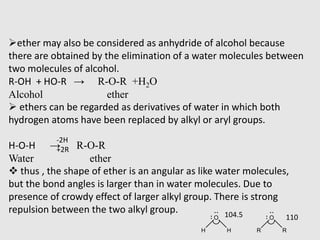
• the general formula of ether is CnH2n+2 O
Classification: ether may be classified in two ways.
1. If both the groups are same, the ether is known as symmetrical
ether or simple ether. Example :
CH3-O-CH3 C2H5-O-C2H5 C6H5-OC6H5
Dimethyl ether diethyl ether diphenyl ether
If both the groups are different , the ether is known as unsymmetrical
or mixed ether. Example:
C2H5 –O- CH3
ethyl methyl ether
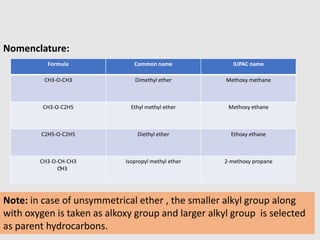
Nomenclature:
Formula Common name IUPAC name
CH3-O-CH3 Dimethyl ether Methoxy methane
CH3-O-C2H5 Ethyl methyl ether Methoxy ethane
C2H5-O-C2H5 Diethyl ether Ethoxy ethane
CH3-O-CH-CH3
CH3
Isopropyl methyl ether 2-methoxy propane
-
Note: in case of unsymmetrical ether , the smaller alkyl group along
with oxygen is taken as alkoxy group and larger alkyl group is selected
as parent hydrocarbons.
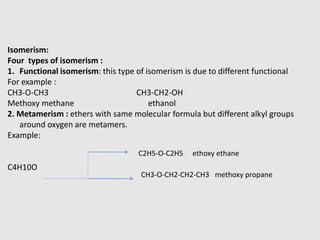
Isomerism:
Four types of isomerism :
1. Functional isomerism: this type of isomerism is due to different functional
For example :
CH3-O-CH3 CH3-CH2-OH
Methoxy methane ethanol
2. Metamerism : ethers with same molecular formula but different alkyl groups
around oxygen are metamers.
Example:
C4H10O
C2H5-O-C2H5 ethoxy ethane
CH3-O-CH2-CH2-CH3 methoxy propane
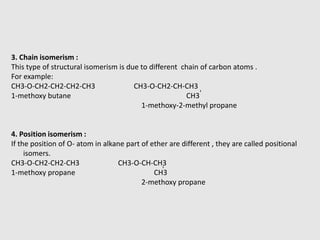
3. Chain isomerism :
This type of structural isomerism is due to different chain of carbon atoms .
For example:
CH3-O-CH2-CH2-CH2-CH3 CH3-O-CH2-CH-CH3
1-methoxy butane CH3
1-methoxy-2-methyl propane
4. Position isomerism :
If the position of O- atom in alkane part of ether are different , they are called positional
isomers.
CH3-O-CH2-CH2-CH3 CH3-O-CH-CH3
1-methoxy propane CH3
2-methoxy propane
-
-
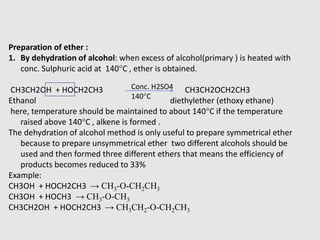
Preparation of ether :
1. By dehydration of alcohol: when excess of alcohol(primary ) is heated with
conc. Sulphuric acid at 140°C , ether is obtained.
CH3CH2OH + HOCH2CH3 CH3CH2OCH2CH3
Ethanol diethylether (ethoxy ethane)
here, temperature should be maintained to about 140°C if the temperature
raised above 140°C , alkene is formed .
The dehydration of alcohol method is only useful to prepare symmetrical ether
because to prepare unsymmetrical ether two different alcohols should be
used and then formed three different ethers that means the efficiency of
products becomes reduced to 33%
Example:
CH3OH + HOCH2CH3 → CH3-O-CH2CH3
CH3OH + HOCH3 → CH3-O-CH3
CH3CH2OH + HOCH2CH3 → CH3CH2-O-CH2CH3
Conc. H2SO4
140°C
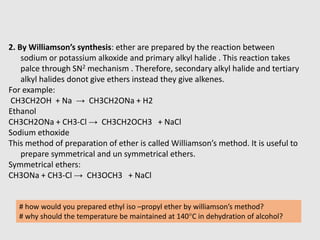
2. By Williamson’s synthesis: ether are prepared by the reaction between
sodium or potassium alkoxide and primary alkyl halide . This reaction takes
palce through SN2 mechanism . Therefore, secondary alkyl halide and tertiary
alkyl halides donot give ethers instead they give alkenes.
For example:
CH3CH2OH + Na → CH3CH2ONa + H2
Ethanol
CH3CH2ONa + CH3-Cl → CH3CH2OCH3 + NaCl
Sodium ethoxide
This method of preparation of ether is called Williamson’s method. It is useful to
prepare symmetrical and un symmetrical ethers.
Symmetrical ethers:
CH3ONa + CH3-Cl → CH3OCH3 + NaCl
# how would you prepared ethyl iso –propyl ether by williamson’s method?
# why should the temperature be maintained at 140°C in dehydration of alcohol?
Physical properties:
 State : dimethyl ether and ethylmethyl ether are gases at
ordinary temperature but other molecules are volatile liquids
with pleasant smell.
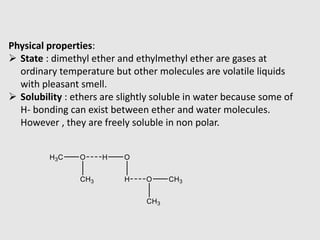
 Solubility : ethers are slightly soluble in water because some of
H- bonding can exist between ether and water molecules.
However , they are freely soluble in non polar.
 Boiling points: boiling points of ethers shows gradual increase with
rise in molecular weight .
Ethers are isomeric with monohydric alcohols but their boiling points
are much lower than the isomeric alcohols. This is because unlike
alcohols , ethers cannot form intermolecular hydrogen bonding. As
a results ether donot show molecular association and hence have
lower boiling points than their corresponding alcohols.
Chemical properties:
 Ethers are less reactive or inert compare with alcohols because
C-O bond in ether is very little polar while –OH bond in alcohols
is highly polar ( due to absence of active site in functional group
or replaceable hydrogen atom), therefore at normal conditions
ethers donot reacts with acids , bases , oxidising agent and
reducing agents, etc. however under certain condition ethers
shows following properties.
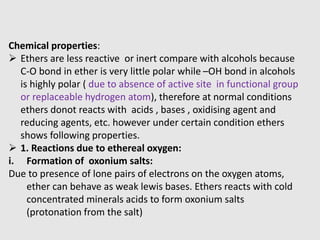
 1. Reactions due to ethereal oxygen:
i. Formation of oxonium salts:
Due to presence of lone pairs of electrons on the oxygen atoms,
ether can behave as weak lewis bases. Ethers reacts with cold
concentrated minerals acids to form oxonium salts
(protonation from the salt)
CH3CH2-OCH2CH3 + HCl →
]
[
+
Cl -
Oxonium salts are stable at low temperature in strongly acidic
solution . On dilution with water oxonium salts dissociated to give
ether and acid.
CH3CH2-OCH2CH3 + HCl
+
Cl -
]
[ →
H2O
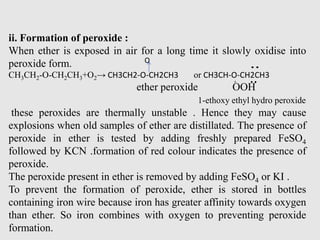
ii. Formation of peroxide :
When ether is exposed in air for a long time it slowly oxidise into
peroxide form.
CH3CH2-O-CH2CH3+O2→ CH3CH2-O-CH2CH3 or CH3CH-O-CH2CH3
ether peroxide OOH
1-ethoxy ethyl hydro peroxide
these peroxides are thermally unstable . Hence they may cause
explosions when old samples of ether are distillated. The presence of
peroxide in ether is tested by adding freshly prepared FeSO4
followed by KCN .formation of red colour indicates the presence of
peroxide.
The peroxide present in ether is removed by adding FeSO4 or KI .
To prevent the formation of peroxide, ether is stored in bottles
containing iron wire because iron has greater affinity towards oxygen
than ether. So iron combines with oxygen to preventing peroxide
formation. -
O
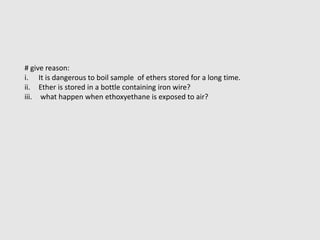
# give reason:
i. It is dangerous to boil sample of ethers stored for a long time.
ii. Ether is stored in a bottle containing iron wire?
iii. what happen when ethoxyethane is exposed to air?
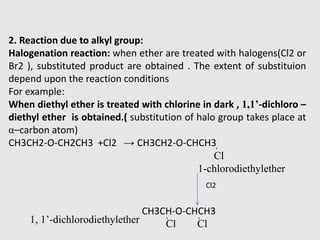
2. Reaction due to alkyl group:
Halogenation reaction: when ether are treated with halogens(Cl2 or
Br2 ), substituted product are obtained . The extent of substituion
depend upon the reaction conditions
For example:
When diethyl ether is treated with chlorine in dark , 1,1’-dichloro –
diethyl ether is obtained.( substitution of halo group takes place at
α–carbon atom)
CH3CH2-O-CH2CH3 +Cl2 → CH3CH2-O-CHCH3
Cl
1-chlorodiethylether
1, 1’-dichlorodiethylether
-
CH3CH-O-CHCH3
Cl Cl
-
-
Cl2
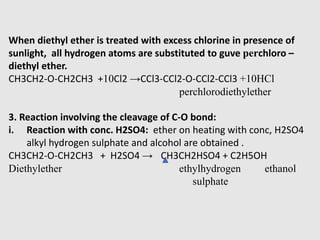
When diethyl ether is treated with excess chlorine in presence of
sunlight, all hydrogen atoms are substituted to guve perchloro –
diethyl ether.
CH3CH2-O-CH2CH3 +10Cl2 →CCl3-CCl2-O-CCl2-CCl3 +10HCl
perchlorodiethylether
3. Reaction involving the cleavage of C-O bond:
i. Reaction with conc. H2SO4: ether on heating with conc, H2SO4
alkyl hydrogen sulphate and alcohol are obtained .
CH3CH2-O-CH2CH3 + H2SO4 → CH3CH2HSO4 + C2H5OH
Diethylether ethylhydrogen ethanol
sulphate
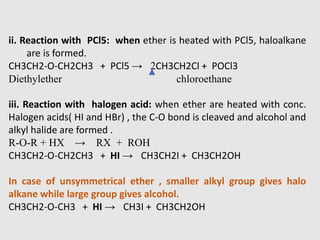
ii. Reaction with PCl5: when ether is heated with PCl5, haloalkane
are is formed.
CH3CH2-O-CH2CH3 + PCl5 → 2CH3CH2Cl + POCl3
Diethylether chloroethane
iii. Reaction with halogen acid: when ether are heated with conc.
Halogen acids( HI and HBr) , the C-O bond is cleaved and alcohol and
alkyl halide are formed .
R-O-R + HX → RX + ROH
CH3CH2-O-CH2CH3 + HI → CH3CH2I + CH3CH2OH
In case of unsymmetrical ether , smaller alkyl group gives halo
alkane while large group gives alcohol.
CH3CH2-O-CH3 + HI → CH3I + CH3CH2OH
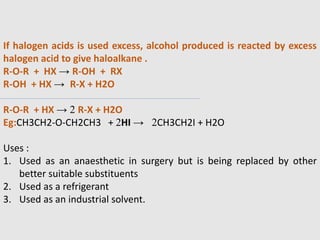
If halogen acids is used excess, alcohol produced is reacted by excess
halogen acid to give haloalkane .
R-O-R + HX → R-OH + RX
R-OH + HX → R-X + H2O
R-O-R + HX → 2 R-X + H2O
Eg:CH3CH2-O-CH2CH3 + 2HI → 2CH3CH2I + H2O
Uses :
1. Used as an anaesthetic in surgery but is being replaced by other
better suitable substituents
2. Used as a refrigerant
3. Used as an industrial solvent.
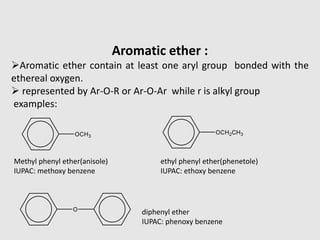
Aromatic ether :
Aromatic ether contain at least one aryl group bonded with the
ethereal oxygen.
 represented by Ar-O-R or Ar-O-Ar while r is alkyl group
examples:
Methyl phenyl ether(anisole)
IUPAC: methoxy benzene
ethyl phenyl ether(phenetole)
IUPAC: ethoxy benzene
diphenyl ether
IUPAC: phenoxy benzene
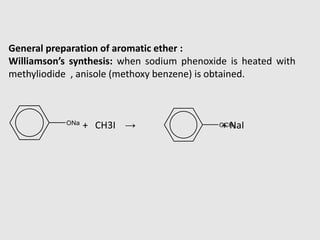
General preparation of aromatic ether :
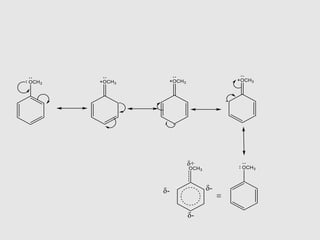
Williamson’s synthesis: when sodium phenoxide is heated with
methyliodide , anisole (methoxy benzene) is obtained.
+ CH3I → + NaI
≡
δ-
δ-
δ-
δ+
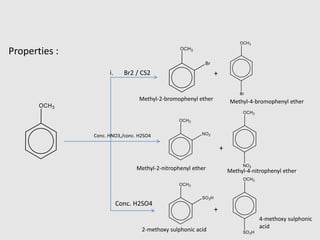
Properties :
i. Br2 / CS2
Conc. HNO3,/conc. H2SO4
Conc. H2SO4
Methyl-2-bromophenyl ether Methyl-4-bromophenyl ether
Methyl-2-nitrophenyl ether Methyl-4-nitrophenyl ether
2-methoxy sulphonic acid
4-methoxy sulphonic
acid
+
+
+
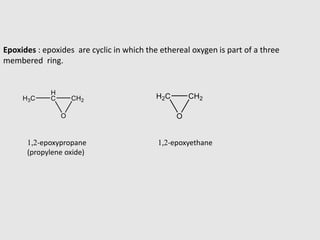
Epoxides : epoxides are cyclic in which the ethereal oxygen is part of a three
membered ring.
1,2-epoxypropane
(propylene oxide)
1,2-epoxyethane
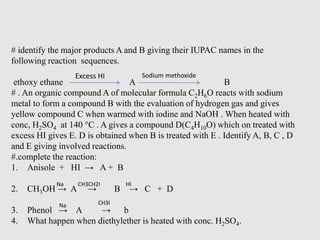
# identify the major products A and B giving their IUPAC names in the
following reaction sequences.
ethoxy ethane A B
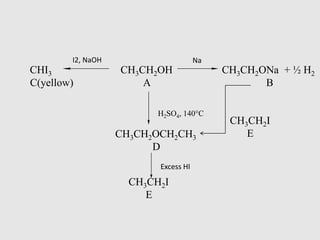
# . An organic compound A of molecular formula C2H6O reacts with sodium
metal to form a compound B with the evaluation of hydrogen gas and gives
yellow compound C when warmed with iodine and NaOH . When heated with
conc, H2SO4 at 140 °C . A gives a compound D(C4H10O) which on treated with
excess HI gives E. D is obtained when B is treated with E . Identify A, B, C , D
and E giving involved reactions.
#.complete the reaction:
1. Anisole + HI → A + B
2. CH3OH → A → B → C + D
3. Phenol → A → b
4. What happen when diethylether is heated with conc. H2SO4.
Excess HI Sodium methoxide
Na CH3CH2I HI
Na CH3I
CH3CH2I
E
CH3CH2OCH2CH3
D
CH3CH2OH
A
CH3CH2ONa + ½ H2
B
CHI3
C(yellow)
Na
H2SO4, 140°C
I2, NaOH
Excess HI
CH3CH2I
E

ETHER-[6087].pptx

  • 1.
    Ethers  organic compoundshaving –O- as the functional group are called ether or ether are those organic compounds in which oxygen atom is bonded with two alkyl grou or aryl group. Ethers are represented by general formula : R-O-R, or R-OR’ where R and R’ may be alkyl or aryl(-C6H6) groups Example : CH3-O-CH3 C2H5-O-C2H5 C6H5-OCH3 Dimethyl ether diethyl ether methyl phenyl ether simple simple mixed  if both are alkyl groups bonded with oxygen atom. These are called aliphatic ethers.  if one of them is phenyl group ,these are called aromatic ethers.
  • 2.
    ether may alsobe considered as anhydride of alcohol because there are obtained by the elimination of a water molecules between two molecules of alcohol. R-OH + HO-R → R-O-R +H2O Alcohol ether  ethers can be regarded as derivatives of water in which both hydrogen atoms have been replaced by alkyl or aryl groups. H-O-H → R-O-R Water ether  thus , the shape of ether is an angular as like water molecules, but the bond angles is larger than in water molecules. Due to presence of crowdy effect of larger alkyl group. There is strong repulsion between the two alkyl group. -2H +2R 104.5 110
  • 3.
    • the generalformula of ether is CnH2n+2 O Classification: ether may be classified in two ways. 1. If both the groups are same, the ether is known as symmetrical ether or simple ether. Example : CH3-O-CH3 C2H5-O-C2H5 C6H5-OC6H5 Dimethyl ether diethyl ether diphenyl ether If both the groups are different , the ether is known as unsymmetrical or mixed ether. Example: C2H5 –O- CH3 ethyl methyl ether
  • 4.
    Nomenclature: Formula Common nameIUPAC name CH3-O-CH3 Dimethyl ether Methoxy methane CH3-O-C2H5 Ethyl methyl ether Methoxy ethane C2H5-O-C2H5 Diethyl ether Ethoxy ethane CH3-O-CH-CH3 CH3 Isopropyl methyl ether 2-methoxy propane - Note: in case of unsymmetrical ether , the smaller alkyl group along with oxygen is taken as alkoxy group and larger alkyl group is selected as parent hydrocarbons.
  • 5.
    Isomerism: Four types ofisomerism : 1. Functional isomerism: this type of isomerism is due to different functional For example : CH3-O-CH3 CH3-CH2-OH Methoxy methane ethanol 2. Metamerism : ethers with same molecular formula but different alkyl groups around oxygen are metamers. Example: C4H10O C2H5-O-C2H5 ethoxy ethane CH3-O-CH2-CH2-CH3 methoxy propane
  • 6.
    3. Chain isomerism: This type of structural isomerism is due to different chain of carbon atoms . For example: CH3-O-CH2-CH2-CH2-CH3 CH3-O-CH2-CH-CH3 1-methoxy butane CH3 1-methoxy-2-methyl propane 4. Position isomerism : If the position of O- atom in alkane part of ether are different , they are called positional isomers. CH3-O-CH2-CH2-CH3 CH3-O-CH-CH3 1-methoxy propane CH3 2-methoxy propane - -
  • 7.
    Preparation of ether: 1. By dehydration of alcohol: when excess of alcohol(primary ) is heated with conc. Sulphuric acid at 140°C , ether is obtained. CH3CH2OH + HOCH2CH3 CH3CH2OCH2CH3 Ethanol diethylether (ethoxy ethane) here, temperature should be maintained to about 140°C if the temperature raised above 140°C , alkene is formed . The dehydration of alcohol method is only useful to prepare symmetrical ether because to prepare unsymmetrical ether two different alcohols should be used and then formed three different ethers that means the efficiency of products becomes reduced to 33% Example: CH3OH + HOCH2CH3 → CH3-O-CH2CH3 CH3OH + HOCH3 → CH3-O-CH3 CH3CH2OH + HOCH2CH3 → CH3CH2-O-CH2CH3 Conc. H2SO4 140°C
  • 8.
    2. By Williamson’ssynthesis: ether are prepared by the reaction between sodium or potassium alkoxide and primary alkyl halide . This reaction takes palce through SN2 mechanism . Therefore, secondary alkyl halide and tertiary alkyl halides donot give ethers instead they give alkenes. For example: CH3CH2OH + Na → CH3CH2ONa + H2 Ethanol CH3CH2ONa + CH3-Cl → CH3CH2OCH3 + NaCl Sodium ethoxide This method of preparation of ether is called Williamson’s method. It is useful to prepare symmetrical and un symmetrical ethers. Symmetrical ethers: CH3ONa + CH3-Cl → CH3OCH3 + NaCl # how would you prepared ethyl iso –propyl ether by williamson’s method? # why should the temperature be maintained at 140°C in dehydration of alcohol?
  • 9.
    Physical properties:  State: dimethyl ether and ethylmethyl ether are gases at ordinary temperature but other molecules are volatile liquids with pleasant smell.  Solubility : ethers are slightly soluble in water because some of H- bonding can exist between ether and water molecules. However , they are freely soluble in non polar.
  • 10.
     Boiling points:boiling points of ethers shows gradual increase with rise in molecular weight . Ethers are isomeric with monohydric alcohols but their boiling points are much lower than the isomeric alcohols. This is because unlike alcohols , ethers cannot form intermolecular hydrogen bonding. As a results ether donot show molecular association and hence have lower boiling points than their corresponding alcohols.
  • 11.
    Chemical properties:  Ethersare less reactive or inert compare with alcohols because C-O bond in ether is very little polar while –OH bond in alcohols is highly polar ( due to absence of active site in functional group or replaceable hydrogen atom), therefore at normal conditions ethers donot reacts with acids , bases , oxidising agent and reducing agents, etc. however under certain condition ethers shows following properties.  1. Reactions due to ethereal oxygen: i. Formation of oxonium salts: Due to presence of lone pairs of electrons on the oxygen atoms, ether can behave as weak lewis bases. Ethers reacts with cold concentrated minerals acids to form oxonium salts (protonation from the salt)
  • 12.
    CH3CH2-OCH2CH3 + HCl→ ] [ + Cl - Oxonium salts are stable at low temperature in strongly acidic solution . On dilution with water oxonium salts dissociated to give ether and acid. CH3CH2-OCH2CH3 + HCl + Cl - ] [ → H2O
  • 13.
    ii. Formation ofperoxide : When ether is exposed in air for a long time it slowly oxidise into peroxide form. CH3CH2-O-CH2CH3+O2→ CH3CH2-O-CH2CH3 or CH3CH-O-CH2CH3 ether peroxide OOH 1-ethoxy ethyl hydro peroxide these peroxides are thermally unstable . Hence they may cause explosions when old samples of ether are distillated. The presence of peroxide in ether is tested by adding freshly prepared FeSO4 followed by KCN .formation of red colour indicates the presence of peroxide. The peroxide present in ether is removed by adding FeSO4 or KI . To prevent the formation of peroxide, ether is stored in bottles containing iron wire because iron has greater affinity towards oxygen than ether. So iron combines with oxygen to preventing peroxide formation. - O
  • 14.
    # give reason: i.It is dangerous to boil sample of ethers stored for a long time. ii. Ether is stored in a bottle containing iron wire? iii. what happen when ethoxyethane is exposed to air?
  • 15.
    2. Reaction dueto alkyl group: Halogenation reaction: when ether are treated with halogens(Cl2 or Br2 ), substituted product are obtained . The extent of substituion depend upon the reaction conditions For example: When diethyl ether is treated with chlorine in dark , 1,1’-dichloro – diethyl ether is obtained.( substitution of halo group takes place at α–carbon atom) CH3CH2-O-CH2CH3 +Cl2 → CH3CH2-O-CHCH3 Cl 1-chlorodiethylether 1, 1’-dichlorodiethylether - CH3CH-O-CHCH3 Cl Cl - - Cl2
  • 16.
    When diethyl etheris treated with excess chlorine in presence of sunlight, all hydrogen atoms are substituted to guve perchloro – diethyl ether. CH3CH2-O-CH2CH3 +10Cl2 →CCl3-CCl2-O-CCl2-CCl3 +10HCl perchlorodiethylether 3. Reaction involving the cleavage of C-O bond: i. Reaction with conc. H2SO4: ether on heating with conc, H2SO4 alkyl hydrogen sulphate and alcohol are obtained . CH3CH2-O-CH2CH3 + H2SO4 → CH3CH2HSO4 + C2H5OH Diethylether ethylhydrogen ethanol sulphate
  • 17.
    ii. Reaction withPCl5: when ether is heated with PCl5, haloalkane are is formed. CH3CH2-O-CH2CH3 + PCl5 → 2CH3CH2Cl + POCl3 Diethylether chloroethane iii. Reaction with halogen acid: when ether are heated with conc. Halogen acids( HI and HBr) , the C-O bond is cleaved and alcohol and alkyl halide are formed . R-O-R + HX → RX + ROH CH3CH2-O-CH2CH3 + HI → CH3CH2I + CH3CH2OH In case of unsymmetrical ether , smaller alkyl group gives halo alkane while large group gives alcohol. CH3CH2-O-CH3 + HI → CH3I + CH3CH2OH
  • 18.
    If halogen acidsis used excess, alcohol produced is reacted by excess halogen acid to give haloalkane . R-O-R + HX → R-OH + RX R-OH + HX → R-X + H2O R-O-R + HX → 2 R-X + H2O Eg:CH3CH2-O-CH2CH3 + 2HI → 2CH3CH2I + H2O Uses : 1. Used as an anaesthetic in surgery but is being replaced by other better suitable substituents 2. Used as a refrigerant 3. Used as an industrial solvent.
  • 19.
    Aromatic ether : Aromaticether contain at least one aryl group bonded with the ethereal oxygen.  represented by Ar-O-R or Ar-O-Ar while r is alkyl group examples: Methyl phenyl ether(anisole) IUPAC: methoxy benzene ethyl phenyl ether(phenetole) IUPAC: ethoxy benzene diphenyl ether IUPAC: phenoxy benzene
  • 20.
    General preparation ofaromatic ether : Williamson’s synthesis: when sodium phenoxide is heated with methyliodide , anisole (methoxy benzene) is obtained. + CH3I → + NaI
  • 21.
  • 22.
    Properties : i. Br2/ CS2 Conc. HNO3,/conc. H2SO4 Conc. H2SO4 Methyl-2-bromophenyl ether Methyl-4-bromophenyl ether Methyl-2-nitrophenyl ether Methyl-4-nitrophenyl ether 2-methoxy sulphonic acid 4-methoxy sulphonic acid + + +
  • 23.
    Epoxides : epoxidesare cyclic in which the ethereal oxygen is part of a three membered ring. 1,2-epoxypropane (propylene oxide) 1,2-epoxyethane
  • 24.
    # identify themajor products A and B giving their IUPAC names in the following reaction sequences. ethoxy ethane A B # . An organic compound A of molecular formula C2H6O reacts with sodium metal to form a compound B with the evaluation of hydrogen gas and gives yellow compound C when warmed with iodine and NaOH . When heated with conc, H2SO4 at 140 °C . A gives a compound D(C4H10O) which on treated with excess HI gives E. D is obtained when B is treated with E . Identify A, B, C , D and E giving involved reactions. #.complete the reaction: 1. Anisole + HI → A + B 2. CH3OH → A → B → C + D 3. Phenol → A → b 4. What happen when diethylether is heated with conc. H2SO4. Excess HI Sodium methoxide Na CH3CH2I HI Na CH3I
  • 25.
    CH3CH2I E CH3CH2OCH2CH3 D CH3CH2OH A CH3CH2ONa + ½H2 B CHI3 C(yellow) Na H2SO4, 140°C I2, NaOH Excess HI CH3CH2I E