STEROIDS
By:
Dr. Kiran B. Dhamak
Department of Pharmaceutical Chemistry
Formation of Steroid Hormones
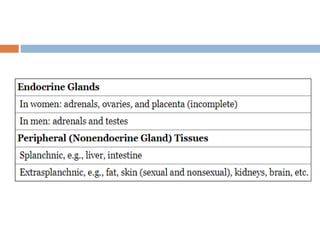
 Sources of steroid hormone formation in the body
can be divided into two types.
 One source is the endocrine glands. In women, they
include the adrenals, ovaries, and placenta, which is
an incomplete endocrine gland. In men, the
endocrine glands include the adrenals and testes.
 A second source of steroid hormones in the body is
peripheral tissues. These are nonendocrine tissues
such as the liver, intestine, fat, skin, kidneys, and
brain.
Chemistry of Steroids
 From the chemical standpoint, hormones can generally be
divided into three types: proteins (e.g., FSH and LH),
peptides (e.g., GnRH and ACTH), and steroids (e.g.,
progesterone and estradiol).
 The basic units of proteins and peptides are amino acids,
whereas steroids contain the gonane structure.
 Proteins are relatively large molecules and are water
soluble, whereas steroids are small molecules and are
generally soluble in organic solvents.
 Peptides are somewhere in between these two classes of
hormones with respect to molecular weight and solubility.
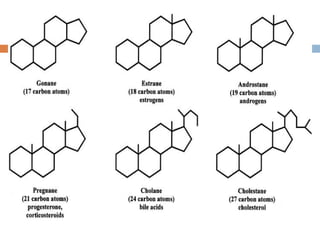
 The basic structure of steroids, gonane
(cyclopentanoperhydrophenanthrene), has 17 carbons
which are arranged as three six-member carbon rings
to which a five-member carbon ring is attached. Each
carbon has one or two hydrogens attached. The
gonane structure can be represented without showing
the carbons and hydrogens.
 Steroids can be divided into different groups of
parent compounds, based on the number of carbons
that they contain.
 In addition to gonanes, which consist of 17 carbons,
estranes consist of 18 carbons (C18 steroids) and
include estrogens.
 Androstanes have 19 carbons (C19 steroids) and
include androgens.
 Pregnanes contain 21 carbons (C21 steroids) and
include progesterone and corticosteroids. This chapter
focuses primarily on C18, C19, and C21 steroids.
 Cholanes have 24 carbons and include bile acids, and
cholestanes have 27 carbons and include cholesterol as
well as cholesterol-like compounds.
 The compounds in this group are also referred to as
sterols.
The Nomenclature of Steroids
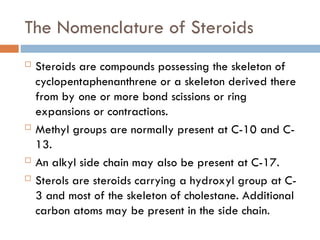
 Steroids are compounds possessing the skeleton of
cyclopentaphenanthrene or a skeleton derived there
from by one or more bond scissions or ring
expansions or contractions.
 Methyl groups are normally present at C-10 and C-
13.
 An alkyl side chain may also be present at C-17.
 Sterols are steroids carrying a hydroxyl group at C-
3 and most of the skeleton of cholestane. Additional
carbon atoms may be present in the side chain.
Numbering and ring letters
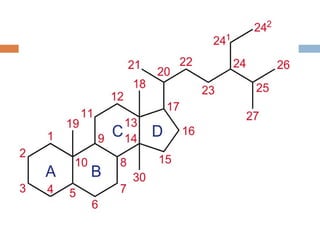
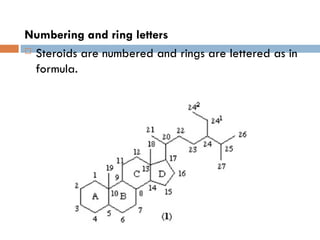
 Steroids are numbered and rings are lettered as in
formula.
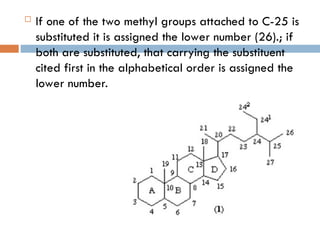
 If one of the two methyl groups attached to C-25 is
substituted it is assigned the lower number (26).; if
both are substituted, that carrying the substituent
cited first in the alphabetical order is assigned the
lower number.
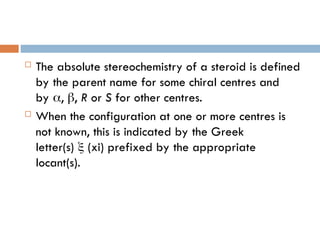
 The absolute stereochemistry of a steroid is defined
by the parent name for some chiral centres and
by , , R or S for other centres.
 When the configuration at one or more centres is
not known, this is indicated by the Greek
letter(s)  (xi) prefixed by the appropriate
locant(s).
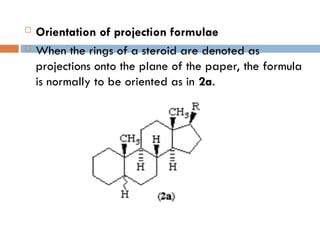
 Orientation of projection formulae
 When the rings of a steroid are denoted as
projections onto the plane of the paper, the formula
is normally to be oriented as in 2a.
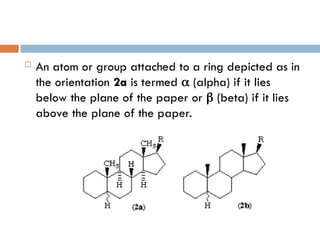
 An atom or group attached to a ring depicted as in
the orientation 2a is termed  (alpha) if it lies
below the plane of the paper or  (beta) if it lies
above the plane of the paper.
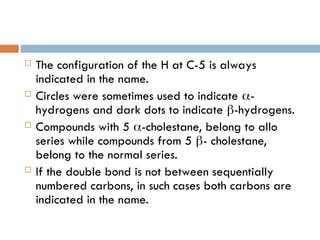
 The configuration of the H at C-5 is always
indicated in the name.
 Circles were sometimes used to indicate -
hydrogens and dark dots to indicate -hydrogens.
 Compounds with 5 -cholestane, belong to allo
series while compounds from 5 - cholestane,
belong to the normal series.
 If the double bond is not between sequentially
numbered carbons, in such cases both carbons are
indicated in the name.
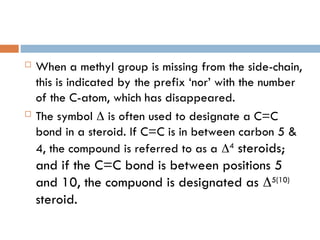
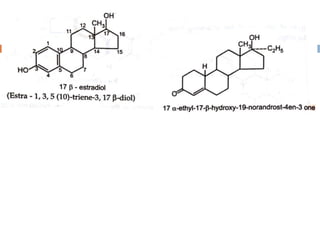
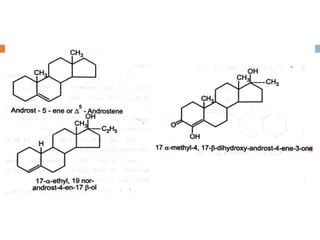
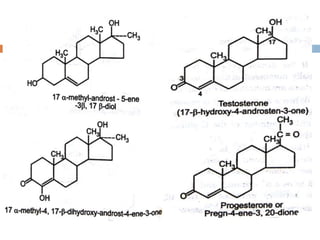
 When a methyl group is missing from the side-chain,
this is indicated by the prefix ‘nor’ with the number
of the C-atom, which has disappeared.
 The symbol  is often used to designate a C=C
bond in a steroid. If C=C is in between carbon 5 &
4, the compound is referred to as a 4
steroids;
and if the C=C bond is between positions 5
and 10, the compuond is designated as 5(10)
steroid.
Stereochemistry
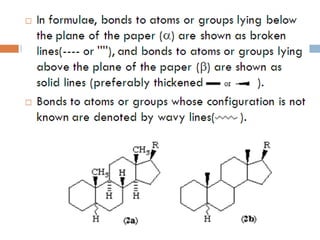
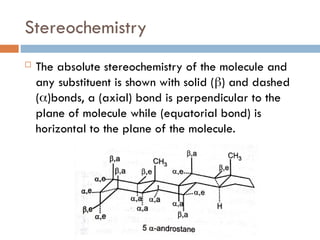
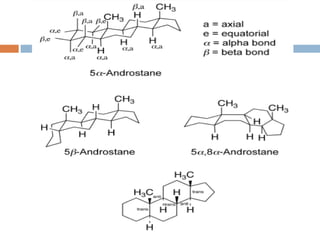
 The absolute stereochemistry of the molecule and
any substituent is shown with solid () and dashed
()bonds, a (axial) bond is perpendicular to the
plane of molecule while (equatorial bond) is
horizontal to the plane of the molecule.
 The aliphatic side chain at position 17 is always
assumed to be of  configuration.
 The terms cis and trans are occasionally used to
indicate the backbone stereochemistry between
rings.
 For example, 5 -steroids are A/B trans ; and 5 -
steroids are A/B cis. The terms syn and anti are
used analogously to trans and cis.
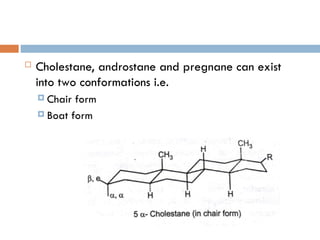
 Cholestane, androstane and pregnane can exist
into two conformations i.e.
 Chair form
 Boat form
 Chair conformation is more stable than boat
conformation due to less angle strain and hence all
cyclohexane rings in the steroid nucleus exist in the
chair conformation.
Adrenocorticoids
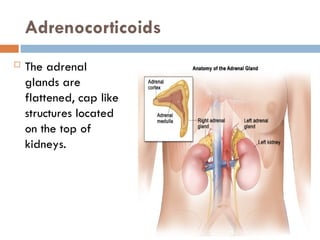
 The adrenal
glands are
flattened, cap like
structures located
on the top of
kidneys.
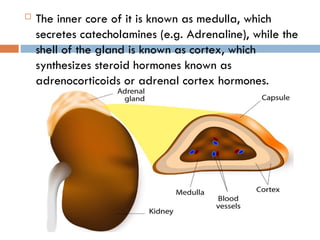
 The inner core of it is known as medulla, which
secretes catecholamines (e.g. Adrenaline), while the
shell of the gland is known as cortex, which
synthesizes steroid hormones known as
adrenocorticoids or adrenal cortex hormones.
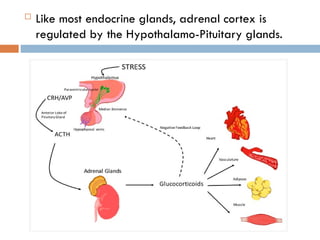
 Like most endocrine glands, adrenal cortex is
regulated by the Hypothalamo-Pituitary glands.
 The activation of the hypothalamic-pituitary-adrenal (HPA)
axis.
 Response to a stress stimulus is routed to the
hypophysiotropic neurons in the paraventricular nucleus
(PVN) of the hypothalamus.
 These neurosecretory cells release corticotropin-releasing
hormone (CRH) and arginine vasopressin (AVP), which travel
through the median eminence and hypophyseal portal
vessels.
 Once CRH reaches the anterior pituitary, it binds CRF type
1 receptors of pituitary corticotroph cells.
 Adrenocorticotropic hormone (ACTH) is released into
circulation, binds its receptors in the zona fasiculata of the
adrenal cortex, and causes release of glucocorticoids.
 Glucocorticoids in circulation act on target cardiovascular
tissues (including, the heart, the vasculature, adipose tissue
and muscle) then feedback to the level of the central
nervous system (CNS) to inhibit activation of the HPA axis.
 The adrenal cortex synthesizes two classes of steroids.
 Glucocorticoids
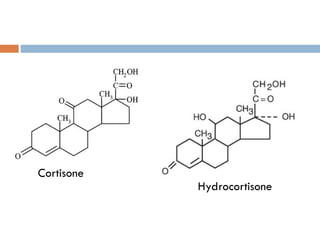
e.g. Cortisone, Hydrocortisone, Prednisone, Prednisolone
 Mineralocorticoids
e.g. Aldosterone
Glucocorticoids
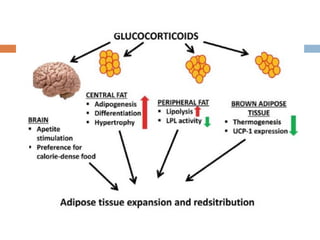
 These steroids regulate the carbohydrate, protein and
fat metabolism and are intimately involved in the
operation of the process that enable the body to resist
the infection and stress.
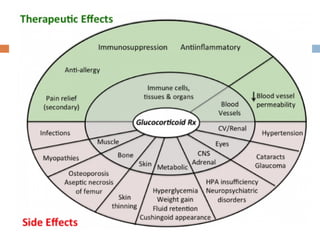
 Glucocorticoids are a type of corticosteroid hormone
that is very effective at reducing inflammation and
suppressing the immune system.
 Glucocorticoids are secreted naturally by our adrenal
gland in response to stress and have numerous effects
on our bodies that are essential for life. Glucocorticoid
drugs are synthetic versions of these hormones.
 Glucocorticoids are used to treat conditions that have
inflammation as a symptom, such as:
 Allergies Arthritis
 Asthma Autoimmune disorders such as multiple
sclerosis and rheumatoid arthritis
 Cancer Inflammatory bowel disease
 Lichen planus Lupus
 Psoriasis Severe mouth ulcers
 Skin inflammation and rashes
 Ulcerative colitis.
 Postoperative or chemotherapy-
induced nausea and vomiting
 Postoperative swelling or inflammation
Cortisone
Hydrocortisone
SAR of Glucocorticoids
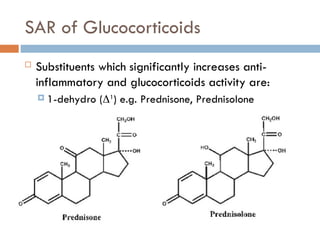
 Substituents which significantly increases anti-
inflammatory and glucocorticoids activity are:
 1-dehydro (1
) e.g. Prednisone, Prednisolone
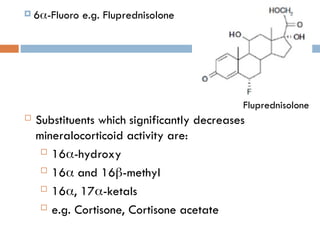
 6-Fluoro e.g. Fluprednisolone
Fluprednisolone
 Substituents which significantly decreases
mineralocorticoid activity are:
 16-hydroxy
 16 and 16-methyl
 16, 17-ketals
 e.g. Cortisone, Cortisone acetate
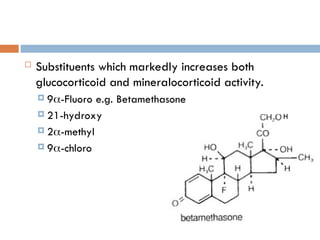
 Substituents which markedly increases both
glucocorticoid and mineralocorticoid activity.
 9-Fluoro e.g. Betamethasone
 21-hydroxy
 2-methyl
 9-chloro
H
Mechanism of Action
 The majority of effects produced by glucocorticoids
result from initial steroid binding to intracellular
glucocorticoid receptors followed by translocation
to the nucleus and changes in gene transcription.
 In their steroid-free (unbound) state, intracellular
glucocorticoid receptors (GR) are bound to
stabilizing proteins that include heat-shock protein
90 (Hsp90) and immunophilin.
 The unbound form of the receptor is not capable of
affecting gene transcription.
 Binding of steroid initiates a conformational change
that results in an exchange of chaperone proteins,
which permits attachment of the steroid- GR
complex to the dynein protein trafficking pathway.
This results in translocation of the steroid- GR
complex from the cytoplasm into the nucleus.
 Once in the nucleus, the steroid- GR complex
dimerizes and binds to glucocorticoid response
elements (GRE) associated with the regulatory
region of glucocorticoid-sensitive genes.
 Binding of the glucocorticoid- GR dimer either
represses, or stimulates the transcription of sensitive
genes, resulting in changes in synthesis of mRNA,
followed by changes in protein synthesis. These steps
are necessary for producing most cellular responses to
glucocorticoids, and typically take hours to days to
develop.
 Both a reduction in the synthesis of inflammatory
cytokines, as well as upregulation in the synthesis of
annexin A1 are known to play important roles in
mediating the antiinflammatory and immunomodulatory
effects of glucocorticoids.
 In some situations glucocorticoids are able to
produce more rapid responses by binding to
membrane-associated receptors and exerting
effects that do not involve changes in gene
regulation.
Mineralocorticoids
 A class of steroid hormones that cause retention of
sodium (and water).
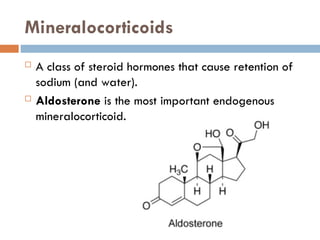
 Aldosterone is the most important endogenous
mineralocorticoid.
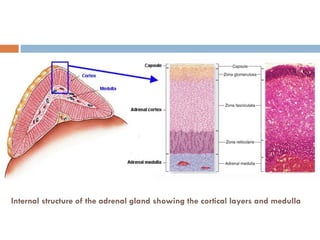
 Aldosterone is produced in the zona glomerulosa
region of the adrenal cortex. Because of it comes
from a zone of the adrenal cortex, it is also
considered a type of corticosteroid.
 Aldosterone physiological role is essential in
maintenance of adequate fluid volume needed for
normal cardiac output and arterial blood pressure.
 Without adequate levels of mineralocorticoids,
diminished cardiac output can result in fatal shock.
 In contrast, elevated levels of aldosterone
associated with long term stimulation of the Renin-
Angiotensin-Aldosterone-System (RAAS) is involved
in the development of vascular remodeling and
systolic heart failure.
Internal structure of the adrenal gland showing the cortical layers and medulla
SAR of Mineralocorticoids
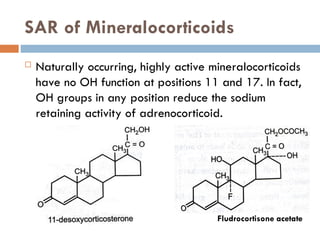
 Naturally occurring, highly active mineralocorticoids
have no OH function at positions 11 and 17. In fact,
OH groups in any position reduce the sodium
retaining activity of adrenocorticoid.
Fludrocortisone acetate
 According to the hormone-receptor binding studies,
the C and D rings, involving positions
11,12,13,16,17,20 and 21 are more important for
binding than the rings A and B.
 More specifically, the -surface of rings A, C and
D, as well as the the 17 -ketol side chain, is
essential for sodium retaining activity.
 Generally 9-F, 9-Cl, 9-Br substituents cause
increased mineralocorticoid activity where order of
activity is F>Cl>Br.
 Insertion of a 16-OH group results in reverse effect
i.e. sodium excretion rather than Na retention.
 A double bond between positions 1 and 2
(-1
cortcoids), also decreases the activity.
 21-F, 16-CH₃,16-CH₃, 16-CH₃O, 6-Cl, and
17-OH groups are reported to inhibit the sodium
retention property.
 12-F, 2-CH₃ and 21-OH groups moderately
elevate the mineralocorticoid activity.
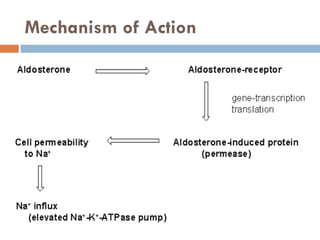
Mechanism of Action
 Like other steroids, aldosterone probably acts to
initiate transcription of RNA that serves as template
for the synthesis of carrier protein or proteins that
subsequently facilitate the crossing of Na⁺ ions
through the rate limiting permeability barrier of
the mucosal surface.
 Progesterone, the diuretic agent Spironolactone,
Actinomycin and Puromycin block the aldosterone
stimulated transport of Na⁺. Such inhibitors have
no effects on the non-hormonal basal transport
system of Na⁺
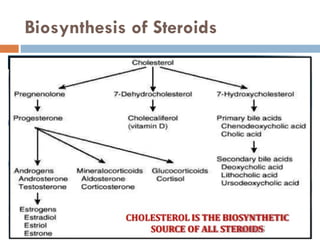
Biosynthesis of Steroids
Steroids with Chemistry, Nomenclature, Stereochemistry and Classification of Steroids.  .ppt