STEROIDS
STRUCTURALELUCIDATIONOF
TESTOSTERONEANDPROGESTERONE
RUDRESH.H.M
1ST M PHARM
( PHARMACEUTICAL CHEMISTRY)
AL-AMEEN COLLEGE OF PHARMACY
STEROIDS
 Steroids are the members of large class of organic compounds
occurring widely in plants and animals ,they are characterised
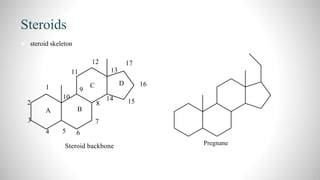
by the presence of a 1,2-cyclopentanoperhydrophenanthrene
nucleus.
 Steroids include a wide variety of natural occurring substance
like vitamin D, bile acids ,adrenal , cortical and sex hormone
,etc.
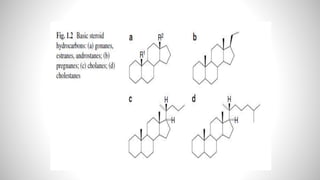
Most steroid compounds are derived from the following six basic
hydrocarbons:
 Gonanes (Fig. 1.2a, R1 = R2 = H), having hydrogen atoms at carbons 13
and 10
 Estranes, with R1 = H, R2 = methyl; the word rings in trivial names like
estradiol, estrone (Applezweig, 1964)
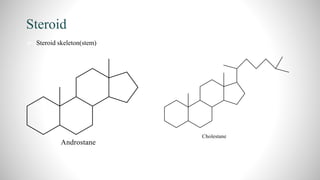
 Androstane, with R1 = R2 = methyl, reminds us of androsterone and
androgens
 Pregnane (Fig. 1.2b), its echo – pregnancy – points to gestagens
 Cholane (Fig. 1.2c), found mainly in cholic alcohols and acids
 Cholestane (Fig. 1.2d), the foundation of sterols and their derivatives
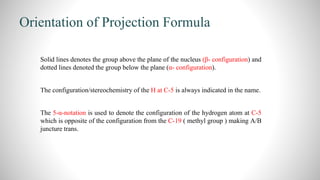
Orientation of Projection Formula
 Solid lines denotes the group above the plane of the nucleus (β- configuration) and
dotted lines denoted the group below the plane (α- configuration).
 The configuration/stereochemistry of the H at C-5 is always indicated in the name.
 The 5-α-notation is used to denote the configuration of the hydrogen atom at C-5
which is opposite of the configuration from the C-19 ( methyl group ) making A/B
juncture trans.
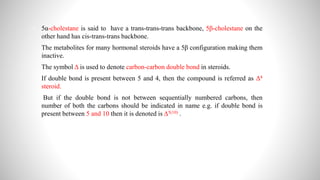
 5α-cholestane is said to have a trans-trans-trans backbone, 5β-cholestane on the
other hand has cis-trans-trans backbone.
 The metabolites for many hormonal steroids have a 5β configuration making them
inactive.
 The symbol Δ is used to denote carbon-carbon double bond in steroids.
 If double bond is present between 5 and 4, then the compound is referred as Δ4
steroid.
 But if the double bond is not between sequentially numbered carbons, then
number of both the carbons should be indicated in name e.g. if double bond is
present between 5 and 10 then it is denoted is Δ5(10) .
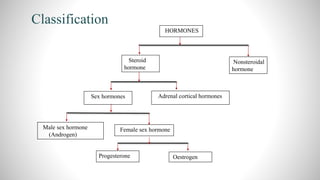
Classification
HORMONES
Steroid
hormone
Nonsteroidal
hormone
Sex hormones Adrenal cortical hormones
Male sex hormone
(Androgen)
Female sex hormone
Progesterone Oestrogen
Steroids
 steroid skeleton
Steroid
 Steroid skeleton(stem)
Sex Hormones
 These are group of steroids biosynthesised in the testes,
ovaries, adrenals and placenta during pregnancy.
 Sex hormone regulate reproductive function and responsible
for secondary sex characteristics.
 Sex hormones classified into
1.Androgens: Male sex hormone(Testosterone).
2.Oestrogen: Female sex hormone(Progesterone).
3.Gestogen: Corpus luteum hormone.
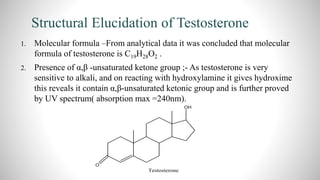
Testosterone (Androst-4-en-17β-ol-3-one)
 The testes produce mainly one type of androgen namely testosterone.
Testosterone and its reductant product 5α-dihydrotestosterone (DHT)
causes masculinizing effect even in the male foetus .
 Testosterone is a potent derivative of androstane. Androstane is the
more potent among the other androgens having approximately one-
seventh of the activity of testosterone.
 Testosterone and its derivative have been found useful in treatment of
advanced metastatic carcinoma of breast.
 Testosterone with combination of estrogen used in treatment of
menopausal syndrome
Structural Elucidation of Testosterone
1. Molecular formula –From analytical data it was concluded that molecular
formula of testosterone is C19H28O2 .
2. Presence of α,β -unsaturated ketone group ;- As testosterone is very
sensitive to alkali, and on reacting with hydroxylamine it gives hydroxime
this reveals it contain α,β-unsaturated ketonic group and is further proved
by UV spectrum( absorption max =240nm).
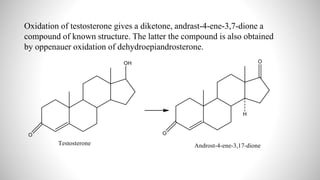
Oxidation of testosterone gives a diketone, andrast-4-ene-3,7-dione a
compound of known structure. The latter the compound is also obtained
by oppenauer oxidation of dehydroepiandrosterone.
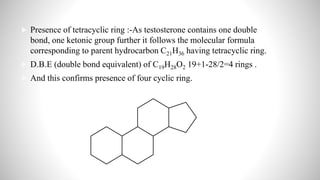
 Presence of tetracyclic ring :-As testosterone contains one double
bond, one ketonic group further it follows the molecular formula
corresponding to parent hydrocarbon C21H36 having tetracyclic ring.
 D.B.E (double bond equivalent) of C19H28O2 19+1-28/2=4 rings .
 And this confirms presence of four cyclic ring.
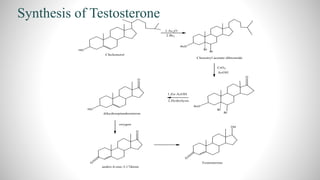
Synthesis of Testosterone
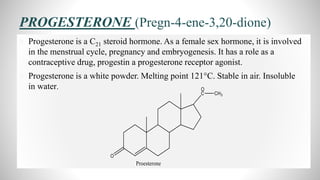
PROGESTERONE (Pregn-4-ene-3,20-dione)
 Progesterone is a C21 steroid hormone. As a female sex hormone, it is involved
in the menstrual cycle, pregnancy and embryogenesis. It has a role as a
contraceptive drug, progestin a progesterone receptor agonist.
 Progesterone is a white powder. Melting point 121°C. Stable in air. Insoluble
in water.
Structural Elucidation of Progesterone
 From the analytical the molecular formula of progesterone has been found to
be C21H30O2 .
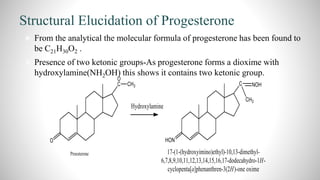
 Presence of two ketonic groups-As progesterone forms a dioxime with
hydroxylamine(NH2OH) this shows it contains two ketonic group.
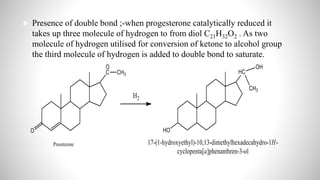
 Presence of double bond ;-when progesterone catalytically reduced it
takes up three molecule of hydrogen to from diol C21H32O2 . As two
molecule of hydrogen utilised for conversion of ketone to alcohol group
the third molecule of hydrogen is added to double bond to saturate.
 Presence of steroid nucleus; As progesterone contain two ketonic
group and one double bond it follows parent hydrocarbon ,so it’s a
tetracyclic furthermore its formation from cholesterol and
stigmasterol and X-ray studies confirm the steroid nucleus.
 Presence of α,β-unsaturated ketonic group; Progesterone gives
absorption spectrum λmax 240nm which confirms the presence of
ketonic group.
 Presence of CH3-CO- group; When progesterone heated with any
halogen atom and NaOH it yield haloforms which indicates the
presence of CH3-CO- group.
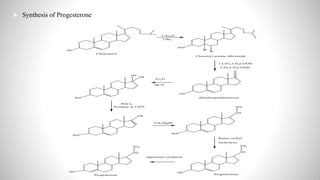
 Synthesis of Progesterone
Steroids,  testosterone and progesterone

Steroids, testosterone and progesterone

  • 1.
  • 2.
    STEROIDS  Steroids arethe members of large class of organic compounds occurring widely in plants and animals ,they are characterised by the presence of a 1,2-cyclopentanoperhydrophenanthrene nucleus.  Steroids include a wide variety of natural occurring substance like vitamin D, bile acids ,adrenal , cortical and sex hormone ,etc.
  • 3.
    Most steroid compoundsare derived from the following six basic hydrocarbons:  Gonanes (Fig. 1.2a, R1 = R2 = H), having hydrogen atoms at carbons 13 and 10  Estranes, with R1 = H, R2 = methyl; the word rings in trivial names like estradiol, estrone (Applezweig, 1964)  Androstane, with R1 = R2 = methyl, reminds us of androsterone and androgens  Pregnane (Fig. 1.2b), its echo – pregnancy – points to gestagens  Cholane (Fig. 1.2c), found mainly in cholic alcohols and acids  Cholestane (Fig. 1.2d), the foundation of sterols and their derivatives
  • 5.
    Orientation of ProjectionFormula  Solid lines denotes the group above the plane of the nucleus (β- configuration) and dotted lines denoted the group below the plane (α- configuration).  The configuration/stereochemistry of the H at C-5 is always indicated in the name.  The 5-α-notation is used to denote the configuration of the hydrogen atom at C-5 which is opposite of the configuration from the C-19 ( methyl group ) making A/B juncture trans.
  • 6.
     5α-cholestane issaid to have a trans-trans-trans backbone, 5β-cholestane on the other hand has cis-trans-trans backbone.  The metabolites for many hormonal steroids have a 5β configuration making them inactive.  The symbol Δ is used to denote carbon-carbon double bond in steroids.  If double bond is present between 5 and 4, then the compound is referred as Δ4 steroid.  But if the double bond is not between sequentially numbered carbons, then number of both the carbons should be indicated in name e.g. if double bond is present between 5 and 10 then it is denoted is Δ5(10) .
  • 8.
    Classification HORMONES Steroid hormone Nonsteroidal hormone Sex hormones Adrenalcortical hormones Male sex hormone (Androgen) Female sex hormone Progesterone Oestrogen
  • 9.
  • 10.
  • 11.
    Sex Hormones  Theseare group of steroids biosynthesised in the testes, ovaries, adrenals and placenta during pregnancy.  Sex hormone regulate reproductive function and responsible for secondary sex characteristics.  Sex hormones classified into 1.Androgens: Male sex hormone(Testosterone). 2.Oestrogen: Female sex hormone(Progesterone). 3.Gestogen: Corpus luteum hormone.
  • 12.
    Testosterone (Androst-4-en-17β-ol-3-one)  Thetestes produce mainly one type of androgen namely testosterone. Testosterone and its reductant product 5α-dihydrotestosterone (DHT) causes masculinizing effect even in the male foetus .  Testosterone is a potent derivative of androstane. Androstane is the more potent among the other androgens having approximately one- seventh of the activity of testosterone.  Testosterone and its derivative have been found useful in treatment of advanced metastatic carcinoma of breast.  Testosterone with combination of estrogen used in treatment of menopausal syndrome
  • 13.
    Structural Elucidation ofTestosterone 1. Molecular formula –From analytical data it was concluded that molecular formula of testosterone is C19H28O2 . 2. Presence of α,β -unsaturated ketone group ;- As testosterone is very sensitive to alkali, and on reacting with hydroxylamine it gives hydroxime this reveals it contain α,β-unsaturated ketonic group and is further proved by UV spectrum( absorption max =240nm).
  • 14.
    Oxidation of testosteronegives a diketone, andrast-4-ene-3,7-dione a compound of known structure. The latter the compound is also obtained by oppenauer oxidation of dehydroepiandrosterone.
  • 15.
     Presence oftetracyclic ring :-As testosterone contains one double bond, one ketonic group further it follows the molecular formula corresponding to parent hydrocarbon C21H36 having tetracyclic ring.  D.B.E (double bond equivalent) of C19H28O2 19+1-28/2=4 rings .  And this confirms presence of four cyclic ring.
  • 16.
  • 17.
    PROGESTERONE (Pregn-4-ene-3,20-dione)  Progesteroneis a C21 steroid hormone. As a female sex hormone, it is involved in the menstrual cycle, pregnancy and embryogenesis. It has a role as a contraceptive drug, progestin a progesterone receptor agonist.  Progesterone is a white powder. Melting point 121°C. Stable in air. Insoluble in water.
  • 18.
    Structural Elucidation ofProgesterone  From the analytical the molecular formula of progesterone has been found to be C21H30O2 .  Presence of two ketonic groups-As progesterone forms a dioxime with hydroxylamine(NH2OH) this shows it contains two ketonic group.
  • 19.
     Presence ofdouble bond ;-when progesterone catalytically reduced it takes up three molecule of hydrogen to from diol C21H32O2 . As two molecule of hydrogen utilised for conversion of ketone to alcohol group the third molecule of hydrogen is added to double bond to saturate.
  • 20.
     Presence ofsteroid nucleus; As progesterone contain two ketonic group and one double bond it follows parent hydrocarbon ,so it’s a tetracyclic furthermore its formation from cholesterol and stigmasterol and X-ray studies confirm the steroid nucleus.  Presence of α,β-unsaturated ketonic group; Progesterone gives absorption spectrum λmax 240nm which confirms the presence of ketonic group.  Presence of CH3-CO- group; When progesterone heated with any halogen atom and NaOH it yield haloforms which indicates the presence of CH3-CO- group.
  • 21.
     Synthesis ofProgesterone