Estrogen and Progestinal
Agent
Atanu Chakraborty
Roll No:20801914021
B.Phram 6th Sem
Medicinal Chemistry
Bharat Technology
Introduction
Introduction
 The steroids form a group of structurally related compounds which
are widely distributed in animals and plants. The structure of
steroids are based on 1,2-cyclcopentenophenanthrene skeleton.
Steroid consist of four fused rings. A perhydrophenanthrene (rings
A,B and C) is the completely saturated derivative of
phenanthrene while D is a five membered cyclopentane ring.
 The major therapeutic classes of steroids are :
 Anti-inflammatory agents : e.g cortisone
 Sex hormones : e.g Estrogrn, progesterone and testosterone.
 Oral contraceptives : e.g Nor- ethisterone.
 Cardiac steroids: e.g. Digitoxigenin
 Diuretics: e.g Spironolactone
 Antibiotic: e.g. Fusidic acide, and Vitamine D precursor : Ergastirol
Conformation
Steroids can have either a cis or trans
fusion of the A and B rings.
A-B trans steroid has C19 angular
methyl group up, and the C5
hydrogen atom down, on
opposite sides of
the molecule.
A-B cis steroid has both C19 angular
methyl group and C5 hydrogen atom
on the same side off the molecule.
A-B cis steroid has both C19 angular
methyl group and C5 hydrogen atom
On the same side the molecule.
Estrogen
The oestrogens are mainly concerned with growth
and function of the sex organs. In general , the are
classified under two sub heads, namely :
Steroidal Estrogen
Non steroidal estrogen
•Steroidal Oestrogens :All of them essentially possess
a steroidal nucleus and attribute estrogenic activity.
E.g : oestron, oestriol, oestradiol.
•Non-steroidal oestrogens : Diethylstilbestrol,
Hexestrol, Dienoestrol
•They are the primary female sex hormones. Like all sterid
hormone estrogens readily diffuse across cell membrane.
•Once inside the cell they bind to and activate estrogen
receptors which in turn modulate the expression of many
genes. Additionally, estrogen have been shone to activate a
G-protine coupled receptor, GPR30.
• Estradiol is the predominant estrogen during reproductive
years. During menopause,estrone is the predominant
circulating estrogen.
• During pregnancy estriol is the predominant circulating
estrogen
1.Estradiol : Known also as 17 beta - estradiol.
--Most patent estrogen produced and secreted by the
ovary.
--Principle estrogen in premenopausal women
2.Estrone :Metabolic of eatradiol that has approximately
1/3 the estrogenic potency of estradiol.
-- Primary circulatimg estrogen after menopause.
--Generated mainly from conversion of androsteredione
in peripheral tissue.
3.Estriol : Metabolite of estradiol, is significantly les
potent than estradiol.
--Present in significant amounts during pregnancy,
because its principal estrogen produced by
placenta.
4.Ethynyl Estradiol (Synthetic steroid)
--Undergo less 1st -pass metabolism than
naturally occurring steroids.
--Effective when administered orally at lower
doses.
--Readily absorbed when taken orally.
--Absorbed in the smal intestine.
--Excreted with the bile.
5.Conjugated Estrogens
--Reduce symptoms of menopause (hot
flushes and vaginal dryness).
Mechanism of action
 After dissociation from their binding sites on sex
hormone -binding globulin or albumin in the plasma,
stroid hormones diffuse acrose the cell membrane
and bind with high affinity to specific -receptor
proteins.
 2 estrogen - receptor subtypes mediate the effects
of
the hormone :
1. Alpha receptor : Considered as the
classic Estrogen Receptor.
 2. Beta receptor : Highly homologous to
the alpha receptor.
 -- Alpha receptor
 N- terminal portion of receptor contains a region
that Promotes transcription activation
Mechanism of action
 Beta receptor
Contains a repressor Domain.
 Affinity for the receptor type varies with the particular estrogen
 The alpha and beta estrogen receptor isoforms varies in :
--Structure
--Chromosomal location
--Tissue distribution
 Activated steroid - Receptor Complex interacts with nuclear
chromatin to initiate Hormone- Specific RNA synthesis:
-- Attachment of 2 estrogen - linked receptors (estrogen
receptor dimer) to the genome is required for a response
--this result is synthsis of specific protines that mediate a
number of physiologic functions.
Sythesis
Synthesis of
oestrone,oestr
adiol,oestradi
ol cypionate,
Ethinyl
estradiol, and
oestradiol
valerate
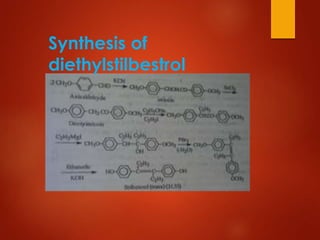
Synthesis of
diethylstilbestrol
Progestinal agent
Progestins
Progestins include the naturally occurring hormone progesterone, 17-
acetoxyprogesterone derivatives in the pregnane series, 19-
nortestosteron derivatives (estrogenes),and norgesterol and related
compounds in the gonane series.
Progestinal
derivative
Synthesis of
pregnan
derivatives
Progesteron
Synthesis
of
norgesterol
Classification
1. One group of progestines contains 21 carbon skeleton of
progesterone.
These agent are highly selective and have a spectrum of
activity very similar to that of endogenous hormones.This
conpounds are most frequently used in conjugation with
oestrogen for hormone replacement therapy in post
menopausal women e.g hydroxyprogesteron
caporate.,medroxy progesterone acetate, chlormadinone
acetate and delmadinone acetateacetate.
2. A second major class of compounds is derived from 19-
nortestosterone. This so called 19-nor compounds lack the
C19,C20 and C 21 carbons found in progesterone and
resemble testosterone the vicinity of the D ring.
Compound in this 19-norcategory historically have been
that progestine component of combination oral
contraceptives. This 19-nor copounds have potent
progestational activity,but they also have an androgenic and
other activities that are thought to contribute to their side
effects--e.g,norethindron norethynodrel, norgestrel,tigestol
and ethyneron.
The progestin Receptor
There is a single gene that encodes two isoforms of the progesterone
receptor(PR): PR-A and PR-B
Since the ligand-binding domains of the two PR isoforms
are identical, there is no difference in ligand binding .
However, the biological activities of PR-A and PR-B
isoforms distinct and depend on the target gent in question
PR-B mediates the stimulatory activities of
progesterone
PR-A strongly inhibits this action of PR-b
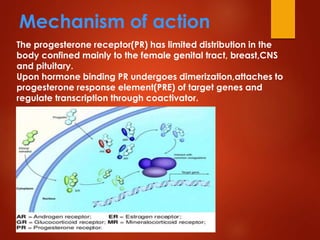
Mechanism of action
The progesterone receptor(PR) has limited distribution in the
body confined mainly to the female genital tract, breast,CNS
and pituitary.
Upon hormone binding PR undergoes dimerization,attaches to
progesterone response element(PRE) of target genes and
regulate transcription through coactivator.
Biosynthetic
pathway
Therapeutic uses
Contraception :
With estrogens is combined contraceptive tab or Alone in progestine-
only contraceptive tabs.
Progestins act by :
Interfering with endometrial implantation of fertilized ovam :
by making endometrium out of phase.
Fertilization is prevented due to interference with passage of
spermatozoa from vagina to uterus by making secretions of the cervix
thick and viscid ,so difficult to be penetrated by spermatozoa.
3.With large dose or with some preparation ,Gn secretion is inhibited.
The occurs in
~ 50% of cases, but always with depot preparation.
Menstrual disorders : Such as:
Primary Dysmenorrhea :(At first NSAIDs e.g. mefenimic acid are used
;if this fail, then dydrogesteron or combined contraceptive tabs are
employed).
Dysfunction uterine bleeding with menorrhagia : Norethin drone (oral)
or IM (Depot Provera)
Endometriosis : Inhibit ecotopic endometrial tissue by antagonising
estrogen and by inhibiting Gn secretion which leads to inhibition of
ovarian function including estrogen secretion.
-Medroxyprogesteron acetate IM (Depot Provera)
Premature labour : Progesteron , often given in the form of
17-hydroxyprogesteron caproate, relax uterine musculature ,
maintains cervical length, and has anti-inflammatory properties, and
thus exert activities expected to be beneficial in reducing perterm
birth
Side effect
• Many side effects were found to be dose dependent,
hence the development of the current low dose preparations.
• Side effects include :
-- Cardiovascular effects (hypertension, MI,hemorrhagic
strock,venous thrombosis)
-- Breast , hepatocellular, and cervical cancers
-- Endocrine and metabolic effects.
Currently its found that the low dose preparation pose
minimal health risks in women who have no predisposing risk factor.
References:
 1)MEDICINAL CHEMCISTRY D.SIRAM,P.
JOGEESWARI
 2) TEXT BOOK OF ORGANIC MEDICINAL AND
OHARMACEUTICAL CHEMISTRY. WILSON AND
GISVOLD’S.
 3)ESSENTIAL MEDICINAL CHEMISTRY : PANDEY
Thank You

Estrogen and progestinal agent

  • 1.
    Estrogen and Progestinal Agent AtanuChakraborty Roll No:20801914021 B.Phram 6th Sem Medicinal Chemistry Bharat Technology
  • 2.
  • 3.
    Introduction  The steroidsform a group of structurally related compounds which are widely distributed in animals and plants. The structure of steroids are based on 1,2-cyclcopentenophenanthrene skeleton. Steroid consist of four fused rings. A perhydrophenanthrene (rings A,B and C) is the completely saturated derivative of phenanthrene while D is a five membered cyclopentane ring.  The major therapeutic classes of steroids are :  Anti-inflammatory agents : e.g cortisone  Sex hormones : e.g Estrogrn, progesterone and testosterone.  Oral contraceptives : e.g Nor- ethisterone.  Cardiac steroids: e.g. Digitoxigenin  Diuretics: e.g Spironolactone  Antibiotic: e.g. Fusidic acide, and Vitamine D precursor : Ergastirol
  • 4.
    Conformation Steroids can haveeither a cis or trans fusion of the A and B rings. A-B trans steroid has C19 angular methyl group up, and the C5 hydrogen atom down, on opposite sides of the molecule. A-B cis steroid has both C19 angular methyl group and C5 hydrogen atom on the same side off the molecule. A-B cis steroid has both C19 angular methyl group and C5 hydrogen atom On the same side the molecule.
  • 5.
  • 6.
    The oestrogens aremainly concerned with growth and function of the sex organs. In general , the are classified under two sub heads, namely : Steroidal Estrogen Non steroidal estrogen •Steroidal Oestrogens :All of them essentially possess a steroidal nucleus and attribute estrogenic activity. E.g : oestron, oestriol, oestradiol. •Non-steroidal oestrogens : Diethylstilbestrol, Hexestrol, Dienoestrol •They are the primary female sex hormones. Like all sterid hormone estrogens readily diffuse across cell membrane. •Once inside the cell they bind to and activate estrogen receptors which in turn modulate the expression of many genes. Additionally, estrogen have been shone to activate a G-protine coupled receptor, GPR30. • Estradiol is the predominant estrogen during reproductive years. During menopause,estrone is the predominant circulating estrogen. • During pregnancy estriol is the predominant circulating estrogen
  • 7.
    1.Estradiol : Knownalso as 17 beta - estradiol. --Most patent estrogen produced and secreted by the ovary. --Principle estrogen in premenopausal women 2.Estrone :Metabolic of eatradiol that has approximately 1/3 the estrogenic potency of estradiol. -- Primary circulatimg estrogen after menopause. --Generated mainly from conversion of androsteredione in peripheral tissue.
  • 8.
    3.Estriol : Metaboliteof estradiol, is significantly les potent than estradiol. --Present in significant amounts during pregnancy, because its principal estrogen produced by placenta. 4.Ethynyl Estradiol (Synthetic steroid) --Undergo less 1st -pass metabolism than naturally occurring steroids. --Effective when administered orally at lower doses. --Readily absorbed when taken orally. --Absorbed in the smal intestine. --Excreted with the bile. 5.Conjugated Estrogens --Reduce symptoms of menopause (hot flushes and vaginal dryness).
  • 10.
    Mechanism of action After dissociation from their binding sites on sex hormone -binding globulin or albumin in the plasma, stroid hormones diffuse acrose the cell membrane and bind with high affinity to specific -receptor proteins.  2 estrogen - receptor subtypes mediate the effects of the hormone : 1. Alpha receptor : Considered as the classic Estrogen Receptor.  2. Beta receptor : Highly homologous to the alpha receptor.  -- Alpha receptor  N- terminal portion of receptor contains a region that Promotes transcription activation
  • 11.
    Mechanism of action Beta receptor Contains a repressor Domain.  Affinity for the receptor type varies with the particular estrogen  The alpha and beta estrogen receptor isoforms varies in : --Structure --Chromosomal location --Tissue distribution  Activated steroid - Receptor Complex interacts with nuclear chromatin to initiate Hormone- Specific RNA synthesis: -- Attachment of 2 estrogen - linked receptors (estrogen receptor dimer) to the genome is required for a response --this result is synthsis of specific protines that mediate a number of physiologic functions.
  • 12.
  • 13.
  • 15.
  • 16.
    Progestins Progestins include thenaturally occurring hormone progesterone, 17- acetoxyprogesterone derivatives in the pregnane series, 19- nortestosteron derivatives (estrogenes),and norgesterol and related compounds in the gonane series.
  • 17.
  • 18.
  • 19.
    Classification 1. One groupof progestines contains 21 carbon skeleton of progesterone. These agent are highly selective and have a spectrum of activity very similar to that of endogenous hormones.This conpounds are most frequently used in conjugation with oestrogen for hormone replacement therapy in post menopausal women e.g hydroxyprogesteron caporate.,medroxy progesterone acetate, chlormadinone acetate and delmadinone acetateacetate. 2. A second major class of compounds is derived from 19- nortestosterone. This so called 19-nor compounds lack the C19,C20 and C 21 carbons found in progesterone and resemble testosterone the vicinity of the D ring. Compound in this 19-norcategory historically have been that progestine component of combination oral contraceptives. This 19-nor copounds have potent progestational activity,but they also have an androgenic and other activities that are thought to contribute to their side effects--e.g,norethindron norethynodrel, norgestrel,tigestol and ethyneron.
  • 20.
    The progestin Receptor Thereis a single gene that encodes two isoforms of the progesterone receptor(PR): PR-A and PR-B Since the ligand-binding domains of the two PR isoforms are identical, there is no difference in ligand binding . However, the biological activities of PR-A and PR-B isoforms distinct and depend on the target gent in question PR-B mediates the stimulatory activities of progesterone PR-A strongly inhibits this action of PR-b
  • 21.
    Mechanism of action Theprogesterone receptor(PR) has limited distribution in the body confined mainly to the female genital tract, breast,CNS and pituitary. Upon hormone binding PR undergoes dimerization,attaches to progesterone response element(PRE) of target genes and regulate transcription through coactivator.
  • 22.
  • 23.
    Therapeutic uses Contraception : Withestrogens is combined contraceptive tab or Alone in progestine- only contraceptive tabs. Progestins act by : Interfering with endometrial implantation of fertilized ovam : by making endometrium out of phase.
  • 24.
    Fertilization is preventeddue to interference with passage of spermatozoa from vagina to uterus by making secretions of the cervix thick and viscid ,so difficult to be penetrated by spermatozoa. 3.With large dose or with some preparation ,Gn secretion is inhibited. The occurs in ~ 50% of cases, but always with depot preparation. Menstrual disorders : Such as: Primary Dysmenorrhea :(At first NSAIDs e.g. mefenimic acid are used ;if this fail, then dydrogesteron or combined contraceptive tabs are employed). Dysfunction uterine bleeding with menorrhagia : Norethin drone (oral) or IM (Depot Provera) Endometriosis : Inhibit ecotopic endometrial tissue by antagonising estrogen and by inhibiting Gn secretion which leads to inhibition of ovarian function including estrogen secretion. -Medroxyprogesteron acetate IM (Depot Provera) Premature labour : Progesteron , often given in the form of 17-hydroxyprogesteron caproate, relax uterine musculature , maintains cervical length, and has anti-inflammatory properties, and thus exert activities expected to be beneficial in reducing perterm birth
  • 25.
    Side effect • Manyside effects were found to be dose dependent, hence the development of the current low dose preparations. • Side effects include : -- Cardiovascular effects (hypertension, MI,hemorrhagic strock,venous thrombosis) -- Breast , hepatocellular, and cervical cancers -- Endocrine and metabolic effects. Currently its found that the low dose preparation pose minimal health risks in women who have no predisposing risk factor.
  • 26.
    References:  1)MEDICINAL CHEMCISTRYD.SIRAM,P. JOGEESWARI  2) TEXT BOOK OF ORGANIC MEDICINAL AND OHARMACEUTICAL CHEMISTRY. WILSON AND GISVOLD’S.  3)ESSENTIAL MEDICINAL CHEMISTRY : PANDEY
  • 27.