Medicinal Chemistry-II
Submitted by –
Mr. Suyash Jain
Department Of Pharmaceutical Sciences
Dr. Harisingh Gour Vishwavidyalaya, Sagar (M.P.)
Brnzoic Acid Derivatives
( A Central University )
These agents act locally to abolish
the sensory perception over a
local area.
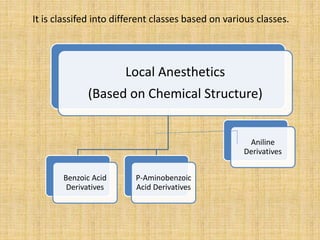
It is classifed into different classes based on various classes.
Local Anesthetics
(Based on Chemical Structure)
Benzoic Acid
Derivatives
P-Aminobenzoic
Acid Derivatives
Aniline
Derivatives
It is classifed into different classes based on various classes.
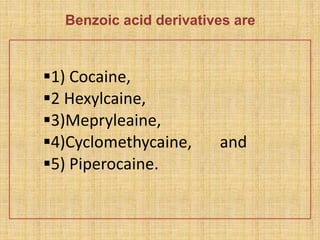
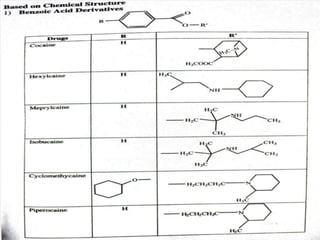
Benzoic acid derivatives are
1) Cocaine,
2 Hexylcaine,
3)Mepryleaine,
4)Cyclomethycaine, and
5) Piperocaine.
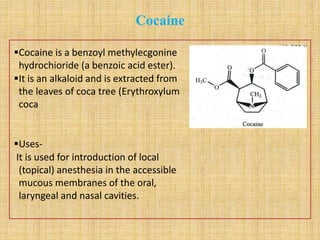
Cocaine
Cocaine is a benzoyl methylecgonine
hydrochioride (a benzoic acid ester).
It is an alkaloid and is extracted from
the leaves of coca tree (Erythroxylum
coca
Uses-
It is used for introduction of local
(topical) anesthesia in the accessible
mucous membranes of the oral,
laryngeal and nasal cavities.
Mechanism of Action
1. Cocaine produces anaesthetic effect by blocking excitation of nerve
endings or by biocking conduction in peripheral nerves.
2. It is achieved by reversibly binding to and inactivating sodium
channels.
3. Sodium influx by these channels is required for the depolarization of
nerve cell membranes and subsequent propagation of impulses along
the course of the nerve.
4. Cocaine is the only local anesthetic with vasoconstrictive properties.
5. It causes anaesthesia due to the blockade of norepinephrine reuptake
in the autonomic nervous system.
6. It binds differentially to the dopamine, serotonin, and norepinephrine
transport proteins and directly blocks the re-uptake of dopamine,
serotonin, and norepinephrine into pre-synaptic neurons.
7. Its effect on dopamine levels is most responsible for the addictive
property of cocaine.
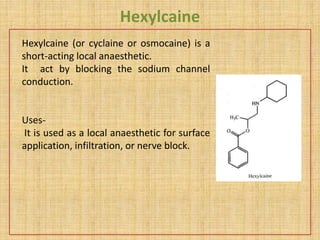
Hexylcaine
Hexylcaine (or cyclaine or osmocaine) is a
short-acting local anaesthetic.
It act by blocking the sodium channel
conduction.
Uses-
It is used as a local anaesthetic for surface
application, infiltration, or nerve block.
Mechanism of Action
Hexylcaine blocks the influx of Na ions through voltage gated
sodium chanel present in the neuronal cell membrane of
peripheral nerves.
When the influx of Na+ ions is interrupted, an action potential does
not arise and signal conduction is inhibited.
The receptor site is situated at the cytoplasmic (inner) portion of
the sodium channel.
Meprylcaine
Meprylcaine (or epirocaine or oracaine) is a
local anaesthetic having stimulant properties.
Its structure is related to dimethocaine.
Mechanism of Action-
Meprylcaine has a relatively potent inhibitory
action on the monoamine transporter. It
blocks the reuptake of dopamine,
norepinephrine, and serotonin.
Uses-
It is used as a local anaesthetic for surface
application, infiltration, or nerve block
Cyclomethycaine
Cyclomethycaine is a benzoate ester.
It is used as a local anaesthetic for surface
application, and infiltration or nerve block
Piperocaine
Piperocaine is a benzoate ester.
It is a local anaesthetic developed in the 1920s.
Its hydrochloride salt was used for infiltration and nerve block.
It is a white coloured crystalline powder that is soluble in
water and chloroform.
It is used as a surface anesthesia for eyes, throat, and caudal
analgesia.
Benzoic acid derivatives

Benzoic acid derivatives

  • 1.
    Medicinal Chemistry-II Submitted by– Mr. Suyash Jain Department Of Pharmaceutical Sciences Dr. Harisingh Gour Vishwavidyalaya, Sagar (M.P.) Brnzoic Acid Derivatives ( A Central University )
  • 2.
    These agents actlocally to abolish the sensory perception over a local area. It is classifed into different classes based on various classes.
  • 3.
    Local Anesthetics (Based onChemical Structure) Benzoic Acid Derivatives P-Aminobenzoic Acid Derivatives Aniline Derivatives It is classifed into different classes based on various classes.
  • 4.
    Benzoic acid derivativesare 1) Cocaine, 2 Hexylcaine, 3)Mepryleaine, 4)Cyclomethycaine, and 5) Piperocaine.
  • 6.
    Cocaine Cocaine is abenzoyl methylecgonine hydrochioride (a benzoic acid ester). It is an alkaloid and is extracted from the leaves of coca tree (Erythroxylum coca Uses- It is used for introduction of local (topical) anesthesia in the accessible mucous membranes of the oral, laryngeal and nasal cavities.
  • 7.
    Mechanism of Action 1.Cocaine produces anaesthetic effect by blocking excitation of nerve endings or by biocking conduction in peripheral nerves. 2. It is achieved by reversibly binding to and inactivating sodium channels. 3. Sodium influx by these channels is required for the depolarization of nerve cell membranes and subsequent propagation of impulses along the course of the nerve. 4. Cocaine is the only local anesthetic with vasoconstrictive properties. 5. It causes anaesthesia due to the blockade of norepinephrine reuptake in the autonomic nervous system. 6. It binds differentially to the dopamine, serotonin, and norepinephrine transport proteins and directly blocks the re-uptake of dopamine, serotonin, and norepinephrine into pre-synaptic neurons. 7. Its effect on dopamine levels is most responsible for the addictive property of cocaine.
  • 8.
    Hexylcaine Hexylcaine (or cyclaineor osmocaine) is a short-acting local anaesthetic. It act by blocking the sodium channel conduction. Uses- It is used as a local anaesthetic for surface application, infiltration, or nerve block.
  • 9.
    Mechanism of Action Hexylcaineblocks the influx of Na ions through voltage gated sodium chanel present in the neuronal cell membrane of peripheral nerves. When the influx of Na+ ions is interrupted, an action potential does not arise and signal conduction is inhibited. The receptor site is situated at the cytoplasmic (inner) portion of the sodium channel.
  • 10.
    Meprylcaine Meprylcaine (or epirocaineor oracaine) is a local anaesthetic having stimulant properties. Its structure is related to dimethocaine. Mechanism of Action- Meprylcaine has a relatively potent inhibitory action on the monoamine transporter. It blocks the reuptake of dopamine, norepinephrine, and serotonin. Uses- It is used as a local anaesthetic for surface application, infiltration, or nerve block
  • 11.
    Cyclomethycaine Cyclomethycaine is abenzoate ester. It is used as a local anaesthetic for surface application, and infiltration or nerve block
  • 12.
    Piperocaine Piperocaine is abenzoate ester. It is a local anaesthetic developed in the 1920s. Its hydrochloride salt was used for infiltration and nerve block. It is a white coloured crystalline powder that is soluble in water and chloroform. It is used as a surface anesthesia for eyes, throat, and caudal analgesia.