Downloaded 45 times
![The Logit Model:
Estimation, Testing and Interpretation
Herman J. Bierens
October 25, 2008
1
1.1
Introduction to maximum likelihood estimation
The likelihood function
Consider a random sample Y1 , ..., Yn from the Bernoulli distribution:
Pr[Yj = 1] = p0
Pr[Yj = 0] = 1 − p0 ,
where p0 is unknown. For example, toss n times a coin for which you suspect
that it is unfair: p0 6= 0.5, and for each tossing j assign Yj = 1 if the outcome
is heads and Yj = 0 if the outcome is tails. The question is how to estimate
p0 and how to test the null hypothesis that the coin is fair: p0 = 0.5.
The probability function involved can be written as
f(y|p0 ) = Pr[Yj = y]
=
py
0
1−y
(1 − p0 )
=
(
p0
if y = 1,
1 − p0 if y = 0.
Next, let y1 , ..., yn be a given sequence of zeros and ones. Thus, each yj is either 0 or 1. The joint probability function of the random sample Y1 , Y2 , ..., Yn
is defined as
fn (y1 , ..., yn |p0 ) = Pr[Y1 = y1 and Y2 = y2 ..... and Yn = yn ].
1](https://image.slidesharecdn.com/logitmodeltestingandinterpretation-140227130738-phpapp01/85/Logit-model-testing-and-interpretation-1-320.jpg)
![The Logit Model:
Estimation, Testing and Interpretation
Herman J. Bierens
October 25, 2008
1
1.1
Introduction to maximum likelihood estimation
The likelihood function
Consider a random sample Y1 , ..., Yn from the Bernoulli distribution:
Pr[Yj = 1] = p0
Pr[Yj = 0] = 1 − p0 ,
where p0 is unknown. For example, toss n times a coin for which you suspect
that it is unfair: p0 6= 0.5, and for each tossing j assign Yj = 1 if the outcome
is heads and Yj = 0 if the outcome is tails. The question is how to estimate
p0 and how to test the null hypothesis that the coin is fair: p0 = 0.5.
The probability function involved can be written as
f(y|p0 ) = Pr[Yj = y]
=
py
0
1−y
(1 − p0 )
=
(
p0
if y = 1,
1 − p0 if y = 0.
Next, let y1 , ..., yn be a given sequence of zeros and ones. Thus, each yj is either 0 or 1. The joint probability function of the random sample Y1 , Y2 , ..., Yn
is defined as
fn (y1 , ..., yn |p0 ) = Pr[Y1 = y1 and Y2 = y2 ..... and Yn = yn ].
1](https://image.slidesharecdn.com/logitmodeltestingandinterpretation-140227130738-phpapp01/75/Logit-model-testing-and-interpretation-1-2048.jpg)
![Because the random variables Y1 , Y2 , ..., Yn are independent, we can write
Pr[Y1 = y1 and Y2 = y2 ..... and Yn = yn ]
= Pr[Y1 = y1 ] × Pr[Y2 = y2 ] × ... × Pr[Yn = yn ]
= f (y1 |p0 ) × f (y2 |p0 ) × ... × f (yn |p0 )
=
n
Y
j=1
f(yj |p0 ),
hence
fn (y1 , ..., yn |p0 ) =
=
n
Y
j=1
⎛
y
p0j (1 − p0 )1−yj
⎞⎛
n
Y
n
yj ⎠ ⎝ Y
⎝
p0
(1
j=1
j=1
Pn
= p0
j=1
yj
⎞
1−yj ⎠
− p0 )
Pn
(1 − p0 )n−
j=1
yj
.
Replacing the given non-random sequence y1 , ..., yn by the random sample
Y1 , Y2 , ..., Yn and the unknown probability p0 by a variable p in the interval
(0, 1) yields the likelihood function
Pn
Ln (p) = fn (Y1 , ..., Yn |p) = p
j=1
Yj
Pn
(1 − p)n−
j=1
Yj
For the case p = p0 the likelihood function can be interpreted as the joint
probability that we draw a particular sample Y1 , ..., Yn .
1.2
Maximum likelihood estimation
The idea of maximum likelihood (ML) estimation is now to choose p such
that Ln (p) is maximal. In other words, choose p such that the probability of
drawing this particular sample Y1 , ..., Yn is maximal.
Note that maximizing Ln (p) is equivalent to maximizing ln (Ln (p)) , i.e.,
⎛
ln (Ln (p)) = ⎝
n
X
j=1
³
⎞
⎛
Yj ⎠ ln(p) + ⎝n −
n
X
j=1
⎞
Yj ⎠ ln(1 − p)
´
= n Y ln(p) + (1 − Y ) ln(1 − p) ,
2](https://image.slidesharecdn.com/logitmodeltestingandinterpretation-140227130738-phpapp01/85/Logit-model-testing-and-interpretation-2-320.jpg)
![where
n
1X
Y =
Yj
n j=1
b
is the sample mean. Therefore, the ML estimator p in this case can be
obtained from the first-order condition for a maximum of ln (Ln (p)) in p =
b
p:
Ã
b
b
b
d ln (Ln (p))
d ln(p)
d ln(1 − p)
=n Y
+ (1 − Y )
0 =
b
b
b
dp
dp
dp
Ã
!
b
b
b
d ln(p)
d ln(1 − p) d(1 − p)
= n Y
+ (1 − Y )
×
b
b
b
dp
d(1 − p)
dp
Ã
!
1
1
× (−1)
= n Y + (1 − Y )
b
b
p
1−p
= n
Ã
Ã
Y
1−Y
−
b
b
p
1−p
b
Y −p
= n
b
b
p (1 − p)
!
!
⎛
= n⎝
³
b
b
Y (1 − p) − p 1 − Y
b
b
p (1 − p)
!
´⎞
⎠
where we have used the fact that d ln(x)/dx = 1/x. Thus, in this case the
b
ML estimator p of p0 is the sample mean:
b
p =Y.
b
Note that this is an unbiased estimator: E (p) =
1.3
1
n
Pn
j=1
E (Yj ) = p0 .
Large sample statistical inference
It can be shown (but this√
requires advanced probability theory) that if the
b
sample size n is large then n (p − p0 ) is approximately normally distributed,
i.e.,
n
√
1 X
2
b
n (p − p0 ) = √
(Yj − p0 ) ∼ N[0, σ0 ],
n j=1
where
h
2
σ0 = var(Yj ) = E (Yj − p0 )2
i
= (1 − p0 )2 p0 + (−p0 )2 (1 − p0 )
= p0 (1 − p0 ).
3](https://image.slidesharecdn.com/logitmodeltestingandinterpretation-140227130738-phpapp01/85/Logit-model-testing-and-interpretation-3-320.jpg)
![Thus, for large sample size n,
√
b
n (p − p0 )
q
p0 (1 − p0 )
∼ N[0, 1].
(1)
This result can be used to test hypotheses about p0 . In particular, under
the null hypothesis that the coin is fair, p0 = 0.5, we have
√
√
b
n (p − 0.5)
b
2 n (p − 0.5) = √
∼ N[0, 1],
0.5 × 0.5
√
b
Therefore, 2 n (p − 0.5) can be used as the test statistic of the standard
normal test of the null hypothesis p0 = 1/2, as follows. Recall that for a
standard normal random variable U , Pr [|U | > 1.96] = 0.05. Thus, under the
null hypothesis p0 = 1/2 one would expect that
¯
h¯ √
i
¯
¯
b
Pr ¯2 n (p − 0.5)¯ > 1.96 = 0.05
¯
h¯ √
i
¯
¯
b
Pr ¯2 n (p − 0.5)¯ ≤ 1.96 = 0.95
√
b
If |2 n (p − 0.5)| > 1.96 then we reject the null hypothesis p0 = 1/2 at
the 5% significance level, because√
this is not what one would expect if the
b
null hypothesis is true, and if |2 n (p − 0.5)| ≤ 1.96 then we accept this
null hypothesis, as this result is then in accordance with the null hypothesis
p0 = 1/2.
The result (1) can also be used to endow the unknown probability p0 with
a confidence interval, for example the 95% confidence interval, as follows. The
result (1) implies
¯
⎡¯ √
⎤
¯
¯
¯ n (p − p0 ) ¯
b
¯ ≤ 1.96⎦ = 0.95,
Pr ⎣¯ q
¯
¯
¯ p0 (1 − p0 ) ¯
which, after some straightforward calculations, can be shown to be equivalent
to
h
i
Pr pn ≤ p0 ≤ pn = 0.95
where
pn =
q
b
b
b
n.p + (1.96)2 /2 − 1.96 n.p (1 − p) + (1.96)2 /4
n + (1.96)2
q
2
pn =
b
b
b
n.p + (1.96) /2 + 1.96 n.p (1 − p) + (1.96)2 /4
n + (1.96)2
4](https://image.slidesharecdn.com/logitmodeltestingandinterpretation-140227130738-phpapp01/85/Logit-model-testing-and-interpretation-4-320.jpg)
![h
i
The interval pn , pn is now the 95% confidence interval for p0 .
1.4
An application election polls
Consider a presidential election with two candidates, candidate A and candidate B, and let p0 be the fraction of likely voters who favor candidate A,
just before the election is held. To predict the outcome of the election, a
polling agency draws a random sample of size n = 3000, for example, from
the population of likely voters.1 Suppose that 1800 of the respondents express a preference for candidate A. Thus, the fraction of respondents favoring
b
b
candidate A is p = 0.6. Substituting n = 3000 and p = 0.6 in the formulas
for pn and pn yields
pn = 0.58, pn = 0.62
Thus, the 95% confidence interval of 100 × p0 is [58, 62]. The polling results
are therefore stated as: 60% of the likely voters will vote for candidate A,
with a margin of error of ±2 points.
2
Motivation for maximum likelihood estimation
A more formal motivation for ML estimation is based on the fact that for
0 < x < 1 and x > 1,
ln(x) < x − 1.
This is illustrated in the following picture:
1
How to draw such a sample is beyond the scope of this lecture note.
5](https://image.slidesharecdn.com/logitmodeltestingandinterpretation-140227130738-phpapp01/85/Logit-model-testing-and-interpretation-5-320.jpg)
![ln(x) ≤ x − 1.
The inequality ln(x) < x − 1 is strict for x 6= 1, and ln(1) = 0. Consequently, taking x = f(Yj |p)/f(Yj |p0 ), we have the inequality
Ã
f (Yj |p)
ln
f(Yj |p0 )
!
≤
f(Yj |p)
− 1.
f (Yj |p0 )
Taking expectations, it follows that
"
Ã
f (Yj |p)
E ln
f (Yj |p0 )
!#
≤
=
=
=
"
#
f(Yj |p)
E
−1
f (Yj |p0 )
f(1|p)
f (0|p)
Pr[Yj = 1] +
Pr[Yj = 0] − 1
f (1|p0 )
f(0|p0 )
1−p
p
p0 +
(1 − p0 ) − 1
p0
1 − p0
p + 1 − p − 1 = 0,
(2)
hence
"
Ã
f(Yj |p)
E [ln (f (Yj |p))] − E [ln (f (Yj |p0 ))] = E ln
f (Yj |p0 )
!#
≤ 0,
and therefore,
E [ln (Ln (p))] ≤ E [ln (Ln(p0 ))] .
(3)
Thus, E [ln (Ln (p))] is maximal for p = p0 , and it can be shown that this
maximum is unique.
6](https://image.slidesharecdn.com/logitmodeltestingandinterpretation-140227130738-phpapp01/85/Logit-model-testing-and-interpretation-6-320.jpg)
![3
Maximum likelihood estimation of the Logit
model
3.1
The Logit model with one explanatory variable
Next, let (Y1 , X1 ), ..., (Yn , Xn ) be a random sample from the conditional Logit
distribution:
1
,
1 + exp (−α0 − β0 Xj )
Pr[Yj = 0|Xj ] = 1 − Pr[Yj = 1|Xj ]
exp (−α0 − β0 Xj )
=
1 + exp (−α0 − β0 Xj )
Pr[Yj = 1|Xj ] =
(4)
where the Xj ’s are the explanatory variables and α0 and β0 are unknown
parameters to be estimated. This model is called a Logit model, because
Pr[Yj = 1|Xj ] = F (α0 + β0 Xj )
where
F (x) =
1
1 + exp(−x)
(5)
(6)
is the distribution function of the logistic (Logit) distribution.
The conditional probability function involved is
f(y|Xj , α0 , β0 ) = Pr[Yj = y|Xj ]
= F (α0 + β0 Xj )y (1 − F (α0 + β0 Xj ))1−y
(
F (α0 + β0 Xj )
if y = 1,
=
1 − F (α0 + β0 Xj ) if y = 0.
Now the conditional log-likelihood function is
ln (Ln (α, β)) =
n
X
j=1
=
n
X
ln (f (Yj |Xj , α, β))
Yj ln (F (α + βXj )) +
j=1
=−
n
X
(1 − Yj ) ln (1 − F (α + βXj ))
j=1
n
X
n
X
(1 − Yj ) (α + βXj ) −
j=1
7
j=1
ln (1 + exp (−α − βXj )) .
(7)](https://image.slidesharecdn.com/logitmodeltestingandinterpretation-140227130738-phpapp01/85/Logit-model-testing-and-interpretation-7-320.jpg)
![Similar to (3) we have
E [ln (Ln (α, β))| X1 , ..., Xn ] ≤ E [ln (Ln (α0 , β0 ))| X1 , ..., Xn ] .
Again, this result motivates to estimate α0 and β0 by maximizing ln (Ln (α, β))
to α and β:
³
´
b b
ln Ln (α, β) = max ln (Ln (α, β)) .
α,β
b
b
However, there is no longer an explicit solution for α and β. These ML
estimators have to be solved numerically. Your econometrics software will do
that for you.
3.2
Pseudo t-values
It can be shown that if the sample size n is large then
´
√
√ ³b
b
n (α − α0 ) ∼ N (0, σ 2 ), n β − β0 ∼ N (0, σ 2 ).
α
β
bα
bβ
Given consistent estimators σ 2 and σ 2 of the unknown variances σ 2 and σ 2 ,
α
β
respectively (which are computed by your econometrics software), we then
have
´
√ ³b
√
n β − β0
b − α0 )
n (α
∼ N (0, 1),
∼ N(0, 1).
b
b
σα
σβ
These results can be used to test whether the coefficients α0 and β0 are zero
or not. In particular the null hypothesis β0 = 0 is of interest, because this
hypothesis implies that the conditional probability Pr[Yj = 1|Xj ] does not
depend on Xj . Under the null hypothesis β0 = 0 we have
√ b
bβ = nβ ∼ N(0, 1).
t
b
σβ
Recall that the 5% critical value of the two-sided standard normal test is
1.96. Thus, for example, the null hypothesis β0 = 0 is rejected¯ at¯ the 5%
¯b ¯
significance level in favor of the alternative hypothesis β0 6= 0 if ¯t β ¯ > 1.96,
¯
¯
¯b ¯
and accepted if ¯t β ¯ ≤ 1.96.
b
b
The statistic t β is called the pseudo t-value of β because it is used in the
b
same way as the t-value in linear regression, and σ β is called the standard
b Your econometric software will report the ML estimators together
error of β.
with their corresponding pseudo t-values and/or standard errors.
8](https://image.slidesharecdn.com/logitmodeltestingandinterpretation-140227130738-phpapp01/85/Logit-model-testing-and-interpretation-8-320.jpg)
![3.3
The general Logit model
The general Logit model takes the form
Pr[Yj = 1|X1j , ...Xk,j ] =
=
1
1+
0
exp (−β1 X1j
³
1 + exp −
0
− ... − βk Xkj )
1
Pk
i=1
βi0 Xij
(8)
´,
where one of the Xij equals 1 for the constant term, for example, let Xkj = 1,
and the βi0 ’s are the true parameter values. This model can be estimated by
ML in the same way as before. Thus, the log-likelihood function is
ln (Ln (β1 , ..., βk )) = −
n
X
j=1
(1 − Yj )
k
X
i=1
βi Xij −
n
X
j=1
Ã
Ã
ln 1 + exp −
k
X
βi Xij
i=1
!!
,
(9)
b
b
and the ML estimators β 1 , ..., β k are obtained by maximizing ln (Ln (β1 , ..., βk )):
³
´
b
b
ln Ln (β 1 , ..., β k ) = max ln (Ln (β1 , ..., βk )) .
β1 ,...,βk
Again, it can be shown that if n is large then for i = 1, ..., k,
´
√ ³b
2
n β i − βi0 ∼ N[0, σi ].
2
bi
Given consistent estimators σ 2 of the variances σi , it follows then that
´
√ ³b
n β i − βi0
b
σi
∼ N[0, 1]
for i = 1, ..., k. Your econometrics software will report the ML estimators
√ b
b
b
b
β i together with their corresponding pseudo t-values ti = nβ i /σ i and/or
b i.
standard errors σ
3.4
Testing joint significance
Now suppose you want to test the joint null hypothesis
0
0
0
H0 : β1 = 0, β2 = 0, ..., βm = 0,
9
(10)](https://image.slidesharecdn.com/logitmodeltestingandinterpretation-140227130738-phpapp01/85/Logit-model-testing-and-interpretation-9-320.jpg)
![where m < k.
There are two ways to do that. One way is akin to the F test in linear
regression: Re-estimate the Logit model under the null hypothesis:
³
´
e
e
ln Ln (0, .., 0, β m+1 , ..., β k ) =
max
βm+1 ,...,βk
ln (Ln (0, .., 0, βm+1 , ..., βk )) .
and compare the log-likelihoods2 . It can be shown that under the null hypothesis (10) and for large samples,
Ã
e
e
Ln (0, .., 0, β m+1 , ..., β k )
LRm = −2 ln
b
b
Ln (β 1 , ..., β k )
!
∼ χ2 ,
m
where the degrees of freedom m corresponds to the number of restrictions
imposed under the null hypothesis. This is the so-called likelihood ratio test,
which is conducted right-sided. For example, choose the 5% significance
level, look up in the table of the χ2 distribution the critical value c such
that for a χ2 distributed random variable Zm , Pr[Zm > c] = 0.05. Then the
m
null hypothesis (10) is rejected at the 5% significance level if LRm > c and
accepted if LRm ≤ c.
An alternative test of the null hypothesis (10) is the Wald test, which is
conducted in the same way as for linear regression models.3 Under the null
hypothesis (10) the Wald test statistic has also a χ2 distribution.
m
4
Interpretation of the coefficients of the Logit
model
4.1
Marginal effects
Consider the Logit model (5). If β0 > 0 then Pr[Yj = 1|Xj ] = F (α0 + β0 Xj )
is an increasing function of Xj :
dP [Yj = 1|Xj ]
= β0 .F 0 (α0 + β0 Xj ),
dXj
where F 0 is the derivative of (6):
2
3
Your econometric software will report the log-likelihood function value.
In EasyReg International the Wald test can be conducted simply by point-and-click.
10](https://image.slidesharecdn.com/logitmodeltestingandinterpretation-140227130738-phpapp01/85/Logit-model-testing-and-interpretation-10-320.jpg)
![exp(−x)
1 + exp(−x)
1
2 =
2 −
(1 + exp(−x))
(1 + exp(−x))
(1 + exp(−x))2
1
1
=
−
= F (x) − F (x)2
1 + exp(−x) (1 + exp(−x))2
= F (x) (1 − F (x)) .
F 0 (x) =
Therefore, the marginal effect of Xj on Pr[Yj = 1|Xj ] depends on Xj :
dP [Yj = 1|Xj ]
= β0 .F (α0 + β0 Xj ) (1 − F (α0 + β0 Xj )) ,
dXj
which renders the interpretation of β0 difficult.
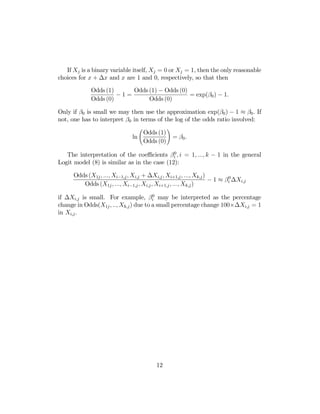
However, the coefficient β0 can be interpreted in terms of relative changes
in odds.
4.2
Odds and odds ratios
The odds is the ratio of the probability that something is true divided by the
probability that it is not true. Thus, in the Logit case (4),
Odds (X) =
Pr[Yj = 1|Xj ]
F (α0 + β0 Xj )
=
= exp(α0 + β0 Xj ).
Pr[Yj = 0|Xj ]
1 − F (α0 + β0 Xj )
(11)
The odds ratio is the ratio of two odds for different values of Xj , say
Xj = x and Xj = x + ∆x:
exp(α + βx + β∆x)
Odds (x + ∆x)
=
= exp(β∆x),
Odds (x)
exp(α + βx)
where ∆x is a small change in x. Then
Ã
!
Odds (x + ∆x) − Odds (x)
exp(β0 ∆x) − 1
= lim
∆x→0
Odds (x)
∆x
¯
exp(β0 ∆x) − 1
d exp(u) ¯
¯
¯
= β0 lim
= β0 ×
= β0 exp(0) = β0 .
β0 ∆x→0
β0 ∆x
du ¯u=0
1
lim
∆x→0 ∆x
Thus, β0 may be interpreted as the relative change in the odds due to a small
change ∆x in Xj :
Odds (x + ∆x) − Odds (x)
Odds (x + ∆x)
=
− 1 ≈ β0 ∆x
Odds (x)
Odds (x)
11
(12)](https://image.slidesharecdn.com/logitmodeltestingandinterpretation-140227130738-phpapp01/85/Logit-model-testing-and-interpretation-11-320.jpg)

The document discusses the logit model, detailing maximum likelihood estimation (MLE) for predicting binary outcomes based on explanatory variables. It introduces the concepts of likelihood functions, unbiased estimators, and statistical inference for hypothesis testing using large sample sizes. Additionally, it demonstrates practical applications, such as election polling, highlighting how to derive confidence intervals for estimated probabilities.


