Arthur CHARPENTIER, Advanced Econometrics Graduate Course
Advanced Econometrics #3: Model & Variable Selection*
A. Charpentier (Université de Rennes 1)
Université de Rennes 1,
Graduate Course, 2017.
@freakonometrics 1
Arthur CHARPENTIER, Advanced Econometrics Graduate Course
“Great plot.
Now need to find the theory that explains it”
Deville (2017) http://twitter.com
@freakonometrics 2
Arthur CHARPENTIER, Advanced Econometrics Graduate Course
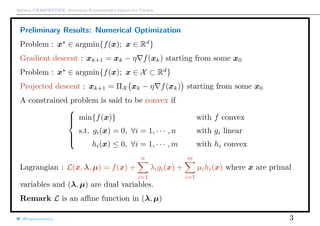
Preliminary Results: Numerical Optimization
Problem : x ∈ argmin{f(x); x ∈ Rd
}
Gradient descent : xk+1 = xk − η f(xk) starting from some x0
Problem : x ∈ argmin{f(x); x ∈ X ⊂ Rd
}
Projected descent : xk+1 = ΠX xk − η f(xk) starting from some x0
A constrained problem is said to be convex if



min{f(x)} with f convex
s.t. gi(x) = 0, ∀i = 1, · · · , n with gi linear
hi(x) ≤ 0, ∀i = 1, · · · , m with hi convex
Lagrangian : L(x, λ, µ) = f(x) +
n
i=1
λigi(x) +
m
i=1
µihi(x) where x are primal
variables and (λ, µ) are dual variables.
Remark L is an affine function in (λ, µ)
@freakonometrics 3
Arthur CHARPENTIER, Advanced Econometrics Graduate Course
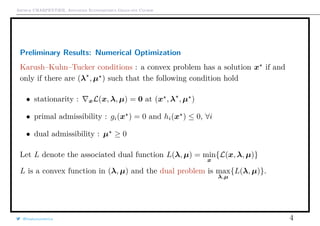
Preliminary Results: Numerical Optimization
Karush–Kuhn–Tucker conditions : a convex problem has a solution x if and
only if there are (λ , µ ) such that the following condition hold
• stationarity : xL(x, λ, µ) = 0 at (x , λ , µ )
• primal admissibility : gi(x ) = 0 and hi(x ) ≤ 0, ∀i
• dual admissibility : µ ≥ 0
Let L denote the associated dual function L(λ, µ) = min
x
{L(x, λ, µ)}
L is a convex function in (λ, µ) and the dual problem is max
λ,µ
{L(λ, µ)}.
@freakonometrics 4
Arthur CHARPENTIER, Advanced Econometrics Graduate Course
References
Motivation
Banerjee, A., Chandrasekhar, A.G., Duflo, E. & Jackson, M.O. (2016). Gossip:
Identifying Central Individuals in a Social Networks.
References
Belloni, A. & Chernozhukov, V. 2009. Least squares after model selection in
high-dimensional sparse models.
Hastie, T., Tibshirani, R. & Wainwright, M. 2015 Statistical Learning with
Sparsity: The Lasso and Generalizations. CRC Press.
@freakonometrics 5
Arthur CHARPENTIER, Advanced Econometrics Graduate Course
Preambule
Assume that y = m(x) + ε, where ε is some idosyncatic impredictible noise.
The error E[(y − m(x))2
] is the sume of three terms
• variance of the estimator : E[(y − m(x))2
]
• bias2
of the estimator : [m(x − m(x)]2
• variance of the noise : E[(y − m(x))2
]
(the latter exists, even with a ‘perfect’ model).
@freakonometrics 6
Arthur CHARPENTIER, Advanced Econometrics Graduate Course
Preambule
Consider a parametric model, with true (unkown) parameter θ, then
mse(ˆθ) = E (ˆθ − θ)2
= E (ˆθ − E ˆθ )2
variance
+ E (E ˆθ − θ)2
bias2
Let θ denote an unbiased estimator of θ. Then
ˆθ =
θ2
θ2 + mse(θ)
· θ = θ −
mse(θ)
θ2 + mse(θ)
· θ
penalty
satisfies mse(ˆθ) ≤ mse(θ).
@freakonometrics 7
−2 −1 0 1 2 3 4
0.00.20.40.60.8
variance
Arthur CHARPENTIER, Advanced Econometrics Graduate Course
Occam’s Razor
The “law of parsimony”, “lex parsimoniæ”
Penalize too complex models
@freakonometrics 8
Arthur CHARPENTIER, Advanced Econometrics Graduate Course
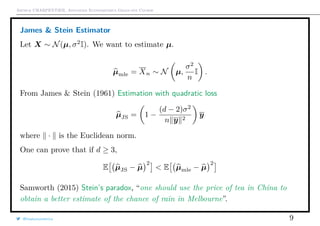
James & Stein Estimator
Let X ∼ N(µ, σ2
I). We want to estimate µ.
µmle = Xn ∼ N µ,
σ2
n
I .
From James & Stein (1961) Estimation with quadratic loss
µJS = 1 −
(d − 2)σ2
n y 2
y
where · is the Euclidean norm.
One can prove that if d ≥ 3,
E µJS − µ
2
< E µmle − µ
2
Samworth (2015) Stein’s paradox, “one should use the price of tea in China to
obtain a better estimate of the chance of rain in Melbourne”.
@freakonometrics 9
Arthur CHARPENTIER, Advanced Econometrics Graduate Course
James & Stein Estimator
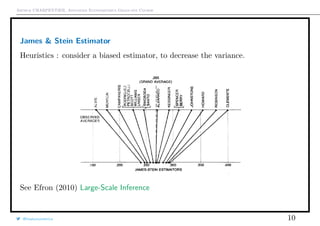
Heuristics : consider a biased estimator, to decrease the variance.
See Efron (2010) Large-Scale Inference
@freakonometrics 10
Arthur CHARPENTIER, Advanced Econometrics Graduate Course
Motivation: Avoiding Overfit
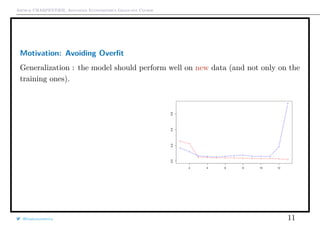
Generalization : the model should perform well on new data (and not only on the
training ones).
q
q
q q q q q q q q q q q
2 4 6 8 10 12
0.00.20.40.6
q
q
q q q q q q
q q q
q
q
@freakonometrics 11
q
q
q
q
q
q
q
q
q
q
q
q
q
q
q
q
q
q
q
q
q
q
0.0 0.2 0.4 0.6 0.8 1.0
−1.5−1.0−0.50.00.51.01.5
q
q
q
q
q
q
q
q
q
q
q
q
q
q
q
q
q
q
q
q
q
q
0.0 0.2 0.4 0.6 0.8 1.0
−1.5−1.0−0.50.00.51.01.5
q
q
q
q
q
q
q
q
q
qq
Arthur CHARPENTIER, Advanced Econometrics Graduate Course
Reducing Dimension with PCA
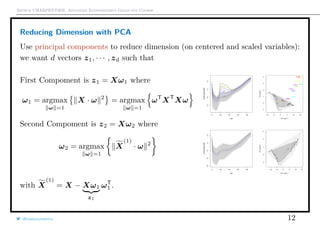
Use principal components to reduce dimension (on centered and scaled variables):
we want d vectors z1, · · · , zd such that
First Compoment is z1 = Xω1 where
ω1 = argmax
ω =1
X · ω 2
= argmax
ω =1
ωT
XT
Xω
Second Compoment is z2 = Xω2 where
ω2 = argmax
ω =1
X
(1)
· ω 2
0 20 40 60 80
−8−6−4−2
Age
LogMortalityRate
−10 −5 0 5 10 15
−101234
PC score 1
PCscore2
q
q
qq
q
q
qqq
q
qqq
qq
q
qqq
q
q
q
qq
q
q
q
q
q
q
qqq
q
q
q
q
q
q
qq
q
qq
q
q
qq
q
q
q
q
q
q
qq
q
qqq
q
q
q
q
q
q
q
q
q
q
q
q
q
q
qq
q
q
qqq
q
qqq
qq
q
qqq
q
q
q
q
q
q
q
q
q
q
q
q
q
q
q
q
q
q
q
qq
q
q
q
q
qq
q
q
qq
q
q
qqqq
q
q
q
q
q
q
q
q
q
qqq
q
qqq
qq
q
qq
q
q
q
q
qq
q
q
q
q
q
q
q
q
q
q
q
q
q
1914
1915
1916
1917
1918
1919
1940
1942
1943
1944
0 20 40 60 80
−10−8−6−4−2
Age
LogMortalityRate
−10 −5 0 5 10 15
−10123
PC score 1
PCscore2
qq
q
q
q
q
q
qq
qq
qq
q
q
q
q
q
q
q
q
q
q
q
q
q
q
q
q
q
q
q
q
q
q
q
q
q
q
q
q
q
qq
qq
q
q
q
q
q
qq
q
q
q
q
q
q
q
q
q
q
q
q
q
q
q
q
q
q
q
q
q
q
q
q
q
q
qq
qq
q
q
q
q
q
q
q
q
q
q
q
q
q
q
q
q
q
q
q
q
q
qq
q
q
q
q
q
q
qq
q
q
q
q
q
q
q
q
q
qq
q
q
q
q
q
q
q
q
q
q
qq
qq
q
q
q
q
q
qq
qqqq
q
qqqq
q
q
q
q
q
q
with X
(1)
= X − Xω1
z1
ωT
1 .
@freakonometrics 12
Arthur CHARPENTIER, Advanced Econometrics Graduate Course
Reducing Dimension with PCA
A regression on (the d) principal components, y = zT
β + η could be an
interesting idea, unfortunatley, principal components have no reason to be
correlated with y. First compoment was z1 = Xω1 where
ω1 = argmax
ω =1
X · ω 2
= argmax
ω =1
ωT
XT
Xω
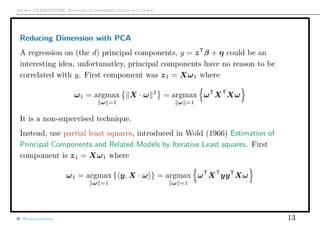
It is a non-supervised technique.
Instead, use partial least squares, introduced in Wold (1966) Estimation of
Principal Components and Related Models by Iterative Least squares. First
compoment is z1 = Xω1 where
ω1 = argmax
ω =1
{ y, X · ω } = argmax
ω =1
ωT
XT
yyT
Xω
@freakonometrics 13
Arthur CHARPENTIER, Advanced Econometrics Graduate Course
Terminology
Consider a dataset {yi, xi}, assumed to be generated from Y, X, from an
unknown distribution P.
Let m0(·) be the “true” model. Assume that yi = m0(xi) + εi.
In a regression context (quadratic loss function function), the risk associated to
m is
R(m) = EP Y − m(X)
2
An optimal model m within a class M satisfies
R(m ) = inf
m∈M
R(m)
Such a model m is usually called oracle.
Observe that m (x) = E[Y |X = x] is the solution of
R(m ) = inf
m∈M
R(m) where M is the set of measurable functions
@freakonometrics 14
Arthur CHARPENTIER, Advanced Econometrics Graduate Course
The empirical risk is
Rn(m) =
1
n
n
i=1
yi − m(xi)
2
For instance, m can be a linear predictor, m(x) = β0 + xT
β, where θ = (β0, β)
should estimated (trained).
E Rn(m) = E (m(X) − Y )2
can be expressed as
E (m(X) − E[m(X)|X])2
variance of m
+ E E[m(X)|X] − E[Y |X]
m0(X)
2
bias of m
+ E Y − E[Y |X]
m0(X)
)2
variance of the noise
The third term is the risk of the “optimal” estimator m, that cannot be
decreased.
@freakonometrics 15
Arthur CHARPENTIER, Advanced Econometrics Graduate Course
Mallows Penalty and Model Complexity
Consider a linear predictor (see #1), i.e. y = m(x) = Ay.
Assume that y = m0(x) + ε, with E[ε] = 0 and Var[ε] = σ2
I.
Let · denote the Euclidean norm
Empirical risk : Rn(m) = 1
n y − m(x) 2
Vapnik’s risk : E[Rn(m)] =
1
n
m0(x − m(x) 2
+
1
n
E y − m0(x 2
with
m0(x = E[Y |X = x].
Observe that
nE Rn(m) = E y − m(x) 2
= (I − A)m0
2
+ σ2
I − A 2
while
= E m0(x) − m(x) 2
=
2
(I − A)m0
bias
+ σ2
A 2
variance
@freakonometrics 16
Arthur CHARPENTIER, Advanced Econometrics Graduate Course
Mallows Penalty and Model Complexity
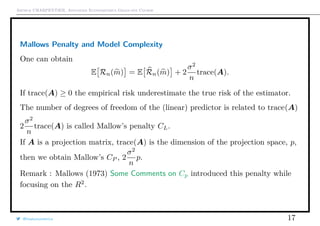
One can obtain
E Rn(m) = E Rn(m) + 2
σ2
n
trace(A).
If trace(A) ≥ 0 the empirical risk underestimate the true risk of the estimator.
The number of degrees of freedom of the (linear) predictor is related to trace(A)
2
σ2
n
trace(A) is called Mallow’s penalty CL.
If A is a projection matrix, trace(A) is the dimension of the projection space, p,
then we obtain Mallow’s CP , 2
σ2
n
p.
Remark : Mallows (1973) Some Comments on Cp introduced this penalty while
focusing on the R2
.
@freakonometrics 17
Arthur CHARPENTIER, Advanced Econometrics Graduate Course
Penalty and Likelihood
CP is associated to a quadratic risk
an alternative is to use a distance on the (conditional) distribution of Y , namely
Kullback-Leibler distance
discrete case: DKL(P Q) =
i
P(i) log
P(i)
Q(i)
continuous case :
DKL(P Q) =
∞
−∞
p(x) log
p(x)
q(x)
dxDKL(P Q) =
∞
−∞
p(x) log p(x)
q(x) dx
Let f denote the true (unknown) density, and fθ some parametric distribution,
DKL(f fθ) =
∞
−∞
f(x) log
f(x)
fθ(x)
dx= f(x) log[f(x)] dx− f(x) log[fθ(x)] dx
relative information
Hence
minimize {DKL(f fθ)} ←→ maximize E log[fθ(X)]
@freakonometrics 18
Arthur CHARPENTIER, Advanced Econometrics Graduate Course
Penalty and Likelihood
Akaike (1974) A new look at the statistical model identification observe that for n
large enough
E log[fθ(X)] ∼ log[L(θ)] − dim(θ)
Thus
AIC = −2 log L(θ) + 2dim(θ)
Example : in a (Gaussian) linear model, yi = β0 + xT
i β + εi
AIC = n log
1
n
n
i=1
εi + 2[dim(β) + 2]
@freakonometrics 19
Arthur CHARPENTIER, Advanced Econometrics Graduate Course
Penalty and Likelihood
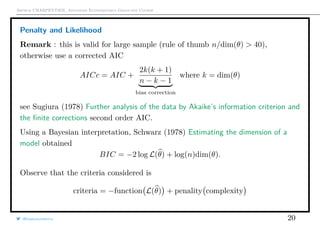
Remark : this is valid for large sample (rule of thumb n/dim(θ) > 40),
otherwise use a corrected AIC
AICc = AIC +
2k(k + 1)
n − k − 1
bias correction
where k = dim(θ)
see Sugiura (1978) Further analysis of the data by Akaike’s information criterion and
the finite corrections second order AIC.
Using a Bayesian interpretation, Schwarz (1978) Estimating the dimension of a
model obtained
BIC = −2 log L(θ) + log(n)dim(θ).
Observe that the criteria considered is
criteria = −function L(θ) + penality complexity
@freakonometrics 20
Arthur CHARPENTIER, Advanced Econometrics Graduate Course
Estimation of the Risk
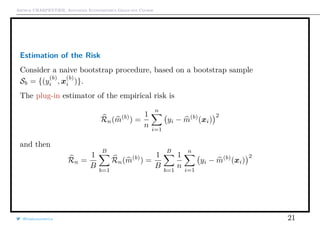
Consider a naive bootstrap procedure, based on a bootstrap sample
Sb = {(y
(b)
i , x
(b)
i )}.
The plug-in estimator of the empirical risk is
Rn(m(b)
) =
1
n
n
i=1
yi − m(b)
(xi)
2
and then
Rn =
1
B
B
b=1
Rn(m(b)
) =
1
B
B
b=1
1
n
n
i=1
yi − m(b)
(xi)
2
@freakonometrics 21
Arthur CHARPENTIER, Advanced Econometrics Graduate Course
Estimation of the Risk
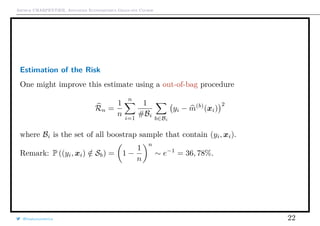
One might improve this estimate using a out-of-bag procedure
Rn =
1
n
n
i=1
1
#Bi
b∈Bi
yi − m(b)
(xi)
2
where Bi is the set of all boostrap sample that contain (yi, xi).
Remark: P ((yi, xi) /∈ Sb) = 1 −
1
n
n
∼ e−1
= 36, 78%.
@freakonometrics 22
Arthur CHARPENTIER, Advanced Econometrics Graduate Course
Linear Regression Shortcoming
Least Squares Estimator β = (XT
X)−1
XT
y
Unbiased Estimator E[β] = β
Variance Var[β] = σ2
(XT
X)−1
which can be (extremely) large when det[(XT
X)] ∼ 0.
X =







1 −1 2
1 0 1
1 2 −1
1 1 0







then XT
X =




4 2 2
2 6 −4
2 −4 6



 while XT
X+I =




5 2 2
2 7 −4
2 −4 7




eigenvalues : {10, 6, 0} {11, 7, 1}
Ad-hoc strategy: use XT
X + λI
@freakonometrics 23
Arthur CHARPENTIER, Advanced Econometrics Graduate Course
Linear Regression Shortcoming
Evolution of (β1, β2) →
n
i=1
[yi − (β1x1,i + β2x2,i)]2
when cor(X1, X2) = r ∈ [0, 1], on top.
Below, Ridge regression
(β1, β2) →
n
i=1
[yi − (β1x1,i + β2x2,i)]2
+λ(β2
1 + β2
2)
where λ ∈ [0, ∞), below,
when cor(X1, X2) ∼ 1 (colinearity).
@freakonometrics 24
−2 −1 0 1 2 3 4
−3−2−10123
β1
β2
500
1000
1500
2000
2000
2500
2500 2500
2500
3000
3000 3000
3000
3500
q
−2 −1 0 1 2 3 4
−3−2−10123
β1
β2
1000
1000
2000
2000
3000
3000
4000
4000
5000
5000
6000
6000
7000
Arthur CHARPENTIER, Advanced Econometrics Graduate Course
Normalization : Euclidean 2 vs. Mahalonobis
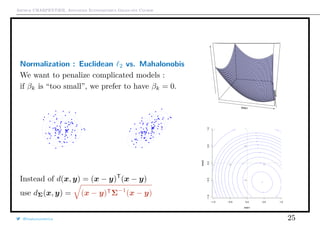
We want to penalize complicated models :
if βk is “too small”, we prefer to have βk = 0.
0.02
0.04
0.06
0.08
0.1
0.12
0.14
0.02
0.04
0.06
0.08
0.1
0.12
0.14
0.16
0.18
Instead of d(x, y) = (x − y)T
(x − y)
use dΣ(x, y) = (x − y)TΣ−1
(x − y)
beta1
beta2
beta1
beta2
−1 −0.5 0.5 1
−1
−0.5
0.5
1
30
40
40
50
60
70
80
90
100
110
120
120
150 150
X
−1.0 −0.5 0.0 0.5 1.0
−1.0−0.50.00.51.0
@freakonometrics 25
Arthur CHARPENTIER, Advanced Econometrics Graduate Course
Ridge Regression
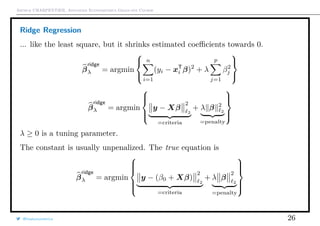
... like the least square, but it shrinks estimated coefficients towards 0.
β
ridge
λ = argmin



n
i=1
(yi − xT
i β)2
+ λ
p
j=1
β2
j



β
ridge
λ = argmin



y − Xβ
2
2
=criteria
+ λ β 2
2
=penalty



λ ≥ 0 is a tuning parameter.
The constant is usually unpenalized. The true equation is
β
ridge
λ = argmin



y − (β0 + Xβ)
2
2
=criteria
+ λ β
2
2
=penalty



@freakonometrics 26
Arthur CHARPENTIER, Advanced Econometrics Graduate Course
Ridge Regression
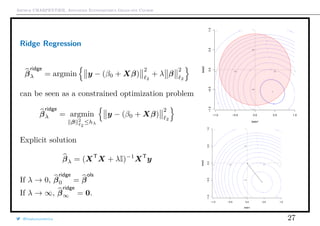
β
ridge
λ = argmin y − (β0 + Xβ)
2
2
+ λ β
2
2
can be seen as a constrained optimization problem
β
ridge
λ = argmin
β 2
2
≤hλ
y − (β0 + Xβ)
2
2
Explicit solution
βλ = (XT
X + λI)−1
XT
y
If λ → 0, β
ridge
0 = β
ols
If λ → ∞, β
ridge
∞ = 0.
beta1
beta2
−1 −0.5 0.5 1
−1
−0.5
0.5
1
30
40
40
50
60
70
80
90
100
110
120
120
150 150
30
X
−1.0 −0.5 0.0 0.5 1.0
−1.0−0.50.00.51.0
beta1
beta2
−1 −0.5 0.5 1
−1
−0.5
0.5
1
30
40
40
50
60
70
80
90
100
110
120
120
150 150
X
−1.0 −0.5 0.0 0.5 1.0
−1.0−0.50.00.51.0
@freakonometrics 27
Arthur CHARPENTIER, Advanced Econometrics Graduate Course
Ridge Regression
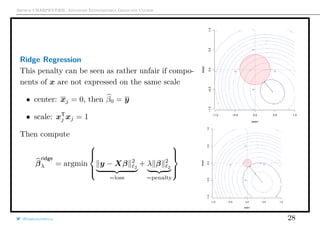
This penalty can be seen as rather unfair if compo-
nents of x are not expressed on the same scale
• center: xj = 0, then β0 = y
• scale: xT
j xj = 1
Then compute
β
ridge
λ = argmin



y − Xβ 2
2
=loss
+ λ β 2
2
=penalty



beta1
beta2
−1 −0.5 0.5 1
−1
−0.5
0.5
1
30
40
40
50
60
70
80
90
100
110
120
120
150 150
30
X
−1.0 −0.5 0.0 0.5 1.0
−1.0−0.50.00.51.0
beta1
beta2
−1 −0.5 0.5 1
−1
−0.5
0.5
1
30
40
40
50
60
70
80
90
100
110
120
120
150 150
40
40
X
−1.0 −0.5 0.0 0.5 1.0
−1.0−0.50.00.51.0
@freakonometrics 28
Arthur CHARPENTIER, Advanced Econometrics Graduate Course
Ridge Regression
Observe that if xj1 ⊥ xj2 , then
β
ridge
λ = [1 + λ]−1
β
ols
λ
which explain relationship with shrinkage.
But generally, it is not the case...
q
q
Theorem There exists λ such that mse[β
ridge
λ ] ≤ mse[β
ols
λ ]
Ridge Regression
@freakonometrics 29
Arthur CHARPENTIER, Advanced Econometrics Graduate Course
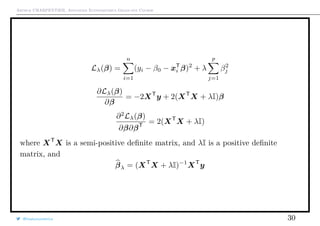
Lλ(β) =
n
i=1
(yi − β0 − xT
i β)2
+ λ
p
j=1
β2
j
∂Lλ(β)
∂β
= −2XT
y + 2(XT
X + λI)β
∂2
Lλ(β)
∂β∂βT
= 2(XT
X + λI)
where XT
X is a semi-positive definite matrix, and λI is a positive definite
matrix, and
βλ = (XT
X + λI)−1
XT
y
@freakonometrics 30
Arthur CHARPENTIER, Advanced Econometrics Graduate Course
The Bayesian Interpretation
From a Bayesian perspective,
P[θ|y]
posterior
∝ P[y|θ]
likelihood
· P[θ]
prior
i.e. log P[θ|y] = log P[y|θ]
log likelihood
+ log P[θ]
penalty
If β has a prior N(0, τ2
I) distribution, then its posterior distribution has mean
E[β|y, X] = XT
X +
σ2
τ2
I
−1
XT
y.
@freakonometrics 31
Arthur CHARPENTIER, Advanced Econometrics Graduate Course
Properties of the Ridge Estimator
βλ = (XT
X + λI)−1
XT
y
E[βλ] = XT
X(λI + XT
X)−1
β.
i.e. E[βλ] = β.
Observe that E[βλ] → 0 as λ → ∞.
Assume that X is an orthogonal design matrix, i.e. XT
X = I, then
βλ = (1 + λ)−1
β
ols
.
@freakonometrics 32
Arthur CHARPENTIER, Advanced Econometrics Graduate Course
Properties of the Ridge Estimator
Set W λ = (I + λ[XT
X]−1
)−1
. One can prove that
W λβ
ols
= βλ.
Thus,
Var[βλ] = W λVar[β
ols
]W T
λ
and
Var[βλ] = σ2
(XT
X + λI)−1
XT
X[(XT
X + λI)−1
]T
.
Observe that
Var[β
ols
] − Var[βλ] = σ2
W λ[2λ(XT
X)−2
+ λ2
(XT
X)−3
]W T
λ ≥ 0.
@freakonometrics 33
Arthur CHARPENTIER, Advanced Econometrics Graduate Course
Properties of the Ridge Estimator
Hence, the confidence ellipsoid of ridge estimator is
indeed smaller than the OLS,
If X is an orthogonal design matrix,
Var[βλ] = σ2
(1 + λ)−2
I.
mse[βλ] = σ2
trace(W λ(XT
X)−1
W T
λ) + βT
(W λ − I)T
(W λ − I)β.
If X is an orthogonal design matrix,
mse[βλ] =
pσ2
(1 + λ)2
+
λ2
(1 + λ)2
βT
β
Properties of the Ridge Estimator
@freakonometrics 34
0.0 0.2 0.4 0.6 0.8
−1.0−0.8−0.6−0.4−0.2
β1
β2
1
2
3
4
5
6
7
Arthur CHARPENTIER, Advanced Econometrics Graduate Course
mse[βλ] =
pσ2
(1 + λ)2
+
λ2
(1 + λ)2
βT
β
is minimal for
λ =
pσ2
βT
β
Note that there exists λ > 0 such that mse[βλ] < mse[β0] = mse[β
ols
].
@freakonometrics 35
Arthur CHARPENTIER, Advanced Econometrics Graduate Course
SVD decomposition
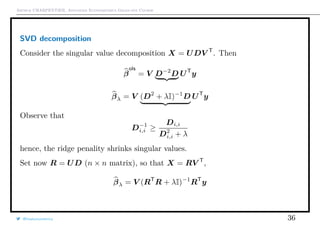
Consider the singular value decomposition X = UDV T
. Then
β
ols
= V D−2
D UT
y
βλ = V (D2
+ λI)−1
D UT
y
Observe that
D−1
i,i ≥
Di,i
D2
i,i + λ
hence, the ridge penality shrinks singular values.
Set now R = UD (n × n matrix), so that X = RV T
,
βλ = V (RT
R + λI)−1
RT
y
@freakonometrics 36
Arthur CHARPENTIER, Advanced Econometrics Graduate Course
Hat matrix and Degrees of Freedom
Recall that Y = HY with
H = X(XT
X)−1
XT
Similarly
Hλ = X(XT
X + λI)−1
XT
trace[Hλ] =
p
j=1
d2
j,j
d2
j,j + λ
→ 0, as λ → ∞.
@freakonometrics 37
Arthur CHARPENTIER, Advanced Econometrics Graduate Course
Sparsity Issues
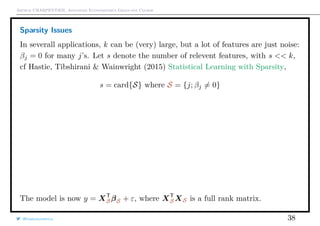
In severall applications, k can be (very) large, but a lot of features are just noise:
βj = 0 for many j’s. Let s denote the number of relevent features, with s << k,
cf Hastie, Tibshirani & Wainwright (2015) Statistical Learning with Sparsity,
s = card{S} where S = {j; βj = 0}
The model is now y = XT
SβS + ε, where XT
SXS is a full rank matrix.
@freakonometrics 38
q
q
= . +
Arthur CHARPENTIER, Advanced Econometrics Graduate Course
Going further on sparcity issues
The Ridge regression problem was to solve
β = argmin
β∈{ β 2 ≤s}
{ Y − XT
β 2
2
}
Define a 0
= 1(|ai| > 0).
Here dim(β) = k but β 0
= s.
We wish we could solve
β = argmin
β∈{ β 0 =s}
{ Y − XT
β 2
2
}
Problem: it is usually not possible to describe all possible constraints, since
s
k
coefficients should be chosen here (with k (very) large).
@freakonometrics 39
beta1
beta2
−1 −0.5 0.5 1
−1
−0.5
0.5
1
30
40
40
50
60
70
80
90
100
110
120
120
150 150
X
−1.0 −0.5 0.0 0.5 1.0
−1.0−0.50.00.51.0
Arthur CHARPENTIER, Advanced Econometrics Graduate Course
Going further on sparcity issues
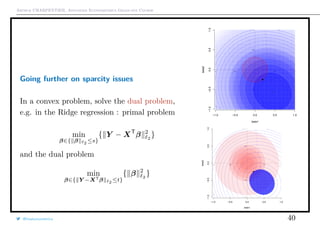
In a convex problem, solve the dual problem,
e.g. in the Ridge regression : primal problem
min
β∈{ β 2 ≤s}
{ Y − XT
β 2
2
}
and the dual problem
min
β∈{ Y −XTβ 2 ≤t}
{ β 2
2
}
beta1
beta2
−1 −0.5 0.5 1
−1
−0.5
0.5
1
26
27
30
32
35
40
40
50
60
70
80
90
100
110
120
120
130
130
140 140
X
q
−1.0 −0.5 0.0 0.5 1.0
−1.0−0.50.00.51.0
beta1
beta2
−1 −0.5 0.5 1
−1
−0.5
0.5
1
26
27
30
32
35
40
40
50
60
70
80
90
100
110
120
120
130
130
140 140
X
q
−1.0 −0.5 0.0 0.5 1.0
−1.0−0.50.00.51.0
@freakonometrics 40
Arthur CHARPENTIER, Advanced Econometrics Graduate Course
Going further on sparcity issues
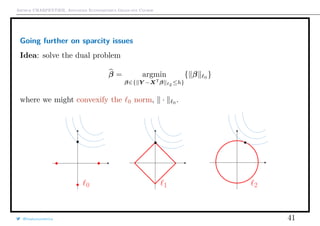
Idea: solve the dual problem
β = argmin
β∈{ Y −XTβ 2 ≤h}
{ β 0 }
where we might convexify the 0 norm, · 0
.
@freakonometrics 41
Arthur CHARPENTIER, Advanced Econometrics Graduate Course
Going further on sparcity issues
On [−1, +1]k
, the convex hull of β 0
is β 1
On [−a, +a]k
, the convex hull of β 0
is a−1
β 1
Hence, why not solve
β = argmin
β; β 1 ≤˜s
{ Y − XT
β 2
}
which is equivalent (Kuhn-Tucker theorem) to the Lagragian optimization
problem
β = argmin{ Y − XT
β 2
2
+λ β 1 }
@freakonometrics 42
Arthur CHARPENTIER, Advanced Econometrics Graduate Course
LASSO Least Absolute Shrinkage and Selection Operator
β ∈ argmin{ Y − XT
β 2
2
+λ β 1
}
is a convex problem (several algorithms ), but not strictly convex (no unicity of
the minimum). Nevertheless, predictions y = xT
β are unique.
MM, minimize majorization, coordinate descent Hunter & Lange (2003) A
Tutorial on MM Algorithms.
@freakonometrics 43
Arthur CHARPENTIER, Advanced Econometrics Graduate Course
LASSO Regression
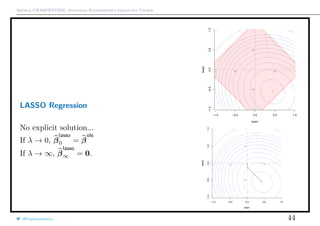
No explicit solution...
If λ → 0, β
lasso
0 = β
ols
If λ → ∞, β
lasso
∞ = 0.
beta1
beta2
−1 −0.5 0.5 1
−1
−0.5
0.5
1
30
40
40
50
60
70
80
90
100
110
120
120
150 150
X
−1.0 −0.5 0.0 0.5 1.0
−1.0−0.50.00.51.0
beta1
beta2
−1 −0.5 0.5 1
−1
−0.5
0.5
1
30
40
40
50
60
70
80
90
100
110
120
120
150 150
X
−1.0 −0.5 0.0 0.5 1.0
−1.0−0.50.00.51.0
@freakonometrics 44
Arthur CHARPENTIER, Advanced Econometrics Graduate Course
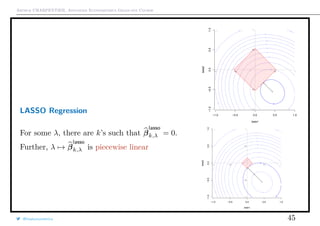
LASSO Regression
For some λ, there are k’s such that β
lasso
k,λ = 0.
Further, λ → β
lasso
k,λ is piecewise linear
beta1
beta2
−1 −0.5 0.5 1
−1
−0.5
0.5
1
30
40
40
50
60
70
80
90
100
110
120
120
150 150
30
X
−1.0 −0.5 0.0 0.5 1.0
−1.0−0.50.00.51.0
beta1
beta2
−1 −0.5 0.5 1
−1
−0.5
0.5
1
30
40
40
50
60
70
80
90
100
110
120
120
150 150
40
40
X
−1.0 −0.5 0.0 0.5 1.0
−1.0−0.50.00.51.0
@freakonometrics 45
Arthur CHARPENTIER, Advanced Econometrics Graduate Course
LASSO Regression
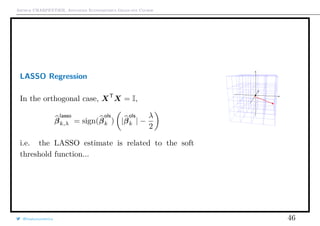
In the orthogonal case, XT
X = I,
β
lasso
k,λ = sign(β
ols
k ) |β
ols
k | −
λ
2
i.e. the LASSO estimate is related to the soft
threshold function...
q
q
@freakonometrics 46
Arthur CHARPENTIER, Advanced Econometrics Graduate Course
Optimal LASSO Penalty
Use cross validation, e.g. K-fold,
β(−k)(λ) = argmin



i∈Ik
[yi − xT
i β]2
+ λ β 1



then compute the sum of the squared errors,
Qk(λ) =
i∈Ik
[yi − xT
i β(−k)(λ)]2
and finally solve
λ = argmin Q(λ) =
1
K
k
Qk(λ)
Note that this might overfit, so Hastie, Tibshiriani & Friedman (2009) Elements
of Statistical Learning suggest the largest λ such that
Q(λ) ≤ Q(λ ) + se[λ ] with se[λ]2
=
1
K2
K
k=1
[Qk(λ) − Q(λ)]2
@freakonometrics 47
Arthur CHARPENTIER, Advanced Econometrics Graduate Course
LASSO and Ridge, with R
1 > library(glmnet)
2 > chicago=read.table("http:// freakonometrics .free.fr/
chicago.txt",header=TRUE ,sep=";")
3 > standardize <- function(x) {(x-mean(x))/sd(x)}
4 > z0 <- standardize(chicago[, 1])
5 > z1 <- standardize(chicago[, 3])
6 > z2 <- standardize(chicago[, 4])
7 > ridge <-glmnet(cbind(z1 , z2), z0 , alpha =0, intercept=
FALSE , lambda =1)
8 > lasso <-glmnet(cbind(z1 , z2), z0 , alpha =1, intercept=
FALSE , lambda =1)
9 > elastic <-glmnet(cbind(z1 , z2), z0 , alpha =.5,
intercept=FALSE , lambda =1)
Elastic net, λ1 β 1
+ λ2 β 2
2
q
q
q
qqqqqqqqqqqqqqqqqqqqqqqqqqqqqqqqqqqqqqqqqqqqqqqqqqqqqqqqqqqqqqqqqqqqqqqqqqqqqqqqqqqqqqqqqqqqqqqqqqqqqqqqqqqqqqqqqqqqqqqqqqqqqqqqqqqqqqqqqqqqqqqqqqqqqqqqqqqqqqqqqqqqqqqqqqqqqqqqqqqqqqqqqqqqqqqqqqq
q
q
qq
q
q
qqqqqqqqqqqqqqqqqqqqqqqqqqqqqqqqqqqqqqqqqqqqqqqqqqqqqqqqqqqqqqqqqqqqqqqqqqqqqqqqqqqqqqqqqqqqqqqqqqqqqqqqqqqqqqqqqqqqqqqqqqqqqqqqqqqqqqqqqqqqqqqqqqqqqqqqqqqqqqqqqqqqqqqqqqqqqqqqqqqqqqqqqqqqqqqqqqq
q
q
q
q
q
q
q
q
q
qqqqqqqqqqqqqqqqqqqqqqqqqqqqqqqqqqqqqqqqqqqqqqqqqqqqqqqqqqqqqqqqqqqqqqqqqqqqqqqqqqqqqqqqqqqqqqqqqqqqqqqqqqqqqqqqqqqqqqqqqqqqqqqqqqqqqqqqqqqqqqqqqqqqqqqqqqqqqqqqqqqqqqqqqqqqqqqqqqqqqqqqqqqqq
q
q
q
q
q
qq
q
q
q
q
q
qqqqqqqqqqqqqqqqqqqqqqqqqqqqqqqqqqqqqqqqqqqqqqqqqqqqqqqqqqqqqqqqqqqqqqqqqqqqqqqqqqqqqqqqqqqqqqqqqqqqqqqqqqqqqqqqqqqqqqqqqqqqqqqqqqqqqqqqqqqqqqqqqqqqqqqqqqqqqqqqqqqqqqqqqqqqqqqqqqqqqqqqqqqqq
q
q
q
q
q
q
q
q
q
qqqqqqqqqqqqqqqqqqqqqqqqqqqqqqqqqqqqqqqqqqqqqqqqqqqqqqqqqqqqqqqqqqqqqqqqqqqqqqqqqqqqqqqqqqqqqqqqqqqqqqqqqqqqqqqqqqqqqqqqqqqqqqqqqqqqqqqqqqqqqqqqqqqqqqqqqqqqqqqqqqqqqqqqqqqqqqqqqqqqqqqqqqqqqqqqqqq
q
q
qq
q
q
qqqqqqqqqqqqqqqqqqqqqqqqqqqqqqqqqqqqqqqqqqqqqqqqqqqqqqqqqqqqqqqqqqqqqqqqqqqqqqqqqqqqqqqqqqqqqqqqqqqqqqqqqqqqqqqqqqqqqqqqqqqqqqqqqqqqqqqqqqqqqqqqqqqqqqqqqqqqqqqqqqqqqqqqqqqqqqqqqqqqqqqqqqqqqqqqqqq
q
q
q
@freakonometrics 48
Arthur CHARPENTIER, Advanced Econometrics Graduate Course
LASSO Regression, Smoothing and Overfit
LASSO can be used to avoid overfit.
@freakonometrics 49
q
q
q
q
q
q
q
q
q
q
q
q
q
q
q
q
q
q
q
q
q
0.0 0.2 0.4 0.6 0.8 1.0
−1.0−0.50.00.51.0
Arthur CHARPENTIER, Advanced Econometrics Graduate Course
Ridge vs. LASSO
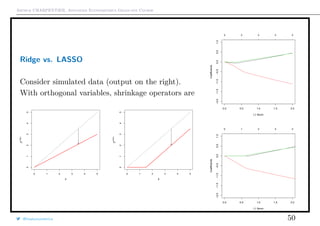
Consider simulated data (output on the right).
With orthogonal variables, shrinkage operators are
0 1 2 3 4 5
012345
β
β(ridge)
0 1 2 3 4 5
012345
β
β(lasso)
0.0 0.5 1.0 1.5 2.0
−2.0−1.5−1.0−0.50.00.51.0
L1 Norm
Coefficients
3 3 3 3 3
0.0 0.5 1.0 1.5 2.0
−2.0−1.5−1.0−0.50.00.51.0
L1 Norm
Coefficients
0 1 3 3 3
@freakonometrics 50
Arthur CHARPENTIER, Advanced Econometrics Graduate Course
Optimization Heuristics
First idea: given some initial guess β(0), |β| ∼ |β(0)| +
1
2|β(0)|
(β2
− β2
(0))
LASSO estimate can probably be derived from iterated Ridge estimates
y − Xβ(k+1)
2
2
+ λ β(k+1) 1 ∼ Xβ(k+1)
2
2
+
λ
2 j
1
|βj,(k)|
[βj,(k+1)]2
which is a weighted ridge penalty function
Thus,
β(k+1) = XT
X + λ∆(k)
−1
XT
y
where ∆(k) = diag[|βj,(k)|−1
]. Then β(k) → β
lasso
, as k → ∞.
@freakonometrics 51
Arthur CHARPENTIER, Advanced Econometrics Graduate Course
Properties of LASSO Estimate
From this iterative technique
β
lasso
λ ∼ XT
X + λ∆
−1
XT
y
where ∆ = diag[|β
lasso
j,λ |−1
] if β
lasso
j,λ = 0, 0 otherwise.
Thus,
E[β
lasso
λ ] ∼ XT
X + λ∆
−1
XT
Xβ
and
Var[β
lasso
λ ] ∼ σ2
XT
X + λ∆
−1
XT
XT
X XT
X + λ∆
−1
XT
@freakonometrics 52
Arthur CHARPENTIER, Advanced Econometrics Graduate Course
Optimization Heuristics
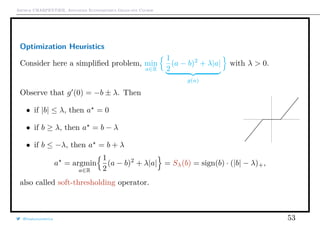
Consider here a simplified problem, min
a∈R
1
2
(a − b)2
+ λ|a|
g(a)
with λ > 0.
Observe that g (0) = −b ± λ. Then
• if |b| ≤ λ, then a = 0
• if b ≥ λ, then a = b − λ
• if b ≤ −λ, then a = b + λ
a = argmin
a∈R
1
2
(a − b)2
+ λ|a| = Sλ(b) = sign(b) · (|b| − λ)+,
also called soft-thresholding operator.
@freakonometrics 53
Arthur CHARPENTIER, Advanced Econometrics Graduate Course
Optimization Heuristics
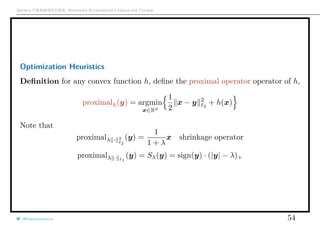
Definition for any convex function h, define the proximal operator operator of h,
proximalh(y) = argmin
x∈Rd
1
2
x − y 2
2
+ h(x)
Note that
proximalλ · 2
2
(y) =
1
1 + λ
x shrinkage operator
proximalλ · 1
(y) = Sλ(y) = sign(y) · (|y| − λ)+
@freakonometrics 54
Arthur CHARPENTIER, Advanced Econometrics Graduate Course
Optimization Heuristics
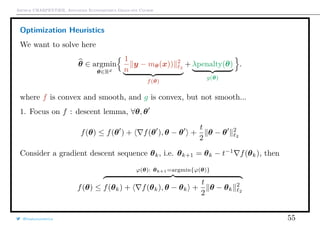
We want to solve here
θ ∈ argmin
θ∈Rd
1
n
y − mθ(x)) 2
2
f(θ)
+ λpenalty(θ)
g(θ)
.
where f is convex and smooth, and g is convex, but not smooth...
1. Focus on f : descent lemma, ∀θ, θ
f(θ) ≤ f(θ ) + f(θ ), θ − θ +
t
2
θ − θ 2
2
Consider a gradient descent sequence θk, i.e. θk+1 = θk − t−1
f(θk), then
f(θ) ≤
ϕ(θ): θk+1=argmin{ϕ(θ)}
f(θk) + f(θk), θ − θk +
t
2
θ − θk
2
2
@freakonometrics 55
Arthur CHARPENTIER, Advanced Econometrics Graduate Course
Optimization Heuristics
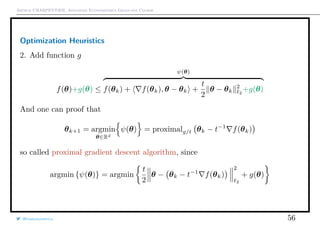
2. Add function g
f(θ)+g(θ) ≤
ψ(θ)
f(θk) + f(θk), θ − θk +
t
2
θ − θk
2
2
+g(θ)
And one can proof that
θk+1 = argmin
θ∈Rd
ψ(θ) = proximalg/t θk − t−1
f(θk)
so called proximal gradient descent algorithm, since
argmin {ψ(θ)} = argmin
t
2
θ − θk − t−1
f(θk)
2
2
+ g(θ)
@freakonometrics 56
Arthur CHARPENTIER, Advanced Econometrics Graduate Course
Coordinate-wise minimization
Consider some convex differentiable f : Rk
→ R function.
Consider x ∈ Rk
obtained by minimizing along each coordinate axis, i.e.
f(x1, xi−1, xi, xi+1, · · · , xk) ≥ f(x1, xi−1, xi , xi+1, · · · , xk)
for all i. Is x a global minimizer? i.e.
f(x) ≥ f(x ), ∀x ∈ Rk
.
Yes. If f is convex and differentiable.
f(x)|x=x =
∂f(x)
∂x1
, · · · ,
∂f(x)
∂xk
= 0
There might be problem if f is not differentiable (except in each axis direction).
If f(x) = g(x) +
k
i=1 hi(xi) with g convex and differentiable, yes, since
f(x) − f(x ) ≥ g(x )T
(x − x ) +
i
[hi(xi) − hi(xi )]
@freakonometrics 57
Arthur CHARPENTIER, Advanced Econometrics Graduate Course
Coordinate-wise minimization
f(x) − f(x ) ≥
i
[ ig(x )T
(xi − xi )hi(xi) − hi(xi )]
≥0
≥ 0
Thus, for functions f(x) = g(x) +
k
i=1 hi(xi) we can use coordinate descent to
find a minimizer, i.e. at step j
x
(j)
1 ∈ argmin
x1
f(x1, x
(j−1)
2 , x
(j−1)
3 , · · · x
(j−1)
k )
x
(j)
2 ∈ argmin
x2
f(x
(j)
1 , x2, x
(j−1)
3 , · · · x
(j−1)
k )
x
(j)
3 ∈ argmin
x3
f(x
(j)
1 , x
(j)
2 , x3, · · · x
(j−1)
k )
Tseng (2001) Convergence of Block Coordinate Descent Method: if f is continuous,
then x∞
is a minimizer of f.
@freakonometrics 58
Arthur CHARPENTIER, Advanced Econometrics Graduate Course
Application in Linear Regression
Let f(x) = 1
2 y − Ax 2
, with y ∈ Rn
and A ∈ Mn×k. Let A = [A1, · · · , Ak].
Let us minimize in direction i. Let x−i denote the vector in Rk−1
without xi.
Here
0 =
∂f(x)
∂xi
= AT
i [Ax − y] = AT
i [Aixi + A−ix−i − y]
thus, the optimal value is here
xi =
AT
i [A−ix−i − y]
AT
i Ai
@freakonometrics 59
Arthur CHARPENTIER, Advanced Econometrics Graduate Course
Application to LASSO
Let f(x) = 1
2 y − Ax 2
+ λ x 1 , so that the non-differentiable part is
separable, since x 1
=
k
i=1 |xi|.
Let us minimize in direction i. Let x−i denote the vector in Rk−1
without xi.
Here
0 =
∂f(x)
∂xi
= AT
i [Aixi + A−ix−i − y] + λsi
where si ∈ ∂|xi|. Thus, solution is obtained by soft-thresholding
xi = Sλ/ Ai
2
AT
i [A−ix−i − y]
AT
i Ai
@freakonometrics 60
Arthur CHARPENTIER, Advanced Econometrics Graduate Course
Convergence rate for LASSO
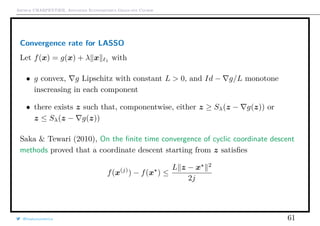
Let f(x) = g(x) + λ x 1
with
• g convex, g Lipschitz with constant L > 0, and Id − g/L monotone
inscreasing in each component
• there exists z such that, componentwise, either z ≥ Sλ(z − g(z)) or
z ≤ Sλ(z − g(z))
Saka & Tewari (2010), On the finite time convergence of cyclic coordinate descent
methods proved that a coordinate descent starting from z satisfies
f(x(j)
) − f(x ) ≤
L z − x 2
2j
@freakonometrics 61
Arthur CHARPENTIER, Advanced Econometrics Graduate Course
Graphical Lasso and Covariance Estimation
We want to estimate an (unknown) covariance matrix Σ, or Σ−1
.
An estimate for Σ−1
is Θ solution of
Θ ∈ argmin
Θ∈Mk×k
{− log[det(Θ)] + trace[SΘ] + λ Θ 1
} where S =
XT
X
n
and where Θ 1
= |Θi,j|.
See van Wieringen (2016) Undirected network reconstruction from high-dimensional
data and https://github.com/kaizhang/glasso
@freakonometrics 62
Arthur CHARPENTIER, Advanced Econometrics Graduate Course
Application to Network Simplification
Can be applied on networks, to spot ‘significant’
connexions...
Source: http://khughitt.github.io/graphical-lasso/
@freakonometrics 63
Arthur CHARPENTIER, Advanced Econometrics Graduate Course
Extention of Penalization Techniques
In a more general context, we want to solve
θ ∈ argmin
θ∈Rd
1
n
n
i=1
(yi, mθ(xi)) + λ · penalty(θ) .
@freakonometrics 64

Econometrics 2017-graduate-3

  • 1.
    Arthur CHARPENTIER, AdvancedEconometrics Graduate Course Advanced Econometrics #3: Model & Variable Selection* A. Charpentier (Université de Rennes 1) Université de Rennes 1, Graduate Course, 2017. @freakonometrics 1
  • 2.
    Arthur CHARPENTIER, AdvancedEconometrics Graduate Course “Great plot. Now need to find the theory that explains it” Deville (2017) http://twitter.com @freakonometrics 2
  • 3.
    Arthur CHARPENTIER, AdvancedEconometrics Graduate Course Preliminary Results: Numerical Optimization Problem : x ∈ argmin{f(x); x ∈ Rd } Gradient descent : xk+1 = xk − η f(xk) starting from some x0 Problem : x ∈ argmin{f(x); x ∈ X ⊂ Rd } Projected descent : xk+1 = ΠX xk − η f(xk) starting from some x0 A constrained problem is said to be convex if    min{f(x)} with f convex s.t. gi(x) = 0, ∀i = 1, · · · , n with gi linear hi(x) ≤ 0, ∀i = 1, · · · , m with hi convex Lagrangian : L(x, λ, µ) = f(x) + n i=1 λigi(x) + m i=1 µihi(x) where x are primal variables and (λ, µ) are dual variables. Remark L is an affine function in (λ, µ) @freakonometrics 3
  • 4.
    Arthur CHARPENTIER, AdvancedEconometrics Graduate Course Preliminary Results: Numerical Optimization Karush–Kuhn–Tucker conditions : a convex problem has a solution x if and only if there are (λ , µ ) such that the following condition hold • stationarity : xL(x, λ, µ) = 0 at (x , λ , µ ) • primal admissibility : gi(x ) = 0 and hi(x ) ≤ 0, ∀i • dual admissibility : µ ≥ 0 Let L denote the associated dual function L(λ, µ) = min x {L(x, λ, µ)} L is a convex function in (λ, µ) and the dual problem is max λ,µ {L(λ, µ)}. @freakonometrics 4
  • 5.
    Arthur CHARPENTIER, AdvancedEconometrics Graduate Course References Motivation Banerjee, A., Chandrasekhar, A.G., Duflo, E. & Jackson, M.O. (2016). Gossip: Identifying Central Individuals in a Social Networks. References Belloni, A. & Chernozhukov, V. 2009. Least squares after model selection in high-dimensional sparse models. Hastie, T., Tibshirani, R. & Wainwright, M. 2015 Statistical Learning with Sparsity: The Lasso and Generalizations. CRC Press. @freakonometrics 5
  • 6.
    Arthur CHARPENTIER, AdvancedEconometrics Graduate Course Preambule Assume that y = m(x) + ε, where ε is some idosyncatic impredictible noise. The error E[(y − m(x))2 ] is the sume of three terms • variance of the estimator : E[(y − m(x))2 ] • bias2 of the estimator : [m(x − m(x)]2 • variance of the noise : E[(y − m(x))2 ] (the latter exists, even with a ‘perfect’ model). @freakonometrics 6
  • 7.
    Arthur CHARPENTIER, AdvancedEconometrics Graduate Course Preambule Consider a parametric model, with true (unkown) parameter θ, then mse(ˆθ) = E (ˆθ − θ)2 = E (ˆθ − E ˆθ )2 variance + E (E ˆθ − θ)2 bias2 Let θ denote an unbiased estimator of θ. Then ˆθ = θ2 θ2 + mse(θ) · θ = θ − mse(θ) θ2 + mse(θ) · θ penalty satisfies mse(ˆθ) ≤ mse(θ). @freakonometrics 7 −2 −1 0 1 2 3 4 0.00.20.40.60.8 variance
  • 8.
    Arthur CHARPENTIER, AdvancedEconometrics Graduate Course Occam’s Razor The “law of parsimony”, “lex parsimoniæ” Penalize too complex models @freakonometrics 8
  • 9.
    Arthur CHARPENTIER, AdvancedEconometrics Graduate Course James & Stein Estimator Let X ∼ N(µ, σ2 I). We want to estimate µ. µmle = Xn ∼ N µ, σ2 n I . From James & Stein (1961) Estimation with quadratic loss µJS = 1 − (d − 2)σ2 n y 2 y where · is the Euclidean norm. One can prove that if d ≥ 3, E µJS − µ 2 < E µmle − µ 2 Samworth (2015) Stein’s paradox, “one should use the price of tea in China to obtain a better estimate of the chance of rain in Melbourne”. @freakonometrics 9
  • 10.
    Arthur CHARPENTIER, AdvancedEconometrics Graduate Course James & Stein Estimator Heuristics : consider a biased estimator, to decrease the variance. See Efron (2010) Large-Scale Inference @freakonometrics 10
  • 11.
    Arthur CHARPENTIER, AdvancedEconometrics Graduate Course Motivation: Avoiding Overfit Generalization : the model should perform well on new data (and not only on the training ones). q q q q q q q q q q q q q 2 4 6 8 10 12 0.00.20.40.6 q q q q q q q q q q q q q @freakonometrics 11 q q q q q q q q q q q q q q q q q q q q q q 0.0 0.2 0.4 0.6 0.8 1.0 −1.5−1.0−0.50.00.51.01.5 q q q q q q q q q q q q q q q q q q q q q q 0.0 0.2 0.4 0.6 0.8 1.0 −1.5−1.0−0.50.00.51.01.5 q q q q q q q q q qq
  • 12.
    Arthur CHARPENTIER, AdvancedEconometrics Graduate Course Reducing Dimension with PCA Use principal components to reduce dimension (on centered and scaled variables): we want d vectors z1, · · · , zd such that First Compoment is z1 = Xω1 where ω1 = argmax ω =1 X · ω 2 = argmax ω =1 ωT XT Xω Second Compoment is z2 = Xω2 where ω2 = argmax ω =1 X (1) · ω 2 0 20 40 60 80 −8−6−4−2 Age LogMortalityRate −10 −5 0 5 10 15 −101234 PC score 1 PCscore2 q q qq q q qqq q qqq qq q qqq q q q qq q q q q q q qqq q q q q q q qq q qq q q qq q q q q q q qq q qqq q q q q q q q q q q q q q q qq q q qqq q qqq qq q qqq q q q q q q q q q q q q q q q q q q q qq q q q q qq q q qq q q qqqq q q q q q q q q q qqq q qqq qq q qq q q q q qq q q q q q q q q q q q q q 1914 1915 1916 1917 1918 1919 1940 1942 1943 1944 0 20 40 60 80 −10−8−6−4−2 Age LogMortalityRate −10 −5 0 5 10 15 −10123 PC score 1 PCscore2 qq q q q q q qq qq qq q q q q q q q q q q q q q q q q q q q q q q q q q q q q q qq qq q q q q q qq q q q q q q q q q q q q q q q q q q q q q q q q q q qq qq q q q q q q q q q q q q q q q q q q q q q qq q q q q q q qq q q q q q q q q q qq q q q q q q q q q q qq qq q q q q q qq qqqq q qqqq q q q q q q with X (1) = X − Xω1 z1 ωT 1 . @freakonometrics 12
  • 13.
    Arthur CHARPENTIER, AdvancedEconometrics Graduate Course Reducing Dimension with PCA A regression on (the d) principal components, y = zT β + η could be an interesting idea, unfortunatley, principal components have no reason to be correlated with y. First compoment was z1 = Xω1 where ω1 = argmax ω =1 X · ω 2 = argmax ω =1 ωT XT Xω It is a non-supervised technique. Instead, use partial least squares, introduced in Wold (1966) Estimation of Principal Components and Related Models by Iterative Least squares. First compoment is z1 = Xω1 where ω1 = argmax ω =1 { y, X · ω } = argmax ω =1 ωT XT yyT Xω @freakonometrics 13
  • 14.
    Arthur CHARPENTIER, AdvancedEconometrics Graduate Course Terminology Consider a dataset {yi, xi}, assumed to be generated from Y, X, from an unknown distribution P. Let m0(·) be the “true” model. Assume that yi = m0(xi) + εi. In a regression context (quadratic loss function function), the risk associated to m is R(m) = EP Y − m(X) 2 An optimal model m within a class M satisfies R(m ) = inf m∈M R(m) Such a model m is usually called oracle. Observe that m (x) = E[Y |X = x] is the solution of R(m ) = inf m∈M R(m) where M is the set of measurable functions @freakonometrics 14
  • 15.
    Arthur CHARPENTIER, AdvancedEconometrics Graduate Course The empirical risk is Rn(m) = 1 n n i=1 yi − m(xi) 2 For instance, m can be a linear predictor, m(x) = β0 + xT β, where θ = (β0, β) should estimated (trained). E Rn(m) = E (m(X) − Y )2 can be expressed as E (m(X) − E[m(X)|X])2 variance of m + E E[m(X)|X] − E[Y |X] m0(X) 2 bias of m + E Y − E[Y |X] m0(X) )2 variance of the noise The third term is the risk of the “optimal” estimator m, that cannot be decreased. @freakonometrics 15
  • 16.
    Arthur CHARPENTIER, AdvancedEconometrics Graduate Course Mallows Penalty and Model Complexity Consider a linear predictor (see #1), i.e. y = m(x) = Ay. Assume that y = m0(x) + ε, with E[ε] = 0 and Var[ε] = σ2 I. Let · denote the Euclidean norm Empirical risk : Rn(m) = 1 n y − m(x) 2 Vapnik’s risk : E[Rn(m)] = 1 n m0(x − m(x) 2 + 1 n E y − m0(x 2 with m0(x = E[Y |X = x]. Observe that nE Rn(m) = E y − m(x) 2 = (I − A)m0 2 + σ2 I − A 2 while = E m0(x) − m(x) 2 = 2 (I − A)m0 bias + σ2 A 2 variance @freakonometrics 16
  • 17.
    Arthur CHARPENTIER, AdvancedEconometrics Graduate Course Mallows Penalty and Model Complexity One can obtain E Rn(m) = E Rn(m) + 2 σ2 n trace(A). If trace(A) ≥ 0 the empirical risk underestimate the true risk of the estimator. The number of degrees of freedom of the (linear) predictor is related to trace(A) 2 σ2 n trace(A) is called Mallow’s penalty CL. If A is a projection matrix, trace(A) is the dimension of the projection space, p, then we obtain Mallow’s CP , 2 σ2 n p. Remark : Mallows (1973) Some Comments on Cp introduced this penalty while focusing on the R2 . @freakonometrics 17
  • 18.
    Arthur CHARPENTIER, AdvancedEconometrics Graduate Course Penalty and Likelihood CP is associated to a quadratic risk an alternative is to use a distance on the (conditional) distribution of Y , namely Kullback-Leibler distance discrete case: DKL(P Q) = i P(i) log P(i) Q(i) continuous case : DKL(P Q) = ∞ −∞ p(x) log p(x) q(x) dxDKL(P Q) = ∞ −∞ p(x) log p(x) q(x) dx Let f denote the true (unknown) density, and fθ some parametric distribution, DKL(f fθ) = ∞ −∞ f(x) log f(x) fθ(x) dx= f(x) log[f(x)] dx− f(x) log[fθ(x)] dx relative information Hence minimize {DKL(f fθ)} ←→ maximize E log[fθ(X)] @freakonometrics 18
  • 19.
    Arthur CHARPENTIER, AdvancedEconometrics Graduate Course Penalty and Likelihood Akaike (1974) A new look at the statistical model identification observe that for n large enough E log[fθ(X)] ∼ log[L(θ)] − dim(θ) Thus AIC = −2 log L(θ) + 2dim(θ) Example : in a (Gaussian) linear model, yi = β0 + xT i β + εi AIC = n log 1 n n i=1 εi + 2[dim(β) + 2] @freakonometrics 19
  • 20.
    Arthur CHARPENTIER, AdvancedEconometrics Graduate Course Penalty and Likelihood Remark : this is valid for large sample (rule of thumb n/dim(θ) > 40), otherwise use a corrected AIC AICc = AIC + 2k(k + 1) n − k − 1 bias correction where k = dim(θ) see Sugiura (1978) Further analysis of the data by Akaike’s information criterion and the finite corrections second order AIC. Using a Bayesian interpretation, Schwarz (1978) Estimating the dimension of a model obtained BIC = −2 log L(θ) + log(n)dim(θ). Observe that the criteria considered is criteria = −function L(θ) + penality complexity @freakonometrics 20
  • 21.
    Arthur CHARPENTIER, AdvancedEconometrics Graduate Course Estimation of the Risk Consider a naive bootstrap procedure, based on a bootstrap sample Sb = {(y (b) i , x (b) i )}. The plug-in estimator of the empirical risk is Rn(m(b) ) = 1 n n i=1 yi − m(b) (xi) 2 and then Rn = 1 B B b=1 Rn(m(b) ) = 1 B B b=1 1 n n i=1 yi − m(b) (xi) 2 @freakonometrics 21
  • 22.
    Arthur CHARPENTIER, AdvancedEconometrics Graduate Course Estimation of the Risk One might improve this estimate using a out-of-bag procedure Rn = 1 n n i=1 1 #Bi b∈Bi yi − m(b) (xi) 2 where Bi is the set of all boostrap sample that contain (yi, xi). Remark: P ((yi, xi) /∈ Sb) = 1 − 1 n n ∼ e−1 = 36, 78%. @freakonometrics 22
  • 23.
    Arthur CHARPENTIER, AdvancedEconometrics Graduate Course Linear Regression Shortcoming Least Squares Estimator β = (XT X)−1 XT y Unbiased Estimator E[β] = β Variance Var[β] = σ2 (XT X)−1 which can be (extremely) large when det[(XT X)] ∼ 0. X =        1 −1 2 1 0 1 1 2 −1 1 1 0        then XT X =     4 2 2 2 6 −4 2 −4 6     while XT X+I =     5 2 2 2 7 −4 2 −4 7     eigenvalues : {10, 6, 0} {11, 7, 1} Ad-hoc strategy: use XT X + λI @freakonometrics 23
  • 24.
    Arthur CHARPENTIER, AdvancedEconometrics Graduate Course Linear Regression Shortcoming Evolution of (β1, β2) → n i=1 [yi − (β1x1,i + β2x2,i)]2 when cor(X1, X2) = r ∈ [0, 1], on top. Below, Ridge regression (β1, β2) → n i=1 [yi − (β1x1,i + β2x2,i)]2 +λ(β2 1 + β2 2) where λ ∈ [0, ∞), below, when cor(X1, X2) ∼ 1 (colinearity). @freakonometrics 24 −2 −1 0 1 2 3 4 −3−2−10123 β1 β2 500 1000 1500 2000 2000 2500 2500 2500 2500 3000 3000 3000 3000 3500 q −2 −1 0 1 2 3 4 −3−2−10123 β1 β2 1000 1000 2000 2000 3000 3000 4000 4000 5000 5000 6000 6000 7000
  • 25.
    Arthur CHARPENTIER, AdvancedEconometrics Graduate Course Normalization : Euclidean 2 vs. Mahalonobis We want to penalize complicated models : if βk is “too small”, we prefer to have βk = 0. 0.02 0.04 0.06 0.08 0.1 0.12 0.14 0.02 0.04 0.06 0.08 0.1 0.12 0.14 0.16 0.18 Instead of d(x, y) = (x − y)T (x − y) use dΣ(x, y) = (x − y)TΣ−1 (x − y) beta1 beta2 beta1 beta2 −1 −0.5 0.5 1 −1 −0.5 0.5 1 30 40 40 50 60 70 80 90 100 110 120 120 150 150 X −1.0 −0.5 0.0 0.5 1.0 −1.0−0.50.00.51.0 @freakonometrics 25
  • 26.
    Arthur CHARPENTIER, AdvancedEconometrics Graduate Course Ridge Regression ... like the least square, but it shrinks estimated coefficients towards 0. β ridge λ = argmin    n i=1 (yi − xT i β)2 + λ p j=1 β2 j    β ridge λ = argmin    y − Xβ 2 2 =criteria + λ β 2 2 =penalty    λ ≥ 0 is a tuning parameter. The constant is usually unpenalized. The true equation is β ridge λ = argmin    y − (β0 + Xβ) 2 2 =criteria + λ β 2 2 =penalty    @freakonometrics 26
  • 27.
    Arthur CHARPENTIER, AdvancedEconometrics Graduate Course Ridge Regression β ridge λ = argmin y − (β0 + Xβ) 2 2 + λ β 2 2 can be seen as a constrained optimization problem β ridge λ = argmin β 2 2 ≤hλ y − (β0 + Xβ) 2 2 Explicit solution βλ = (XT X + λI)−1 XT y If λ → 0, β ridge 0 = β ols If λ → ∞, β ridge ∞ = 0. beta1 beta2 −1 −0.5 0.5 1 −1 −0.5 0.5 1 30 40 40 50 60 70 80 90 100 110 120 120 150 150 30 X −1.0 −0.5 0.0 0.5 1.0 −1.0−0.50.00.51.0 beta1 beta2 −1 −0.5 0.5 1 −1 −0.5 0.5 1 30 40 40 50 60 70 80 90 100 110 120 120 150 150 X −1.0 −0.5 0.0 0.5 1.0 −1.0−0.50.00.51.0 @freakonometrics 27
  • 28.
    Arthur CHARPENTIER, AdvancedEconometrics Graduate Course Ridge Regression This penalty can be seen as rather unfair if compo- nents of x are not expressed on the same scale • center: xj = 0, then β0 = y • scale: xT j xj = 1 Then compute β ridge λ = argmin    y − Xβ 2 2 =loss + λ β 2 2 =penalty    beta1 beta2 −1 −0.5 0.5 1 −1 −0.5 0.5 1 30 40 40 50 60 70 80 90 100 110 120 120 150 150 30 X −1.0 −0.5 0.0 0.5 1.0 −1.0−0.50.00.51.0 beta1 beta2 −1 −0.5 0.5 1 −1 −0.5 0.5 1 30 40 40 50 60 70 80 90 100 110 120 120 150 150 40 40 X −1.0 −0.5 0.0 0.5 1.0 −1.0−0.50.00.51.0 @freakonometrics 28
  • 29.
    Arthur CHARPENTIER, AdvancedEconometrics Graduate Course Ridge Regression Observe that if xj1 ⊥ xj2 , then β ridge λ = [1 + λ]−1 β ols λ which explain relationship with shrinkage. But generally, it is not the case... q q Theorem There exists λ such that mse[β ridge λ ] ≤ mse[β ols λ ] Ridge Regression @freakonometrics 29
  • 30.
    Arthur CHARPENTIER, AdvancedEconometrics Graduate Course Lλ(β) = n i=1 (yi − β0 − xT i β)2 + λ p j=1 β2 j ∂Lλ(β) ∂β = −2XT y + 2(XT X + λI)β ∂2 Lλ(β) ∂β∂βT = 2(XT X + λI) where XT X is a semi-positive definite matrix, and λI is a positive definite matrix, and βλ = (XT X + λI)−1 XT y @freakonometrics 30
  • 31.
    Arthur CHARPENTIER, AdvancedEconometrics Graduate Course The Bayesian Interpretation From a Bayesian perspective, P[θ|y] posterior ∝ P[y|θ] likelihood · P[θ] prior i.e. log P[θ|y] = log P[y|θ] log likelihood + log P[θ] penalty If β has a prior N(0, τ2 I) distribution, then its posterior distribution has mean E[β|y, X] = XT X + σ2 τ2 I −1 XT y. @freakonometrics 31
  • 32.
    Arthur CHARPENTIER, AdvancedEconometrics Graduate Course Properties of the Ridge Estimator βλ = (XT X + λI)−1 XT y E[βλ] = XT X(λI + XT X)−1 β. i.e. E[βλ] = β. Observe that E[βλ] → 0 as λ → ∞. Assume that X is an orthogonal design matrix, i.e. XT X = I, then βλ = (1 + λ)−1 β ols . @freakonometrics 32
  • 33.
    Arthur CHARPENTIER, AdvancedEconometrics Graduate Course Properties of the Ridge Estimator Set W λ = (I + λ[XT X]−1 )−1 . One can prove that W λβ ols = βλ. Thus, Var[βλ] = W λVar[β ols ]W T λ and Var[βλ] = σ2 (XT X + λI)−1 XT X[(XT X + λI)−1 ]T . Observe that Var[β ols ] − Var[βλ] = σ2 W λ[2λ(XT X)−2 + λ2 (XT X)−3 ]W T λ ≥ 0. @freakonometrics 33
  • 34.
    Arthur CHARPENTIER, AdvancedEconometrics Graduate Course Properties of the Ridge Estimator Hence, the confidence ellipsoid of ridge estimator is indeed smaller than the OLS, If X is an orthogonal design matrix, Var[βλ] = σ2 (1 + λ)−2 I. mse[βλ] = σ2 trace(W λ(XT X)−1 W T λ) + βT (W λ − I)T (W λ − I)β. If X is an orthogonal design matrix, mse[βλ] = pσ2 (1 + λ)2 + λ2 (1 + λ)2 βT β Properties of the Ridge Estimator @freakonometrics 34 0.0 0.2 0.4 0.6 0.8 −1.0−0.8−0.6−0.4−0.2 β1 β2 1 2 3 4 5 6 7
  • 35.
    Arthur CHARPENTIER, AdvancedEconometrics Graduate Course mse[βλ] = pσ2 (1 + λ)2 + λ2 (1 + λ)2 βT β is minimal for λ = pσ2 βT β Note that there exists λ > 0 such that mse[βλ] < mse[β0] = mse[β ols ]. @freakonometrics 35
  • 36.
    Arthur CHARPENTIER, AdvancedEconometrics Graduate Course SVD decomposition Consider the singular value decomposition X = UDV T . Then β ols = V D−2 D UT y βλ = V (D2 + λI)−1 D UT y Observe that D−1 i,i ≥ Di,i D2 i,i + λ hence, the ridge penality shrinks singular values. Set now R = UD (n × n matrix), so that X = RV T , βλ = V (RT R + λI)−1 RT y @freakonometrics 36
  • 37.
    Arthur CHARPENTIER, AdvancedEconometrics Graduate Course Hat matrix and Degrees of Freedom Recall that Y = HY with H = X(XT X)−1 XT Similarly Hλ = X(XT X + λI)−1 XT trace[Hλ] = p j=1 d2 j,j d2 j,j + λ → 0, as λ → ∞. @freakonometrics 37
  • 38.
    Arthur CHARPENTIER, AdvancedEconometrics Graduate Course Sparsity Issues In severall applications, k can be (very) large, but a lot of features are just noise: βj = 0 for many j’s. Let s denote the number of relevent features, with s << k, cf Hastie, Tibshirani & Wainwright (2015) Statistical Learning with Sparsity, s = card{S} where S = {j; βj = 0} The model is now y = XT SβS + ε, where XT SXS is a full rank matrix. @freakonometrics 38 q q = . +
  • 39.
    Arthur CHARPENTIER, AdvancedEconometrics Graduate Course Going further on sparcity issues The Ridge regression problem was to solve β = argmin β∈{ β 2 ≤s} { Y − XT β 2 2 } Define a 0 = 1(|ai| > 0). Here dim(β) = k but β 0 = s. We wish we could solve β = argmin β∈{ β 0 =s} { Y − XT β 2 2 } Problem: it is usually not possible to describe all possible constraints, since s k coefficients should be chosen here (with k (very) large). @freakonometrics 39 beta1 beta2 −1 −0.5 0.5 1 −1 −0.5 0.5 1 30 40 40 50 60 70 80 90 100 110 120 120 150 150 X −1.0 −0.5 0.0 0.5 1.0 −1.0−0.50.00.51.0
  • 40.
    Arthur CHARPENTIER, AdvancedEconometrics Graduate Course Going further on sparcity issues In a convex problem, solve the dual problem, e.g. in the Ridge regression : primal problem min β∈{ β 2 ≤s} { Y − XT β 2 2 } and the dual problem min β∈{ Y −XTβ 2 ≤t} { β 2 2 } beta1 beta2 −1 −0.5 0.5 1 −1 −0.5 0.5 1 26 27 30 32 35 40 40 50 60 70 80 90 100 110 120 120 130 130 140 140 X q −1.0 −0.5 0.0 0.5 1.0 −1.0−0.50.00.51.0 beta1 beta2 −1 −0.5 0.5 1 −1 −0.5 0.5 1 26 27 30 32 35 40 40 50 60 70 80 90 100 110 120 120 130 130 140 140 X q −1.0 −0.5 0.0 0.5 1.0 −1.0−0.50.00.51.0 @freakonometrics 40
  • 41.
    Arthur CHARPENTIER, AdvancedEconometrics Graduate Course Going further on sparcity issues Idea: solve the dual problem β = argmin β∈{ Y −XTβ 2 ≤h} { β 0 } where we might convexify the 0 norm, · 0 . @freakonometrics 41
  • 42.
    Arthur CHARPENTIER, AdvancedEconometrics Graduate Course Going further on sparcity issues On [−1, +1]k , the convex hull of β 0 is β 1 On [−a, +a]k , the convex hull of β 0 is a−1 β 1 Hence, why not solve β = argmin β; β 1 ≤˜s { Y − XT β 2 } which is equivalent (Kuhn-Tucker theorem) to the Lagragian optimization problem β = argmin{ Y − XT β 2 2 +λ β 1 } @freakonometrics 42
  • 43.
    Arthur CHARPENTIER, AdvancedEconometrics Graduate Course LASSO Least Absolute Shrinkage and Selection Operator β ∈ argmin{ Y − XT β 2 2 +λ β 1 } is a convex problem (several algorithms ), but not strictly convex (no unicity of the minimum). Nevertheless, predictions y = xT β are unique. MM, minimize majorization, coordinate descent Hunter & Lange (2003) A Tutorial on MM Algorithms. @freakonometrics 43
  • 44.
    Arthur CHARPENTIER, AdvancedEconometrics Graduate Course LASSO Regression No explicit solution... If λ → 0, β lasso 0 = β ols If λ → ∞, β lasso ∞ = 0. beta1 beta2 −1 −0.5 0.5 1 −1 −0.5 0.5 1 30 40 40 50 60 70 80 90 100 110 120 120 150 150 X −1.0 −0.5 0.0 0.5 1.0 −1.0−0.50.00.51.0 beta1 beta2 −1 −0.5 0.5 1 −1 −0.5 0.5 1 30 40 40 50 60 70 80 90 100 110 120 120 150 150 X −1.0 −0.5 0.0 0.5 1.0 −1.0−0.50.00.51.0 @freakonometrics 44
  • 45.
    Arthur CHARPENTIER, AdvancedEconometrics Graduate Course LASSO Regression For some λ, there are k’s such that β lasso k,λ = 0. Further, λ → β lasso k,λ is piecewise linear beta1 beta2 −1 −0.5 0.5 1 −1 −0.5 0.5 1 30 40 40 50 60 70 80 90 100 110 120 120 150 150 30 X −1.0 −0.5 0.0 0.5 1.0 −1.0−0.50.00.51.0 beta1 beta2 −1 −0.5 0.5 1 −1 −0.5 0.5 1 30 40 40 50 60 70 80 90 100 110 120 120 150 150 40 40 X −1.0 −0.5 0.0 0.5 1.0 −1.0−0.50.00.51.0 @freakonometrics 45
  • 46.
    Arthur CHARPENTIER, AdvancedEconometrics Graduate Course LASSO Regression In the orthogonal case, XT X = I, β lasso k,λ = sign(β ols k ) |β ols k | − λ 2 i.e. the LASSO estimate is related to the soft threshold function... q q @freakonometrics 46
  • 47.
    Arthur CHARPENTIER, AdvancedEconometrics Graduate Course Optimal LASSO Penalty Use cross validation, e.g. K-fold, β(−k)(λ) = argmin    i∈Ik [yi − xT i β]2 + λ β 1    then compute the sum of the squared errors, Qk(λ) = i∈Ik [yi − xT i β(−k)(λ)]2 and finally solve λ = argmin Q(λ) = 1 K k Qk(λ) Note that this might overfit, so Hastie, Tibshiriani & Friedman (2009) Elements of Statistical Learning suggest the largest λ such that Q(λ) ≤ Q(λ ) + se[λ ] with se[λ]2 = 1 K2 K k=1 [Qk(λ) − Q(λ)]2 @freakonometrics 47
  • 48.
    Arthur CHARPENTIER, AdvancedEconometrics Graduate Course LASSO and Ridge, with R 1 > library(glmnet) 2 > chicago=read.table("http:// freakonometrics .free.fr/ chicago.txt",header=TRUE ,sep=";") 3 > standardize <- function(x) {(x-mean(x))/sd(x)} 4 > z0 <- standardize(chicago[, 1]) 5 > z1 <- standardize(chicago[, 3]) 6 > z2 <- standardize(chicago[, 4]) 7 > ridge <-glmnet(cbind(z1 , z2), z0 , alpha =0, intercept= FALSE , lambda =1) 8 > lasso <-glmnet(cbind(z1 , z2), z0 , alpha =1, intercept= FALSE , lambda =1) 9 > elastic <-glmnet(cbind(z1 , z2), z0 , alpha =.5, intercept=FALSE , lambda =1) Elastic net, λ1 β 1 + λ2 β 2 2 q q q qqqqqqqqqqqqqqqqqqqqqqqqqqqqqqqqqqqqqqqqqqqqqqqqqqqqqqqqqqqqqqqqqqqqqqqqqqqqqqqqqqqqqqqqqqqqqqqqqqqqqqqqqqqqqqqqqqqqqqqqqqqqqqqqqqqqqqqqqqqqqqqqqqqqqqqqqqqqqqqqqqqqqqqqqqqqqqqqqqqqqqqqqqqqqqqqqqq q q qq q q qqqqqqqqqqqqqqqqqqqqqqqqqqqqqqqqqqqqqqqqqqqqqqqqqqqqqqqqqqqqqqqqqqqqqqqqqqqqqqqqqqqqqqqqqqqqqqqqqqqqqqqqqqqqqqqqqqqqqqqqqqqqqqqqqqqqqqqqqqqqqqqqqqqqqqqqqqqqqqqqqqqqqqqqqqqqqqqqqqqqqqqqqqqqqqqqqqq q q q q q q q q q qqqqqqqqqqqqqqqqqqqqqqqqqqqqqqqqqqqqqqqqqqqqqqqqqqqqqqqqqqqqqqqqqqqqqqqqqqqqqqqqqqqqqqqqqqqqqqqqqqqqqqqqqqqqqqqqqqqqqqqqqqqqqqqqqqqqqqqqqqqqqqqqqqqqqqqqqqqqqqqqqqqqqqqqqqqqqqqqqqqqqqqqqqqqq q q q q q qq q q q q q qqqqqqqqqqqqqqqqqqqqqqqqqqqqqqqqqqqqqqqqqqqqqqqqqqqqqqqqqqqqqqqqqqqqqqqqqqqqqqqqqqqqqqqqqqqqqqqqqqqqqqqqqqqqqqqqqqqqqqqqqqqqqqqqqqqqqqqqqqqqqqqqqqqqqqqqqqqqqqqqqqqqqqqqqqqqqqqqqqqqqqqqqqqqq q q q q q q q q q qqqqqqqqqqqqqqqqqqqqqqqqqqqqqqqqqqqqqqqqqqqqqqqqqqqqqqqqqqqqqqqqqqqqqqqqqqqqqqqqqqqqqqqqqqqqqqqqqqqqqqqqqqqqqqqqqqqqqqqqqqqqqqqqqqqqqqqqqqqqqqqqqqqqqqqqqqqqqqqqqqqqqqqqqqqqqqqqqqqqqqqqqqqqqqqqqqq q q qq q q qqqqqqqqqqqqqqqqqqqqqqqqqqqqqqqqqqqqqqqqqqqqqqqqqqqqqqqqqqqqqqqqqqqqqqqqqqqqqqqqqqqqqqqqqqqqqqqqqqqqqqqqqqqqqqqqqqqqqqqqqqqqqqqqqqqqqqqqqqqqqqqqqqqqqqqqqqqqqqqqqqqqqqqqqqqqqqqqqqqqqqqqqqqqqqqqqqq q q q @freakonometrics 48
  • 49.
    Arthur CHARPENTIER, AdvancedEconometrics Graduate Course LASSO Regression, Smoothing and Overfit LASSO can be used to avoid overfit. @freakonometrics 49 q q q q q q q q q q q q q q q q q q q q q 0.0 0.2 0.4 0.6 0.8 1.0 −1.0−0.50.00.51.0
  • 50.
    Arthur CHARPENTIER, AdvancedEconometrics Graduate Course Ridge vs. LASSO Consider simulated data (output on the right). With orthogonal variables, shrinkage operators are 0 1 2 3 4 5 012345 β β(ridge) 0 1 2 3 4 5 012345 β β(lasso) 0.0 0.5 1.0 1.5 2.0 −2.0−1.5−1.0−0.50.00.51.0 L1 Norm Coefficients 3 3 3 3 3 0.0 0.5 1.0 1.5 2.0 −2.0−1.5−1.0−0.50.00.51.0 L1 Norm Coefficients 0 1 3 3 3 @freakonometrics 50
  • 51.
    Arthur CHARPENTIER, AdvancedEconometrics Graduate Course Optimization Heuristics First idea: given some initial guess β(0), |β| ∼ |β(0)| + 1 2|β(0)| (β2 − β2 (0)) LASSO estimate can probably be derived from iterated Ridge estimates y − Xβ(k+1) 2 2 + λ β(k+1) 1 ∼ Xβ(k+1) 2 2 + λ 2 j 1 |βj,(k)| [βj,(k+1)]2 which is a weighted ridge penalty function Thus, β(k+1) = XT X + λ∆(k) −1 XT y where ∆(k) = diag[|βj,(k)|−1 ]. Then β(k) → β lasso , as k → ∞. @freakonometrics 51
  • 52.
    Arthur CHARPENTIER, AdvancedEconometrics Graduate Course Properties of LASSO Estimate From this iterative technique β lasso λ ∼ XT X + λ∆ −1 XT y where ∆ = diag[|β lasso j,λ |−1 ] if β lasso j,λ = 0, 0 otherwise. Thus, E[β lasso λ ] ∼ XT X + λ∆ −1 XT Xβ and Var[β lasso λ ] ∼ σ2 XT X + λ∆ −1 XT XT X XT X + λ∆ −1 XT @freakonometrics 52
  • 53.
    Arthur CHARPENTIER, AdvancedEconometrics Graduate Course Optimization Heuristics Consider here a simplified problem, min a∈R 1 2 (a − b)2 + λ|a| g(a) with λ > 0. Observe that g (0) = −b ± λ. Then • if |b| ≤ λ, then a = 0 • if b ≥ λ, then a = b − λ • if b ≤ −λ, then a = b + λ a = argmin a∈R 1 2 (a − b)2 + λ|a| = Sλ(b) = sign(b) · (|b| − λ)+, also called soft-thresholding operator. @freakonometrics 53
  • 54.
    Arthur CHARPENTIER, AdvancedEconometrics Graduate Course Optimization Heuristics Definition for any convex function h, define the proximal operator operator of h, proximalh(y) = argmin x∈Rd 1 2 x − y 2 2 + h(x) Note that proximalλ · 2 2 (y) = 1 1 + λ x shrinkage operator proximalλ · 1 (y) = Sλ(y) = sign(y) · (|y| − λ)+ @freakonometrics 54
  • 55.
    Arthur CHARPENTIER, AdvancedEconometrics Graduate Course Optimization Heuristics We want to solve here θ ∈ argmin θ∈Rd 1 n y − mθ(x)) 2 2 f(θ) + λpenalty(θ) g(θ) . where f is convex and smooth, and g is convex, but not smooth... 1. Focus on f : descent lemma, ∀θ, θ f(θ) ≤ f(θ ) + f(θ ), θ − θ + t 2 θ − θ 2 2 Consider a gradient descent sequence θk, i.e. θk+1 = θk − t−1 f(θk), then f(θ) ≤ ϕ(θ): θk+1=argmin{ϕ(θ)} f(θk) + f(θk), θ − θk + t 2 θ − θk 2 2 @freakonometrics 55
  • 56.
    Arthur CHARPENTIER, AdvancedEconometrics Graduate Course Optimization Heuristics 2. Add function g f(θ)+g(θ) ≤ ψ(θ) f(θk) + f(θk), θ − θk + t 2 θ − θk 2 2 +g(θ) And one can proof that θk+1 = argmin θ∈Rd ψ(θ) = proximalg/t θk − t−1 f(θk) so called proximal gradient descent algorithm, since argmin {ψ(θ)} = argmin t 2 θ − θk − t−1 f(θk) 2 2 + g(θ) @freakonometrics 56
  • 57.
    Arthur CHARPENTIER, AdvancedEconometrics Graduate Course Coordinate-wise minimization Consider some convex differentiable f : Rk → R function. Consider x ∈ Rk obtained by minimizing along each coordinate axis, i.e. f(x1, xi−1, xi, xi+1, · · · , xk) ≥ f(x1, xi−1, xi , xi+1, · · · , xk) for all i. Is x a global minimizer? i.e. f(x) ≥ f(x ), ∀x ∈ Rk . Yes. If f is convex and differentiable. f(x)|x=x = ∂f(x) ∂x1 , · · · , ∂f(x) ∂xk = 0 There might be problem if f is not differentiable (except in each axis direction). If f(x) = g(x) + k i=1 hi(xi) with g convex and differentiable, yes, since f(x) − f(x ) ≥ g(x )T (x − x ) + i [hi(xi) − hi(xi )] @freakonometrics 57
  • 58.
    Arthur CHARPENTIER, AdvancedEconometrics Graduate Course Coordinate-wise minimization f(x) − f(x ) ≥ i [ ig(x )T (xi − xi )hi(xi) − hi(xi )] ≥0 ≥ 0 Thus, for functions f(x) = g(x) + k i=1 hi(xi) we can use coordinate descent to find a minimizer, i.e. at step j x (j) 1 ∈ argmin x1 f(x1, x (j−1) 2 , x (j−1) 3 , · · · x (j−1) k ) x (j) 2 ∈ argmin x2 f(x (j) 1 , x2, x (j−1) 3 , · · · x (j−1) k ) x (j) 3 ∈ argmin x3 f(x (j) 1 , x (j) 2 , x3, · · · x (j−1) k ) Tseng (2001) Convergence of Block Coordinate Descent Method: if f is continuous, then x∞ is a minimizer of f. @freakonometrics 58
  • 59.
    Arthur CHARPENTIER, AdvancedEconometrics Graduate Course Application in Linear Regression Let f(x) = 1 2 y − Ax 2 , with y ∈ Rn and A ∈ Mn×k. Let A = [A1, · · · , Ak]. Let us minimize in direction i. Let x−i denote the vector in Rk−1 without xi. Here 0 = ∂f(x) ∂xi = AT i [Ax − y] = AT i [Aixi + A−ix−i − y] thus, the optimal value is here xi = AT i [A−ix−i − y] AT i Ai @freakonometrics 59
  • 60.
    Arthur CHARPENTIER, AdvancedEconometrics Graduate Course Application to LASSO Let f(x) = 1 2 y − Ax 2 + λ x 1 , so that the non-differentiable part is separable, since x 1 = k i=1 |xi|. Let us minimize in direction i. Let x−i denote the vector in Rk−1 without xi. Here 0 = ∂f(x) ∂xi = AT i [Aixi + A−ix−i − y] + λsi where si ∈ ∂|xi|. Thus, solution is obtained by soft-thresholding xi = Sλ/ Ai 2 AT i [A−ix−i − y] AT i Ai @freakonometrics 60
  • 61.
    Arthur CHARPENTIER, AdvancedEconometrics Graduate Course Convergence rate for LASSO Let f(x) = g(x) + λ x 1 with • g convex, g Lipschitz with constant L > 0, and Id − g/L monotone inscreasing in each component • there exists z such that, componentwise, either z ≥ Sλ(z − g(z)) or z ≤ Sλ(z − g(z)) Saka & Tewari (2010), On the finite time convergence of cyclic coordinate descent methods proved that a coordinate descent starting from z satisfies f(x(j) ) − f(x ) ≤ L z − x 2 2j @freakonometrics 61
  • 62.
    Arthur CHARPENTIER, AdvancedEconometrics Graduate Course Graphical Lasso and Covariance Estimation We want to estimate an (unknown) covariance matrix Σ, or Σ−1 . An estimate for Σ−1 is Θ solution of Θ ∈ argmin Θ∈Mk×k {− log[det(Θ)] + trace[SΘ] + λ Θ 1 } where S = XT X n and where Θ 1 = |Θi,j|. See van Wieringen (2016) Undirected network reconstruction from high-dimensional data and https://github.com/kaizhang/glasso @freakonometrics 62
  • 63.
    Arthur CHARPENTIER, AdvancedEconometrics Graduate Course Application to Network Simplification Can be applied on networks, to spot ‘significant’ connexions... Source: http://khughitt.github.io/graphical-lasso/ @freakonometrics 63
  • 64.
    Arthur CHARPENTIER, AdvancedEconometrics Graduate Course Extention of Penalization Techniques In a more general context, we want to solve θ ∈ argmin θ∈Rd 1 n n i=1 (yi, mθ(xi)) + λ · penalty(θ) . @freakonometrics 64