ADRENAL
INSUFFICIENCY
NUR FARRA NAJWA BINTI ABDUL AZIM
082015100035
LEARNING OBJECTIVES
• What is adrenal insufficiency
• Features/clinical findings
• Investigation
• Making diagnosis
• Treatment and follow-up
• Addisonian crisis
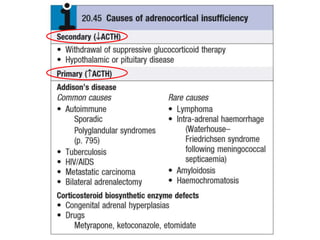
1. Primary adrenocortical
insufficiency
2. Secondary adrenocortical
insufficiency
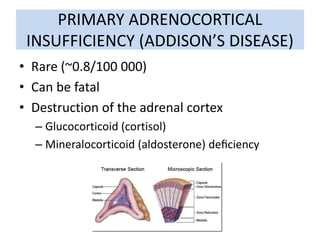
PRIMARY ADRENOCORTICAL
INSUFFICIENCY (ADDISON’S DISEASE)
• Rare (~0.8/100 000)
• Can be fatal
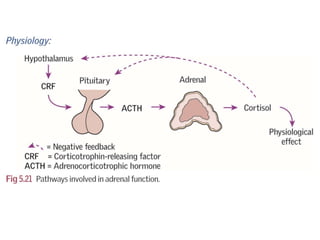
• Destruction of the adrenal cortex
– Glucocorticoid (cortisol)
– Mineralocorticoid (aldosterone) deficiency
Cont.
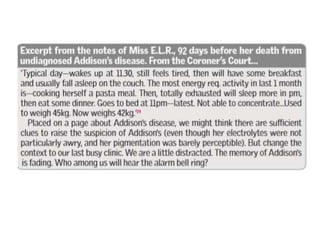
• It is ‘the unforgiving master of non-specificity
and disguise’.
• Suspected in : UNEXPLAINED FATIGUE,
HYPONATRAEMIA OR HYPOTENSION
• Misdiagnose a viral infection or anorexia
nervosa, chronic fatigue syndrome or
depression
Causes
• 80% are due to autoimmunity in the UK.
• Other causes:
– TB (commonest cause worldwide)
– Adrenal metastases (from lung, breast, renal cancer)
– Lymphoma
– Opportunistic infections in HIV (eg CMV, mycobacterium
avium)
– Adrenal haemorrhage (waterhouse–friderichsen
syndrome)
– Antiphospholipid syndrome
– SLE
– Congenital (late-onset congenital adrenal hyperplasia).
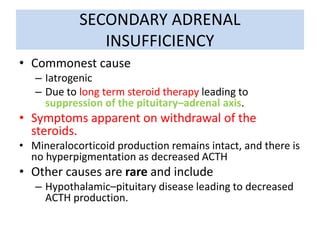
SECONDARY ADRENAL
INSUFFICIENCY
• Commonest cause
– Iatrogenic
– Due to long term steroid therapy leading to
suppression of the pituitary–adrenal axis.
• Symptoms apparent on withdrawal of the
steroids.
• Mineralocorticoid production remains intact, and there is
no hyperpigmentation as decreased ACTH
• Other causes are rare and include
– Hypothalamic–pituitary disease leading to decreased
ACTH production.
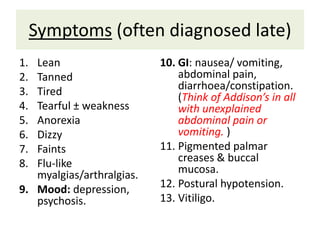
Symptoms (often diagnosed late)
1. Lean
2. Tanned
3. Tired
4. Tearful ± weakness
5. Anorexia
6. Dizzy
7. Faints
8. Flu-like
myalgias/arthralgias.
9. Mood: depression,
psychosis.
10. GI: nausea/ vomiting,
abdominal pain,
diarrhoea/constipation.
(Think of Addison’s in all
with unexplained
abdominal pain or
vomiting. )
11. Pigmented palmar
creases & buccal
mucosa.
12. Postural hypotension.
13. Vitiligo.
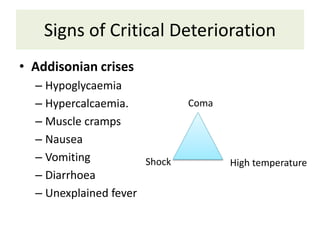
Signs of Critical Deterioration
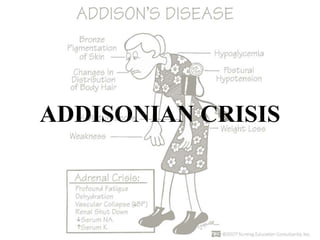
• Addisonian crises
– Hypoglycaemia
– Hypercalcaemia.
– Muscle cramps
– Nausea
– Vomiting
– Diarrhoea
– Unexplained fever
High temperatureShock
Coma
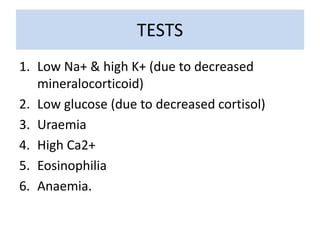
TESTS
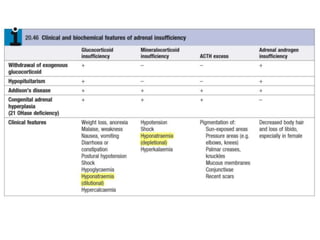
1. Low Na+ & high K+ (due to decreased
mineralocorticoid)
2. Low glucose (due to decreased cortisol)
3. Uraemia
4. High Ca2+
5. Eosinophilia
6. Anaemia.
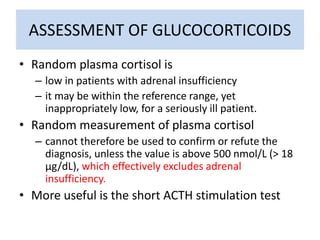
ASSESSMENT OF GLUCOCORTICOIDS
• Random plasma cortisol is
– low in patients with adrenal insufficiency
– it may be within the reference range, yet
inappropriately low, for a seriously ill patient.
• Random measurement of plasma cortisol
– cannot therefore be used to confirm or refute the
diagnosis, unless the value is above 500 nmol/L (> 18
µg/dL), which effectively excludes adrenal
insufficiency.
• More useful is the short ACTH stimulation test
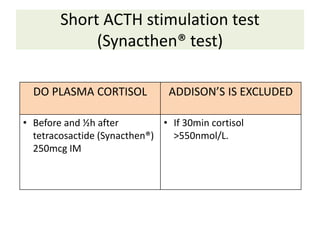
Short ACTH stimulation test
(Synacthen® test)
DO PLASMA CORTISOL ADDISON’S IS EXCLUDED
• Before and ½h after
tetracosactide (Synacthen®)
250mcg IM
• If 30min cortisol
>550nmol/L.
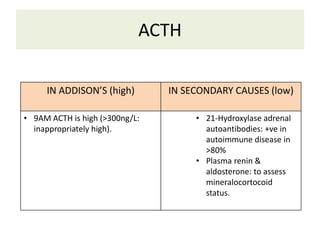
ACTH
IN ADDISON’S (high) IN SECONDARY CAUSES (low)
• 9AM ACTH is high (>300ng/L:
inappropriately high).
• 21-Hydroxylase adrenal
autoantibodies: +ve in
autoimmune disease in
>80%
• Plasma renin &
aldosterone: to assess
mineralocortocoid
status.
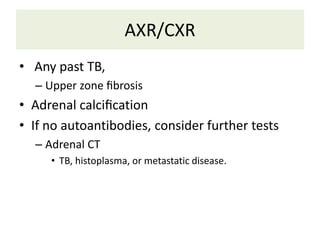
AXR/CXR
• Any past TB,
– Upper zone fibrosis
• Adrenal calcification
• If no autoantibodies, consider further tests
– Adrenal CT
• TB, histoplasma, or metastatic disease.
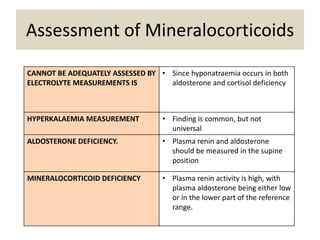
Assessment of Mineralocorticoids
CANNOT BE ADEQUATELY ASSESSED BY
ELECTROLYTE MEASUREMENTS IS
• Since hyponatraemia occurs in both
aldosterone and cortisol deficiency
HYPERKALAEMIA MEASUREMENT • Finding is common, but not
universal
ALDOSTERONE DEFICIENCY. • Plasma renin and aldosterone
should be measured in the supine
position
MINERALOCORTICOID DEFICIENCY • Plasma renin activity is high, with
plasma aldosterone being either low
or in the lower part of the reference
range.
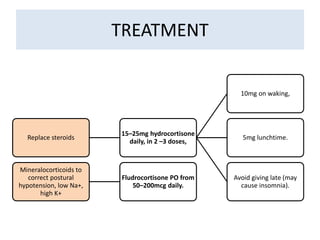
TREATMENT
Replace steroids
15–25mg hydrocortisone
daily, in 2 –3 doses,
10mg on waking,
5mg lunchtime.
Avoid giving late (may
cause insomnia).
Mineralocorticoids to
correct postural
hypotension, low Na+,
high K+
Fludrocortisone PO from
50–200mcg daily.
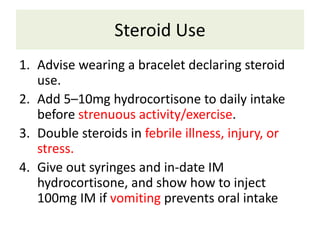
Steroid Use
1. Advise wearing a bracelet declaring steroid
use.
2. Add 5–10mg hydrocortisone to daily intake
before strenuous activity/exercise.
3. Double steroids in febrile illness, injury, or
stress.
4. Give out syringes and in-date IM
hydrocortisone, and show how to inject
100mg IM if vomiting prevents oral intake
Follow-up
• Yearly (BP, U&E)
• Watch for autoimmune diseases (pernicious
anaemia).
Prognosis
• (Treated) adrenal crises and infections do
cause excess deaths
• Mean age at death for
– Men is ~65yrs (11yrs <estimated life expectancy
– Women lose ~3yrs).
EXOGENOUS STEROID USE
• Replacement steroids are vital in those taking
long-term steroids when acutely unwell.
• Adrenal insufficiency may develop with deadly
hypovolaemic shock, if additional steroid is not
given.
• Warn against abruptly stopping steroids.
• Give steroid card.
• Emphasize that prescribing
doctors/dentists/surgeons must know of steroid
use
ADDISONIAN CRISIS
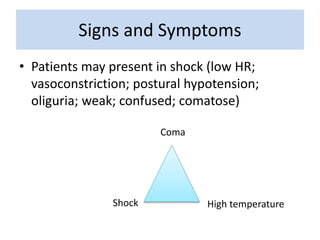
Signs and Symptoms
• Patients may present in shock (low HR;
vasoconstriction; postural hypotension;
oliguria; weak; confused; comatose)
High temperatureShock
Coma
Precipitating Factors
1. Infection, trauma, surgery, missed
medication
2. In a patient with known Addison’s
– oral steroid has not been increased to cover stress
such as pneumonia
3. Remember
– Bilateral adrenal haemorrhage (eg
meningococcaemia) hypoglycaemia.
Management
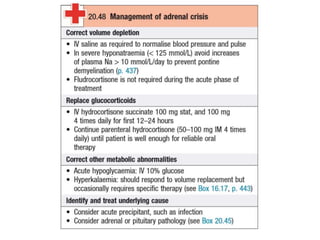
• If suspected, treat before biochemical results.
• Bloods for cortisol and ACTH (this needs to go straight to laboratory,
call ahead!)
• U&ES
– can have high K+ (check ECG and give calcium gluconate if needed)
– Low Na+ (salt depletion, should resolve with rehydration and steroids).
• Hydrocortisone 100mg IV stat.
• IV fluid bolus eg 500mL 0.9% saline to support BP, repeated as
necessary.
• Monitor blood glucose: the danger is hypoglycaemia.
• Blood, urine, sputum for culture, then antibiotics if concern about
infection
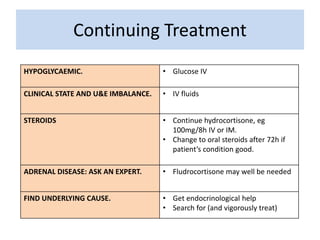
Continuing Treatment
HYPOGLYCAEMIC. • Glucose IV
CLINICAL STATE AND U&E IMBALANCE. • IV fluids
STEROIDS • Continue hydrocortisone, eg
100mg/8h IV or IM.
• Change to oral steroids after 72h if
patient’s condition good.
ADRENAL DISEASE: ASK AN EXPERT. • Fludrocortisone may well be needed
FIND UNDERLYING CAUSE. • Get endocrinological help
• Search for (and vigorously treat)
SUMMARY
• What is adrenal insufficiency
• Features/clinical findings
• Investigation
• Making diagnosis
• Treatment and follow-up
• Addisonian crisis, diagnosis,
investigation, management and follow-up
REFERENCES
• Clinical Medicine, Oxford Handbook
• Davidson, Medicine
• THANK YOU

Adrenal insufficiency

  • 1.
    ADRENAL INSUFFICIENCY NUR FARRA NAJWABINTI ABDUL AZIM 082015100035
  • 2.
    LEARNING OBJECTIVES • Whatis adrenal insufficiency • Features/clinical findings • Investigation • Making diagnosis • Treatment and follow-up • Addisonian crisis
  • 4.
    1. Primary adrenocortical insufficiency 2.Secondary adrenocortical insufficiency
  • 6.
    PRIMARY ADRENOCORTICAL INSUFFICIENCY (ADDISON’SDISEASE) • Rare (~0.8/100 000) • Can be fatal • Destruction of the adrenal cortex – Glucocorticoid (cortisol) – Mineralocorticoid (aldosterone) deficiency
  • 7.
    Cont. • It is‘the unforgiving master of non-specificity and disguise’. • Suspected in : UNEXPLAINED FATIGUE, HYPONATRAEMIA OR HYPOTENSION • Misdiagnose a viral infection or anorexia nervosa, chronic fatigue syndrome or depression
  • 8.
    Causes • 80% aredue to autoimmunity in the UK. • Other causes: – TB (commonest cause worldwide) – Adrenal metastases (from lung, breast, renal cancer) – Lymphoma – Opportunistic infections in HIV (eg CMV, mycobacterium avium) – Adrenal haemorrhage (waterhouse–friderichsen syndrome) – Antiphospholipid syndrome – SLE – Congenital (late-onset congenital adrenal hyperplasia).
  • 9.
    SECONDARY ADRENAL INSUFFICIENCY • Commonestcause – Iatrogenic – Due to long term steroid therapy leading to suppression of the pituitary–adrenal axis. • Symptoms apparent on withdrawal of the steroids. • Mineralocorticoid production remains intact, and there is no hyperpigmentation as decreased ACTH • Other causes are rare and include – Hypothalamic–pituitary disease leading to decreased ACTH production.
  • 11.
    Symptoms (often diagnosedlate) 1. Lean 2. Tanned 3. Tired 4. Tearful ± weakness 5. Anorexia 6. Dizzy 7. Faints 8. Flu-like myalgias/arthralgias. 9. Mood: depression, psychosis. 10. GI: nausea/ vomiting, abdominal pain, diarrhoea/constipation. (Think of Addison’s in all with unexplained abdominal pain or vomiting. ) 11. Pigmented palmar creases & buccal mucosa. 12. Postural hypotension. 13. Vitiligo.
  • 12.
    Signs of CriticalDeterioration • Addisonian crises – Hypoglycaemia – Hypercalcaemia. – Muscle cramps – Nausea – Vomiting – Diarrhoea – Unexplained fever High temperatureShock Coma
  • 13.
    TESTS 1. Low Na+& high K+ (due to decreased mineralocorticoid) 2. Low glucose (due to decreased cortisol) 3. Uraemia 4. High Ca2+ 5. Eosinophilia 6. Anaemia.
  • 14.
    ASSESSMENT OF GLUCOCORTICOIDS •Random plasma cortisol is – low in patients with adrenal insufficiency – it may be within the reference range, yet inappropriately low, for a seriously ill patient. • Random measurement of plasma cortisol – cannot therefore be used to confirm or refute the diagnosis, unless the value is above 500 nmol/L (> 18 µg/dL), which effectively excludes adrenal insufficiency. • More useful is the short ACTH stimulation test
  • 15.
    Short ACTH stimulationtest (Synacthen® test) DO PLASMA CORTISOL ADDISON’S IS EXCLUDED • Before and ½h after tetracosactide (Synacthen®) 250mcg IM • If 30min cortisol >550nmol/L.
  • 16.
    ACTH IN ADDISON’S (high)IN SECONDARY CAUSES (low) • 9AM ACTH is high (>300ng/L: inappropriately high). • 21-Hydroxylase adrenal autoantibodies: +ve in autoimmune disease in >80% • Plasma renin & aldosterone: to assess mineralocortocoid status.
  • 17.
    AXR/CXR • Any pastTB, – Upper zone fibrosis • Adrenal calcification • If no autoantibodies, consider further tests – Adrenal CT • TB, histoplasma, or metastatic disease.
  • 18.
    Assessment of Mineralocorticoids CANNOTBE ADEQUATELY ASSESSED BY ELECTROLYTE MEASUREMENTS IS • Since hyponatraemia occurs in both aldosterone and cortisol deficiency HYPERKALAEMIA MEASUREMENT • Finding is common, but not universal ALDOSTERONE DEFICIENCY. • Plasma renin and aldosterone should be measured in the supine position MINERALOCORTICOID DEFICIENCY • Plasma renin activity is high, with plasma aldosterone being either low or in the lower part of the reference range.
  • 19.
    TREATMENT Replace steroids 15–25mg hydrocortisone daily,in 2 –3 doses, 10mg on waking, 5mg lunchtime. Avoid giving late (may cause insomnia). Mineralocorticoids to correct postural hypotension, low Na+, high K+ Fludrocortisone PO from 50–200mcg daily.
  • 20.
    Steroid Use 1. Advisewearing a bracelet declaring steroid use. 2. Add 5–10mg hydrocortisone to daily intake before strenuous activity/exercise. 3. Double steroids in febrile illness, injury, or stress. 4. Give out syringes and in-date IM hydrocortisone, and show how to inject 100mg IM if vomiting prevents oral intake
  • 21.
    Follow-up • Yearly (BP,U&E) • Watch for autoimmune diseases (pernicious anaemia).
  • 22.
    Prognosis • (Treated) adrenalcrises and infections do cause excess deaths • Mean age at death for – Men is ~65yrs (11yrs <estimated life expectancy – Women lose ~3yrs).
  • 23.
    EXOGENOUS STEROID USE •Replacement steroids are vital in those taking long-term steroids when acutely unwell. • Adrenal insufficiency may develop with deadly hypovolaemic shock, if additional steroid is not given. • Warn against abruptly stopping steroids. • Give steroid card. • Emphasize that prescribing doctors/dentists/surgeons must know of steroid use
  • 25.
  • 26.
    Signs and Symptoms •Patients may present in shock (low HR; vasoconstriction; postural hypotension; oliguria; weak; confused; comatose) High temperatureShock Coma
  • 27.
    Precipitating Factors 1. Infection,trauma, surgery, missed medication 2. In a patient with known Addison’s – oral steroid has not been increased to cover stress such as pneumonia 3. Remember – Bilateral adrenal haemorrhage (eg meningococcaemia) hypoglycaemia.
  • 28.
    Management • If suspected,treat before biochemical results. • Bloods for cortisol and ACTH (this needs to go straight to laboratory, call ahead!) • U&ES – can have high K+ (check ECG and give calcium gluconate if needed) – Low Na+ (salt depletion, should resolve with rehydration and steroids). • Hydrocortisone 100mg IV stat. • IV fluid bolus eg 500mL 0.9% saline to support BP, repeated as necessary. • Monitor blood glucose: the danger is hypoglycaemia. • Blood, urine, sputum for culture, then antibiotics if concern about infection
  • 30.
    Continuing Treatment HYPOGLYCAEMIC. •Glucose IV CLINICAL STATE AND U&E IMBALANCE. • IV fluids STEROIDS • Continue hydrocortisone, eg 100mg/8h IV or IM. • Change to oral steroids after 72h if patient’s condition good. ADRENAL DISEASE: ASK AN EXPERT. • Fludrocortisone may well be needed FIND UNDERLYING CAUSE. • Get endocrinological help • Search for (and vigorously treat)
  • 32.
    SUMMARY • What isadrenal insufficiency • Features/clinical findings • Investigation • Making diagnosis • Treatment and follow-up • Addisonian crisis, diagnosis, investigation, management and follow-up
  • 33.
    REFERENCES • Clinical Medicine,Oxford Handbook • Davidson, Medicine
  • 34.