HYPERTENSION
HYPERTENSION
Hypertension
A World Wide Epidemic
Nearly 1 billion hypertensive in the world
Hypertension is poorly controlled, with less than 25%
controlled in developed countries and less than 10% in
developing countries.
Hypertension which is responsible for 3 million death
annually.
May 14th is World Hypertension Day
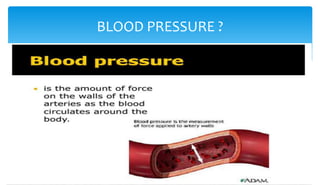
BLOOD PRESSURE ?
Factors Influencing
Blood Pressure (BP)
Cardiac output is total blood flow through systemic or pulmonary
circulation per min. CO =stroke volume (amt pumped out of
L ventricle per beat [70 ml]) times the HR for 1 min.
SVR + force opposing movement of blood in vessels;
determined primarily by radius of small arteries & arterioles
Blood
Pressure
Cardiac
Output
Systemic
Vascular
Resistance
= x
Copyright © 2007, 2004, 2000, Mosby, Inc., an affiliate of Elsevier Inc. All Rights Reserved.
Normal regulation of blood pressure
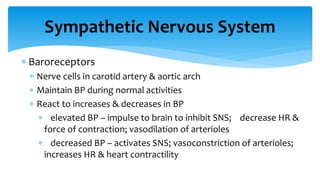
Sympathetic Nervous System
 Baroreceptors
 Nerve cells in carotid artery & aortic arch
 Maintain BP during normal activities
 React to increases & decreases in BP
 elevated BP – impulse to brain to inhibit SNS; decrease HR &
force of contraction; vasodilation of arterioles
 decreased BP – activates SNS; vasoconstriction of arterioles;
increases HR & heart contractility
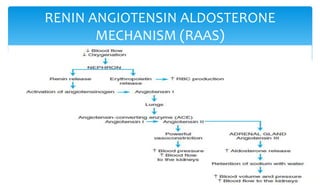
RENIN ANGIOTENSIN ALDOSTERONE
MECHANISM (RAAS)
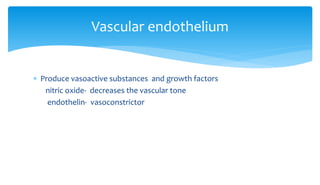
 Produce vasoactive substances and growth factors
nitric oxide- decreases the vascular tone
endothelin- vasoconstrictor
Vascular endothelium
 Hypertension is a persistent systolic blood pressure
greater than 140 mm Hg and a diastolic pressure greater
than 90 mm Hg or current use of antihypertensive
medication
 (Seventh Report of the Joint National Committee on Prevention,
Detection, Evaluation, and Treatment of High Blood Pressure [JNC
VI]
DEFINITION
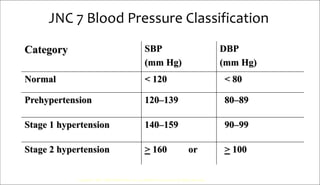
JNC 7 Blood Pressure Classification
Category SBP
(mm Hg)
DBP
(mm Hg)
Normal < 120 < 80
Prehypertension 120–139 80–89
Stage 1 hypertension 140–159 90–99
Stage 2 hypertension > 160 or > 100
Copyright © 2007, 2004, 2000, Mosby, Inc., an affiliate of Elsevier Inc. All Rights Reserved.
Systolic blood pressure tends to rise and diastolic to fall.
When the average systolic blood pressure is 140 mm Hg
and diastolic blood pressure is <90 mm Hg, the patient is
classified as isolated systolic hypertensive.
COMMON IN OLDER ADULTS
Isolated Systolic Hypertension
 More commonly seen in some younger adults, the average systolic
pressure remains <140 mm Hg but the diastolic is 90 mm Hg. Although
diastolic pressure is generally thought to be the best predictor of risk
in patients younger than age 50 years
 Common in younger adults
Isolated Diastolic Hypertension
 Accelerated hypertension is defined as a recent significant increase
over baseline BP that is associated with target organ damage
Accelerated hypertension/malignant
hypertension
 Blood pressure may only be elevated persistently in the presence of a
health care worker, particularly a physician. When measured elsewhere,
including while at work, the blood pressure is not elevated. it is
referred to as white coat hypertension or isolated office hypertension
 The commonly used definition is a persistently elevated average office
blood pressure of >140/90 mm Hg and an average awake ambulatory
reading of <135/85 mm Hg.
White coat hypertension
 In some elderly patients the peripheral muscular arteries
become very rigid from advanced, and sometimes calcified,
arteriosclerosis. Consequently, the cuff has to be at a higher
pressure to compress them, so that a falsely high blood
pressure is recorded.
 It is difficult to detect clinically, so these patients may be
overdosed with antihypertensive medications resulting in
orthostatic hypotension and other side effects
Pseudohypertension
 Primary hypertension (essential or idiopathic) - 90% to 95% of allcases
 Secondary hypertension - 5-10%
Classification by Cause
Etiology of Hypertension
 Primary (essential or idiopathic) hypertension
 Contributing factors
↑ SNS activity
↑ Sodium retaining, hormones and vasoconstrictors
Diabetes mellitus
> Ideal body weight
↑ Sodium intake
Excessive alcohol intake
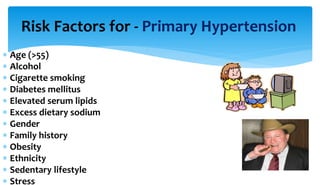
Risk Factors for - Primary Hypertension
 Age (>55)
 Alcohol
 Cigarette smoking
 Diabetes mellitus
 Elevated serum lipids
 Excess dietary sodium
 Gender
 Family history
 Obesity
 Ethnicity
 Sedentary lifestyle
 Stress
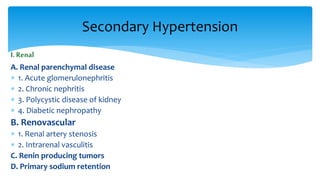
I. Renal
A. Renal parenchymal disease
 1. Acute glomerulonephritis
 2. Chronic nephritis
 3. Polycystic disease of kidney
 4. Diabetic nephropathy
B. Renovascular
 1. Renal artery stenosis
 2. Intrarenal vasculitis
C. Renin producing tumors
D. Primary sodium retention
Secondary Hypertension
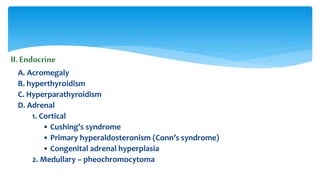
II.Endocrine
A. Acromegaly
B. hyperthyroidism
C. Hyperparathyroidism
D. Adrenal
1. Cortical
• Cushing’s syndrome
• Primary hyperaldosteronism (Conn’s syndrome)
• Congenital adrenal hyperplasia
2. Medullary – pheochromocytoma
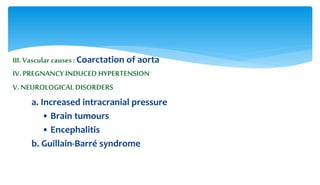
III. Vascular causes : Coarctation of aorta
IV. PREGNANCY INDUCED HYPERTENSION
V. NEUROLOGICAL DISORDERS
a. Increased intracranial pressure
• Brain tumours
• Encephalitis
b. Guillain-Barré syndrome
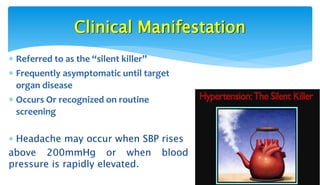
Clinical Manifestation
 Referred to as the “silent killer”
 Frequently asymptomatic until target
organ disease
 Occurs Or recognized on routine
screening
 Headache may occur when SBP rises
above 200mmHg or when blood
pressure is rapidly elevated.
Symptoms secondary to the effects on blood vessels in the various
organs and tissues or increased workload of the heart
Fatigue
Dizziness
Palpitations
Nosebleeds
Angina
Dyspnea etc..
Clinical Manifestation
Hypertension
Complications
Target organ diseases occur most frequently in:
 Heart
 Brain
 Peripheral vasculature
 Kidney
 Eyes
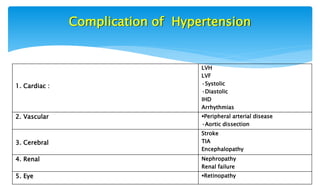
Complication of Hypertension
1. Cardiac :
LVH
LVF
•Systolic
•Diastolic
IHD
Arrhythmias
2. Vascular Peripheral arterial disease
•Aortic dissection
3. Cerebral
Stroke
TIA
Encephalopathy
4. Renal Nephropathy
Renal failure
5. Eye Retinopathy
Hypertension
Complications
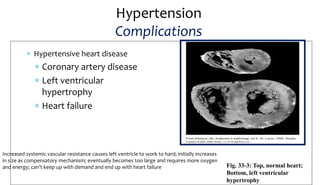
 Hypertensive heart disease
 Coronary artery disease
 Left ventricular
hypertrophy
 Heart failure
Fig. 33-3: Top, normal heart;
Bottom, left ventricular
hypertrophy
Increased systemic vascular resistance causes left ventricle to work to hard; initially increases
in size as compensatory mechanism; eventually becomes too large and requires more oxygen
and energy; can’t keep up with demand and end up with heart failure
Hypertension
Diagnostic Studies
 History and physical examination
 BP measurement in both arms
 Use arm with higher reading for subsequent
measurements
 BP highest in early morning, lowest at night
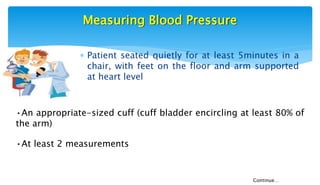
Measuring Blood Pressure
 Patient seated quietly for at least 5minutes in a
chair, with feet on the floor and arm supported
at heart level
•An appropriate-sized cuff (cuff bladder encircling at least 80% of
the arm)
•At least 2 measurements
Continue…
Hypertension
Diagnostic Studies
 Urinalysis, creatinine clearance
 Serum electrolytes, glucose
 BUN and serum creatinine
 Serum lipid profile
 ECG
 Echocardiogram
MANAGEMENT
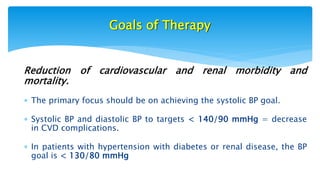
Goals of Therapy
Reduction of cardiovascular and renal morbidity and
mortality.
 The primary focus should be on achieving the systolic BP goal.
 Systolic BP and diastolic BP to targets < 140/90 mmHg = decrease
in CVD complications.
 In patients with hypertension with diabetes or renal disease, the BP
goal is < 130/80 mmHg
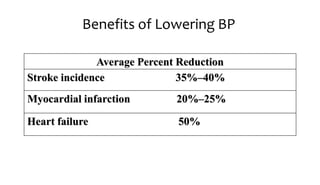
Benefits of Lowering BP
Average Percent Reduction
Stroke incidence 35%–40%
Myocardial infarction 20%–25%
Heart failure 50%
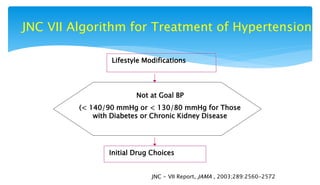
JNC VII Algorithm for Treatment of Hypertension
JNC - VII Report, JAMA , 2003;289:2560-2572
Lifestyle Modifications
Not at Goal BP
(< 140/90 mmHg or < 130/80 mmHg for Those
with Diabetes or Chronic Kidney Disease
Initial Drug Choices
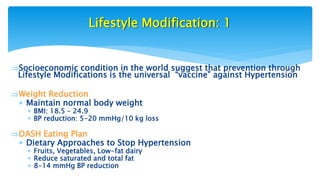
Lifestyle Modification: 1
Socioeconomic condition in the world suggest that prevention through
Lifestyle Modifications is the universal “vaccine” against Hypertension
Weight Reduction
 Maintain normal body weight
 BMI: 18.5 – 24.9
 BP reduction: 5-20 mmHg/10 kg loss
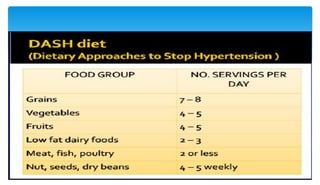
DASH Eating Plan
 Dietary Approaches to Stop Hypertension
 Fruits, Vegetables, Low-fat dairy
 Reduce saturated and total fat
 8-14 mmHg BP reduction
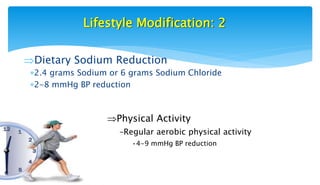
Lifestyle Modification: 2
Dietary Sodium Reduction
2.4 grams Sodium or 6 grams Sodium Chloride
2-8 mmHg BP reduction
Physical Activity
–Regular aerobic physical activity
•4-9 mmHg BP reduction
Lifestyle Modification: 3
Smoking Cessation
Any independent chronic effect of smoking on BP is small
Smoking cessation does not decrease BP
BUT total cardiovascular risk is increased by smoking.
Therefore hypertensives who smoke should be
counselled on smoking cessation
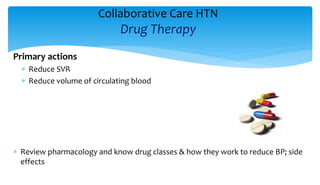
Collaborative Care HTN
Drug Therapy
Primary actions
 Reduce SVR
 Reduce volume of circulating blood
 Review pharmacology and know drug classes & how they work to reduce BP; side
effects
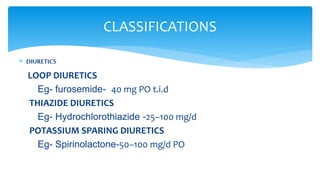
CLASSIFICATIONS
 DIURETICS
LOOP DIURETICS
Eg- furosemide- 40 mg PO t.i.d
THIAZIDE DIURETICS
Eg- Hydrochlorothiazide -25–100 mg/d
POTASSIUM SPARING DIURETICS
Eg- Spirinolactone-50–100 mg/d PO
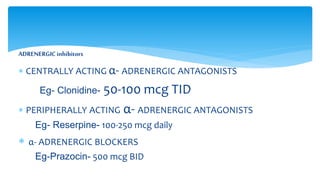
ADRENERGICinhibitors
 CENTRALLY ACTING α- ADRENERGIC ANTAGONISTS
Eg- Clonidine- 50-100 mcg TID
 PERIPHERALLY ACTING α- ADRENERGIC ANTAGONISTS
Eg- Reserpine- 100-250 mcg daily
 α- ADRENERGIC BLOCKERS
Eg-Prazocin- 500 mcg BID
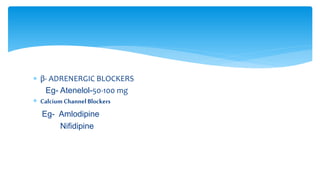
 β- ADRENERGIC BLOCKERS
Eg- Atenelol-50-100 mg
 Calcium ChannelBlockers
Eg- Amlodipine
Nifidipine
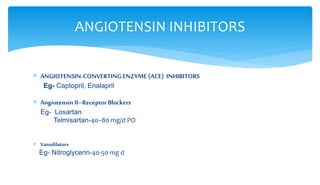
ANGIOTENSIN INHIBITORS
 ANGIOTENSIN-CONVERTINGENZYME(ACE) INHIBITORS
Eg- Captopril, Enalapril
 Angiotensin II–Receptor Blockers
Eg- Losartan
Telmisartan-40–80 mg/d PO
 Vasodilators
Eg- Nitroglycerin-40-50 mg d
 DIRECT VASODILATORS
Eg- Nitroglycerin
Sodium nitroprusside-40-50 mg d
NURSING MANAGEMENT
Collaborative Care
Nursing Management
Assessment
 Subjective data
Past health history
Medications
Functional health patterns
 Objective data
Target organ damage
Collaborative Care
Nursing Management
Nursing Diagnoses
 Ineffective health maintenance R/T lack of knowledge of
pathology,complication and management
 Anxiety r/t complexity of mgmnt regimen, lifestyle changes
 Ineffective therapeutic regimen management r/t lack of
knwldge, unpleasent side effects, returns of bp to normal
while on medication, inconvenient schedule
Hypertensive Crisis
 Severe, abrupt increase in DBP
 Defined as >140 mm Hg
 Rate of increase in BP more important than absolute value
 Often occurs in patients with Hx of HTN who failed to comply with
medications or who have been undermedicated
 Monitor MAP mean arterial pressure: MAP = (SBP + 2DBP)
3

Hypertension

  • 1.
  • 2.
    Hypertension A World WideEpidemic Nearly 1 billion hypertensive in the world Hypertension is poorly controlled, with less than 25% controlled in developed countries and less than 10% in developing countries. Hypertension which is responsible for 3 million death annually. May 14th is World Hypertension Day
  • 3.
  • 4.
    Factors Influencing Blood Pressure(BP) Cardiac output is total blood flow through systemic or pulmonary circulation per min. CO =stroke volume (amt pumped out of L ventricle per beat [70 ml]) times the HR for 1 min. SVR + force opposing movement of blood in vessels; determined primarily by radius of small arteries & arterioles Blood Pressure Cardiac Output Systemic Vascular Resistance = x Copyright © 2007, 2004, 2000, Mosby, Inc., an affiliate of Elsevier Inc. All Rights Reserved.
  • 5.
    Normal regulation ofblood pressure
  • 6.
    Sympathetic Nervous System Baroreceptors  Nerve cells in carotid artery & aortic arch  Maintain BP during normal activities  React to increases & decreases in BP  elevated BP – impulse to brain to inhibit SNS; decrease HR & force of contraction; vasodilation of arterioles  decreased BP – activates SNS; vasoconstriction of arterioles; increases HR & heart contractility
  • 7.
  • 8.
     Produce vasoactivesubstances and growth factors nitric oxide- decreases the vascular tone endothelin- vasoconstrictor Vascular endothelium
  • 9.
     Hypertension isa persistent systolic blood pressure greater than 140 mm Hg and a diastolic pressure greater than 90 mm Hg or current use of antihypertensive medication  (Seventh Report of the Joint National Committee on Prevention, Detection, Evaluation, and Treatment of High Blood Pressure [JNC VI] DEFINITION
  • 10.
    JNC 7 BloodPressure Classification Category SBP (mm Hg) DBP (mm Hg) Normal < 120 < 80 Prehypertension 120–139 80–89 Stage 1 hypertension 140–159 90–99 Stage 2 hypertension > 160 or > 100 Copyright © 2007, 2004, 2000, Mosby, Inc., an affiliate of Elsevier Inc. All Rights Reserved.
  • 11.
    Systolic blood pressuretends to rise and diastolic to fall. When the average systolic blood pressure is 140 mm Hg and diastolic blood pressure is <90 mm Hg, the patient is classified as isolated systolic hypertensive. COMMON IN OLDER ADULTS Isolated Systolic Hypertension
  • 12.
     More commonlyseen in some younger adults, the average systolic pressure remains <140 mm Hg but the diastolic is 90 mm Hg. Although diastolic pressure is generally thought to be the best predictor of risk in patients younger than age 50 years  Common in younger adults Isolated Diastolic Hypertension
  • 13.
     Accelerated hypertensionis defined as a recent significant increase over baseline BP that is associated with target organ damage Accelerated hypertension/malignant hypertension
  • 14.
     Blood pressuremay only be elevated persistently in the presence of a health care worker, particularly a physician. When measured elsewhere, including while at work, the blood pressure is not elevated. it is referred to as white coat hypertension or isolated office hypertension  The commonly used definition is a persistently elevated average office blood pressure of >140/90 mm Hg and an average awake ambulatory reading of <135/85 mm Hg. White coat hypertension
  • 15.
     In someelderly patients the peripheral muscular arteries become very rigid from advanced, and sometimes calcified, arteriosclerosis. Consequently, the cuff has to be at a higher pressure to compress them, so that a falsely high blood pressure is recorded.  It is difficult to detect clinically, so these patients may be overdosed with antihypertensive medications resulting in orthostatic hypotension and other side effects Pseudohypertension
  • 16.
     Primary hypertension(essential or idiopathic) - 90% to 95% of allcases  Secondary hypertension - 5-10% Classification by Cause
  • 17.
    Etiology of Hypertension Primary (essential or idiopathic) hypertension  Contributing factors ↑ SNS activity ↑ Sodium retaining, hormones and vasoconstrictors Diabetes mellitus > Ideal body weight ↑ Sodium intake Excessive alcohol intake
  • 18.
    Risk Factors for- Primary Hypertension  Age (>55)  Alcohol  Cigarette smoking  Diabetes mellitus  Elevated serum lipids  Excess dietary sodium  Gender  Family history  Obesity  Ethnicity  Sedentary lifestyle  Stress
  • 19.
    I. Renal A. Renalparenchymal disease  1. Acute glomerulonephritis  2. Chronic nephritis  3. Polycystic disease of kidney  4. Diabetic nephropathy B. Renovascular  1. Renal artery stenosis  2. Intrarenal vasculitis C. Renin producing tumors D. Primary sodium retention Secondary Hypertension
  • 20.
    II.Endocrine A. Acromegaly B. hyperthyroidism C.Hyperparathyroidism D. Adrenal 1. Cortical • Cushing’s syndrome • Primary hyperaldosteronism (Conn’s syndrome) • Congenital adrenal hyperplasia 2. Medullary – pheochromocytoma
  • 21.
    III. Vascular causes: Coarctation of aorta IV. PREGNANCY INDUCED HYPERTENSION V. NEUROLOGICAL DISORDERS a. Increased intracranial pressure • Brain tumours • Encephalitis b. Guillain-Barré syndrome
  • 22.
    Clinical Manifestation  Referredto as the “silent killer”  Frequently asymptomatic until target organ disease  Occurs Or recognized on routine screening  Headache may occur when SBP rises above 200mmHg or when blood pressure is rapidly elevated.
  • 23.
    Symptoms secondary tothe effects on blood vessels in the various organs and tissues or increased workload of the heart Fatigue Dizziness Palpitations Nosebleeds Angina Dyspnea etc.. Clinical Manifestation
  • 24.
    Hypertension Complications Target organ diseasesoccur most frequently in:  Heart  Brain  Peripheral vasculature  Kidney  Eyes
  • 25.
    Complication of Hypertension 1.Cardiac : LVH LVF •Systolic •Diastolic IHD Arrhythmias 2. Vascular Peripheral arterial disease •Aortic dissection 3. Cerebral Stroke TIA Encephalopathy 4. Renal Nephropathy Renal failure 5. Eye Retinopathy
  • 26.
    Hypertension Complications  Hypertensive heartdisease  Coronary artery disease  Left ventricular hypertrophy  Heart failure Fig. 33-3: Top, normal heart; Bottom, left ventricular hypertrophy Increased systemic vascular resistance causes left ventricle to work to hard; initially increases in size as compensatory mechanism; eventually becomes too large and requires more oxygen and energy; can’t keep up with demand and end up with heart failure
  • 27.
    Hypertension Diagnostic Studies  Historyand physical examination  BP measurement in both arms  Use arm with higher reading for subsequent measurements  BP highest in early morning, lowest at night
  • 28.
    Measuring Blood Pressure Patient seated quietly for at least 5minutes in a chair, with feet on the floor and arm supported at heart level •An appropriate-sized cuff (cuff bladder encircling at least 80% of the arm) •At least 2 measurements Continue…
  • 29.
    Hypertension Diagnostic Studies  Urinalysis,creatinine clearance  Serum electrolytes, glucose  BUN and serum creatinine  Serum lipid profile  ECG  Echocardiogram
  • 30.
  • 31.
    Goals of Therapy Reductionof cardiovascular and renal morbidity and mortality.  The primary focus should be on achieving the systolic BP goal.  Systolic BP and diastolic BP to targets < 140/90 mmHg = decrease in CVD complications.  In patients with hypertension with diabetes or renal disease, the BP goal is < 130/80 mmHg
  • 32.
    Benefits of LoweringBP Average Percent Reduction Stroke incidence 35%–40% Myocardial infarction 20%–25% Heart failure 50%
  • 33.
    JNC VII Algorithmfor Treatment of Hypertension JNC - VII Report, JAMA , 2003;289:2560-2572 Lifestyle Modifications Not at Goal BP (< 140/90 mmHg or < 130/80 mmHg for Those with Diabetes or Chronic Kidney Disease Initial Drug Choices
  • 34.
    Lifestyle Modification: 1 Socioeconomiccondition in the world suggest that prevention through Lifestyle Modifications is the universal “vaccine” against Hypertension Weight Reduction  Maintain normal body weight  BMI: 18.5 – 24.9  BP reduction: 5-20 mmHg/10 kg loss DASH Eating Plan  Dietary Approaches to Stop Hypertension  Fruits, Vegetables, Low-fat dairy  Reduce saturated and total fat  8-14 mmHg BP reduction
  • 36.
    Lifestyle Modification: 2 DietarySodium Reduction 2.4 grams Sodium or 6 grams Sodium Chloride 2-8 mmHg BP reduction Physical Activity –Regular aerobic physical activity •4-9 mmHg BP reduction
  • 37.
    Lifestyle Modification: 3 SmokingCessation Any independent chronic effect of smoking on BP is small Smoking cessation does not decrease BP BUT total cardiovascular risk is increased by smoking. Therefore hypertensives who smoke should be counselled on smoking cessation
  • 38.
    Collaborative Care HTN DrugTherapy Primary actions  Reduce SVR  Reduce volume of circulating blood  Review pharmacology and know drug classes & how they work to reduce BP; side effects
  • 39.
    CLASSIFICATIONS  DIURETICS LOOP DIURETICS Eg-furosemide- 40 mg PO t.i.d THIAZIDE DIURETICS Eg- Hydrochlorothiazide -25–100 mg/d POTASSIUM SPARING DIURETICS Eg- Spirinolactone-50–100 mg/d PO
  • 40.
    ADRENERGICinhibitors  CENTRALLY ACTINGα- ADRENERGIC ANTAGONISTS Eg- Clonidine- 50-100 mcg TID  PERIPHERALLY ACTING α- ADRENERGIC ANTAGONISTS Eg- Reserpine- 100-250 mcg daily  α- ADRENERGIC BLOCKERS Eg-Prazocin- 500 mcg BID
  • 41.
     β- ADRENERGICBLOCKERS Eg- Atenelol-50-100 mg  Calcium ChannelBlockers Eg- Amlodipine Nifidipine
  • 42.
    ANGIOTENSIN INHIBITORS  ANGIOTENSIN-CONVERTINGENZYME(ACE)INHIBITORS Eg- Captopril, Enalapril  Angiotensin II–Receptor Blockers Eg- Losartan Telmisartan-40–80 mg/d PO  Vasodilators Eg- Nitroglycerin-40-50 mg d
  • 43.
     DIRECT VASODILATORS Eg-Nitroglycerin Sodium nitroprusside-40-50 mg d
  • 44.
  • 45.
    Collaborative Care Nursing Management Assessment Subjective data Past health history Medications Functional health patterns  Objective data Target organ damage
  • 46.
    Collaborative Care Nursing Management NursingDiagnoses  Ineffective health maintenance R/T lack of knowledge of pathology,complication and management  Anxiety r/t complexity of mgmnt regimen, lifestyle changes  Ineffective therapeutic regimen management r/t lack of knwldge, unpleasent side effects, returns of bp to normal while on medication, inconvenient schedule
  • 47.
    Hypertensive Crisis  Severe,abrupt increase in DBP  Defined as >140 mm Hg  Rate of increase in BP more important than absolute value  Often occurs in patients with Hx of HTN who failed to comply with medications or who have been undermedicated  Monitor MAP mean arterial pressure: MAP = (SBP + 2DBP) 3