Hypertension
Definition
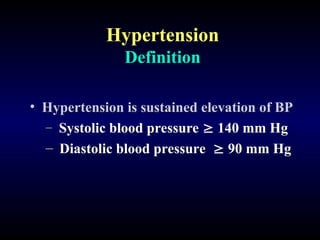
• Hypertension issustained elevation of BP
Hypertension is sustained elevation of BP
– Systolic blood pressure 140 mm Hg
– Diastolic blood pressure 90 mm Hg
5.
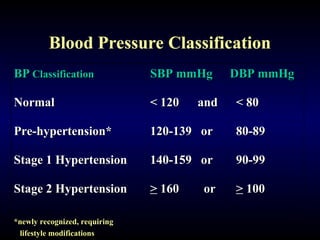
Blood Pressure Classification
BP
BPClassification
Classification SBP mmHg
SBP mmHg DBP mmHg
DBP mmHg
Normal
Normal < 120 and
< 120 and < 80
< 80
Pre-hypertension*
Pre-hypertension* 120-139 or
120-139 or 80-89
80-89
Stage 1 Hypertension
Stage 1 Hypertension 140-159 or
140-159 or 90-99
90-99
Stage 2 Hypertension
Stage 2 Hypertension >
> 160 or
160 or >
> 100
100
*newly recognized, requiring
*newly recognized, requiring
lifestyle modifications
lifestyle modifications
6.
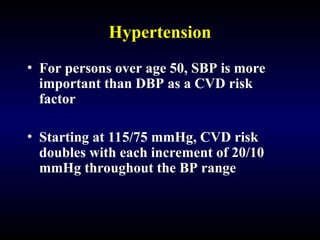
Hypertension
• For personsover age 50, SBP is more
important than DBP as a CVD risk
factor
• Starting at 115/75 mmHg, CVD risk
doubles with each increment of 20/10
mmHg throughout the BP range
7.
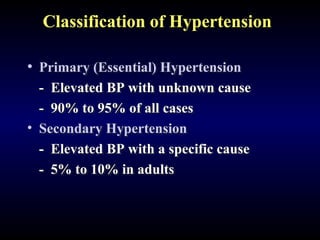
Classification of Hypertension
•Primary (Essential) Hypertension
Primary (Essential) Hypertension
-
- Elevated BP with unknown cause
Elevated BP with unknown cause
- 90% to 95% of all cases
- 90% to 95% of all cases
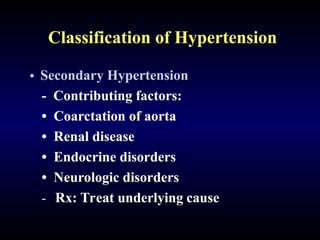
• Secondary Hypertension
Secondary Hypertension
- Elevated BP with a specific cause
- Elevated BP with a specific cause
- 5% to 10% in adults
- 5% to 10% in adults
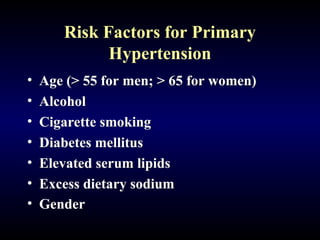
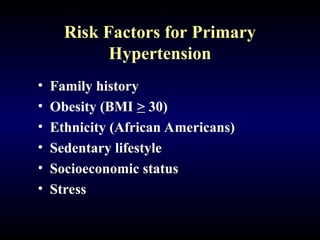
Risk Factors forPrimary
Hypertension
• Family history
• Obesity (BMI > 30)
• Ethnicity (African Americans)
• Sedentary lifestyle
• Socioeconomic status
• Stress
12.
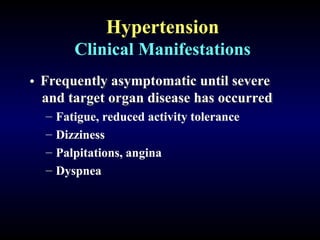
Hypertension
Clinical Manifestations
• Frequentlyasymptomatic until severe
Frequently asymptomatic until severe
and target organ disease has occurred
and target organ disease has occurred
– Fatigue, reduced activity tolerance
– Dizziness
– Palpitations, angina
– Dyspnea
Hypertension
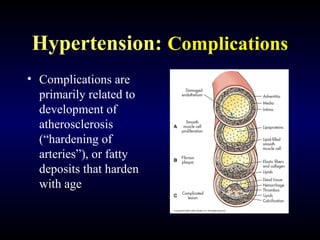
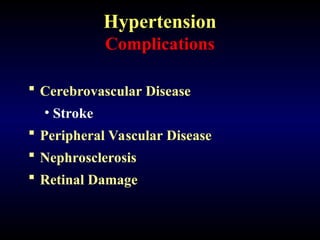
Complications
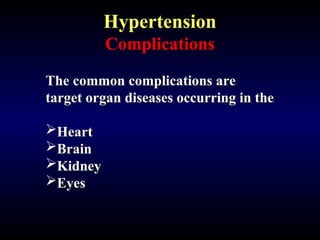
The common complicationsare
The common complications are
target organ diseases occurring in the
target organ diseases occurring in the
Heart
Heart
Brain
Brain
Kidney
Kidney
Eyes
Eyes
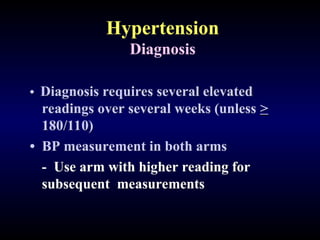
Hypertension
Diagnosis
• Diagnosis requiresseveral elevated
readings over several weeks (unless >
180/110)
• BP measurement in both arms
- Use arm with higher reading for
subsequent measurements
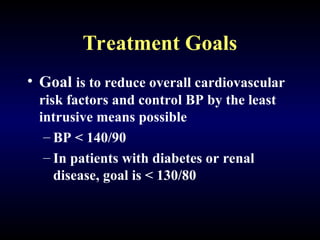
Treatment Goals
• Goalis to reduce overall cardiovascular
risk factors and control BP by the least
intrusive means possible
– BP < 140/90
– In patients with diabetes or renal
disease, goal is < 130/80
22.
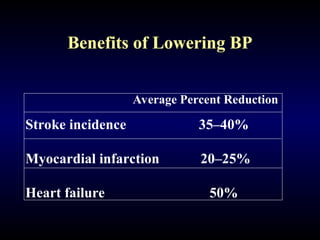
Benefits of LoweringBP
Average Percent Reduction
Stroke incidence 35–40%
Myocardial infarction 20–25%
Heart failure 50%
23.
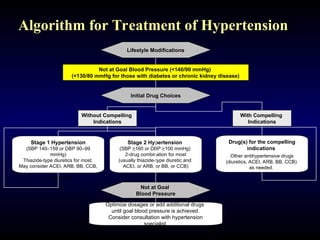
Algorithm for Treatmentof Hypertension
Not at Goal Blood Pressure (<140/90 mmHg)
(<130/80 mmHg for those with diabetes or chronic kidney disease)
Initial Drug Choices
Drug(s) for the compelling
indications
Other antihypertensive drugs
(diuretics, ACEI, ARB, BB, CCB)
as needed.
With Compelling
Indications
Lifestyle Modifications
Stage 2 Hypertension
(SBP >160 or DBP >100 mmHg)
2-drug combination for most
(usually thiazide-type diuretic and
ACEI, or ARB, or BB, or CCB)
Stage 1 Hypertension
(SBP 140–159 or DBP 90–99
mmHg)
Thiazide-type diuretics for most.
May consider ACEI, ARB, BB, CCB,
or combination.
Without Compelling
Indications
Not at Goal
Blood Pressure
Optimize dosages or add additional drugs
until goal blood pressure is achieved.
Consider consultation with hypertension
specialist.
24.
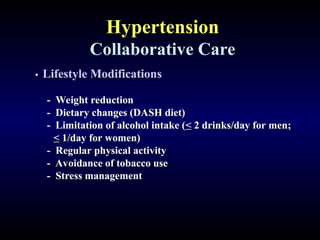
Hypertension
Collaborative Care
• LifestyleModifications
- Weight reduction
- Dietary changes (DASH diet)
- Limitation of alcohol intake (< 2 drinks/day for men;
< 1/day for women)
- Regular physical activity
- Avoidance of tobacco use
- Stress management
25.
Hypertension
Collaborative Care
• NutritionalTherapy: DASH Diet =
Dietary Approahes to Stop HTN
- Sodium restriction
- Rich in vegetables, fruit, and nonfat
dairy products
- Calorie restriction if overweight
Hypertension: Drug Therapy
•Thiazide-type Diuretics
– Inhibit NaCl reabsorption
– Side effects:
• Electrolyte imbalances: ↓ Na, ↓ Cl, ↓ K** (advise K
rich foods)
• Fluid volume depletion (monitor for orthostatic
hypotension)
• Impotence, decreased libido
29.
Hypertension: Drug Therapy
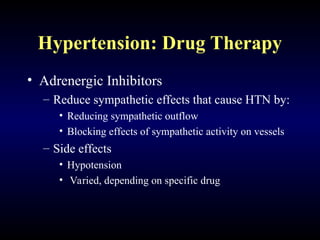
•Adrenergic Inhibitors
– Reduce sympathetic effects that cause HTN by:
• Reducing sympathetic outflow
• Blocking effects of sympathetic activity on vessels
– Side effects
• Hypotension
• Varied, depending on specific drug
Hypertension: Drug Therapy
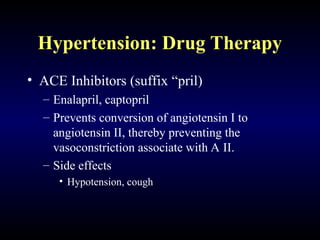
•ACE Inhibitors (suffix “pril)
– Enalapril, captopril
– Prevents conversion of angiotensin I to
angiotensin II, thereby preventing the
vasoconstriction associate with A II.
– Side effects
• Hypotension, cough
32.
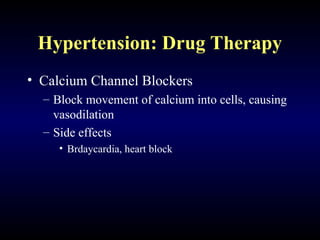
Hypertension: Drug Therapy
•Calcium Channel Blockers
– Block movement of calcium into cells, causing
vasodilation
– Side effects
• Brdaycardia, heart block
33.
Hypertension
Collaborative Care
• DrugTherapy and Patient Teaching
- Identify, report, and minimize side effects
• Orthostatic hypotension
• Sexual dysfunction
• Dry mouth
• Frequent urination
34.
Primary Hypertension
Nursing Management
NursingDiagnoses
- Ineffective health maintenance
- Anxiety
- Sexual dysfunction
- Ineffective therapeutic regimen
management r/t
- lack of S/S of HTN, side effects of Rx, cost of
Rx, etc.
Hypertensive Crisis
• Severe,abrupt elevation in BP
• The rate of in BP is more important than
the absolute value
• Most common in patients with a history of
HTN who have failed to comply with
medications or who have been under-
medicated
Hypertensive Crisis
Nursing andCollaborative
Management
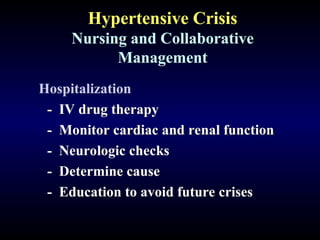
Hospitalization
- IV drug therapy
- Monitor cardiac and renal function
- Neurologic checks
- Determine cause
- Education to avoid future crises