MYXEDEMA
COMA
By PINKY RATHEE
M.Sc. NURSING
 Myxedema coma is a rare life-threatening
condition.It is the decompensated state
of severe hypothyroidism in whichthe
patient is hypothermic and
unconscious.The condition occurs most
often among elderly women in the winter
months and appears to be precipitated
by cold.
Myxedema Coma
 Myxedema coma, occasionally called myxedema
crisis, is a rare life- threatening clinical condition
that represents severe hypothyroidism with
physiological decompensation. The condition
usually occurs in patients with long-standing,
undiagnosed hypothyroidism and is usually
precipitated by infection, cerebrovascular disease,
heart failure, trauma, or drug therapy.
Myxedema Coma
 Myxedema is also used to describe the
dermatologic changes that occur in
hypothyroidism which refers to
deposition of mucopolysaccharides in
the dermis, which results in swelling of
the affected area.
Myxedema Coma
It is deficiency of thyroid hormone resulting in-
 slowed body metabolism,
 decreased heat production,
 decreased oxygen consumption by tissues.
HYPOTHYROIDISM
 Chronic autoimmune thyroiditis,
 Thyroidectomy
 Underwent radioactive iodine therapy for
hyperthyroidism,
 Secondary hypothyroidism.
ETIOLOGY AND RISK FACTORS of
Myxedema Coma
 Poor compliance and lack of knowledge
about managing levothyroxine therapy
in acute illness.
 Undiagnosed hypothyroidism
ETIOLOGY AND RISK FACTORS of
Myxedema Coma
 Infection, Exposure to cold temperatures,
 Trauma,
 Burns,
 Cerebrovascular accident, Myocardial
infarction,
 Congestive heart failure,
 Respiratory acidosis.
PRECIPITATING FACTORS
 Medications –
sedatives, narcotics, amiodarone,
rifampin, beta blockers.
 Decreased drug metabolism leading to
overdosing of medications particularly
sedatives, hypnotics, and anesthetic
agents; this can precipitate myxedema
coma.
PRECIPITATING FACTORS
 Metabolic disturbances –
 hypoglycemia,
 hyponatremia,
 acidosis and
 hypercapnia.
PRECIPITATING FACTORS
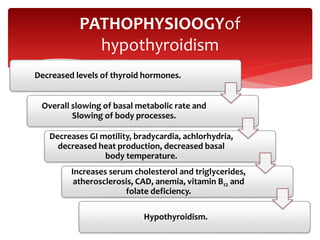
Decreased levels of thyroid hormones.
Overall slowing of basal metabolic rate and
Slowing of body processes.
Decreases GI motility, bradycardia, achlorhydria,
decreased heat production, decreased basal
body temperature.
Increases serum cholesterol and triglycerides,
atherosclerosis, CAD, anemia, vitamin B12 and
folate deficiency.
Hypothyroidism.
PATHOPHYSIOOGYof
hypothyroidism
 CVS – cardiac contractility is impaired
leading to reduced stroke volume, low
cardiac output, bradycardia and
hypotension.
 CNS –Brain function is affected by
reduction in oxygen delivery and
subsequent consumption, decreased
glucose utilization and reduced cerebral
blood flow.
PATHOPHYSIOOGYof
Myxedema Coma
 Pulmonary – hypoventilation due to
central depression of ventilatory drive
with decreased responsiveness to
hypoxia and hypercapnia
 Renal - Hyponatremia is common in
patients with myxedema coma and is
caused by increased serum antidiuretic
hormone and impaired water excretion
and reduced GFR due to low cardiac
output.
PATHOPHYSIOOGYof
Myxedema Coma
 GI - malabsorption, impaired peristalsis,
paralytic ileus. Ascites may occur due to
increased capillary permeability, heart
failure, or other mechanisms.
Gastrointestinal bleeding secondary to
an associated coagulopathy may occur.
PATHOPHYSIOOGYof
Myxedema Coma
 History-Most patients with myxedema coma have a history of
hypothyroidism. Some patients may have developed
hypothyroidism after thyroidectomy or iodine therapy for
hyperthyroidism.
 Symptoms of hypothyroidism, including fatigue, weight gain,
cold intolerance, constipation, and dry skin, may be elicited.
 Patients have depressed mental state with lethargy, delirium,
or coma. Cold extremities, non pitting edema of the upper
and lower extremities. Confusion, stupor, slow speech,
delayed reflexes, seizures, coma
 Symptoms of the precipitating illness can be seen such as
infection (commonly pneumonia), stroke, myocardial
infarction, trauma, or heart failure.
CLINICAL MANIFESTATION
 Hypoventilation leading to respiratory
acidosis.
 Hypothermia
 Hypotension
 Hypoglycaemia
 Hyponatremia
 Hypercapnia
 hypoxia
Drastic decrease in metabolic rate.
 TFTs – TSH (0.4-4mU/L) is elevated, fT3 and fT4
is low.
 A low or normal TSH level with low levels of
free T4(0.7-1.9ng/dl) and free T3 (80-180ng/dl)
may indicate that the disorder is due to
pituitary or hypothalamic dysfunction
 Other tests – Serum osmolality (hyponatremia),
serum creatinine (because of decreased renal
perfusion), CBC (infection), serum cortisol.
LABORATORY INVESTIGATIONS
 CXR (signs of Pulmonary Edema,
cardiomegaly, CHF, pericardia effusion),
 ECG (sinus bradycardia, low-amplitude
QRS complexes, a prolonged QT
interval, flattened or inverted T waves,
or arrhythmias).
Imaging studies –
 Levothyroxine sodium-lifelong therapy.
 Myxedema Coma-
 Maintain a patent airway
 Oxygen administration
 I/V fluids.
 Vital signs to be monitored.
 Correct hypothermia
 Vasopressor for tissue perfusion
 Levothyroxine sodium with I/V glucose,
corticosteroids
MANAGEMENT
 Airway maintenance is crucial, mechanical
ventilation is commonly required during the first
36-48 hours, but some patients require
prolonged respiratory support for as long as 2-3
weeks.
 Thyroid hormone replacement – controversial,
some favor levothyroxine (T4) while others favor
combination of T4 and liothyronine (T3).An
intravenous loading dose of 300-600 micrograms
of levothyroxine (T4) is followed by a daily
intravenous dose of 50-100 micrograms.
ICU setting with continuous cardiac
monitoring
 Because the rate of conversion of T4 to the active
hormone T3 can be reduced in these patients, the
addition of T3 along with T4 has been recommended. T3
has a quicker onset of action than T4, as increases in body
temperature and oxygen consumption has been reported
to be faster with T3 therapy compared to T4.T3 therapy is
given as bolus of 5-20 micrograms intravenously and to be
continued at a dosage of 2.5-10 micrograms every 8 hours.
 Measurement of thyroid hormones every 1-2 days is
suggested. Failure of TSH to decrease or of thyroid
hormone levels to increase suggests the need to increase
doses of T4 and/or add T3.
 The treatment is changed to the oral form once the
patient is able to take medications by mouth.
 Patients with primary hypothyroidism may have
concomitant primary adrenal insufficiency while patients
with secondary hypothyroidism may have associated
hypopituitarism and secondary adrenal insufficiency. The
other rationale for the treatment with corticosteroids is
the potential risk of precipitating acute adrenal
insufficiency caused by the accelerated metabolism of
cortisol that follows T4 therapy.
 Hydrocortisone at a dose of 50-100 mg every 8 hours is
administered. An alternative is dexamethasone at a dose
of 2-4 mg every 12 hours.
Glucocorticoid therapy –
 Treat hypothermia with passive rewarming using
ordinary blankets and a warm room.
 Treat associated infection.
 Correct severe hyponatremia with saline and free water
restriction.
 Correct hypoglycemia with IV dextrose.
 Hypotension is usually corrected with thyroid hormone
therapy. If blood pressure continues to be low, cautious
use of intravenous fluids with normal saline is advised.
Refractory hypotension can be cautiously treated with
vasopressors such as dopamine.
Supportive measures –
Activity intolerance related to fatigue.
 Space activities to promote rest and exercise.
 Assist with self-care activities when patient is fatigued.
Risk for imbalanced body temperature related to
decreased metabolism.
 Provide extra layer of blanket/clothing.
 Monitor vital signs.
 Protect from exposure to cold and drafts.
NURSING MANAGEMENT
Constipation related to depressed GI function.
 Encourage increased fluid intake.
 Provide food rich in roughage, fibre.
 Avoid abuse of laxatives.
 Encourage increased mobility.
Deficient knowledge about the therapeutic regimen.
 Explain rational for lifelong thyroid hormone
replacement therapy.
 Explain side-effects, action, overdose, symptoms of
medication.
 Follow-up visits.
Ineffective breathing patterns related to
depressed ventilation.
 Monitor respiratory rate, pattern, depth .
 Encourage deep breathing exercises, coughing
exercises.
 Maintain patent airway.
Disturbed thought process related to
hypothyroidism
 Orient patient to time, place and person.
 Provide stimulation through conversation and
activities.
Myxedema & myxedema coma related to the
disease process.
 Monitor for complications.
 Monitor compliance and response to therapy.
THANK YOU

Myxedema coma

  • 1.
  • 2.
     Myxedema comais a rare life-threatening condition.It is the decompensated state of severe hypothyroidism in whichthe patient is hypothermic and unconscious.The condition occurs most often among elderly women in the winter months and appears to be precipitated by cold. Myxedema Coma
  • 3.
     Myxedema coma,occasionally called myxedema crisis, is a rare life- threatening clinical condition that represents severe hypothyroidism with physiological decompensation. The condition usually occurs in patients with long-standing, undiagnosed hypothyroidism and is usually precipitated by infection, cerebrovascular disease, heart failure, trauma, or drug therapy. Myxedema Coma
  • 4.
     Myxedema isalso used to describe the dermatologic changes that occur in hypothyroidism which refers to deposition of mucopolysaccharides in the dermis, which results in swelling of the affected area. Myxedema Coma
  • 5.
    It is deficiencyof thyroid hormone resulting in-  slowed body metabolism,  decreased heat production,  decreased oxygen consumption by tissues. HYPOTHYROIDISM
  • 6.
     Chronic autoimmunethyroiditis,  Thyroidectomy  Underwent radioactive iodine therapy for hyperthyroidism,  Secondary hypothyroidism. ETIOLOGY AND RISK FACTORS of Myxedema Coma
  • 7.
     Poor complianceand lack of knowledge about managing levothyroxine therapy in acute illness.  Undiagnosed hypothyroidism ETIOLOGY AND RISK FACTORS of Myxedema Coma
  • 8.
     Infection, Exposureto cold temperatures,  Trauma,  Burns,  Cerebrovascular accident, Myocardial infarction,  Congestive heart failure,  Respiratory acidosis. PRECIPITATING FACTORS
  • 9.
     Medications – sedatives,narcotics, amiodarone, rifampin, beta blockers.  Decreased drug metabolism leading to overdosing of medications particularly sedatives, hypnotics, and anesthetic agents; this can precipitate myxedema coma. PRECIPITATING FACTORS
  • 10.
     Metabolic disturbances–  hypoglycemia,  hyponatremia,  acidosis and  hypercapnia. PRECIPITATING FACTORS
  • 11.
    Decreased levels ofthyroid hormones. Overall slowing of basal metabolic rate and Slowing of body processes. Decreases GI motility, bradycardia, achlorhydria, decreased heat production, decreased basal body temperature. Increases serum cholesterol and triglycerides, atherosclerosis, CAD, anemia, vitamin B12 and folate deficiency. Hypothyroidism. PATHOPHYSIOOGYof hypothyroidism
  • 12.
     CVS –cardiac contractility is impaired leading to reduced stroke volume, low cardiac output, bradycardia and hypotension.  CNS –Brain function is affected by reduction in oxygen delivery and subsequent consumption, decreased glucose utilization and reduced cerebral blood flow. PATHOPHYSIOOGYof Myxedema Coma
  • 13.
     Pulmonary –hypoventilation due to central depression of ventilatory drive with decreased responsiveness to hypoxia and hypercapnia  Renal - Hyponatremia is common in patients with myxedema coma and is caused by increased serum antidiuretic hormone and impaired water excretion and reduced GFR due to low cardiac output. PATHOPHYSIOOGYof Myxedema Coma
  • 14.
     GI -malabsorption, impaired peristalsis, paralytic ileus. Ascites may occur due to increased capillary permeability, heart failure, or other mechanisms. Gastrointestinal bleeding secondary to an associated coagulopathy may occur. PATHOPHYSIOOGYof Myxedema Coma
  • 15.
     History-Most patientswith myxedema coma have a history of hypothyroidism. Some patients may have developed hypothyroidism after thyroidectomy or iodine therapy for hyperthyroidism.  Symptoms of hypothyroidism, including fatigue, weight gain, cold intolerance, constipation, and dry skin, may be elicited.  Patients have depressed mental state with lethargy, delirium, or coma. Cold extremities, non pitting edema of the upper and lower extremities. Confusion, stupor, slow speech, delayed reflexes, seizures, coma  Symptoms of the precipitating illness can be seen such as infection (commonly pneumonia), stroke, myocardial infarction, trauma, or heart failure. CLINICAL MANIFESTATION
  • 16.
     Hypoventilation leadingto respiratory acidosis.  Hypothermia  Hypotension  Hypoglycaemia  Hyponatremia  Hypercapnia  hypoxia Drastic decrease in metabolic rate.
  • 17.
     TFTs –TSH (0.4-4mU/L) is elevated, fT3 and fT4 is low.  A low or normal TSH level with low levels of free T4(0.7-1.9ng/dl) and free T3 (80-180ng/dl) may indicate that the disorder is due to pituitary or hypothalamic dysfunction  Other tests – Serum osmolality (hyponatremia), serum creatinine (because of decreased renal perfusion), CBC (infection), serum cortisol. LABORATORY INVESTIGATIONS
  • 18.
     CXR (signsof Pulmonary Edema, cardiomegaly, CHF, pericardia effusion),  ECG (sinus bradycardia, low-amplitude QRS complexes, a prolonged QT interval, flattened or inverted T waves, or arrhythmias). Imaging studies –
  • 19.
     Levothyroxine sodium-lifelongtherapy.  Myxedema Coma-  Maintain a patent airway  Oxygen administration  I/V fluids.  Vital signs to be monitored.  Correct hypothermia  Vasopressor for tissue perfusion  Levothyroxine sodium with I/V glucose, corticosteroids MANAGEMENT
  • 20.
     Airway maintenanceis crucial, mechanical ventilation is commonly required during the first 36-48 hours, but some patients require prolonged respiratory support for as long as 2-3 weeks.  Thyroid hormone replacement – controversial, some favor levothyroxine (T4) while others favor combination of T4 and liothyronine (T3).An intravenous loading dose of 300-600 micrograms of levothyroxine (T4) is followed by a daily intravenous dose of 50-100 micrograms. ICU setting with continuous cardiac monitoring
  • 21.
     Because therate of conversion of T4 to the active hormone T3 can be reduced in these patients, the addition of T3 along with T4 has been recommended. T3 has a quicker onset of action than T4, as increases in body temperature and oxygen consumption has been reported to be faster with T3 therapy compared to T4.T3 therapy is given as bolus of 5-20 micrograms intravenously and to be continued at a dosage of 2.5-10 micrograms every 8 hours.  Measurement of thyroid hormones every 1-2 days is suggested. Failure of TSH to decrease or of thyroid hormone levels to increase suggests the need to increase doses of T4 and/or add T3.  The treatment is changed to the oral form once the patient is able to take medications by mouth.
  • 22.
     Patients withprimary hypothyroidism may have concomitant primary adrenal insufficiency while patients with secondary hypothyroidism may have associated hypopituitarism and secondary adrenal insufficiency. The other rationale for the treatment with corticosteroids is the potential risk of precipitating acute adrenal insufficiency caused by the accelerated metabolism of cortisol that follows T4 therapy.  Hydrocortisone at a dose of 50-100 mg every 8 hours is administered. An alternative is dexamethasone at a dose of 2-4 mg every 12 hours. Glucocorticoid therapy –
  • 23.
     Treat hypothermiawith passive rewarming using ordinary blankets and a warm room.  Treat associated infection.  Correct severe hyponatremia with saline and free water restriction.  Correct hypoglycemia with IV dextrose.  Hypotension is usually corrected with thyroid hormone therapy. If blood pressure continues to be low, cautious use of intravenous fluids with normal saline is advised. Refractory hypotension can be cautiously treated with vasopressors such as dopamine. Supportive measures –
  • 24.
    Activity intolerance relatedto fatigue.  Space activities to promote rest and exercise.  Assist with self-care activities when patient is fatigued. Risk for imbalanced body temperature related to decreased metabolism.  Provide extra layer of blanket/clothing.  Monitor vital signs.  Protect from exposure to cold and drafts. NURSING MANAGEMENT
  • 25.
    Constipation related todepressed GI function.  Encourage increased fluid intake.  Provide food rich in roughage, fibre.  Avoid abuse of laxatives.  Encourage increased mobility. Deficient knowledge about the therapeutic regimen.  Explain rational for lifelong thyroid hormone replacement therapy.  Explain side-effects, action, overdose, symptoms of medication.  Follow-up visits.
  • 26.
    Ineffective breathing patternsrelated to depressed ventilation.  Monitor respiratory rate, pattern, depth .  Encourage deep breathing exercises, coughing exercises.  Maintain patent airway. Disturbed thought process related to hypothyroidism  Orient patient to time, place and person.  Provide stimulation through conversation and activities.
  • 27.
    Myxedema & myxedemacoma related to the disease process.  Monitor for complications.  Monitor compliance and response to therapy.
  • 28.