Education&Bernstein1Language and Social Class:
This sessionClive McGoun: Language, Thought, and Representation2How is the social structure of a discourse community reflected, constructed and perpetrated by the way its members ‘language’ their experience in a style appropriate to the conventions of the group?Can Bernstein help?
Spoken Language3What is the difference between speech and writing?Speech is transientSpeech is additive or ‘rhapsodic’Speech is aggregativeSpeech is redundant or ‘copious’Speech is loosely structured grammatically and lexically sparseSpeech tends to be people centredSpeech is context dependent
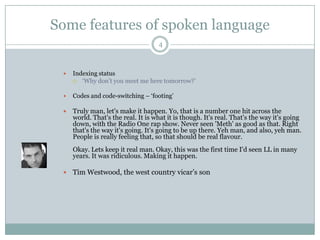
Some features of spoken language4Indexing status‘Why don’t you meet me here tomorrow?’Codes and code-switching – ‘footing’Truly man, let's make it happen. Yo, that is a number one hit across the world. That's the real. It is what it is though. It's real. That's the way it's going down, with the Radio One rap show. Never seen 'Meth' as good as that. Right that's the way it's going. It's going to be up there. Yeh man, and also, yeh man. People is really feeling that, so that should be real flavour. Okay. Lets keep it real man. Okay, this was the first time I'd seen LL in many years. It was ridiculous. Making it happen.Tim Westwood, the west country vicar’s son
Conversational Style5Different contexts of situation and different contexts of culture call for different conversational stylesDifferent groups will have different conversational stylesThose styles will involve differences in the meanings produced by languageThose meanings will privilege a particular way of thinkingIf such a way of thinking allows privileged access to material resources in society those who do not think in this way will be denied such access.This is close to a version of Bernstein’s argument.
Bernstein’s theory of codes (1)6On the relationship between Bernstein’s theory and Whorf’s:It differs [from] … Whorf by asserting that, in the context of a common language in the sense of a general code, there will arise distinct linguistic forms … which induce in their speakers different ways of relating to objects and persons. (Bernstein 1974)What, then, are Bernstein’s codes?
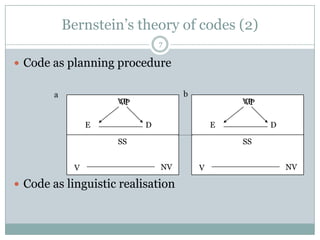
Bernstein’s theory of codes (2)7Code as planning procedureCode as linguistic realisationVPVPVPVPEDEDSSSSNVNVVVba
Bernstein’s theory of codes (3)8ContextI regard code as referring to a socially constituted regulative principle, tacitly acquired, which integrates:The relevant meaningsThe form of their realisationThe evoking contexts(Adlamet al., 1977: ix)
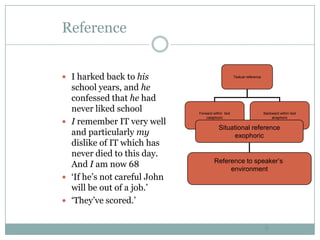
ReferenceI harked back to his school years, and he confessed that he had never liked schoolI remember IT very well and particularly my dislike of IT which has never died to this day. And I am now 68‘If he’s not careful John will be out of a job.’‘They’ve scored.’9
Testing the theory10Hypothesis:7 year-old working class children in a structured interview will make more use of situational reference than middle class counterparts.Working class children will tend to use exophoric items.Their language will tend to depend heavily on context and so will realise particularistic meanings.ProcedurePicture story
Results11The class differences all move in the predicted direction; among the exophoric categories the working-class speakers consistently produced either more users or more occurrences, usually both, in both tasks of the schedule. The consistency of these results, the high levels of significance, and the implications for the orientation towards different modes of communication, combine to make this a noteworthy finding.(Hawkins, 1977: 93)
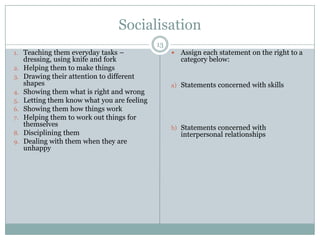
Explaining the results12Social relationships determine the linguistic code.Therefore, family relations are fundamental.The socialisation of middle class children differs from that of working class children.Families from different social classes have different attitudes towards and relationships with their children.These differences lead to working class children having access to restricted codes and middle class children having access to both restricted and elaborate codes.
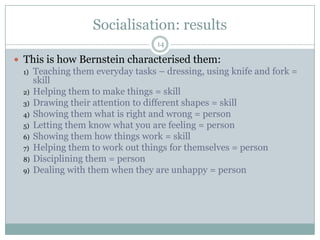
Socialisation13Teaching them everyday tasks – dressing, using knife and forkHelping them to make thingsDrawing their attention to different shapesShowing them what is right and wrongLetting them know what you are feelingShowing them how things workHelping them to work out things for themselvesDisciplining themDealing with them when they are unhappyAssign each statement on the right to a category below:Statements concerned with skillsStatements concerned with interpersonal relationships
Socialisation: results14This is how Bernstein characterised them:Teaching them everyday tasks – dressing, using knife and fork = skillHelping them to make things = skillDrawing their attention to different shapes = skillShowing them what is right and wrong = personLetting them know what you are feeling = personShowing them how things work = skillHelping them to work out things for themselves = personDisciplining them = personDealing with them when they are unhappy = person
Results15The middle class mother take greater care to make the whole of the inter-person area verbally explicit for her child, much more than the working class mother.
Conclusion16Different social-class practices in socialisation lead to social-class differences in language use.These social class differences in code within the same language do affect behaviourLanguage is affected by social structures.We have moved from the linguistic determinism of Whorf to a social determinism where social relationships determine the language used.

Language and Social Class

  • 1.
  • 2.
    This sessionClive McGoun:Language, Thought, and Representation2How is the social structure of a discourse community reflected, constructed and perpetrated by the way its members ‘language’ their experience in a style appropriate to the conventions of the group?Can Bernstein help?
  • 3.
    Spoken Language3What isthe difference between speech and writing?Speech is transientSpeech is additive or ‘rhapsodic’Speech is aggregativeSpeech is redundant or ‘copious’Speech is loosely structured grammatically and lexically sparseSpeech tends to be people centredSpeech is context dependent
  • 4.
    Some features ofspoken language4Indexing status‘Why don’t you meet me here tomorrow?’Codes and code-switching – ‘footing’Truly man, let's make it happen. Yo, that is a number one hit across the world. That's the real. It is what it is though. It's real. That's the way it's going down, with the Radio One rap show. Never seen 'Meth' as good as that. Right that's the way it's going. It's going to be up there. Yeh man, and also, yeh man. People is really feeling that, so that should be real flavour. Okay. Lets keep it real man. Okay, this was the first time I'd seen LL in many years. It was ridiculous. Making it happen.Tim Westwood, the west country vicar’s son
  • 5.
    Conversational Style5Different contextsof situation and different contexts of culture call for different conversational stylesDifferent groups will have different conversational stylesThose styles will involve differences in the meanings produced by languageThose meanings will privilege a particular way of thinkingIf such a way of thinking allows privileged access to material resources in society those who do not think in this way will be denied such access.This is close to a version of Bernstein’s argument.
  • 6.
    Bernstein’s theory ofcodes (1)6On the relationship between Bernstein’s theory and Whorf’s:It differs [from] … Whorf by asserting that, in the context of a common language in the sense of a general code, there will arise distinct linguistic forms … which induce in their speakers different ways of relating to objects and persons. (Bernstein 1974)What, then, are Bernstein’s codes?
  • 7.
    Bernstein’s theory ofcodes (2)7Code as planning procedureCode as linguistic realisationVPVPVPVPEDEDSSSSNVNVVVba
  • 8.
    Bernstein’s theory ofcodes (3)8ContextI regard code as referring to a socially constituted regulative principle, tacitly acquired, which integrates:The relevant meaningsThe form of their realisationThe evoking contexts(Adlamet al., 1977: ix)
  • 9.
    ReferenceI harked backto his school years, and he confessed that he had never liked schoolI remember IT very well and particularly my dislike of IT which has never died to this day. And I am now 68‘If he’s not careful John will be out of a job.’‘They’ve scored.’9
  • 10.
    Testing the theory10Hypothesis:7year-old working class children in a structured interview will make more use of situational reference than middle class counterparts.Working class children will tend to use exophoric items.Their language will tend to depend heavily on context and so will realise particularistic meanings.ProcedurePicture story
  • 11.
    Results11The class differencesall move in the predicted direction; among the exophoric categories the working-class speakers consistently produced either more users or more occurrences, usually both, in both tasks of the schedule. The consistency of these results, the high levels of significance, and the implications for the orientation towards different modes of communication, combine to make this a noteworthy finding.(Hawkins, 1977: 93)
  • 12.
    Explaining the results12Socialrelationships determine the linguistic code.Therefore, family relations are fundamental.The socialisation of middle class children differs from that of working class children.Families from different social classes have different attitudes towards and relationships with their children.These differences lead to working class children having access to restricted codes and middle class children having access to both restricted and elaborate codes.
  • 13.
    Socialisation13Teaching them everydaytasks – dressing, using knife and forkHelping them to make thingsDrawing their attention to different shapesShowing them what is right and wrongLetting them know what you are feelingShowing them how things workHelping them to work out things for themselvesDisciplining themDealing with them when they are unhappyAssign each statement on the right to a category below:Statements concerned with skillsStatements concerned with interpersonal relationships
  • 14.
    Socialisation: results14This ishow Bernstein characterised them:Teaching them everyday tasks – dressing, using knife and fork = skillHelping them to make things = skillDrawing their attention to different shapes = skillShowing them what is right and wrong = personLetting them know what you are feeling = personShowing them how things work = skillHelping them to work out things for themselves = personDisciplining them = personDealing with them when they are unhappy = person
  • 15.
    Results15The middle classmother take greater care to make the whole of the inter-person area verbally explicit for her child, much more than the working class mother.
  • 16.
    Conclusion16Different social-class practicesin socialisation lead to social-class differences in language use.These social class differences in code within the same language do affect behaviourLanguage is affected by social structures.We have moved from the linguistic determinism of Whorf to a social determinism where social relationships determine the language used.