

Error Analysis
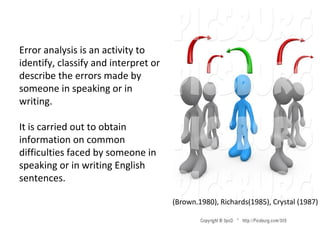
Error analysis is an activity to
identify, classify and interpret or
describe the errors made by
someone in speaking or in
writing.
It is carried out to obtain
information on common
difficulties faced by someone in
speaking or in writing English
sentences.
(Brown.1980), Richards(1985), Crystal (1987)
Mistake and Error
According to Norrish:
Error is a systematic
deviation, when a learner
has not learnt something
and consistently gets it
wrong.
According to Norrish:
Mistake is an
inconsistent deviation
that is sometimes the
learner ‘gets it right’
but sometimes wrong
A mistake is made by a learner because he
does not apply the rule that he actually
knows, in other words, a mistake is a non
systematic deviation from the norms of the
language.
Sources of Errors
1. Interlingual transfer
It is the negative influence of the mother
tongue of learner.
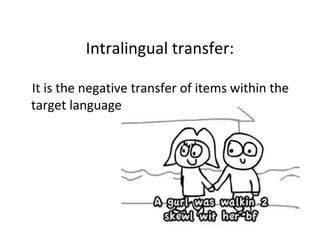
Intralingual transfer:
It is the negative transfer of items within the
target language.
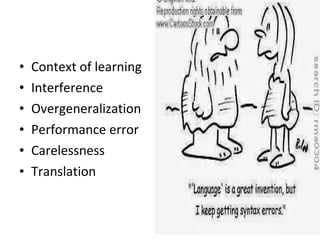
• Context of learning
• Interference
• Overgeneralization
• Performance error
• Carelessness
• Translation
Methodology
• Application
• Forwarded it for approval
• Different departments
• Checked assignments
• Analyzed
• Categorized
• Presented in the form of charts
Analysis of results
• The results show that students in these
assignments have committed eight common
errors.
• These errors are:
(1) Tense
(2) Word order
(3) Singular/plural form
(4) Subject-verb agreement
(5) Punctuation
(6) Spellings
(7) Capitalization
(8) Articles.
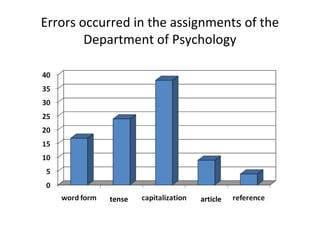
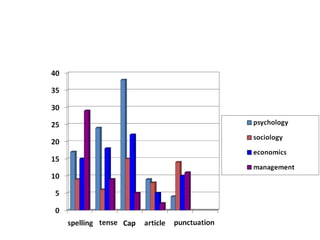
Errors occurred in the assignments of the
Department of Psychology
tense article
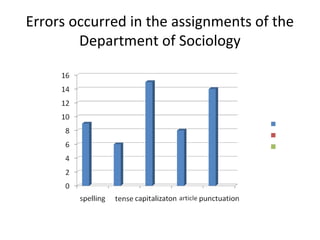
Errors occurred in the assignments of the
Department of Sociology
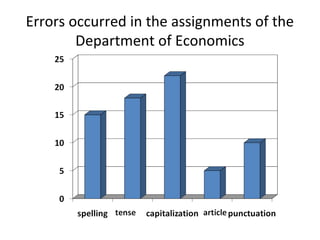
Errors occurred in the assignments of the
Department of Economics
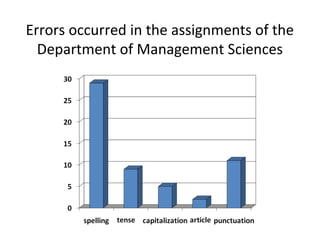
Errors occurred in the assignments of the
Department of Management Sciences
Cap
Conclusion
• Required in developing or increasing the techniques
• Teacher can concentrate on the materials in which most
learners made error
• Evaluate
• Group activities
• Peer correction
• Self correction
• Learning steps
• Thanks 

Error analysis

  • 1.
  • 2.
    Error analysis isan activity to identify, classify and interpret or describe the errors made by someone in speaking or in writing. It is carried out to obtain information on common difficulties faced by someone in speaking or in writing English sentences. (Brown.1980), Richards(1985), Crystal (1987)
  • 3.
    Mistake and Error Accordingto Norrish: Error is a systematic deviation, when a learner has not learnt something and consistently gets it wrong.
  • 4.
    According to Norrish: Mistakeis an inconsistent deviation that is sometimes the learner ‘gets it right’ but sometimes wrong
  • 6.
    A mistake ismade by a learner because he does not apply the rule that he actually knows, in other words, a mistake is a non systematic deviation from the norms of the language.
  • 8.
    Sources of Errors 1.Interlingual transfer It is the negative influence of the mother tongue of learner.
  • 9.
    Intralingual transfer: It isthe negative transfer of items within the target language.
  • 10.
    • Context oflearning • Interference • Overgeneralization • Performance error • Carelessness • Translation
  • 11.
    Methodology • Application • Forwardedit for approval • Different departments • Checked assignments • Analyzed • Categorized • Presented in the form of charts
  • 12.
    Analysis of results •The results show that students in these assignments have committed eight common errors. • These errors are: (1) Tense (2) Word order (3) Singular/plural form (4) Subject-verb agreement (5) Punctuation (6) Spellings (7) Capitalization (8) Articles.
  • 13.
    Errors occurred inthe assignments of the Department of Psychology tense article
  • 14.
    Errors occurred inthe assignments of the Department of Sociology
  • 15.
    Errors occurred inthe assignments of the Department of Economics
  • 16.
    Errors occurred inthe assignments of the Department of Management Sciences
  • 17.
  • 18.
    Conclusion • Required indeveloping or increasing the techniques • Teacher can concentrate on the materials in which most learners made error • Evaluate • Group activities • Peer correction • Self correction • Learning steps
  • 19.