Discourse Analysis and Language
Teaching
Scarlett Espinoza
Claudia Millafilo
Aracely Rodríguez
- 0. Introduction: The interface of discourse analysis
and language teaching.
- 1. Shared Knowledge: The basis for planning the
teaching/learning continuum.
- 2. Discourse in the language classroom:
The basis for creating the context for language learning
- 3. Discourse analysis and the teaching of
the language areas
- 4. Discourse analysis and the teaching of
the language skills
- 5. Conclusion
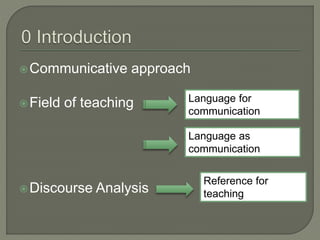
Communicative approach
Field of teaching
Discourse Analysis
Language for
communication
Language as
communication
Reference for
teaching
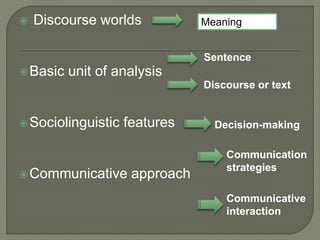
 Discourse worlds
Basic unit of analysis
Sociolinguistic features
Communicative approach
Meaning
Sentence
Discourse or text
Decision-making
Communication
strategies
Communicative
interaction
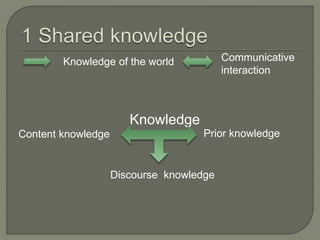
Knowledge
Knowledge of the world Communicative
interaction
Content knowledge Prior knowledge
Discourse knowledge
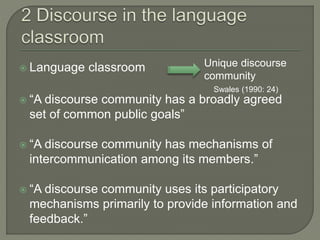
 Language classroom
 “A discourse community has a broadly agreed
set of common public goals”
 “A discourse community has mechanisms of
intercommunication among its members.”
 “A discourse community uses its participatory
mechanisms primarily to provide information and
feedback.”
Unique discourse
community
Swales (1990: 24)
 “A discourse community utilizes and hence
possesses one or more genres in the
communicative furtherance of its aims.”
 “In addition to owning genres, a discourse
community has acquired some specific lexis.”
 “A discourse community has a threshold level of
members with a suitable degree of relevant
content and discoursal expertise.”
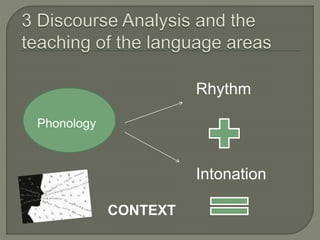
Phonology
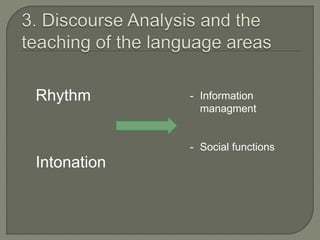
Rhythm
Intonation
CONTEXT
Rhythm
Intonation
- Information
managment
- Social functions
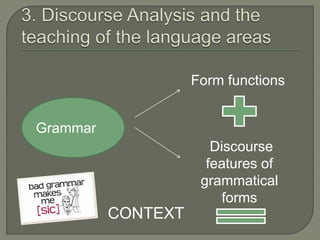
Grammar
Form functions
Discourse
features of
grammatical
forms
CONTEXT
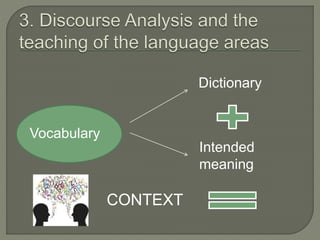
Vocabulary
Dictionary
Intended
meaning
CONTEXT
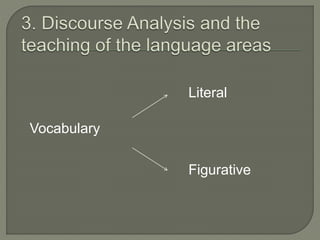
Vocabulary
Literal
Figurative
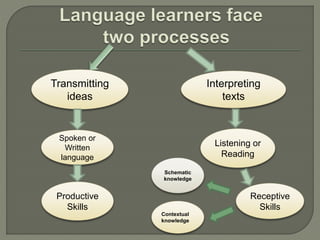
Transmitting
ideas
Spoken or
Written
language
Productive
Skills
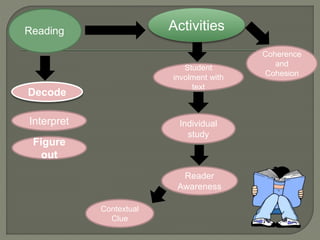
Interpreting
texts
Listening or
Reading
Receptive
Skills
Schematic
knowledge
Contextual
knowledge
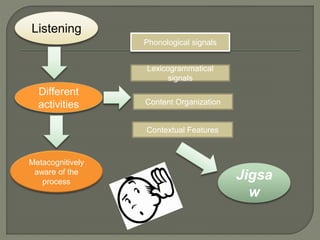
Listening
Different
activities
Metacognitively
aware of the
process
Phonological signals
Lexicogrammatical
signals
Content Organization
Contextual Features
Jigsa
w
Decode
Interpret
Figure
out
Activities
Student
involment with
text
Individual
study
Reader
Awareness
Contextual
Clue
Coherence
and
Cohesion
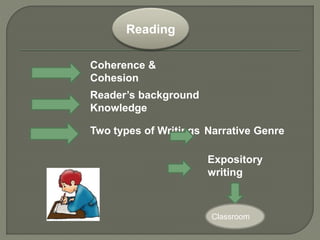
Reading
Coherence &
Cohesion
Reader’s background
Knowledge
Two types of Writings Narrative Genre
Expository
writing
Reading
Classroom
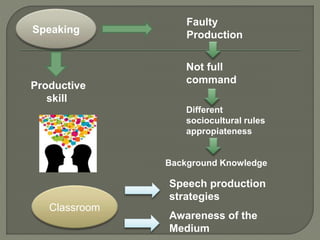
Speaking
Productive
skill
Faulty
Production
Not full
command
Different
sociocultural rules
appropiateness
Background Knowledge
Classroom
Speech production
strategies
Awareness of the
Medium
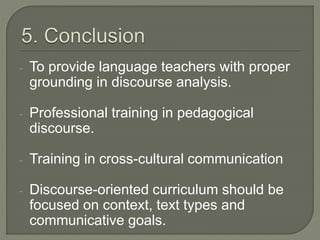
- To provide language teachers with proper
grounding in discourse analysis.
- Professional training in pedagogical
discourse.
- Training in cross-cultural communication
- Discourse-oriented curriculum should be
focused on context, text types and
communicative goals.

Discourse analysis and language teaching