EnterpriseEnterprise ResourceResource
Planning-Planning-ERPERP
1
Professor, Entrepreneur & Lawyer.
Puttu Guru Prasad,Puttu Guru Prasad,
M.Com. M.B.A., L.L.B., M.Phil. PGDFTM.
AP.SET., ICFAI TMF., (PhD) at JNTUK.
Senior Faculty for Management Science,
VVIT-NamburVVIT-Nambur
My Blog: puttuguru.blogspot.in
93 94 96 98 98, 807 444 95 39,
What is ERP?
Definition:

ENTERPRISE RESOURCE PLANNING(ERP) is a
cross-functional enterprise system
driven by an integrated suite of
software modules that supports the
basic internal business processes of
a company
2
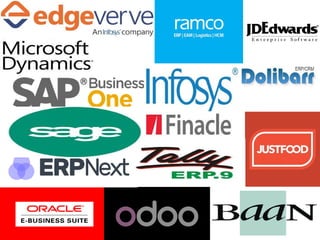
37 Main ERP vendors
• A German software company whose products
allow businesses to track customer and
business interactions. SAP is especially well-
known for its Enterprise Resource Planning
(ERP) and data management programs.
• SAP is an acronym for
Systems, Applications and Products.
• Business Processes included in SAP ERP are
• Operations (Sales & Distribution,
Materials Management, Production Planning, Logistics
• Execution, and Quality Management),
• Financials (Financial Accounting, Management Accounting,
• Financial Supply Chain Management),
• Human Capital Management (Training, Payroll, e-Recruiting)
• and Corporate Services (Travel
Management, Environment, Health and Safety,
• and Real-Estate Management).
 The practice of consolidating an enterprise’s
planning, manufacturing, sales and marketing efforts
into one management system.
 Combines all databases across departments into a
single database that can be accessed by all
employees.
 ERP automates the tasks involved in performing a
business process.
3
What is ERP?
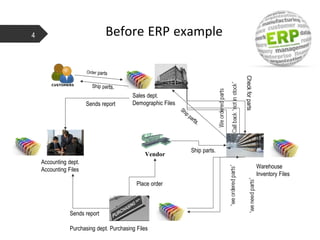
Before ERP example4
Vendor
Sales dept.
Demographic Files
Warehouse
Inventory Files
Sends report
Purchasing dept. Purchasing Files
Accounting dept.
Accounting Files
Order parts
Checkforparts
Place order
Ship parts.
Sends report
Ship parts.
Ship parts.
Typical Business Process :
Key observation
5
 A typical enterprise has many Departments/ Business
units(BU).
 These Departments/ BU continuously communicate and
exchange data with each other.
 The success of any organization lie’s in effective
communication and data exchange within the
Departments/ BU as well as associated third party such
as Vendors, Outsourcers and Costumers.
 Also known as Decentralized System.
Problems with Decentralized
System
6
 Numerous disparate information system are developed
individually over the time.
 Integrating the data becomes time and money consuming.
 Inconsistences and duplication of data.
 High inventory, material and human resource cost.
7
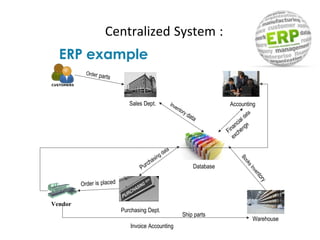
Vendor
Order parts
Sales Dept. Accounting
Purchasing Dept.
Warehouse
Database
Inventory data
Purchasing data
Ship parts
BooksInventory
Order is placed
Invoice Accounting
Financial data
exchenge
Centralized System :
ERP example
Centralized System :
Key observation
8
 Data is maintained at a central location and is shared
with various Departments.
 Departments have access information/ data of the other
Departments/ BU/
Benefits of Centralized
System
9
 Eliminates the duplication, discontinuity and redundancy in
data.
 Provides information across departments in real time.
 Provides control over various business processes.
 Increase Productivity, better inventory management,
promotes quality, reduced material cost, boosts profits.
□Better Customers interaction, increased throughput,
improves customer services.
10
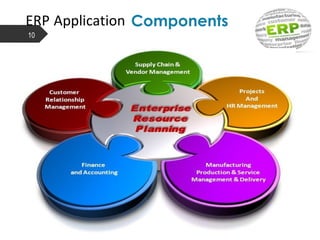
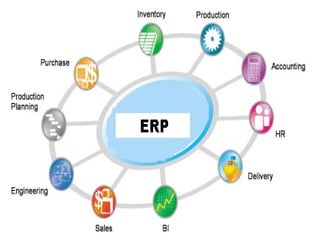
ERP Application Components
ERP Components
 Financial Management
At the core of ERP are the financial modules, including
general ledger, accounts receivable, accounts payable,
billing and fixed asset management. If your organization is
considering the move to an ERP system to support expansion
into global markets, make sure that multiple currencies and
languages are supported, as well as regulatory compliance
in the U.S. and in foreign countries.
Other functionality in the financial management modules
will include budgets, cash-flow, expense and tax reporting.
The evaluation team should focus on areas that are most
important to support the strategic plans for your
organization.
11
ERP Components12

Business Intelligence
Business Intelligence (BI) has become a standard component
of most ERP packages. In general, BI tools allow users to share
and analyse the data collected across the enterprise and
centralized in the ERP database. BI can come in the form of
dashboards, automated reporting and analysis tools used to
monitor the organizational business performance. BI supports
informed decision making by everyone, from executives to line
managers and accountants.
ERP Components13

Supply Chain Management
Supply Chain Management (SCM), sometimes referred to as
logistics, improves the flow of materials through an organization
by managing planning, scheduling, procurement, and
fulfillment, to maximize customer satisfaction and profitability.
Sub modules in SCM often include production scheduling,
demand management, distribution management, inventory
management, warehouse management, procurement and
order management..
ERP Components14
Human Resource Management
Human resource management ERP modules should
enhance the employee experience – from initial
recruitment to time tracking. Â Sub modules can
include payroll, performance management, time
tracking, benefits, compensation and workforce
planning. Self-service tools that allow managers and
employees to enter time and attendance, choose
benefits and manage PTO are available in many ERP
solutions.
ERP Components15

Manufacturing Operations
Manufacturing modules make manufacturing operations more
efficient through product configuration, job costing and bill of
materials management. ERP manufacturing modules often include
Capacity Requirements Planning, Materials Requirements Planning,
forecasting, Master Production Scheduling, work-order management
and shop- floor control
Integration
Key to the value of an ERP package is the integration between
modules, so that all of the core business functions are connected.
Information should flow across the organization so that BI reports on
organization-wide results.
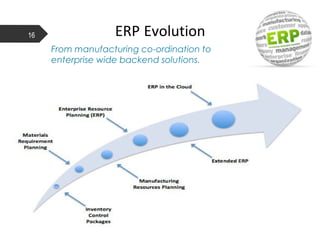
16 ERP Evolution
From manufacturing co-ordination to
enterprise wide backend solutions.
ERP Evolution17

Inventory Management & Control-1960’s
Inventory Management and control is the combination
of information technology and business processes of
maintaining the appropriate level of stock in a
warehouse. The activities of inventory management
include identifying inventory requirements, setting
targets, providing replenishment techniques and
options, monitoring item usages, reconciling the
inventory balances, and reporting inventory status.
ERP Evolution18

Material Requirement Planning (MRP)-1970’s
Materials Requirement Planning (MRP) utilizes software applications
for scheduling production processes. MRP generates schedules for
the operations and raw material purchases based on the production
requirements of finished goods, the structure of the production
system, the current inventories levels and the lot sizing procedure for
each operation
Manufacturing Requirements Planning (MRP) – 1980’s
Manufacturing Requirements Planning or MRP utilizes software
applications for coordinating manufacturing processes, from
product planning, parts purchasing, inventory control to product
distribution.
ERP Evolution19

Enterprise Resource Planning (ERP)-1990’s
Enterprise Resource Planning or ERP uses multi-module
application software for improving the performance of
the internal business processes. ERP systems often
integrates business activities across functional
departments, from product planning, parts purchasing,
inventory control, product distribution, fulfillment, to order
tracking. ERP software systems may include application
modules for supporting marketing, finance, accounting
and human resources.
20
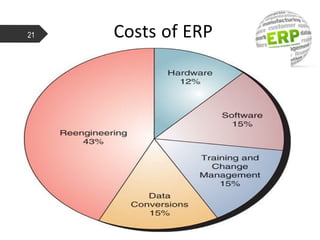
21 Costs of ERP
ERP Project and Time
 Real transformational ERP efforts will usually run between 1 to 3
years, on average.
 Short implementations (3 to 6 months):
 small companies,
 implementation limited to a small area of the company, or
 the company only used the financial pieces of the ERP system.
 The important thing is not to focus on how long it will take but to
understand why you need ERP and how you will use it to improve
your business.
23
Hidden Costs of ERP
 Training
 Integration and testing
 Data conversion
 Data analysis
 Consultants
 Replacing best and brightest staff after implementation
 Implementation teams can never stop
 Waiting for ROI
 Post-ERP depression
24
Benefits of ERP Systems
 Improving integration, flexibility
 Fewer errors
 Improved speed and efficiency
 More complete access to information
 Lower total costs in the complete supply chain
 Shorten throughput times
 Sustained involvement and commitment of the top management
25
□ Reduce stock to a minimum
 Enlarge product assortment
 Improve product quality
 Provide more reliable delivery dates and higher service to the
customer
 Efficiently coordinate global demand, supply and production
26 Benefits of ERP Systems
Risks with ERP
Implementation
 Expensive (can costs 100 thousands to millions of dollars)
 Time-consuming (can take months to years)
 Great risk for the organization
 Transfer of Knowledge
 Acceptance with the company
29
Conclusion
 The benefits of a properly selected and implemented ERP system
can be significant.
 An average, 25 to 30% reduction on inventory costs; 25%
reduction on raw material costs.
 Lead-time for customers, production time, and production
costs can be reduced.
 BUT cost of implementing can be quite high and risks are great.
31
38
Thank You!

9. erp pgp1

  • 1.
    EnterpriseEnterprise ResourceResource Planning-Planning-ERPERP 1 Professor, Entrepreneur& Lawyer. Puttu Guru Prasad,Puttu Guru Prasad, M.Com. M.B.A., L.L.B., M.Phil. PGDFTM. AP.SET., ICFAI TMF., (PhD) at JNTUK. Senior Faculty for Management Science, VVIT-NamburVVIT-Nambur My Blog: puttuguru.blogspot.in 93 94 96 98 98, 807 444 95 39,
  • 2.
    What is ERP? Definition:  ENTERPRISERESOURCE PLANNING(ERP) is a cross-functional enterprise system driven by an integrated suite of software modules that supports the basic internal business processes of a company 2
  • 3.
    37 Main ERPvendors
  • 4.
    • A Germansoftware company whose products allow businesses to track customer and business interactions. SAP is especially well- known for its Enterprise Resource Planning (ERP) and data management programs. • SAP is an acronym for Systems, Applications and Products.
  • 5.
    • Business Processesincluded in SAP ERP are • Operations (Sales & Distribution, Materials Management, Production Planning, Logistics • Execution, and Quality Management), • Financials (Financial Accounting, Management Accounting, • Financial Supply Chain Management), • Human Capital Management (Training, Payroll, e-Recruiting) • and Corporate Services (Travel Management, Environment, Health and Safety, • and Real-Estate Management).
  • 6.
     The practiceof consolidating an enterprise’s planning, manufacturing, sales and marketing efforts into one management system.  Combines all databases across departments into a single database that can be accessed by all employees.  ERP automates the tasks involved in performing a business process. 3 What is ERP?
  • 7.
    Before ERP example4 Vendor Salesdept. Demographic Files Warehouse Inventory Files Sends report Purchasing dept. Purchasing Files Accounting dept. Accounting Files Order parts Checkforparts Place order Ship parts. Sends report Ship parts. Ship parts.
  • 8.
    Typical Business Process: Key observation 5  A typical enterprise has many Departments/ Business units(BU).  These Departments/ BU continuously communicate and exchange data with each other.  The success of any organization lie’s in effective communication and data exchange within the Departments/ BU as well as associated third party such as Vendors, Outsourcers and Costumers.  Also known as Decentralized System.
  • 9.
    Problems with Decentralized System 6 Numerous disparate information system are developed individually over the time.  Integrating the data becomes time and money consuming.  Inconsistences and duplication of data.  High inventory, material and human resource cost.
  • 10.
    7 Vendor Order parts Sales Dept.Accounting Purchasing Dept. Warehouse Database Inventory data Purchasing data Ship parts BooksInventory Order is placed Invoice Accounting Financial data exchenge Centralized System : ERP example
  • 11.
    Centralized System : Keyobservation 8  Data is maintained at a central location and is shared with various Departments.  Departments have access information/ data of the other Departments/ BU/
  • 12.
    Benefits of Centralized System 9 Eliminates the duplication, discontinuity and redundancy in data.  Provides information across departments in real time.  Provides control over various business processes.  Increase Productivity, better inventory management, promotes quality, reduced material cost, boosts profits. □Better Customers interaction, increased throughput, improves customer services.
  • 13.
  • 14.
    ERP Components  FinancialManagement At the core of ERP are the financial modules, including general ledger, accounts receivable, accounts payable, billing and fixed asset management. If your organization is considering the move to an ERP system to support expansion into global markets, make sure that multiple currencies and languages are supported, as well as regulatory compliance in the U.S. and in foreign countries. Other functionality in the financial management modules will include budgets, cash-flow, expense and tax reporting. The evaluation team should focus on areas that are most important to support the strategic plans for your organization. 11
  • 15.
    ERP Components12  Business Intelligence BusinessIntelligence (BI) has become a standard component of most ERP packages. In general, BI tools allow users to share and analyse the data collected across the enterprise and centralized in the ERP database. BI can come in the form of dashboards, automated reporting and analysis tools used to monitor the organizational business performance. BI supports informed decision making by everyone, from executives to line managers and accountants.
  • 16.
    ERP Components13  Supply ChainManagement Supply Chain Management (SCM), sometimes referred to as logistics, improves the flow of materials through an organization by managing planning, scheduling, procurement, and fulfillment, to maximize customer satisfaction and profitability. Sub modules in SCM often include production scheduling, demand management, distribution management, inventory management, warehouse management, procurement and order management..
  • 17.
    ERP Components14 Human ResourceManagement Human resource management ERP modules should enhance the employee experience – from initial recruitment to time tracking. Â Sub modules can include payroll, performance management, time tracking, benefits, compensation and workforce planning. Self-service tools that allow managers and employees to enter time and attendance, choose benefits and manage PTO are available in many ERP solutions.
  • 18.
    ERP Components15  Manufacturing Operations Manufacturingmodules make manufacturing operations more efficient through product configuration, job costing and bill of materials management. ERP manufacturing modules often include Capacity Requirements Planning, Materials Requirements Planning, forecasting, Master Production Scheduling, work-order management and shop- floor control Integration Key to the value of an ERP package is the integration between modules, so that all of the core business functions are connected. Information should flow across the organization so that BI reports on organization-wide results.
  • 19.
    16 ERP Evolution Frommanufacturing co-ordination to enterprise wide backend solutions.
  • 20.
    ERP Evolution17  Inventory Management& Control-1960’s Inventory Management and control is the combination of information technology and business processes of maintaining the appropriate level of stock in a warehouse. The activities of inventory management include identifying inventory requirements, setting targets, providing replenishment techniques and options, monitoring item usages, reconciling the inventory balances, and reporting inventory status.
  • 21.
    ERP Evolution18  Material RequirementPlanning (MRP)-1970’s Materials Requirement Planning (MRP) utilizes software applications for scheduling production processes. MRP generates schedules for the operations and raw material purchases based on the production requirements of finished goods, the structure of the production system, the current inventories levels and the lot sizing procedure for each operation Manufacturing Requirements Planning (MRP) – 1980’s Manufacturing Requirements Planning or MRP utilizes software applications for coordinating manufacturing processes, from product planning, parts purchasing, inventory control to product distribution.
  • 22.
    ERP Evolution19  Enterprise ResourcePlanning (ERP)-1990’s Enterprise Resource Planning or ERP uses multi-module application software for improving the performance of the internal business processes. ERP systems often integrates business activities across functional departments, from product planning, parts purchasing, inventory control, product distribution, fulfillment, to order tracking. ERP software systems may include application modules for supporting marketing, finance, accounting and human resources.
  • 23.
  • 24.
  • 25.
    ERP Project andTime  Real transformational ERP efforts will usually run between 1 to 3 years, on average.  Short implementations (3 to 6 months):  small companies,  implementation limited to a small area of the company, or  the company only used the financial pieces of the ERP system.  The important thing is not to focus on how long it will take but to understand why you need ERP and how you will use it to improve your business. 23
  • 26.
    Hidden Costs ofERP  Training  Integration and testing  Data conversion  Data analysis  Consultants  Replacing best and brightest staff after implementation  Implementation teams can never stop  Waiting for ROI  Post-ERP depression 24
  • 27.
    Benefits of ERPSystems  Improving integration, flexibility  Fewer errors  Improved speed and efficiency  More complete access to information  Lower total costs in the complete supply chain  Shorten throughput times  Sustained involvement and commitment of the top management 25
  • 28.
    □ Reduce stockto a minimum  Enlarge product assortment  Improve product quality  Provide more reliable delivery dates and higher service to the customer  Efficiently coordinate global demand, supply and production 26 Benefits of ERP Systems
  • 29.
    Risks with ERP Implementation Expensive (can costs 100 thousands to millions of dollars)  Time-consuming (can take months to years)  Great risk for the organization  Transfer of Knowledge  Acceptance with the company 29
  • 30.
    Conclusion  The benefitsof a properly selected and implemented ERP system can be significant.  An average, 25 to 30% reduction on inventory costs; 25% reduction on raw material costs.  Lead-time for customers, production time, and production costs can be reduced.  BUT cost of implementing can be quite high and risks are great. 31
  • 31.