UNIVERSITY SCHOOL OF
MANAGEMENT
KURUKSHETRA UNIVERSITY
ENTERPRISE RESOURCE PLANNING
(ERP)
PREPARED BY
MEGHNA GOEL
MBA
MEANING
Enterprise resource planning (ERP) is a process by which a
company (often a manufacturer) manages and integrates the
important parts of its business. An ERP management information
system integrates areas such as planning, purchasing, inventory,
sales, marketing, finance and human resources.
Major Reasons for Adopting ERP
To improve business performance – An ERP system is a business tool and needs
to be viewed as a tool to conduct and execute business processes and
transactions. It has no intrinsic value; only the value it creates by delivering
benefits to the business organization.
To make employee jobs easier – Employee productivity increases. The benefits
here can be real, make sure your new system will deliver these types of benefits
if you’re counting on them.
To better integrate systems across multiple locations – This is a big benefit if
you now have disparate systems or systems that aren’t or can’t be integrated.
To position a company for growth – It’s almost always less
painful to implement a new ERP system when your organization
is smaller, than when you’re in a huge growth spurt. If growth is
predictably in your near future, take the plunge now and
implement a new system. The training and familiarity you get
with the system now, will pay off handsomely in the future.
To better serve customers
To standardize global business operations – This can be a huge
benefit! Make sure the system you select has language sets and
localizations that fit your current operations and future plans.
To reduce working capital – This is a basic benefit if the new
system is used properly.
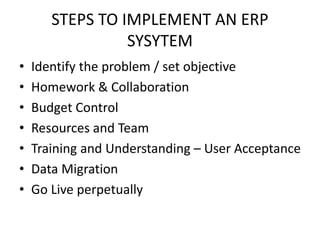
STEPS TO IMPLEMENT AN ERP
SYSYTEM
• Identify the problem / set objective
• Homework & Collaboration
• Budget Control
• Resources and Team
• Training and Understanding – User Acceptance
• Data Migration
• Go Live perpetually
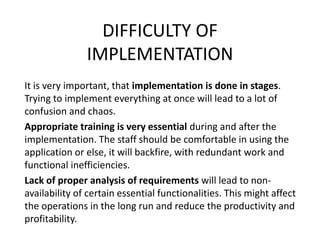
DIFFICULTY OF
IMPLEMENTATION
It is very important, that implementation is done in stages.
Trying to implement everything at once will lead to a lot of
confusion and chaos.
Appropriate training is very essential during and after the
implementation. The staff should be comfortable in using the
application or else, it will backfire, with redundant work and
functional inefficiencies.
Lack of proper analysis of requirements will lead to non-
availability of certain essential functionalities. This might affect
the operations in the long run and reduce the productivity and
profitability.
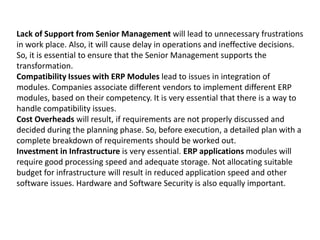
Lack of Support from Senior Management will lead to unnecessary frustrations
in work place. Also, it will cause delay in operations and ineffective decisions.
So, it is essential to ensure that the Senior Management supports the
transformation.
Compatibility Issues with ERP Modules lead to issues in integration of
modules. Companies associate different vendors to implement different ERP
modules, based on their competency. It is very essential that there is a way to
handle compatibility issues.
Cost Overheads will result, if requirements are not properly discussed and
decided during the planning phase. So, before execution, a detailed plan with a
complete breakdown of requirements should be worked out.
Investment in Infrastructure is very essential. ERP applications modules will
require good processing speed and adequate storage. Not allocating suitable
budget for infrastructure will result in reduced application speed and other
software issues. Hardware and Software Security is also equally important.
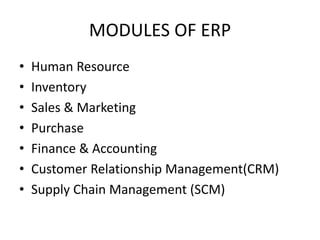
MODULES OF ERP
• Human Resource
• Inventory
• Sales & Marketing
• Purchase
• Finance & Accounting
• Customer Relationship Management(CRM)
• Supply Chain Management (SCM)
Human Resource Module(HR):
Human Resource module helps to HR team for efficient
management of human resources. HR module helps to manage
employee information, track employee records like performance
reviews, designations, job descriptions, skill matrix, time &
attendance tracking.
Inventory Module:
Inventory module can be used to track the stock of items. Items
can be identified by unique serial numbers. Using that unique
numbers inventory system can keep track of item and trace its
current location in organization.
Sales Module :
Typical sales process includes processes like Sales queries &
enquiry analysis & handling, quotation drafting, accepting sales
orders, drafting sales invoices with proper taxation,
dispatch/Shipment of material or service, tracking pending sales
order .
Purchase Module:
Purchase module consist of functionalities like supplier/vendor
listing, supplier & item linking, sending quotation request to
vendors, receiving & recording quotations, preparing purchase
orders, tracking the purchase items, Good Receipt Notes & various
reports .
Finance & Accounting module:
Whole inflow & outflow of money/capital is managed by finance
module. This module keeps track of all account related
transactions like expenditures, Balance sheet, account ledgers,
budgeting, bank statements ,payment receipts, tax management
etc.
Customer Relationship Management (CRM) module:
CRM module helps to manage & track detailed information of the customer like
communication history ,calls, meetings, details of purchases made by customer,
contract duration etc.
Supply Chain Management (SCM):
SCM module manages the flow of product items from manufacturer to
consumer & consumer to manufacturer.
Common roles involved are manufacturer, Super Stockiest, Stockiest,
distributors, retailers etc. SCM involves demand & supply management , sales
returns & replacing process, shipping & transportation tracking etc.
ADVANTAGES OF ERP SYSTEM
•Better organizational control, especially in large companies,
where the volume of information is more than in a small
company.
•Duplication of information is avoided.
•Improved communication, both internally and externally.
•Company profitability analysis can be carried out to analyse
where costs are higher and where there are more sales.
•Improved decision-making process within the company.
•The company is able to react better to any unforeseen problem
or situation.
•Better use of time.
DISADVANTAGES OF ERP SYSYTEM
• High cost of implementation.
• Necessary to train all employees
• Integration with other applications in the
enterprise needed.
• Inflexibility of the system, because this is a
generic system.
• There are few experts in this system.
• If the system is not applied correctly, it can be
very detrimental to the company.
ENTERPRISE RESOURCE PLANNING (ERP)

ENTERPRISE RESOURCE PLANNING (ERP)

  • 1.
    UNIVERSITY SCHOOL OF MANAGEMENT KURUKSHETRAUNIVERSITY ENTERPRISE RESOURCE PLANNING (ERP) PREPARED BY MEGHNA GOEL MBA
  • 2.
    MEANING Enterprise resource planning(ERP) is a process by which a company (often a manufacturer) manages and integrates the important parts of its business. An ERP management information system integrates areas such as planning, purchasing, inventory, sales, marketing, finance and human resources.
  • 3.
    Major Reasons forAdopting ERP To improve business performance – An ERP system is a business tool and needs to be viewed as a tool to conduct and execute business processes and transactions. It has no intrinsic value; only the value it creates by delivering benefits to the business organization. To make employee jobs easier – Employee productivity increases. The benefits here can be real, make sure your new system will deliver these types of benefits if you’re counting on them. To better integrate systems across multiple locations – This is a big benefit if you now have disparate systems or systems that aren’t or can’t be integrated.
  • 4.
    To position acompany for growth – It’s almost always less painful to implement a new ERP system when your organization is smaller, than when you’re in a huge growth spurt. If growth is predictably in your near future, take the plunge now and implement a new system. The training and familiarity you get with the system now, will pay off handsomely in the future. To better serve customers To standardize global business operations – This can be a huge benefit! Make sure the system you select has language sets and localizations that fit your current operations and future plans. To reduce working capital – This is a basic benefit if the new system is used properly.
  • 5.
    STEPS TO IMPLEMENTAN ERP SYSYTEM • Identify the problem / set objective • Homework & Collaboration • Budget Control • Resources and Team • Training and Understanding – User Acceptance • Data Migration • Go Live perpetually
  • 6.
    DIFFICULTY OF IMPLEMENTATION It isvery important, that implementation is done in stages. Trying to implement everything at once will lead to a lot of confusion and chaos. Appropriate training is very essential during and after the implementation. The staff should be comfortable in using the application or else, it will backfire, with redundant work and functional inefficiencies. Lack of proper analysis of requirements will lead to non- availability of certain essential functionalities. This might affect the operations in the long run and reduce the productivity and profitability.
  • 7.
    Lack of Supportfrom Senior Management will lead to unnecessary frustrations in work place. Also, it will cause delay in operations and ineffective decisions. So, it is essential to ensure that the Senior Management supports the transformation. Compatibility Issues with ERP Modules lead to issues in integration of modules. Companies associate different vendors to implement different ERP modules, based on their competency. It is very essential that there is a way to handle compatibility issues. Cost Overheads will result, if requirements are not properly discussed and decided during the planning phase. So, before execution, a detailed plan with a complete breakdown of requirements should be worked out. Investment in Infrastructure is very essential. ERP applications modules will require good processing speed and adequate storage. Not allocating suitable budget for infrastructure will result in reduced application speed and other software issues. Hardware and Software Security is also equally important.
  • 8.
    MODULES OF ERP •Human Resource • Inventory • Sales & Marketing • Purchase • Finance & Accounting • Customer Relationship Management(CRM) • Supply Chain Management (SCM)
  • 9.
    Human Resource Module(HR): HumanResource module helps to HR team for efficient management of human resources. HR module helps to manage employee information, track employee records like performance reviews, designations, job descriptions, skill matrix, time & attendance tracking. Inventory Module: Inventory module can be used to track the stock of items. Items can be identified by unique serial numbers. Using that unique numbers inventory system can keep track of item and trace its current location in organization.
  • 10.
    Sales Module : Typicalsales process includes processes like Sales queries & enquiry analysis & handling, quotation drafting, accepting sales orders, drafting sales invoices with proper taxation, dispatch/Shipment of material or service, tracking pending sales order . Purchase Module: Purchase module consist of functionalities like supplier/vendor listing, supplier & item linking, sending quotation request to vendors, receiving & recording quotations, preparing purchase orders, tracking the purchase items, Good Receipt Notes & various reports .
  • 11.
    Finance & Accountingmodule: Whole inflow & outflow of money/capital is managed by finance module. This module keeps track of all account related transactions like expenditures, Balance sheet, account ledgers, budgeting, bank statements ,payment receipts, tax management etc. Customer Relationship Management (CRM) module: CRM module helps to manage & track detailed information of the customer like communication history ,calls, meetings, details of purchases made by customer, contract duration etc. Supply Chain Management (SCM): SCM module manages the flow of product items from manufacturer to consumer & consumer to manufacturer. Common roles involved are manufacturer, Super Stockiest, Stockiest, distributors, retailers etc. SCM involves demand & supply management , sales returns & replacing process, shipping & transportation tracking etc.
  • 12.
    ADVANTAGES OF ERPSYSTEM •Better organizational control, especially in large companies, where the volume of information is more than in a small company. •Duplication of information is avoided. •Improved communication, both internally and externally. •Company profitability analysis can be carried out to analyse where costs are higher and where there are more sales. •Improved decision-making process within the company. •The company is able to react better to any unforeseen problem or situation. •Better use of time.
  • 13.
    DISADVANTAGES OF ERPSYSYTEM • High cost of implementation. • Necessary to train all employees • Integration with other applications in the enterprise needed. • Inflexibility of the system, because this is a generic system. • There are few experts in this system. • If the system is not applied correctly, it can be very detrimental to the company.