Jagannath Vidyala
welcomes
All the Participants
to the ERP Overview Session
Agenda
1. Introduction
2. Awareness on ERP for better prospects.
3. What is ERP?
4. Why ERP is needed?
5. How ERP defines any process simple and easy?
6. Manufacturing processes
7. Procurement Process
8. Inventory Process
9. Integration between business functions
10.Benefits of ERP Software
Introduction
to
Enterprise Resource Planning
Introduction & Overview
Introduction to ERP
• Enterprise Resource Planning
Enterprise Resource Planning (ERP) is an exercise that focuses on
optimizing the way things are done internally. It attempts to
integrate all departments and functions across a company onto a
single computer system that can serve all those different
departments' particular needs.
ERP – Enterprise Resource Planning
• Planning Resources for effective Utilization
– Man
– Money
– Machinery
– Materials
• Integrating all the Departments
– Inventory, Purchase, Production, Sales, Accounts etc.,
ERP Evolution
1970’s MRP
Inventory and process time reduction with new production planning systems
1980’s MRP I
Greater reductions due to the integration with Accounting and Human
Resource Systems
2000 ERP Extended or ERP II
Focused on clients, optimizing the whole business network, including
suppliers and clients
1990’s MRP II
Focused on clients, Real time transactions, Asset management
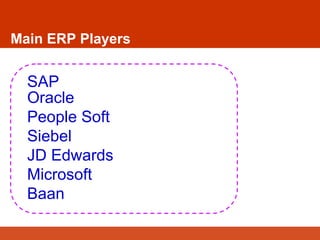
Oracle
People Soft
Siebel
JD Edwards
Microsoft
Baan
SAP
Main ERP Players
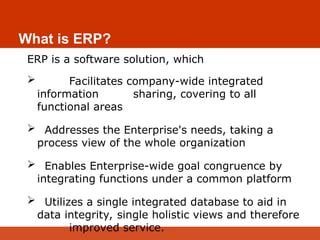
What is ERP?
ERP is a software solution, which
 Facilitates company-wide integrated
information sharing, covering to all
functional areas
 Addresses the Enterprise's needs, taking a
process view of the whole organization
 Enables Enterprise-wide goal congruence by
integrating functions under a common platform
 Utilizes a single integrated database to aid in
data integrity, single holistic views and therefore
improved service.
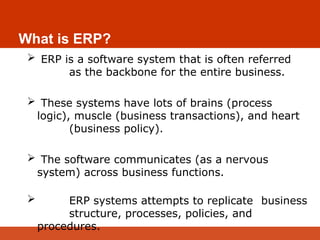
What is ERP?
 ERP is a software system that is often referred
as the backbone for the entire business.
 These systems have lots of brains (process
logic), muscle (business transactions), and heart
(business policy).
 The software communicates (as a nervous
system) across business functions.
 ERP systems attempts to replicate business
structure, processes, policies, and
procedures.
Why ERP is needed?

Reduced cycle time

Customer focus

Sharing information across the enterprise globally

Resource planning

Integration of manufacturing

Efficiency in distribution

Financial applications

Messaging and electronic mail

Document management and database systems

Internet technology and data warehousing
Why ERP is needed?
 The ERP systems have functionality to support
industry standard and best practices
(APICS).
 ERP systems are implemented by
companies for many tangible, intangible,
strategic benefits and hence don’t even try to
calculate Return On Investment (ROI).
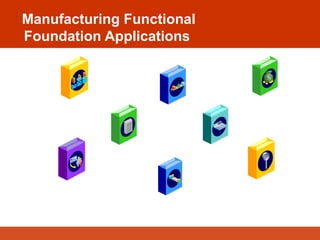
Manufacturing Functional
Foundation Applications
Oracle Bills of Material
and Engineering
Oracle Master
Scheduling / MRP
Oracle
Inventory
Oracle Cost
Management
Oracle Quality
Oracle Work
in Process
Oracle Order
Management
Oracle
Purchasing
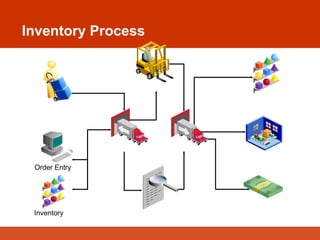
Inventory Process
Internal
Shipment
Receive Deliver
Inspect
Transfer
Shop Floor
Inventory
Supplier
Shipment
Expense
Inventory
Order Entry
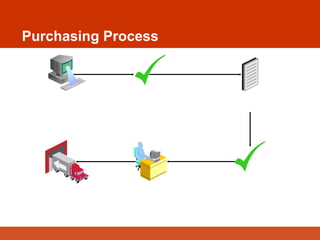
Purchasing Process
Create
requisition
AutoCreate
Purchasing
document
Send to
supplier
Receive
goods
Approve
requisition
Approve
document
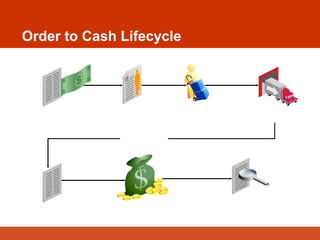
Order to Cash Lifecycle
Bank
Reconciliation
Invoice
Pick
Release
Book
Orders
Receiving
Payment
Enter and Price
Orders
Receivables
Ship
Confirm
Order Management
AutoInvoice
Cash Management
Shipping Execution
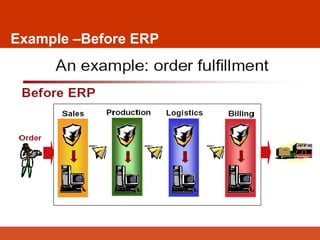
Example –Before ERP
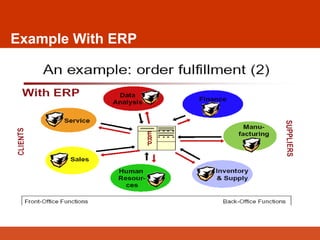
Example With ERP
Oracle Apps – Manufacturing & Distribution
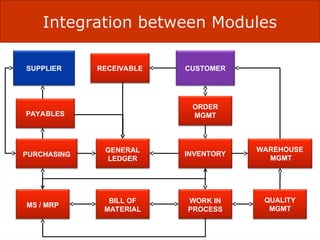
Integration between Modules
PAYABLES
PURCHASING
GENERAL
LEDGER
WORK IN
PROCESS
RECEIVABLE
ORDER
MGMT
INVENTORY
BILL OF
MATERIAL
MS / MRP
QUALITY
MGMT
WAREHOUSE
MGMT
CUSTOMER
SUPPLIER
 Independent of the nature of the Industry
 Easy Access to Information
 Integration of the cross functional business
processes
 Integration of Database, Application and People
 Consolidation of data in a single database
 Alignment with the best practices of the industry
 Efficient reporting facility
 Improve workflow and efficiency
 Improve control and program alerts
Benefits - ERP
Benefits - ERP
 Reduce the amount invested in inventory.
 Improve worker productivity.
 Reduce processing cost per business
transaction.
 Reduce the time to perform a financial close
and prepare statements.
 Reduce procurement costs.
 Install systems with vendor-supported
maintenance.
 Improve the scalability of business systems
to support future growth.
 Upgrade systems to support globalized
transactions.
Benefits - ERP
 Accuracy in reporting business Info.
 Replace legacy systems and install new or
improved business processes.
 Integrate and standardize processes among
business units and trading partners in supply
chain.
 Improve system performance, reliability, and fault
tolerance.
 Improve Order management, customer service
and on-time delivery.
Aerospace & Defense
Automotive
Chemicals
Consumer
Communications
Energy
Engineering & Construction
Financial Services
Government
Healthcare
High Technology
Higher Education
Industrial Manufacturing
Life Sciences
Professional Services
Retail
Travel & Transportation
Utilities
Any where - ERP
Develop
Market
Sell
Order
Plan
Procure
Make
Fulfill
Service
HR
Finance Projects
Maintain
All
All Information in One Place
in One Place
Oracle
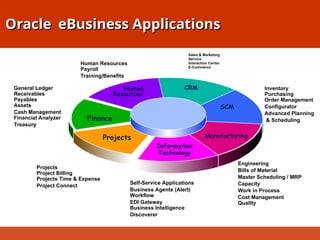
Oracle eBusiness Applications
eBusiness Applications
Finance
Self-Service Applications
Business Agents (Alert)
Workflow
EDI Gateway
Business Intelligence
Discoverer
Human Resources
Payroll
Training/Benefits
Sales & Marketing
Service
Interaction Center
E-Commerce
Inventory
Purchasing
Order Management
Configurator
Advanced Planning
& Scheduling
Projects
Project Billing
Projects Time & Expense
Project Connect
Engineering
Bills of Material
Master Scheduling / MRP
Capacity
Work in Process
Cost Management
Quality
Projects
Human
Resources
SCM
Information
Technology
Manufacturing
CRM
General Ledger
Receivables
Payables
Assets
Cash Management
Financial Analyzer
Treasury
Oracle Apps – Manufacturing & Distribution
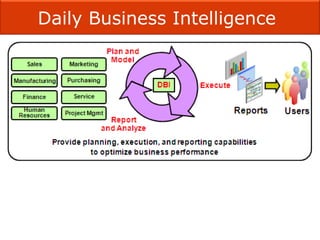
Daily Business Intelligence
Daily Business Intelligence is an integrated reporting
and analysis application that enables senior managers
and executives to see relevant, accurate, and timely
information using self-service dashboards.
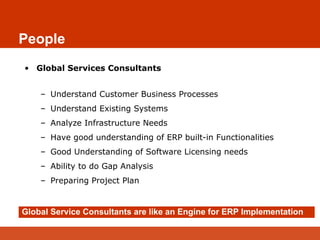
People
• Global Services Consultants
– Understand Customer Business Processes
– Understand Existing Systems
– Analyze Infrastructure Needs
– Have good understanding of ERP built-in Functionalities
– Good Understanding of Software Licensing needs
– Ability to do Gap Analysis
– Preparing Project Plan
Global Service Consultants are like an Engine for ERP Implementation
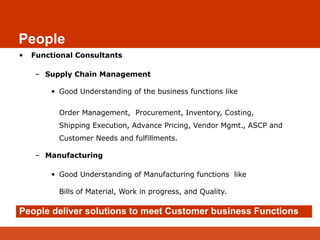
People
• Functional Consultants
– Supply Chain Management
• Good Understanding of the business functions like
Order Management, Procurement, Inventory, Costing,
Shipping Execution, Advance Pricing, Vendor Mgmt., ASCP and
Customer Needs and fulfillments.
– Manufacturing
• Good Understanding of Manufacturing functions like
Bills of Material, Work in progress, and Quality.
People deliver solutions to meet Customer business Functions
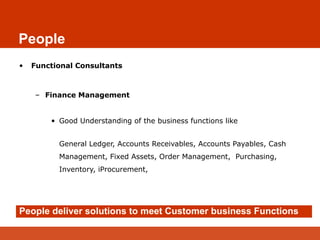
People
• Functional Consultants
– Finance Management
• Good Understanding of the business functions like
General Ledger, Accounts Receivables, Accounts Payables, Cash
Management, Fixed Assets, Order Management, Purchasing,
Inventory, iProcurement,
People deliver solutions to meet Customer business Functions
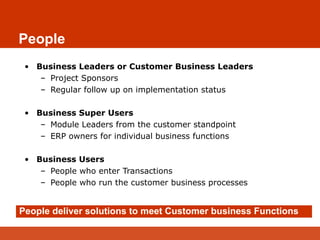
People
• Business Leaders or Customer Business Leaders
– Project Sponsors
– Regular follow up on implementation status
• Business Super Users
– Module Leaders from the customer standpoint
– ERP owners for individual business functions
• Business Users
– People who enter Transactions
– People who run the customer business processes
People deliver solutions to meet Customer business Functions
Conclusion
• Enterprise Resource Planning is the end result of thirty
years of trial and error, innovative thinking and
leveraging of computer technology.
• The business concepts embedded in it have and will
continue to produce tremendous competitive advantage
and economic benefit to the manufacturing industry.
• A sizable amount of time and dedication as well as
commitment from all user levels in an organization is
required for setting ERP up and running.
• ERP is the right tool for the years ahead.

Oracle Supply Chain management ERP Introduction

  • 1.
    Jagannath Vidyala welcomes All theParticipants to the ERP Overview Session
  • 2.
    Agenda 1. Introduction 2. Awarenesson ERP for better prospects. 3. What is ERP? 4. Why ERP is needed? 5. How ERP defines any process simple and easy? 6. Manufacturing processes 7. Procurement Process 8. Inventory Process 9. Integration between business functions 10.Benefits of ERP Software
  • 3.
  • 4.
    Introduction to ERP •Enterprise Resource Planning Enterprise Resource Planning (ERP) is an exercise that focuses on optimizing the way things are done internally. It attempts to integrate all departments and functions across a company onto a single computer system that can serve all those different departments' particular needs. ERP – Enterprise Resource Planning • Planning Resources for effective Utilization – Man – Money – Machinery – Materials • Integrating all the Departments – Inventory, Purchase, Production, Sales, Accounts etc.,
  • 5.
    ERP Evolution 1970’s MRP Inventoryand process time reduction with new production planning systems 1980’s MRP I Greater reductions due to the integration with Accounting and Human Resource Systems 2000 ERP Extended or ERP II Focused on clients, optimizing the whole business network, including suppliers and clients 1990’s MRP II Focused on clients, Real time transactions, Asset management
  • 6.
  • 7.
    What is ERP? ERPis a software solution, which  Facilitates company-wide integrated information sharing, covering to all functional areas  Addresses the Enterprise's needs, taking a process view of the whole organization  Enables Enterprise-wide goal congruence by integrating functions under a common platform  Utilizes a single integrated database to aid in data integrity, single holistic views and therefore improved service.
  • 8.
    What is ERP? ERP is a software system that is often referred as the backbone for the entire business.  These systems have lots of brains (process logic), muscle (business transactions), and heart (business policy).  The software communicates (as a nervous system) across business functions.  ERP systems attempts to replicate business structure, processes, policies, and procedures.
  • 9.
    Why ERP isneeded?  Reduced cycle time  Customer focus  Sharing information across the enterprise globally  Resource planning  Integration of manufacturing  Efficiency in distribution  Financial applications  Messaging and electronic mail  Document management and database systems  Internet technology and data warehousing
  • 10.
    Why ERP isneeded?  The ERP systems have functionality to support industry standard and best practices (APICS).  ERP systems are implemented by companies for many tangible, intangible, strategic benefits and hence don’t even try to calculate Return On Investment (ROI).
  • 11.
    Manufacturing Functional Foundation Applications OracleBills of Material and Engineering Oracle Master Scheduling / MRP Oracle Inventory Oracle Cost Management Oracle Quality Oracle Work in Process Oracle Order Management Oracle Purchasing
  • 12.
    Inventory Process Internal Shipment Receive Deliver Inspect Transfer ShopFloor Inventory Supplier Shipment Expense Inventory Order Entry
  • 13.
  • 14.
    Order to CashLifecycle Bank Reconciliation Invoice Pick Release Book Orders Receiving Payment Enter and Price Orders Receivables Ship Confirm Order Management AutoInvoice Cash Management Shipping Execution
  • 15.
  • 16.
  • 17.
    Oracle Apps –Manufacturing & Distribution Integration between Modules PAYABLES PURCHASING GENERAL LEDGER WORK IN PROCESS RECEIVABLE ORDER MGMT INVENTORY BILL OF MATERIAL MS / MRP QUALITY MGMT WAREHOUSE MGMT CUSTOMER SUPPLIER
  • 18.
     Independent ofthe nature of the Industry  Easy Access to Information  Integration of the cross functional business processes  Integration of Database, Application and People  Consolidation of data in a single database  Alignment with the best practices of the industry  Efficient reporting facility  Improve workflow and efficiency  Improve control and program alerts Benefits - ERP
  • 19.
    Benefits - ERP Reduce the amount invested in inventory.  Improve worker productivity.  Reduce processing cost per business transaction.  Reduce the time to perform a financial close and prepare statements.  Reduce procurement costs.  Install systems with vendor-supported maintenance.  Improve the scalability of business systems to support future growth.  Upgrade systems to support globalized transactions.
  • 20.
    Benefits - ERP Accuracy in reporting business Info.  Replace legacy systems and install new or improved business processes.  Integrate and standardize processes among business units and trading partners in supply chain.  Improve system performance, reliability, and fault tolerance.  Improve Order management, customer service and on-time delivery.
  • 21.
    Aerospace & Defense Automotive Chemicals Consumer Communications Energy Engineering& Construction Financial Services Government Healthcare High Technology Higher Education Industrial Manufacturing Life Sciences Professional Services Retail Travel & Transportation Utilities Any where - ERP
  • 22.
  • 23.
    Oracle Oracle eBusiness Applications eBusinessApplications Finance Self-Service Applications Business Agents (Alert) Workflow EDI Gateway Business Intelligence Discoverer Human Resources Payroll Training/Benefits Sales & Marketing Service Interaction Center E-Commerce Inventory Purchasing Order Management Configurator Advanced Planning & Scheduling Projects Project Billing Projects Time & Expense Project Connect Engineering Bills of Material Master Scheduling / MRP Capacity Work in Process Cost Management Quality Projects Human Resources SCM Information Technology Manufacturing CRM General Ledger Receivables Payables Assets Cash Management Financial Analyzer Treasury
  • 24.
    Oracle Apps –Manufacturing & Distribution Daily Business Intelligence Daily Business Intelligence is an integrated reporting and analysis application that enables senior managers and executives to see relevant, accurate, and timely information using self-service dashboards.
  • 25.
    People • Global ServicesConsultants – Understand Customer Business Processes – Understand Existing Systems – Analyze Infrastructure Needs – Have good understanding of ERP built-in Functionalities – Good Understanding of Software Licensing needs – Ability to do Gap Analysis – Preparing Project Plan Global Service Consultants are like an Engine for ERP Implementation
  • 26.
    People • Functional Consultants –Supply Chain Management • Good Understanding of the business functions like Order Management, Procurement, Inventory, Costing, Shipping Execution, Advance Pricing, Vendor Mgmt., ASCP and Customer Needs and fulfillments. – Manufacturing • Good Understanding of Manufacturing functions like Bills of Material, Work in progress, and Quality. People deliver solutions to meet Customer business Functions
  • 27.
    People • Functional Consultants –Finance Management • Good Understanding of the business functions like General Ledger, Accounts Receivables, Accounts Payables, Cash Management, Fixed Assets, Order Management, Purchasing, Inventory, iProcurement, People deliver solutions to meet Customer business Functions
  • 28.
    People • Business Leadersor Customer Business Leaders – Project Sponsors – Regular follow up on implementation status • Business Super Users – Module Leaders from the customer standpoint – ERP owners for individual business functions • Business Users – People who enter Transactions – People who run the customer business processes People deliver solutions to meet Customer business Functions
  • 29.
    Conclusion • Enterprise ResourcePlanning is the end result of thirty years of trial and error, innovative thinking and leveraging of computer technology. • The business concepts embedded in it have and will continue to produce tremendous competitive advantage and economic benefit to the manufacturing industry. • A sizable amount of time and dedication as well as commitment from all user levels in an organization is required for setting ERP up and running. • ERP is the right tool for the years ahead.

Editor's Notes

  • #11 Manufacturing Functional Foundation The functional foundation of Oracle Manufacturing / Supply Chain consists of the following products: Oracle Bills of Material / Engineering Oracle Inventory Oracle Cost Management Oracle Purchasing Oracle Order Management Oracle Master Scheduling / MRP Oracle Work in Process Oracle Quality
  • #12 Inventory Overview You must plan how Oracle Inventory represents your company’s inventory sites and business units. This includes defining organizations, locations, subinventories, and locators depending on your company structure. Oracle Inventory, with Oracle Order Management, Oracle Purchasing, and Oracle Work in Process, provides you with a complete set of transactions and reports for maintaining inventory control. This enables you to control the flow of material from the time you receive items to the time you ship finished goods to the customer. Instructor Note: Refer to the Oracle Inventory User’s Guide.
  • #13 Purchasing Overview Through Oracle Purchasing, you can automatically create and approve purchase orders, manage suppliers and items, and track projects and reports. Purchasing streamlines the procurement process with end-to-end business automation for direct and indirect materials and services. Instructor Note: Refer participants to the Oracle Purchasing User’s Guide.
  • #14 Order to Cash Lifecycle You can enter orders manually or import orders from external systems like CRM, EDI/XML. In a standard order lifecycle, the order is priced, scheduled and booked, then shipped to customers. Items may be accepted or rejected by customers, in which case returns (with or without credit notes) are registered in the Order Management module. Other order cycles include: Drop Shipments (where the items are sent directly to the customers from the suppliers as the company may not have them in stock). Sales Agreements (long term agreements between the company and the customer to transact goods over a period of time in specified quantities or amount) Internal Orders (where items are required by an organization that belongs to the same legal entity/set of books). In Order Management the order is entered which allows for a review of the order information including: customer, ship-to, bill-to, payment terms, order type, price list, unit price, and warehouse. Then the order is booked which allows it to proceed through the workflow process. If it is a shipping item and the quantities are available, it can be processed by shipping execution. In Shipping Execution the order is pick released which generates the move order. Once the item is brought from the sub-inventory into the staging area it is ready to be placed on a shipping vehicle. Now you can run the ship confirm process to allow the shipment to processed. AutoInvoice is run to bring the order from Order Management to Receivables. In Receivables you can print the invoice and send it to the customer. You can proceed with collection efforts until you receive payment and post your receipt. In Cash Management the system pulls information from posted receipts and matches them to the bank statement for reconciliation.
  • #23 A tightly integrated family of Application Products with a common database Automates an entire enterprise with more than 35 software modules Provides strong built-in adaptability Full Graphical User Interface Business Flow Orientation Oracle Application enables: Worldwide Best Practices Standardisation of Business Processes across the Organisation Enables Global Financial Management Enterprise Decision Support Rapid Continuous Improvement