1

11/6/2013

CONSTRUCTION
ERGONOMICS

SIMPLE SOLUTIONS
ANKUR SHARMA
12IH401, MIHS


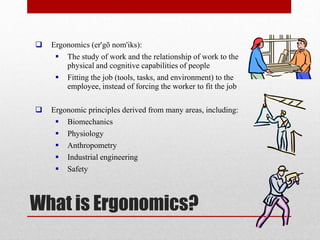
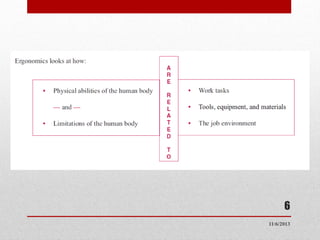
Ergonomics (er'gõ nom'iks):
 The study of work and the relationship of work to the
physical and cognitive capabilities of people
 Fitting the job (tools, tasks, and environment) to the
employee, instead of forcing the worker to fit the job



Ergonomic principles derived from many areas, including:
 Biomechanics
 Physiology
 Anthropometry
 Industrial engineering
 Safety

What is Ergonomics?
•

Two classifications of ergonomic injuries
• Cumulative Trauma Disorders (CTD’s) – exposure driven
• Strains/Sprains – instantaneous (event driven)

Ergonomic Injuries
•

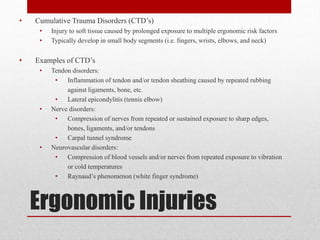
Cumulative Trauma Disorders (CTD’s)
•
•

•

Injury to soft tissue caused by prolonged exposure to multiple ergonomic risk factors
Typically develop in small body segments (i.e. fingers, wrists, elbows, and neck)

Examples of CTD’s
•

•

•

Tendon disorders:
•
Inflammation of tendon and/or tendon sheathing caused by repeated rubbing
against ligaments, bone, etc.
•
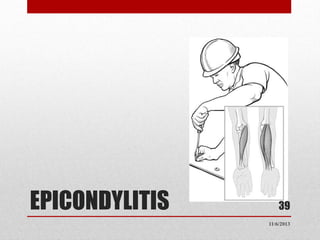
Lateral epicondylitis (tennis elbow)
Nerve disorders:
•
Compression of nerves from repeated or sustained exposure to sharp edges,
bones, ligaments, and/or tendons
•
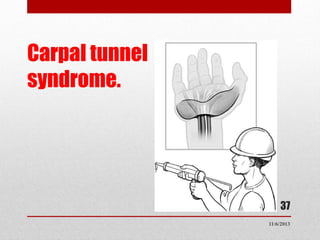
Carpal tunnel syndrome
Neurovascular disorders:
•
Compression of blood vessels and/or nerves from repeated exposure to vibration
or cold temperatures
•
Raynaud’s phenomenon (white finger syndrome)

Ergonomic Injuries
•

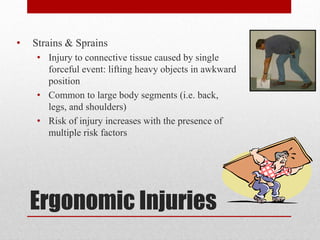
Strains & Sprains
• Injury to connective tissue caused by single
forceful event: lifting heavy objects in awkward
position
• Common to large body segments (i.e. back,
legs, and shoulders)
• Risk of injury increases with the presence of
multiple risk factors

Ergonomic Injuries
6
11/6/2013
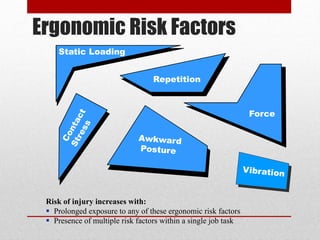
Ergonomic Risk Factors
Static Loading
Repetition

Force

Risk of injury increases with:
 Prolonged exposure to any of these ergonomic risk factors
 Presence of multiple risk factors within a single job task
8
11/6/2013
9
11/6/2013
•

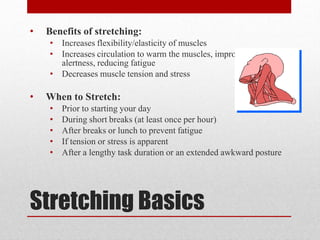
Benefits of stretching:
• Increases flexibility/elasticity of muscles
• Increases circulation to warm the muscles, improving mental
alertness, reducing fatigue
• Decreases muscle tension and stress

•

When to Stretch:
•
•
•
•
•

Prior to starting your day
During short breaks (at least once per hour)
After breaks or lunch to prevent fatigue
If tension or stress is apparent
After a lengthy task duration or an extended awkward posture

Stretching Basics
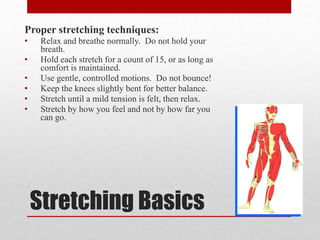
Proper stretching techniques:
•
•
•
•
•
•

Relax and breathe normally. Do not hold your
breath.
Hold each stretch for a count of 15, or as long as
comfort is maintained.
Use gentle, controlled motions. Do not bounce!
Keep the knees slightly bent for better balance.
Stretch until a mild tension is felt, then relax.
Stretch by how you feel and not by how far you
can go.

Stretching Basics
Simple Solutions
Ergonomics for Construction Workers

12
11/6/2013
13
11/6/2013
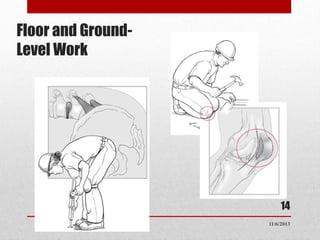
Floor and GroundLevel Work

14
11/6/2013
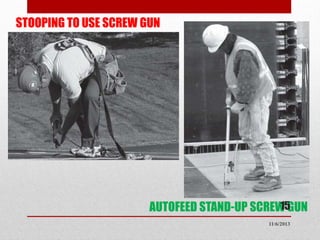
STOOPING TO USE SCREW GUN

15
AUTOFEED STAND-UP SCREW GUN
11/6/2013
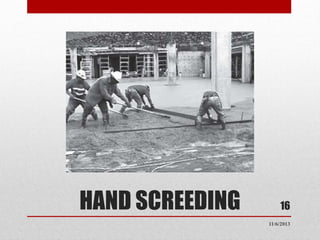
HAND SCREEDING

16
11/6/2013
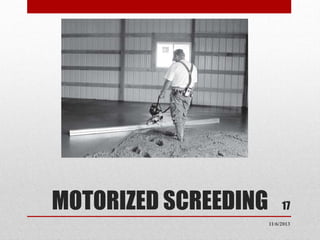
MOTORIZED SCREEDING

17
11/6/2013
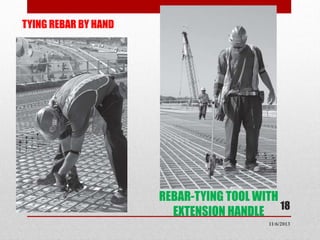
TYING REBAR BY HAND

REBAR-TYING TOOL WITH
18
EXTENSION HANDLE
11/6/2013
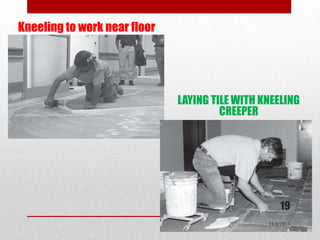
Kneeling to work near floor

LAYING TILE WITH KNEELING
CREEPER

19
11/6/2013
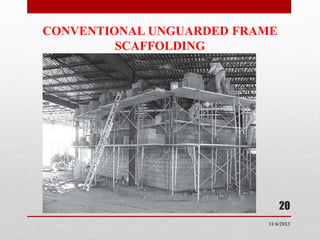
CONVENTIONAL UNGUARDED FRAME
SCAFFOLDING

20
11/6/2013
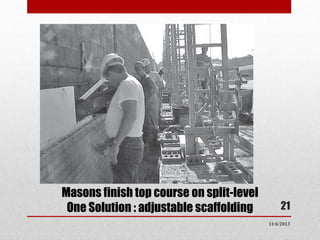
Masons finish top course on split-level
One Solution : adjustable scaffolding

21
11/6/2013
22
11/6/2013
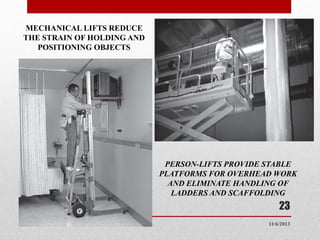
MECHANICAL LIFTS REDUCE
THE STRAIN OF HOLDING AND
POSITIONING OBJECTS

PERSON-LIFTS PROVIDE STABLE
PLATFORMS FOR OVERHEAD WORK
AND ELIMINATE HANDLING OF
LADDERS AND SCAFFOLDING

23
11/6/2013
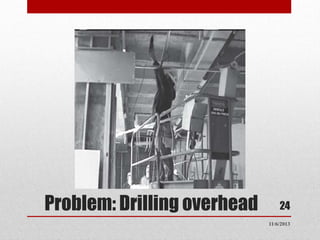
Problem: Drilling overhead

24
11/6/2013
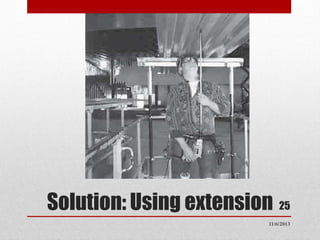
Solution: Using extension 25
11/6/2013
26
11/6/2013
27
11/6/2013
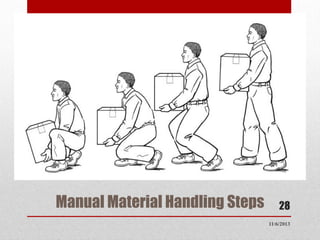
Manual Material Handling Steps

28
11/6/2013
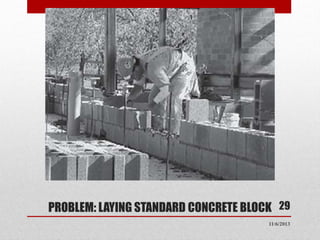
PROBLEM: LAYING STANDARD CONCRETE BLOCK 29
11/6/2013
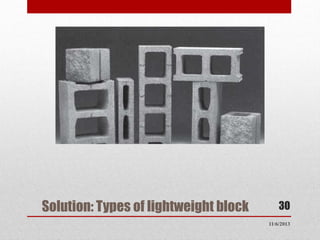
Solution: Types of lightweight block

30
11/6/2013
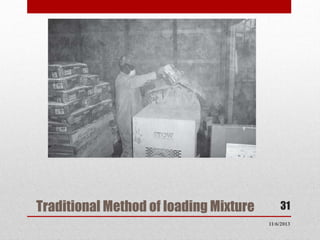
Traditional Method of loading Mixture

31
11/6/2013
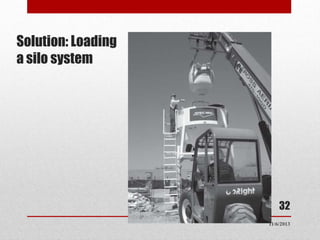
Solution: Loading
a silo system

32
11/6/2013
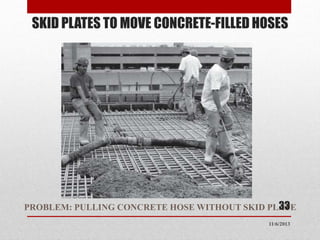
SKID PLATES TO MOVE CONCRETE-FILLED HOSES

33
PROBLEM: PULLING CONCRETE HOSE WITHOUT SKID PLATE
11/6/2013
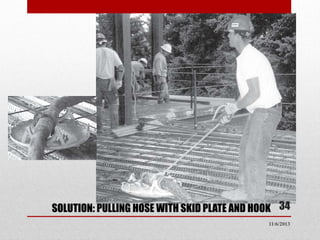
SOLUTION: PULLING HOSE WITH SKID PLATE AND HOOK 34
11/6/2013
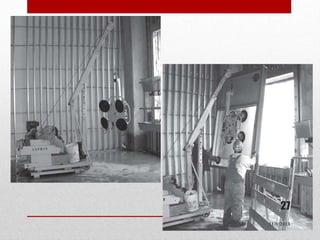
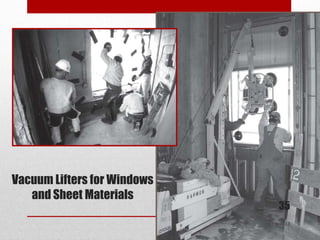
Vacuum Lifters for Windows
and Sheet Materials

35
11/6/2013
36
Carpal tunnel
syndrome.

37
11/6/2013
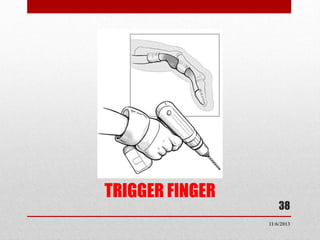
TRIGGER FINGER

38
11/6/2013
EPICONDYLITIS

39
11/6/2013
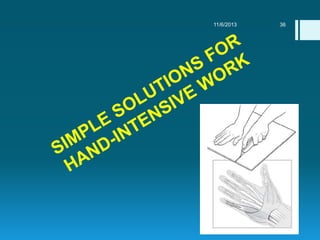
Hand-intensive work cannot be eliminated from construction :
 General solutions for doing hand-intensive work with less
risk of injury include
 Change tools and/or equipment.
 Change work rules and provide training.

40
11/6/2013
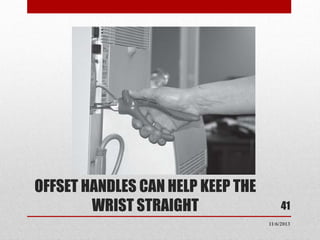
OFFSET HANDLES CAN HELP KEEP THE
WRIST STRAIGHT

41
11/6/2013
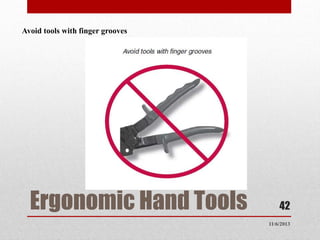
Avoid tools with finger grooves

Ergonomic Hand Tools

42
11/6/2013
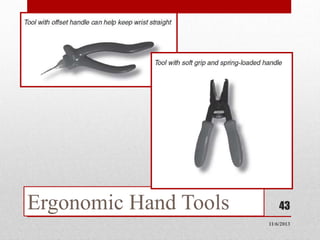
Avoid tools with finger grooves

Ergonomic Hand Tools

43
11/6/2013
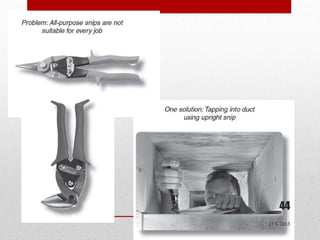
44
11/6/2013
45
11/6/2013
46
11/6/2013
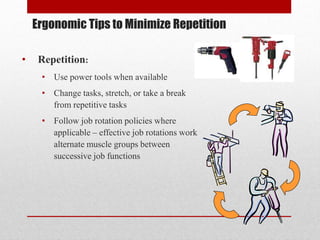
Ergonomic Tips to Minimize Repetition
•

Repetition:
• Use power tools when available
• Change tasks, stretch, or take a break
from repetitive tasks
• Follow job rotation policies where
applicable – effective job rotations work
alternate muscle groups between
successive job functions
Ergonomic Tips to Minimize Static Loading
•

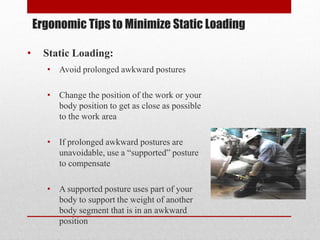
Static Loading:
• Avoid prolonged awkward postures
• Change the position of the work or your
body position to get as close as possible
to the work area

• If prolonged awkward postures are
unavoidable, use a “supported” posture
to compensate
• A supported posture uses part of your
body to support the weight of another
body segment that is in an awkward
position
Ergonomic Tips to Minimize Contact Stress
•

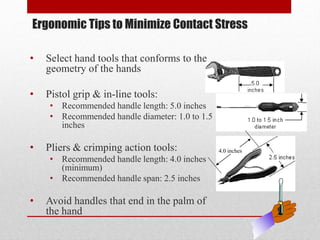
Select hand tools that conforms to the
geometry of the hands

•

Pistol grip & in-line tools:
• Recommended handle length: 5.0 inches
• Recommended handle diameter: 1.0 to 1.5
inches

•

Pliers & crimping action tools:
• Recommended handle length: 4.0 inches
(minimum)
• Recommended handle span: 2.5 inches

•

Avoid handles that end in the palm of
the hand

4.0 inches
Ergonomic Tips to Minimize Contact Stress
 Avoid pressure on palms, wrists, and
elbows:
 Use padding on hard or sharp surfaces
 Change your position to eliminate the
stress

•

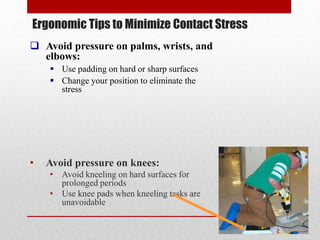
Avoid pressure on knees:
• Avoid kneeling on hard surfaces for
prolonged periods
• Use knee pads when kneeling tasks are
unavoidable
Ergonomic Tips to Minimize Force
•

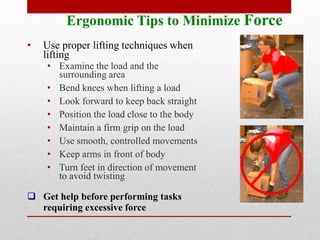
Use proper lifting techniques when
lifting

• Examine the load and the
surrounding area
• Bend knees when lifting a load
• Look forward to keep back straight
• Position the load close to the body
• Maintain a firm grip on the load
• Use smooth, controlled movements
• Keep arms in front of body
• Turn feet in direction of movement
to avoid twisting

 Get help before performing tasks
requiring excessive force
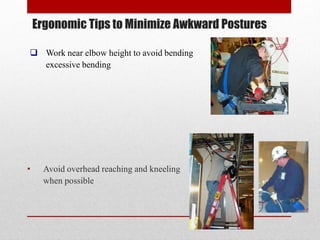
Ergonomic Tips to Minimize Awkward Postures
 Work near elbow height to avoid bending
excessive bending

•

Avoid overhead reaching and kneeling
when possible
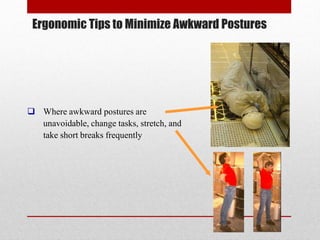
Ergonomic Tips to Minimize Awkward Postures

 Where awkward postures are
unavoidable, change tasks, stretch, and
take short breaks frequently
•

Minimize ergonomic risk factors in your area

•

Stretch throughout the shift especially before and after
activities that require awkward positions or lifting

•

Pay attention to your body and know your physical
limitations

•

Report ergonomics issues through appropriate channels.

•

Ergonomic injuries are preventable, and you own your
own safety

Summary
11/6/2013

55

 A guide to selecting non-powered hand
 Practical demonstrations of ergonomic principles tools
 Ergonomics: implement ergonomic interventions in construction
 An Ergonomic Walkthrough Observation of Carpentry Tasks

 Ergonomic/Biomechanical Principles
 An Ergonomic Evaluation of Excavating Operations
 Construction Ergonomics
 Ergonomics For Scaffold Erection
 Spreading good ideas: A case study of the adoption of an

innovation in the construction sector
 OSHA Excavation & trenching training

References

Ergonomics issues in Construction

  • 1.
  • 2.
     Ergonomics (er'gõ nom'iks): The study of work and the relationship of work to the physical and cognitive capabilities of people  Fitting the job (tools, tasks, and environment) to the employee, instead of forcing the worker to fit the job  Ergonomic principles derived from many areas, including:  Biomechanics  Physiology  Anthropometry  Industrial engineering  Safety What is Ergonomics?
  • 3.
    • Two classifications ofergonomic injuries • Cumulative Trauma Disorders (CTD’s) – exposure driven • Strains/Sprains – instantaneous (event driven) Ergonomic Injuries
  • 4.
    • Cumulative Trauma Disorders(CTD’s) • • • Injury to soft tissue caused by prolonged exposure to multiple ergonomic risk factors Typically develop in small body segments (i.e. fingers, wrists, elbows, and neck) Examples of CTD’s • • • Tendon disorders: • Inflammation of tendon and/or tendon sheathing caused by repeated rubbing against ligaments, bone, etc. • Lateral epicondylitis (tennis elbow) Nerve disorders: • Compression of nerves from repeated or sustained exposure to sharp edges, bones, ligaments, and/or tendons • Carpal tunnel syndrome Neurovascular disorders: • Compression of blood vessels and/or nerves from repeated exposure to vibration or cold temperatures • Raynaud’s phenomenon (white finger syndrome) Ergonomic Injuries
  • 5.
    • Strains & Sprains •Injury to connective tissue caused by single forceful event: lifting heavy objects in awkward position • Common to large body segments (i.e. back, legs, and shoulders) • Risk of injury increases with the presence of multiple risk factors Ergonomic Injuries
  • 6.
  • 7.
    Ergonomic Risk Factors StaticLoading Repetition Force Risk of injury increases with:  Prolonged exposure to any of these ergonomic risk factors  Presence of multiple risk factors within a single job task
  • 8.
  • 9.
  • 10.
    • Benefits of stretching: •Increases flexibility/elasticity of muscles • Increases circulation to warm the muscles, improving mental alertness, reducing fatigue • Decreases muscle tension and stress • When to Stretch: • • • • • Prior to starting your day During short breaks (at least once per hour) After breaks or lunch to prevent fatigue If tension or stress is apparent After a lengthy task duration or an extended awkward posture Stretching Basics
  • 11.
    Proper stretching techniques: • • • • • • Relaxand breathe normally. Do not hold your breath. Hold each stretch for a count of 15, or as long as comfort is maintained. Use gentle, controlled motions. Do not bounce! Keep the knees slightly bent for better balance. Stretch until a mild tension is felt, then relax. Stretch by how you feel and not by how far you can go. Stretching Basics
  • 12.
    Simple Solutions Ergonomics forConstruction Workers 12 11/6/2013
  • 13.
  • 14.
    Floor and GroundLevelWork 14 11/6/2013
  • 15.
    STOOPING TO USESCREW GUN 15 AUTOFEED STAND-UP SCREW GUN 11/6/2013
  • 16.
  • 17.
  • 18.
    TYING REBAR BYHAND REBAR-TYING TOOL WITH 18 EXTENSION HANDLE 11/6/2013
  • 19.
    Kneeling to worknear floor LAYING TILE WITH KNEELING CREEPER 19 11/6/2013
  • 20.
  • 21.
    Masons finish topcourse on split-level One Solution : adjustable scaffolding 21 11/6/2013
  • 22.
  • 23.
    MECHANICAL LIFTS REDUCE THESTRAIN OF HOLDING AND POSITIONING OBJECTS PERSON-LIFTS PROVIDE STABLE PLATFORMS FOR OVERHEAD WORK AND ELIMINATE HANDLING OF LADDERS AND SCAFFOLDING 23 11/6/2013
  • 24.
  • 25.
  • 26.
  • 27.
  • 28.
    Manual Material HandlingSteps 28 11/6/2013
  • 29.
    PROBLEM: LAYING STANDARDCONCRETE BLOCK 29 11/6/2013
  • 30.
    Solution: Types oflightweight block 30 11/6/2013
  • 31.
    Traditional Method ofloading Mixture 31 11/6/2013
  • 32.
    Solution: Loading a silosystem 32 11/6/2013
  • 33.
    SKID PLATES TOMOVE CONCRETE-FILLED HOSES 33 PROBLEM: PULLING CONCRETE HOSE WITHOUT SKID PLATE 11/6/2013
  • 34.
    SOLUTION: PULLING HOSEWITH SKID PLATE AND HOOK 34 11/6/2013
  • 35.
    Vacuum Lifters forWindows and Sheet Materials 35 11/6/2013
  • 36.
  • 37.
  • 38.
  • 39.
  • 40.
    Hand-intensive work cannotbe eliminated from construction :  General solutions for doing hand-intensive work with less risk of injury include  Change tools and/or equipment.  Change work rules and provide training. 40 11/6/2013
  • 41.
    OFFSET HANDLES CANHELP KEEP THE WRIST STRAIGHT 41 11/6/2013
  • 42.
    Avoid tools withfinger grooves Ergonomic Hand Tools 42 11/6/2013
  • 43.
    Avoid tools withfinger grooves Ergonomic Hand Tools 43 11/6/2013
  • 44.
  • 45.
  • 46.
  • 47.
    Ergonomic Tips toMinimize Repetition • Repetition: • Use power tools when available • Change tasks, stretch, or take a break from repetitive tasks • Follow job rotation policies where applicable – effective job rotations work alternate muscle groups between successive job functions
  • 48.
    Ergonomic Tips toMinimize Static Loading • Static Loading: • Avoid prolonged awkward postures • Change the position of the work or your body position to get as close as possible to the work area • If prolonged awkward postures are unavoidable, use a “supported” posture to compensate • A supported posture uses part of your body to support the weight of another body segment that is in an awkward position
  • 49.
    Ergonomic Tips toMinimize Contact Stress • Select hand tools that conforms to the geometry of the hands • Pistol grip & in-line tools: • Recommended handle length: 5.0 inches • Recommended handle diameter: 1.0 to 1.5 inches • Pliers & crimping action tools: • Recommended handle length: 4.0 inches (minimum) • Recommended handle span: 2.5 inches • Avoid handles that end in the palm of the hand 4.0 inches
  • 50.
    Ergonomic Tips toMinimize Contact Stress  Avoid pressure on palms, wrists, and elbows:  Use padding on hard or sharp surfaces  Change your position to eliminate the stress • Avoid pressure on knees: • Avoid kneeling on hard surfaces for prolonged periods • Use knee pads when kneeling tasks are unavoidable
  • 51.
    Ergonomic Tips toMinimize Force • Use proper lifting techniques when lifting • Examine the load and the surrounding area • Bend knees when lifting a load • Look forward to keep back straight • Position the load close to the body • Maintain a firm grip on the load • Use smooth, controlled movements • Keep arms in front of body • Turn feet in direction of movement to avoid twisting  Get help before performing tasks requiring excessive force
  • 52.
    Ergonomic Tips toMinimize Awkward Postures  Work near elbow height to avoid bending excessive bending • Avoid overhead reaching and kneeling when possible
  • 53.
    Ergonomic Tips toMinimize Awkward Postures  Where awkward postures are unavoidable, change tasks, stretch, and take short breaks frequently
  • 54.
    • Minimize ergonomic riskfactors in your area • Stretch throughout the shift especially before and after activities that require awkward positions or lifting • Pay attention to your body and know your physical limitations • Report ergonomics issues through appropriate channels. • Ergonomic injuries are preventable, and you own your own safety Summary
  • 55.
    11/6/2013 55  A guideto selecting non-powered hand  Practical demonstrations of ergonomic principles tools  Ergonomics: implement ergonomic interventions in construction  An Ergonomic Walkthrough Observation of Carpentry Tasks  Ergonomic/Biomechanical Principles  An Ergonomic Evaluation of Excavating Operations  Construction Ergonomics  Ergonomics For Scaffold Erection  Spreading good ideas: A case study of the adoption of an innovation in the construction sector  OSHA Excavation & trenching training References