Ergonomic Risk Factors
and Control Methods
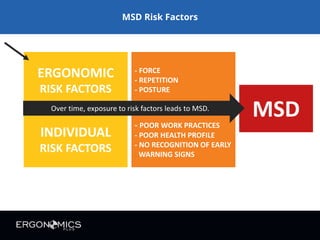
MSD Risk Factors
INDIVIDUAL
RISK FACTORS
ERGONOMIC
RISK FACTORS
MSD
- FORCE
- REPETITION
- POSTURE
- POOR WORK PRACTICES
- POOR HEALTH PROFILE
- NO RECOGNITION OF
EARLY WARNING SIGNS
Over time, exposure to risk factors leads to MSD.
Ergo-Plus.com
MSD Prevention Controls
ERGONOMIC
CONTROLS
INDIVIDUAL
CONTROLS
PREVENT
MSDs
Identify and remove
ergonomic risk factors.
Identify and remove
individual risk factors
Prevent MSDs by identifying and removing risk factors.
Ergo-Plus.com
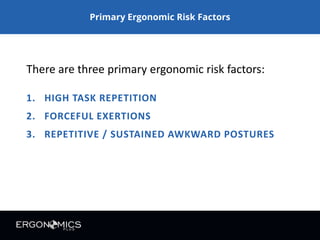
Primary Ergonomic Risk Factors
FORCE REPETITION POSTURE
Many work tasks require high force loads on the human body.
Muscle effort increases in response to high force requirements,
increasing associated fatigue which can lead to MSD.
Ergo-Plus.com
Primary Ergonomic Risk Factors
FORCE REPETITION POSTURE
High Force
Requirement
= RISK!
Ergo-Plus.com
Primary Ergonomic Risk Factors
FORCE REPETITION POSTURE
ENGINEERING CONTROLS
Eliminating excessive force requirements will reduce worker fatigue
and the risk of MSD formation in most workers. Using mechanical
assists, counter balance systems, adjustable height lift tables and
workstations, powered equipment and ergonomic tools will reduce
work effort and muscle exertions.
Control Methods for Excessive Force
Ergo-Plus.com
Primary Ergonomic Risk Factors
FORCE REPETITION POSTURE
WORK PRACTICE CONTROLS
Work process improvements such as using carts and dollies to
reduce lifting and carrying demands, sliding objects instead of
carrying or lifting, and eliminating any reaching obstruction to
reduce the lever arm required to lift the object.
Control Methods for Excessive Force
Ergo-Plus.com
Primary Ergonomic Risk Factors
FORCE REPETITION POSTURE
PROPER BODY MECHANICS
Workers should be trained to use proper lifting and work
techniques to reduce force requirements.
Control Methods for Excessive Force
Ergo-Plus.com
Primary Ergonomic Risk Factors
FORCE REPETITION POSTURE
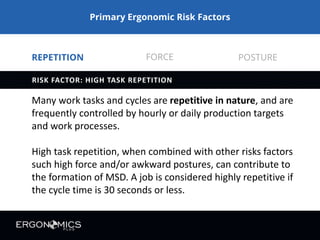
Many work tasks and cycles are repetitive in nature, and are
frequently controlled by hourly or daily production targets and work
processes.
High task repetition, when combined with other risks factors such
high force and/or awkward postures, can contribute to the formation
of MSD. A job is considered highly repetitive if the cycle time is 30
seconds or less.
Ergo-Plus.com
Primary Ergonomic Risk Factors
FORCE REPETITION POSTURE
High Task Repetition
= RISK!
Ergo-Plus.com
Primary Ergonomic Risk Factors
FORCE REPETITION POSTURE
ENINEERING CONTROLS
Eliminating excessive force and awkward posture requirements will
reduce worker fatigue and allow high repetition tasks to be
performed without a significant increase in MSD risk for most
workers.
Control Methods for High Repetition
Ergo-Plus.com
Primary Ergonomic Risk Factors
FORCE REPETITION POSTURE
WORK PRACTICE CONTROLS
Providing safe & effective procedures for completing work tasks can
reduce MSD risk. In addition, workers should be trained on proper
work technique and encouraged to accept their responsibilities for
MSD prevention.
Control Methods for High Repetition
Ergo-Plus.com
Primary Ergonomic Risk Factors
FORCE REPETITION POSTURE
JOB ROTATION
Job task enlargement is a way to reduce duration, frequency and
severity of MSD risk factors. Workers can rotate between
workstations and tasks to avoid prolonged periods of performing a
single task, thereby reducing fatigue that can lead to MSD.
Control Methods for High Repetition
Ergo-Plus.com
Primary Ergonomic Risk Factors
FORCE REPETITION POSTURE
COUNTERACTIVE STRETCH BREAKS
Implement rest or stretch breaks to provide an opportunity for
increased circulation needed for recovery.
Control Methods for High Repetition
Ergo-Plus.com
Primary Ergonomic Risk Factors
FORCE REPETITION POSTURE
Awkward postures place excessive force on joints and overload the
muscles and tendons around the effected joint. Joints of the body
are most efficient when they operate closest to the mid-range
motion of the joint.
Risk of MSD is increased when joints are worked outside of this mid-
range repetitively or for sustained periods of time without adequate
recovery time.
Ergo-Plus.com
Primary Ergonomic Risk Factors
FORCE REPETITION POSTURE
Awkward postures
= RISK!
Ergo-Plus.com
Primary Ergonomic Risk Factors
FORCE REPETITION POSTURE
ENGINEERING CONTROLS
Eliminate or reduce awkward postures with ergonomic modifications
that seek to maintain joint range of motion to accomplish work tasks
within the mid-range of motion positions for vulnerable joints.
Proper ergonomic tools should be utilized that allow workers to
maintain optimal joint positions.
Control Methods for Awkward Postures
Ergo-Plus.com
Primary Ergonomic Risk Factors
FORCE REPETITION POSTURE
WORK PRACTICE CONTROLS
Work procedures that consider and reduce awkward postures should
be implemented. In addition, workers should be trained on proper
work technique and encouraged to accept their responsibility to use
their body properly and to avoid awkward postures whenever
possible.
Control Methods for Awkward Postures
Ergo-Plus.com
Primary Ergonomic Risk Factors
FORCE REPETITION POSTURE
JOB ROTATION CONTROLS
Job rotation and job task enlargement is a way to reduce repeated
and sustained awkward postures that can lead to MSD.
Control Methods for Awkward Postures
Ergo-Plus.com
Primary Ergonomic Risk Factors
FORCE REPETITION POSTURE
COUNTERACTIVE STRETCH BREAKS
Implement rest or stretch breaks to provide an opportunity to
counteract any repeated or sustained awkward postures and allow
for adequate recovery time.
Control Methods for Awkward Postures
Ergo-Plus.com

Ergonomic Risk Factors and Control Methods

  • 1.
  • 2.
    MSD Risk Factors INDIVIDUAL RISKFACTORS ERGONOMIC RISK FACTORS MSD - FORCE - REPETITION - POSTURE - POOR WORK PRACTICES - POOR HEALTH PROFILE - NO RECOGNITION OF EARLY WARNING SIGNS Over time, exposure to risk factors leads to MSD. Ergo-Plus.com
  • 3.
    MSD Prevention Controls ERGONOMIC CONTROLS INDIVIDUAL CONTROLS PREVENT MSDs Identifyand remove ergonomic risk factors. Identify and remove individual risk factors Prevent MSDs by identifying and removing risk factors. Ergo-Plus.com
  • 4.
    Primary Ergonomic RiskFactors FORCE REPETITION POSTURE Many work tasks require high force loads on the human body. Muscle effort increases in response to high force requirements, increasing associated fatigue which can lead to MSD. Ergo-Plus.com
  • 5.
    Primary Ergonomic RiskFactors FORCE REPETITION POSTURE High Force Requirement = RISK! Ergo-Plus.com
  • 6.
    Primary Ergonomic RiskFactors FORCE REPETITION POSTURE ENGINEERING CONTROLS Eliminating excessive force requirements will reduce worker fatigue and the risk of MSD formation in most workers. Using mechanical assists, counter balance systems, adjustable height lift tables and workstations, powered equipment and ergonomic tools will reduce work effort and muscle exertions. Control Methods for Excessive Force Ergo-Plus.com
  • 7.
    Primary Ergonomic RiskFactors FORCE REPETITION POSTURE WORK PRACTICE CONTROLS Work process improvements such as using carts and dollies to reduce lifting and carrying demands, sliding objects instead of carrying or lifting, and eliminating any reaching obstruction to reduce the lever arm required to lift the object. Control Methods for Excessive Force Ergo-Plus.com
  • 8.
    Primary Ergonomic RiskFactors FORCE REPETITION POSTURE PROPER BODY MECHANICS Workers should be trained to use proper lifting and work techniques to reduce force requirements. Control Methods for Excessive Force Ergo-Plus.com
  • 9.
    Primary Ergonomic RiskFactors FORCE REPETITION POSTURE Many work tasks and cycles are repetitive in nature, and are frequently controlled by hourly or daily production targets and work processes. High task repetition, when combined with other risks factors such high force and/or awkward postures, can contribute to the formation of MSD. A job is considered highly repetitive if the cycle time is 30 seconds or less. Ergo-Plus.com
  • 10.
    Primary Ergonomic RiskFactors FORCE REPETITION POSTURE High Task Repetition = RISK! Ergo-Plus.com
  • 11.
    Primary Ergonomic RiskFactors FORCE REPETITION POSTURE ENINEERING CONTROLS Eliminating excessive force and awkward posture requirements will reduce worker fatigue and allow high repetition tasks to be performed without a significant increase in MSD risk for most workers. Control Methods for High Repetition Ergo-Plus.com
  • 12.
    Primary Ergonomic RiskFactors FORCE REPETITION POSTURE WORK PRACTICE CONTROLS Providing safe & effective procedures for completing work tasks can reduce MSD risk. In addition, workers should be trained on proper work technique and encouraged to accept their responsibilities for MSD prevention. Control Methods for High Repetition Ergo-Plus.com
  • 13.
    Primary Ergonomic RiskFactors FORCE REPETITION POSTURE JOB ROTATION Job task enlargement is a way to reduce duration, frequency and severity of MSD risk factors. Workers can rotate between workstations and tasks to avoid prolonged periods of performing a single task, thereby reducing fatigue that can lead to MSD. Control Methods for High Repetition Ergo-Plus.com
  • 14.
    Primary Ergonomic RiskFactors FORCE REPETITION POSTURE COUNTERACTIVE STRETCH BREAKS Implement rest or stretch breaks to provide an opportunity for increased circulation needed for recovery. Control Methods for High Repetition Ergo-Plus.com
  • 15.
    Primary Ergonomic RiskFactors FORCE REPETITION POSTURE Awkward postures place excessive force on joints and overload the muscles and tendons around the effected joint. Joints of the body are most efficient when they operate closest to the mid-range motion of the joint. Risk of MSD is increased when joints are worked outside of this mid- range repetitively or for sustained periods of time without adequate recovery time. Ergo-Plus.com
  • 16.
    Primary Ergonomic RiskFactors FORCE REPETITION POSTURE Awkward postures = RISK! Ergo-Plus.com
  • 17.
    Primary Ergonomic RiskFactors FORCE REPETITION POSTURE ENGINEERING CONTROLS Eliminate or reduce awkward postures with ergonomic modifications that seek to maintain joint range of motion to accomplish work tasks within the mid-range of motion positions for vulnerable joints. Proper ergonomic tools should be utilized that allow workers to maintain optimal joint positions. Control Methods for Awkward Postures Ergo-Plus.com
  • 18.
    Primary Ergonomic RiskFactors FORCE REPETITION POSTURE WORK PRACTICE CONTROLS Work procedures that consider and reduce awkward postures should be implemented. In addition, workers should be trained on proper work technique and encouraged to accept their responsibility to use their body properly and to avoid awkward postures whenever possible. Control Methods for Awkward Postures Ergo-Plus.com
  • 19.
    Primary Ergonomic RiskFactors FORCE REPETITION POSTURE JOB ROTATION CONTROLS Job rotation and job task enlargement is a way to reduce repeated and sustained awkward postures that can lead to MSD. Control Methods for Awkward Postures Ergo-Plus.com
  • 20.
    Primary Ergonomic RiskFactors FORCE REPETITION POSTURE COUNTERACTIVE STRETCH BREAKS Implement rest or stretch breaks to provide an opportunity to counteract any repeated or sustained awkward postures and allow for adequate recovery time. Control Methods for Awkward Postures Ergo-Plus.com