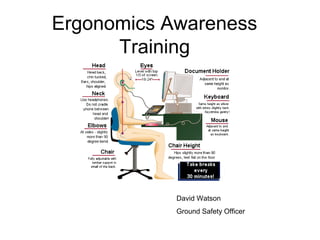
Ergonomics Awareness
Training
David Watson
Ground Safety Officer
Ergonomics
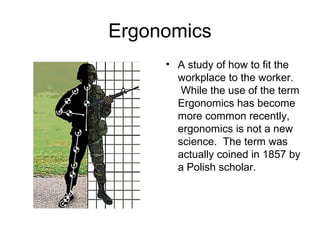
• A study of how to fit the
workplace to the worker.
While the use of the term
Ergonomics has become
more common recently,
ergonomics is not a new
science. The term was
actually coined in 1857 by
a Polish scholar.
Ergonomics Awareness
Fitting Workplace to the Worker
The workplace has been modified to fit the
worker. To reduce the risk of Work-
related Musculoskeletal Disorders
(WMSDs), the workplace should be
designed to fit the worker.
Importance of Ergonomics
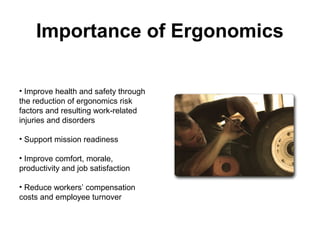
• Improve health and safety through
the reduction of ergonomics risk
factors and resulting work-related
injuries and disorders
• Support mission readiness
• Improve comfort, morale,
productivity and job satisfaction
• Reduce workers’ compensation
costs and employee turnover
Injuries — Musculoskeletal Disorders
(MSD)
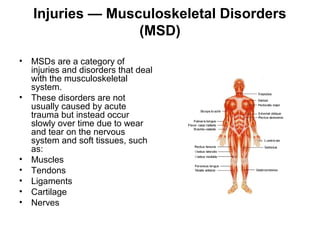
• MSDs are a category of
injuries and disorders that deal
with the musculoskeletal
system.
• These disorders are not
usually caused by acute
trauma but instead occur
slowly over time due to wear
and tear on the nervous
system and soft tissues, such
as:
• Muscles
• Tendons
• Ligaments
• Cartilage
• Nerves
WMSDs are caused or aggravated by work
methods and/or environments. WMSDs do not
generally result from a single event or
accident, but rather are disorders that have
developed gradually from chronic workplace
and occupational conditions causing repeated
trauma.
Common WMSDs include:
Work-related Musculoskeletal
Disorders (WMSDs)
Tendinitis (informally also tendonitis),
• Meaning inflammation of a tendon (the suffix
"itis" means "inflammation"), is a type of
tendinopathy often confused with the more
common tendinosis, which has similar
symptoms but requires different treatment.[1]
The term tendinitis should be reserved for
tendon injuries that involve larger-scale acute
injuries accompanied by inflammation. Generally
tendinitis is referred to by the body part involved,
such as Achilles tendinitis (affecting the
Achilles tendon), or patellar tendinitis (
jumper's knee, affecting the patellar tendon).
Tennis Elbow
• A condition where the outer part of the
elbow becomes sore and tender. It is a
condition that is commonly associated with
playing tennis and other racquet sports,
though the injury can happen to almost
anybody
Bursitis
• A inflammation of one or more bursae (small
sacs) of synovial fluid in the body. The bursae
rest at the points where internal functionaries,
such as muscles and tendons, slide across
bone. Healthy bursae create a smooth, almost
frictionless functional gliding surface making
normal movement painless. When bursitis
occurs, however, movement relying upon the
inflamed bursa becomes difficult and painful.
Moreover, movement of tendons and muscles
over the inflamed bursa aggravates its
inflammation, perpetuating the problem
Carpal tunnel syndrome (CTS), or
median neuropathy at the wrist
• A medical condition in which the median
nerve is compressed at the wrist, leading
to paresthesias, numbness and muscle
weakness in the hand. Night symptoms
and waking at night is a characteristic of
established carpal tunnel syndrome.
Herniated disc
• Rupturing of the tissue that separates the
vertebral bones of the spinal column.
Physical factors have to occur in combination to pose a risk.
Physical risk factors include:
• Compression
• Non-neutral, awkward or static posture
• Vibration
• High forces
• Repetition
• Duration
By applying ergonomics principles to tasks, jobs and the
work environment, physical risk factors can usually be
modified or reduced.
Summary
• The key points to remember about
ergonomics are that:
1. Ergonomics is defined as fitting the work to the worker.
2. Physical risk factors that can cause WMSDs are :
force, posture, duration, repetition, and vibration.
3. Physical risk factors can be eliminated or reduced in
the work place.
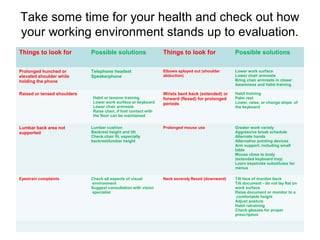
Take some time for your health and check out how
your working environment stands up to evaluation.
Things to look for Possible solutions Things to look for Possible solutions
Prolonged hunched or
elevated shoulder while
holding the phone
Telephone headset
Speakerphone
Elbows splayed out (shoulder
abduction)
Lower work surface
Lower chair armrests
Bring chair armrests in closer
Awareness and habit training
Raised or tensed shoulders
Habit or tension training
Lower work surface or keyboard
Lower chair armrests
Raise chair, if foot contact with
the floor can be maintained
Wrists bent back (extended) or
forward (flexed) for prolonged
periods
Habit training
Palm rest
Lower, raise, or change slope of
the keyboard
Lumbar back area not
supported
Lumbar cushion
Backrest height and tilt
Check chair fit, especially
backrest/lumbar height
Prolonged mouse use Greater work variety
Aggressive break schedule
Alternate hands
Alternative pointing devices
Arm support, including small
table
Mouse close to body
(extended keyboard tray)
Learn keystroke substitutes for
menus
Eyestrain complaints Check all aspects of visual
environment
Suggest consultation with vision
specialist
Neck severely flexed (downward) Tilt face of monitor back
Tilt document - do not lay flat on
work surface
Raise document or monitor to a
comfortable height
Adjust posture
Habit retraining
Check glasses for proper
prescription
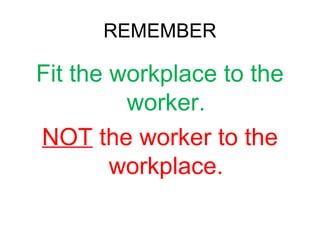
REMEMBER
Fit the workplace to the
worker.
NOT the worker to the
workplace.

Ergonomics

  • 1.
  • 2.
    Ergonomics • A studyof how to fit the workplace to the worker. While the use of the term Ergonomics has become more common recently, ergonomics is not a new science. The term was actually coined in 1857 by a Polish scholar.
  • 3.
    Ergonomics Awareness Fitting Workplaceto the Worker The workplace has been modified to fit the worker. To reduce the risk of Work- related Musculoskeletal Disorders (WMSDs), the workplace should be designed to fit the worker.
  • 4.
    Importance of Ergonomics •Improve health and safety through the reduction of ergonomics risk factors and resulting work-related injuries and disorders • Support mission readiness • Improve comfort, morale, productivity and job satisfaction • Reduce workers’ compensation costs and employee turnover
  • 5.
    Injuries — MusculoskeletalDisorders (MSD) • MSDs are a category of injuries and disorders that deal with the musculoskeletal system. • These disorders are not usually caused by acute trauma but instead occur slowly over time due to wear and tear on the nervous system and soft tissues, such as: • Muscles • Tendons • Ligaments • Cartilage • Nerves
  • 6.
    WMSDs are causedor aggravated by work methods and/or environments. WMSDs do not generally result from a single event or accident, but rather are disorders that have developed gradually from chronic workplace and occupational conditions causing repeated trauma. Common WMSDs include: Work-related Musculoskeletal Disorders (WMSDs)
  • 7.
    Tendinitis (informally alsotendonitis), • Meaning inflammation of a tendon (the suffix "itis" means "inflammation"), is a type of tendinopathy often confused with the more common tendinosis, which has similar symptoms but requires different treatment.[1] The term tendinitis should be reserved for tendon injuries that involve larger-scale acute injuries accompanied by inflammation. Generally tendinitis is referred to by the body part involved, such as Achilles tendinitis (affecting the Achilles tendon), or patellar tendinitis ( jumper's knee, affecting the patellar tendon).
  • 8.
    Tennis Elbow • Acondition where the outer part of the elbow becomes sore and tender. It is a condition that is commonly associated with playing tennis and other racquet sports, though the injury can happen to almost anybody
  • 9.
    Bursitis • A inflammationof one or more bursae (small sacs) of synovial fluid in the body. The bursae rest at the points where internal functionaries, such as muscles and tendons, slide across bone. Healthy bursae create a smooth, almost frictionless functional gliding surface making normal movement painless. When bursitis occurs, however, movement relying upon the inflamed bursa becomes difficult and painful. Moreover, movement of tendons and muscles over the inflamed bursa aggravates its inflammation, perpetuating the problem
  • 10.
    Carpal tunnel syndrome(CTS), or median neuropathy at the wrist • A medical condition in which the median nerve is compressed at the wrist, leading to paresthesias, numbness and muscle weakness in the hand. Night symptoms and waking at night is a characteristic of established carpal tunnel syndrome.
  • 11.
    Herniated disc • Rupturingof the tissue that separates the vertebral bones of the spinal column.
  • 12.
    Physical factors haveto occur in combination to pose a risk. Physical risk factors include: • Compression • Non-neutral, awkward or static posture • Vibration • High forces • Repetition • Duration By applying ergonomics principles to tasks, jobs and the work environment, physical risk factors can usually be modified or reduced.
  • 13.
    Summary • The keypoints to remember about ergonomics are that: 1. Ergonomics is defined as fitting the work to the worker. 2. Physical risk factors that can cause WMSDs are : force, posture, duration, repetition, and vibration. 3. Physical risk factors can be eliminated or reduced in the work place.
  • 14.
    Take some timefor your health and check out how your working environment stands up to evaluation. Things to look for Possible solutions Things to look for Possible solutions Prolonged hunched or elevated shoulder while holding the phone Telephone headset Speakerphone Elbows splayed out (shoulder abduction) Lower work surface Lower chair armrests Bring chair armrests in closer Awareness and habit training Raised or tensed shoulders Habit or tension training Lower work surface or keyboard Lower chair armrests Raise chair, if foot contact with the floor can be maintained Wrists bent back (extended) or forward (flexed) for prolonged periods Habit training Palm rest Lower, raise, or change slope of the keyboard Lumbar back area not supported Lumbar cushion Backrest height and tilt Check chair fit, especially backrest/lumbar height Prolonged mouse use Greater work variety Aggressive break schedule Alternate hands Alternative pointing devices Arm support, including small table Mouse close to body (extended keyboard tray) Learn keystroke substitutes for menus Eyestrain complaints Check all aspects of visual environment Suggest consultation with vision specialist Neck severely flexed (downward) Tilt face of monitor back Tilt document - do not lay flat on work surface Raise document or monitor to a comfortable height Adjust posture Habit retraining Check glasses for proper prescription
  • 15.
    REMEMBER Fit the workplaceto the worker. NOT the worker to the workplace.