ERGONOMICS
(ASPECTS IN WORKSTATION
DESIGN AND ANALYSIS)
Chandrakanth.C
S1 M.Tech
Roll No:01
mail me @ geothomasseril@gmail.com
1
Contents
 Definition
 Objectives
 Fields interact with ergonomics
 Importance
 Ergonomic approaches
 Advantages & Disadvantages
 Applications
 Conclusion
2
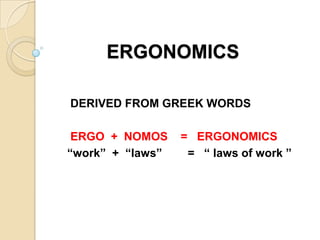
ERGONOMICS
DERIVED FROM GREEK WORDS
ERGO + NOMOS = ERGONOMICS
“work” + “laws” = “ laws of work ”
ERGONOMICS - DEFINITION
 SCIENTIFIC STUDY OF HUMAN WORK
 "DESIGNING THE JOB TO FIT THE WORKER , NOT
FORCING THE WORKER TO FIT THE JOB“
 SCIENCE THAT DEALS WITH DESIGNING AND
ARRANGING THINGS SO THAT PEOPLE CAN USE
THEM EASILY AND SAFELY
4
ERGONOMICS - OBJECTIVES
 To improve the relationship b/w people , equipment ,
workplace, and the environment.
 Increase work efficiency and productivity.
 Promote safety and comfort at work station.
 To reduce physical work loads.
 To minimize the risk of injury , illness , accidents and
errors without compromising productivity.
5
FIELDS THAT INTERACT WITH
ERGONOMICS
 Anthropometry
 Psychology
 Operations
Research
 Surgery
 Physics
 Orthopedics
 Physiology
 Statistics
 Engineering
 Biomechanics
 Industrial Hygiene
 Industrial Medicine
6
JOB RISK FACTORS
 Working in awkward
postures / positions
 Prolonged sitting and
standing
 Bending, reaching,
stretching
 Driving for extended
periods of time
 Heavy lifting
 Illumination
 Awkward lifting
 Lifting in combination with
twisting
 Pushing, pulling, carrying
 Accidents, slips, trips, falls
 Vibration & Noise
 Repetition
 Contact Stress
 Thermal Condition
7
ERGONOMICS - IMPORTANCE
 Work Related Musculoskeletal Disorders
(WMSD) are fastest-growing injury
category
1997 study of 420 medical secretaries
◦ 63 % reported neck/shoulder pain
◦ 51% low back pain
◦ 30 % hand/wrist pain
8
Musculo Skeletal Disorders(MSD)
 MSD’s are injuries caused by sustained exposure to
stresses or repetitive motion.
 They may affect muscles, tendons, ligaments, bones,
circulation, or nerves.
 Some well-known MSD’s are:
1. Carpel tunnel syndrome
2. Tennis elbow
9
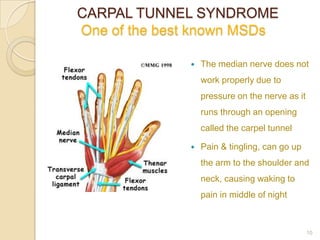
CARPAL TUNNEL SYNDROME
One of the best known MSDs
 The median nerve does not
work properly due to
pressure on the nerve as it
runs through an opening
called the carpel tunnel
 Pain & tingling, can go up
the arm to the shoulder and
neck, causing waking to
pain in middle of night
10
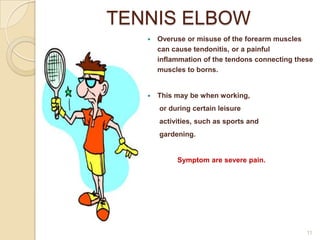
TENNIS ELBOW
 Overuse or misuse of the forearm muscles
can cause tendonitis, or a painful
inflammation of the tendons connecting these
muscles to borns.
 This may be when working,
or during certain leisure
activities, such as sports and
gardening.
Symptom are severe pain.
11
Body Parts Prone To Workplace
MSDs
 Back - Lower
 Neck and Upper Back
 Upper Extremities - Arms and Hands
 Lower Extremities - Legs and Feet
12
Musculoskeletal Disorders:
Signs and Symptoms
 Decreased ROM
 Decreased grip
and/or pinch
strength
 Swelling
 Fatigue
 Loss of function
 Numbness
 Burning sensation
 Tingling
 Pain
 Cramping
 Stiffness
13
Leading Causes of Back
Problems
• Poor Body Mechanics
• Stressful Living & Working
• Loss of Flexibility
• Loss of Strength
14
ERGNONIMICS APPROCHES
• Body Mechanics
• Proper Lifting Techniques
• Exercise
• Stretching
• Improved postures
15
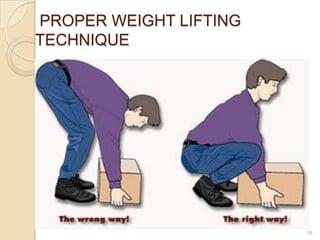
PROPER WEIGHT LIFTING
TECHNIQUE
16
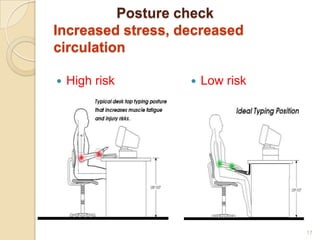
Posture check
Increased stress, decreased
circulation
 High risk  Low risk
17
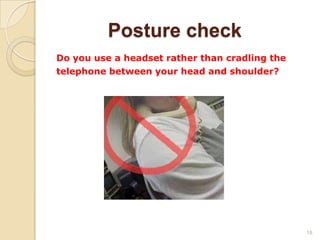
Posture check
Do you use a headset rather than cradling the
telephone between your head and shoulder?
18
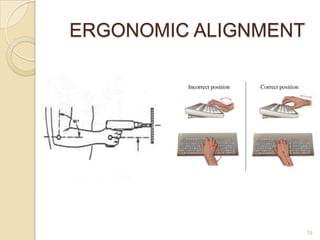
ERGONOMIC ALIGNMENT
19
20
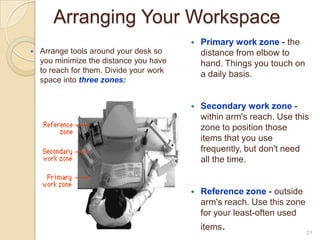
Arranging Your Workspace
 Arrange tools around your desk so
you minimize the distance you have
to reach for them. Divide your work
space into three zones:
 Primary work zone - the
distance from elbow to
hand. Things you touch on
a daily basis.
 Secondary work zone -
within arm's reach. Use this
zone to position those
items that you use
frequently, but don't need
all the time.
 Reference zone - outside
arm's reach. Use this zone
for your least-often used
items. 21
To be ergonomic , a design
must
• Fit the user
• Be easy to use
• Improve comfort
• Improve performance
• Improve health and safety
22
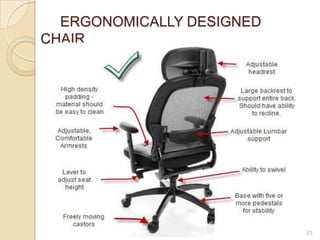
ERGONOMICALLY DESIGNED
CHAIR
23
Materials storage and
handling
 Clear and mark transport routes
 Provide ramps of 5-8% inclination instead of small
stairs
 Use mechanical devices for lifting, lowering and
moving heavy material
 Instead of carrying heavy weights divide them into
smaller lightweights e.g. 2x10 kg instead of 20 kg.
 Combine heavy lifting with physically lighter tasks
24
Hand Tools
 Use hanging tools for operations repeated in
the same place
 Provide hand support when using precision
tools
 Provide hand tools with a grip of the proper
thickness (hand diameter 30-40 mm, handle
length 125 mm and size to fit male hands)
 Provide a home for each tool (Enables good
housekeeping)
25
Production machine safety
 Locate controls in sequence of operations
 Make displays and signals easy to distinguish
and easy to read
 Use properly fixed guards and interlock devices
26
Lighting
 Increased use of daylight
 Light up the work area evenly
 Sufficient lighting for working
 Local lighting for precision work
 Removing shiny surfaces
 Avoid glare
27
28
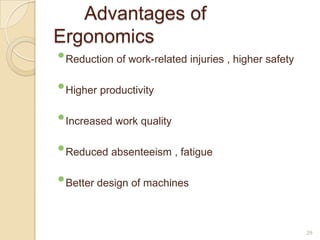
Advantages of
Ergonomics
•Reduction of work-related injuries , higher safety
•Higher productivity
•Increased work quality
•Reduced absenteeism , fatigue
•Better design of machines
29
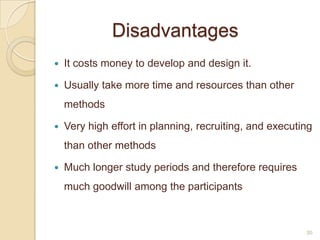
Disadvantages
 It costs money to develop and design it.
 Usually take more time and resources than other
methods
 Very high effort in planning, recruiting, and executing
than other methods
 Much longer study periods and therefore requires
much goodwill among the participants
30
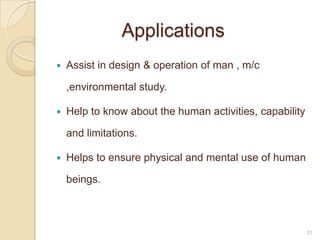
Applications
 Assist in design & operation of man , m/c
,environmental study.
 Help to know about the human activities, capability
and limitations.
 Helps to ensure physical and mental use of human
beings.
31
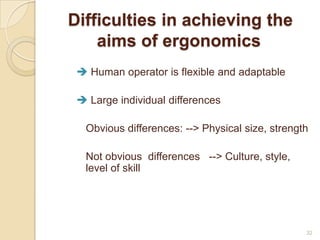
Difficulties in achieving the
aims of ergonomics
 Human operator is flexible and adaptable
 Large individual differences
Obvious differences: --> Physical size, strength
Not obvious differences --> Culture, style,
level of skill
32
Work Smarter – Not Harder
 Notice and report symptoms EARLY
 Stretch
 Take adequate and frequent breathers
 Do a different task or do the
task differently
33
Conclusion..
 As we discussed above ergonomics
"DESIGNING THE JOB TO FIT THE WORKER ,
NOT FORCING THE WORKER TO FIT THE
JOB“
So it will reduces the fatigue and improve the work
conditions for the workers.
34
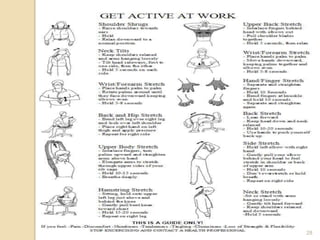
Help Yourself
 Micro-Breaks
◦ Every 20-40 minutes
 Exercises
◦ Body stretch
◦ Raise forearms
◦ Shoulder blade squeeze/shrugs
◦ Eye palming
◦ Arm and shoulder shake
◦ Arm extensions
◦ Side bends
35
Practice Wellness at Work and
Home !
Exercise(Body)
Nutrition(Mind)
Relaxation(Spirit)
36
THANK YOU….
37

Ergonomics

  • 1.
    ERGONOMICS (ASPECTS IN WORKSTATION DESIGNAND ANALYSIS) Chandrakanth.C S1 M.Tech Roll No:01 mail me @ geothomasseril@gmail.com 1
  • 2.
    Contents  Definition  Objectives Fields interact with ergonomics  Importance  Ergonomic approaches  Advantages & Disadvantages  Applications  Conclusion 2
  • 3.
    ERGONOMICS DERIVED FROM GREEKWORDS ERGO + NOMOS = ERGONOMICS “work” + “laws” = “ laws of work ”
  • 4.
    ERGONOMICS - DEFINITION SCIENTIFIC STUDY OF HUMAN WORK  "DESIGNING THE JOB TO FIT THE WORKER , NOT FORCING THE WORKER TO FIT THE JOB“  SCIENCE THAT DEALS WITH DESIGNING AND ARRANGING THINGS SO THAT PEOPLE CAN USE THEM EASILY AND SAFELY 4
  • 5.
    ERGONOMICS - OBJECTIVES To improve the relationship b/w people , equipment , workplace, and the environment.  Increase work efficiency and productivity.  Promote safety and comfort at work station.  To reduce physical work loads.  To minimize the risk of injury , illness , accidents and errors without compromising productivity. 5
  • 6.
    FIELDS THAT INTERACTWITH ERGONOMICS  Anthropometry  Psychology  Operations Research  Surgery  Physics  Orthopedics  Physiology  Statistics  Engineering  Biomechanics  Industrial Hygiene  Industrial Medicine 6
  • 7.
    JOB RISK FACTORS Working in awkward postures / positions  Prolonged sitting and standing  Bending, reaching, stretching  Driving for extended periods of time  Heavy lifting  Illumination  Awkward lifting  Lifting in combination with twisting  Pushing, pulling, carrying  Accidents, slips, trips, falls  Vibration & Noise  Repetition  Contact Stress  Thermal Condition 7
  • 8.
    ERGONOMICS - IMPORTANCE Work Related Musculoskeletal Disorders (WMSD) are fastest-growing injury category 1997 study of 420 medical secretaries ◦ 63 % reported neck/shoulder pain ◦ 51% low back pain ◦ 30 % hand/wrist pain 8
  • 9.
    Musculo Skeletal Disorders(MSD) MSD’s are injuries caused by sustained exposure to stresses or repetitive motion.  They may affect muscles, tendons, ligaments, bones, circulation, or nerves.  Some well-known MSD’s are: 1. Carpel tunnel syndrome 2. Tennis elbow 9
  • 10.
    CARPAL TUNNEL SYNDROME Oneof the best known MSDs  The median nerve does not work properly due to pressure on the nerve as it runs through an opening called the carpel tunnel  Pain & tingling, can go up the arm to the shoulder and neck, causing waking to pain in middle of night 10
  • 11.
    TENNIS ELBOW  Overuseor misuse of the forearm muscles can cause tendonitis, or a painful inflammation of the tendons connecting these muscles to borns.  This may be when working, or during certain leisure activities, such as sports and gardening. Symptom are severe pain. 11
  • 12.
    Body Parts ProneTo Workplace MSDs  Back - Lower  Neck and Upper Back  Upper Extremities - Arms and Hands  Lower Extremities - Legs and Feet 12
  • 13.
    Musculoskeletal Disorders: Signs andSymptoms  Decreased ROM  Decreased grip and/or pinch strength  Swelling  Fatigue  Loss of function  Numbness  Burning sensation  Tingling  Pain  Cramping  Stiffness 13
  • 14.
    Leading Causes ofBack Problems • Poor Body Mechanics • Stressful Living & Working • Loss of Flexibility • Loss of Strength 14
  • 15.
    ERGNONIMICS APPROCHES • BodyMechanics • Proper Lifting Techniques • Exercise • Stretching • Improved postures 15
  • 16.
  • 17.
    Posture check Increased stress,decreased circulation  High risk  Low risk 17
  • 18.
    Posture check Do youuse a headset rather than cradling the telephone between your head and shoulder? 18
  • 19.
  • 20.
  • 21.
    Arranging Your Workspace Arrange tools around your desk so you minimize the distance you have to reach for them. Divide your work space into three zones:  Primary work zone - the distance from elbow to hand. Things you touch on a daily basis.  Secondary work zone - within arm's reach. Use this zone to position those items that you use frequently, but don't need all the time.  Reference zone - outside arm's reach. Use this zone for your least-often used items. 21
  • 22.
    To be ergonomic, a design must • Fit the user • Be easy to use • Improve comfort • Improve performance • Improve health and safety 22
  • 23.
  • 24.
    Materials storage and handling Clear and mark transport routes  Provide ramps of 5-8% inclination instead of small stairs  Use mechanical devices for lifting, lowering and moving heavy material  Instead of carrying heavy weights divide them into smaller lightweights e.g. 2x10 kg instead of 20 kg.  Combine heavy lifting with physically lighter tasks 24
  • 25.
    Hand Tools  Usehanging tools for operations repeated in the same place  Provide hand support when using precision tools  Provide hand tools with a grip of the proper thickness (hand diameter 30-40 mm, handle length 125 mm and size to fit male hands)  Provide a home for each tool (Enables good housekeeping) 25
  • 26.
    Production machine safety Locate controls in sequence of operations  Make displays and signals easy to distinguish and easy to read  Use properly fixed guards and interlock devices 26
  • 27.
    Lighting  Increased useof daylight  Light up the work area evenly  Sufficient lighting for working  Local lighting for precision work  Removing shiny surfaces  Avoid glare 27
  • 28.
  • 29.
    Advantages of Ergonomics •Reduction ofwork-related injuries , higher safety •Higher productivity •Increased work quality •Reduced absenteeism , fatigue •Better design of machines 29
  • 30.
    Disadvantages  It costsmoney to develop and design it.  Usually take more time and resources than other methods  Very high effort in planning, recruiting, and executing than other methods  Much longer study periods and therefore requires much goodwill among the participants 30
  • 31.
    Applications  Assist indesign & operation of man , m/c ,environmental study.  Help to know about the human activities, capability and limitations.  Helps to ensure physical and mental use of human beings. 31
  • 32.
    Difficulties in achievingthe aims of ergonomics  Human operator is flexible and adaptable  Large individual differences Obvious differences: --> Physical size, strength Not obvious differences --> Culture, style, level of skill 32
  • 33.
    Work Smarter –Not Harder  Notice and report symptoms EARLY  Stretch  Take adequate and frequent breathers  Do a different task or do the task differently 33
  • 34.
    Conclusion..  As wediscussed above ergonomics "DESIGNING THE JOB TO FIT THE WORKER , NOT FORCING THE WORKER TO FIT THE JOB“ So it will reduces the fatigue and improve the work conditions for the workers. 34
  • 35.
    Help Yourself  Micro-Breaks ◦Every 20-40 minutes  Exercises ◦ Body stretch ◦ Raise forearms ◦ Shoulder blade squeeze/shrugs ◦ Eye palming ◦ Arm and shoulder shake ◦ Arm extensions ◦ Side bends 35
  • 36.
    Practice Wellness atWork and Home ! Exercise(Body) Nutrition(Mind) Relaxation(Spirit) 36
  • 37.