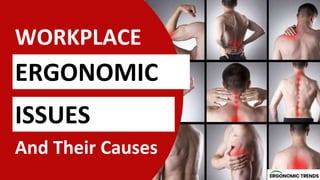
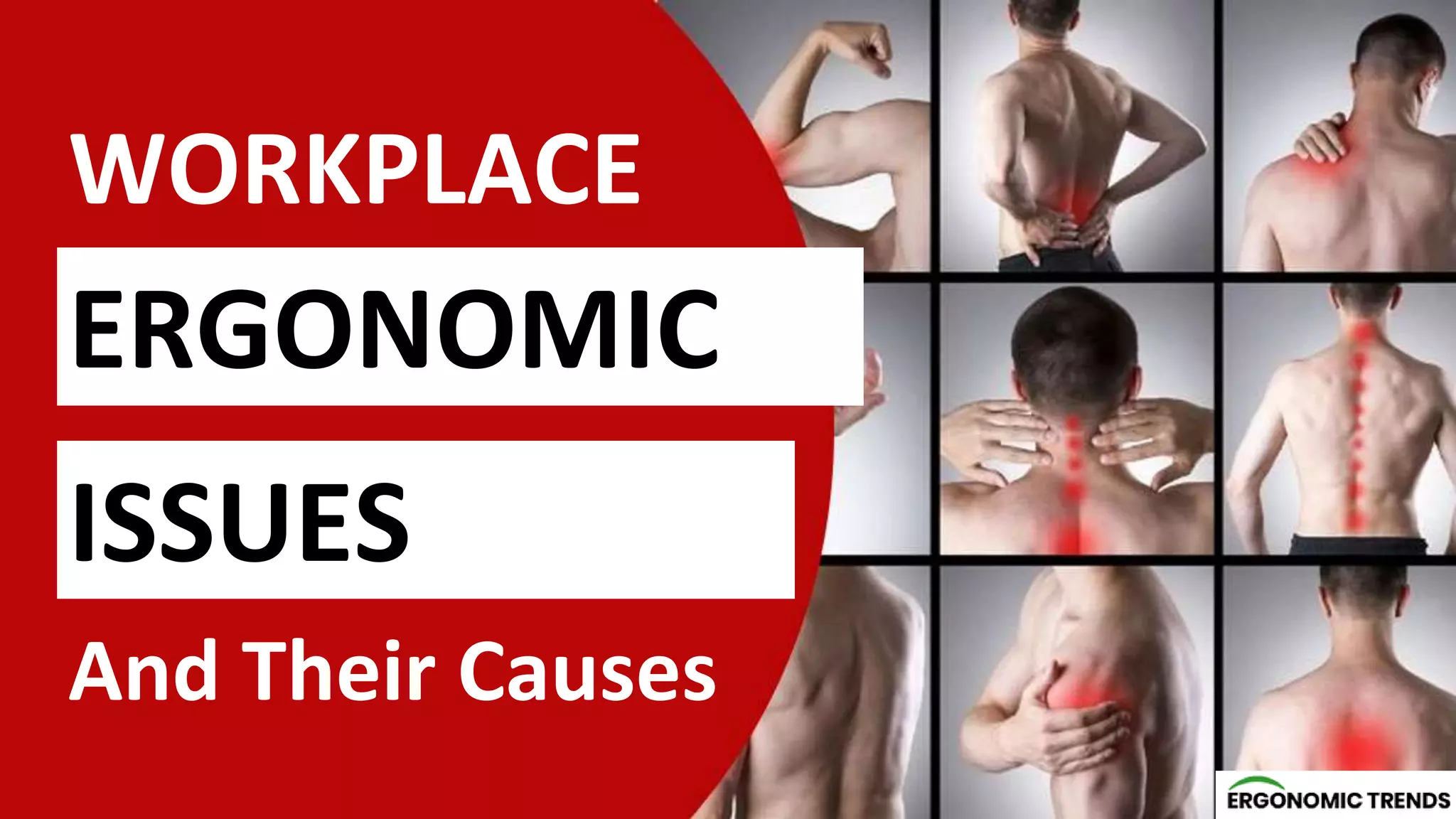
WORKPLACE
ERGONOMIC
ISSUES
And Their Causes
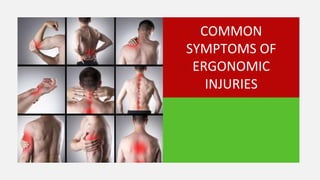
COMMON
SYMPTOMS OF
ERGONOMIC
INJURIES
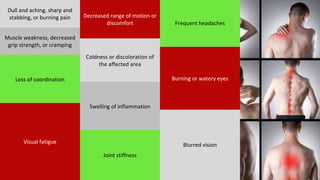
Dull and aching, sharp and
stabbing, or burning pain
Muscle weakness, decreased
grip strength, or cramping
Loss of coordination
Decreased range of motion or
discomfort
Coldness or discoloration of
the affected area
Swelling of inflammation
Joint stiffness
Visual fatigue
Blurred vision
Frequent headaches
Burning or watery eyes
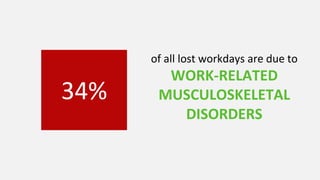
34%
of all lost workdays are due to
WORK-RELATED
MUSCULOSKELETAL
DISORDERS
Motions And Tasks That
Lead To Ergonomic
Problems
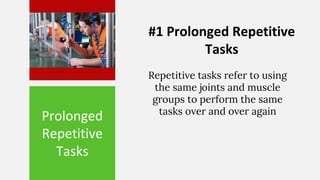
Prolonged
Repetitive
Tasks
Repetitive tasks refer to using
the same joints and muscle
groups to perform the same
tasks over and over again
#1 Prolonged Repetitive
Tasks
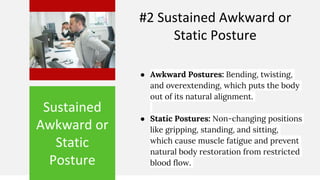
Sustained
Awkward or
Static
Posture
#2 Sustained Awkward or
Static Posture
● Awkward Postures: Bending, twisting,
and overextending, which puts the body
out of its natural alignment.
● Static Postures: Non-changing positions
like gripping, standing, and sitting,
which cause muscle fatigue and prevent
natural body restoration from restricted
blood flow.
Vibration
Whole body vibrations like those
experienced by bus drivers or
localized vibrations caused by
power tools can damage the small
capillaries that bring nutrients to
the body
#3 Vibrations
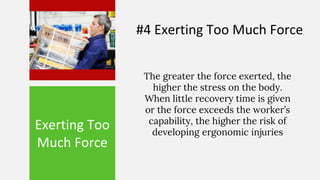
Exerting Too
Much Force
The greater the force exerted, the
higher the stress on the body.
When little recovery time is given
or the force exceeds the worker’s
capability, the higher the risk of
developing ergonomic injuries
#4 Exerting Too Much Force
Jobs Most At Risk of
Causing Ergonomic
Issues
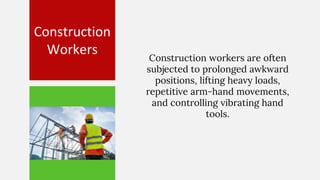
Construction
Workers Construction workers are often
subjected to prolonged awkward
positions, lifting heavy loads,
repetitive arm-hand movements,
and controlling vibrating hand
tools.
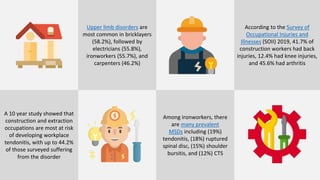
A 10 year study showed that
construction and extraction
occupations are most at risk
of developing workplace
tendonitis, with up to 44.2%
of those surveyed suffering
from the disorder
Upper limb disorders are
most common in bricklayers
(58.2%), followed by
electricians (55.8%),
ironworkers (55.7%), and
carpenters (46.2%)
Among ironworkers, there
are many prevalent
MSDs including (19%)
tendonitis, (18%) ruptured
spinal disc, (15%) shoulder
bursitis, and (12%) CTS
According to the Survey of
Occupational Injuries and
Illnesses (SOII) 2019, 41.7% of
construction workers had back
injuries, 12.4% had knee injuries,
and 45.6% had arthritis
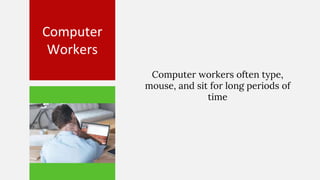
Computer
Workers
Computer workers often type,
mouse, and sit for long periods of
time
A 2008 BLS report found that
60% of US computer workers
complain of wrist pain due to
poor ergonomics and
inadequate breaks
In a 2016 survey, 41% and
38% of the surveyed
computer workers in a study
had upper back and neck
fatigue respectively
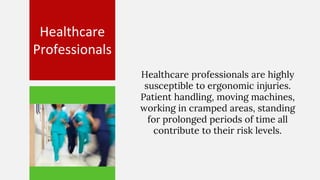
Healthcare
Professionals
Healthcare professionals are highly
susceptible to ergonomic injuries.
Patient handling, moving machines,
working in cramped areas, standing
for prolonged periods of time all
contribute to their risk levels.
A 2014 survey of healthcare
workers in India indicated
that the top risk factors for
MSD are staying in one
position for too long
(37.10%), awkward working
positions (29.20%),and
repetitive tasks (29%)
In terms of annual
prevalence, hospital workers,
particularly nurses, have neck
pain (40%), back injuries (30
to 60%), and shoulder injuries
(47%)
The work-related MSD rate
for nurses is four times higher
than other workers
Cashiers
Cashier workers often develop
Carpal Tunnel Syndrome due to the
repetitive scanning of products
In a 2015 study, the number
of grocery workers who have
CTS from 2011 to 2013
increased by 138%
93% of cashiers perform low
force, repetitive tasks for at
least half of their work
period.
Cleaners
Cleaners often perform repetitive
swiping motions and assume
awkward positions to clean hard to
reach areas at work
54 to 79% of cleaners do
frequent or continuous
repetitive movements
More than 25% of cleaners
are required to manage loads
that are more than 25 kg
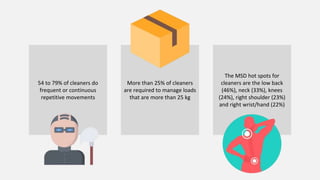
The MSD hot spots for
cleaners are the low back
(46%), neck (33%), knees
(24%), right shoulder (23%)
and right wrist/hand (22%)
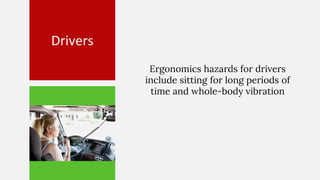
Drivers
Ergonomics hazards for drivers
include sitting for long periods of
time and whole-body vibration
According to the Centers for
Disease Control and
Prevention (CDC), in 2014,
23% of the sick work days of
bus drivers are due to MSDs
In terms of annual
occurrence, the most
problematic areas for bus
drivers are neck (26%), back
(24%), upper limbs (20%),
knees (6%), and ankles (4%).
In another study, the
prevalence of neck pain is as
high as 49%
The prevalence of low back
pain over 12 months for truck
drivers is 60% and 51% for
taxi drivers
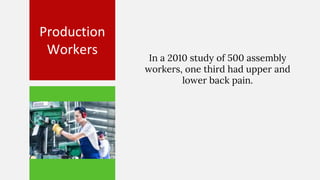
Production
Workers In a 2010 study of 500 assembly
workers, one third had upper and
lower back pain.
In a 2010 study of 500
assembly workers, one third
had upper and lower back
pain
Upper limb MSD
prevalence is 35% for women
and 12% for men in some
manufacturing plants. For
neck, shoulder, and back
MSDs, the prevalence was
27% female and 18% for male
workers
Musculoskeletal discomfort is
rampant among assembly
workers in the following body
areas: right shoulder (61.4%),
right wrist (60%), and upper
back (63.2%)
READ THE
ENTIRE BOG
http://ergonomictrends.com/common-
workplace-ergonomic-issues/

Most Common Workplace Ergonomic Issues and their Causes

  • 1.
  • 2.
  • 3.
    Dull and aching,sharp and stabbing, or burning pain Muscle weakness, decreased grip strength, or cramping Loss of coordination Decreased range of motion or discomfort Coldness or discoloration of the affected area Swelling of inflammation Joint stiffness Visual fatigue Blurred vision Frequent headaches Burning or watery eyes
  • 4.
    34% of all lostworkdays are due to WORK-RELATED MUSCULOSKELETAL DISORDERS
  • 5.
    Motions And TasksThat Lead To Ergonomic Problems
  • 6.
    Prolonged Repetitive Tasks Repetitive tasks referto using the same joints and muscle groups to perform the same tasks over and over again #1 Prolonged Repetitive Tasks
  • 7.
    Sustained Awkward or Static Posture #2 SustainedAwkward or Static Posture ● Awkward Postures: Bending, twisting, and overextending, which puts the body out of its natural alignment. ● Static Postures: Non-changing positions like gripping, standing, and sitting, which cause muscle fatigue and prevent natural body restoration from restricted blood flow.
  • 8.
    Vibration Whole body vibrationslike those experienced by bus drivers or localized vibrations caused by power tools can damage the small capillaries that bring nutrients to the body #3 Vibrations
  • 9.
    Exerting Too Much Force Thegreater the force exerted, the higher the stress on the body. When little recovery time is given or the force exceeds the worker’s capability, the higher the risk of developing ergonomic injuries #4 Exerting Too Much Force
  • 10.
    Jobs Most AtRisk of Causing Ergonomic Issues
  • 11.
    Construction Workers Construction workersare often subjected to prolonged awkward positions, lifting heavy loads, repetitive arm-hand movements, and controlling vibrating hand tools.
  • 12.
    A 10 yearstudy showed that construction and extraction occupations are most at risk of developing workplace tendonitis, with up to 44.2% of those surveyed suffering from the disorder Upper limb disorders are most common in bricklayers (58.2%), followed by electricians (55.8%), ironworkers (55.7%), and carpenters (46.2%) Among ironworkers, there are many prevalent MSDs including (19%) tendonitis, (18%) ruptured spinal disc, (15%) shoulder bursitis, and (12%) CTS According to the Survey of Occupational Injuries and Illnesses (SOII) 2019, 41.7% of construction workers had back injuries, 12.4% had knee injuries, and 45.6% had arthritis
  • 13.
    Computer Workers Computer workers oftentype, mouse, and sit for long periods of time
  • 14.
    A 2008 BLSreport found that 60% of US computer workers complain of wrist pain due to poor ergonomics and inadequate breaks In a 2016 survey, 41% and 38% of the surveyed computer workers in a study had upper back and neck fatigue respectively
  • 15.
    Healthcare Professionals Healthcare professionals arehighly susceptible to ergonomic injuries. Patient handling, moving machines, working in cramped areas, standing for prolonged periods of time all contribute to their risk levels.
  • 16.
    A 2014 surveyof healthcare workers in India indicated that the top risk factors for MSD are staying in one position for too long (37.10%), awkward working positions (29.20%),and repetitive tasks (29%) In terms of annual prevalence, hospital workers, particularly nurses, have neck pain (40%), back injuries (30 to 60%), and shoulder injuries (47%) The work-related MSD rate for nurses is four times higher than other workers
  • 17.
    Cashiers Cashier workers oftendevelop Carpal Tunnel Syndrome due to the repetitive scanning of products
  • 18.
    In a 2015study, the number of grocery workers who have CTS from 2011 to 2013 increased by 138% 93% of cashiers perform low force, repetitive tasks for at least half of their work period.
  • 19.
    Cleaners Cleaners often performrepetitive swiping motions and assume awkward positions to clean hard to reach areas at work
  • 20.
    54 to 79%of cleaners do frequent or continuous repetitive movements More than 25% of cleaners are required to manage loads that are more than 25 kg The MSD hot spots for cleaners are the low back (46%), neck (33%), knees (24%), right shoulder (23%) and right wrist/hand (22%)
  • 21.
    Drivers Ergonomics hazards fordrivers include sitting for long periods of time and whole-body vibration
  • 22.
    According to theCenters for Disease Control and Prevention (CDC), in 2014, 23% of the sick work days of bus drivers are due to MSDs In terms of annual occurrence, the most problematic areas for bus drivers are neck (26%), back (24%), upper limbs (20%), knees (6%), and ankles (4%). In another study, the prevalence of neck pain is as high as 49% The prevalence of low back pain over 12 months for truck drivers is 60% and 51% for taxi drivers
  • 23.
    Production Workers In a2010 study of 500 assembly workers, one third had upper and lower back pain.
  • 24.
    In a 2010study of 500 assembly workers, one third had upper and lower back pain Upper limb MSD prevalence is 35% for women and 12% for men in some manufacturing plants. For neck, shoulder, and back MSDs, the prevalence was 27% female and 18% for male workers Musculoskeletal discomfort is rampant among assembly workers in the following body areas: right shoulder (61.4%), right wrist (60%), and upper back (63.2%)
  • 25.