Soft Tissue Injury Prevention
Safety Stand Down
Safety Stand Down
June 14, 2010
June 14, 2010
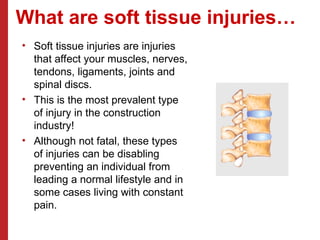
What are soft tissue injuries…
• Soft tissue injuries are injuries
that affect your muscles, nerves,
tendons, ligaments, joints and
spinal discs.
• This is the most prevalent type
of injury in the construction
industry!
• Although not fatal, these types
of injuries can be disabling
preventing an individual from
leading a normal lifestyle and in
some cases living with constant
pain.
Why is soft tissue injury training so
important?
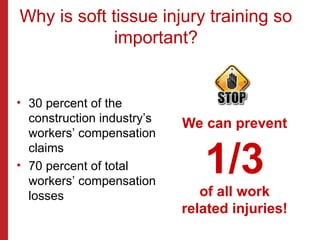
• 30 percent of the
construction industry’s
workers’ compensation
claims
• 70 percent of total
workers’ compensation
losses
We can prevent
1/3
of all work
related injuries!
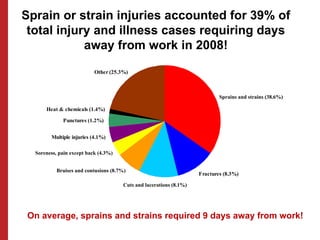
Sprain or strain injuries accounted for 39% of
total injury and illness cases requiring days
away from work in 2008!
Multiple injuries (4.1%)
Fractures (8.3%)
Punctures (1.2%)
Heat & chemicals (1.4%)
Other (25.3%)
Sprains and strains (38.6%)
Cuts and lacerations (8.1%)
Bruises and contusions (8.7%)
Soreness, pain except back (4.3%)
On average, sprains and strains required 9 days away from work!
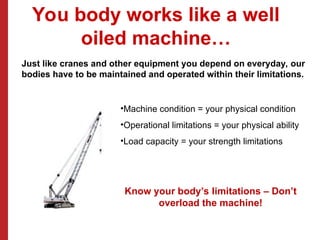
You body works like a well
oiled machine…
Just like cranes and other equipment you depend on everyday, our
bodies have to be maintained and operated within their limitations.
•Machine condition = your physical condition
•Operational limitations = your physical ability
•Load capacity = your strength limitations
Know your body’s limitations – Don’t
overload the machine!
Don’t let this be you……
• Example: A building worker who has worked on
construction sites since the age of 14, using drilling and
pneumatic hammers three or four days a week for several
hours, now suffers from an occupational disease. At the
age of 42, the pain in his wrist is so severe that he can no
longer work.
• Example: A machine operator, who has driven an
excavator and loader every day for some 20 years, has had
to give up his job because the pain in his back is so severe.
This situation could have been avoided if he had used a
modern, well-designed and adjustable seat on his vehicle
and limited his exposure; for example, by rotating jobs.
Examples of soft tissue injuries include:
• Sprains (an injury to ligaments that is caused by
being stretched beyond their normal capacity and
possibly torn)
• Strains (a stretching or tearing of muscle or tendon)
• Nerve Damage
• Crush Syndrome
• Sciatica (pain, weakness, numbness, or tingling in
the leg)
• Tendonitis (inflammation of a tendon)
• Bulging or Ruptured Disk
• Bursitis (inflammation of the fluid-filled sac (bursa)
that lies between a tendon and skin, or between a
tendon and bone)
• Carpal Tunnel Syndrome
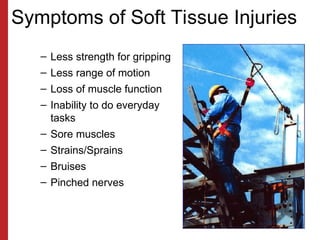
Symptoms of Soft Tissue Injuries
– Less strength for gripping
– Less range of motion
– Loss of muscle function
– Inability to do everyday
tasks
– Sore muscles
– Strains/Sprains
– Bruises
– Pinched nerves
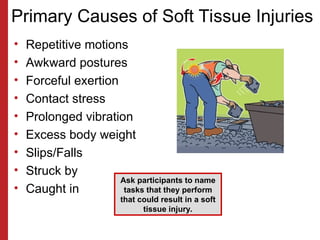
Primary Causes of Soft Tissue Injuries
• Repetitive motions
• Awkward postures
• Forceful exertion
• Contact stress
• Prolonged vibration
• Excess body weight
• Slips/Falls
• Struck by
• Caught in
Ask participants to name
tasks that they perform
that could result in a soft
tissue injury.
Repetitive Motions
• Tasks with high repetition
rates can become a source of
injury even when the required
forces are minimal and
normally safe.
Examples:
• Raising and lowering your arm
over and over again while
using a table or concrete saw
• Using tools like a hammer,
screw gun, caulk gun, etc.
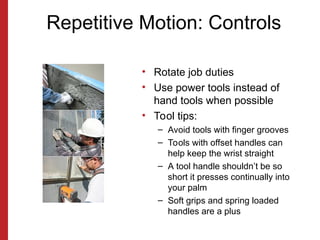
Repetitive Motion: Controls
• Rotate job duties
• Use power tools instead of
hand tools when possible
• Tool tips:
– Avoid tools with finger grooves
– Tools with offset handles can
help keep the wrist straight
– A tool handle shouldn’t be so
short it presses continually into
your palm
– Soft grips and spring loaded
handles are a plus
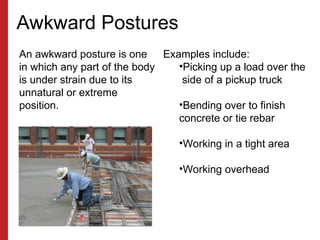
Awkward Postures
An awkward posture is one
in which any part of the body
is under strain due to its
unnatural or extreme
position.
Examples include:
•Picking up a load over the
side of a pickup truck
•Bending over to finish
concrete or tie rebar
•Working in a tight area
•Working overhead
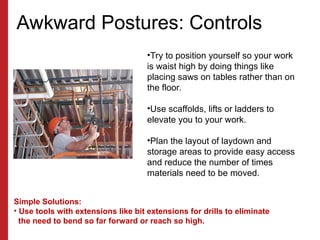
Awkward Postures: Controls
•Try to position yourself so your work
is waist high by doing things like
placing saws on tables rather than on
the floor.
•Use scaffolds, lifts or ladders to
elevate you to your work.
•Plan the layout of laydown and
storage areas to provide easy access
and reduce the number of times
materials need to be moved.
Simple Solutions:
• Use tools with extensions like bit extensions for drills to eliminate
the need to bend so far forward or reach so high.
Forceful Exertion
• Force is the amount of
effort it takes to perform
a task, such as pushing,
pulling or gripping a tool.
• The more force you have
to exert, the greater the
stress on your body.
Examples:
• Repeatedly turning a screwdriver
while pushing at the same time.
• Repeated pressure on a finger
when pressing the trigger on a
power tool.
• Lifting an excessive amount of
weight.
45% of sprains and strains are the result of overexertion.
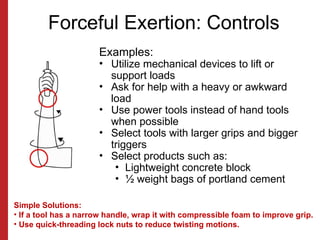
Forceful Exertion: Controls
Examples:
• Utilize mechanical devices to lift or
support loads
• Ask for help with a heavy or awkward
load
• Use power tools instead of hand tools
when possible
• Select tools with larger grips and bigger
triggers
• Select products such as:
• Lightweight concrete block
• ½ weight bags of portland cement
Simple Solutions:
• If a tool has a narrow handle, wrap it with compressible foam to improve grip.
• Use quick-threading lock nuts to reduce twisting motions.
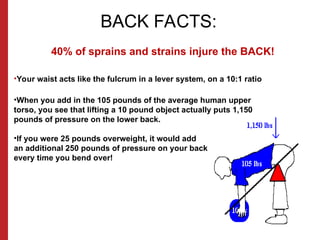
BACK FACTS:
•Your waist acts like the fulcrum in a lever system, on a 10:1 ratio
•When you add in the 105 pounds of the average human upper
torso, you see that lifting a 10 pound object actually puts 1,150
pounds of pressure on the lower back.
•If you were 25 pounds overweight, it would add
an additional 250 pounds of pressure on your back
every time you bend over!
40% of sprains and strains injure the BACK!
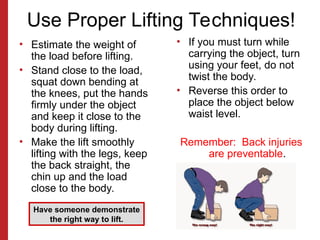
Use Proper Lifting Techniques!
• Estimate the weight of
the load before lifting.
• Stand close to the load,
squat down bending at
the knees, put the hands
firmly under the object
and keep it close to the
body during lifting.
• Make the lift smoothly
lifting with the legs, keep
the back straight, the
chin up and the load
close to the body.
• If you must turn while
carrying the object, turn
using your feet, do not
twist the body.
• Reverse this order to
place the object below
waist level.
Remember: Back injuries
are preventable.
Have someone demonstrate
the right way to lift.
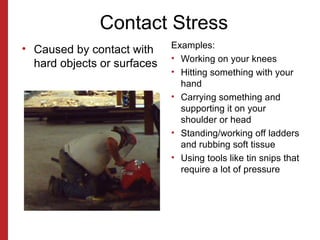
Contact Stress
• Caused by contact with
hard objects or surfaces
Examples:
• Working on your knees
• Hitting something with your
hand
• Carrying something and
supporting it on your
shoulder or head
• Standing/working off ladders
and rubbing soft tissue
• Using tools like tin snips that
require a lot of pressure
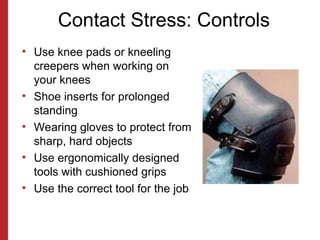
Contact Stress: Controls
• Use knee pads or kneeling
creepers when working on
your knees
• Shoe inserts for prolonged
standing
• Wearing gloves to protect from
sharp, hard objects
• Use ergonomically designed
tools with cushioned grips
• Use the correct tool for the job
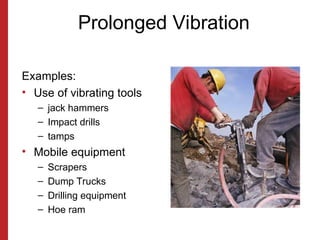
Prolonged Vibration
Examples:
• Use of vibrating tools
– jack hammers
– Impact drills
– tamps
• Mobile equipment
– Scrapers
– Dump Trucks
– Drilling equipment
– Hoe ram
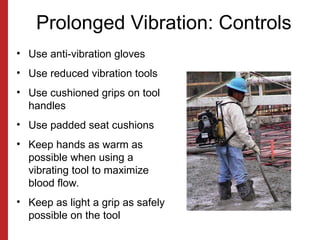
Prolonged Vibration: Controls
• Use anti-vibration gloves
• Use reduced vibration tools
• Use cushioned grips on tool
handles
• Use padded seat cushions
• Keep hands as warm as
possible when using a
vibrating tool to maximize
blood flow.
• Keep as light a grip as safely
possible on the tool
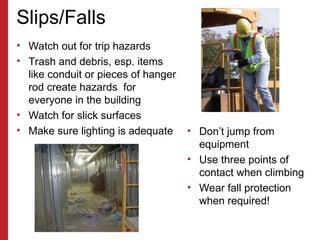
Slips/Falls
• Watch out for trip hazards
• Trash and debris, esp. items
like conduit or pieces of hanger
rod create hazards for
everyone in the building
• Watch for slick surfaces
• Make sure lighting is adequate • Don’t jump from
equipment
• Use three points of
contact when climbing
• Wear fall protection
when required!
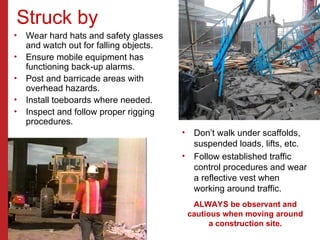
Struck by
• Wear hard hats and safety glasses
and watch out for falling objects.
• Ensure mobile equipment has
functioning back-up alarms.
• Post and barricade areas with
overhead hazards.
• Install toeboards where needed.
• Inspect and follow proper rigging
procedures.
• Don’t walk under scaffolds,
suspended loads, lifts, etc.
• Follow established traffic
control procedures and wear
a reflective vest when
working around traffic.
ALWAYS be observant and
cautious when moving around
a construction site.
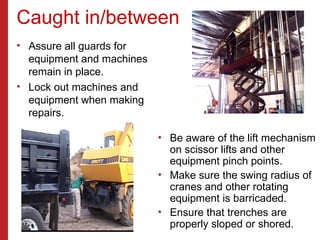
Caught in/between
• Assure all guards for
equipment and machines
remain in place.
• Lock out machines and
equipment when making
repairs.
• Be aware of the lift mechanism
on scissor lifts and other
equipment pinch points.
• Make sure the swing radius of
cranes and other rotating
equipment is barricaded.
• Ensure that trenches are
properly sloped or shored.
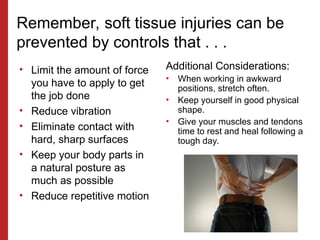
Remember, soft tissue injuries can be
prevented by controls that . . .
• Limit the amount of force
you have to apply to get
the job done
• Reduce vibration
• Eliminate contact with
hard, sharp surfaces
• Keep your body parts in
a natural posture as
much as possible
• Reduce repetitive motion
Additional Considerations:
• When working in awkward
positions, stretch often.
• Keep yourself in good physical
shape.
• Give your muscles and tendons
time to rest and heal following a
tough day.
Summary
Summary
• Each of you perform numerous activities every day that have the
potential to result in some type of soft tissue injury.
• It is important that you take time to recognize when these potential
dangers exist and really look at ways to do the job in a safe way.
• Most importantly – listen to your body! It tells you when you are doing
things you shouldn’t be doing.
• We all know someone whose life has been significantly impacted by
something like a severe back injury – DON’T LET IT HAPPEN TO YOU!
Safety is everyone's responsibility —
ALL of the time.
Lets work together to prevent sprains and strains
and other soft tissue injuries!
You can contact the following for additional
information on injury prevention:
Call 1-800-249-8510 or go to their
website at www.state.tn.us or
www.osha.gov
OR
Your (association) representative
at (phone)/(email)/(website)
INSERT YOUR
LOGO

Soft_Tissue_Injury_Prevention_Stand_Down_Final.ppt

  • 1.
    Soft Tissue InjuryPrevention Soft Tissue Injury Prevention Safety Stand Down Safety Stand Down June 14, 2010 June 14, 2010
  • 2.
    What are softtissue injuries… • Soft tissue injuries are injuries that affect your muscles, nerves, tendons, ligaments, joints and spinal discs. • This is the most prevalent type of injury in the construction industry! • Although not fatal, these types of injuries can be disabling preventing an individual from leading a normal lifestyle and in some cases living with constant pain.
  • 3.
    Why is softtissue injury training so important? • 30 percent of the construction industry’s workers’ compensation claims • 70 percent of total workers’ compensation losses We can prevent 1/3 of all work related injuries!
  • 4.
    Sprain or straininjuries accounted for 39% of total injury and illness cases requiring days away from work in 2008! Multiple injuries (4.1%) Fractures (8.3%) Punctures (1.2%) Heat & chemicals (1.4%) Other (25.3%) Sprains and strains (38.6%) Cuts and lacerations (8.1%) Bruises and contusions (8.7%) Soreness, pain except back (4.3%) On average, sprains and strains required 9 days away from work!
  • 5.
    You body workslike a well oiled machine… Just like cranes and other equipment you depend on everyday, our bodies have to be maintained and operated within their limitations. •Machine condition = your physical condition •Operational limitations = your physical ability •Load capacity = your strength limitations Know your body’s limitations – Don’t overload the machine!
  • 6.
    Don’t let thisbe you…… • Example: A building worker who has worked on construction sites since the age of 14, using drilling and pneumatic hammers three or four days a week for several hours, now suffers from an occupational disease. At the age of 42, the pain in his wrist is so severe that he can no longer work. • Example: A machine operator, who has driven an excavator and loader every day for some 20 years, has had to give up his job because the pain in his back is so severe. This situation could have been avoided if he had used a modern, well-designed and adjustable seat on his vehicle and limited his exposure; for example, by rotating jobs.
  • 7.
    Examples of softtissue injuries include: Examples of soft tissue injuries include: • Sprains (an injury to ligaments that is caused by being stretched beyond their normal capacity and possibly torn) • Strains (a stretching or tearing of muscle or tendon) • Nerve Damage • Crush Syndrome • Sciatica (pain, weakness, numbness, or tingling in the leg) • Tendonitis (inflammation of a tendon) • Bulging or Ruptured Disk • Bursitis (inflammation of the fluid-filled sac (bursa) that lies between a tendon and skin, or between a tendon and bone) • Carpal Tunnel Syndrome
  • 8.
    Symptoms of SoftTissue Injuries – Less strength for gripping – Less range of motion – Loss of muscle function – Inability to do everyday tasks – Sore muscles – Strains/Sprains – Bruises – Pinched nerves
  • 9.
    Primary Causes ofSoft Tissue Injuries • Repetitive motions • Awkward postures • Forceful exertion • Contact stress • Prolonged vibration • Excess body weight • Slips/Falls • Struck by • Caught in Ask participants to name tasks that they perform that could result in a soft tissue injury.
  • 10.
    Repetitive Motions • Taskswith high repetition rates can become a source of injury even when the required forces are minimal and normally safe. Examples: • Raising and lowering your arm over and over again while using a table or concrete saw • Using tools like a hammer, screw gun, caulk gun, etc.
  • 11.
    Repetitive Motion: Controls •Rotate job duties • Use power tools instead of hand tools when possible • Tool tips: – Avoid tools with finger grooves – Tools with offset handles can help keep the wrist straight – A tool handle shouldn’t be so short it presses continually into your palm – Soft grips and spring loaded handles are a plus
  • 12.
    Awkward Postures An awkwardposture is one in which any part of the body is under strain due to its unnatural or extreme position. Examples include: •Picking up a load over the side of a pickup truck •Bending over to finish concrete or tie rebar •Working in a tight area •Working overhead
  • 13.
    Awkward Postures: Controls •Tryto position yourself so your work is waist high by doing things like placing saws on tables rather than on the floor. •Use scaffolds, lifts or ladders to elevate you to your work. •Plan the layout of laydown and storage areas to provide easy access and reduce the number of times materials need to be moved. Simple Solutions: • Use tools with extensions like bit extensions for drills to eliminate the need to bend so far forward or reach so high.
  • 14.
    Forceful Exertion • Forceis the amount of effort it takes to perform a task, such as pushing, pulling or gripping a tool. • The more force you have to exert, the greater the stress on your body. Examples: • Repeatedly turning a screwdriver while pushing at the same time. • Repeated pressure on a finger when pressing the trigger on a power tool. • Lifting an excessive amount of weight. 45% of sprains and strains are the result of overexertion.
  • 15.
    Forceful Exertion: Controls Examples: •Utilize mechanical devices to lift or support loads • Ask for help with a heavy or awkward load • Use power tools instead of hand tools when possible • Select tools with larger grips and bigger triggers • Select products such as: • Lightweight concrete block • ½ weight bags of portland cement Simple Solutions: • If a tool has a narrow handle, wrap it with compressible foam to improve grip. • Use quick-threading lock nuts to reduce twisting motions.
  • 16.
    BACK FACTS: •Your waistacts like the fulcrum in a lever system, on a 10:1 ratio •When you add in the 105 pounds of the average human upper torso, you see that lifting a 10 pound object actually puts 1,150 pounds of pressure on the lower back. •If you were 25 pounds overweight, it would add an additional 250 pounds of pressure on your back every time you bend over! 40% of sprains and strains injure the BACK!
  • 17.
    Use Proper LiftingTechniques! • Estimate the weight of the load before lifting. • Stand close to the load, squat down bending at the knees, put the hands firmly under the object and keep it close to the body during lifting. • Make the lift smoothly lifting with the legs, keep the back straight, the chin up and the load close to the body. • If you must turn while carrying the object, turn using your feet, do not twist the body. • Reverse this order to place the object below waist level. Remember: Back injuries are preventable. Have someone demonstrate the right way to lift.
  • 18.
    Contact Stress • Causedby contact with hard objects or surfaces Examples: • Working on your knees • Hitting something with your hand • Carrying something and supporting it on your shoulder or head • Standing/working off ladders and rubbing soft tissue • Using tools like tin snips that require a lot of pressure
  • 19.
    Contact Stress: Controls •Use knee pads or kneeling creepers when working on your knees • Shoe inserts for prolonged standing • Wearing gloves to protect from sharp, hard objects • Use ergonomically designed tools with cushioned grips • Use the correct tool for the job
  • 20.
    Prolonged Vibration Examples: • Useof vibrating tools – jack hammers – Impact drills – tamps • Mobile equipment – Scrapers – Dump Trucks – Drilling equipment – Hoe ram
  • 21.
    Prolonged Vibration: Controls •Use anti-vibration gloves • Use reduced vibration tools • Use cushioned grips on tool handles • Use padded seat cushions • Keep hands as warm as possible when using a vibrating tool to maximize blood flow. • Keep as light a grip as safely possible on the tool
  • 22.
    Slips/Falls • Watch outfor trip hazards • Trash and debris, esp. items like conduit or pieces of hanger rod create hazards for everyone in the building • Watch for slick surfaces • Make sure lighting is adequate • Don’t jump from equipment • Use three points of contact when climbing • Wear fall protection when required!
  • 23.
    Struck by • Wearhard hats and safety glasses and watch out for falling objects. • Ensure mobile equipment has functioning back-up alarms. • Post and barricade areas with overhead hazards. • Install toeboards where needed. • Inspect and follow proper rigging procedures. • Don’t walk under scaffolds, suspended loads, lifts, etc. • Follow established traffic control procedures and wear a reflective vest when working around traffic. ALWAYS be observant and cautious when moving around a construction site.
  • 24.
    Caught in/between • Assureall guards for equipment and machines remain in place. • Lock out machines and equipment when making repairs. • Be aware of the lift mechanism on scissor lifts and other equipment pinch points. • Make sure the swing radius of cranes and other rotating equipment is barricaded. • Ensure that trenches are properly sloped or shored.
  • 25.
    Remember, soft tissueinjuries can be prevented by controls that . . . • Limit the amount of force you have to apply to get the job done • Reduce vibration • Eliminate contact with hard, sharp surfaces • Keep your body parts in a natural posture as much as possible • Reduce repetitive motion Additional Considerations: • When working in awkward positions, stretch often. • Keep yourself in good physical shape. • Give your muscles and tendons time to rest and heal following a tough day.
  • 26.
    Summary Summary • Each ofyou perform numerous activities every day that have the potential to result in some type of soft tissue injury. • It is important that you take time to recognize when these potential dangers exist and really look at ways to do the job in a safe way. • Most importantly – listen to your body! It tells you when you are doing things you shouldn’t be doing. • We all know someone whose life has been significantly impacted by something like a severe back injury – DON’T LET IT HAPPEN TO YOU! Safety is everyone's responsibility — ALL of the time. Lets work together to prevent sprains and strains and other soft tissue injuries!
  • 27.
    You can contactthe following for additional information on injury prevention: Call 1-800-249-8510 or go to their website at www.state.tn.us or www.osha.gov OR Your (association) representative at (phone)/(email)/(website) INSERT YOUR LOGO