ANKUR SHARMA
Master of Industrial Hygiene & Safety
BS-Plant Operations & Maintenance
www.ankur-mihs.blogspot.in
ISTAR, SPU VVN Anand
1
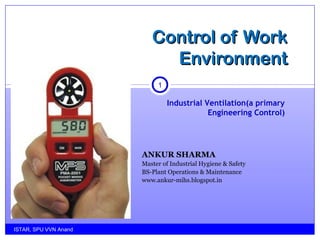
Control of WorkControl of Work
EnvironmentEnvironment
Industrial Ventilation(a primary
Engineering Control)
Work Environment Control…..
ISTAR, SPU VVN Anand
2
To prevent or minimize exposure of workers
to harmful environmental hazards which
could lead to serious occupational illnesses
and diseases or even death.
Hazards of Poor or No Ventilation
ISTAR, SPU VVN Anand
3
Lack of oxygen (headache, fatigue, Asphyxiation,
particularly in confined spaces)
Excessive heat, cold, and humidity
Toxic fumes (e.g.- Lead, cadmium, zinc)
Toxic vapors (e.g.- Benzene, toluene, TCE, MEK)
Toxic gases (e.g.- Hydrogen Sulphide, ammonia)
Dusts (causing poisoning or gradually reduced lung
capacity)
Fire/explosion
Control philosophy
ISTAR, SPU VVN Anand
4
“The correct recognition and careful
evaluation of the hazards are extremely
important and will constitute the basis of
appropriate control measures”
Generalized Diagram:--
Methods of Control
ISTAR, SPU VVN Anand
5
Desired control priority for chemical hazards
1.Source control
2.Pathway control
3.Receiver control
Pathway Controls
ISTAR, SPU VVN Anand
6
Pathway controls generally are not as desirable as
source controls:-
Exposures are reduced, but not eliminated (general
ventilation)
The source hazard still remains
Pathway controls often are costly
Operation cost ↑
Pathway control systems must be maintained
Industrial Ventilation
ISTAR, SPU VVN Anand
7
 Ventilation is a primary engineering control available
to eliminate or reduce the concentration of gases,
dusts, vapors, smoke, and fumes present in the work
environment .
 Ventilation is defined as the process of supplying air
to, or removing air from, any space by natural or
mechanical means.
Purpose
ISTAR, SPU VVN Anand
8
 To dilute airborne contaminants to acceptable levels
 To prevent hazardous air contaminants from
dispersing into the working environment (LEV)
 To prevent fire and explosion
 To create a comfortable environment in the plant -
i.e. The HVAC system
Types of Ventilation
ISTAR, SPU VVN Anand
9
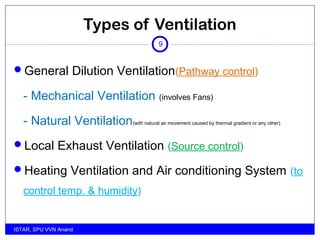
General Dilution Ventilation(Pathway control)
- Mechanical Ventilation (involves Fans)
- Natural Ventilation(with natural air movement caused by thermal gradient or any other)
Local Exhaust Ventilation (Source control)
Heating Ventilation and Air conditioning System (to
control temp. & humidity)
Natural Ventilation Mechanical Ventilation
Preferred if significant
health hazards exist
ISTAR, SPU VVN Anand
10
General or Dilution Ventilation
Clean Air
Supply
Zone of Contaminant
Release
Operators Breathing
Zone
Discharge
Opening
Direction of air flow must remove contaminants from workers
breathing zone
Principle of General Ventilation
ISTAR, SPU VVN Anand
11
Blowing and Exhausting
ISTAR, SPU VVN Anand
12
Approx 10% of the face
velocity at 30d away from
Pr. Jet Opening
Approx 10% of the face
velocity at 1-dia. away
exhaust opening
4000 FPM
4000 FPM
400 FPM
400 FPM
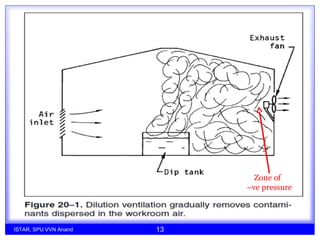
Zone of
–ve pressure
ISTAR, SPU VVN Anand 13
X
Recommended
Practices
ISTAR, SPU VVN Anand 14
ISTAR, SPU VVN Anand 15
The dilution ventilation
must work with natural
air movement such as
the convective rise due
to solar heat load on
this process vessel.
ISTAR, SPU VVN Anand 16
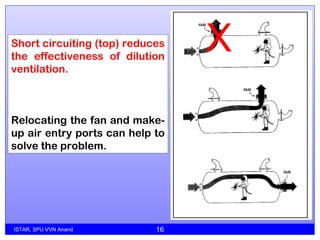
Short circuiting (top) reduces
the effectiveness of dilution
ventilation.
Relocating the fan and make-
up air entry ports can help to
solve the problem.
X
ISTAR, SPU VVN Anand 17
An exhaust fan cannot direct
airflow (top).
The same fan system blowing air
(bottom) can direct airflow, and is
much more effective in diluting
contaminants in the work zone.
(Courtesy ExxonMobil Corporation.)
X
General Dilution Ventilation
ISTAR, SPU VVN Anand
18
 If (TLV <100ppm)- not recommended
 Only suitable for contaminant with low & uniform generation rate
 Not completely remove the contaminant
 Some general ventilation devices:---
Industrial
exhaust fansRoof-mounted exhaust fans
Local Exhaust Ventilation-Source Control
ISTAR, SPU VVN Anand
19
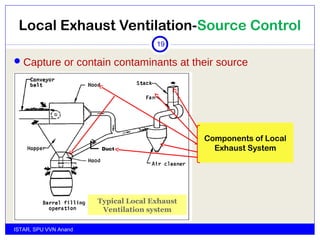
Capture or contain contaminants at their source
Typical Local Exhaust
Ventilation system
Components of Local
Exhaust SystemDuct
ISTAR, SPU VVN Anand 20
Hoods - any point where air is drawn into the
ventilation system to capture or control contaminants.
Ducts - the network of piping that connects the
hoods and other system components.
Fan - air-moving device that provides the energy to
draw air and contaminants into the exhaust system &
through the ducts and other components.
Air Cleaner - a device to remove airborne
materials that may be needed before the exhaust air is
discharged into the community environment.
LEV system is usually preferred control
method, if:
ISTAR, SPU VVN Anand
21
 Air contaminants pose serious health risk.
 Large amounts of dusts or fumes are generated.
 Increased heating costs from ventilation in cold
weather are a concern.
 Emission sources are near the workers' breathing
zones.
Face velocity
Air velocity at the hood
or slot opening
Ventilation Terminology
ISTAR, SPU VVN Anand
22
Capture Velocity - Air velocity at any point in
front of the hood necessary to overcome opposing
air currents and to capture the contaminant at
that point causing it to flow into the hood
- Important hood/process design criteria
ISTAR, SPU VVN Anand
23
Effect of Side Baffles
Hood Proximity(Location) & Exhaust Volume
ISTAR, SPU VVN Anand
24
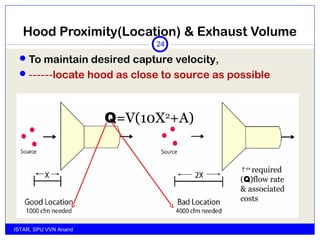
To maintain desired capture velocity,
------locate hood as close to source as possible
Q=V(10X2
+A)
↑es
required
(Q)flow rate
& associated
costs
Use of Enclosures
ISTAR, SPU VVN Anand
25
-- ed power consumption↑
-- less collection efficiency
-- ed flow rate to have↑
sufficient capture velocity
-- more collection efficiency
--less flow rate required
--less power consumption
Benefits of ENCLOSURES
ISTAR, SPU VVN Anand
26
Using techniques such as enclosures,
control capabilities are maximized
Air volumes requirements are drastically
minimized
Reduces required make-up air and
associated costs
Direction of Air Movement
ISTAR, SPU VVN Anand
27
X
ISTAR, SPU VVN Anand
28
ISTAR, SPU VVN Anand
29
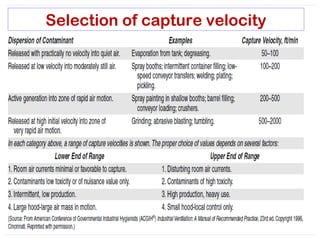
Selection of capture velocity
Testing Ventilation Systems
ISTAR, SPU VVN Anand
30
Ensure it meets design criteria
Comply with regulatory standards
Determine system balance
Determine if maintenance or repair require
Determine whether existing system is capable of
handling additional hoods
Reference
ISTAR, SPU VVN Anand
31
• Industrial Ventilation ( A manual of Recommended Practice, 22nd
Edition-1998)
• Fundamentals of Industrial Hygiene (5th Edition) by Barbara A Plog (Part-5(control of Hazards))
• http://www.epa.gov/eogapti1/bces/module5/hoods/principle/principle.htm
• www.hse.gov.uk/pubns/guidance/ocm2.pdf
• www.hse.gov.uk/lev/
• www.hse.gov.uk/lev/faqs.htm
• www.coshh-essentials.org.uk/assets/live/G200.pdf
• http://www.ccohs.ca/oshanswers/prevention/ventilation/introduction.html
• www.ohsl.co.uk/local-exhaust-ventilation.php
• http://www.ohsl.co.uk/local-exhaust-ventilation.php
ISTAR, SPU VVN Anand
32

Industrial Ventilation-Introduction

  • 1.
    ANKUR SHARMA Master ofIndustrial Hygiene & Safety BS-Plant Operations & Maintenance www.ankur-mihs.blogspot.in ISTAR, SPU VVN Anand 1 Control of WorkControl of Work EnvironmentEnvironment Industrial Ventilation(a primary Engineering Control)
  • 2.
    Work Environment Control….. ISTAR,SPU VVN Anand 2 To prevent or minimize exposure of workers to harmful environmental hazards which could lead to serious occupational illnesses and diseases or even death.
  • 3.
    Hazards of Pooror No Ventilation ISTAR, SPU VVN Anand 3 Lack of oxygen (headache, fatigue, Asphyxiation, particularly in confined spaces) Excessive heat, cold, and humidity Toxic fumes (e.g.- Lead, cadmium, zinc) Toxic vapors (e.g.- Benzene, toluene, TCE, MEK) Toxic gases (e.g.- Hydrogen Sulphide, ammonia) Dusts (causing poisoning or gradually reduced lung capacity) Fire/explosion
  • 4.
    Control philosophy ISTAR, SPUVVN Anand 4 “The correct recognition and careful evaluation of the hazards are extremely important and will constitute the basis of appropriate control measures”
  • 5.
    Generalized Diagram:-- Methods ofControl ISTAR, SPU VVN Anand 5 Desired control priority for chemical hazards 1.Source control 2.Pathway control 3.Receiver control
  • 6.
    Pathway Controls ISTAR, SPUVVN Anand 6 Pathway controls generally are not as desirable as source controls:- Exposures are reduced, but not eliminated (general ventilation) The source hazard still remains Pathway controls often are costly Operation cost ↑ Pathway control systems must be maintained
  • 7.
    Industrial Ventilation ISTAR, SPUVVN Anand 7  Ventilation is a primary engineering control available to eliminate or reduce the concentration of gases, dusts, vapors, smoke, and fumes present in the work environment .  Ventilation is defined as the process of supplying air to, or removing air from, any space by natural or mechanical means.
  • 8.
    Purpose ISTAR, SPU VVNAnand 8  To dilute airborne contaminants to acceptable levels  To prevent hazardous air contaminants from dispersing into the working environment (LEV)  To prevent fire and explosion  To create a comfortable environment in the plant - i.e. The HVAC system
  • 9.
    Types of Ventilation ISTAR,SPU VVN Anand 9 General Dilution Ventilation(Pathway control) - Mechanical Ventilation (involves Fans) - Natural Ventilation(with natural air movement caused by thermal gradient or any other) Local Exhaust Ventilation (Source control) Heating Ventilation and Air conditioning System (to control temp. & humidity)
  • 10.
    Natural Ventilation MechanicalVentilation Preferred if significant health hazards exist ISTAR, SPU VVN Anand 10 General or Dilution Ventilation
  • 11.
    Clean Air Supply Zone ofContaminant Release Operators Breathing Zone Discharge Opening Direction of air flow must remove contaminants from workers breathing zone Principle of General Ventilation ISTAR, SPU VVN Anand 11
  • 12.
    Blowing and Exhausting ISTAR,SPU VVN Anand 12 Approx 10% of the face velocity at 30d away from Pr. Jet Opening Approx 10% of the face velocity at 1-dia. away exhaust opening 4000 FPM 4000 FPM 400 FPM 400 FPM
  • 13.
  • 14.
  • 15.
    ISTAR, SPU VVNAnand 15 The dilution ventilation must work with natural air movement such as the convective rise due to solar heat load on this process vessel.
  • 16.
    ISTAR, SPU VVNAnand 16 Short circuiting (top) reduces the effectiveness of dilution ventilation. Relocating the fan and make- up air entry ports can help to solve the problem. X
  • 17.
    ISTAR, SPU VVNAnand 17 An exhaust fan cannot direct airflow (top). The same fan system blowing air (bottom) can direct airflow, and is much more effective in diluting contaminants in the work zone. (Courtesy ExxonMobil Corporation.) X
  • 18.
    General Dilution Ventilation ISTAR,SPU VVN Anand 18  If (TLV <100ppm)- not recommended  Only suitable for contaminant with low & uniform generation rate  Not completely remove the contaminant  Some general ventilation devices:--- Industrial exhaust fansRoof-mounted exhaust fans
  • 19.
    Local Exhaust Ventilation-SourceControl ISTAR, SPU VVN Anand 19 Capture or contain contaminants at their source Typical Local Exhaust Ventilation system Components of Local Exhaust SystemDuct
  • 20.
    ISTAR, SPU VVNAnand 20 Hoods - any point where air is drawn into the ventilation system to capture or control contaminants. Ducts - the network of piping that connects the hoods and other system components. Fan - air-moving device that provides the energy to draw air and contaminants into the exhaust system & through the ducts and other components. Air Cleaner - a device to remove airborne materials that may be needed before the exhaust air is discharged into the community environment.
  • 21.
    LEV system isusually preferred control method, if: ISTAR, SPU VVN Anand 21  Air contaminants pose serious health risk.  Large amounts of dusts or fumes are generated.  Increased heating costs from ventilation in cold weather are a concern.  Emission sources are near the workers' breathing zones.
  • 22.
    Face velocity Air velocityat the hood or slot opening Ventilation Terminology ISTAR, SPU VVN Anand 22 Capture Velocity - Air velocity at any point in front of the hood necessary to overcome opposing air currents and to capture the contaminant at that point causing it to flow into the hood - Important hood/process design criteria
  • 23.
    ISTAR, SPU VVNAnand 23 Effect of Side Baffles
  • 24.
    Hood Proximity(Location) &Exhaust Volume ISTAR, SPU VVN Anand 24 To maintain desired capture velocity, ------locate hood as close to source as possible Q=V(10X2 +A) ↑es required (Q)flow rate & associated costs
  • 25.
    Use of Enclosures ISTAR,SPU VVN Anand 25 -- ed power consumption↑ -- less collection efficiency -- ed flow rate to have↑ sufficient capture velocity -- more collection efficiency --less flow rate required --less power consumption
  • 26.
    Benefits of ENCLOSURES ISTAR,SPU VVN Anand 26 Using techniques such as enclosures, control capabilities are maximized Air volumes requirements are drastically minimized Reduces required make-up air and associated costs
  • 27.
    Direction of AirMovement ISTAR, SPU VVN Anand 27 X
  • 28.
  • 29.
    ISTAR, SPU VVNAnand 29 Selection of capture velocity
  • 30.
    Testing Ventilation Systems ISTAR,SPU VVN Anand 30 Ensure it meets design criteria Comply with regulatory standards Determine system balance Determine if maintenance or repair require Determine whether existing system is capable of handling additional hoods
  • 31.
    Reference ISTAR, SPU VVNAnand 31 • Industrial Ventilation ( A manual of Recommended Practice, 22nd Edition-1998) • Fundamentals of Industrial Hygiene (5th Edition) by Barbara A Plog (Part-5(control of Hazards)) • http://www.epa.gov/eogapti1/bces/module5/hoods/principle/principle.htm • www.hse.gov.uk/pubns/guidance/ocm2.pdf • www.hse.gov.uk/lev/ • www.hse.gov.uk/lev/faqs.htm • www.coshh-essentials.org.uk/assets/live/G200.pdf • http://www.ccohs.ca/oshanswers/prevention/ventilation/introduction.html • www.ohsl.co.uk/local-exhaust-ventilation.php • http://www.ohsl.co.uk/local-exhaust-ventilation.php
  • 32.