Ergonomics Training
Lesson 1 – Using Computers Safely
Designed by:
Wayne Pascall
Ergonomics – Using Computers Safely
Objectives
Ergonomics – Using Computers Safely
Objectives
• Use a desktop computer and its accessories
following safe ergonomic guidelines.
• Adopt the proper posture and equipment when
using the personal computer.
• Use the computer repeatedly in a manner that
will avoid injury to back, hands, nerves and
eyes.
At the end of this course you will be able to:
Ergonomics – Using Computers Safely
Lesson 1
What is Ergonomics?
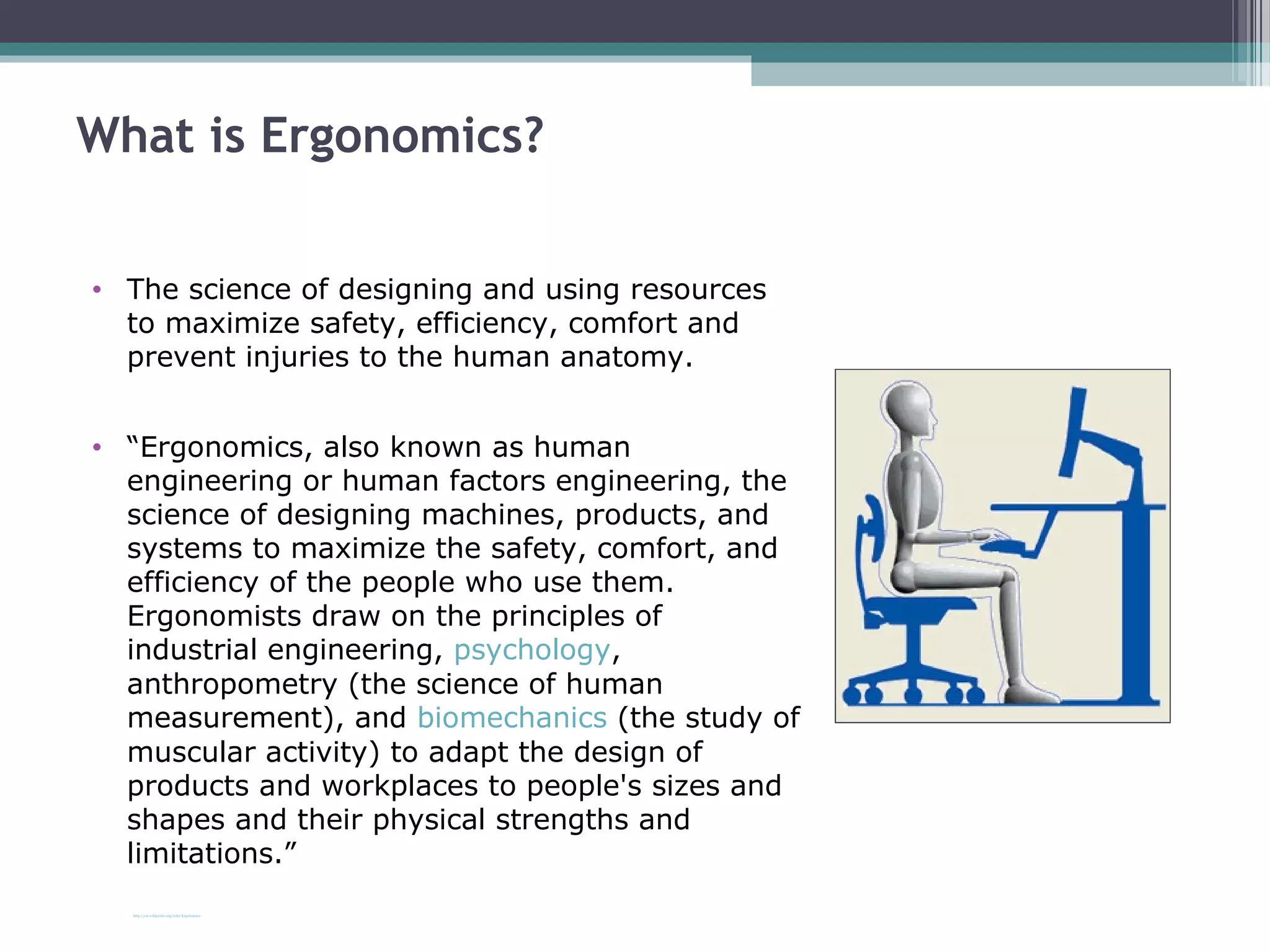
• The science of designing and using resources
to maximize safety, efficiency, comfort and
prevent injuries to the human anatomy.
• “Ergonomics, also known as human
engineering or human factors engineering, the
science of designing machines, products, and
systems to maximize the safety, comfort, and
efficiency of the people who use them.
Ergonomists draw on the principles of
industrial engineering, psychology,
anthropometry (the science of human
measurement), and biomechanics (the study of
muscular activity) to adapt the design of
products and workplaces to people's sizes and
shapes and their physical strengths and
limitations.”
http://en.wikipedia.org/wiki/Ergonomics
Importance of Ergonomics
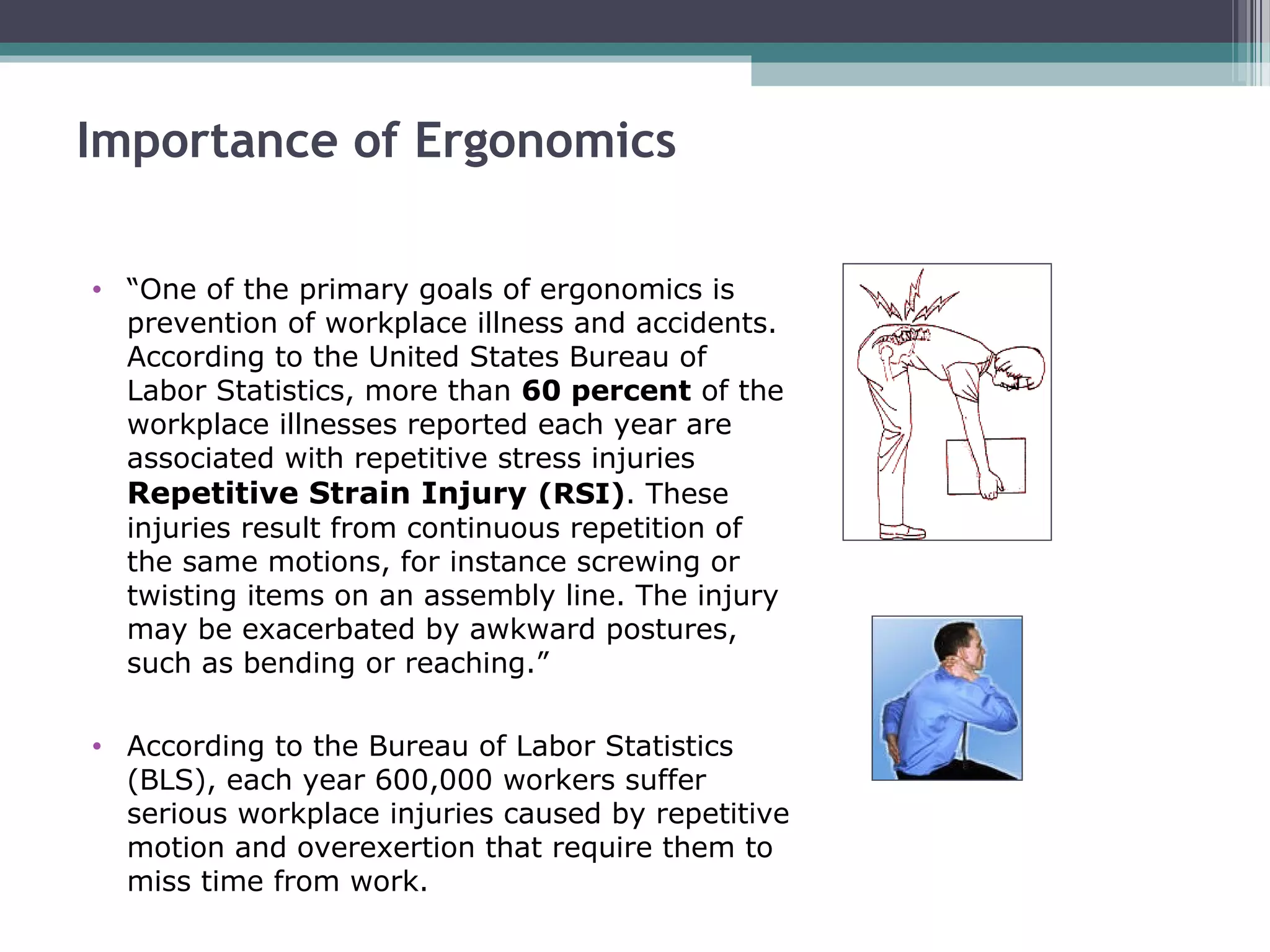
• “One of the primary goals of ergonomics is
prevention of workplace illness and accidents.
According to the United States Bureau of
Labor Statistics, more than 60 percent of the
workplace illnesses reported each year are
associated with repetitive stress injuries
Repetitive Strain Injury (RSI). These
injuries result from continuous repetition of
the same motions, for instance screwing or
twisting items on an assembly line. The injury
may be exacerbated by awkward postures,
such as bending or reaching.”
• According to the Bureau of Labor Statistics
(BLS), each year 600,000 workers suffer
serious workplace injuries caused by repetitive
motion and overexertion that require them to
miss time from work.
Importance of Ergonomics
• According to the National Academy of Sciences, these injuries cost the
country $45 - $54 billion annually.
http://www.ufcw.org/issues_and_actions/stop_the_pain/how_it_effe
cts_you/ergo_problem.cfm
• The three most common work-related injuries associated with bad
practices in using computers are:
1. Repetitive Strain Injury (RSI),
2. Carpal Tunnel Syndrome
3. Back Injuries
Repetitive Strain Injury (RSI)
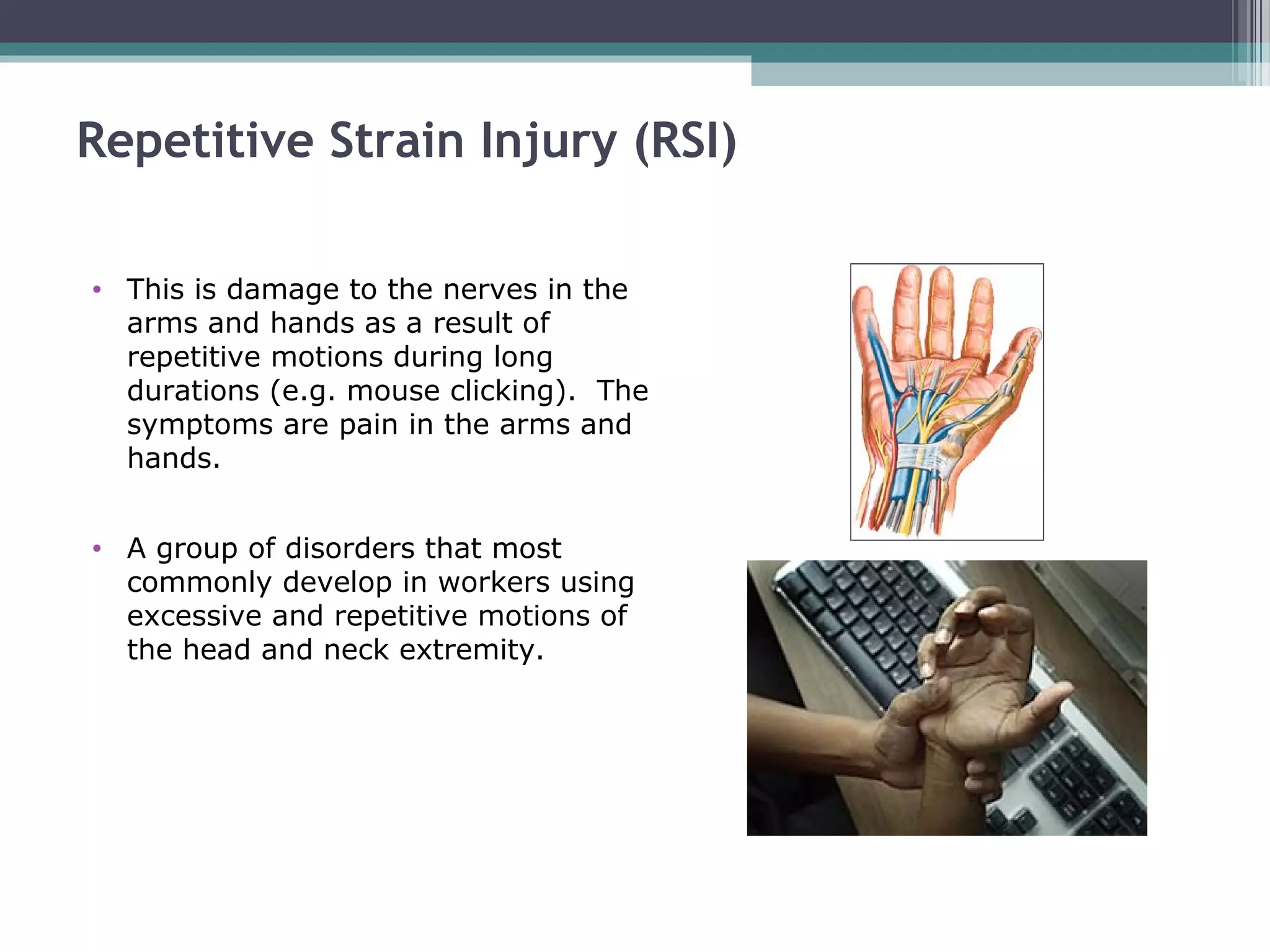
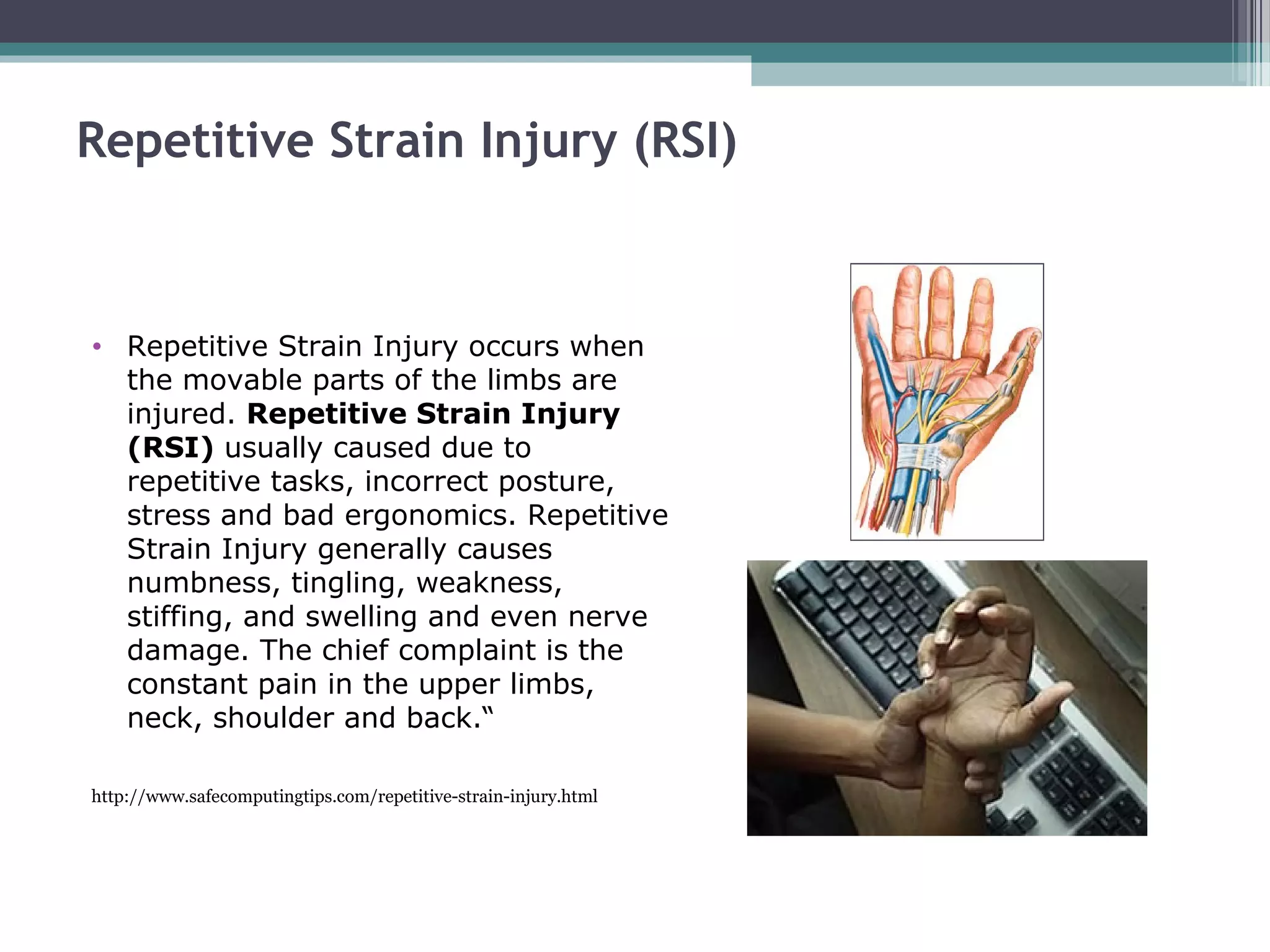
• This is damage to the nerves in the
arms and hands as a result of
repetitive motions during long
durations (e.g. mouse clicking). The
symptoms are pain in the arms and
hands.
• A group of disorders that most
commonly develop in workers using
excessive and repetitive motions of
the head and neck extremity.
Repetitive Strain Injury (RSI)
• Repetitive Strain Injury occurs when
the movable parts of the limbs are
injured. Repetitive Strain Injury
(RSI) usually caused due to
repetitive tasks, incorrect posture,
stress and bad ergonomics. Repetitive
Strain Injury generally causes
numbness, tingling, weakness,
stiffing, and swelling and even nerve
damage. The chief complaint is the
constant pain in the upper limbs,
neck, shoulder and back.“
http://www.safecomputingtips.com/repetitive-strain-injury.html
Carpal Tunnel Syndrome
• “A pinched nerve (called the Median
nerve) in the wrist. Carpal Tunnel
Syndrome (CTS) is the inflammatory
disorder that is caused due to
repetitive stress, physical injury or
any other condition that causes the
tissues around the median nerve to
inflated…This ultimately results in
pain, numbness, and tingling
sensation in the wrist, hand, and
fingers.”
http://www.safecomputingtips.com/carpal-tunnel-
syndrome.html
Musculoskeletal Disorders
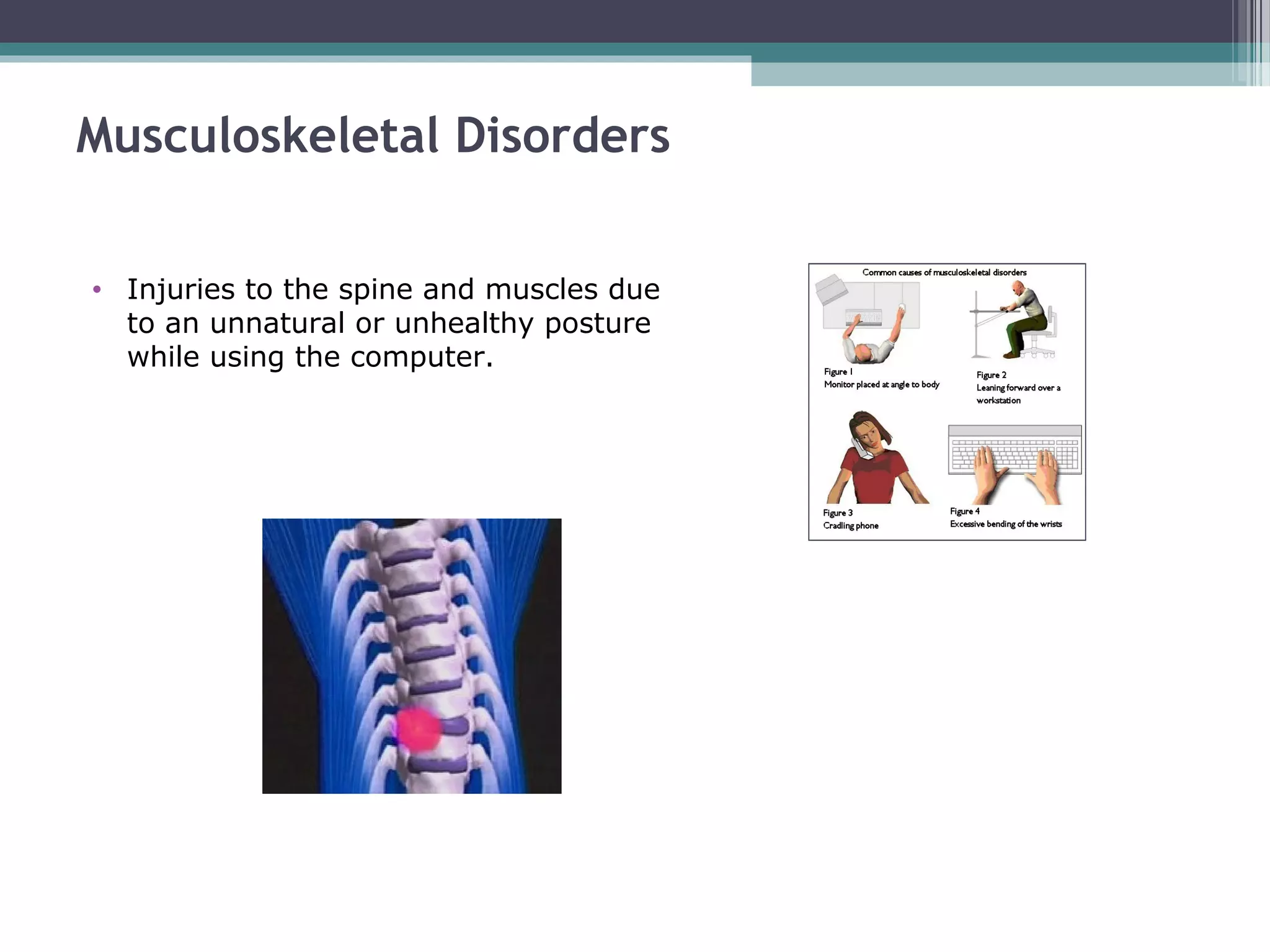
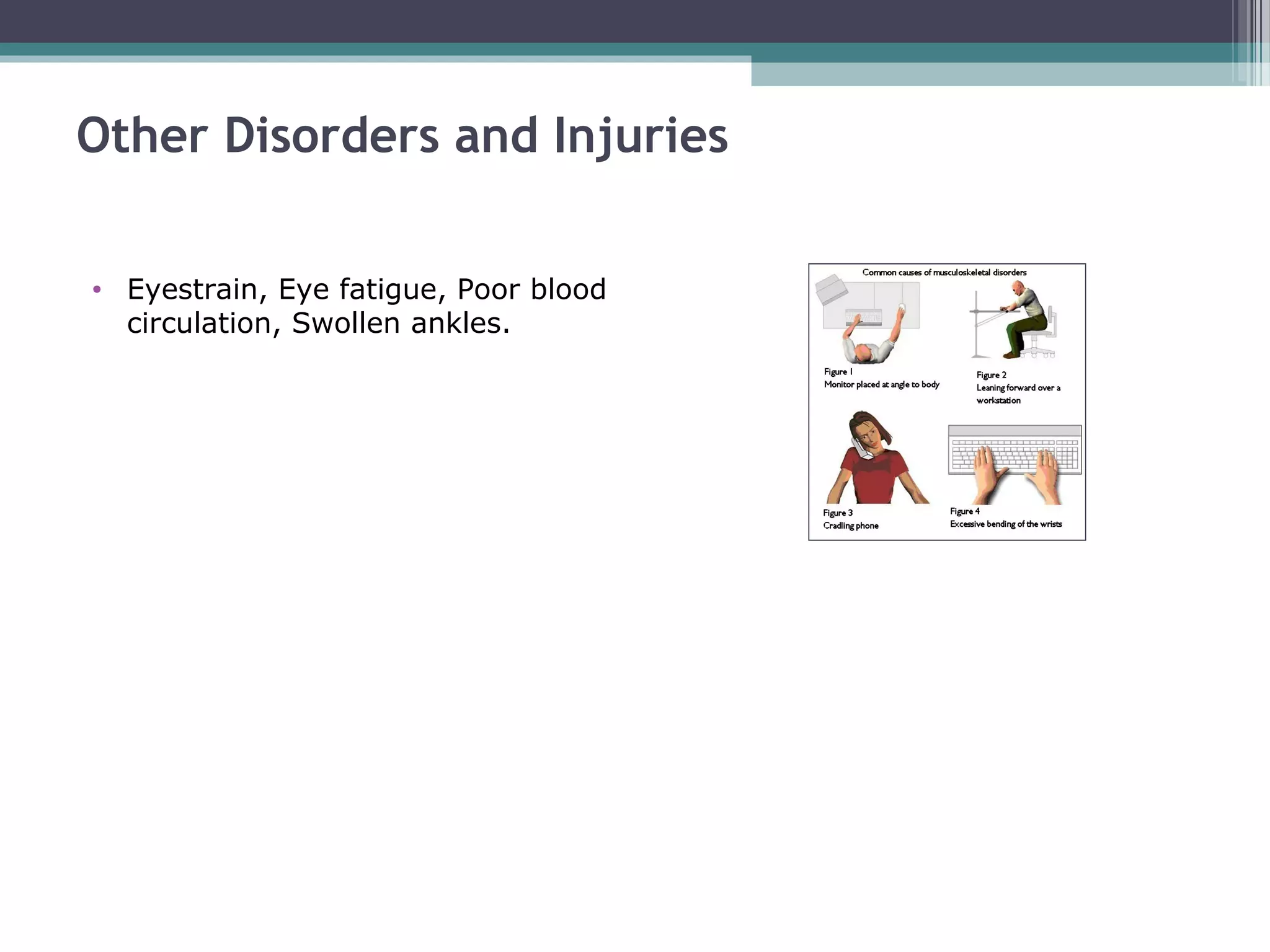
• Injuries to the spine and muscles due
to an unnatural or unhealthy posture
while using the computer.
Other Disorders and Injuries
• Eyestrain, Eye fatigue, Poor blood
circulation, Swollen ankles.
Positive Work Habits When Using The Computer
Eyesight
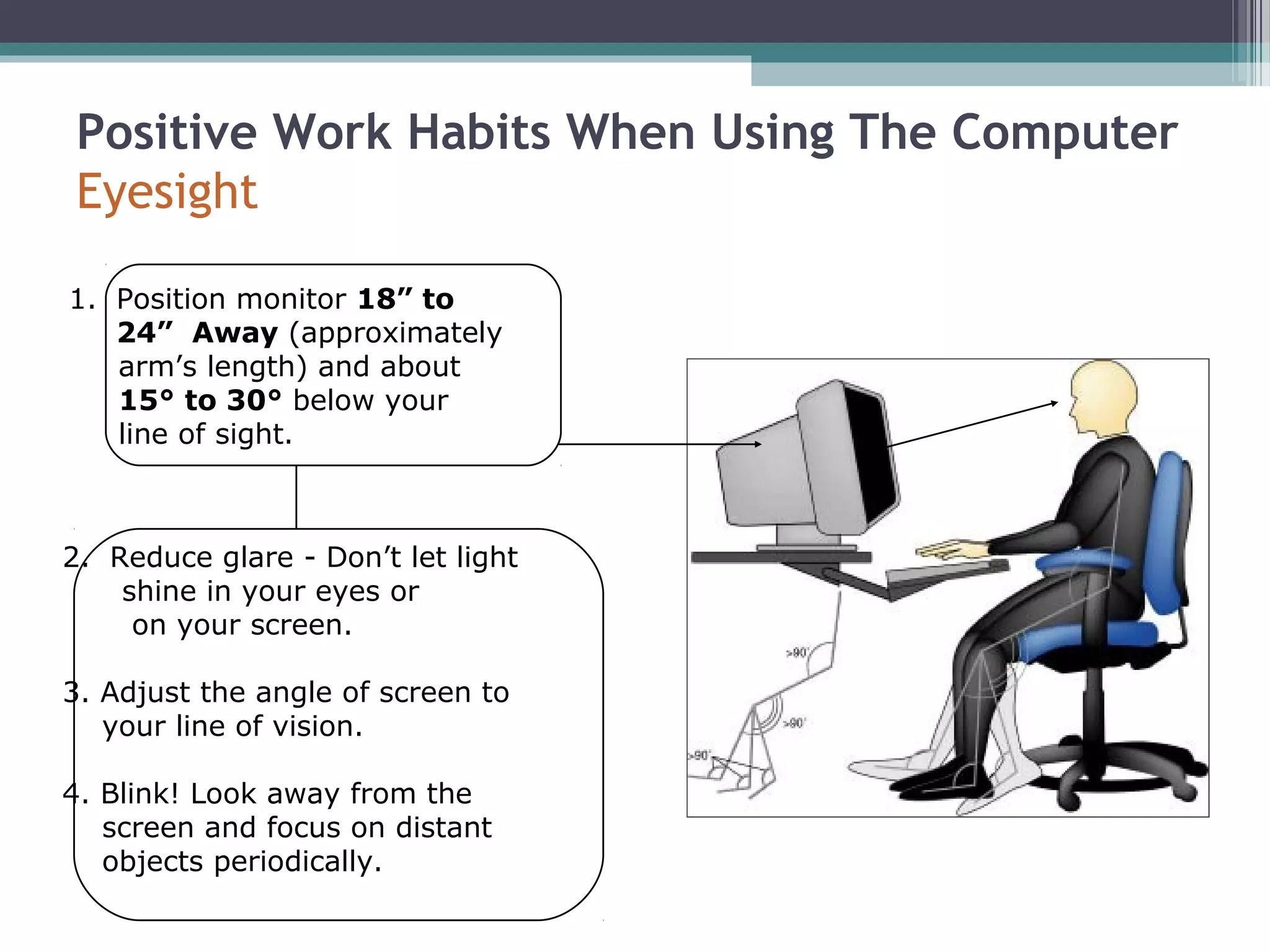
1. Position monitor 18” to
24” Away (approximately
arm’s length) and about
15° to 30° below your
line of sight.
2. Reduce glare - Don’t let light
shine in your eyes or
on your screen.
3. Adjust the angle of screen to
your line of vision.
4. Blink! Look away from the
screen and focus on distant
objects periodically.
Positive Work Habits When Using The Computer
Posture
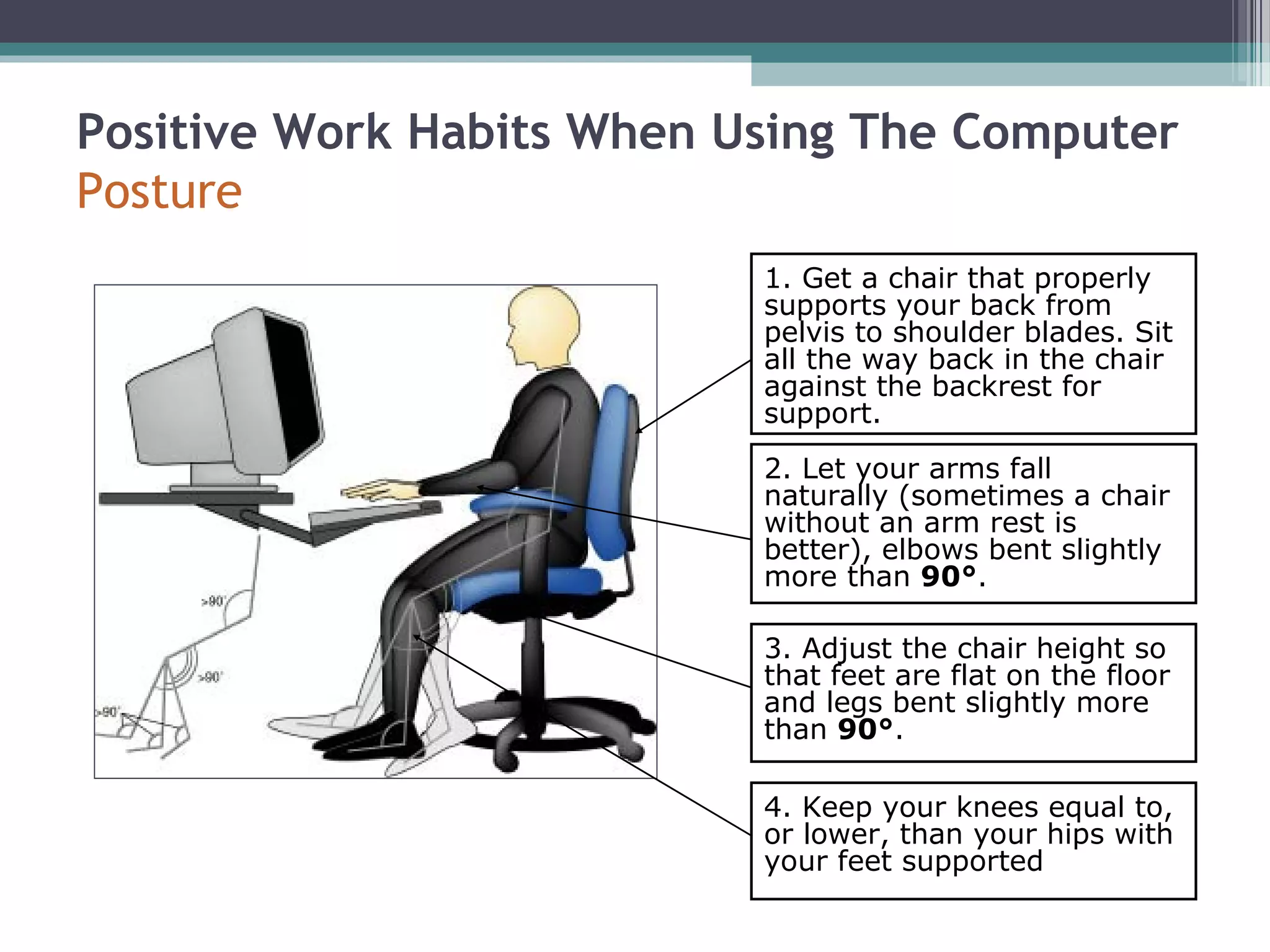
1. Get a chair that properly
supports your back from
pelvis to shoulder blades. Sit
all the way back in the chair
against the backrest for
support.
2. Let your arms fall
naturally (sometimes a chair
without an arm rest is
better), elbows bent slightly
more than 90°.
4. Keep your knees equal to,
or lower, than your hips with
your feet supported
3. Adjust the chair height so
that feet are flat on the floor
and legs bent slightly more
than 90°.
Positive Work Habits When Using The Computer
Keyboard and Mouse
• Strike the keys softly.
• Glide your hands over the keyboard.
• Rest your palms on a palm rest in
between keystrokes, but don't fix your
wrists or palms on the palm rest while
keying.
• Keep your wrists straight and relaxed.
• Reduce risk of RSI by limiting
repetitive motions - avoid Excessive
clicking of mouse by using the aid of
voice recognition software and
macros.
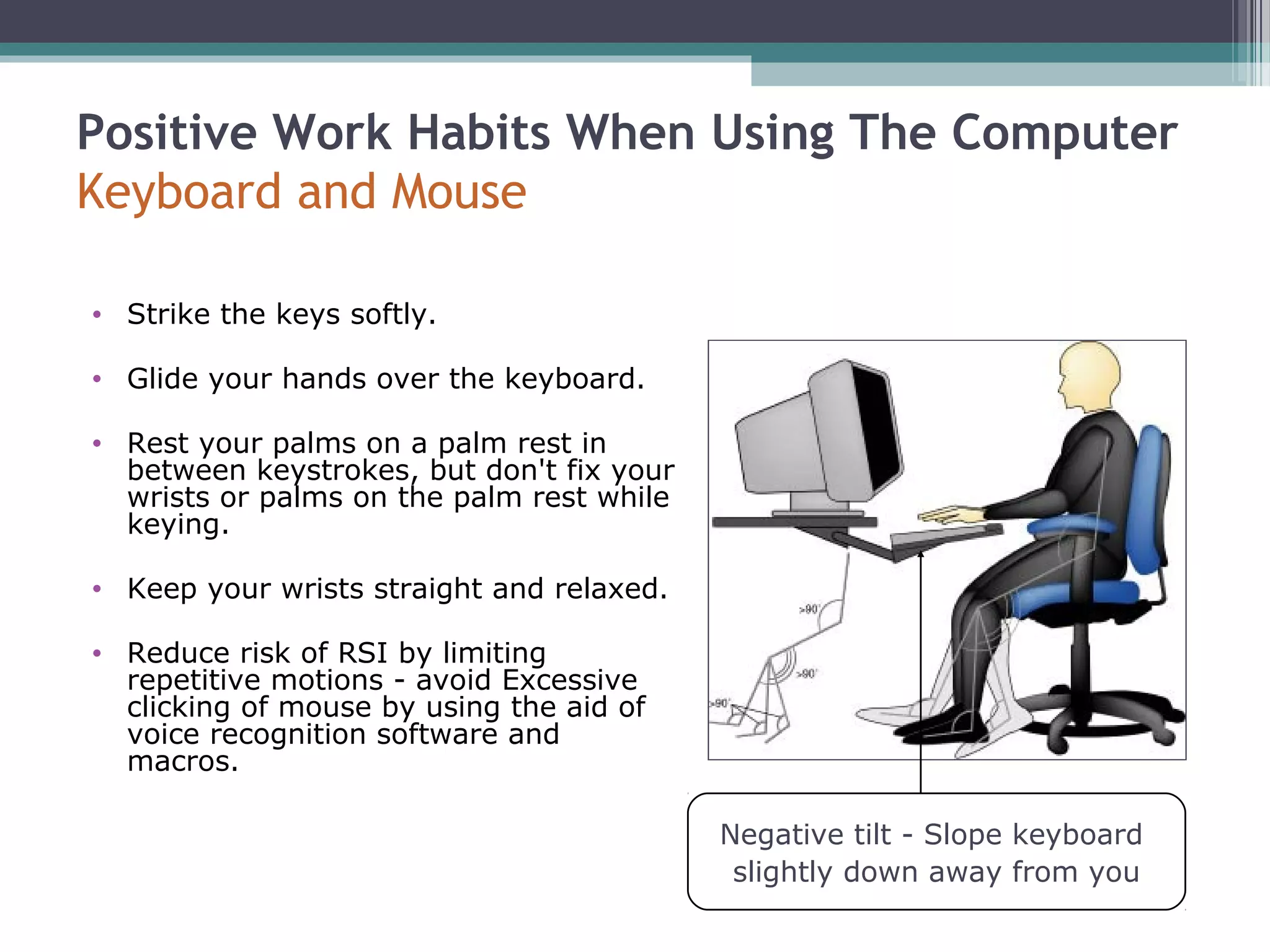
Negative tilt - Slope keyboard
slightly down away from you
Positive Work Habits When Using The Computer
Pace, Duration and Exercises
• Don't sit in one position at the
computer for extended periods. Take
stand and stretch breaks occasionally.
• Occasional breaks accompanied with
simple stretches can help prevent
fatigue and injury:
• Stretches:
Neck and Shoulders
Hands and Wrists
Upper and Mid-Back
Lower Back
Legs
Hips
Ankles
Positive Work Habits When Using The Computer
Lifting
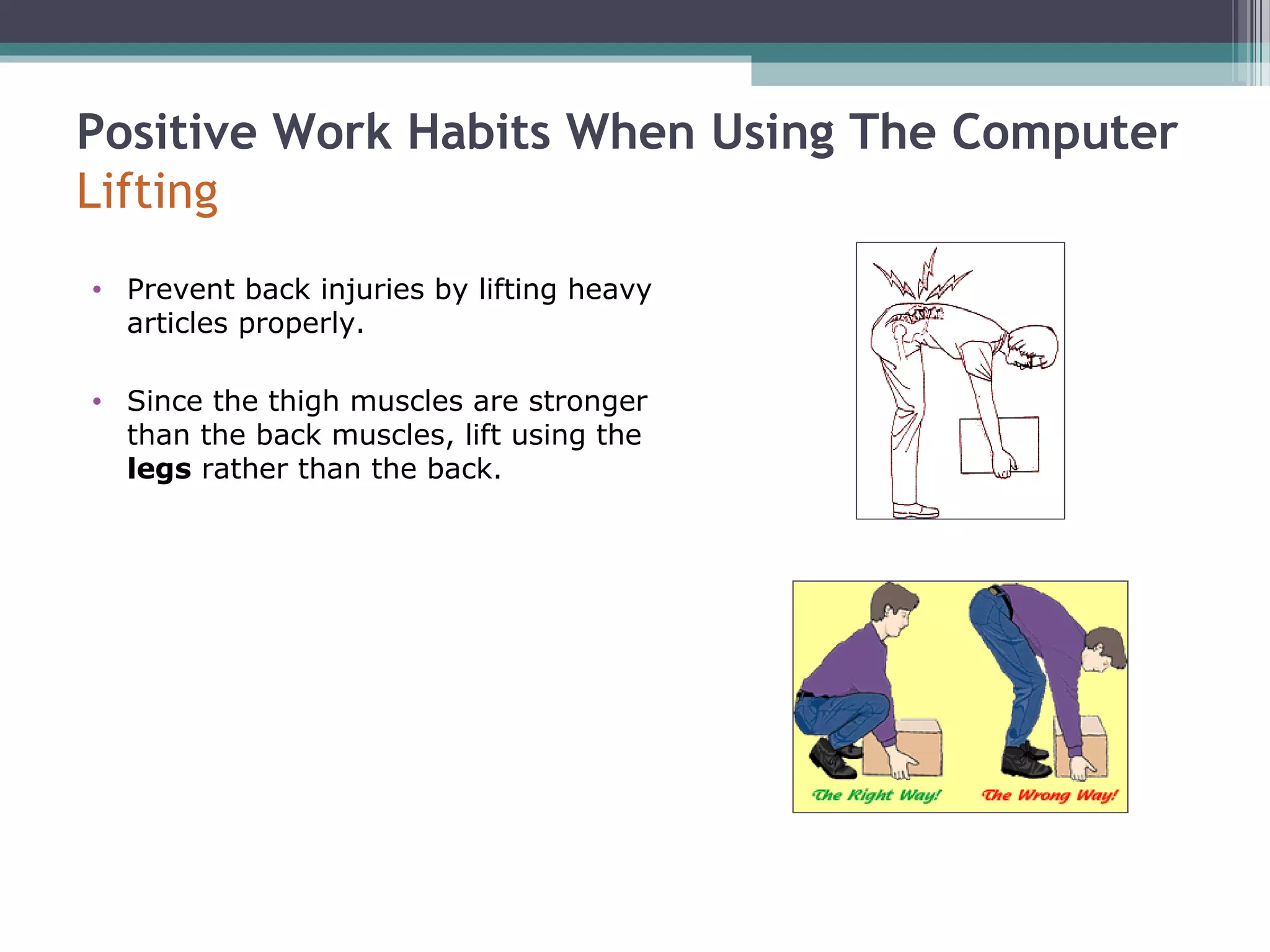
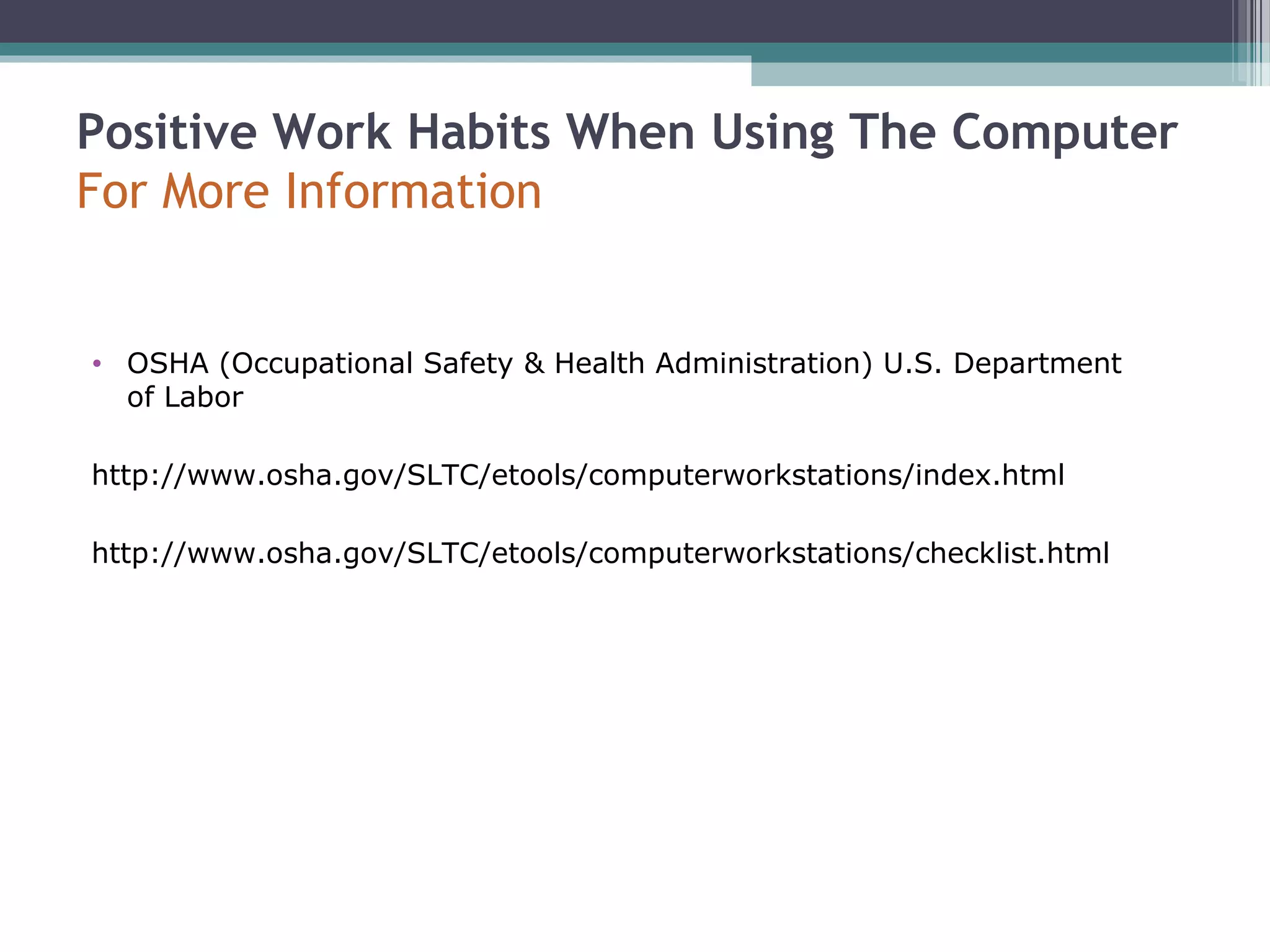
• Prevent back injuries by lifting heavy
articles properly.
• Since the thigh muscles are stronger
than the back muscles, lift using the
legs rather than the back.
Positive Work Habits When Using The Computer
For More Information
• OSHA (Occupational Safety & Health Administration) U.S. Department
of Labor
http://www.osha.gov/SLTC/etools/computerworkstations/index.html
http://www.osha.gov/SLTC/etools/computerworkstations/checklist.html
Ergonomics – Using Computers Safely
Summary
Ergonomics – Using Computers Safely
Summary
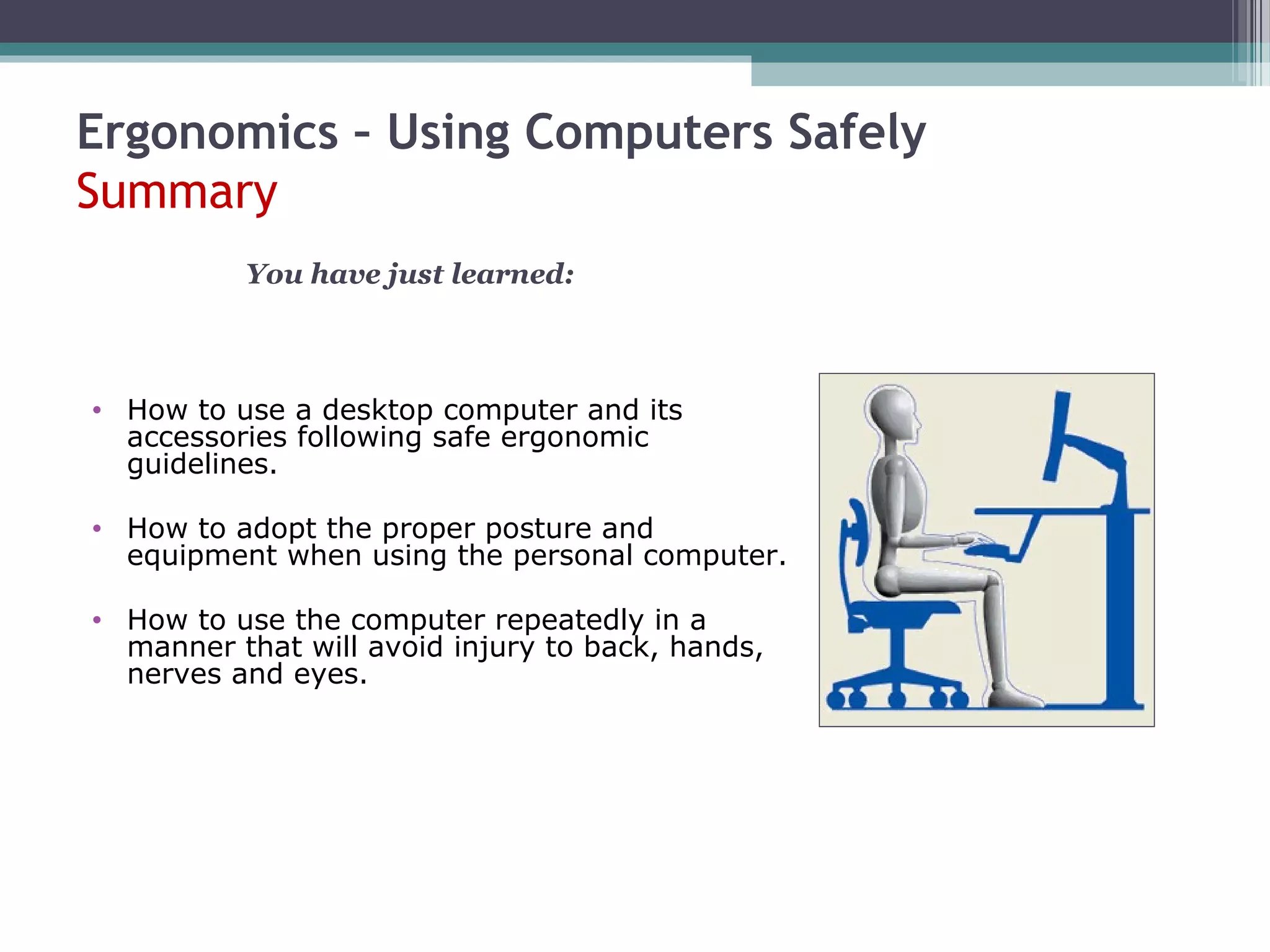
• How to use a desktop computer and its
accessories following safe ergonomic
guidelines.
• How to adopt the proper posture and
equipment when using the personal computer.
• How to use the computer repeatedly in a
manner that will avoid injury to back, hands,
nerves and eyes.
You have just learned:
Ergonomics – Using Computers Safely
Quiz
Ergonomics – Using Computers Safely
Quiz
• Carpal Tunnel Syndrome (CTS) and Repetitive Strain Injury (RSI) are
injuries to the nerves caused by repetitive motions of the arms and
hands during long durations.
True or False?
Ergonomics – Using Computers Safely
Quiz
• What can a computer user do to prevent Carpal Tunnel Syndrome and
Repetitive Strain Injuries?
Question
Ergonomics – Using Computers Safely
Quiz
• While using the computer, sitting upright all the way back in the chair
against the backrest will prevent injury to:
 Eyes
 Spine and back
 Fingers
 Arms
Multiple Choice
Ergonomics – Using Computers Safely
Quiz
• What can a computer user do to prevent eyestrain and other eye
injuries?
Question
Ergonomics – Using Computers Safely
Thanks For Your Participation!

Introduction to Ergonomics - Using Computers Safely

  • 1.
    Ergonomics Training Lesson 1– Using Computers Safely Designed by: Wayne Pascall
  • 2.
    Ergonomics – UsingComputers Safely Objectives
  • 3.
    Ergonomics – UsingComputers Safely Objectives • Use a desktop computer and its accessories following safe ergonomic guidelines. • Adopt the proper posture and equipment when using the personal computer. • Use the computer repeatedly in a manner that will avoid injury to back, hands, nerves and eyes. At the end of this course you will be able to:
  • 4.
    Ergonomics – UsingComputers Safely Lesson 1
  • 5.
    What is Ergonomics? •The science of designing and using resources to maximize safety, efficiency, comfort and prevent injuries to the human anatomy. • “Ergonomics, also known as human engineering or human factors engineering, the science of designing machines, products, and systems to maximize the safety, comfort, and efficiency of the people who use them. Ergonomists draw on the principles of industrial engineering, psychology, anthropometry (the science of human measurement), and biomechanics (the study of muscular activity) to adapt the design of products and workplaces to people's sizes and shapes and their physical strengths and limitations.” http://en.wikipedia.org/wiki/Ergonomics
  • 6.
    Importance of Ergonomics •“One of the primary goals of ergonomics is prevention of workplace illness and accidents. According to the United States Bureau of Labor Statistics, more than 60 percent of the workplace illnesses reported each year are associated with repetitive stress injuries Repetitive Strain Injury (RSI). These injuries result from continuous repetition of the same motions, for instance screwing or twisting items on an assembly line. The injury may be exacerbated by awkward postures, such as bending or reaching.” • According to the Bureau of Labor Statistics (BLS), each year 600,000 workers suffer serious workplace injuries caused by repetitive motion and overexertion that require them to miss time from work.
  • 7.
    Importance of Ergonomics •According to the National Academy of Sciences, these injuries cost the country $45 - $54 billion annually. http://www.ufcw.org/issues_and_actions/stop_the_pain/how_it_effe cts_you/ergo_problem.cfm • The three most common work-related injuries associated with bad practices in using computers are: 1. Repetitive Strain Injury (RSI), 2. Carpal Tunnel Syndrome 3. Back Injuries
  • 8.
    Repetitive Strain Injury(RSI) • This is damage to the nerves in the arms and hands as a result of repetitive motions during long durations (e.g. mouse clicking). The symptoms are pain in the arms and hands. • A group of disorders that most commonly develop in workers using excessive and repetitive motions of the head and neck extremity.
  • 9.
    Repetitive Strain Injury(RSI) • Repetitive Strain Injury occurs when the movable parts of the limbs are injured. Repetitive Strain Injury (RSI) usually caused due to repetitive tasks, incorrect posture, stress and bad ergonomics. Repetitive Strain Injury generally causes numbness, tingling, weakness, stiffing, and swelling and even nerve damage. The chief complaint is the constant pain in the upper limbs, neck, shoulder and back.“ http://www.safecomputingtips.com/repetitive-strain-injury.html
  • 10.
    Carpal Tunnel Syndrome •“A pinched nerve (called the Median nerve) in the wrist. Carpal Tunnel Syndrome (CTS) is the inflammatory disorder that is caused due to repetitive stress, physical injury or any other condition that causes the tissues around the median nerve to inflated…This ultimately results in pain, numbness, and tingling sensation in the wrist, hand, and fingers.” http://www.safecomputingtips.com/carpal-tunnel- syndrome.html
  • 11.
    Musculoskeletal Disorders • Injuriesto the spine and muscles due to an unnatural or unhealthy posture while using the computer.
  • 12.
    Other Disorders andInjuries • Eyestrain, Eye fatigue, Poor blood circulation, Swollen ankles.
  • 13.
    Positive Work HabitsWhen Using The Computer Eyesight 1. Position monitor 18” to 24” Away (approximately arm’s length) and about 15° to 30° below your line of sight. 2. Reduce glare - Don’t let light shine in your eyes or on your screen. 3. Adjust the angle of screen to your line of vision. 4. Blink! Look away from the screen and focus on distant objects periodically.
  • 14.
    Positive Work HabitsWhen Using The Computer Posture 1. Get a chair that properly supports your back from pelvis to shoulder blades. Sit all the way back in the chair against the backrest for support. 2. Let your arms fall naturally (sometimes a chair without an arm rest is better), elbows bent slightly more than 90°. 4. Keep your knees equal to, or lower, than your hips with your feet supported 3. Adjust the chair height so that feet are flat on the floor and legs bent slightly more than 90°.
  • 15.
    Positive Work HabitsWhen Using The Computer Keyboard and Mouse • Strike the keys softly. • Glide your hands over the keyboard. • Rest your palms on a palm rest in between keystrokes, but don't fix your wrists or palms on the palm rest while keying. • Keep your wrists straight and relaxed. • Reduce risk of RSI by limiting repetitive motions - avoid Excessive clicking of mouse by using the aid of voice recognition software and macros. Negative tilt - Slope keyboard slightly down away from you
  • 16.
    Positive Work HabitsWhen Using The Computer Pace, Duration and Exercises • Don't sit in one position at the computer for extended periods. Take stand and stretch breaks occasionally. • Occasional breaks accompanied with simple stretches can help prevent fatigue and injury: • Stretches: Neck and Shoulders Hands and Wrists Upper and Mid-Back Lower Back Legs Hips Ankles
  • 17.
    Positive Work HabitsWhen Using The Computer Lifting • Prevent back injuries by lifting heavy articles properly. • Since the thigh muscles are stronger than the back muscles, lift using the legs rather than the back.
  • 18.
    Positive Work HabitsWhen Using The Computer For More Information • OSHA (Occupational Safety & Health Administration) U.S. Department of Labor http://www.osha.gov/SLTC/etools/computerworkstations/index.html http://www.osha.gov/SLTC/etools/computerworkstations/checklist.html
  • 19.
    Ergonomics – UsingComputers Safely Summary
  • 20.
    Ergonomics – UsingComputers Safely Summary • How to use a desktop computer and its accessories following safe ergonomic guidelines. • How to adopt the proper posture and equipment when using the personal computer. • How to use the computer repeatedly in a manner that will avoid injury to back, hands, nerves and eyes. You have just learned:
  • 21.
    Ergonomics – UsingComputers Safely Quiz
  • 22.
    Ergonomics – UsingComputers Safely Quiz • Carpal Tunnel Syndrome (CTS) and Repetitive Strain Injury (RSI) are injuries to the nerves caused by repetitive motions of the arms and hands during long durations. True or False?
  • 23.
    Ergonomics – UsingComputers Safely Quiz • What can a computer user do to prevent Carpal Tunnel Syndrome and Repetitive Strain Injuries? Question
  • 24.
    Ergonomics – UsingComputers Safely Quiz • While using the computer, sitting upright all the way back in the chair against the backrest will prevent injury to:  Eyes  Spine and back  Fingers  Arms Multiple Choice
  • 25.
    Ergonomics – UsingComputers Safely Quiz • What can a computer user do to prevent eyestrain and other eye injuries? Question
  • 26.
    Ergonomics – UsingComputers Safely Thanks For Your Participation!