DONE BY ,
HARISH R KULKARNI
NIKHIL SAI RAM
SAMARTH KL “X” B
RISHABH YADAV
PREM CHULAKI
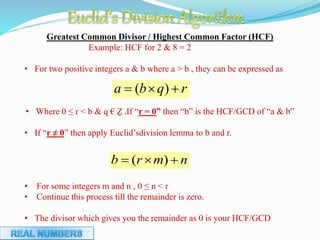
Greatest Common Divisor / Highest Common Factor (HCF)
Example: HCF for 2 & 8 = 2
• For two positive integers a & b where a > b , they can be expressed as
• Where 0 ≤ r < b & q € Ẕ .If “r = 0” then “b” is the HCF/GCD of “a & b”
• If “r ≠ 0” then apply Euclid’sdivision lemma to b and r.
• For some integers m and n , 0 ≤ n < r
• Continue this process till the remainder is zero.
• The divisor which gives you the remainder as 0 is your HCF/GCD
rqba  )(
nmrb  )(
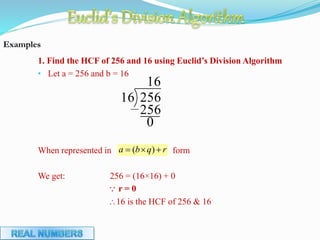
1. Find the HCF of 256 and 16 using Euclid’s Division Algorithm
• Let a = 256 and b = 16
When represented in form
We get: 256 = (16×16) + 0
 r = 0
16 is the HCF of 256 & 16
Examples
16
0
256
25616
rqba  )(
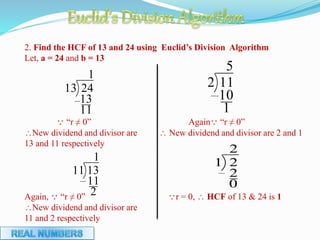
2. Find the HCF of 13 and 24 using Euclid’s Division Algorithm
Let, a = 24 and b = 13
 “r ≠ 0” Again “r ≠ 0”
New dividend and divisor are  New dividend and divisor are 2 and 1
13 and 11 respectively
Again,  “r ≠ 0” r = 0,  HCF of 13 & 24 is 1
New dividend and divisor are
11 and 2 respectively
1
11
13
2413
5
1
10
112
1
2
11
1311
2
0
2
21
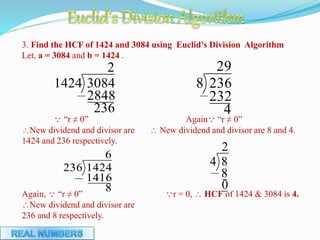
3. Find the HCF of 1424 and 3084 using Euclid’s Division Algorithm
Let, a = 3084 and b = 1424 .
 “r ≠ 0” Again “r ≠ 0”
New dividend and divisor are  New dividend and divisor are 8 and 4.
1424 and 236 respectively.
Again,  “r ≠ 0” r = 0,  HCF of 1424 & 3084 is 4.
New dividend and divisor are
236 and 8 respectively.
6
8
1416
1424236
2
236
2848
30841424
29
4
232
2368
2
0
8
84
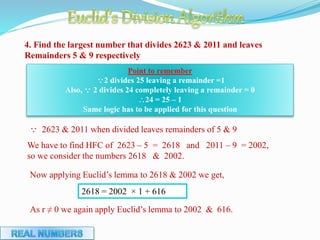
4. Find the largest number that divides 2623 & 2011 and leaves
Remainders 5 & 9 respectively
Point to remember
2 divides 25 leaving a remainder =1
Also,  2 divides 24 completely leaving a remainder = 0
24 = 25 – 1
Same logic has to be applied for this question
 2623 & 2011 when divided leaves remainders of 5 & 9
We have to find HFC of 2623 – 5 = 2618 and 2011 – 9 = 2002,
so we consider the numbers 2618 & 2002.
2618 = 2002 × 1 + 616
Now applying Euclid’s lemma to 2618 & 2002 we get,
As r ≠ 0 we again apply Euclid’s lemma to 2002 & 616.
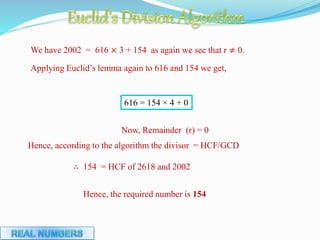
616 = 154 × 4 + 0
Now, Remainder (r) = 0
Hence, the required number is 154
We have 2002 = 616 × 3 + 154 as again we see that r ≠ 0.
Applying Euclid’s lemma again to 616 and 154 we get,
Hence, according to the algorithm the divisor = HCF/GCD
∴ 154 = HCF of 2618 and 2002
1. Arranging the terms in the given question as per the Euclid’s
Division Lemma
2. Identification of the Dividend, Divisor, Quotient and Remainder .
3. Any positive integer can be represented as ‘2q’ or ‘2q+1’.
4. Even number × Any Number = Even number .
5. Even number × Any Number + Odd number = Odd number .
a = b × q + r
REVISION
General equation
introduction to division algorithm

introduction to division algorithm

  • 1.
    DONE BY , HARISHR KULKARNI NIKHIL SAI RAM SAMARTH KL “X” B RISHABH YADAV PREM CHULAKI
  • 3.
    Greatest Common Divisor/ Highest Common Factor (HCF) Example: HCF for 2 & 8 = 2 • For two positive integers a & b where a > b , they can be expressed as • Where 0 ≤ r < b & q € Ẕ .If “r = 0” then “b” is the HCF/GCD of “a & b” • If “r ≠ 0” then apply Euclid’sdivision lemma to b and r. • For some integers m and n , 0 ≤ n < r • Continue this process till the remainder is zero. • The divisor which gives you the remainder as 0 is your HCF/GCD rqba  )( nmrb  )(
  • 4.
    1. Find theHCF of 256 and 16 using Euclid’s Division Algorithm • Let a = 256 and b = 16 When represented in form We get: 256 = (16×16) + 0  r = 0 16 is the HCF of 256 & 16 Examples 16 0 256 25616 rqba  )(
  • 5.
    2. Find theHCF of 13 and 24 using Euclid’s Division Algorithm Let, a = 24 and b = 13  “r ≠ 0” Again “r ≠ 0” New dividend and divisor are  New dividend and divisor are 2 and 1 13 and 11 respectively Again,  “r ≠ 0” r = 0,  HCF of 13 & 24 is 1 New dividend and divisor are 11 and 2 respectively 1 11 13 2413 5 1 10 112 1 2 11 1311 2 0 2 21
  • 6.
    3. Find theHCF of 1424 and 3084 using Euclid’s Division Algorithm Let, a = 3084 and b = 1424 .  “r ≠ 0” Again “r ≠ 0” New dividend and divisor are  New dividend and divisor are 8 and 4. 1424 and 236 respectively. Again,  “r ≠ 0” r = 0,  HCF of 1424 & 3084 is 4. New dividend and divisor are 236 and 8 respectively. 6 8 1416 1424236 2 236 2848 30841424 29 4 232 2368 2 0 8 84
  • 7.
    4. Find thelargest number that divides 2623 & 2011 and leaves Remainders 5 & 9 respectively Point to remember 2 divides 25 leaving a remainder =1 Also,  2 divides 24 completely leaving a remainder = 0 24 = 25 – 1 Same logic has to be applied for this question  2623 & 2011 when divided leaves remainders of 5 & 9 We have to find HFC of 2623 – 5 = 2618 and 2011 – 9 = 2002, so we consider the numbers 2618 & 2002. 2618 = 2002 × 1 + 616 Now applying Euclid’s lemma to 2618 & 2002 we get, As r ≠ 0 we again apply Euclid’s lemma to 2002 & 616.
  • 8.
    616 = 154× 4 + 0 Now, Remainder (r) = 0 Hence, the required number is 154 We have 2002 = 616 × 3 + 154 as again we see that r ≠ 0. Applying Euclid’s lemma again to 616 and 154 we get, Hence, according to the algorithm the divisor = HCF/GCD ∴ 154 = HCF of 2618 and 2002
  • 9.
    1. Arranging theterms in the given question as per the Euclid’s Division Lemma 2. Identification of the Dividend, Divisor, Quotient and Remainder . 3. Any positive integer can be represented as ‘2q’ or ‘2q+1’. 4. Even number × Any Number = Even number . 5. Even number × Any Number + Odd number = Odd number . a = b × q + r REVISION General equation

Editor's Notes

  • #8 Introduction to Trigonometry
  • #9 Introduction to Trigonometry