s
a

n
a
t
A

Prediction of vertebral fracture by Trabecular Bone
Score in elderly women of The Rotterdam Study

.
s
r

.
B

Atanasovska Biljana

Department of Internal Medicine, Erasmus MC
Rotterdam, The Netherlands

Osteoporosedag der Hoge Landen
November 30th 2013
s
a

Authors

n
a
t
A

Biljana Atanasovska, MSc1,2, Ling Oei, MD, MSc, MA1,2,3, Carolina Medina-Gomez,
MSc1,2,3, Natalia Campos Obando, MD, MSc1,2,3, Karol Estrada, PhD1,2,3,4, Albert
Hofman, MD, PhD2,3, Berengere Aubry-rozier, MD5, M. Carola Zillikens, MD, PhD1,3,
André G. Uitterlinden, PhD1,2,3, Edwin H.G. Oei, MD, PhD6, Didier Hans, MBA, PhD5,
Fernando Rivadeneira, MD, PhD1,2,3,.

.
B

1Department

of Internal Medicine Erasmus MC Rotterdam, the Netherlands.

2Department

of Epidemiology Erasmus MC Rotterdam, the Netherlands.

3Netherlands

Genomics Initiative (NGI)-sponsored Netherlands Consortium for Healthy Aging
(NCHA), the Netherlands.

.
s
r
4Analytical

& Translational Genetics Unit, Massachusetts General Hospital, USA.

5Lausanne

University Hospital, Switzerland.

6Department

of Radiology Erasmus MC Rotterdam, the Netherlands.

Disclosures:

Didier Hans has a co-ownership of the TBS patent
The other co-authors have nothing to declare
s
a

BMD measured by DXA is an imperfect predictor of fracture
risk, therefore, additional assessments are desirable

n
a
t
A

Dual-energy X-ray absorptiometry (DXA) is commonly used to diagnose
osteoporosis, providing accurate estimates of bone mass through the
evaluation of bone mineral density (BMD)

BMD is not always an accurate predictor of fracture; it is an assessment of
the quantity of bone but does not provide information on bone quality

.
s
r

.
B

Further, > 50% of fractures occur above the “osteoprosis” BMD threshold
Evaluating other bone parameters, such as bone microarchitecture, could
significantly enhance the assessment of bone strength and fracture risk
s
a

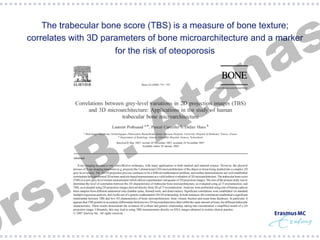
§  The trabecular bone score (TBS) is a measure of bone texture;
correlates with 3D parameters of bone microarchitecture and a marker
for the risk of oteoporosis

.
s
r

.
B

n
a
t
A
s
a

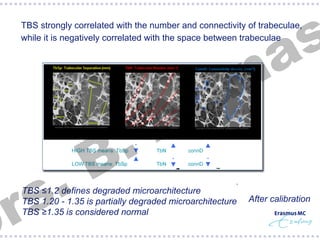
§  TBS strongly correlated with the number and connectivity of trabeculae,
while it is negatively correlated with the space between trabeculae

.
s
r

.
B

n
a
t
A

TBS ≤1.2 defines degraded microarchitecture
TBS 1.20 - 1.35 is partially degraded microarchitecture
TBS ≥1.35 is considered normal

After calibration
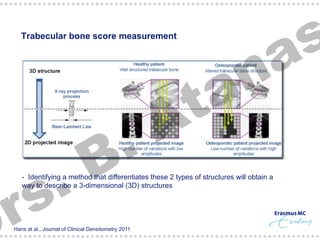
§  Trabecular bone score measurement

.
s
r

.
B

n
a
t
A

- Identifying a method that differentiates these 2 types of structures will obtain a
way to describe a 3-dimensional (3D) structures

Hans at al., Journal of Clinical Densitometry 2011

s
a
Aim of this study

§  -

n
a
t
A

examine the relation of trabecular bone score (TBS) with vertebral
fracture in a population-based setting for:

.
B

s
a

§  1) prevalent vertebral fractures assessed on radiographs (X-rays)

.
s
r

§  2) incident clinical vertebral fractures (general practioner+hospital)
s
a

Study population

n
a
t
A

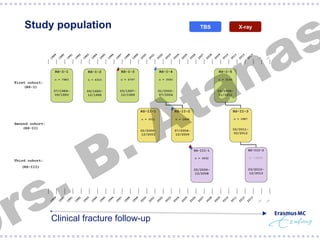
§  Rotterdam Study cohorts (RS-I, RS-II and RS-III)
§  N = 2760 women with DXA scans

§  DXA scans (GE-Lunar Prodigy; Madison, WI), LS-BMD and TBS measurement
(TBS iNsight software – not calibrated) available in:

.
B

§  RS-I during the third follow-up
§  RS-II during the first follow-up

.
s
r

§  RS-III during the baseline visit

§  Women with BMI>35g/cm2 excluded
Study population

.
s
r

.
B

Clinical fracture follow-up

TBS

s
a

X-ray

n
a
t
A
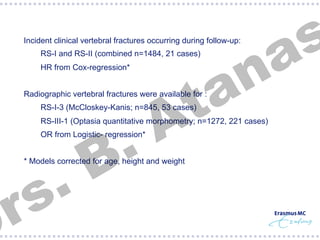
§  RS-I and RS-II (combined n=1484, 21 cases)
§  HR from Cox-regression*

§  Radiographic vertebral fractures were available for :
§  RS-I-3 (McCloskey-Kanis; n=845, 53 cases)

.
B

§  RS-III-1 (Optasia quantitative morphometry; n=1272, 221 cases)
§  OR from Logistic- regression*

.
s
r

s
a

n
a
t
A

§  Incident clinical vertebral fractures occurring during follow-up:

§  * Models corrected for age, height and weight
s
a

Results
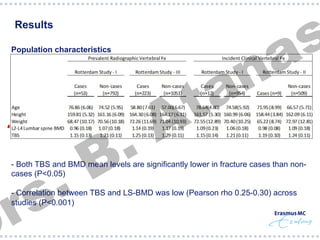
Population characteristics

.
s
r

.
B

n
a
t
A

- Both TBS and BMD mean levels are significantly lower in fracture cases than noncases (P<0.05)
- Correlation between TBS and LS-BMD was low (Pearson rho 0.25-0.30) across
studies (P<0.001)
s
a

§  Lower TBS scores were associated with increased risk
for prevalent and incident clinical vertebral fractures

n
a
t
A

§  Radiographic prevalent vertebral fractures were associated with increased risk
per SD decrease in TBS score:
§  RS-I

OR 1.71 95%CI [1.29-2.27]; P=0.0002

§  RS-III

OR 1.27 95%CI [1.08-1.48]; P=0.004

.
B

§  Combined analysis of incident clinical vertebral fractures was suggestive of
increased risk per SD decrease in TBS score:

.
s
r

§  RS-I+RS-II

HR 1.48 95%CI [0.96-2.29]; P=0.08

§  Additional adjustment for lumbar spine BMD did NOT affect the risk estimates nor
the interaction TBS x BMD
s
a

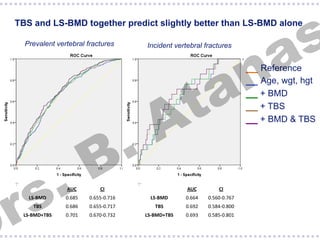
TBS and LS-BMD together predict slightly better than LS-BMD alone
Prevalent vertebral fractures

.
s
r


AUC	
  

LS-­‐BMD	
  

0.685	
  

TBS	
  

LS-­‐BMD+TBS	
  

.
B

n
a
t
A

Incident vertebral fractures

__ Reference
__ Age, wgt, hgt
__ + BMD
__ + TBS
__ + BMD & TBS

CI	


AUC	
  

CI	
  

0.655-­‐0.716	
  

LS-­‐BMD	
  

0.664	
  

0.560-­‐0.767	
  

0.686	
  

0.655-­‐0.717	
  

TBS	
  

0.692	
  

0.584-­‐0.800	
  

0.701	
  

0.670-­‐0.732	
  

LS-­‐BMD+TBS	
  

0.693	
  

0.585-­‐0.801	
  
s
a

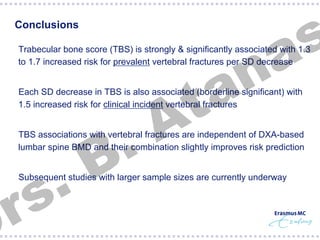
Conclusions

n
a
t
A

§  Trabecular bone score (TBS) is strongly & significantly associated with 1.3
to 1.7 increased risk for prevalent vertebral fractures per SD decrease
§  Each SD decrease in TBS is also associated (borderline significant) with
1.5 increased risk for clinical incident vertebral fractures

.
B

§  TBS associations with vertebral fractures are independent of DXA-based
lumbar spine BMD and their combination slightly improves risk prediction

.
s
r

§  Subsequent studies with larger sample sizes are currently underway
s
a

Acknowledgments

n
a
t
A

Anis Abuseiris

Jolande Verkroost Frank van Rooij

Marijn Verkerk

Nano Suwarno

Edward Peters

Joost Verburg

Jan Heeringa

René Vermeeren

Mart Rentmeester Hans Bowier

Hannie van den Boogert

Mette Offerhaus

Florian Buisman

Bart Hazemeijer

Lisanne van de Koevering

Nuray Çakici

Nienke Bart

Rodinde Bloot

Hanna Ning

Maarten Meijer

Khadija Moumni

Sander Verkade

Sebastian Valk Bonila

Nadia Rbia

Maria Tihaya

Burak Kalin

.
s
r

.
B

Eugene McCloskey, Sheffield University, UK
TBS inSIGHT:

Research and Development section, Nuclear Medicine Division,
University of Geneva.

Optasia:

SpineAnalyzer® software

§ 

Seminar 30-11-2013 - Prediction of vertebral fracture

  • 1.
    s a n a t A Prediction of vertebralfracture by Trabecular Bone Score in elderly women of The Rotterdam Study . s r . B Atanasovska Biljana Department of Internal Medicine, Erasmus MC Rotterdam, The Netherlands Osteoporosedag der Hoge Landen November 30th 2013
  • 2.
    s a Authors n a t A Biljana Atanasovska, MSc1,2,Ling Oei, MD, MSc, MA1,2,3, Carolina Medina-Gomez, MSc1,2,3, Natalia Campos Obando, MD, MSc1,2,3, Karol Estrada, PhD1,2,3,4, Albert Hofman, MD, PhD2,3, Berengere Aubry-rozier, MD5, M. Carola Zillikens, MD, PhD1,3, André G. Uitterlinden, PhD1,2,3, Edwin H.G. Oei, MD, PhD6, Didier Hans, MBA, PhD5, Fernando Rivadeneira, MD, PhD1,2,3,. . B 1Department of Internal Medicine Erasmus MC Rotterdam, the Netherlands. 2Department of Epidemiology Erasmus MC Rotterdam, the Netherlands. 3Netherlands Genomics Initiative (NGI)-sponsored Netherlands Consortium for Healthy Aging (NCHA), the Netherlands. . s r 4Analytical & Translational Genetics Unit, Massachusetts General Hospital, USA. 5Lausanne University Hospital, Switzerland. 6Department of Radiology Erasmus MC Rotterdam, the Netherlands. Disclosures: Didier Hans has a co-ownership of the TBS patent The other co-authors have nothing to declare
  • 3.
    s a BMD measured byDXA is an imperfect predictor of fracture risk, therefore, additional assessments are desirable n a t A Dual-energy X-ray absorptiometry (DXA) is commonly used to diagnose osteoporosis, providing accurate estimates of bone mass through the evaluation of bone mineral density (BMD) BMD is not always an accurate predictor of fracture; it is an assessment of the quantity of bone but does not provide information on bone quality . s r . B Further, > 50% of fractures occur above the “osteoprosis” BMD threshold Evaluating other bone parameters, such as bone microarchitecture, could significantly enhance the assessment of bone strength and fracture risk
  • 4.
    s a §  The trabecularbone score (TBS) is a measure of bone texture; correlates with 3D parameters of bone microarchitecture and a marker for the risk of oteoporosis . s r . B n a t A
  • 5.
    s a §  TBS stronglycorrelated with the number and connectivity of trabeculae, while it is negatively correlated with the space between trabeculae . s r . B n a t A TBS ≤1.2 defines degraded microarchitecture TBS 1.20 - 1.35 is partially degraded microarchitecture TBS ≥1.35 is considered normal After calibration
  • 6.
    §  Trabecular bonescore measurement . s r . B n a t A - Identifying a method that differentiates these 2 types of structures will obtain a way to describe a 3-dimensional (3D) structures Hans at al., Journal of Clinical Densitometry 2011 s a
  • 7.
    Aim of thisstudy §  - n a t A examine the relation of trabecular bone score (TBS) with vertebral fracture in a population-based setting for: . B s a §  1) prevalent vertebral fractures assessed on radiographs (X-rays) . s r §  2) incident clinical vertebral fractures (general practioner+hospital)
  • 8.
    s a Study population n a t A §  RotterdamStudy cohorts (RS-I, RS-II and RS-III) §  N = 2760 women with DXA scans §  DXA scans (GE-Lunar Prodigy; Madison, WI), LS-BMD and TBS measurement (TBS iNsight software – not calibrated) available in: . B §  RS-I during the third follow-up §  RS-II during the first follow-up . s r §  RS-III during the baseline visit §  Women with BMI>35g/cm2 excluded
  • 9.
    Study population . s r . B Clinical fracturefollow-up TBS s a X-ray n a t A
  • 10.
    §  RS-I andRS-II (combined n=1484, 21 cases) §  HR from Cox-regression* §  Radiographic vertebral fractures were available for : §  RS-I-3 (McCloskey-Kanis; n=845, 53 cases) . B §  RS-III-1 (Optasia quantitative morphometry; n=1272, 221 cases) §  OR from Logistic- regression* . s r s a n a t A §  Incident clinical vertebral fractures occurring during follow-up: §  * Models corrected for age, height and weight
  • 11.
    s a Results Population characteristics . s r . B n a t A - BothTBS and BMD mean levels are significantly lower in fracture cases than noncases (P<0.05) - Correlation between TBS and LS-BMD was low (Pearson rho 0.25-0.30) across studies (P<0.001)
  • 12.
    s a §  Lower TBSscores were associated with increased risk for prevalent and incident clinical vertebral fractures n a t A §  Radiographic prevalent vertebral fractures were associated with increased risk per SD decrease in TBS score: §  RS-I OR 1.71 95%CI [1.29-2.27]; P=0.0002 §  RS-III OR 1.27 95%CI [1.08-1.48]; P=0.004 . B §  Combined analysis of incident clinical vertebral fractures was suggestive of increased risk per SD decrease in TBS score: . s r §  RS-I+RS-II HR 1.48 95%CI [0.96-2.29]; P=0.08 §  Additional adjustment for lumbar spine BMD did NOT affect the risk estimates nor the interaction TBS x BMD
  • 13.
    s a TBS and LS-BMDtogether predict slightly better than LS-BMD alone Prevalent vertebral fractures . s r   AUC   LS-­‐BMD   0.685   TBS   LS-­‐BMD+TBS   . B n a t A Incident vertebral fractures __ Reference __ Age, wgt, hgt __ + BMD __ + TBS __ + BMD & TBS CI     AUC   CI   0.655-­‐0.716   LS-­‐BMD   0.664   0.560-­‐0.767   0.686   0.655-­‐0.717   TBS   0.692   0.584-­‐0.800   0.701   0.670-­‐0.732   LS-­‐BMD+TBS   0.693   0.585-­‐0.801  
  • 14.
    s a Conclusions n a t A §  Trabecular bonescore (TBS) is strongly & significantly associated with 1.3 to 1.7 increased risk for prevalent vertebral fractures per SD decrease §  Each SD decrease in TBS is also associated (borderline significant) with 1.5 increased risk for clinical incident vertebral fractures . B §  TBS associations with vertebral fractures are independent of DXA-based lumbar spine BMD and their combination slightly improves risk prediction . s r §  Subsequent studies with larger sample sizes are currently underway
  • 15.
    s a Acknowledgments n a t A Anis Abuseiris Jolande VerkroostFrank van Rooij Marijn Verkerk Nano Suwarno Edward Peters Joost Verburg Jan Heeringa René Vermeeren Mart Rentmeester Hans Bowier Hannie van den Boogert Mette Offerhaus Florian Buisman Bart Hazemeijer Lisanne van de Koevering Nuray Çakici Nienke Bart Rodinde Bloot Hanna Ning Maarten Meijer Khadija Moumni Sander Verkade Sebastian Valk Bonila Nadia Rbia Maria Tihaya Burak Kalin . s r . B Eugene McCloskey, Sheffield University, UK TBS inSIGHT: Research and Development section, Nuclear Medicine Division, University of Geneva. Optasia: SpineAnalyzer® software §