MODERATORS
DR. T. VENKATESHWARA RAO
professor & HOD
DR. J. VENKATESHWARLU
associate professor
DR. K. VENKATSWAMY
assistant professor
DR. PRASAD REDDY
tutor
BONE DENSITOMETRY
Introduction
 Osteoporosis is a systemic skeletal disorder
characterized by decreased bone mass and
deterioration of bony microarchitecture .
 This decrease in bone mineral density (BMD)
results in fragile bones and an increased risk
for fracture with even minimal trauma
 Prior to testing, osteoporosis remains
clinically silent until a fracture occurs.
Pathophysiology
 Decreased bone mineral density is a result of a
combination of genetic and environmental
factors that affect both peak bone mass and the
rate of bone loss
 These factors include medications, diet, race, sex,
lifestyle, and physical activity
So Who Do We Test?
 Postmenopausal women older than 65 years
 Postmenopausal women younger than 65 years who have
1 or more risk factor
 Postmenopausal women who present with fragility
fractures
 Women who are considering therapy in which BMD will
affect that decision
 Women who have been on hormone replacement therapy
(HRT) for prolonged periods
 Men who experience fractures after minimal trauma
 People with evidence of osteopenia on radiographs or a
disease known to place them at risk for osteoporosis
RISK FACTORS FOR OSTEOPOROSIS IN
WOMEN
 menopause
 small bone frame
 family history
 advanced age
 low calcium diet
 inactive lifestyle
 cigarette smoking
 GI malabsorption problem
 certain medication use- corticosteroids
Lab Studies
 Levels of serum calcium, phosphate, and alkaline
phosphatase are usually normal in persons with
primary osteoporosis, although alkaline
phosphatase levels may be elevated for several
months after a fracture
 It is important to also check thyroid function,
PTH levels and testosterone levels in men
BMD IN PAEDIATRIC AGE GROUP…
 Osteopenia in adolescent can place children at
risk of development of osteoporosis at a later
stage.
 Certain conditions which might cause this are :-
 Decreased weight bearing - chronic illness or
injuries requiring prolonged immobolisation.
 Poor nutritional status – PEM, GI malabsorptions
like coeliac disease, IBD can result in low
calcium, vit D def.
BMD IN PAEDIATRIC AGE GROUP…
 Musculoskeletal disorders - muscular dystrophy,
osteogenesis imperfecta, spina bifida,
dermatomyositis, scoliosis, idiopathic juvenile
osteoporosis, JRA.
 Hormonal status – deficient GH, testosterone,
estrogen; when considering OCP in adolescence.
 Chronic medical disease – liver /renal disease,
chronic anaemia, sickle cell anaemia,
hemophilia, asthma, leukemias
BMD IN PAEDIATRIC AGE GROUP…
 Select appropriate protocols in pediatric patients
to reduce radiation risk and ensure that images
and information are of diagnostic quality.
 Determine whether the benefits of BMD
measurement for a child or adolescent outweigh
risk from radiation.
 The optimal method for BMD measurement must
be determined based on estimated radiation dose
and reports of efficacy in the pediatric
population.
Imaging Studies
 First, obtain plain radiographs if a decrease in
bone mineral density is suspected.
 Osteopenia may be apparent as radiographic
lucency but is not always noticeable until 30% of
bone mineral is lost
 Plain radiography is not as accurate as BMD
testing
BONE DENSITOMETRY
 The art and science of measuring the
bone mineral content, BMC and density,
BMD of specific skeletal sites or the
whole body.
BMD Imaging
 BMD tests are usually done on bones that are
likely to break as a result of osteoporosis like the
lower spine and hip
 Can also be done on the wrist or heel
 Devices that measure BMD include:
 Quantitative computed tomography , QCT
 Dual-energy x-ray absorptiometry (DEXA)
 Quantitative ultrasonography
 Digital Xray Radiogrammetry , DXR
THE MOST VERSATILE AND WIDELY USED
TECHNIQUE
DUAL X-RAY ABSORPTIOMETRY
DXA
(A) DXA
 Is a subtraction technique- soft tissue
structures are eliminated. x-ray
attenuation of the bone is measured.
bone mineral density is calculated.
SPECIFIC BONE
 40% ORGANIC MATTER
 60% BONE MINERAL
DXA MEASURES THE DENSITY
OF BONE MINERAL
MINERAL CONTENT CALCULATION IN BONE
DENSITOMETRY
BMC = BMD X AREA
DXA SYSTEMS
 PENCIL BEAM
 FAN BEAM
The difference between two is, pencil beam uses
single x ray tube and a single detector whereas fan
beam uses multiple detectors which thus has short
scanning time, high radiation exposure and
higher magnification.
PENCIL BEAM SCANNER
FAN BEAM SCANNER
Bone densitometry is the only method
for diagnosing or confirming
osteoporosis in the absence of a
fracture
• The National Osteoporosis Foundation
recommends that bone densitometry be
performed routinely in all women > 65,
particularly in those who have one or more risk
factors.
• Densitometry can also be used for monitoring the
response to therapy.
DEXA
 Standard method.
 Can be used in both adults and children.
 Central DEXA measures BMD in hip, spine ,
 Peripheral DEXA can be used to measure BMD in
the wrist.
 Falsely high values are seen in
1. fractures,
2. osteophytosis, and
3. soft tissue calcification, eg. Vascular.
 Better reproducibility than QCT.
• DEXA measures areal density (ie, g/cm2) rather
than true volumetric density.
• The test is non-invasive and involves no special
preparation.
• Radiation exposure is minimal, and the procedure
is rapid. This is the most popular and accurate test
to date and the test only takes about 20 to 40
minutes, with a 5 mrem dose of radiation (a full
dental x-ray is 300 mrem).
Screening - DEXA
However, the standard apparatus is expensive and not portable.
Small DEXA machines that can measure the forearm, finger, or
heel are less expensive and are portable.
DXA ADVANTAGES
 low radiation dose
 wide availability
 ease of use
 short scan time
 high resolution images
 good precision
 stable calibration
LIMITATIONS..
 Cannot predict a fracture- only provides indications
of relative risk.
 Limited use in people with a spinal deformity or
those who have had previous spinal surgery,
vertebral compression fractures or osteoarthritis.
 Expensive.
 pDXA are not helpful in following response to
treatment, and if they indicate that drug therapy is
needed, a baseline central DXA scan should be
obtained.
LIMITATIONS..
 DXA cannot distinguish between cortical and trabecular
bone - makes it impossible to measure the changes in
the patient’s skeletal structure during puberty.
 Since it provides 2D real representation and not the
volumetric evaluation, i.e 3D image, the accuracy can
be affected by actual size of the measured area.
1. Children develop and grow differently, making
compilation of an age-based reference database for
comparison difficult.
2. The measurement can be overstated for larger
subjects and understated for small children.
HOW TO PREPARE..
 Avoid calcium supplements for at least 24 hours
before your exam.
 Avoid any metal objects or clothing that might
interfere with the x-ray images.
 Inform your physician if you recently had a barium
examination or have been injected with a
contrast material for a CT scan or radioisotope scan.
You may have to wait 10 to 14 days before undergoing
a DXA test.
 Women should always inform if there is any possibility
that they are pregnant.
HOW IS IT PERFORMED..
 Done on an outpatient basis.
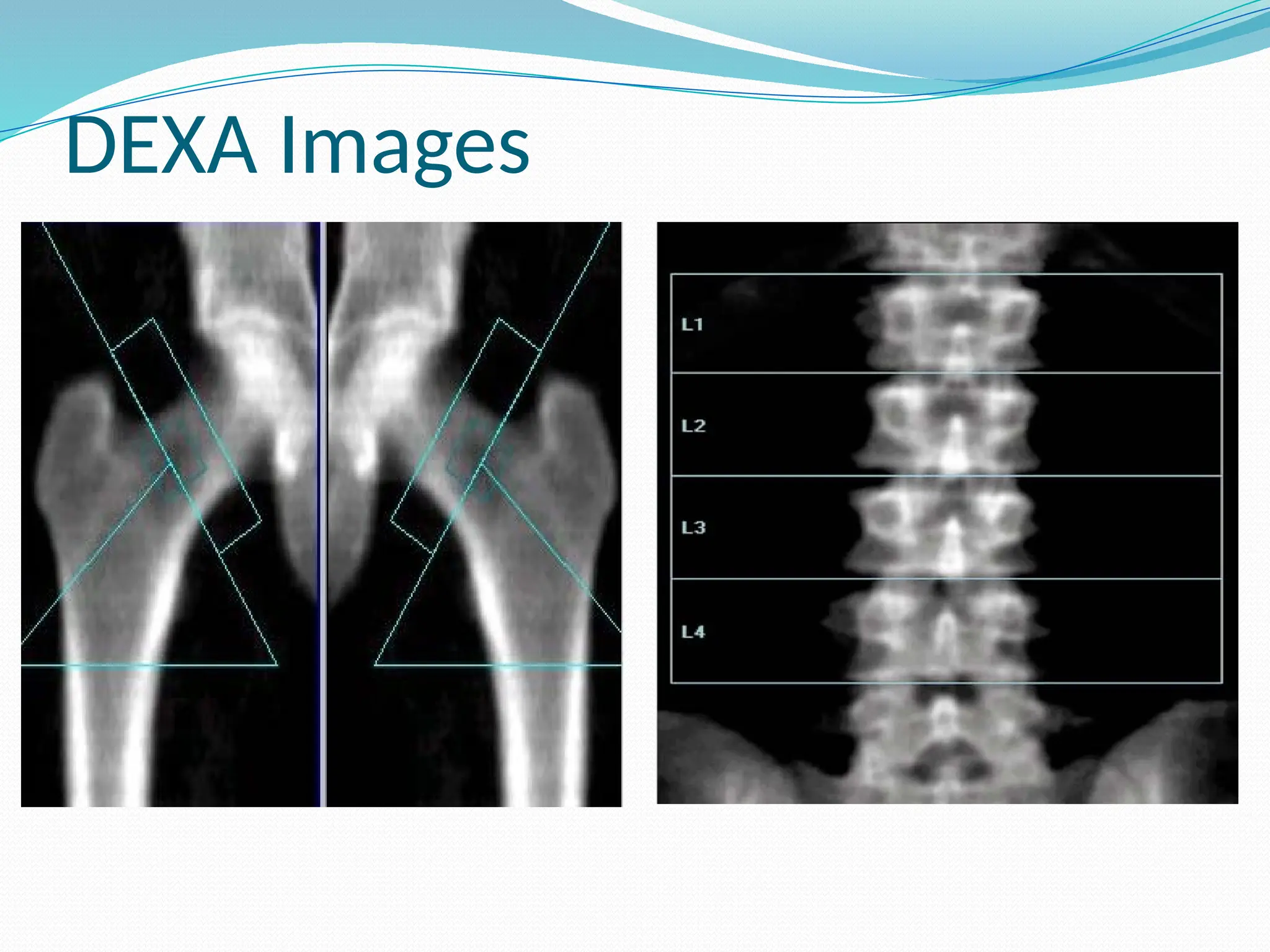
 In the Central DXA examination, which measures bone density
in the hip and spine, the patient lies on a padded table.
 An x-ray generator is located below the patient and an imaging
device, or detector, is positioned above.
 To assess the spine, the patient's legs are supported on a
padded box to flatten the pelvis and lower (lumbar) spine.
 To assess the hip, the patient's foot is placed in a brace that
rotates the hip inward.
 In both cases, the detector is slowly passed over the area,
generating images on a computer monitor.
 The peripheral tests are simpler.
DEXA Images
BMD
 An additional procedure called Lateral Vertebral
Assessment (LVA) is now being done at many
centers.
 It is a low-dose x-ray examination of the spine to
screen for vertebral fractures that is performed on
the DXA machine.
 The LVA test adds only a few minutes to the DXA
procedure.
 Recommended for older patients, especially if:
1) they have lost more than an inch of height.
2) have unexplained back pain.
3) if a DXA scan gives borderline readings.
What Are The Results?
 Results are reported as two values, T and Z
scores
 T scores are the number of standard
deviations above or below what is normally
expected in a healthy young adult of the same
sex
 Z score is the number of standard deviations
above or below what is normally expected for
someone of the same age, sex, weight, and
ethinic origin
T Score
 > -1 : the bone density is normal
 Between -1 and -2.5 : osteopenia
 < -2.5 : osteoporosis
BMD Score Report
Z Score
 The Z score is help ful because it may suggest
that the patient may have a secondary form of
osteoporosis unrelated to normal aging which is
causing decreased BMD
 A score less than -1.5 should make you
investigate the cause of decreased BMD
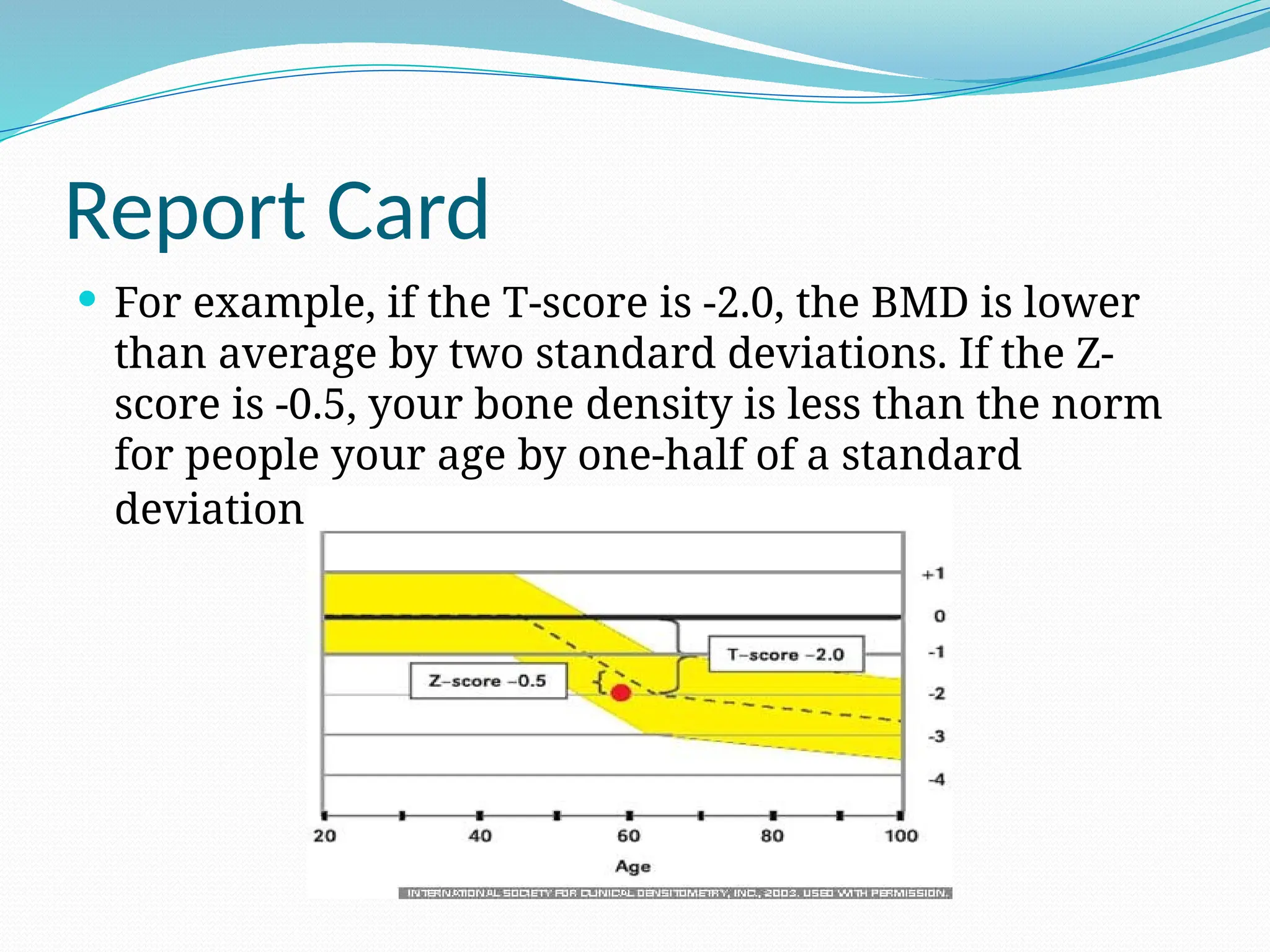
Report Card
 For example, if the T-score is -2.0, the BMD is lower
than average by two standard deviations. If the Z-
score is -0.5, your bone density is less than the norm
for people your age by one-half of a standard
deviation
(B) Quantitative Computed Tomography
 Measures BMD as a true volume density in
g/cm3, which is not influenced by bone size.
 This technique can be used for both adults
and children.
 The QCT scan can show the patient’s
periosteal and endosteal circumferences,
along with the actual cortical area and
thickness, trabeular bone thickness.
 Cortical BMD can be accurately measured at
distal radius sites using peripheral QCT
(pQCT).
QCT
QCT
 QCT isolates metabolically active trabecular bone
for greater anatomic accuracy than other methods.
 The size and geometric factors of bone can be
assessed.
 QCT and pQCT create true volumetric data sets by
measuring the bone in 3 dimensions, while DXA
provides 2-D measurement.
 Since it can differentiate between cortical and
trabecular bone, it allows the radiologist to track the
true changes in the size and shape of bone that
occur during puberty, which can aid in diagnosis
Cortical pQCT
 Cortical bone measurement
using pQCT.
 Patient in A has significant
reduction of cortical bone
volume when compared
with a healthy control (B).
pQCT Images
 Images A and B show pQCT
images through the distal radius
of 2 patients with substantial
differences in trabecular and
cortical structure. The 2 patients
have identical BMD
measurements in this region
using DXA.
 Images C and D depict 3-D
reconstructions of the cortical
and trabecular bone
compartments. Red areas depict
porosity of the cortical bone.
Disadvantages :-
(1) osteophytes can interfere with measurement,
(2) significant radiation exposure,
(3) expensive,
(4) Unable to accurately image cortical bone that is
less
than 2 mm in size- results in underestimation of
the
volumetric BMD.
(5) difficult to perform in paediatric patient as the
movement between scans can interfere with
imaging
accuracy.
(C) Ultrasound Densitometry
Ultrasound densitometry can assess the density and
structure of the skeleton.
Can predict fracture risk in the elderly.
 Speed of sound measures the strength and elastic
modulus of bone using a ratio of distance to
travel and time for the sound waves produced by
the transducer to move through the skeletal site
being imaged.
 The broadband ultrasound attenuation measures
how much energy of the sound wave is lost from
bone attenuation.
 Relatively inexpensive
 portable
 used only in peripheral sites (eg, the heel) -
bone is relatively superficial
 No exposure to ionizing radiation.
 However, this is not accurate and thus is less
useful in following response to treatment
( D ) Radiogrammetry, DXR
 Usually performed on the hand, specifically the second
metacarpal
 The cortical thickness of the 2nd
metacarpal is
measured in a digital X-ray image by a computer and is
through a geometrical operation converted to BMD.
 The BMD is corrected for porosity of the bone,
estimated by a texture analysis performed on the
cortical part of the bone.
 Useful in assessing BMD in children and is the simplest
and least expensive method
 Disadvantages:- not as precise as DEXA and, therefore,
is less sensitive for detecting changes over time
Thankyou

bone densitometry in orthopedic clinical practice.pptx

  • 1.
    MODERATORS DR. T. VENKATESHWARARAO professor & HOD DR. J. VENKATESHWARLU associate professor DR. K. VENKATSWAMY assistant professor DR. PRASAD REDDY tutor
  • 2.
  • 3.
    Introduction  Osteoporosis isa systemic skeletal disorder characterized by decreased bone mass and deterioration of bony microarchitecture .  This decrease in bone mineral density (BMD) results in fragile bones and an increased risk for fracture with even minimal trauma  Prior to testing, osteoporosis remains clinically silent until a fracture occurs.
  • 4.
    Pathophysiology  Decreased bonemineral density is a result of a combination of genetic and environmental factors that affect both peak bone mass and the rate of bone loss  These factors include medications, diet, race, sex, lifestyle, and physical activity
  • 5.
    So Who DoWe Test?  Postmenopausal women older than 65 years  Postmenopausal women younger than 65 years who have 1 or more risk factor  Postmenopausal women who present with fragility fractures  Women who are considering therapy in which BMD will affect that decision  Women who have been on hormone replacement therapy (HRT) for prolonged periods  Men who experience fractures after minimal trauma  People with evidence of osteopenia on radiographs or a disease known to place them at risk for osteoporosis
  • 6.
    RISK FACTORS FOROSTEOPOROSIS IN WOMEN  menopause  small bone frame  family history  advanced age  low calcium diet  inactive lifestyle  cigarette smoking  GI malabsorption problem  certain medication use- corticosteroids
  • 7.
    Lab Studies  Levelsof serum calcium, phosphate, and alkaline phosphatase are usually normal in persons with primary osteoporosis, although alkaline phosphatase levels may be elevated for several months after a fracture  It is important to also check thyroid function, PTH levels and testosterone levels in men
  • 8.
    BMD IN PAEDIATRICAGE GROUP…  Osteopenia in adolescent can place children at risk of development of osteoporosis at a later stage.  Certain conditions which might cause this are :-  Decreased weight bearing - chronic illness or injuries requiring prolonged immobolisation.  Poor nutritional status – PEM, GI malabsorptions like coeliac disease, IBD can result in low calcium, vit D def.
  • 9.
    BMD IN PAEDIATRICAGE GROUP…  Musculoskeletal disorders - muscular dystrophy, osteogenesis imperfecta, spina bifida, dermatomyositis, scoliosis, idiopathic juvenile osteoporosis, JRA.  Hormonal status – deficient GH, testosterone, estrogen; when considering OCP in adolescence.  Chronic medical disease – liver /renal disease, chronic anaemia, sickle cell anaemia, hemophilia, asthma, leukemias
  • 10.
    BMD IN PAEDIATRICAGE GROUP…  Select appropriate protocols in pediatric patients to reduce radiation risk and ensure that images and information are of diagnostic quality.  Determine whether the benefits of BMD measurement for a child or adolescent outweigh risk from radiation.  The optimal method for BMD measurement must be determined based on estimated radiation dose and reports of efficacy in the pediatric population.
  • 11.
    Imaging Studies  First,obtain plain radiographs if a decrease in bone mineral density is suspected.  Osteopenia may be apparent as radiographic lucency but is not always noticeable until 30% of bone mineral is lost  Plain radiography is not as accurate as BMD testing
  • 12.
    BONE DENSITOMETRY  Theart and science of measuring the bone mineral content, BMC and density, BMD of specific skeletal sites or the whole body.
  • 13.
    BMD Imaging  BMDtests are usually done on bones that are likely to break as a result of osteoporosis like the lower spine and hip  Can also be done on the wrist or heel  Devices that measure BMD include:  Quantitative computed tomography , QCT  Dual-energy x-ray absorptiometry (DEXA)  Quantitative ultrasonography  Digital Xray Radiogrammetry , DXR
  • 14.
    THE MOST VERSATILEAND WIDELY USED TECHNIQUE DUAL X-RAY ABSORPTIOMETRY
  • 15.
  • 16.
    (A) DXA  Isa subtraction technique- soft tissue structures are eliminated. x-ray attenuation of the bone is measured. bone mineral density is calculated.
  • 17.
    SPECIFIC BONE  40%ORGANIC MATTER  60% BONE MINERAL DXA MEASURES THE DENSITY OF BONE MINERAL
  • 18.
    MINERAL CONTENT CALCULATIONIN BONE DENSITOMETRY BMC = BMD X AREA
  • 19.
    DXA SYSTEMS  PENCILBEAM  FAN BEAM The difference between two is, pencil beam uses single x ray tube and a single detector whereas fan beam uses multiple detectors which thus has short scanning time, high radiation exposure and higher magnification.
  • 20.
  • 21.
  • 22.
    Bone densitometry isthe only method for diagnosing or confirming osteoporosis in the absence of a fracture • The National Osteoporosis Foundation recommends that bone densitometry be performed routinely in all women > 65, particularly in those who have one or more risk factors. • Densitometry can also be used for monitoring the response to therapy.
  • 23.
    DEXA  Standard method. Can be used in both adults and children.  Central DEXA measures BMD in hip, spine ,  Peripheral DEXA can be used to measure BMD in the wrist.  Falsely high values are seen in 1. fractures, 2. osteophytosis, and 3. soft tissue calcification, eg. Vascular.  Better reproducibility than QCT.
  • 24.
    • DEXA measuresareal density (ie, g/cm2) rather than true volumetric density. • The test is non-invasive and involves no special preparation. • Radiation exposure is minimal, and the procedure is rapid. This is the most popular and accurate test to date and the test only takes about 20 to 40 minutes, with a 5 mrem dose of radiation (a full dental x-ray is 300 mrem).
  • 25.
    Screening - DEXA However,the standard apparatus is expensive and not portable. Small DEXA machines that can measure the forearm, finger, or heel are less expensive and are portable.
  • 26.
    DXA ADVANTAGES  lowradiation dose  wide availability  ease of use  short scan time  high resolution images  good precision  stable calibration
  • 27.
    LIMITATIONS..  Cannot predicta fracture- only provides indications of relative risk.  Limited use in people with a spinal deformity or those who have had previous spinal surgery, vertebral compression fractures or osteoarthritis.  Expensive.  pDXA are not helpful in following response to treatment, and if they indicate that drug therapy is needed, a baseline central DXA scan should be obtained.
  • 28.
    LIMITATIONS..  DXA cannotdistinguish between cortical and trabecular bone - makes it impossible to measure the changes in the patient’s skeletal structure during puberty.  Since it provides 2D real representation and not the volumetric evaluation, i.e 3D image, the accuracy can be affected by actual size of the measured area. 1. Children develop and grow differently, making compilation of an age-based reference database for comparison difficult. 2. The measurement can be overstated for larger subjects and understated for small children.
  • 29.
    HOW TO PREPARE.. Avoid calcium supplements for at least 24 hours before your exam.  Avoid any metal objects or clothing that might interfere with the x-ray images.  Inform your physician if you recently had a barium examination or have been injected with a contrast material for a CT scan or radioisotope scan. You may have to wait 10 to 14 days before undergoing a DXA test.  Women should always inform if there is any possibility that they are pregnant.
  • 30.
    HOW IS ITPERFORMED..  Done on an outpatient basis.  In the Central DXA examination, which measures bone density in the hip and spine, the patient lies on a padded table.  An x-ray generator is located below the patient and an imaging device, or detector, is positioned above.  To assess the spine, the patient's legs are supported on a padded box to flatten the pelvis and lower (lumbar) spine.  To assess the hip, the patient's foot is placed in a brace that rotates the hip inward.  In both cases, the detector is slowly passed over the area, generating images on a computer monitor.  The peripheral tests are simpler.
  • 31.
  • 32.
  • 33.
     An additionalprocedure called Lateral Vertebral Assessment (LVA) is now being done at many centers.  It is a low-dose x-ray examination of the spine to screen for vertebral fractures that is performed on the DXA machine.  The LVA test adds only a few minutes to the DXA procedure.  Recommended for older patients, especially if: 1) they have lost more than an inch of height. 2) have unexplained back pain. 3) if a DXA scan gives borderline readings.
  • 34.
    What Are TheResults?  Results are reported as two values, T and Z scores  T scores are the number of standard deviations above or below what is normally expected in a healthy young adult of the same sex  Z score is the number of standard deviations above or below what is normally expected for someone of the same age, sex, weight, and ethinic origin
  • 35.
    T Score  >-1 : the bone density is normal  Between -1 and -2.5 : osteopenia  < -2.5 : osteoporosis
  • 36.
  • 37.
    Z Score  TheZ score is help ful because it may suggest that the patient may have a secondary form of osteoporosis unrelated to normal aging which is causing decreased BMD  A score less than -1.5 should make you investigate the cause of decreased BMD
  • 38.
    Report Card  Forexample, if the T-score is -2.0, the BMD is lower than average by two standard deviations. If the Z- score is -0.5, your bone density is less than the norm for people your age by one-half of a standard deviation
  • 39.
    (B) Quantitative ComputedTomography  Measures BMD as a true volume density in g/cm3, which is not influenced by bone size.  This technique can be used for both adults and children.  The QCT scan can show the patient’s periosteal and endosteal circumferences, along with the actual cortical area and thickness, trabeular bone thickness.  Cortical BMD can be accurately measured at distal radius sites using peripheral QCT (pQCT).
  • 40.
  • 41.
    QCT  QCT isolatesmetabolically active trabecular bone for greater anatomic accuracy than other methods.  The size and geometric factors of bone can be assessed.  QCT and pQCT create true volumetric data sets by measuring the bone in 3 dimensions, while DXA provides 2-D measurement.  Since it can differentiate between cortical and trabecular bone, it allows the radiologist to track the true changes in the size and shape of bone that occur during puberty, which can aid in diagnosis
  • 42.
    Cortical pQCT  Corticalbone measurement using pQCT.  Patient in A has significant reduction of cortical bone volume when compared with a healthy control (B).
  • 43.
    pQCT Images  ImagesA and B show pQCT images through the distal radius of 2 patients with substantial differences in trabecular and cortical structure. The 2 patients have identical BMD measurements in this region using DXA.  Images C and D depict 3-D reconstructions of the cortical and trabecular bone compartments. Red areas depict porosity of the cortical bone.
  • 44.
    Disadvantages :- (1) osteophytescan interfere with measurement, (2) significant radiation exposure, (3) expensive, (4) Unable to accurately image cortical bone that is less than 2 mm in size- results in underestimation of the volumetric BMD. (5) difficult to perform in paediatric patient as the movement between scans can interfere with imaging accuracy.
  • 45.
    (C) Ultrasound Densitometry Ultrasounddensitometry can assess the density and structure of the skeleton. Can predict fracture risk in the elderly.
  • 46.
     Speed ofsound measures the strength and elastic modulus of bone using a ratio of distance to travel and time for the sound waves produced by the transducer to move through the skeletal site being imaged.  The broadband ultrasound attenuation measures how much energy of the sound wave is lost from bone attenuation.
  • 47.
     Relatively inexpensive portable  used only in peripheral sites (eg, the heel) - bone is relatively superficial  No exposure to ionizing radiation.  However, this is not accurate and thus is less useful in following response to treatment
  • 48.
    ( D )Radiogrammetry, DXR  Usually performed on the hand, specifically the second metacarpal  The cortical thickness of the 2nd metacarpal is measured in a digital X-ray image by a computer and is through a geometrical operation converted to BMD.  The BMD is corrected for porosity of the bone, estimated by a texture analysis performed on the cortical part of the bone.  Useful in assessing BMD in children and is the simplest and least expensive method  Disadvantages:- not as precise as DEXA and, therefore, is less sensitive for detecting changes over time
  • 49.