Vertebroplasty Introduction Percutaneous spine intervention.  Image guided. Treatment of painful pathologic vertebral  compression fractures.
Vertebroplasty Introduction Vertebroplasty is an effective, minimally invasive spine procedure where acrylic bone cement is injected into a painful pathologically compressed vertebral body.
Vertebroplasty Objective Provide instant pain relief. Prevent further vertebral collapse.
Vertebroplasty History Acrylic cement used as jeep windshields in WWII. European total joint surgery in 1960. FDA approved for total hips 1971. FDA approved for total knees in 1973. FDA approved for pathological fractures 1973 (Simplex P). Used in Vertebroplasty (Simplex P) 1984. Deramond 50 year old female with neck pain due to hemangioma.
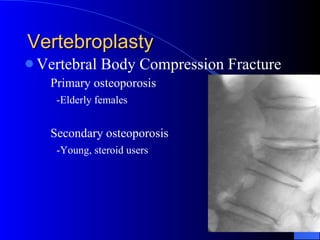
Vertebroplasty Vertebral Body Compression Fracture Primary osteoporosis -Elderly females Secondary osteoporosis -Young, steroid users
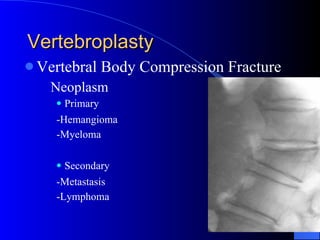
Vertebroplasty Vertebral Body Compression Fracture Neoplasm Primary -Hemangioma -Myeloma Secondary -Metastasis -Lymphoma
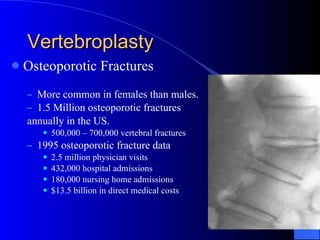
Vertebroplasty Osteoporotic Fractures More common in females than males. 1.5 Million osteoporotic fractures  annually in the US. 500,000 – 700,000 vertebral fractures 1995 osteoporotic fracture data 2.5 million physician visits 432,000 hospital admissions 180,000 nursing home admissions $13.5 billion in direct medical costs
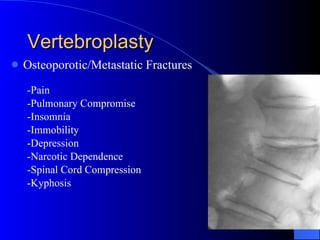
Vertebroplasty Osteoporotic/Metastatic Fractures -Pain -Pulmonary Compromise -Insomnia -Immobility -Depression -Narcotic Dependence -Spinal Cord Compression -Kyphosis
Vertebroplasty Traditional Vertebral Body Compression Fracture Management -Analgesics -Bed Rest Temporary DVT Side Effects Pneumonia -Immobilization -Surgery Variable success High failure rates Demineralization
Vertebroplasty Early Intervention May Reduce: Duration of acute pain Height loss Duration of immobilization Use of analgesics Occurrence of chronic pain Incidence of pneumonia Further collapse of the treated vertebral body Benefits Of Vertebroplasty Pain Relief Improved Mobility -Quick   -Mobility within 24 hrs -Complete
Vertebroplasty Efficacy Osteoporotic compression fracture 80-90% of patients experience dramatic or complete relief of pain immediately or within 72 hours. Neoplastic compression fractures 70% of patients experience marked reduction in narcotic requirements or complete pain relief.
Vertebroplasty Indications Pain related to vertebral compression fractures associated with osteoporosis or tumor infiltration. Contraindications Uncorrected coagulpathy or systemic or spinal infection.  Moderate to severe retropulsion of the posterior vertebral body cortex into the spinal canal. Height loss>70%
Vertebroplasty Patient Selection Patients who tend to respond the best One to three levels of fractures. Focal pain and tenderness corresponding to the level of edema by MRI. Fracture present < 2 months. Recent worsening of fracture. No sclerosis of fractured vertebra.
Vertebroplasty Patient Consultation Alteration of lifestyle due to fracture. Analgesic use. Orthotic use. Past medical history Past surgical history. Spine Medications. Anticoagulants Allergies Iodine contrast agents and antibiotics Laboratory Hct/Hgt, PT/PTT/INR, Platelets
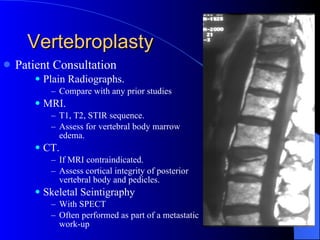
Vertebroplasty Patient Consultation Plain Radiographs. Compare with any prior studies MRI. T1, T2, STIR sequence. Assess for vertebral body marrow edema. CT. If MRI contraindicated. Assess cortical integrity of posterior vertebral body and pedicles. Skeletal Seintigraphy With SPECT Often performed as part of a metastatic work-up
Vertebroplasty Complications Incidence. Minor complications <3% Major complications <1% Majority are transient and self limiting. Steroid therapy or surgery are rarely required. Spinal cord or nerve root injury <1%. Hemorrhage, infection and PE – Rare Fracture Lamina Pedicle Increased pain. Death.
Vertebroplasty Complications Symptomatic cement extravasation. Incidence depends upon etiology of fracture. Osteoporosis 1-2% Neoplasm 5-10% Location Epidural Foraminal Paravertebral Disc
Vertebroplasty Pre-Procedure Care Antibiotics Optional. Recommended for immune compromised patients. Systemic. Local. Added to cement. Patient Positioning and Draping Patient prone. Strict sterile technique.
Vertebroplasty Pre-Procedure Care Anesthesia Intravenous sedation Sedation: Versed Analgesia: Fentanyl Local 1% Lidocaine Bipivicaine General Anesthesia   Rarely required Patient Monitoring Nursing Intravenous line Continuous Monitoring Parameters Vital signs Oxygen saturation
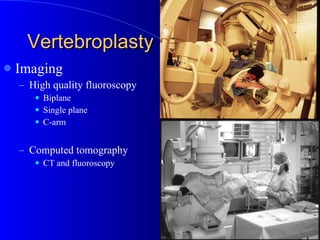
Vertebroplasty Imaging High quality fluoroscopy Biplane Single plane C-arm Computed tomography CT and fluoroscopy
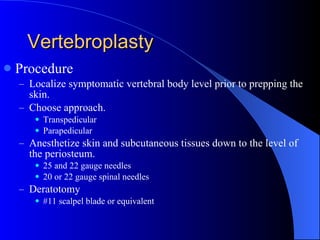
Vertebroplasty Procedure Localize symptomatic vertebral body level prior to prepping the skin. Choose approach. Transpedicular Parapedicular Anesthetize skin and subcutaneous tissues down to the level of the periosteum. 25 and 22 gauge needles 20 or 22 gauge spinal needles Deratotomy #11 scalpel blade or equivalent
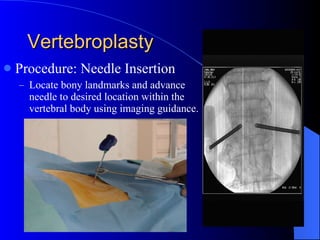
Vertebroplasty Procedure: Needle Insertion Locate bony landmarks and advance needle to desired location within the vertebral body using imaging guidance.
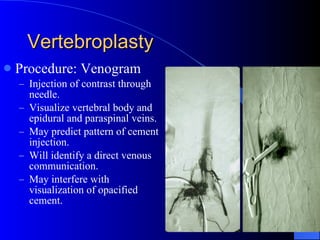
Vertebroplasty Procedure: Venogram Injection of contrast through needle. Visualize vertebral body and epidural and paraspinal veins. May predict pattern of cement injection. Will identify a direct venous communication. May interfere with visualization of opacified cement.
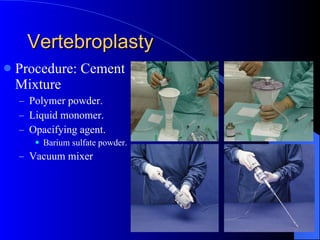
Vertebroplasty Procedure: Cement Mixture Polymer powder. Liquid monomer. Opacifying agent. Barium sulfate powder. Vacuum mixer
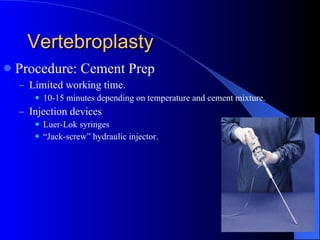
Vertebroplasty Procedure: Cement Prep Limited working time. 10-15 minutes depending on temperature and cement mixture. Injection devices Luer-Lok syringes “ Jack-screw” hydraulic injector.
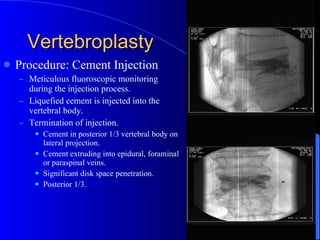
Vertebroplasty Procedure: Cement Injection Meticulous fluoroscopic monitoring during the injection process. Liquefied cement is injected into the vertebral body. Termination of injection. Cement in posterior 1/3 vertebral body on lateral projection. Cement extruding into epidural, foraminal or paraspinal veins. Significant disk space penetration. Posterior 1/3.
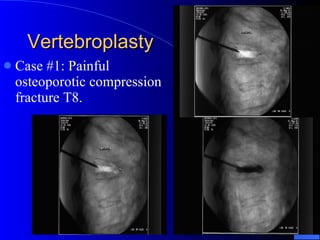
Vertebroplasty Case #1: Painful osteoporotic compression fracture T8.
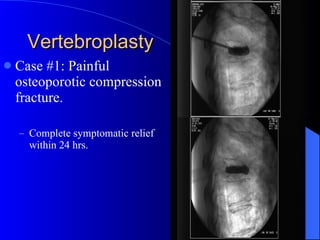
Vertebroplasty Case #1: Painful osteoporotic compression fracture. Complete symptomatic relief within 24 hrs.
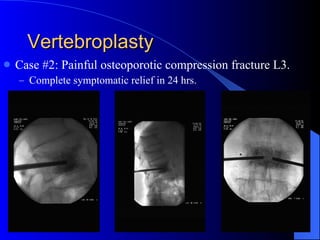
Vertebroplasty Case #2: Painful osteoporotic compression fracture L3. Complete symptomatic relief in 24 hrs.
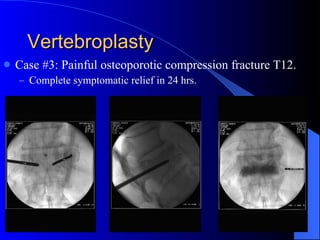
Vertebroplasty Case #3: Painful osteoporotic compression fracture T12. Complete symptomatic relief in 24 hrs.
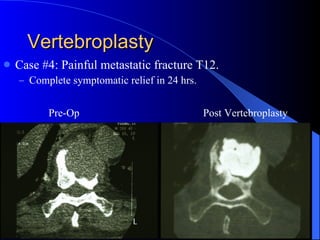
Vertebroplasty Case #4: Painful metastatic fracture T12. Complete symptomatic relief in 24 hrs. Pre-Op Post Vertebroplasty
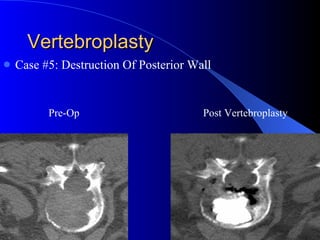
Vertebroplasty Case #5: Destruction Of Posterior Wall Pre-Op Post Vertebroplasty
Vertebroplasty Post Operative Care Dressing at needle site. Strict bed rest for 2-3 hours post vertebroplasty. Monitor vital signs. Monitor neurologic examination. Patient Follow-up Patient Instructed to call for New back pain Chest pain Lower extremity weakness Fever >100 degrees Follow-up at 24 hours and 1 week.
Vertebroplasty Results F. Grados, C. Depriester, G. Cayrolle, N. Hardy, H. Dermond and P.Fardellone  Long-term Observations Of Vertebral Osteoporotic Fractures Treated By Percutaneous Vertebroplasty 34 levels in 25 patients. Follow-up 12-84 months (mean 48). No severe complications. No progression of vertebral deformity in any injected vertebral body. M. Jensen, A. Evans, J. Mathis, D. Kallmes, H. Cloft and J. Dion  Percutaneous Polymethlymethacrylate Vertebroplasty in the Treatment of osteoporotic Vertebral Body Compression Fractures: Technical Aspects 47 levels in 29 patients. No severe complications. 90% significant immediate pain relief.
Vertebroplasty Results Deramond,   Percutaneous Vertebroplasty With Polymethylmethacrylate: Technique, Indications, and Results ,  Musculoskeletal Radiology , 5/98 80 Osteoporotic pts, 90% complete pain relief 101Tumor pts, 80% complete pain relief4 levels in 25 patients. Martin,   Vertebroplasty: Clinical Experience and Follow-up Results ,  Bone , 8/99 40 pts, 68 levels 80% complete pain relief
Vertebroplasty Conclusions In experienced hands and with appropriate patient selection, vertebroplasty is a safe and efficacious procedure for the treatment of pain and disability associated with osteoporotic compression fractures. The procedure has a low complication rate and a very high success rate. Vertebroplasty is a palliative procedure and does not correct the underlying cause of the vertebral fracture. Medical management of osteoporosis or malignancy must therefore be initiated and continued.

Vertebroplasty Grand Rounds

  • 1.
    Vertebroplasty Introduction Percutaneousspine intervention. Image guided. Treatment of painful pathologic vertebral compression fractures.
  • 2.
    Vertebroplasty Introduction Vertebroplastyis an effective, minimally invasive spine procedure where acrylic bone cement is injected into a painful pathologically compressed vertebral body.
  • 3.
    Vertebroplasty Objective Provideinstant pain relief. Prevent further vertebral collapse.
  • 4.
    Vertebroplasty History Acryliccement used as jeep windshields in WWII. European total joint surgery in 1960. FDA approved for total hips 1971. FDA approved for total knees in 1973. FDA approved for pathological fractures 1973 (Simplex P). Used in Vertebroplasty (Simplex P) 1984. Deramond 50 year old female with neck pain due to hemangioma.
  • 5.
    Vertebroplasty Vertebral BodyCompression Fracture Primary osteoporosis -Elderly females Secondary osteoporosis -Young, steroid users
  • 6.
    Vertebroplasty Vertebral BodyCompression Fracture Neoplasm Primary -Hemangioma -Myeloma Secondary -Metastasis -Lymphoma
  • 7.
    Vertebroplasty Osteoporotic FracturesMore common in females than males. 1.5 Million osteoporotic fractures annually in the US. 500,000 – 700,000 vertebral fractures 1995 osteoporotic fracture data 2.5 million physician visits 432,000 hospital admissions 180,000 nursing home admissions $13.5 billion in direct medical costs
  • 8.
    Vertebroplasty Osteoporotic/Metastatic Fractures-Pain -Pulmonary Compromise -Insomnia -Immobility -Depression -Narcotic Dependence -Spinal Cord Compression -Kyphosis
  • 9.
    Vertebroplasty Traditional VertebralBody Compression Fracture Management -Analgesics -Bed Rest Temporary DVT Side Effects Pneumonia -Immobilization -Surgery Variable success High failure rates Demineralization
  • 10.
    Vertebroplasty Early InterventionMay Reduce: Duration of acute pain Height loss Duration of immobilization Use of analgesics Occurrence of chronic pain Incidence of pneumonia Further collapse of the treated vertebral body Benefits Of Vertebroplasty Pain Relief Improved Mobility -Quick -Mobility within 24 hrs -Complete
  • 11.
    Vertebroplasty Efficacy Osteoporoticcompression fracture 80-90% of patients experience dramatic or complete relief of pain immediately or within 72 hours. Neoplastic compression fractures 70% of patients experience marked reduction in narcotic requirements or complete pain relief.
  • 12.
    Vertebroplasty Indications Painrelated to vertebral compression fractures associated with osteoporosis or tumor infiltration. Contraindications Uncorrected coagulpathy or systemic or spinal infection. Moderate to severe retropulsion of the posterior vertebral body cortex into the spinal canal. Height loss>70%
  • 13.
    Vertebroplasty Patient SelectionPatients who tend to respond the best One to three levels of fractures. Focal pain and tenderness corresponding to the level of edema by MRI. Fracture present < 2 months. Recent worsening of fracture. No sclerosis of fractured vertebra.
  • 14.
    Vertebroplasty Patient ConsultationAlteration of lifestyle due to fracture. Analgesic use. Orthotic use. Past medical history Past surgical history. Spine Medications. Anticoagulants Allergies Iodine contrast agents and antibiotics Laboratory Hct/Hgt, PT/PTT/INR, Platelets
  • 15.
    Vertebroplasty Patient ConsultationPlain Radiographs. Compare with any prior studies MRI. T1, T2, STIR sequence. Assess for vertebral body marrow edema. CT. If MRI contraindicated. Assess cortical integrity of posterior vertebral body and pedicles. Skeletal Seintigraphy With SPECT Often performed as part of a metastatic work-up
  • 16.
    Vertebroplasty Complications Incidence.Minor complications <3% Major complications <1% Majority are transient and self limiting. Steroid therapy or surgery are rarely required. Spinal cord or nerve root injury <1%. Hemorrhage, infection and PE – Rare Fracture Lamina Pedicle Increased pain. Death.
  • 17.
    Vertebroplasty Complications Symptomaticcement extravasation. Incidence depends upon etiology of fracture. Osteoporosis 1-2% Neoplasm 5-10% Location Epidural Foraminal Paravertebral Disc
  • 18.
    Vertebroplasty Pre-Procedure CareAntibiotics Optional. Recommended for immune compromised patients. Systemic. Local. Added to cement. Patient Positioning and Draping Patient prone. Strict sterile technique.
  • 19.
    Vertebroplasty Pre-Procedure CareAnesthesia Intravenous sedation Sedation: Versed Analgesia: Fentanyl Local 1% Lidocaine Bipivicaine General Anesthesia Rarely required Patient Monitoring Nursing Intravenous line Continuous Monitoring Parameters Vital signs Oxygen saturation
  • 20.
    Vertebroplasty Imaging Highquality fluoroscopy Biplane Single plane C-arm Computed tomography CT and fluoroscopy
  • 21.
    Vertebroplasty Procedure Localizesymptomatic vertebral body level prior to prepping the skin. Choose approach. Transpedicular Parapedicular Anesthetize skin and subcutaneous tissues down to the level of the periosteum. 25 and 22 gauge needles 20 or 22 gauge spinal needles Deratotomy #11 scalpel blade or equivalent
  • 22.
    Vertebroplasty Procedure: NeedleInsertion Locate bony landmarks and advance needle to desired location within the vertebral body using imaging guidance.
  • 23.
    Vertebroplasty Procedure: VenogramInjection of contrast through needle. Visualize vertebral body and epidural and paraspinal veins. May predict pattern of cement injection. Will identify a direct venous communication. May interfere with visualization of opacified cement.
  • 24.
    Vertebroplasty Procedure: CementMixture Polymer powder. Liquid monomer. Opacifying agent. Barium sulfate powder. Vacuum mixer
  • 25.
    Vertebroplasty Procedure: CementPrep Limited working time. 10-15 minutes depending on temperature and cement mixture. Injection devices Luer-Lok syringes “ Jack-screw” hydraulic injector.
  • 26.
    Vertebroplasty Procedure: CementInjection Meticulous fluoroscopic monitoring during the injection process. Liquefied cement is injected into the vertebral body. Termination of injection. Cement in posterior 1/3 vertebral body on lateral projection. Cement extruding into epidural, foraminal or paraspinal veins. Significant disk space penetration. Posterior 1/3.
  • 27.
    Vertebroplasty Case #1:Painful osteoporotic compression fracture T8.
  • 28.
    Vertebroplasty Case #1:Painful osteoporotic compression fracture. Complete symptomatic relief within 24 hrs.
  • 29.
    Vertebroplasty Case #2:Painful osteoporotic compression fracture L3. Complete symptomatic relief in 24 hrs.
  • 30.
    Vertebroplasty Case #3:Painful osteoporotic compression fracture T12. Complete symptomatic relief in 24 hrs.
  • 31.
    Vertebroplasty Case #4:Painful metastatic fracture T12. Complete symptomatic relief in 24 hrs. Pre-Op Post Vertebroplasty
  • 32.
    Vertebroplasty Case #5:Destruction Of Posterior Wall Pre-Op Post Vertebroplasty
  • 33.
    Vertebroplasty Post OperativeCare Dressing at needle site. Strict bed rest for 2-3 hours post vertebroplasty. Monitor vital signs. Monitor neurologic examination. Patient Follow-up Patient Instructed to call for New back pain Chest pain Lower extremity weakness Fever >100 degrees Follow-up at 24 hours and 1 week.
  • 34.
    Vertebroplasty Results F.Grados, C. Depriester, G. Cayrolle, N. Hardy, H. Dermond and P.Fardellone Long-term Observations Of Vertebral Osteoporotic Fractures Treated By Percutaneous Vertebroplasty 34 levels in 25 patients. Follow-up 12-84 months (mean 48). No severe complications. No progression of vertebral deformity in any injected vertebral body. M. Jensen, A. Evans, J. Mathis, D. Kallmes, H. Cloft and J. Dion Percutaneous Polymethlymethacrylate Vertebroplasty in the Treatment of osteoporotic Vertebral Body Compression Fractures: Technical Aspects 47 levels in 29 patients. No severe complications. 90% significant immediate pain relief.
  • 35.
    Vertebroplasty Results Deramond, Percutaneous Vertebroplasty With Polymethylmethacrylate: Technique, Indications, and Results , Musculoskeletal Radiology , 5/98 80 Osteoporotic pts, 90% complete pain relief 101Tumor pts, 80% complete pain relief4 levels in 25 patients. Martin, Vertebroplasty: Clinical Experience and Follow-up Results , Bone , 8/99 40 pts, 68 levels 80% complete pain relief
  • 36.
    Vertebroplasty Conclusions Inexperienced hands and with appropriate patient selection, vertebroplasty is a safe and efficacious procedure for the treatment of pain and disability associated with osteoporotic compression fractures. The procedure has a low complication rate and a very high success rate. Vertebroplasty is a palliative procedure and does not correct the underlying cause of the vertebral fracture. Medical management of osteoporosis or malignancy must therefore be initiated and continued.