Episode	
  9:	
  

Calling	
  the	
  Shots
KRIZTINE	
  ROSALES-­‐VIRAY
Concept	
  Catcher
• Shot	
  	
  -­‐-­‐	
  	
  smallest	
  unit	
  of	
  the	
  visual	
  
narrative.	
  	
  It	
  can	
  be	
  as	
  short	
  as	
  a	
  single	
  
frame.	
  
• Most	
  feature	
  films	
  are	
  projected	
  at	
  a	
  rate	
  
of	
  24	
  frames	
  per	
  second	
  (fps).	
  
• For	
  video	
  NTSC	
  (National	
  Television	
  System	
  
Committee)	
  there	
  are	
  29.97fps	
  or	
  30fps.
!
• For	
  PAL	
  (Phase	
  Alteration	
  by	
  Line)	
  there	
  are	
  
25fps	
  
!
• For	
  SECAM	
  (Systeme	
  Electronique	
  Coloure	
  
Avec	
  Memoire)	
  there	
  are	
  25fps.	
  
!
• NTSC,	
  PAL	
  and	
  SECAM	
  are	
  the	
  three	
  Main	
  
Analog	
  Video	
  Standards	
  used	
  around	
  the	
  
world.	
  
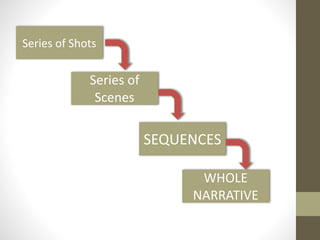
Series	
  of	
  Shots
Series	
  of	
  
Scenes
SEQUENCES
WHOLE	
  
NARRATIVE
SHOT	
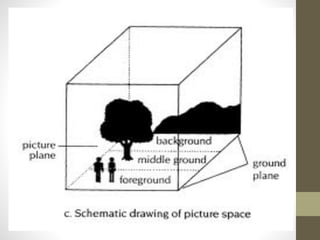
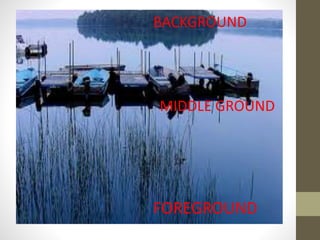
  ZONES
• Foreground	
  
!
• Middle	
  ground	
  
!
• Background	


!
• These	
  areas	
  may	
  contain	
  actor,	
  props,	
  
background	
  setting,	
  nature,	
  etc.	
  	
  These	
  areas	
  
exist	
  simultaneously	
  although	
  they	
  may	
  not	
  all	
  
appear	
  in	
  a	
  single	
  shot.
FOREGROUND
MIDDLE	
  GROUND
BACKGROUND
Four	
  Framing	
  Elements
• SHOT	
  SIZE	
  
!
• Angle	
  of	
  the	
  Shot	
  
!
• Camera	
  Movement	
  
!
• Compositional	
  Style
SHOT	
  SIZE
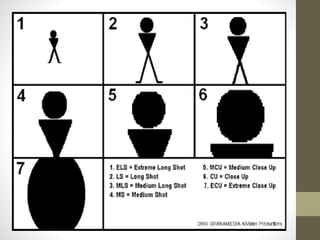
• Refers	
  to	
  the	
  dimension	
  of	
  the	
  screen	
  
border	
  that	
  contains	
  actors,	
  props,	
  etc.	
  
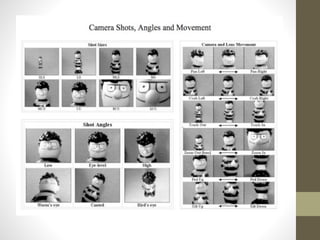
• Sizes	
  ranges	
  from	
  establishing	
  shot,	
  long	
  
shot,	
  close-­‐up,	
  extreme	
  close-­‐up,	
  to	
  a	
  
variety	
  of	
  in-­‐between	
  sizes	
  such	
  as	
  the	
  
Medium	
  shot,	
  medium	
  long	
  shot,	
  medium	
  
head	
  shot,	
  etc.
SHOT	
  ANGLES
• Described	
  as	
  the	
  incline	
  or	
  perspective	
  
taken	
  by	
  the	
  cameraman	
  when	
  shooting	
  a	
  
subject.	
  
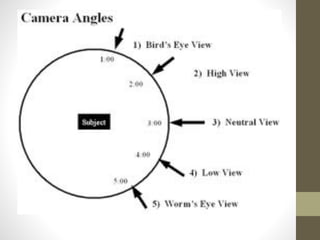
• The	
  most	
  basic	
  angles	
  are	
  related	
  to	
  height.	
  
• High	
  and	
  low	
  angle	
  are	
  also	
  known	
  as	
  the	
  
bird’s	
  eye	
  view	
  and	
  worm’s	
  eye	
  view,	
  
respectively.
Camera	
  Movement
• There	
  are	
  2	
  kinds	
  of	
  Camera	
  Movement:	


• Apparent	
  
• It	
  stimulates	
  the	
  actual	
  movement	
  of	
  the	
  
camera	
  
!
• Physical	
  
• There	
  is	
  a	
  physical	
  movement	
  of	
  the	
  camera
!
• Zoom	
  is	
  an	
  example	
  of	
  an	
  apparent	
  
movement.	
  	
  Shot	
  sizes	
  before	
  and	
  after	
  the	
  
motion	
  is	
  to	
  be	
  considered.	
  	
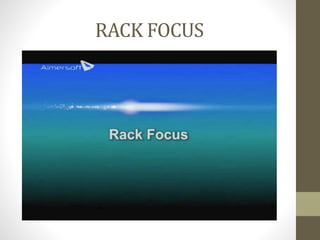
  The	
  technique	
  
known	
  a	
  RACK	
  FOCUS	
  or	
  PULL	
  FOCUS	
  
manipulates	
  the	
  change	
  in	
  shot	
  zones	
  by	
  
manually	
  shifting	
  the	
  camera	
  lens	
  from	
  
foreground	
  to	
  background	
  or	
  vice	
  versa.
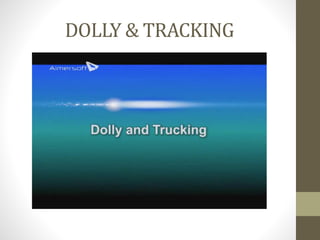
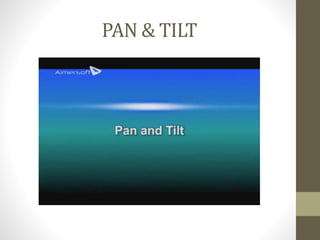
• Physical	
  movements	
  include	
  PAN,	
  TILT,	
  
CRANE,	
  DOLLY	
  and	
  TRACKING	
  
• Combination	
  of	
  movements	
  can	
  also	
  be	
  
done	
  to	
  create	
  new	
  and	
  varied	
  results.	
  	
  The	
  
best	
  example	
  is	
  Alfred	
  Hitchcocks’s	
  
signature	
  move	
  known	
  as	
  the	
  VERTIGO	
  
EFFECT–	
  a	
  combination	
  of	
  a	
  simultaneous	
  
zooming	
  in	
  and	
  tracking	
  out.	
  
DOLLY	
  &	
  TRACKING
PAN	
  &	
  TILT
RACK	
  FOCUS
Composition	
  Style
• Some	
  basic	
  framing	
  and	
  composition	
  style:	
  
!
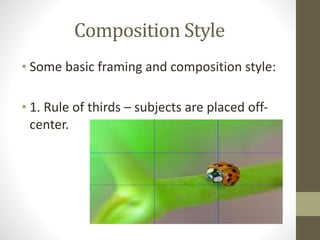
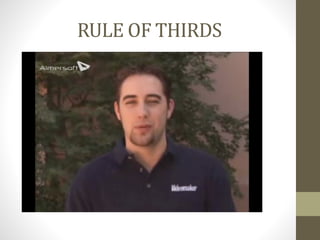
• 1.	
  Rule	
  of	
  thirds	
  –	
  subjects	
  are	
  placed	
  off-­‐
center.
RULE	
  OF	
  THIRDS
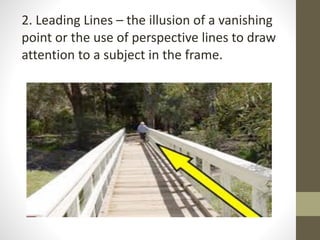
2.	
  Leading	
  Lines	
  –	
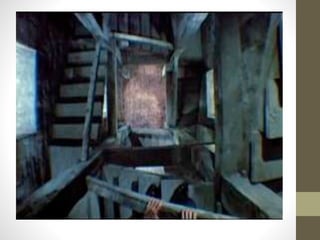
  the	
  illusion	
  of	
  a	
  vanishing	
  
point	
  or	
  the	
  use	
  of	
  perspective	
  lines	
  to	
  draw	
  
attention	
  to	
  a	
  subject	
  in	
  the	
  frame.
LEADING	
  LINES
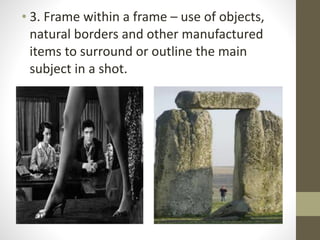
• 3.	
  Frame	
  within	
  a	
  frame	
  –	
  use	
  of	
  objects,	
  
natural	
  borders	
  and	
  other	
  manufactured	
  
items	
  to	
  surround	
  or	
  outline	
  the	
  main	
  
subject	
  in	
  a	
  shot.
FRAME	
  WITHIN	
  A	
  FRAME	
  
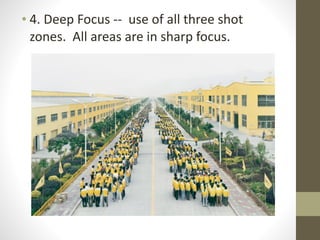
• 4.	
  Deep	
  Focus	
  -­‐-­‐	
  	
  use	
  of	
  all	
  three	
  shot	
  
zones.	
  	
  All	
  areas	
  are	
  in	
  sharp	
  focus.
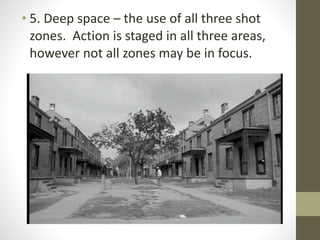
• 5.	
  Deep	
  space	
  –	
  the	
  use	
  of	
  all	
  three	
  shot	
  
zones.	
  	
  Action	
  is	
  staged	
  in	
  all	
  three	
  areas,	
  
however	
  not	
  all	
  zones	
  may	
  be	
  in	
  focus.
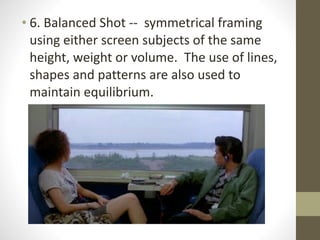
• 6.	
  Balanced	
  Shot	
  -­‐-­‐	
  	
  symmetrical	
  framing	
  
using	
  either	
  screen	
  subjects	
  of	
  the	
  same	
  
height,	
  weight	
  or	
  volume.	
  	
  The	
  use	
  of	
  lines,	
  
shapes	
  and	
  patterns	
  are	
  also	
  used	
  to	
  
maintain	
  equilibrium.
BALANCE
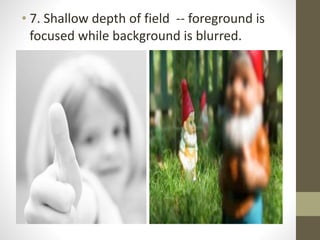
• 7.	
  Shallow	
  depth	
  of	
  field	
  	
  -­‐-­‐	
  foreground	
  is	
  
focused	
  while	
  background	
  is	
  blurred.
8.	
  Avoiding	
  growths	
  and	
  joints	
  –	
  set	
  limits	
  to	
  the	
  
borders	
  of	
  your	
  composition.	
  
!
9. Headroom	
  –	
  avoid	
  too	
  much	
  space	
  on	
  top	
  so	
  
as	
  not	
  to	
  dwarf	
  areas	
  in	
  the	
  shot.	
  
!
10.Look/Walk/Talk	
  room	
  -­‐-­‐	
  	
  establish	
  a	
  sense	
  of	
  
space	
  in	
  your	
  shots	
  by	
  leaving	
  just	
  the	
  right	
  
amount	
  of	
  space	
  to	
  the	
  right	
  or	
  left	
  side	
  of	
  
your	
  subject	
  to	
  indicate	
  that	
  s/he	
  is	
  
interacting	
  with	
  someone	
  off	
  screen,	
  or	
  is	
  
preparing	
  to	
  go	
  toward	
  that	
  direction	
  in	
  the	
  
succeeding	
  shots.
Learning	
  activity
• Storyboard	
  –	
  illustration	
  that	
  usually	
  show	
  
visually	
  the	
  flow	
  of	
  the	
  story	
  from	
  
beginning	
  to	
  end.	
  
!
• Shot	
  list	
  -­‐-­‐	
  	
  acts	
  as	
  guide	
  for	
  the	
  director	
  
during	
  filming.	
  	
  Usually	
  follows	
  the	
  Master	
  
Shot	
  Sequence.
• Master	
  Shot	
  Sequence	
  –	
  essentially	
  
shooting	
  the	
  scenes	
  in	
  descending	
  order,	
  
from	
  wide	
  shots	
  to	
  narrow	
  shots.	
  Actor	
  
repeatedly	
  does	
  his	
  work	
  from	
  start	
  to	
  
finish	
  for	
  every	
  shot	
  size	
  or	
  angle	
  require	
  by	
  
the	
  boards.	
  
• Master	
  shot	
  –	
  is	
  a	
  wide	
  enough	
  shot	
  that	
  
covers	
  the	
  entire	
  scene	
  from	
  start	
  to	
  end,	
  
allowing	
  all	
  important	
  actions	
  to	
  be	
  seen.	
  	
  
This	
  serves	
  as	
  a	
  safety	
  shot	
  for	
  the	
  entire	
  
film.
Brainstorm
• In	
  doing	
  your	
  30	
  seconder	
  values	
  formation	
  
video,	
  create	
  a	
  storyboard	
  and	
  shot	
  list	
  that	
  
shall	
  be	
  used	
  as	
  your	
  guide	
  in	
  directing	
  the	
  
video.
36
Next:	
  	
  Episode	
  10:	
  Rules	
  of	
  Engagement

Episode9 calling the shots pdf

  • 1.
    Episode  9:  
 Calling  the  Shots KRIZTINE  ROSALES-­‐VIRAY
  • 2.
    Concept  Catcher • Shot    -­‐-­‐    smallest  unit  of  the  visual   narrative.    It  can  be  as  short  as  a  single   frame.   • Most  feature  films  are  projected  at  a  rate   of  24  frames  per  second  (fps).   • For  video  NTSC  (National  Television  System   Committee)  there  are  29.97fps  or  30fps.
  • 3.
    ! • For  PAL  (Phase  Alteration  by  Line)  there  are   25fps   ! • For  SECAM  (Systeme  Electronique  Coloure   Avec  Memoire)  there  are  25fps.   ! • NTSC,  PAL  and  SECAM  are  the  three  Main   Analog  Video  Standards  used  around  the   world.  
  • 4.
    Series  of  Shots Series  of   Scenes SEQUENCES WHOLE   NARRATIVE
  • 5.
    SHOT  ZONES • Foreground   ! • Middle  ground   ! • Background         ! • These  areas  may  contain  actor,  props,   background  setting,  nature,  etc.    These  areas   exist  simultaneously  although  they  may  not  all   appear  in  a  single  shot.
  • 7.
  • 8.
    Four  Framing  Elements •SHOT  SIZE   ! • Angle  of  the  Shot   ! • Camera  Movement   ! • Compositional  Style
  • 9.
    SHOT  SIZE • Refers  to  the  dimension  of  the  screen   border  that  contains  actors,  props,  etc.   • Sizes  ranges  from  establishing  shot,  long   shot,  close-­‐up,  extreme  close-­‐up,  to  a   variety  of  in-­‐between  sizes  such  as  the   Medium  shot,  medium  long  shot,  medium   head  shot,  etc.
  • 11.
    SHOT  ANGLES • Described  as  the  incline  or  perspective   taken  by  the  cameraman  when  shooting  a   subject.   • The  most  basic  angles  are  related  to  height.   • High  and  low  angle  are  also  known  as  the   bird’s  eye  view  and  worm’s  eye  view,   respectively.
  • 13.
    Camera  Movement • There  are  2  kinds  of  Camera  Movement:       • Apparent   • It  stimulates  the  actual  movement  of  the   camera   ! • Physical   • There  is  a  physical  movement  of  the  camera
  • 14.
    ! • Zoom  is  an  example  of  an  apparent   movement.    Shot  sizes  before  and  after  the   motion  is  to  be  considered.    The  technique   known  a  RACK  FOCUS  or  PULL  FOCUS   manipulates  the  change  in  shot  zones  by   manually  shifting  the  camera  lens  from   foreground  to  background  or  vice  versa.
  • 15.
    • Physical  movements  include  PAN,  TILT,   CRANE,  DOLLY  and  TRACKING   • Combination  of  movements  can  also  be   done  to  create  new  and  varied  results.    The   best  example  is  Alfred  Hitchcocks’s   signature  move  known  as  the  VERTIGO   EFFECT–  a  combination  of  a  simultaneous   zooming  in  and  tracking  out.  
  • 16.
  • 17.
  • 18.
  • 21.
    Composition  Style • Some  basic  framing  and  composition  style:   ! • 1.  Rule  of  thirds  –  subjects  are  placed  off-­‐ center.
  • 22.
  • 23.
    2.  Leading  Lines  –  the  illusion  of  a  vanishing   point  or  the  use  of  perspective  lines  to  draw   attention  to  a  subject  in  the  frame.
  • 24.
  • 25.
    • 3.  Frame  within  a  frame  –  use  of  objects,   natural  borders  and  other  manufactured   items  to  surround  or  outline  the  main   subject  in  a  shot.
  • 26.
  • 27.
    • 4.  Deep  Focus  -­‐-­‐    use  of  all  three  shot   zones.    All  areas  are  in  sharp  focus.
  • 28.
    • 5.  Deep  space  –  the  use  of  all  three  shot   zones.    Action  is  staged  in  all  three  areas,   however  not  all  zones  may  be  in  focus.
  • 29.
    • 6.  Balanced  Shot  -­‐-­‐    symmetrical  framing   using  either  screen  subjects  of  the  same   height,  weight  or  volume.    The  use  of  lines,   shapes  and  patterns  are  also  used  to   maintain  equilibrium.
  • 30.
  • 31.
    • 7.  Shallow  depth  of  field    -­‐-­‐  foreground  is   focused  while  background  is  blurred.
  • 32.
    8.  Avoiding  growths  and  joints  –  set  limits  to  the   borders  of  your  composition.   ! 9. Headroom  –  avoid  too  much  space  on  top  so   as  not  to  dwarf  areas  in  the  shot.   ! 10.Look/Walk/Talk  room  -­‐-­‐    establish  a  sense  of   space  in  your  shots  by  leaving  just  the  right   amount  of  space  to  the  right  or  left  side  of   your  subject  to  indicate  that  s/he  is   interacting  with  someone  off  screen,  or  is   preparing  to  go  toward  that  direction  in  the   succeeding  shots.
  • 33.
    Learning  activity • Storyboard  –  illustration  that  usually  show   visually  the  flow  of  the  story  from   beginning  to  end.   ! • Shot  list  -­‐-­‐    acts  as  guide  for  the  director   during  filming.    Usually  follows  the  Master   Shot  Sequence.
  • 34.
    • Master  Shot  Sequence  –  essentially   shooting  the  scenes  in  descending  order,   from  wide  shots  to  narrow  shots.  Actor   repeatedly  does  his  work  from  start  to   finish  for  every  shot  size  or  angle  require  by   the  boards.   • Master  shot  –  is  a  wide  enough  shot  that   covers  the  entire  scene  from  start  to  end,   allowing  all  important  actions  to  be  seen.     This  serves  as  a  safety  shot  for  the  entire   film.
  • 35.
    Brainstorm • In  doing  your  30  seconder  values  formation   video,  create  a  storyboard  and  shot  list  that   shall  be  used  as  your  guide  in  directing  the   video.
  • 36.
    36 Next:    Episode  10:  Rules  of  Engagement