Understanding
The EXPOSURE TRIANGLE
In Photography
Prepared by: ABHIJIT GHOSH
Faculty of Filmmaking at Techno India University
What You will Learn
— You will learn how to use the exposure triangle to set a
correct exposure in your camera.
— You will learn about the link between ISO, shutter speed
and aperture.
— You will learn what aperture is, and how to use it
creatively.
— You will learn what shutter speed is, and how to
produce blur or freeze motion photos.
— You will learn what ISO is, and how to prevent 'noisy'
photos.
Overview
— How important is exposure in photography?
— What are the components of exposure?
— What is the “Exposure Triangle”?
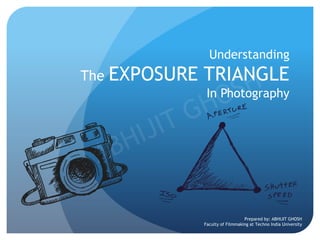
The Exposure Triangle in Photography is a common way of associating the three
variables that determine the exposure of a photograph: aperture, shutter speed, and
ISO.
One must balance all three of these to achieve a desired result, an adjustment of one
requiring adjustments of at least one of the others..
These are the questions that will be answered in the webinar
about ISO, Aperture and Shutter Speed — the components of achieving a properly
exposed photo. Understanding the purpose and value of exposure is a must for
photographers, particularly beginners who are serious about developing their craft.
Camera Configuration
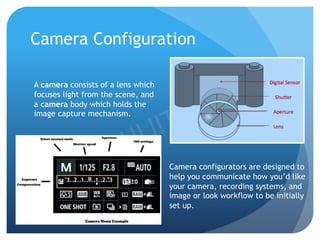
Camera configurators are designed to
help you communicate how you’d like
your camera, recording systems, and
image or look workflow to be initially
set up.
A camera consists of a lens which
focuses light from the scene, and
a camera body which holds the
image capture mechanism.
Exposure
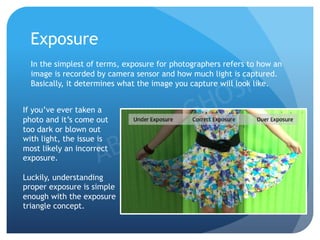
In the simplest of terms, exposure for photographers refers to how an
image is recorded by camera sensor and how much light is captured.
Basically, it determines what the image you capture will look like.
If you’ve ever taken a
photo and it’s come out
too dark or blown out
with light, the issue is
most likely an incorrect
exposure.
Luckily, understanding
proper exposure is simple
enough with the exposure
triangle concept.
Exposure
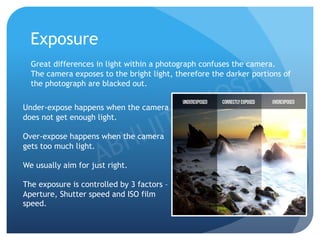
Great differences in light within a photograph confuses the camera.
The camera exposes to the bright light, therefore the darker portions of
the photograph are blacked out.
Under-expose happens when the camera
does not get enough light.
Over-expose happens when the camera
gets too much light.
We usually aim for just right.
The exposure is controlled by 3 factors –
Aperture, Shutter speed and ISO film
speed.
Shutter Speed
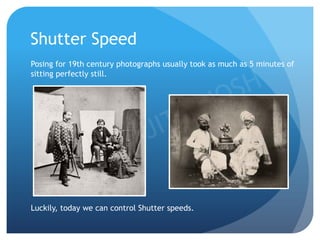
Posing for 19th century photographs usually took as much as 5 minutes of
sitting perfectly still.
Luckily, today we can control Shutter speeds.
Shutter Speed
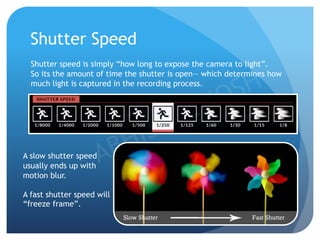
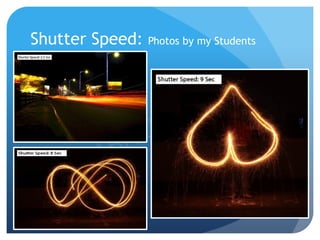
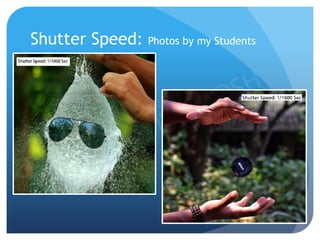
Shutter speed is simply “how long to expose the camera to light”.
So its the amount of time the shutter is open— which determines how
much light is captured in the recording process.
A slow shutter speed
usually ends up with
motion blur.
A fast shutter speed will
“freeze frame”.
Shutter Speed: Photos by my Students
Aperture
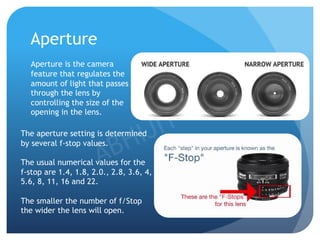
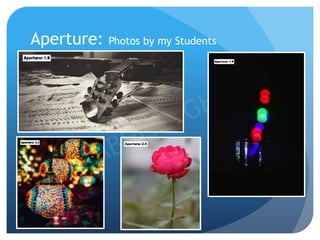
Aperture is the camera
feature that regulates the
amount of light that passes
through the lens by
controlling the size of the
opening in the lens.
The aperture setting is determined
by several f-stop values.
The usual numerical values for the
f-stop are 1.4, 1.8, 2.0., 2.8, 3.6, 4,
5.6, 8, 11, 16 and 22.
The smaller the number of f/Stop
the wider the lens will open.
Aperture
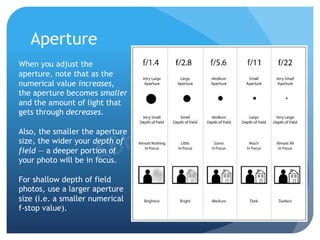
When you adjust the
aperture, note that as the
numerical value increases,
the aperture becomes smaller
and the amount of light that
gets through decreases.
Also, the smaller the aperture
size, the wider your depth of
field — a deeper portion of
your photo will be in focus.
For shallow depth of field
photos, use a larger aperture
size (i.e. a smaller numerical
f-stop value).
Aperture: Photos by my Students
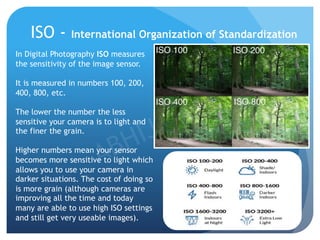
ISO - International Organization of Standardization
In Digital Photography ISO measures
the sensitivity of the image sensor.
It is measured in numbers 100, 200,
400, 800, etc.
The lower the number the less
sensitive your camera is to light and
the finer the grain.
Higher numbers mean your sensor
becomes more sensitive to light which
allows you to use your camera in
darker situations. The cost of doing so
is more grain (although cameras are
improving all the time and today
many are able to use high ISO settings
and still get very useable images).
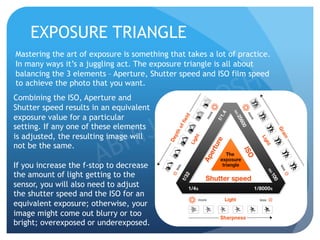
EXPOSURE TRIANGLE
Mastering the art of exposure is something that takes a lot of practice.
In many ways it’s a juggling act. The exposure triangle is all about
balancing the 3 elements – Aperture, Shutter speed and ISO film speed
to achieve the photo that you want.
Combining the ISO, Aperture and
Shutter speed results in an equivalent
exposure value for a particular
setting. If any one of these elements
is adjusted, the resulting image will
not be the same.
If you increase the f-stop to decrease
the amount of light getting to the
sensor, you will also need to adjust
the shutter speed and the ISO for an
equivalent exposure; otherwise, your
image might come out blurry or too
bright; overexposed or underexposed.
THANK YOU
The most important thing about mastering the Exposure Triangle is, you need
to go out and shoot.
It can be frustrating at first, but once you master it, all the settings will come
naturally.
So go crash over this barrier and have fun!
You can reach me at
abhijitghosh123@gmail.com

Understanding Exposure Triangle in Photography

  • 1.
    Understanding The EXPOSURE TRIANGLE InPhotography Prepared by: ABHIJIT GHOSH Faculty of Filmmaking at Techno India University
  • 2.
    What You willLearn — You will learn how to use the exposure triangle to set a correct exposure in your camera. — You will learn about the link between ISO, shutter speed and aperture. — You will learn what aperture is, and how to use it creatively. — You will learn what shutter speed is, and how to produce blur or freeze motion photos. — You will learn what ISO is, and how to prevent 'noisy' photos.
  • 3.
    Overview — How importantis exposure in photography? — What are the components of exposure? — What is the “Exposure Triangle”? The Exposure Triangle in Photography is a common way of associating the three variables that determine the exposure of a photograph: aperture, shutter speed, and ISO. One must balance all three of these to achieve a desired result, an adjustment of one requiring adjustments of at least one of the others.. These are the questions that will be answered in the webinar about ISO, Aperture and Shutter Speed — the components of achieving a properly exposed photo. Understanding the purpose and value of exposure is a must for photographers, particularly beginners who are serious about developing their craft.
  • 4.
    Camera Configuration Camera configuratorsare designed to help you communicate how you’d like your camera, recording systems, and image or look workflow to be initially set up. A camera consists of a lens which focuses light from the scene, and a camera body which holds the image capture mechanism.
  • 5.
    Exposure In the simplestof terms, exposure for photographers refers to how an image is recorded by camera sensor and how much light is captured. Basically, it determines what the image you capture will look like. If you’ve ever taken a photo and it’s come out too dark or blown out with light, the issue is most likely an incorrect exposure. Luckily, understanding proper exposure is simple enough with the exposure triangle concept.
  • 6.
    Exposure Great differences inlight within a photograph confuses the camera. The camera exposes to the bright light, therefore the darker portions of the photograph are blacked out. Under-expose happens when the camera does not get enough light. Over-expose happens when the camera gets too much light. We usually aim for just right. The exposure is controlled by 3 factors – Aperture, Shutter speed and ISO film speed.
  • 7.
    Shutter Speed Posing for19th century photographs usually took as much as 5 minutes of sitting perfectly still. Luckily, today we can control Shutter speeds.
  • 8.
    Shutter Speed Shutter speedis simply “how long to expose the camera to light”. So its the amount of time the shutter is open— which determines how much light is captured in the recording process. A slow shutter speed usually ends up with motion blur. A fast shutter speed will “freeze frame”.
  • 9.
    Shutter Speed: Photosby my Students
  • 10.
    Shutter Speed: Photosby my Students
  • 11.
    Aperture Aperture is thecamera feature that regulates the amount of light that passes through the lens by controlling the size of the opening in the lens. The aperture setting is determined by several f-stop values. The usual numerical values for the f-stop are 1.4, 1.8, 2.0., 2.8, 3.6, 4, 5.6, 8, 11, 16 and 22. The smaller the number of f/Stop the wider the lens will open.
  • 12.
    Aperture When you adjustthe aperture, note that as the numerical value increases, the aperture becomes smaller and the amount of light that gets through decreases. Also, the smaller the aperture size, the wider your depth of field — a deeper portion of your photo will be in focus. For shallow depth of field photos, use a larger aperture size (i.e. a smaller numerical f-stop value).
  • 13.
  • 14.
  • 15.
    ISO - InternationalOrganization of Standardization In Digital Photography ISO measures the sensitivity of the image sensor. It is measured in numbers 100, 200, 400, 800, etc. The lower the number the less sensitive your camera is to light and the finer the grain. Higher numbers mean your sensor becomes more sensitive to light which allows you to use your camera in darker situations. The cost of doing so is more grain (although cameras are improving all the time and today many are able to use high ISO settings and still get very useable images).
  • 16.
    EXPOSURE TRIANGLE Mastering theart of exposure is something that takes a lot of practice. In many ways it’s a juggling act. The exposure triangle is all about balancing the 3 elements – Aperture, Shutter speed and ISO film speed to achieve the photo that you want. Combining the ISO, Aperture and Shutter speed results in an equivalent exposure value for a particular setting. If any one of these elements is adjusted, the resulting image will not be the same. If you increase the f-stop to decrease the amount of light getting to the sensor, you will also need to adjust the shutter speed and the ISO for an equivalent exposure; otherwise, your image might come out blurry or too bright; overexposed or underexposed.
  • 17.
    THANK YOU The mostimportant thing about mastering the Exposure Triangle is, you need to go out and shoot. It can be frustrating at first, but once you master it, all the settings will come naturally. So go crash over this barrier and have fun! You can reach me at abhijitghosh123@gmail.com