Cinematography
Cin·e·ma·tog·ra·phy
What is cinematography?
Cinematography is the art and craft of making motion pictures by capturing a story
visually. Though, technically, cinematography is the art and the science of
recording light either electronically onto an image sensor or chemically onto film.
Taken from the Greek for "writing with movement," cinematography is the creation of
images you see on screen. A series of shots that form a cohesive narrative.
Cinematography composes each shot, considering, where everything in frame
demands attention.
What does a cinematographer do?
A cinematographer or director of photography (shortened to DP or DoP) is the crew
chief that presides over the camera and light crews on a film or video production.
They are involved throughout the entire production and collaborate closely with the
director to create the images you see.
CINEMATOGRAPHY ELEMENTS:
● Lighting
● Shot size
● Camera focus
● Shot composition
● Camera placement
● Camera movement
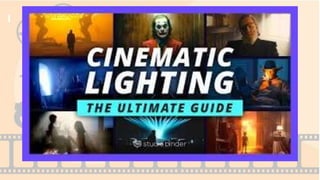
Lighting
While there is a separate lighting person, cinematography demands this
knowledge. After all, cinematography is what we see on-screen, and how
well or horribly the scene is lit is a huge aspect of the craft.
Types Of Light
Not all types of film lighting are created equally. Light comes in a wide variety of forms, packages and
sources. So before you start flipping switches on set, it’s important to know all the options you can
work with.
All types of film lighting fall under one of two categories: natural and artificial.
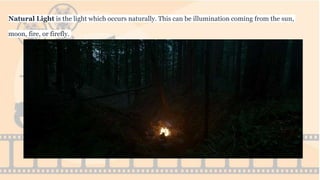
Natural Light is the light which occurs naturally. This can be illumination coming from the sun,
moon, fire, or firefly.
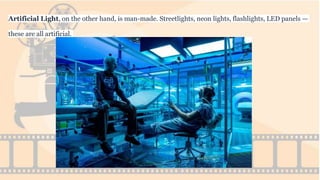
Artificial Light, on the other hand, is man-made. Streetlights, neon lights, flashlights, LED panels —
these are all artificial.
Natural Light is the light which occurs naturally. This can be illumination coming from the sun,
moon, fire, or firefly.
Artificial Light, on the other hand, is man-made. Streetlights, neon lights, flashlights, LED panels —
these are all artificial.
Camera Shots Size
Shot size is how much of the setting or subject is displayed within a given frame of a video, photo, or
animation, hence the scope or size of the shot. Different types of camera shots in film or video
communicate different narrative value, and are combined during post-production to tell a story. Most
filmmakers use standard names for shot sizes, often abbreviated into 2 or 3 letters on a shot list or
storyboard. For example, a close up shot would be abridged to "CU," or a wide shot would be denoted
as "WS."
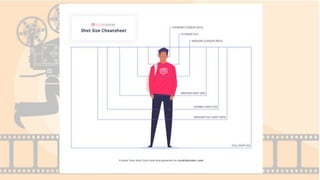
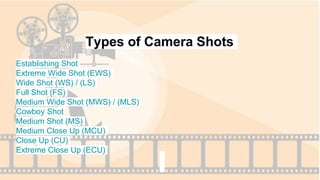
Types of Camera Shots
Establishing Shot
Extreme Wide Shot (EWS)
Wide Shot (WS) / (LS)
Full Shot (FS)
Medium Wide Shot (MWS) / (MLS)
Cowboy Shot
Medium Shot (MS)
Medium Close Up (MCU)
Close Up (CU)
Extreme Close Up (ECU)
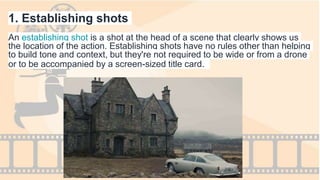
1. Establishing shots
An establishing shot is a shot at the head of a scene that clearly shows us
the location of the action. Establishing shots have no rules other than helping
to build tone and context, but they're not required to be wide or from a drone
or to be accompanied by a screen-sized title card.
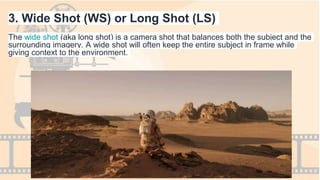
3. Wide Shot (WS) or Long Shot (LS)
The wide shot (aka long shot) is a camera shot that balances both the subject and the
surrounding imagery. A wide shot will often keep the entire subject in frame while
giving context to the environment.
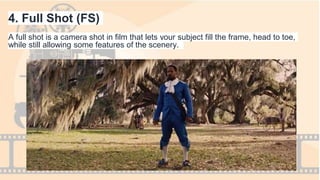
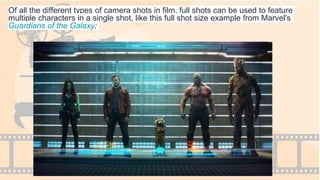
4. Full Shot (FS)
A full shot is a camera shot in film that lets your subject fill the frame, head to toe,
while still allowing some features of the scenery.
Of all the different types of camera shots in film, full shots can be used to feature
multiple characters in a single shot, like this full shot size example from Marvel's
Guardians of the Galaxy:
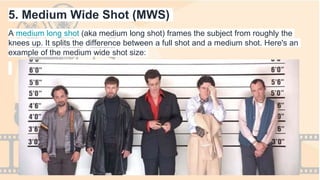
5. Medium Wide Shot (MWS)
A medium long shot (aka medium long shot) frames the subject from roughly the
knees up. It splits the difference between a full shot and a medium shot. Here's an
example of the medium wide shot size:
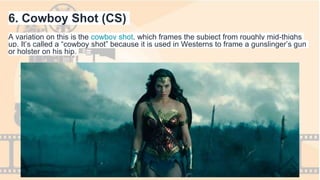
6. Cowboy Shot (CS)
A variation on this is the cowboy shot, which frames the subject from roughly mid-thighs
up. It’s called a “cowboy shot” because it is used in Westerns to frame a gunslinger’s gun
or holster on his hip.
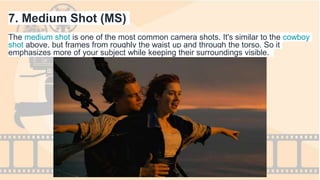
7. Medium Shot (MS)
The medium shot is one of the most common camera shots. It's similar to the cowboy
shot above, but frames from roughly the waist up and through the torso. So it
emphasizes more of your subject while keeping their surroundings visible.
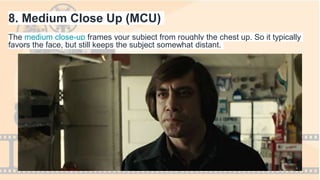
8. Medium Close Up (MCU)
The medium close-up frames your subject from roughly the chest up. So it typically
favors the face, but still keeps the subject somewhat distant.
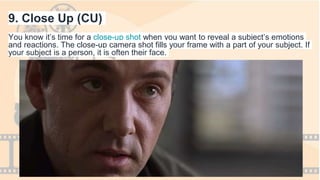
9. Close Up (CU)
You know it’s time for a close-up shot when you want to reveal a subject’s emotions
and reactions. The close-up camera shot fills your frame with a part of your subject. If
your subject is a person, it is often their face.
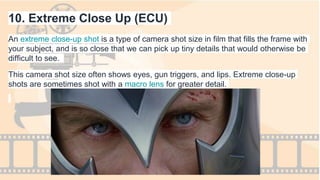
10. Extreme Close Up (ECU)
An extreme close-up shot is a type of camera shot size in film that fills the frame with
your subject, and is so close that we can pick up tiny details that would otherwise be
difficult to see.
This camera shot size often shows eyes, gun triggers, and lips. Extreme close-up
shots are sometimes shot with a macro lens for greater detail.
Camera Focus
Part of a cinematographer’s job is to play with focus to emphasize
different aspects of the story. A basic example of this is showing how
intoxicated the character is by going in and out of focus. There are many
types of camera focus available, each with their own particular
storytelling value.
Shot Composition
Composition refers to the way elements of a scene are arranged in a
camera frame. Shot composition refers to the arrangement of visual
elements to convey an intended message.
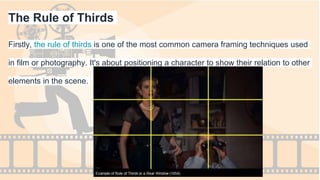
The Rule of Thirds
Firstly, the rule of thirds is one of the most common camera framing techniques used
in film or photography. It's about positioning a character to show their relation to other
elements in the scene.
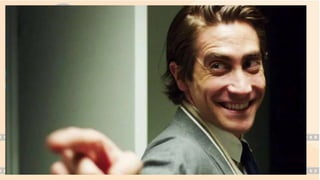
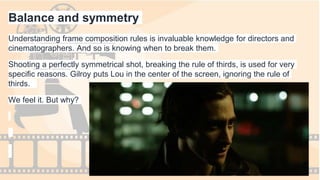
Balance and symmetry
Understanding frame composition rules is invaluable knowledge for directors and
cinematographers. And so is knowing when to break them.
Shooting a perfectly symmetrical shot, breaking the rule of thirds, is used for very
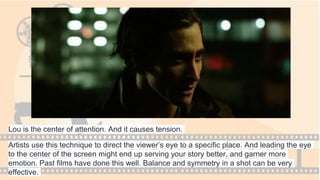
specific reasons. Gilroy puts Lou in the center of the screen, ignoring the rule of
thirds.
We feel it. But why?
Lou is the center of attention. And it causes tension.
Artists use this technique to direct the viewer’s eye to a specific place. And leading the eye
to the center of the screen might end up serving your story better, and garner more
emotion. Past films have done this well. Balance and symmetry in a shot can be very
effective.
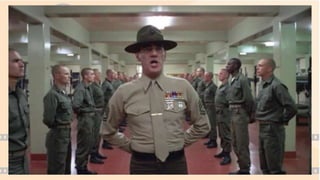
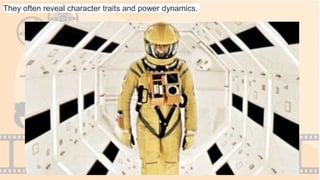
They often reveal character traits and power dynamics.
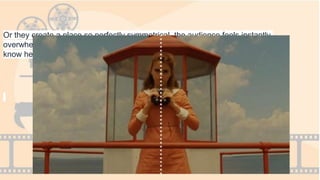
Or they create a place so perfectly symmetrical, the audience feels instantly
overwhelmed. If you know anything about Wes Anderson's directing style, you
know he loves a symmetrical frame.
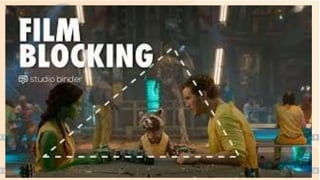
What is blocking?
Blocking is the way the director moves actors in a scene. The director's approach to
blocking is dependent on the desired outcome (e.g., for dramatic effect, to convey an
intended message, or to visualize a power dynamic).
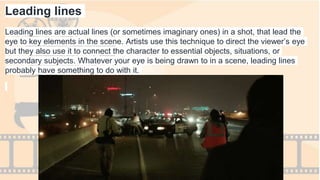
Leading lines
Leading lines are actual lines (or sometimes imaginary ones) in a shot, that lead the
eye to key elements in the scene. Artists use this technique to direct the viewer’s eye
but they also use it to connect the character to essential objects, situations, or
secondary subjects. Whatever your eye is being drawn to in a scene, leading lines
probably have something to do with it.
Camera placement
Where they place the camera greatly affects how the audience reacts to the
shot, and therefore the rest of the scene. It can have significant emotional
impact or even convey character behavior.
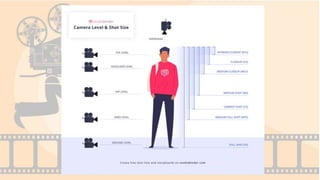
What is camera shot angle?
The camera shot angle is used to specify the location where the camera is placed to
take a shot. The position of the camera in relation to the subjects can affect the way
the viewer perceives the scene. A scene may be shot simultaneously from multiple
camera angles to amplify the cinematic effect and the emotions.
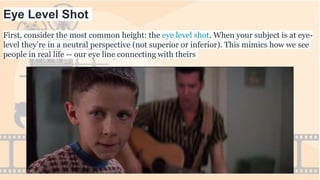
Eye Level Shot
First, consider the most common height: the eye level shot. When your subject is at eye-
level they’re in a neutral perspective (not superior or inferior). This mimics how we see
people in real life -- our eye line connecting with theirs
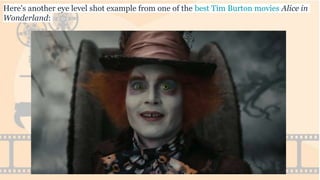
Here's another eye level shot example from one of the best Tim Burton movies Alice in
Wonderland:
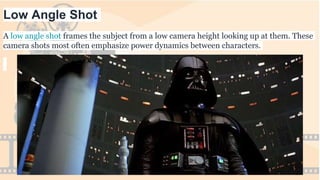
Low Angle Shot
A low angle shot frames the subject from a low camera height looking up at them. These
camera shots most often emphasize power dynamics between characters.
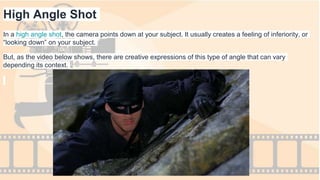
High Angle Shot
In a high angle shot, the camera points down at your subject. It usually creates a feeling of inferiority, or
“looking down” on your subject.
But, as the video below shows, there are creative expressions of this type of angle that can vary
depending its context.
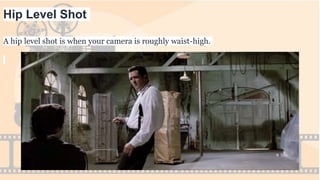
Hip Level Shot
A hip level shot is when your camera is roughly waist-high.
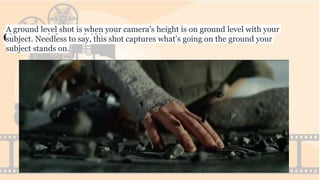
Ground Level Shot
A ground level shot is when your camera’s height is on ground level with your
subject. Needless to say, this shot captures what’s going on the ground your
subject stands on.
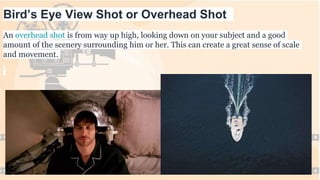
Bird’s Eye View Shot or Overhead Shot
An overhead shot is from way up high, looking down on your subject and a good
amount of the scenery surrounding him or her. This can create a great sense of scale
and movement.
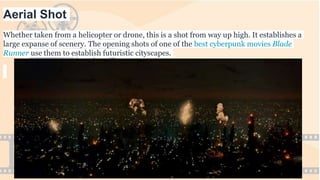
Aerial Shot
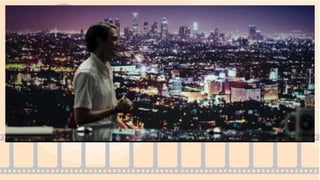
Whether taken from a helicopter or drone, this is a shot from way up high. It establishes a
large expanse of scenery. The opening shots of one of the best cyberpunk movies Blade
Runner use them to establish futuristic cityscapes.
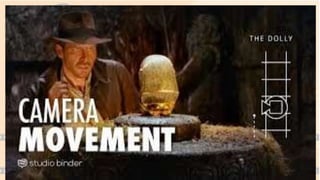
Camera movement
Camera movement can heighten the emotion and suspense in a scene.
Choose to move the camera with the characters and gain perspective. Keep
the camera static, and now we’re separated from them, peering in. Watch our
video on camera movement below.
What is camera movement?
Camera movement is a powerful filmmaking tool employed to modify the relationship
between the subject and the camera frame, with the goal of altering viewer's
perspective of space and time for a more impactful and visceral visual storytelling.
Static / Fixed Shot
Dolly Shot
Zoom Shot
Dolly Zoom Shot
Pan Shot
Tilt Shot
Types of Camera Movement
-end-
Thank You.

Cinematography (1).pptx

  • 1.
  • 2.
    Cin·e·ma·tog·ra·phy What is cinematography? Cinematographyis the art and craft of making motion pictures by capturing a story visually. Though, technically, cinematography is the art and the science of recording light either electronically onto an image sensor or chemically onto film. Taken from the Greek for "writing with movement," cinematography is the creation of images you see on screen. A series of shots that form a cohesive narrative. Cinematography composes each shot, considering, where everything in frame demands attention.
  • 3.
    What does acinematographer do? A cinematographer or director of photography (shortened to DP or DoP) is the crew chief that presides over the camera and light crews on a film or video production. They are involved throughout the entire production and collaborate closely with the director to create the images you see.
  • 4.
    CINEMATOGRAPHY ELEMENTS: ● Lighting ●Shot size ● Camera focus ● Shot composition ● Camera placement ● Camera movement
  • 5.
    Lighting While there isa separate lighting person, cinematography demands this knowledge. After all, cinematography is what we see on-screen, and how well or horribly the scene is lit is a huge aspect of the craft.
  • 6.
    Types Of Light Notall types of film lighting are created equally. Light comes in a wide variety of forms, packages and sources. So before you start flipping switches on set, it’s important to know all the options you can work with. All types of film lighting fall under one of two categories: natural and artificial. Natural Light is the light which occurs naturally. This can be illumination coming from the sun, moon, fire, or firefly. Artificial Light, on the other hand, is man-made. Streetlights, neon lights, flashlights, LED panels — these are all artificial.
  • 7.
    Natural Light isthe light which occurs naturally. This can be illumination coming from the sun, moon, fire, or firefly.
  • 8.
    Artificial Light, onthe other hand, is man-made. Streetlights, neon lights, flashlights, LED panels — these are all artificial.
  • 10.
    Camera Shots Size Shotsize is how much of the setting or subject is displayed within a given frame of a video, photo, or animation, hence the scope or size of the shot. Different types of camera shots in film or video communicate different narrative value, and are combined during post-production to tell a story. Most filmmakers use standard names for shot sizes, often abbreviated into 2 or 3 letters on a shot list or storyboard. For example, a close up shot would be abridged to "CU," or a wide shot would be denoted as "WS."
  • 13.
    Types of CameraShots Establishing Shot Extreme Wide Shot (EWS) Wide Shot (WS) / (LS) Full Shot (FS) Medium Wide Shot (MWS) / (MLS) Cowboy Shot Medium Shot (MS) Medium Close Up (MCU) Close Up (CU) Extreme Close Up (ECU)
  • 14.
    1. Establishing shots Anestablishing shot is a shot at the head of a scene that clearly shows us the location of the action. Establishing shots have no rules other than helping to build tone and context, but they're not required to be wide or from a drone or to be accompanied by a screen-sized title card.
  • 15.
    3. Wide Shot(WS) or Long Shot (LS) The wide shot (aka long shot) is a camera shot that balances both the subject and the surrounding imagery. A wide shot will often keep the entire subject in frame while giving context to the environment.
  • 16.
    4. Full Shot(FS) A full shot is a camera shot in film that lets your subject fill the frame, head to toe, while still allowing some features of the scenery.
  • 17.
    Of all thedifferent types of camera shots in film, full shots can be used to feature multiple characters in a single shot, like this full shot size example from Marvel's Guardians of the Galaxy:
  • 18.
    5. Medium WideShot (MWS) A medium long shot (aka medium long shot) frames the subject from roughly the knees up. It splits the difference between a full shot and a medium shot. Here's an example of the medium wide shot size:
  • 19.
    6. Cowboy Shot(CS) A variation on this is the cowboy shot, which frames the subject from roughly mid-thighs up. It’s called a “cowboy shot” because it is used in Westerns to frame a gunslinger’s gun or holster on his hip.
  • 20.
    7. Medium Shot(MS) The medium shot is one of the most common camera shots. It's similar to the cowboy shot above, but frames from roughly the waist up and through the torso. So it emphasizes more of your subject while keeping their surroundings visible.
  • 21.
    8. Medium CloseUp (MCU) The medium close-up frames your subject from roughly the chest up. So it typically favors the face, but still keeps the subject somewhat distant.
  • 22.
    9. Close Up(CU) You know it’s time for a close-up shot when you want to reveal a subject’s emotions and reactions. The close-up camera shot fills your frame with a part of your subject. If your subject is a person, it is often their face.
  • 23.
    10. Extreme CloseUp (ECU) An extreme close-up shot is a type of camera shot size in film that fills the frame with your subject, and is so close that we can pick up tiny details that would otherwise be difficult to see. This camera shot size often shows eyes, gun triggers, and lips. Extreme close-up shots are sometimes shot with a macro lens for greater detail.
  • 24.
    Camera Focus Part ofa cinematographer’s job is to play with focus to emphasize different aspects of the story. A basic example of this is showing how intoxicated the character is by going in and out of focus. There are many types of camera focus available, each with their own particular storytelling value.
  • 26.
    Shot Composition Composition refersto the way elements of a scene are arranged in a camera frame. Shot composition refers to the arrangement of visual elements to convey an intended message.
  • 27.
    The Rule ofThirds Firstly, the rule of thirds is one of the most common camera framing techniques used in film or photography. It's about positioning a character to show their relation to other elements in the scene.
  • 30.
    Balance and symmetry Understandingframe composition rules is invaluable knowledge for directors and cinematographers. And so is knowing when to break them. Shooting a perfectly symmetrical shot, breaking the rule of thirds, is used for very specific reasons. Gilroy puts Lou in the center of the screen, ignoring the rule of thirds. We feel it. But why?
  • 31.
    Lou is thecenter of attention. And it causes tension. Artists use this technique to direct the viewer’s eye to a specific place. And leading the eye to the center of the screen might end up serving your story better, and garner more emotion. Past films have done this well. Balance and symmetry in a shot can be very effective.
  • 33.
    They often revealcharacter traits and power dynamics.
  • 34.
    Or they createa place so perfectly symmetrical, the audience feels instantly overwhelmed. If you know anything about Wes Anderson's directing style, you know he loves a symmetrical frame.
  • 35.
    What is blocking? Blockingis the way the director moves actors in a scene. The director's approach to blocking is dependent on the desired outcome (e.g., for dramatic effect, to convey an intended message, or to visualize a power dynamic).
  • 37.
    Leading lines Leading linesare actual lines (or sometimes imaginary ones) in a shot, that lead the eye to key elements in the scene. Artists use this technique to direct the viewer’s eye but they also use it to connect the character to essential objects, situations, or secondary subjects. Whatever your eye is being drawn to in a scene, leading lines probably have something to do with it.
  • 38.
    Camera placement Where theyplace the camera greatly affects how the audience reacts to the shot, and therefore the rest of the scene. It can have significant emotional impact or even convey character behavior.
  • 39.
    What is camerashot angle? The camera shot angle is used to specify the location where the camera is placed to take a shot. The position of the camera in relation to the subjects can affect the way the viewer perceives the scene. A scene may be shot simultaneously from multiple camera angles to amplify the cinematic effect and the emotions.
  • 41.
    Eye Level Shot First,consider the most common height: the eye level shot. When your subject is at eye- level they’re in a neutral perspective (not superior or inferior). This mimics how we see people in real life -- our eye line connecting with theirs
  • 42.
    Here's another eyelevel shot example from one of the best Tim Burton movies Alice in Wonderland:
  • 43.
    Low Angle Shot Alow angle shot frames the subject from a low camera height looking up at them. These camera shots most often emphasize power dynamics between characters.
  • 44.
    High Angle Shot Ina high angle shot, the camera points down at your subject. It usually creates a feeling of inferiority, or “looking down” on your subject. But, as the video below shows, there are creative expressions of this type of angle that can vary depending its context.
  • 45.
    Hip Level Shot Ahip level shot is when your camera is roughly waist-high.
  • 46.
    Ground Level Shot Aground level shot is when your camera’s height is on ground level with your subject. Needless to say, this shot captures what’s going on the ground your subject stands on.
  • 47.
    Bird’s Eye ViewShot or Overhead Shot An overhead shot is from way up high, looking down on your subject and a good amount of the scenery surrounding him or her. This can create a great sense of scale and movement.
  • 48.
    Aerial Shot Whether takenfrom a helicopter or drone, this is a shot from way up high. It establishes a large expanse of scenery. The opening shots of one of the best cyberpunk movies Blade Runner use them to establish futuristic cityscapes.
  • 49.
    Camera movement Camera movementcan heighten the emotion and suspense in a scene. Choose to move the camera with the characters and gain perspective. Keep the camera static, and now we’re separated from them, peering in. Watch our video on camera movement below.
  • 50.
    What is cameramovement? Camera movement is a powerful filmmaking tool employed to modify the relationship between the subject and the camera frame, with the goal of altering viewer's perspective of space and time for a more impactful and visceral visual storytelling.
  • 51.
    Static / FixedShot Dolly Shot Zoom Shot Dolly Zoom Shot Pan Shot Tilt Shot Types of Camera Movement
  • 53.