CLE 3001.7.3  Recognize how visual and sound techniques or design (e.g., special effects, camera angles, music) carry or influence messages in various media SPI 3001.7.4  Determine the impact of production elements (e.g., font, color, layout, graphics, light, camera angle) on a message
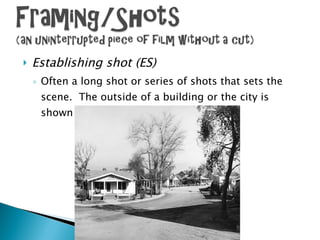
Establishing shot (ES) Often a long shot or series of shots that sets the scene.  The outside of a building or the city is shown first.
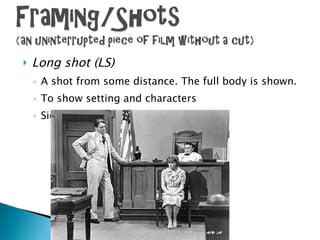
Long shot (LS) A shot from some distance. The full body is shown. To show setting and characters Signifies context and scope
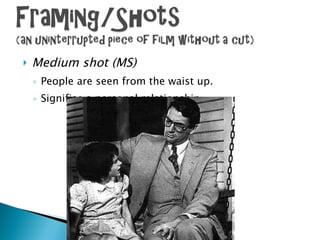
Medium shot (MS) People are seen from the waist up. Signifies a personal relationship
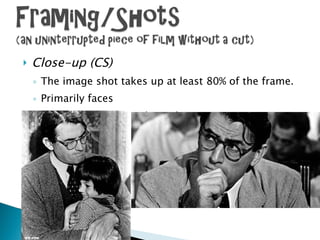
Close-up (CS) The image shot takes up at least 80% of the frame.  Primarily faces Signifies intimacy or intensity
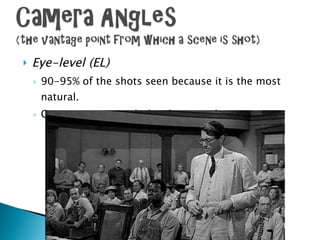
Eye-level (EL) 90-95% of the shots seen because it is the most natural.  Camera is even with the characters’ eyes.
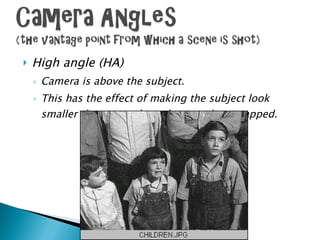
High angle (HA) Camera is above the subject.  This has the effect of making the subject look smaller than normal, weak, powerless, trapped.
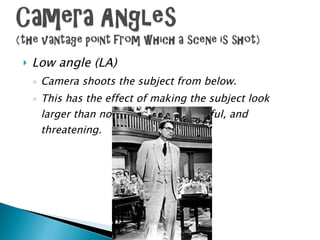
Low angle (LA) Camera shoots the subject from below.  This has the effect of making the subject look larger than normal, strong, powerful, and threatening.
Pan Stationary camera that moves from side to side.
Zoom Stationary camera where the lens moves to make an object look closer or further away from the camera. Moving in to a character is often a personal or revealing moment. Moving away from a character creates distance or separates the audience from the character.
Tilt Stationary camera that tilts up and down Can have the same viewer response as low-angle/high-angle shots
Dolly/Tracking Camera is on a track which allows it to move with the actions (vertical and horizontal)
Boom/Crane Camera is on a crane over the action. This overhead shot gives a bird’s eye view.
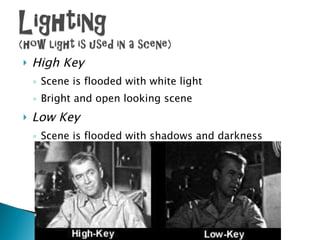
High Key Scene is flooded with white light Bright and open looking scene Low Key Scene is flooded with shadows and darkness Creates suspense/suspicion
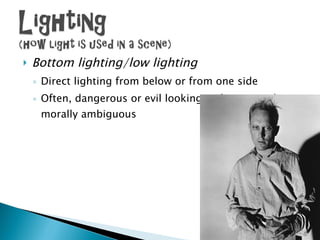
Bottom lighting/low lighting Direct lighting from below or from one side Often, dangerous or evil looking, split personality/morally ambiguous
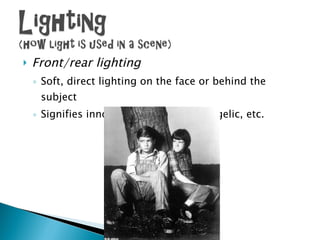
Front/rear lighting Soft, direct lighting on the face or behind the subject Signifies innocence, halo-effect, angelic, etc.
We will now begin watching To Kill a Mockingbird,  an academy award winning film. You will be analyzing the film for these cinematography techniques.

Film shots and techniques

  • 1.
    CLE 3001.7.3 Recognize how visual and sound techniques or design (e.g., special effects, camera angles, music) carry or influence messages in various media SPI 3001.7.4 Determine the impact of production elements (e.g., font, color, layout, graphics, light, camera angle) on a message
  • 2.
    Establishing shot (ES)Often a long shot or series of shots that sets the scene. The outside of a building or the city is shown first.
  • 3.
    Long shot (LS)A shot from some distance. The full body is shown. To show setting and characters Signifies context and scope
  • 4.
    Medium shot (MS)People are seen from the waist up. Signifies a personal relationship
  • 5.
    Close-up (CS) Theimage shot takes up at least 80% of the frame. Primarily faces Signifies intimacy or intensity
  • 6.
    Eye-level (EL) 90-95%of the shots seen because it is the most natural. Camera is even with the characters’ eyes.
  • 7.
    High angle (HA)Camera is above the subject. This has the effect of making the subject look smaller than normal, weak, powerless, trapped.
  • 8.
    Low angle (LA)Camera shoots the subject from below. This has the effect of making the subject look larger than normal, strong, powerful, and threatening.
  • 9.
    Pan Stationary camerathat moves from side to side.
  • 10.
    Zoom Stationary camerawhere the lens moves to make an object look closer or further away from the camera. Moving in to a character is often a personal or revealing moment. Moving away from a character creates distance or separates the audience from the character.
  • 11.
    Tilt Stationary camerathat tilts up and down Can have the same viewer response as low-angle/high-angle shots
  • 12.
    Dolly/Tracking Camera ison a track which allows it to move with the actions (vertical and horizontal)
  • 13.
    Boom/Crane Camera ison a crane over the action. This overhead shot gives a bird’s eye view.
  • 14.
    High Key Sceneis flooded with white light Bright and open looking scene Low Key Scene is flooded with shadows and darkness Creates suspense/suspicion
  • 15.
    Bottom lighting/low lightingDirect lighting from below or from one side Often, dangerous or evil looking, split personality/morally ambiguous
  • 16.
    Front/rear lighting Soft,direct lighting on the face or behind the subject Signifies innocence, halo-effect, angelic, etc.
  • 17.
    We will nowbegin watching To Kill a Mockingbird, an academy award winning film. You will be analyzing the film for these cinematography techniques.