MEKELLE UNIVERSITY
COLLEGE OF HEALTH SCIENCES
SCHOOL OF PUBLIC HEALTH
DEPARTMENT OF EPIDEMIOLOGY
EPIDEMIOLOGY LECTURE NOTE
BY DAWIT Z.
Chapter one
INTRODUCTION TO EPIDEMIOLOGY
• Definition, principles, concepts, and basic
assumptions in epidemiology
Objectives
After completing this session, we will be able to:
Define Epidemiology and describe its components
Distinguish between analytic and descriptive
Epidemiology
Understand history and scope of Epidemiology
Describe the basic assumptions and uses of
Epidemiology
INTRODUCTION…
• Definition of epidemiology?
Epidemiology
Epidemiology comes from the Greek roots:
“Epi” = on or upon
“Demos” = people or population
“Logos” = study of
So epidemiology is the study of what happens in a
population
Epidemiology: Definition
Epidemiology is the study of the
frequency,
 distribution and
 determinants
of diseases and other health related states or
events in specified populations and the
application of this study to the promotion of
health, and to the prevention and control of
health problems .
4/6/2024 6
INTRODUCTION…
Key words in the definition are:
Study
• It is a basic science of public health
• It is a discipline that approaches problems
systematically and quantitatively
• It has, at its foundation, sound methods of
scientific inquiry.
INTRODUCTION…
Frequency: Quantification of the
existence/occurrence of disease
• It answers the question How many?
• Epidemiology is a quantitative science
INTRODUCTION…
Distribution
• Refers to how disease is distributed throughout the
population
– Time (seasonal fluctuation, Long term variations)
– Place (geographical distribution of disease)
• Lowland Vs Highland
• Urban Vs Rural
– Person
• Young Vs Old
• Female Vs Male
• Rich Vs Poor
– (when, where, and to whom does disease occur?)
Descriptive epidemiology
INTRODUCTION…
Determinants:
 These are the factors which determine whether or not
a person will get a disease or the causative factors for
disease
• refers to the:
– ‘why’: cause, risk factors
• Genetic Vs environmental
• Social and cultural conditions
– How: mechanism:
• Mode of transmission
Analytical epidemiology
INTRODUCTION…
Health related States / events
 It includes
– Acute and chronic diseases
– Events such as injuries
– Conditions such as disabilities
– Behaviors
– Genetic characteristics
– Vital events
– Social vactors- poverty
– Etc.
INTRODUCTION…
Population
Epidemiology focuses on populations rather
than individuals.
So the epidemiologist’s “patient” is the
community
INTRODUCTION…
• Application- The ultimate purpose of all
epidemiological studies is the prevention and
control of health problems.
• So Epidemiological studies have direct and
practical applications for prevention of
diseases, control diseases & promotion of
health
• Epidemiology is a science and practice
• Epidemiology is an applied science!
USES/purpose OF EPIDEMIOLOGY
• The ultimate purpose of Epidemiology is
prevention and control of disease, in an effort
to improve the health status of populations.
How?
Functions of epidemiology
Discover the agent, host, and environmental
factors - for the prevention of disease and injury,
and the promotion of health.
Determine the relative importance of causes of
illness, disability, and death - establish priorities
for research
Identify population at the greatest risk from
specific causes of ill health
Functions of epidemiology cont’d …
Evaluate the effectiveness of preventive and
therapeutic health programs and services in
improving the health of the population
Study the natural history of disease from its
precursor states through its manifestations and
clinical course
Conduct surveillance of disease, injury and risk
factors
Investigate outbreaks - Identify their source and
controlling epidemics
Functions of epidemiology cont’d …
Monitoring the Health of Population
Looking for causes of disease, death and
disability - aetiological agents
Evaluating interventions and health service
provision
Functions of epidemiology cont’d …
Planning health services
Decision making in clinical medicine
Core Epidemiologic Functions
• In the mid-1980s, five major tasks of
epidemiology in public health practice were
identified:
• Public health surveillance,
• Field investigation,
• Analytic studies,
• Evaluation, and
• Linkages.
• Policy development [recently added].
Knowledge required by Epidemiologists
Public health, because of the
emphasis on disease prevention.
Clinical medicine, because of the
emphasis on disease classification
and diagnosis.
Pathophysiology, because of the
need to understand basic biological
mechanisms in disease.
Knowledge required cont’d…
Statistics , because of the need to
quantify disease frequency and its
relationships to antecedents.
Social sciences, because of the
need to understand the social
context in which disease occurs and
presents.
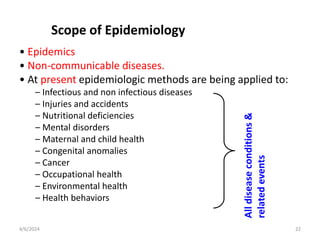
Scope of Epidemiology
• Epidemics
• Non-communicable diseases.
• At present epidemiologic methods are being applied to:
– Infectious and non infectious diseases
– Injuries and accidents
– Nutritional deficiencies
– Mental disorders
– Maternal and child health
– Congenital anomalies
– Cancer
– Occupational health
– Environmental health
– Health behaviors
4/6/2024 22
All
disease
conditions
&
related
events
SCOPE OF EPIDEMIOLOGY:
Since 5th
century
Middle of
20th century
Past 25 yrs
recently
Epidemic of communicable diseases
Endemic communicable diseases &
Non communicable diseases
Chronic diseases,
injuries,
birth defects
MCH
Occupational health
Env’tal health
Health related behavior
Genetic markers of disease risks
▲ +
▲+
▲+
▲+
Fields of Epidemiology – Define the following
fields
1. Microbial/Infectious
epidemiology
2. Descriptive epid
3. Surveillance epid
4. Global epidemiology
5. Testimonial epid
6. Entrepreneurial epid
A. Big Epidemiology
B. Genetic epid
C. Molecular epid
D. Social epid
E. Clinical epid
F. “Risk factor” epid
4/6/2024 24
Epidemiology Fields
Surveillance epidemiology (outbreak
investigations), and epidemic control
Descriptive epidemiology – examination of
patterns of occurrence of disease and injury and
their determinants
Microbial/Infectious epidemiology – biology and
ecology of pathogenic microorganisms, their
lifecycles, and their interactions with their
human and non-human hosts
4/6/2024 25
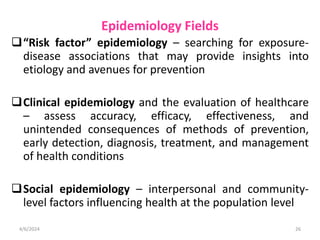
Epidemiology Fields
“Risk factor” epidemiology – searching for exposure-
disease associations that may provide insights into
etiology and avenues for prevention
Clinical epidemiology and the evaluation of healthcare
– assess accuracy, efficacy, effectiveness, and
unintended consequences of methods of prevention,
early detection, diagnosis, treatment, and management
of health conditions
Social epidemiology – interpersonal and community-
level factors influencing health at the population level
4/6/2024 26
Epidemiology Fields
Molecular epidemiology – investigate disease at the
molecular level to precisely characterize pathological
processes and exposures, to elucidate mechanisms of
pathogenesis, and to identify precursor conditions
Genetic epidemiology – the confluence of molecular
biology, population studies, and statistical models with an
emphasis on heritable influences on disease susceptibility
and expression
Big Epidemiology – multisite collaborative trials, such as the
Hypertension Detection and Follow-up Program (HDFP),
Multiple Risk Factor Intervention Trial (MRFIT), Women’s
Health Initiative (WHI)
4/6/2024 27
Epidemiology Fields
Entrepreneurial epidemiology – building institutions
and careers by winning research funding and facilities
Testimonial epidemiology – giving depositions and
testifying in court or in legislative hearings on the state
of epidemiologic evidence on a matter of dispute
Global epidemiology – assessing the effects of human
activity on the ecosystem that supports life on Earth.
4/6/2024 28
BASIC ASSUMPTIONS IN EPIDEMIOLOGY
A. “Disease occurrence in human population is not
random”
– Disease is not randomly distributed throughout a
population
– Epidemiology uses systematic approach to study
the differences in disease distribution in subgroup
– Why certain individuals/group acquire disease and
others not?
B. “Human disease has causal and preventive
factors that can be identified through systematic
investigation of different population or sub
group of individuals within a population at
different place or time”.
– Allows for study of causal and preventive
factors
History of Epidemiology (460-377 B.C)
• Epidemiological thinking traced to the time of
Hippocrates /5th century B.C., but the discipline
did not flourish until the 1940s.
• In 400 B.C. he attempted to explain disease
occurrence from a rational instead of a
supernatural viewpoint on his three books
Epidemics I, Epidemics III, and on Air, Waters
and Places
• Hippocrates - 5th century B.C.- the father of
modern medicine and the first Epidemiologist
• For the first time, he suggested that the
development of human disease might be
related to the external as well as personal
environment of an individual
• Whoever wishes to investigate medicine;
should proceed thus:
– Season of the year
– The wind
– The water
– The earth
– Drinking and eating pattern of the people
– Exercise and labor
John Graunt/1662
• The most important advances in epidemiology
is attributed to the English man John Grant
(1620 – 1674).
– His research laid the groundwork for both
epidemiology and demography.
- He wrote his work as “Natural and Political
Observations…Upon the Bills of Mortality”,
which was first published in England in 1662”
– He was the first to quantify patterns of birth,
death and disease occurrence, noting male-
female disparities, high infant mortality,
urban-rural differences, and seasonal variations
• Seasonal variation for mortality
• Assessed the impact of plague
James Lind/1747-
• he used an experimental approach to prove
the cause of scurvy by showing it could be
treated effectively with fresh fruit
• Designed first experiments to use a
concurrently treated control group
• William Farr/1839 - an English physician,
established the tradition of application of vital
statistical data for the evaluation of health
problems.
Examined mortality, occupation and marital status
• Defined:
 population at risk
Choosing appropriate comparison group
 Considered other factors:
• Age,
• Duration of exposure,
• General health status
He was considered the father of modern vital
statistics and surveillance,
• He developed many of the basic practices used
today in vital statistics and disease classification
• He extended the epidemiologic analysis of
morbidity and mortality data, looking at the
effects of marital status, occupation, and
altitude.
Edward Jenner (1749-1823)
• Pioneered clinical trials for vaccination to
control spread of smallpox
• Jenner's work influenced many others,
including Louis Pasteur who developed
vaccines against rabies and other infectious
diseases
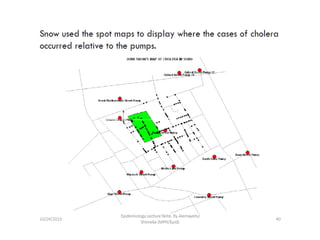
• John Snow/1853: an English physician
formulated and tested a hypothesis
concerning the origin of an epidemic of
cholera in London.
• Snow postulated & demonstrated that
cholera was transmitted by drinking
contaminated water.
• Careful mapping of cholera cases in London
during cholera epidemic
– Lambeth, Southwark and Vauxhall Company
(1949 – 1954) polluted by the sewage from
London.
– Lambeth changed the source
• Rate of Cholera declined in the area supplied
– Southwark and Vauxhall Company continued
Evolution of modern Epidemiology
Milestones have been broadly divided into
four stages
• Sanitary statistics
• Infectious disease epidemiology
• Chronic disease epidemiology and
• Multi-level causality
The Era of sanitary statistics
• Common in the first half of the19th century
• The widespread etiologic theory was "miasma” i.e.,
poisoning by polluted emanations from soil, air, and water
• Focused on assessing the clustering of morbidity and
mortality and on preventive measures such as drainage,
sewage, and sanitation
• Focused on the environment: the theory that all diseases
were due to bad air (contaminations-miasma)
The Era of infectious disease epidemiology
• Late 19th C - first half of the 20th C
• The germ theory prevailed
• It was the “Period of bacteriology”
• Analytic approach
-laboratory isolation and culture
• Preventive approach:
-interrupt transmission of the infectious agent
The Era of chronic disease epidemiology
• Since World War II
• Focused on risk factors at individual levels
• The "black box" approach: exposures are related
to outcomes without always understanding the
intervening factors or pathogenesis
• Primary analytic methods were used:- risk
ratios to relate exposures to outcomes.
• Preventive measures:- control of risk factors
by modifying the environment or human
behavior (e.g., smoking, physical inactivity)
Multi-level causality
• Multiple risk factors interacting to cause
disease including molecular pathogenesis of
diseases
• The focus was on risk factors as well as causal
pathways at the community level and the
pathogenesis at the individual level
Features of Epidemiology
• Studies are conducted on human population
• Ethical issues: tending to observational studies
• Examines patterns of events in groups of people
• Can establish cause and effect relationship
without the knowledge of biologic mechanism
-Smoking and lung cancer
• Covers a wide range of conditions
From infectious to non-infectious
From simple survey to complex drug trials
Major approaches in Epidemiology
• Descriptive epidemiology
• Analytic epidemiology
Descriptive epidemiology
• One of the basic types of Epidemiology which is
concerned with describing:
• the frequency and distribution of diseases and
other health related conditions by time, place, and
person.
• It provides valuable information:
to allocate resources and plan effective prevention
or education programs
It provides the first important clues about possible
determinants of a disease (formulation of hypothesis)
Major characteristics in Descriptive Epidemiology
Person, Place and Time.
• For the full description of the occurrence of a
disease, the following questions must be
considered.
• Who is affected?
• Where? and
• When do the cases occur?
• How many?
Person
• People can be categorized with respect to many
demographic and personal variables such as:
• Age
• Sex
• Religion
• Education
• Ethnic group and Race
• Other personal variables
Place: it refers to region, residence, workplace,
topography, or location of rooms, buildings or
other structures
1. Natural barriers
• Environmental or climatic conditions, such as
temperature, humidity, rainfall, altitude, mineral
content of soil, or water supply.
• helpful to see the nature and aetiology of
diseases.
2. Political boundaries.
- intended for planning and allocation of
resources
3. Urban-rural differences in disease occurrence
in terms of migration, living style and differential
environmental exposures.
Time: it refers to seasonal patterns, secular trends,
or acute changes in disease occurrence
There are three major types of changes in disease
occurrence over time.
1. Secular/slow Trends
Years or decades. E.g. AIDS, Lung Cancer
2. Periodic or cyclic changes; which refers to
recurrent alterations in the frequency of diseases.
Cycles have some periodicity (e.g. annual) Malaria,
meningitis
3. Sporadic –at irregular and unpredictable intervals.
Analytic Epidemiology
• It involves explicit comparison of groups of
individuals to identify determinants of health and
diseases.
• Testing of hypotheses, which in turn may arise
from
Case reports
Case series
Laboratory studies
Descriptive epidemiologic studies
• It focuses on determinants of disease by testing
hypothesis.
– Try to answer questions like “why” and “how”
of a disease
• The key to epidemiologic analysis is
comparison group
Purpose/ Aim of analytic Epidemiology
1. To search for cause and effect: Why?? How??
2. To test hypothesis about causal relationship
3. To quantify the association between
exposure and outcome-Measure of association
• Many studies have both descriptive and analytic
aspects data collected in one mode may end up
being used in the other as well.
• Whether a particular study is primarily
“descriptive” or “analytic” may be a matter of the
investigator’s stance in relationship to the study
question and data collection.
• Due to this descriptive and analytic classification is
a continuum than being a dichotomy.
Epidemiologic Concepts
• Community- refers to a group of people who
share some thing in common. E.g. common
denominators can be neighborhood, work
place, race, religion or social activity.
• Communities - engaged in activities that
demand interrelationship of efforts, they give
rise to shared culture, and they are often sited
in a particular geographic location.
• Community vs Clinical medicine :
Community medicine - is a system of delivery of
comprehensive (preventive, social medicine,
along with curative and promotive) health care
to the people by a health team to improve the
health of a community
• Also concerned with diagnosing the health
problems of a community, and with planning
and managing community health services
• Here (community medicine), the community
replaces the individual patients as the primary
focus of concern
• It helps to evaluate the health of a defined
community including those members who
would benefit from, but could not seek
medical care
• These approach requires techniques and skills
in addition to those needed for clinical practice
Clinical medicine:- medical care of individuals.
• Typically these are sick people who have
presented for help.
• Public health - a science and art of preventing
disease, prolonging life, and promoting health
and efficiency through organized community
effort for sanitation, control of communicable
disease, health education (Winslow, 1920)
• Is saving life as group/community/population
Public health is:
• Preventing disease
• Prolonging life
• Improving quality of life
• Eliminating health inequalities
• Organizing community to promote active
participation
Core functions of Public Health
1. Assessment- of health need, by conducting
surveillance and specific studies
2. Leadership - program design, resource
allocation and social mobilization
3. Provision of services- assure availability of
quality and comprehensive health services
through accessible outlets
• Information on the health and disease of a
defined community is gathered through
Community Diagnosis.
• Community Diagnosis - the process of
identification and detailed description of the
most important health problems of a given
community.
• It may be broad or narrow in scope, and may deal
with only a single topic or a single sub group.
Some of the ways to make community diagnosis
are:
• Discussion with community leaders and health
workers
• Survey of available health records
• Field survey.
• Compilation and analysis of the data.
• It is impossible to address all the identified
problems at the same time because of resource
scarcity.
• Therefore the problems should be put in the
order of priority using a set criterion.
• Community diagnosis provides basis for
decision on:
– The need for intervention
– Type of intervention needed
– Target group at whom intervention should be
directed
– Provide baseline for later intervention
• Preventive medicine:- deals with the
measures to protect the individuals from the
diseases, and to keep them in a state of
positive health
Social medicine:– is a study of man as social
being in relation to his environment
 It is a branch of medical science dealing with
the study of community health with respect of
social aspects (social, economical, cultural,
psychological, environmental and genetic
factors) in the community as a whole
 Epidemiological and statistical aspects are also
dealt with.
Criteria for priority setting
• Magnitude (amount or frequency) of the problem
• Severity (to what extent is the problem disabling,
fatal)
• Feasibility (availability of financial and material
resource, effective control method)
• Community concern (whether it is a felt problem of
the community)
• Government concern (policy support, political
commitment)
Risk Factors:
• any factor associated with an increased or
decreased occurrence of disease.
• A factor associated with an increased
occurrence of a disease is risk factor for the
exposed group;
and a factor associated with a decreased
occurrence of a disease is a risk factor for the
non exposed group.
• Risk factors could be:
 Factors related to the agent: Strain difference
Factors related to the human host: Lack of
specific immunity.
Factors related to the environment:
Overcrowding, Lack of ventilation
Risk factors may further be classified as:
• Factors susceptible to change: smoking habit,
alcohol drinking habit
• Factors not amenable to change: age, sex,
family history
In order to be able to prevent disease, it is
vital to identify factors that can be changed.
• For some diseases, the specific causes are not
known.
• In such cases it is very important to identify risk
factors, especially those that can be changed and
act on them.
• Epidemiology is mainly interested in those risk
factors that are amenable to change as its ultimate
purpose is to prevent and control disease and
promote the health of the population.
• Disease- is a physiological/psychological
dysfunction
• Illness- a subjective state of the person who
feels aware of not being well
• Sickness- is a state of social dysfunction that is
a role that the individual assumes when ill
presentation Assignment
The epidemiological concept of population
• THANK YOU FOR YOUR ATTENTION!

CHAPTER 1 ITRODUCTION TO EPIDEMIOLOGICAL METHODS.pptx

  • 1.
    MEKELLE UNIVERSITY COLLEGE OFHEALTH SCIENCES SCHOOL OF PUBLIC HEALTH DEPARTMENT OF EPIDEMIOLOGY EPIDEMIOLOGY LECTURE NOTE BY DAWIT Z.
  • 2.
    Chapter one INTRODUCTION TOEPIDEMIOLOGY • Definition, principles, concepts, and basic assumptions in epidemiology
  • 3.
    Objectives After completing thissession, we will be able to: Define Epidemiology and describe its components Distinguish between analytic and descriptive Epidemiology Understand history and scope of Epidemiology Describe the basic assumptions and uses of Epidemiology
  • 4.
  • 5.
    Epidemiology Epidemiology comes fromthe Greek roots: “Epi” = on or upon “Demos” = people or population “Logos” = study of So epidemiology is the study of what happens in a population
  • 6.
    Epidemiology: Definition Epidemiology isthe study of the frequency,  distribution and  determinants of diseases and other health related states or events in specified populations and the application of this study to the promotion of health, and to the prevention and control of health problems . 4/6/2024 6
  • 7.
    INTRODUCTION… Key words inthe definition are: Study • It is a basic science of public health • It is a discipline that approaches problems systematically and quantitatively • It has, at its foundation, sound methods of scientific inquiry.
  • 8.
    INTRODUCTION… Frequency: Quantification ofthe existence/occurrence of disease • It answers the question How many? • Epidemiology is a quantitative science
  • 9.
    INTRODUCTION… Distribution • Refers tohow disease is distributed throughout the population – Time (seasonal fluctuation, Long term variations) – Place (geographical distribution of disease) • Lowland Vs Highland • Urban Vs Rural – Person • Young Vs Old • Female Vs Male • Rich Vs Poor – (when, where, and to whom does disease occur?) Descriptive epidemiology
  • 10.
    INTRODUCTION… Determinants:  These arethe factors which determine whether or not a person will get a disease or the causative factors for disease • refers to the: – ‘why’: cause, risk factors • Genetic Vs environmental • Social and cultural conditions – How: mechanism: • Mode of transmission Analytical epidemiology
  • 11.
    INTRODUCTION… Health related States/ events  It includes – Acute and chronic diseases – Events such as injuries – Conditions such as disabilities – Behaviors – Genetic characteristics – Vital events – Social vactors- poverty – Etc.
  • 12.
    INTRODUCTION… Population Epidemiology focuses onpopulations rather than individuals. So the epidemiologist’s “patient” is the community
  • 13.
    INTRODUCTION… • Application- Theultimate purpose of all epidemiological studies is the prevention and control of health problems. • So Epidemiological studies have direct and practical applications for prevention of diseases, control diseases & promotion of health • Epidemiology is a science and practice • Epidemiology is an applied science!
  • 14.
    USES/purpose OF EPIDEMIOLOGY •The ultimate purpose of Epidemiology is prevention and control of disease, in an effort to improve the health status of populations. How?
  • 15.
    Functions of epidemiology Discoverthe agent, host, and environmental factors - for the prevention of disease and injury, and the promotion of health. Determine the relative importance of causes of illness, disability, and death - establish priorities for research Identify population at the greatest risk from specific causes of ill health
  • 16.
    Functions of epidemiologycont’d … Evaluate the effectiveness of preventive and therapeutic health programs and services in improving the health of the population Study the natural history of disease from its precursor states through its manifestations and clinical course Conduct surveillance of disease, injury and risk factors Investigate outbreaks - Identify their source and controlling epidemics
  • 17.
    Functions of epidemiologycont’d … Monitoring the Health of Population Looking for causes of disease, death and disability - aetiological agents Evaluating interventions and health service provision
  • 18.
    Functions of epidemiologycont’d … Planning health services Decision making in clinical medicine
  • 19.
    Core Epidemiologic Functions •In the mid-1980s, five major tasks of epidemiology in public health practice were identified: • Public health surveillance, • Field investigation, • Analytic studies, • Evaluation, and • Linkages. • Policy development [recently added].
  • 20.
    Knowledge required byEpidemiologists Public health, because of the emphasis on disease prevention. Clinical medicine, because of the emphasis on disease classification and diagnosis. Pathophysiology, because of the need to understand basic biological mechanisms in disease.
  • 21.
    Knowledge required cont’d… Statistics, because of the need to quantify disease frequency and its relationships to antecedents. Social sciences, because of the need to understand the social context in which disease occurs and presents.
  • 22.
    Scope of Epidemiology •Epidemics • Non-communicable diseases. • At present epidemiologic methods are being applied to: – Infectious and non infectious diseases – Injuries and accidents – Nutritional deficiencies – Mental disorders – Maternal and child health – Congenital anomalies – Cancer – Occupational health – Environmental health – Health behaviors 4/6/2024 22 All disease conditions & related events
  • 23.
    SCOPE OF EPIDEMIOLOGY: Since5th century Middle of 20th century Past 25 yrs recently Epidemic of communicable diseases Endemic communicable diseases & Non communicable diseases Chronic diseases, injuries, birth defects MCH Occupational health Env’tal health Health related behavior Genetic markers of disease risks ▲ + ▲+ ▲+ ▲+
  • 24.
    Fields of Epidemiology– Define the following fields 1. Microbial/Infectious epidemiology 2. Descriptive epid 3. Surveillance epid 4. Global epidemiology 5. Testimonial epid 6. Entrepreneurial epid A. Big Epidemiology B. Genetic epid C. Molecular epid D. Social epid E. Clinical epid F. “Risk factor” epid 4/6/2024 24
  • 25.
    Epidemiology Fields Surveillance epidemiology(outbreak investigations), and epidemic control Descriptive epidemiology – examination of patterns of occurrence of disease and injury and their determinants Microbial/Infectious epidemiology – biology and ecology of pathogenic microorganisms, their lifecycles, and their interactions with their human and non-human hosts 4/6/2024 25
  • 26.
    Epidemiology Fields “Risk factor”epidemiology – searching for exposure- disease associations that may provide insights into etiology and avenues for prevention Clinical epidemiology and the evaluation of healthcare – assess accuracy, efficacy, effectiveness, and unintended consequences of methods of prevention, early detection, diagnosis, treatment, and management of health conditions Social epidemiology – interpersonal and community- level factors influencing health at the population level 4/6/2024 26
  • 27.
    Epidemiology Fields Molecular epidemiology– investigate disease at the molecular level to precisely characterize pathological processes and exposures, to elucidate mechanisms of pathogenesis, and to identify precursor conditions Genetic epidemiology – the confluence of molecular biology, population studies, and statistical models with an emphasis on heritable influences on disease susceptibility and expression Big Epidemiology – multisite collaborative trials, such as the Hypertension Detection and Follow-up Program (HDFP), Multiple Risk Factor Intervention Trial (MRFIT), Women’s Health Initiative (WHI) 4/6/2024 27
  • 28.
    Epidemiology Fields Entrepreneurial epidemiology– building institutions and careers by winning research funding and facilities Testimonial epidemiology – giving depositions and testifying in court or in legislative hearings on the state of epidemiologic evidence on a matter of dispute Global epidemiology – assessing the effects of human activity on the ecosystem that supports life on Earth. 4/6/2024 28
  • 29.
    BASIC ASSUMPTIONS INEPIDEMIOLOGY A. “Disease occurrence in human population is not random” – Disease is not randomly distributed throughout a population – Epidemiology uses systematic approach to study the differences in disease distribution in subgroup – Why certain individuals/group acquire disease and others not?
  • 30.
    B. “Human diseasehas causal and preventive factors that can be identified through systematic investigation of different population or sub group of individuals within a population at different place or time”. – Allows for study of causal and preventive factors
  • 31.
    History of Epidemiology(460-377 B.C) • Epidemiological thinking traced to the time of Hippocrates /5th century B.C., but the discipline did not flourish until the 1940s. • In 400 B.C. he attempted to explain disease occurrence from a rational instead of a supernatural viewpoint on his three books Epidemics I, Epidemics III, and on Air, Waters and Places • Hippocrates - 5th century B.C.- the father of modern medicine and the first Epidemiologist
  • 32.
    • For thefirst time, he suggested that the development of human disease might be related to the external as well as personal environment of an individual
  • 33.
    • Whoever wishesto investigate medicine; should proceed thus: – Season of the year – The wind – The water – The earth – Drinking and eating pattern of the people – Exercise and labor
  • 34.
    John Graunt/1662 • Themost important advances in epidemiology is attributed to the English man John Grant (1620 – 1674). – His research laid the groundwork for both epidemiology and demography. - He wrote his work as “Natural and Political Observations…Upon the Bills of Mortality”, which was first published in England in 1662”
  • 35.
    – He wasthe first to quantify patterns of birth, death and disease occurrence, noting male- female disparities, high infant mortality, urban-rural differences, and seasonal variations • Seasonal variation for mortality • Assessed the impact of plague
  • 36.
    James Lind/1747- • heused an experimental approach to prove the cause of scurvy by showing it could be treated effectively with fresh fruit • Designed first experiments to use a concurrently treated control group
  • 37.
    • William Farr/1839- an English physician, established the tradition of application of vital statistical data for the evaluation of health problems.
  • 38.
    Examined mortality, occupationand marital status • Defined:  population at risk Choosing appropriate comparison group  Considered other factors: • Age, • Duration of exposure, • General health status He was considered the father of modern vital statistics and surveillance,
  • 39.
    • He developedmany of the basic practices used today in vital statistics and disease classification • He extended the epidemiologic analysis of morbidity and mortality data, looking at the effects of marital status, occupation, and altitude.
  • 40.
    Edward Jenner (1749-1823) •Pioneered clinical trials for vaccination to control spread of smallpox • Jenner's work influenced many others, including Louis Pasteur who developed vaccines against rabies and other infectious diseases
  • 41.
    • John Snow/1853:an English physician formulated and tested a hypothesis concerning the origin of an epidemic of cholera in London. • Snow postulated & demonstrated that cholera was transmitted by drinking contaminated water. • Careful mapping of cholera cases in London during cholera epidemic
  • 42.
    – Lambeth, Southwarkand Vauxhall Company (1949 – 1954) polluted by the sewage from London. – Lambeth changed the source • Rate of Cholera declined in the area supplied – Southwark and Vauxhall Company continued
  • 45.
    Evolution of modernEpidemiology Milestones have been broadly divided into four stages • Sanitary statistics • Infectious disease epidemiology • Chronic disease epidemiology and • Multi-level causality
  • 46.
    The Era ofsanitary statistics • Common in the first half of the19th century • The widespread etiologic theory was "miasma” i.e., poisoning by polluted emanations from soil, air, and water • Focused on assessing the clustering of morbidity and mortality and on preventive measures such as drainage, sewage, and sanitation • Focused on the environment: the theory that all diseases were due to bad air (contaminations-miasma)
  • 47.
    The Era ofinfectious disease epidemiology • Late 19th C - first half of the 20th C • The germ theory prevailed • It was the “Period of bacteriology” • Analytic approach -laboratory isolation and culture • Preventive approach: -interrupt transmission of the infectious agent
  • 48.
    The Era ofchronic disease epidemiology • Since World War II • Focused on risk factors at individual levels • The "black box" approach: exposures are related to outcomes without always understanding the intervening factors or pathogenesis
  • 49.
    • Primary analyticmethods were used:- risk ratios to relate exposures to outcomes. • Preventive measures:- control of risk factors by modifying the environment or human behavior (e.g., smoking, physical inactivity)
  • 50.
    Multi-level causality • Multiplerisk factors interacting to cause disease including molecular pathogenesis of diseases • The focus was on risk factors as well as causal pathways at the community level and the pathogenesis at the individual level
  • 51.
    Features of Epidemiology •Studies are conducted on human population • Ethical issues: tending to observational studies • Examines patterns of events in groups of people • Can establish cause and effect relationship without the knowledge of biologic mechanism -Smoking and lung cancer • Covers a wide range of conditions From infectious to non-infectious From simple survey to complex drug trials
  • 52.
    Major approaches inEpidemiology • Descriptive epidemiology • Analytic epidemiology
  • 53.
    Descriptive epidemiology • Oneof the basic types of Epidemiology which is concerned with describing: • the frequency and distribution of diseases and other health related conditions by time, place, and person. • It provides valuable information: to allocate resources and plan effective prevention or education programs It provides the first important clues about possible determinants of a disease (formulation of hypothesis)
  • 54.
    Major characteristics inDescriptive Epidemiology Person, Place and Time. • For the full description of the occurrence of a disease, the following questions must be considered. • Who is affected? • Where? and • When do the cases occur? • How many?
  • 55.
    Person • People canbe categorized with respect to many demographic and personal variables such as: • Age • Sex • Religion • Education • Ethnic group and Race • Other personal variables
  • 56.
    Place: it refersto region, residence, workplace, topography, or location of rooms, buildings or other structures 1. Natural barriers • Environmental or climatic conditions, such as temperature, humidity, rainfall, altitude, mineral content of soil, or water supply. • helpful to see the nature and aetiology of diseases.
  • 57.
    2. Political boundaries. -intended for planning and allocation of resources 3. Urban-rural differences in disease occurrence in terms of migration, living style and differential environmental exposures.
  • 58.
    Time: it refersto seasonal patterns, secular trends, or acute changes in disease occurrence There are three major types of changes in disease occurrence over time. 1. Secular/slow Trends Years or decades. E.g. AIDS, Lung Cancer 2. Periodic or cyclic changes; which refers to recurrent alterations in the frequency of diseases. Cycles have some periodicity (e.g. annual) Malaria, meningitis 3. Sporadic –at irregular and unpredictable intervals.
  • 59.
    Analytic Epidemiology • Itinvolves explicit comparison of groups of individuals to identify determinants of health and diseases. • Testing of hypotheses, which in turn may arise from Case reports Case series Laboratory studies Descriptive epidemiologic studies
  • 60.
    • It focuseson determinants of disease by testing hypothesis. – Try to answer questions like “why” and “how” of a disease • The key to epidemiologic analysis is comparison group
  • 61.
    Purpose/ Aim ofanalytic Epidemiology 1. To search for cause and effect: Why?? How?? 2. To test hypothesis about causal relationship 3. To quantify the association between exposure and outcome-Measure of association
  • 62.
    • Many studieshave both descriptive and analytic aspects data collected in one mode may end up being used in the other as well. • Whether a particular study is primarily “descriptive” or “analytic” may be a matter of the investigator’s stance in relationship to the study question and data collection. • Due to this descriptive and analytic classification is a continuum than being a dichotomy.
  • 63.
    Epidemiologic Concepts • Community-refers to a group of people who share some thing in common. E.g. common denominators can be neighborhood, work place, race, religion or social activity. • Communities - engaged in activities that demand interrelationship of efforts, they give rise to shared culture, and they are often sited in a particular geographic location.
  • 64.
    • Community vsClinical medicine : Community medicine - is a system of delivery of comprehensive (preventive, social medicine, along with curative and promotive) health care to the people by a health team to improve the health of a community
  • 65.
    • Also concernedwith diagnosing the health problems of a community, and with planning and managing community health services • Here (community medicine), the community replaces the individual patients as the primary focus of concern
  • 66.
    • It helpsto evaluate the health of a defined community including those members who would benefit from, but could not seek medical care • These approach requires techniques and skills in addition to those needed for clinical practice Clinical medicine:- medical care of individuals. • Typically these are sick people who have presented for help.
  • 67.
    • Public health- a science and art of preventing disease, prolonging life, and promoting health and efficiency through organized community effort for sanitation, control of communicable disease, health education (Winslow, 1920) • Is saving life as group/community/population
  • 68.
    Public health is: •Preventing disease • Prolonging life • Improving quality of life • Eliminating health inequalities • Organizing community to promote active participation
  • 69.
    Core functions ofPublic Health 1. Assessment- of health need, by conducting surveillance and specific studies 2. Leadership - program design, resource allocation and social mobilization 3. Provision of services- assure availability of quality and comprehensive health services through accessible outlets
  • 70.
    • Information onthe health and disease of a defined community is gathered through Community Diagnosis. • Community Diagnosis - the process of identification and detailed description of the most important health problems of a given community. • It may be broad or narrow in scope, and may deal with only a single topic or a single sub group.
  • 71.
    Some of theways to make community diagnosis are: • Discussion with community leaders and health workers • Survey of available health records • Field survey. • Compilation and analysis of the data. • It is impossible to address all the identified problems at the same time because of resource scarcity. • Therefore the problems should be put in the order of priority using a set criterion.
  • 72.
    • Community diagnosisprovides basis for decision on: – The need for intervention – Type of intervention needed – Target group at whom intervention should be directed – Provide baseline for later intervention
  • 73.
    • Preventive medicine:-deals with the measures to protect the individuals from the diseases, and to keep them in a state of positive health
  • 74.
    Social medicine:– isa study of man as social being in relation to his environment  It is a branch of medical science dealing with the study of community health with respect of social aspects (social, economical, cultural, psychological, environmental and genetic factors) in the community as a whole  Epidemiological and statistical aspects are also dealt with.
  • 76.
    Criteria for prioritysetting • Magnitude (amount or frequency) of the problem • Severity (to what extent is the problem disabling, fatal) • Feasibility (availability of financial and material resource, effective control method) • Community concern (whether it is a felt problem of the community) • Government concern (policy support, political commitment)
  • 78.
    Risk Factors: • anyfactor associated with an increased or decreased occurrence of disease. • A factor associated with an increased occurrence of a disease is risk factor for the exposed group; and a factor associated with a decreased occurrence of a disease is a risk factor for the non exposed group.
  • 79.
    • Risk factorscould be:  Factors related to the agent: Strain difference Factors related to the human host: Lack of specific immunity. Factors related to the environment: Overcrowding, Lack of ventilation
  • 80.
    Risk factors mayfurther be classified as: • Factors susceptible to change: smoking habit, alcohol drinking habit • Factors not amenable to change: age, sex, family history In order to be able to prevent disease, it is vital to identify factors that can be changed.
  • 81.
    • For somediseases, the specific causes are not known. • In such cases it is very important to identify risk factors, especially those that can be changed and act on them. • Epidemiology is mainly interested in those risk factors that are amenable to change as its ultimate purpose is to prevent and control disease and promote the health of the population.
  • 82.
    • Disease- isa physiological/psychological dysfunction • Illness- a subjective state of the person who feels aware of not being well • Sickness- is a state of social dysfunction that is a role that the individual assumes when ill
  • 83.
  • 84.
    • THANK YOUFOR YOUR ATTENTION!