


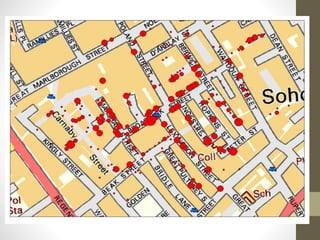


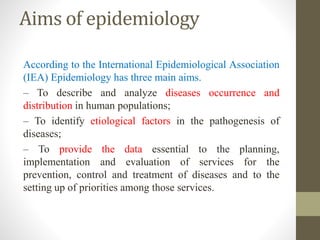
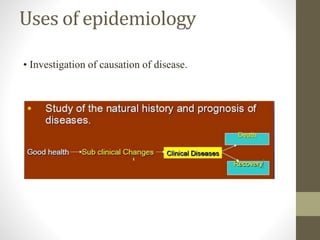
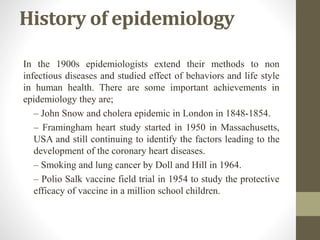










John Snow conducted seminal epidemiological work in 1854 during a cholera outbreak in London. By mapping cases of cholera and determining locations of water sources, he discovered cholera was transmitted through contaminated water from a Broad Street pump. Upon its removal, cholera cases decreased suddenly, demonstrating waterborne transmission. This was a major achievement in epidemiology and earned Snow the title of the father of field epidemiology. Epidemiology involves the scientific study of disease patterns in human populations, including the distribution and determinants of health-related states or events. It aims to describe disease occurrence, identify etiological factors, and provide data to support disease prevention, control, and treatment efforts.


