STATEMENT OF INQUIRY
The systems of life are supported by biochemical reactions and
the transformation of energy that occur within cells. Innovation
in science could lead to these reactions being utilized to meet
growing energy and food needs
KEY CONCEPT
Systems
RELATED CONCEPT
Transformation and Energy
GLOBAL CONTEXT
Scientific and Technological
Innovation
What chemical processes support life?
WHY ARE ENZYMES NEEDED?
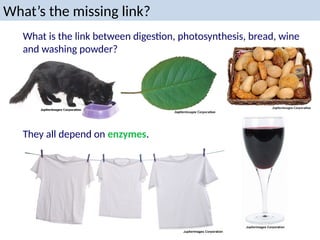
What’s the missing link?
What is the link between digestion, photosynthesis, bread, wine
and washing powder?
They all depend on enzymes.
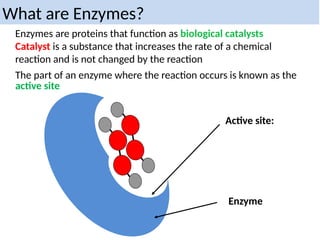
The part of an enzyme where the reaction occurs is known as the
active site
Active site:
Enzyme
What are Enzymes?
Enzymes are proteins that function as biological catalysts
Catalyst is a substance that increases the rate of a chemical
reaction and is not changed by the reaction
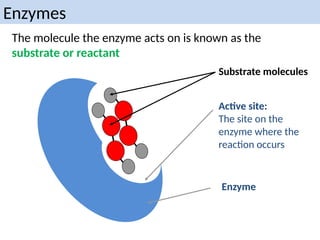
The molecule the enzyme acts on is known as the
substrate or reactant
Active site:
The site on the
enzyme where the
reaction occurs
Enzyme
Substrate molecules
Enzymes
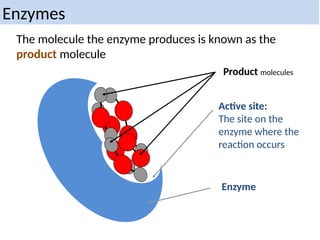
The molecule the enzyme produces is known as the
product molecule
Active site:
The site on the
enzyme where the
reaction occurs
Enzyme
Product molecules
Enzymes
Naming Enzymes
• Most enzymes have an –ase ending
• The root name suggests what molecule it acts upon or
• Example
– carbohydrase breaks down carbohydrate
– proteases break down proteins
– lipases break down lipids
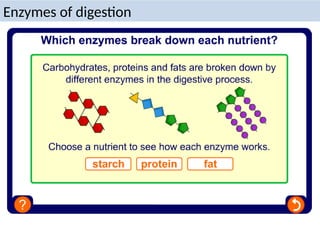
Enzymes of digestion
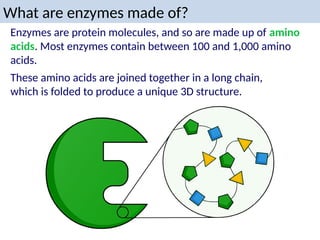
What are enzymes made of?
Enzymes are protein molecules, and so are made up of amino
acids. Most enzymes contain between 100 and 1,000 amino
acids.
These amino acids are joined together in a long chain,
which is folded to produce a unique 3D structure.
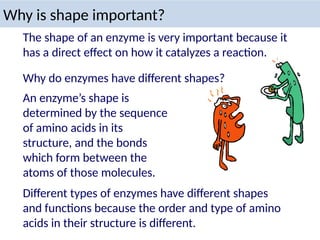
Why is shape important?
The shape of an enzyme is very important because it
has a direct effect on how it catalyzes a reaction.
An enzyme’s shape is
determined by the sequence
of amino acids in its
structure, and the bonds
which form between the
atoms of those molecules.
Why do enzymes have different shapes?
Different types of enzymes have different shapes
and functions because the order and type of amino
acids in their structure is different.
How enzymes work
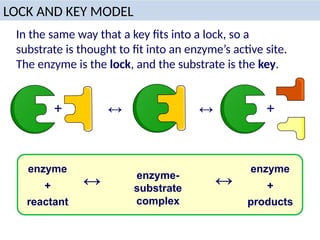
LOCK AND KEY MODEL
In the same way that a key fits into a lock, so a
substrate is thought to fit into an enzyme’s active site.
The enzyme is the lock, and the substrate is the key.
enzyme
reactant
+
enzyme-
substrate
complex
↔
products
enzyme
+
↔
+ ↔ ↔ +
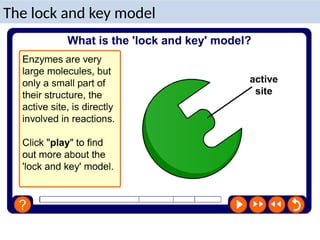
The lock and key model
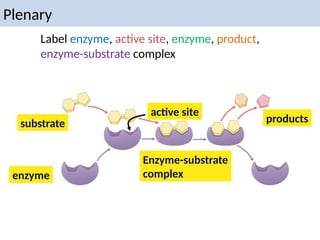
Plenary
substrate
enzyme
products
active site
Label enzyme, active site, enzyme, product,
enzyme-substrate complex
Enzyme-substrate
complex
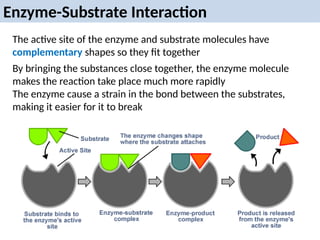
Enzyme-Substrate Interaction
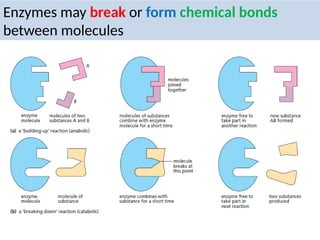
The active site of the enzyme and substrate molecules have
complementary shapes so they fit together
By bringing the substances close together, the enzyme molecule
makes the reaction take place much more rapidly
The enzyme cause a strain in the bond between the substrates,
making it easier for it to break
Enzymes may break or form chemical bonds
between molecules
Factors affecting enzyme action
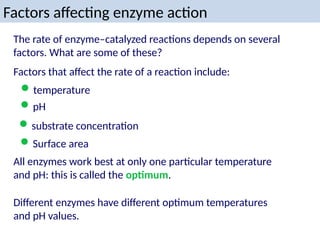
The rate of enzyme–catalyzed reactions depends on several
factors. What are some of these?
All enzymes work best at only one particular temperature
and pH: this is called the optimum.
Factors that affect the rate of a reaction include:
substrate concentration
temperature
Different enzymes have different optimum temperatures
and pH values.
pH
Surface area
Factors affecting enzymes
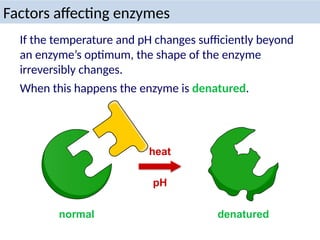
If the temperature and pH changes sufficiently beyond
an enzyme’s optimum, the shape of the enzyme
irreversibly changes.
normal denatured
heat
pH
When this happens the enzyme is denatured.
Rate
Of
Reaction
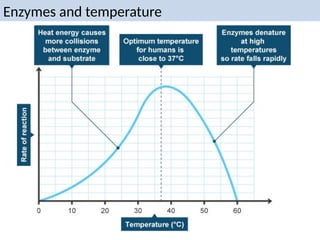
Temperature/o
C
0 10 20 30 40 50 60 70
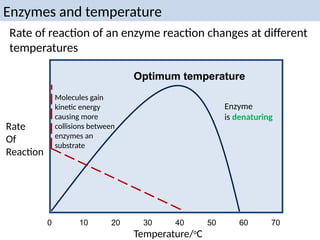
Optimum temperature
Enzyme
is denaturing
Rate of reaction of an enzyme reaction changes at different
temperatures
Molecules gain
kinetic energy
causing more
collisions between
enzymes an
substrate
Enzymes and temperature
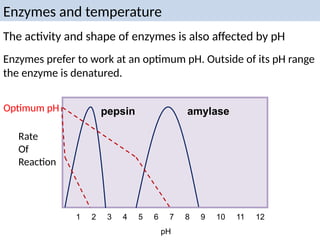
Enzymes prefer to work at an optimum pH. Outside of its pH range
the enzyme is denatured.
Rate
Of
Reaction
pH
1 2 3 4 5 6 7 8 9 10 11 12
pepsin amylase
The activity and shape of enzymes is also affected by pH
Optimum pH
Enzymes and temperature
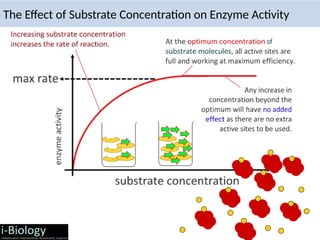
The Effect of Substrate Concentration on Enzyme Activity
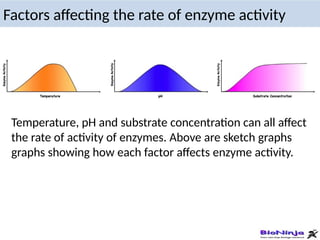
Temperature, pH and substrate concentration can all affect
the rate of activity of enzymes. Above are sketch graphs
graphs showing how each factor affects enzyme activity.
Factors affecting the rate of enzyme activity
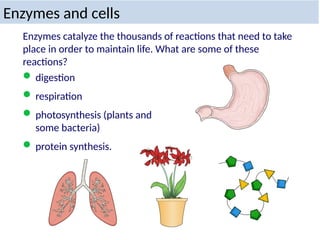
Enzymes and cells
Enzymes catalyze the thousands of reactions that need to take
place in order to maintain life. What are some of these
reactions?
 digestion
 respiration
 photosynthesis (plants and
some bacteria)
 protein synthesis.
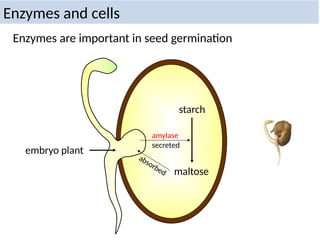
Enzymes are important in seed germination
starch
embryo plant
amylase
secreted
maltose
absorbed
Enzymes and cells
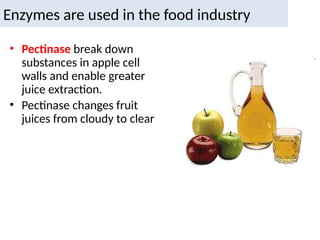
Enzymes are used in the food industry
• Pectinase break down
substances in apple cell
walls and enable greater
juice extraction.
• Pectinase changes fruit
juices from cloudy to clear
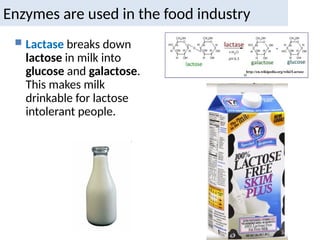
Enzymes are used in the food industry
 Lactase breaks down
lactose in milk into
glucose and galactose.
This makes milk
drinkable for lactose
intolerant people.
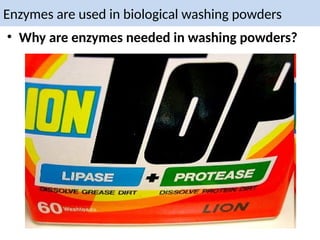
Enzymes are used in biological washing powders
• Why are enzymes needed in washing powders?
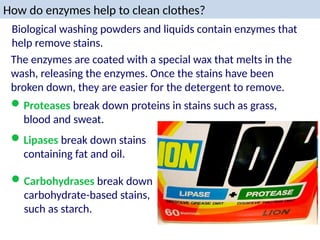
How do enzymes help to clean clothes?
The enzymes are coated with a special wax that melts in the
wash, releasing the enzymes. Once the stains have been
broken down, they are easier for the detergent to remove.
Biological washing powders and liquids contain enzymes that
help remove stains.
Proteases break down proteins in stains such as grass,
blood and sweat.
Lipases break down stains
containing fat and oil.
Carbohydrases break down
carbohydrate-based stains,
such as starch.
ENZYME EXPERIMENTS AND
SCIENTIFIC METHOD
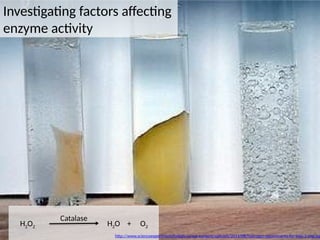
H2O2
Catalase
H2O + O2
http://www.scienceexperimentsforkids.us/wp-content/uploads/2011/08/hydrogen-experiments-for-kids-3-img.jpg
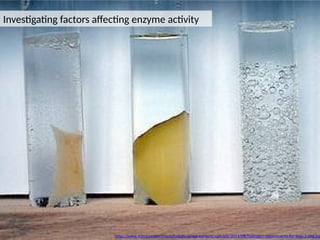
Investigating factors affecting
enzyme activity
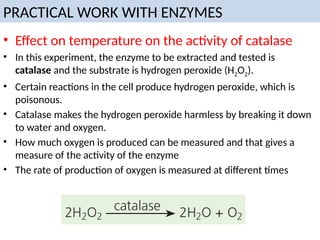
PRACTICAL WORK WITH ENZYMES
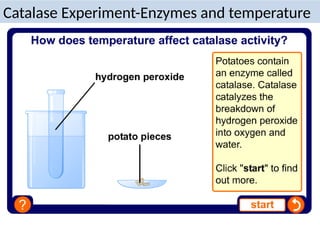
• Effect on temperature on the activity of catalase
• In this experiment, the enzyme to be extracted and tested is
catalase and the substrate is hydrogen peroxide (H2O2).
• Certain reactions in the cell produce hydrogen peroxide, which is
poisonous.
• Catalase makes the hydrogen peroxide harmless by breaking it down
to water and oxygen.
• How much oxygen is produced can be measured and that gives a
measure of the activity of the enzyme
• The rate of production of oxygen is measured at different times
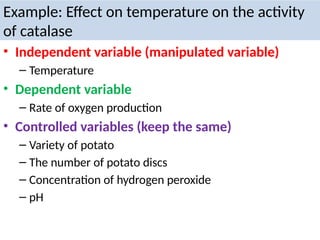
Example: Effect on temperature on the activity
of catalase
• Independent variable (manipulated variable)
– Temperature
• Dependent variable
– Rate of oxygen production
• Controlled variables (keep the same)
– Variety of potato
– The number of potato discs
– Concentration of hydrogen peroxide
– pH
Catalase Experiment-Enzymes and temperature
http://www.scienceexperimentsforkids.us/wp-content/uploads/2011/08/hydrogen-experiments-for-kids-3-img.jpg
Investigating factors affecting enzyme activity
Effect of pH on the activity of catalase

BIOLOGICAL MOLECULES.pdf

  • 1.
    STATEMENT OF INQUIRY Thesystems of life are supported by biochemical reactions and the transformation of energy that occur within cells. Innovation in science could lead to these reactions being utilized to meet growing energy and food needs KEY CONCEPT Systems RELATED CONCEPT Transformation and Energy GLOBAL CONTEXT Scientific and Technological Innovation What chemical processes support life?
  • 2.
  • 3.
    What’s the missinglink? What is the link between digestion, photosynthesis, bread, wine and washing powder? They all depend on enzymes.
  • 4.
    The part ofan enzyme where the reaction occurs is known as the active site Active site: Enzyme What are Enzymes? Enzymes are proteins that function as biological catalysts Catalyst is a substance that increases the rate of a chemical reaction and is not changed by the reaction
  • 5.
    The molecule theenzyme acts on is known as the substrate or reactant Active site: The site on the enzyme where the reaction occurs Enzyme Substrate molecules Enzymes
  • 6.
    The molecule theenzyme produces is known as the product molecule Active site: The site on the enzyme where the reaction occurs Enzyme Product molecules Enzymes
  • 7.
    Naming Enzymes • Mostenzymes have an –ase ending • The root name suggests what molecule it acts upon or • Example – carbohydrase breaks down carbohydrate – proteases break down proteins – lipases break down lipids
  • 8.
  • 9.
    What are enzymesmade of? Enzymes are protein molecules, and so are made up of amino acids. Most enzymes contain between 100 and 1,000 amino acids. These amino acids are joined together in a long chain, which is folded to produce a unique 3D structure.
  • 10.
    Why is shapeimportant? The shape of an enzyme is very important because it has a direct effect on how it catalyzes a reaction. An enzyme’s shape is determined by the sequence of amino acids in its structure, and the bonds which form between the atoms of those molecules. Why do enzymes have different shapes? Different types of enzymes have different shapes and functions because the order and type of amino acids in their structure is different.
  • 11.
  • 12.
    LOCK AND KEYMODEL In the same way that a key fits into a lock, so a substrate is thought to fit into an enzyme’s active site. The enzyme is the lock, and the substrate is the key. enzyme reactant + enzyme- substrate complex ↔ products enzyme + ↔ + ↔ ↔ +
  • 13.
    The lock andkey model
  • 14.
    Plenary substrate enzyme products active site Label enzyme,active site, enzyme, product, enzyme-substrate complex Enzyme-substrate complex
  • 15.
    Enzyme-Substrate Interaction The activesite of the enzyme and substrate molecules have complementary shapes so they fit together By bringing the substances close together, the enzyme molecule makes the reaction take place much more rapidly The enzyme cause a strain in the bond between the substrates, making it easier for it to break
  • 16.
    Enzymes may breakor form chemical bonds between molecules
  • 17.
    Factors affecting enzymeaction The rate of enzyme–catalyzed reactions depends on several factors. What are some of these? All enzymes work best at only one particular temperature and pH: this is called the optimum. Factors that affect the rate of a reaction include: substrate concentration temperature Different enzymes have different optimum temperatures and pH values. pH Surface area
  • 18.
    Factors affecting enzymes Ifthe temperature and pH changes sufficiently beyond an enzyme’s optimum, the shape of the enzyme irreversibly changes. normal denatured heat pH When this happens the enzyme is denatured.
  • 19.
    Rate Of Reaction Temperature/o C 0 10 2030 40 50 60 70 Optimum temperature Enzyme is denaturing Rate of reaction of an enzyme reaction changes at different temperatures Molecules gain kinetic energy causing more collisions between enzymes an substrate Enzymes and temperature
  • 20.
  • 21.
    Enzymes prefer towork at an optimum pH. Outside of its pH range the enzyme is denatured. Rate Of Reaction pH 1 2 3 4 5 6 7 8 9 10 11 12 pepsin amylase The activity and shape of enzymes is also affected by pH Optimum pH Enzymes and temperature
  • 22.
    The Effect ofSubstrate Concentration on Enzyme Activity
  • 23.
    Temperature, pH andsubstrate concentration can all affect the rate of activity of enzymes. Above are sketch graphs graphs showing how each factor affects enzyme activity. Factors affecting the rate of enzyme activity
  • 24.
    Enzymes and cells Enzymescatalyze the thousands of reactions that need to take place in order to maintain life. What are some of these reactions?  digestion  respiration  photosynthesis (plants and some bacteria)  protein synthesis.
  • 25.
    Enzymes are importantin seed germination starch embryo plant amylase secreted maltose absorbed Enzymes and cells
  • 26.
    Enzymes are usedin the food industry • Pectinase break down substances in apple cell walls and enable greater juice extraction. • Pectinase changes fruit juices from cloudy to clear
  • 27.
    Enzymes are usedin the food industry  Lactase breaks down lactose in milk into glucose and galactose. This makes milk drinkable for lactose intolerant people.
  • 28.
    Enzymes are usedin biological washing powders • Why are enzymes needed in washing powders?
  • 29.
    How do enzymeshelp to clean clothes? The enzymes are coated with a special wax that melts in the wash, releasing the enzymes. Once the stains have been broken down, they are easier for the detergent to remove. Biological washing powders and liquids contain enzymes that help remove stains. Proteases break down proteins in stains such as grass, blood and sweat. Lipases break down stains containing fat and oil. Carbohydrases break down carbohydrate-based stains, such as starch.
  • 30.
  • 31.
  • 32.
    PRACTICAL WORK WITHENZYMES • Effect on temperature on the activity of catalase • In this experiment, the enzyme to be extracted and tested is catalase and the substrate is hydrogen peroxide (H2O2). • Certain reactions in the cell produce hydrogen peroxide, which is poisonous. • Catalase makes the hydrogen peroxide harmless by breaking it down to water and oxygen. • How much oxygen is produced can be measured and that gives a measure of the activity of the enzyme • The rate of production of oxygen is measured at different times
  • 33.
    Example: Effect ontemperature on the activity of catalase • Independent variable (manipulated variable) – Temperature • Dependent variable – Rate of oxygen production • Controlled variables (keep the same) – Variety of potato – The number of potato discs – Concentration of hydrogen peroxide – pH
  • 34.
  • 35.
  • 36.
    Effect of pHon the activity of catalase